
The University of Miami Miller School of Medicine MD program
What you actually study, and where you will be
University of Miami Miller School of Medicine's MD is a 4-year program taught through case-based learning in an integrated curriculum, with patient contact from Year 1 and clinical rotations in Miami's Civic Center Health District and other Miami-Dade sites (2027 entry). Phase 1 runs 14 months, including two summer months of scholarly work. It centers on flipped, case-based small groups and a weekly Learning Community of eight or nine students led by a physician coach. Twelve months of clerkships in Miami follow, then a dedicated study period for USMLE Step 1 and Step 2 CK. The final phase brings a sub-internship, electives and a required scholarly project or second degree.
- Degree
- MD
- Length
- 4 years
- Teaching
- Case-based learning + Integrated
- Clinical contact
- Year 1

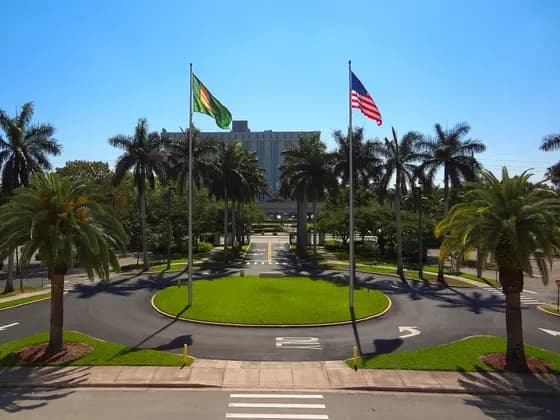
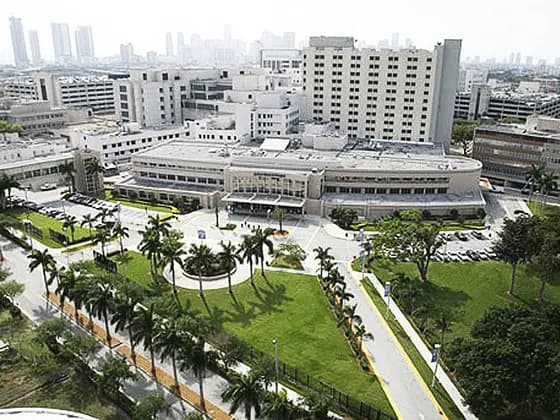
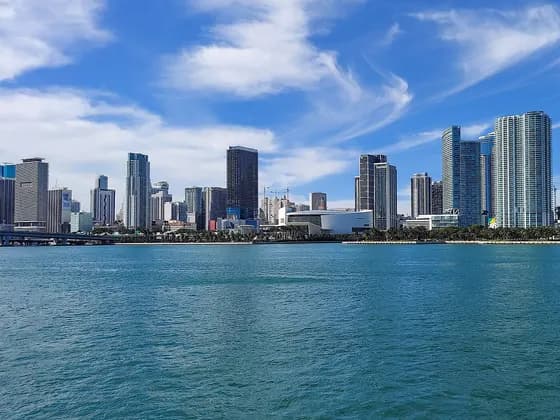
Photo: Darkflowerthree · CC BY-SA 4.0 · cropped
Photo: Chad Cooper · CC BY 2.0 · Photo: Jayzze · CC BY-SA 4.0 · Photo: P. Hughes · CC BY-SA 4.0
The University of Miami Miller School of Medicine MD program at a glance (2027 entry)
The University of Miami Leonard M. Miller School of Medicine admits about 200 MD students a year; 204 started in August 2026. Its curriculum is called NextGenMD. You train in Miami's Civic Center Health District, beside Jackson Memorial Hospital, the school's major teaching hospital, and the Miami Veterans Affairs (VA) Healthcare System. Clinical work also takes you into UHealth, the University of Miami Health System.
Instead of four separate years, the program runs in three phases. Phase 1 is the pre-clerkship (pre-clinical) phase: 14 months, including two summer months for your scholarly project, with the science taught mainly through patient cases. Phase 2 is 12 months of clerkships, the core clinical rotations in fields such as internal medicine, surgery and pediatrics, where you work on hospital and clinic teams. Phase 3 fills the last 17 or 18 months with advanced clinical work shaped by your career plans.
Phase 1 is a flipped classroom: you prepare on your own, then spend class time on patient cases in small groups. One afternoon a week you meet your Learning Community of eight or nine students. It is led by a Longitudinal Clinical Educator (LCE), a physician who coaches the same students through all phases. Clinical experience starts in year 1, through visits to clinical and community settings, patient navigation and emergency medical technician (EMT) training with fire-rescue crews.
Phase 2 ends with dedicated time for the first two parts of the United States Medical Licensing Examination (USMLE). Step 1 tests the science behind medicine, and Step 2 CK (Clinical Knowledge) tests how you apply clinical knowledge to supervised patient care. Phase 3 includes a sub-internship, where you work at close to the level of an intern, a doctor in the first year of residency training.
Every student also completes a Scholarly Concentration. It is either a mentored research project in one of 14 pathways or a second degree, such as a master's in public health or business administration. Students sure of their specialty can apply for a three-year Accelerated Pathway.
| Degree | MD |
|---|---|
| Program length | Four years in three phases of 14, 12 and 17 to 18 months |
| Class size | About 200 a year; 204 started in August 2026 |
| Teaching style | Flipped classroom with case-based small groups and a weekly Learning Community |
| Anatomy | Within Symptoms, Signs, and Disease courses; donor dissection in Phase 3 selectives |
| First patient contact | Year 1: clinical and community visits, patient navigation, EMT ride-alongs |
| Clinical sites | Jackson Memorial Hospital, UHealth and the Miami VA, plus community sites |
| Step 1 timing | With Step 2 CK, in a study period after the clerkship year |
| Grading | Phase 1 pass/fail; clerkships Honors, High Pass, Pass or Fail |
| Three-year option | Accelerated Pathway linked to 18 University of Miami and Jackson residency programs |
What makes the University of Miami Miller School of Medicine MD program different
Clerkships begin early in your second year
Phase 1 lasts 14 months, so full-time clerkships start in late September of your second year. That leaves Phase 3, the final 17 or 18 months, for a sub-internship, electives, a research capstone or a second degree.
Step 1 and Step 2 CK after clinical training
Both Step exams come in a study period after the clerkship year, so you face Step 1 with a year of patient care behind you. The USMLE notes that most students at US MD schools take Step 1 at the end of their second year and Step 2 in their fourth.
The same physician coach through all phases
In Phase 1 you meet weekly with the same eight or nine classmates and your LCE. The group meets every six weeks during clerkships, and in Phase 3 your LCE meets you one-on-one about residency applications. LCEs follow your progress through the school's ePortfolio.
A scholarly project or second degree for everyone
Every student either joins one of 14 Pathways of Emphasis, from AI and health informatics to vision science, or completes a dual degree. Nearly half of the class that started in August 2026 plans a dual degree. In the Class of 2029, 46 students enrolled in the MD/MPH, 25 in the MD/MBA and 11 in the MD/PhD.
A public hospital, a university system and the VA
Course descriptions place students in Jackson Health System, governed by the Public Health Trust on behalf of Miami-Dade County's commissioners; UHealth, the university's own system; and the Miami VA. The school notes that its students serve large Spanish- and Haitian Creole-speaking communities.
A three-year route for students sure of a specialty
The Accelerated Pathway lets students committed to one of 18 participating University of Miami and Jackson residency programs earn the MD in three years. Specialty work starts in year 1, and Phase 3 shrinks to five months.
How University of Miami Miller School of Medicine teaches medicine
Phase 1's five Symptoms, Signs, and Disease (SSD) courses focus on diseases a generalist physician often sees. Each pairs normal physiology with disease and with the anatomy, radiology, pharmacology, diagnostic testing and pathology that go with it. You practice clinical reasoning: moving from a symptom and examination findings to the right tests and a first differential diagnosis, the list of conditions that could explain the problem.
Medicine as a Profession (MAP) runs through all four years around seven themes: clinical skills, professionalism, communication, population health, health systems science, nutrition and wellness, and personal development. Most MAP learning happens in your Learning Community.
Science continues once clerkships begin. In each clerkship block, online learning and interactive small groups cover anatomy and cell biology, biochemistry, microbiology and immunology, pharmacology and physiology. Oncology, genetics, radiology and pathology run through the blocks as longitudinal themes. Simulation and standardized patient work are built into every clerkship.
The ways you will learn
| Case-based small groups | The core of Phase 1 teaching. You prepare beforehand, for example with online ScholarRx modules, then work through patient cases in a small group that students lead and faculty facilitate. Nutrition questions are woven into some of the cases. |
|---|---|
| Learning Community afternoons | Your group meets its LCE on the same afternoon each week in Phase 1. A session might be a small-group discussion, practice with standardized patients, a larger session of about 50 students, or a visit to a clinical or community setting. |
| Standardized patients | People trained to portray patients accurately and consistently, so you can practice interviewing, examination and communication safely. Half of their role is telling you how you made them feel as their patient. The Simulated Patient Program at the Gordon Center for Simulation and Innovation in Medical Education supplies them. |
| Clerkship teaching | Teaching at the bedside and in the operating room, with weekly didactic sessions in clerkships such as pediatrics and neurology. Obstetrics and gynecology adds case-based and problem-based classes and workshops on suturing and ethics. The ER to OR clerkship (surgery, anesthesia and emergency medicine) includes high-fidelity trauma simulation. |
| Nutrition and culinary medicine | About 63.5 hour-equivalents of nutrition across 25 competencies, woven through all phases: in cardiology, gastroenterology and endocrinology sessions, online modules and hands-on cooking labs, including about two hours in a teaching kitchen lab. Physicians, registered dietitians and culinary instructors from the Osher Center for Integrative Health teach together. |
A typical week on the University of Miami Miller School of Medicine program
In Phase 1, MAP sets substantial independent work each week, alone or as a team, which you review with your Learning Community and LCE on your fixed afternoon. MD/MPH students give one more afternoon to public health coursework during the academic year.
In Phase 2 your days follow each clerkship's schedule. Every six weeks your Learning Community meets for two hours from 3 p.m., and clerkship directors keep the whole afternoon, 1 to 5 p.m., free so you can prepare. In Phase 3 an afternoon is set aside for scholarly concentration work.
How anatomy is taught at University of Miami Miller School of Medicine
Anatomy is built into the Symptoms, Signs, and Disease courses: each covers the anatomy of its organ systems alongside physiology, radiology and disease. During clerkships, anatomy and cell biology return as part of the science taught in every block. ER to OR also aims to reinforce anatomy in the context of surgical procedures. Faculty of the Department of Cell and Systems Biology teach gross anatomy, neuroanatomy, histology and embryology.
Donated bodies for teaching come through the Willed Body Program of the Anatomical Board of the State of Florida. Its South Florida office, managed by the school's Medical Education Office, serves the University of Miami and other South Florida schools. The program says its main purpose is teaching normal anatomy to first-year medical students, physical therapy students, residents and professionals in continuing medical education. Everyone using donated specimens signs a Pledge of Respect.
Phase 3 offers six four-week Clinical Anatomy and Surgery selectives, one way to meet the integrated science selective requirement. They cover the thorax, abdomen, extremities, urogenital and gynecologic anatomy, head and neck with brain and spinal cord, and brain and spinal cord. Each combines on-demand lectures, demonstrations by anatomy faculty, proctored dissection of human donors and time in the operating room.
Workshops in knot tying, instrument handling and suturing run twice in each selective and are tested at the end. In the abdomen selective, surgery faculty and residents also teach in the dissection sessions. A two-week Advanced Gross Anatomy elective covers advanced regional anatomy and builds teaching and presentation skills.
When you first meet patients at University of Miami Miller School of Medicine
Clinical skills start in your first weeks: the two in-person weeks of Introduction to the Medical Profession cover communication, interviewing and physical examination. From the fall, some Learning Community afternoons take you into clinical and community settings with your LCE.
In the spring, MAP 102 teaches you to tailor an interview and examination to a patient's main concern. You also plan how to improve health in one of Miami's communities and learn to help someone navigate South Florida's health care system. At the end of the spring you begin EMT training, including ride-alongs with fire-rescue crews.
EMT training continues in MAP 103, during the two fall months before clerkships, when you also review key clinical skills and teach them. Clerkships open with a one-week Transition to Clerkships course on the student's role, basic procedures, documentation and patient safety.
Each clerkship lists Required Clinical Experiences and the level of responsibility expected of you. In ER to OR, for example, you place urinary catheters and IV lines, ventilate patients with a bag and mask and intubate them, all with help. You also observe trauma resuscitation. In obstetrics and gynecology you give contraceptive counseling and screen for intimate partner violence on your own.
Year by year at University of Miami Miller School of Medicine
- Phase 1 (14 months)
Foundations
Phase 1 is the pre-clerkship phase, running from August of your first year to mid-September of your second. It moves from an introduction to the profession, through core biomedical science, into five organ-system courses built around symptoms.
- Introduction to the Medical Profession (August, 3 credits): online modules and readings, then two in-person weeks of basic clinical skills, core principles and professional behavior.
- Biomedical Principles of Health (nine weeks, 10 credits, September to November): genetics, cell physiology, pharmacology, the autonomic nervous system, pathology, microbiology and immunology.
- SSD 1 to 3: hematology and cardiovascular; respiratory and renal; then gastroenterology, hepatology and nutrition with rheumatology. The SSD courses run from December to the following September.
- SSD 4 covers neurology and psychiatry; SSD 5 covers endocrinology, reproductive medicine, ear, nose and throat (ENT) and dermatology.
- Medicine as a Profession 101, 102 and 103 in your Learning Community, including the start of EMT training.
- Three Milepost weeks, set aside for LCE meetings, clinical skills assessments and exams from the National Board of Medical Examiners (NBME). On the 2026-27 calendar for the Class of 2030 they fall in mid-December, early March and early June.
- Introduction to Scholarly Concentration and Scholarly Concentration I. The summer after year 1 goes to your project: for the Class of 2029, mid-June to early August 2026.
- Phase 2 (12 months)
Clerkships
Clerkships run from late September of your second year to the following September, in four 12-week periods split into six-week halves. The curriculum overview page speaks of four integrated clerkships, while the phases page and the 2026-27 Bulletin list six. The phase ends with dedicated Step exam preparation.
- Practice of Medicine (12 weeks): inpatient and outpatient internal medicine and its subspecialties, family medicine and palliative care, with a focus on continuity of care, prevention and long-term illness.
- ER to OR (12 weeks), formally From the Emergency Department to the Operating Room: surgery, anesthesia and emergency medicine, following patients from arrival through surgery and recovery.
- Neurology (6 weeks): four weeks of neurology, one of ophthalmology and one of physical medicine and rehabilitation (PM&R), with weekly teaching and feedback sessions.
- Psychiatry, obstetrics and gynecology, and pediatrics (6 weeks each), spanning inpatient units, clinics, labor and delivery, the emergency department and newborn care.
- MAP 201 to 203: two-hour Learning Community sessions every six weeks, plus sessions in two Milepost weeks.
- Phase 3 (17 to 18 months)
Pathways and Capstones
Phase 3 begins in January, after the study period, and runs to graduation. The curriculum pages describe it as 18 months and the 2026-27 Bulletin as 17. It is built around your career goals, with advanced courses, electives, residency applications and your scholarly concentration or second degree.
- A four-week inpatient sub-internship, also called an acting internship. On the pediatrics sub-internship, for example, you join a ward team in the regular first-year resident rotation.
- A four-week Advanced Integrated Science Selective linking basic science to your career interests, and a two-week critical care selective in a critical care setting of your choice.
- Advanced Clinical Experiences and two-week electives, described under Electives below.
- Medicine as a Profession 301 and 302: residency application seminars and one-on-one meetings with your LCE.
- Transition to Residency: a course in the final semester that ends in a four-week in-person boot camp of simulated emergencies, procedures and communication labs.
- Scholarly Concentration II, in which you complete your capstone project.
- The Match, the national process that pairs graduating students with residency programs, falls in March; Match Day for the Class of 2026 was March 20, 2026.
How you are assessed at University of Miami Miller School of Medicine
Grading changes by phase. Phase 1 courses are pass/fail, and Phase 2 clerkships use four tiers: Honors, High Pass, Pass and Fail. In Phase 3 most courses are pass/fail, but sub-internships, Advanced Integrated Science Selectives and Advanced Clinical Experiences are graded Honors, Pass or Fail. Scholarly concentration courses are pass/fail, and a failed course passed after remediation shows on your transcript as R.
Phase 1's three Milepost weeks are used for meetings with your LCE, clinical skills assessments and customized or comprehensive NBME exams. The 2026-27 calendar then sets aside two weeks in June, after the last Milepost week, as a Phase 1 remediation period.
Clerkships assess areas such as medical knowledge, clinical performance, communication and professionalism, while the MAP 200 courses are pass/fail with no exams: you must attend every session, prepared. Clinical skills are also tested in Objective Structured Clinical Examinations (OSCEs), where you rotate through timed stations with standardized patients. The nutrition curriculum plans a Phase 2 OSCE in which you take a diet history and give brief counseling.
The USMLE is run by the Federation of State Medical Boards and the NBME. Step 1 has been reported only as pass or fail since January 26, 2022. Step 2 CK keeps a three-digit score, and its minimum passing score has been 218 since July 1, 2025.
The 2026-27 Bulletin gives students dedicated time at the end of Phase 2 to prepare for and take both exams. The calendar calls it the USMLE Step 1 and 2 Study Period and places it after the last clerkship block and a Milepost week. It runs from September 26 to December 18, 2026, for the Class of 2028, and Phase 3 begins in January.
In August 2026 the USMLE program announced a move to designated testing dates from January 2029, with Step exams offered less often each year. Its June 2026 notice had set the start for 2028. On the current schedule, a student entering in 2027 (the Class of 2031) would reach this study period in about fall 2029, after the change. This projection uses the 2026-27 calendar, the latest the school has posted.
- The USMLE says each year's testing dates will be published more than a year ahead. It has also urged schools to review rules on when students must take the Step exams.
- The Liaison Committee on Medical Education (LCME) accredits MD programs in the United States. Its accreditation is what makes students in an MD program like this one eligible to sit the USMLE.
- The LCME directory, updated October 14, 2026, lists the school's accreditation as full, first granted in 1955, with the next survey due in 2032-33.
Where you will actually train at University of Miami Miller School of Medicine
Clinical training is centered on Miami. Course descriptions place students in three systems: Jackson Health System, UHealth and the Miami VA. Most clinical sites are on the health system campus, but rotations at Jackson North, Jackson South, the Miami Beach Community Health Center and preceptor offices may need transportation.
Jackson Memorial Hospital has about 1,500 licensed beds and houses the Ryder Trauma Center, the Miami Burn Center and the Miami Transplant Institute. It is the centerpiece of Jackson Health System, and the Public Health Trust, which governs the system, has had an affiliation agreement with the school since 1952.
UHealth includes the Bascom Palmer Eye Institute and the Sylvester Comprehensive Cancer Center, plus nearly 40 outpatient sites in four South Florida counties. One UHealth hospital, UHealth Tower, was called University of Miami Hospital until 2017, and course descriptions still use both names. The Miami VA's Bruce W. Carter VA Medical Center, in downtown Miami, has 367 operating beds and names the Miller School as its primary affiliation.
Sites vary within each clerkship. Obstetrics and gynecology students are assigned to Jackson Memorial, community hospital and private practice sites. Psychiatry students work in two settings, such as Jackson Behavioral Health Hospital, VA inpatient units or the consultation service at UHealth Tower.
The medical campus the school shares with Jackson Memorial, plus the nearby Miami VA. Rotations here include consultation psychiatry, dermatology, cardiology and neurosurgery at UHealth Tower, ophthalmology at Bascom Palmer and psycho-oncology at Sylvester.
- Jackson Memorial Hospital
- Jackson Behavioral Health Hospital
- UHealth Tower (formerly University of Miami Hospital)
- Bascom Palmer Eye Institute
- Sylvester Comprehensive Cancer Center
- Bruce W. Carter VA Medical Center (Miami VA)
Sites away from the medical campus, used for some clinical rotations and electives.
- Jackson North Medical Center
- Jackson South Medical Center
- Miami Beach Community Health Center
- Preceptor offices
- Pediatric Mobile Clinic stops across Miami-Dade
Three two-week Phase 3 electives outside Miami-Dade County.
- Bascom Palmer Eye Institute, Naples (ophthalmology elective)
- Ophthalmology elective, Palm Beach Gardens
- West Palm Beach VA Medical Center (PM&R elective)
Electives, selectives and away rotations at University of Miami Miller School of Medicine
Most of your choice comes in Phase 3. Electives are two-week courses chosen for your career interests. Advanced Clinical Experiences (ACEs) last four weeks and add responsibility: you work up and manage selected patients under residents and attending physicians, the senior doctors in charge. Selectives are required categories with a choice of topic: the sub-internship, critical care and integrated science.
Away rotations at other medical schools, called externships, earn credit when arranged through the Visiting Student Learning Opportunities (VSLO) service of the Association of American Medical Colleges (AAMC). Externships outside VSLO carry extra requirements. You must be in good standing and have completed Phase 2, including its clerkships and Step 1 and Step 2 requirements. Seniors can also earn elective credit abroad with advance approval from the Senior Associate Dean for Undergraduate Medical Education.
The 2026-27 Bulletin requires 18 weeks, about four months, of ACEs or electives, while the course text for outside externships refers to 14 required weeks of electives. That text caps elective time away from Miami at 12 weeks, so at least two weeks must be at the home school. It also rules out externships with physicians in private practice.
Options include a Street Classroom ACE caring for unhoused patients with Dade County Street Response and the Pediatric Mobile Clinic, which serves uninsured children across Miami-Dade. You can also study toxicology at the Florida Poison Information Center or join a two-week cardiology teaching lab built around Harvey, the Gordon Center's heart and lung simulator. A pilot culinary medicine elective runs as four two-hour sessions. One elective spans Phases 2 and 3: two weeks of credit for at least 18 sessions at student-run free clinics and health fairs.
- Sub-internships listed in the 2026-27 Bulletin include internal medicine, pediatrics, family medicine, obstetrics and gynecology, neurology, otolaryngology, PM&R, trauma surgery, acute care surgery, the burn unit and general surgery at the Miami VA.
- Critical care selectives cover the medical, pediatric, surgical, trauma and neuroscience intensive care units.
- Integrated science selectives range from clinical anatomy and surgery to immunology and transplant, neuroscience, pharmacology, oncology, cardiac and pulmonary physiology, and dermatology.
Dual degrees and research years at University of Miami Miller School of Medicine
Every student completes a Scholarly Concentration, through either a Pathway of Emphasis or a dual degree. In a pathway you pursue a research question with a faculty mentor, starting with an introductory course of at least 15 hours in the spring of year 1. The work continues through Phase 3 and ends in a written Capstone report and a poster at the Spring Symposium in your final spring.
The 14 pathways are Advancing Mind-Body Medicine; Biomedical Engineering; Business of Medicine, Quality Improvement and Patient Safety; Diagnostic Pathology and Laboratory Medicine; and Doctor of the Future, on AI and health informatics. They continue with Ethics, Humanities, and Health Law; Global Health and Surgery; the Jay Weiss Pathway in Community Health Empowerment; Maternal and Child Health; and Neuroscience and Behavioral Science. The last four are Oncology and Related Health Disparities, Regenerative Medicine, Translational and Molecular Medicine, and Vision Science.
Some pathways add structure. Maternal and Child Health draws on the federally funded Leadership Education in Neurodevelopmental Disabilities (LEND) program at the Mailman Center for Child Development. Biomedical Engineering students may join an engineering capstone design team, and Doctor of the Future includes an industry apprenticeship program.
The three-year Accelerated Pathway is for students committed to one of 18 participating University of Miami and Jackson Health System residency programs, such as anesthesiology, neurosurgery or urology. Alongside the standard Phase 1 and 2 courses, you spend a weekly afternoon in your specialty from the spring of year 1. An eight-week immersion course follows that summer, and Phase 3 then lasts five months.
Program directors intend to rank Accelerated Pathway students highly, but you must still enter the Match. If you do not secure a residency position, change specialty or ask for a research year, you move to the four-year curriculum. Failing a course or Step 1 may lead there too. The pathway cannot be combined with a dual degree.
A dual degree replaces the pathway, and dual-degree students take 136 MD credits instead of 142. University of Miami undergraduates have one more route, the Medical Scholars Program. Its Early Matriculation track starts medical school after junior year and awards the bachelor's degree after the first year of medical school.
- MD/MPH (four years): three public health courses in the summer before medical school, then an extra afternoon of coursework. It adds a capstone, a rotation in health department clinics and the Certified in Public Health exam.
- MD/MBA (four years), with the Patti and Allan Herbert Business School: 44 MBA credits, including a Health Management and Policy concentration.
- MD/PhD, the Medical Scientist Training Program: PhD research in fields such as neuroscience, cancer biology, biomedical engineering or epidemiology, which replaces the scholarly concentration. Its curriculum page puts Step 1 after two 12-week clerkship blocks, one of them Practice of Medicine, before three to four PhD years, and Step 2 CK after the last two.
- MD/JD (six years), with the School of Law: two years of medicine, two of law, then two years completing both degrees. The Bulletin's sample plan puts Step 1 between June and August, just before law school starts in year 3, and Step 2 CK after you return and finish the clerkships.
- MD/MS in Genomic Medicine (four years), with the John P. Hussman Institute for Human Genomics: online study plus a weekly small-group block, ending in a capstone.
- MD/MS in Global Medical Sciences: a one-year, 30-credit hybrid program with a faculty-led study abroad opportunity.
- MD/MAIA, a Master of Arts in International Administration that includes a Certificate in Security Management, or the 12-credit certificate alone, which fits in one summer.
- Research year: after Phase 2, including the USMLE exams, you may take a year off for research. One route is the one-year Dean's Research Excellence Award in Medicine (DREAM) scholarship, which starts in January.
Facilities and support at University of Miami Miller School of Medicine
Where you will learn
The Gordon Center is a 34,000-square-foot simulation facility. Its ten fully equipped patient exam rooms support the school's clinical skills and standardized patient program, and standardized patient encounters are recorded for quality assurance and training. It also has high-fidelity patient simulators, a mock emergency department, a full-scale emergency rescue vehicle and a disaster response training zone. The center is home to Harvey, the cardiopulmonary simulator Dr. Michael S. Gordon developed in 1968, which reproduces heart and lung sounds, pulses, blood pressure and breathing movements.
Surgical skills have their own space. The Surgical Skills Elective runs in the Minimally Invasive Surgical Training and Education (MISTE) Center, using high-fidelity simulation for open surgery and emergency procedures.
Support while you study
In your first week you are assigned to one of 12 Academic Societies, which mix students from every class year. You stay in yours for all four years. Each has two LCEs as faculty mentors and runs small-group teaching, clinical skills practice, exam preparation, service, wellness and social events. The societies began in 2001, after a group of students saw the need for stronger connections among classmates.
Your LCE is also a mentor. Conversations stay confidential unless someone's health or safety is at risk, and LCEs give candid feedback and point you to remediation resources when needed. Every new student also gets a second-year peer mentor, matched on shared interests, and an advising dean for one-on-one meetings.
Academic Enrichment Services assigns a learning specialist for each phase, with one-on-one coaching on topics such as time management, study strategies and test anxiety. Peer programs add workshops, biweekly small-group content reviews for Phase 1 and one-on-one tutoring. Before the Step study period, Phase 2 students are matched by intended specialty with Phase 3 peer coaches who have passed both exams.
For health and well-being, the Office of Student Services points you to Student Health, the Counseling Center, a Peer Support Network, the Physician Support Line, and disability services and accommodations.
Students also run the Mitchell Wolfson Sr. Department of Community Service (DOCS), which holds 10 health fairs a year across Miami-Dade, Monroe and Broward counties, plus four free weekly clinics.
Is the University of Miami Miller School of Medicine program right for you?
This program may suit you if
- You learn best by preparing on your own and then working through cases with classmates, because Phase 1 runs as a flipped, case-based classroom.
- You want the same physician coach from your first fall through your residency applications, with the same small group of classmates through the clerkship year.
- You would rather take Step 1 and Step 2 CK after a year of clerkships than before your first clinical rotation.
- You want room inside four years for a mentored research capstone or a second degree such as an MPH or MBA.
- You want to train across a county public hospital system, a university health system and a VA medical center, serving Spanish- and Haitian Creole-speaking communities.
Things to think about
- MAP adds substantial independent work every week on top of preparing for each small-group class.
- The dissection courses the school describes are Phase 3 selectives you choose, so if dissecting in your first year matters to you, ask how Phase 1 anatomy is taught.
- For a 2027 entrant, the Step study period would fall after the USMLE's January 2029 move to designated testing dates, so watch how the school's calendar adjusts.
- A scholarly concentration or second degree is compulsory, so expect research or extra coursework alongside clinical work.
- Some rotations, such as those at Jackson North, Jackson South and preceptor offices, may need transportation, although the school says many students manage without a car.
University of Miami Miller School of Medicine MD program — frequently asked questions
Applying to University of Miami Miller School of Medicine?
How to get into University of Miami Miller School of Medicine
Prerequisites, MCAT, AMCAS personal statement, secondaries and interview, step by step.
Open the guide →University of Miami Miller School of Medicine admissions profile
MCAT and GPA profile, acceptance rate, interview format and key dates.
See the profile →Compare University of Miami Miller School of Medicine with other schools
Put the teaching style, anatomy teaching and clinical sites next to another school.
Open the comparison →Prepare for the University of Miami Miller School of Medicine interview
Format breakdown, school-specific sample questions and prep tips from tutors who interviewed here.
Read the guide →Where this University of Miami Miller School of Medicine program guide came from
This guide was written from 78 official sources — University of Miami Miller School of Medicine's own program pages and curriculum documents, plus the accreditor and the hospitals and health systems the school trains students in where they publish detail — read on 2026-10-14, then checked claim by claim against those sources.
- Miller School of Medicine: Curriculum (NextGenMD overview)
- Miller School of Medicine: Curriculum Phases
- University of Miami Academic Bulletin 2026-2027: MD Program
- University of Miami Academic Bulletin 2026-2027: Medicine (MDR) course descriptions
- Miller School of Medicine: Academic Calendars, 2026-27 and 2025-26
- Miller School of Medicine: Learner Assessment and Curriculum Evaluation, with clerkship objectives and required clinical experiences
- Miller School of Medicine: Medical School Transcripts (grading basis)
- Miller School of Medicine: Externships Services
- Medical Student Rights and Responsibilities Handbook 2026-2027 (contents page)
- Miller School of Medicine: Medicine as a Profession (MAP)
- Miller School of Medicine: Message from the Dean of Curriculum
- Miller School of Medicine: Nutrition Curriculum
- Miller School of Medicine: Nutrition Curriculum Overview
- Miller School of Medicine: Scholarly Concentration
- Miller School of Medicine: Scholarly Concentration Pathways
- Scholarly Concentration: Biomedical Engineering Pathway
- Scholarly Concentration: Doctor of the Future Pathway
- Scholarly Concentration: Maternal and Child Health Pathway
- Miller School of Medicine: Transition to Residency Course
- Miller School of Medicine: M.D. Programs
- Miller School of Medicine: M.D./M.P.H. Program
- Miller School of Medicine: M.D./M.P.H. Curriculum
- University of Miami Academic Bulletin 2026-2027: MD/MPH Program
- Miller School of Medicine: M.D./M.B.A. Program
- University of Miami Academic Bulletin 2026-2027: MD/MBA Dual Degree Program
- Miller School of Medicine: Medical Scientist Training Program (M.D./Ph.D.)
- Medical Scientist Training Program: NextGen M.D. Curriculum for MSTP students
- University of Miami Academic Bulletin 2026-2027: Medical Scientist Training Program
- Miller School of Medicine: M.D./J.D. Program
- University of Miami Academic Bulletin 2026-2027: MD/JD Program
- Miller School of Medicine: M.D./M.S. in Genomic Medicine
- University of Miami Academic Bulletin 2026-2027: MD/MS in Genomic Medicine
- Miller School of Medicine: M.D./M.S. in Global Medical Sciences
- University of Miami Academic Bulletin 2026-2027: MD/MAIA Dual Degree Program
- Miller School of Medicine: M.D./Certificate in Security Management
- Miller School of Medicine: Three-Year M.D. Accelerated Pathway
- Miller School of Medicine: Three-Year M.D. Curriculum
- Miller School of Medicine: Accelerated Pathway Participating Specialties
- Miller School of Medicine: Accelerated Pathway Frequently Asked Questions
- Miller School of Medicine: Early Admission to Medical School (Medical Scholars Program)
- Miller School of Medicine: Academic Societies
- Miller School of Medicine: Mentoring at Miller
- Miller School of Medicine: Longitudinal Clinician Educator Profiles
- Miller School of Medicine: Academic Enrichment Services
- Miller School of Medicine: Student Services
- Miller School of Medicine: Wellness Resources
- Miller School of Medicine: Department of Community Service (DOCS)
- Miller School of Medicine: Research and the year off for research
- Miller School of Medicine: Class of 2029 Profile
- Miller School news: White Coat Ceremony Welcomes the Class of 2030 (August 2026)
- Miller School of Medicine: Admissions FAQ (language of instruction)
- Miller School of Medicine: Newly Admitted Students FAQ
- Miller School of Medicine: Student Life
- Miller School news: What's Next for NextGenMD? (June 2024)
- Gordon Center for Simulation and Innovation in Medical Education: About Us
- Gordon Center: Standardized Patient Program
- Department of Cell and Systems Biology: Education and Training
- Willed Body Program, South Florida Office of the Anatomical Board
- Willed Body Program: About Us
- Jackson Health System: Jackson Memorial Hospital
- Jackson Health System: Jackson Behavioral Health Hospital
- Jackson Health System: About Us
- VA Miami Health Care: About Us
- UHealth, University of Miami Health System: Why Choose UHealth
- UHealth, University of Miami Health System: UHealth Tower
- Bascom Palmer Eye Institute (Miami): Directions, Parking, and Transportation
- Miller School news: UHealth is Transformed into a Fully Integrated Academic Health System (November 2017)
- LCME: About the LCME
- LCME: Accredited Programs directory (updated October 14, 2026)
- USMLE: Designated Testing Dates Information Hub (lists the January 2029 announcement as August 6, 2026)
- USMLE: Updated Timeline for Designated Testing Dates, transition in January 2029 (August 2026)
- USMLE: Transition to Limited Testing Dates Starting in 2028 (June 23, 2026, since updated)
- USMLE: Designated Testing Dates FAQs
- USMLE: Step 1
- USMLE: Step 2 CK
- USMLE: Examination Results and Scoring
- USMLE: Common Questions
- USMLE: About the USMLE
Curricula are restructured between cycles. Anything here that decides your application — how anatomy is taught, a clinical campus assignment, a required research year — should be confirmed against the official page for your entry year.
Applying to University of Miami Miller School of Medicine?
We help US applicants with MCAT strategy, the AMCAS personal statement, secondary essays and interview prep — everything you need for a competitive University of Miami Miller School of Medicine application.