
The Keck School of Medicine of USC MD program
What you actually study, and where you will be
Keck School of Medicine of USC's MD is a 4-year program taught through case-based learning in an integrated curriculum, with patient contact from Year 1 and clinical rotations in Greater Los Angeles, Bakersfield, Santa Barbara and Ventura (2027 entry). Keck's Physician-Citizen-Scholar curriculum fits the basic sciences into three pass/fail pre-clerkship semesters, mostly in body-system courses. Clinical skills, a coached professional identity course and a health justice course run alongside from the first week. After Step 1 you spend about a year in seven block clerkships at Los Angeles General Medical Center, Keck Hospital of USC, Children's Hospital Los Angeles and other affiliated sites. The last phase is a largely self-designed run of electives, a sub-internship and a Senior Seminar.
- Degree
- MD
- Length
- 4 years
- Teaching
- Integrated + Case-based learning
- Clinical contact
- Year 1

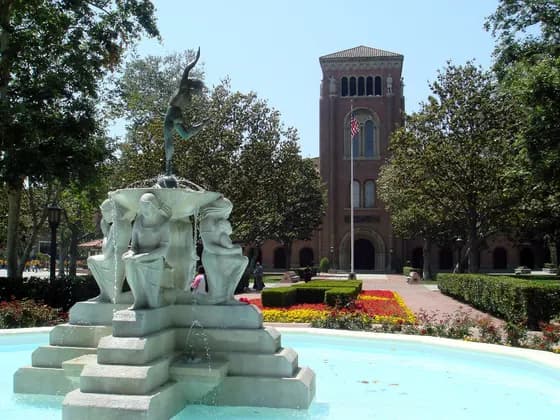
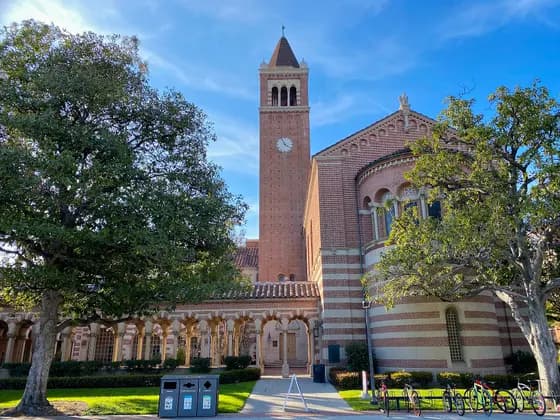

Photo: Downtowngal · CC BY-SA 4.0 · cropped
Photo: Bobak Ha'Eri · CC BY 3.0 · Photo: EEJCC · CC0 · Photo: Shesmax · CC BY-SA 4.0
The Keck School of Medicine of USC MD program at a glance (2027 entry)
The Keck School of Medicine of USC, founded in 1885, runs a four-year MD built on what it calls the Physician-Citizen-Scholar curriculum. The aim is to train you as a doctor, as a citizen who serves communities and as a scholar who can investigate questions. You are taught on the USC Health Sciences Campus in Los Angeles, which is also home to Los Angeles General Medical Center, the county hospital formerly called LAC+USC.
The program runs in three phases. The pre-clerkship (pre-clinical) phase fits the sciences into three semesters of pass/fail courses, from August of year 1 to late November of year 2. A dedicated study period follows for Step 1 of the United States Medical Licensing Examination (USMLE), the first national licensing exam. The clerkship phase then takes you through seven core clinical rotations, called clerkships, and from the middle of year 3 the post-clerkship phase is largely yours to design.
Patients appear early. From your first week, Introduction to Clinical Medicine (ICM) teaches you skills on standardized patients, trained professionals who portray patients. You then use those skills with real patients at Keck Hospital and LA General. Two more courses run beside the science. Empowerment through Professional Identity Cultivation (EPIC) is taught in learning communities with physician coaches, and Health Justice and Systems of Care (HJSC) includes required community service-learning.
Clinical training spans a large public safety-net hospital, a private university hospital, a children's hospital and community sites across Southern California, with some rotations as far away as Bakersfield. You also complete a faculty-mentored Scholarly Project. The program is fully accredited by the Liaison Committee on Medical Education (LCME), the body that accredits MD programs in the United States.
| Degree | MD |
|---|---|
| Program length | 4 years; most dual degrees take 5, and the MD/PhD averages 8 |
| Main campus | USC Health Sciences Campus, Los Angeles |
| Teaching style | Integrated body-system courses with active and case-based learning |
| Anatomy | Cadaveric dissection in year 1, per the anatomy division |
| First patient contact | Standardized patients in week 1; hospital patients within the first weeks |
| Core clerkships | Seven block rotations in tracks, starting in the spring of year 2 |
| Step 1 timing | During a late November to January study period after the third semester |
| Grading | Pass/fail pre-clerkship; clerkships graded Honors, High Pass, Pass or Fail |
| Accreditation | LCME, full; first accredited 1949; next survey 2033-34 |
What makes the Keck School of Medicine of USC MD program different
A county safety-net hospital as a core training site
Los Angeles General Medical Center is a site for six of the seven required clerkships. It cares for many patients who are uninsured or underinsured or have limited access to care, and its pediatric department alone records about 35,000 emergency visits a year.
A learning community and a personal coach from the start
EPIC places you in a learning community of 24 students, made up of three ICM groups, with three physician faculty members. Each faculty member coaches eight students one-on-one and does not grade the students they coach, and the community meets for EPIC sessions throughout year 1.
Health justice as a required three-semester course
HJSC joins social justice with health systems science across all three pre-clerkship semesters, then returns as a two-week seminar at the end of the clerkship phase. Its hands-on part is a year-long service-learning experience in year 1: at least 12 hours with one community organization, assigned from your ranked choices on an approved list and reflected on in course assignments.
An optional four-year Primary Care Program
Students interested in family medicine, general pediatrics, general internal medicine, geriatrics or women's health apply before their first year. You are paired with a primary care physician mentor for monthly community clinic sessions linked to ICM, take extra skills workshops and help teach bilingual English-Spanish nutrition and cooking classes. A four-week Primary Care Senior Seminar follows later.
Two weeks of procedures and bedside ultrasound
Paired with the neurology clerkship, this required course gives you hands-on practice placing IV lines, nasogastric tubes and urinary catheters, drawing blood, splinting fractures and managing airways. You also learn point-of-care ultrasound (POCUS), scans done at the bedside, of the heart, lungs and abdomen. You borrow a Butterfly iQ+ ultrasound probe and an iPad. Week 1 is in person; week 2 is remote and ends with a multiple-choice exam.
How Keck School of Medicine of USC teaches medicine
The science comes as a sequence of courses rather than separate subjects. Introduction to Medical Sciences (IMS) fills the first 19 weeks with foundations, from biochemistry, genetics and histology to immunology, pathology and microbiology. Body-system courses follow, each teaching the anatomy, physiology, disease and drug treatment of one system, such as the heart, lungs or kidneys. The curriculum pages still list an Integrated Case Series closing the third semester, but the degree requirements for the Classes of 2028 to 2030 and the current calendar do not include it.
Three longitudinal courses, which run across semesters rather than in a single block, sit beside the science: ICM, EPIC and HJSC. In the clerkship phase teaching moves to wards and clinics, with classroom courses at the start, middle and end. A Humanities, Ethics, Art, and Law (HEAL) thread runs through all four years, from ethics discussions in EPIC to the Narrative Medicine Senior Seminar.
The ways you will learn
| Large-group and small-group sessions | Most science courses combine interactive presentations for the whole class with small-group active learning. IMS III posts pre-recorded lectures to review before its active sessions, and the Endocrine course mixes lectures with case-based learning, where patient cases frame the topics. |
|---|---|
| Team-based and problem-based learning | In team-based learning you prepare beforehand and sit an individual readiness test, which counts for 15 percent of the IMS II grade, before working through problems with your team. The Brain, Behavior and Movement courses add problem-based learning sessions, in which a clinical problem drives the group's discussion. |
| Clinical skills in ICM | ICM runs a teach-practice-assess cycle each week in groups of seven or eight students with one faculty instructor, split into subgroups of three or four. A skill is taught on standardized patients in the learning communities, practiced on them and on hospital patients, then assessed in the Clinical Skills Education and Evaluation Center. Examining classmates is voluntary. |
| EPIC sessions | EPIC meets in two-hour sessions that combine a large-group presentation with discussion in your learning community. Sessions are technology-free, and written assignments are graded by a faculty member who does not coach you. |
| HJSC sessions | HJSC sessions usually open with guest speakers or panels for the whole class, then move to small groups for debriefs, case discussions or team-based learning led by five faculty facilitators. |
A typical week on the Keck School of Medicine of USC program
The school caps pre-clerkship instructional time at 28 hours a week, averaged over each course. The cap includes required work assigned outside class and is meant to leave you time for independent study and reflection.
The longitudinal courses fall on set days. On the 2026-27 calendar, first-years have ICM on 36 Tuesdays, EPIC from 1 to 3 pm on 16 Mondays and HJSC from 10 am to noon on 16 Wednesdays. The science courses run in consecutive blocks around them.
The pattern changes in the fall of year 2. The Class of 2029 calendar puts ICM on 12 Thursdays, ending with an Objective Structured Clinical Examination (OSCE) on November 12, and HJSC on five Wednesdays. An OSCE is a timed exam with standardized patients. EPIC holds no sessions that fall, because it continues as coaching only.
How anatomy is taught at Keck School of Medicine of USC
The Division of Integrative Anatomical Sciences teaches gross anatomy, histology and neuroanatomy. The division's training page, which shows no date (its page data records a March 2025 update), says cadaveric dissection remains a mainstay of the first year. That means students dissect donated bodies themselves, and the page calls the donors their first patients. It also says the gross anatomy lab was recently renovated to add digital resources to dissection.
Gross anatomy is spread through the courses rather than taught in one block, and a first-semester wellbeing session introduces you to the lab. The 2026-27 calendars set practical exams in IMS I, IMS IV, GI/Liver and Reproduction in year 1, and in both Brain, Behavior and Movement (BBM) courses in the fall of year 2. In the latest syllabi, practicals count for 10 percent of the IMS IV grade, 15 percent of GI/Liver, Reproduction and BBM I, and 25 percent of BBM II.
A 2019 USC News feature described the anatomy course as it ran then: first-years were assigned a team and a donor at the start of the year. It also described a yearly ceremony honoring the donors, to which their families are invited. The division's page says histology uses virtual microscopy, with digital slides studied on your laptop in lab rooms of 25 students. The Learning Enhancement and Academic Development (LEAD) unit offers gross anatomy tutoring for practicals.
When you first meet patients at Keck School of Medicine of USC
From the first few weeks, set ICM sessions take you to affiliated hospitals, mainly Keck Hospital and LA General, to interview and examine real patients. Your ICM instructor watches and gives feedback on the spot. Skill-building sessions add practice in working with interpreters, writing notes in the electronic health record and presenting cases.
ICM moves from history-taking to physical examination to assessment, planning and case presentation over three semesters. In semesters 2 and 3, standardized patients also join the learning communities to help demonstrate and practice physical examination.
Supervision rules apply throughout. You always have a named faculty supervisor, orders you enter need approval before they take effect, and sensitive examinations and most procedures require a supervisor in the room. You may decline to take part in care if you do not feel properly supervised.
Year by year at Keck School of Medicine of USC
- Year 1
Foundations, then the first body systems
Year 1 opens with orientation and the White Coat Ceremony in early August, then Introduction to Medical Sciences runs to mid-December. Spring brings the first body-system courses, and the year closes with a Year 1 Comprehensive Exam in early June.
- IMS I to IV: applied anatomy, biochemistry, biostatistics and epidemiology, genetics, histology and basic pharmacology; then immunology, physiology, cancer biology and pathology; then hematology and pathology; then microbiology, infections and anti-infective drugs.
- Cardiovascular, Pulmonary (which also covers ear, nose and throat conditions), Renal, GI/Liver and Reproduction, which includes health disparities in reproduction.
- ICM I and II: history-taking and building rapport with patients in the fall, then physical examination in the spring.
- EPIC I and II: the move into medical school, mindfulness, narrative humility, empathy and careers in the fall; ethics, resilience, communicating uncertainty and interprofessional education in the spring.
- HJSC I and II: cultural humility, the social and structural causes of ill health, insurance and financing, and, in spring 2026, sessions on homelessness, prison health and immigrant health.
- Scholarly Project groundwork: lectures on research ethics and clinical research, a workshop on research questions and hypotheses, and CITI research-ethics training.
- Year 2, fall
Brain and movement, hormones, then Step 1
The third and last pre-clerkship semester ends in late November with the Comprehensive Basic Science Subject Exam (CBSE), a National Board of Medical Examiners (NBME) test of readiness for Step 1, and a debrief. Your dedicated Step 1 study period follows, split around the winter break.
- Brain, Behavior and Movement I (8 weeks): neuroanatomy, neurology and psychiatry taught together, from the head, neck and senses to stroke, seizures, movement disorders and psychiatric illness.
- Brain, Behavior and Movement II (5 weeks): skin and the musculoskeletal system, including the anatomy of the limbs and back, musculoskeletal imaging and rheumatologic disease.
- Endocrine (3 weeks): the pituitary, thyroid, parathyroid and adrenal glands, the pancreas, diabetes and obesity, taught through lectures and case-based sessions.
- ICM III: building a problem list, differential diagnosis and plan, presenting patients and documenting encounters.
- HJSC III: international health systems, informatics, pharmacoequity and population health, ending with group presentations of a design for a just health care system.
- Clerkship phase (Years 2-3)
Clinical Immersion
After Step 1 and Transition to Clinical Practice, you rotate through the seven required clerkships in the order set by your assigned track, each in a six-week block. Neurology takes four weeks and shares its block with the procedures course. Clerkships end with an NBME subject exam, a national end-of-rotation test often called a shelf exam.
- Transition to Clinical Practice: rounds, case presentations, handoffs, EKGs, radiology, airway skills and point-of-care ultrasound. The curriculum pages and 2026-27 catalogue call it one week; the Class of 2028 chart and Class of 2029 calendar give it three.
- Family medicine (6 weeks): an orientation week, then about four and a half weeks with a preceptor, a supervising physician, in a community practice. You return to campus at the end for a wrap-up, the OSCE and the shelf exam.
- General surgery (6 weeks): three weeks on an acute care (trauma) team and three on a general surgery service, such as colorectal or vascular surgery. You manage two to four patients and take call shifts of up to 28 hours.
- Internal medicine (6 weeks) at LA General or Santa Barbara Cottage, per the June 2026 site descriptions; the 2026-27 syllabus also mentions students at Huntington. You join an inpatient team of an attending, a resident and two interns, admit patients daily and work 6:30 am to 5:30 pm.
- Neurology (4 weeks): an individual schedule with relatively little call or weekend work, so you can prepare for the shelf exam.
- Obstetrics and gynecology (6 weeks): labor and delivery, operating rooms, clinics and emergency consults. Inpatient duties run seven days a week, with day and night shifts often 12 hours long.
- Pediatrics (6 weeks): three inpatient weeks at Children's Hospital Los Angeles (CHLA) or LA General, then three outpatient weeks with focus weeks such as newborn care, well-child clinics or a subspecialty.
- Psychiatry (6 weeks): inpatient, emergency, outpatient and consultation-liaison work, which means seeing patients on medical and surgical wards, including at Keck and Norris hospitals.
- Intersession (1 week, midway): simulation, delivering bad news, ethics, radiology and care for substance use disorders, plus ACLS (advanced cardiovascular life support) certification.
- HJSC Seminar (2 weeks, at the end): quality improvement, patient safety, advocacy, trauma-informed care and informatics, plus a group health-system project.
- Post-clerkship phase (Years 3-4)
Individuation and Transformation
From the middle of year 3 you build an individual schedule with the academic and career advisors, shaped by your specialty choice and residency applications. You sit Step 2 CK, the USMLE's clinical knowledge exam, early in this phase and use discretionary time for residency interviews. Match Day in March is when you learn where you will train as a resident.
- Internal Medicine Sub-Internship (4 weeks): as a sub-intern, doing much of an intern's work under supervision, you propose and carry out plans for your own inpatients.
- Senior Seminar (2 weeks): one in-depth topic. Nine seminars ran in spring 2026, including Business of Medicine, which the curriculum page and catalogue do not list. The Primary Care seminar runs four weeks.
- The sub-internship, the Senior Seminar and neurology, if you did not take it as a clerkship, are placed by lottery; you book electives after that.
- Transition to Residency (2 weeks, after Match Day and before graduation in May): simulation, sessions on handling mistakes and de-escalating conflict, and specialty track days led by residents or faculty from your matched field.
How you are assessed at Keck School of Medicine of USC
Every pre-clerkship course is graded pass/fail. Science courses end with a computer-based multiple-choice exam on your own laptop, sometimes with a gross anatomy practical or team-based readiness tests. You pass with a composite of 70 or above, and a first failure brings an Incomplete and one retake. Weekly Performance Checks, quizzes released on Friday afternoons, do not count toward grades, but LEAD coaches use them for individual feedback.
OSCEs end each ICM semester and are video recorded so you can review them. ICM instructors also write a narrative paragraph each semester, and a summary of your ICM performance goes into the Medical Student Performance Evaluation (MSPE), the dean's letter that accompanies residency applications.
Step 1 tests the sciences that underpin medicine and has been reported only as pass or fail since January 26, 2022. A first CBSE score below 50 Equated Percent Correct means joining the three-week Pathways to Achieve Step Success (PASS) Program and taking a second CBSE. You take Step 1 within the designated study and exam period, and you get at most three attempts at each Step exam.
In August 2026 the USMLE program announced a move to designated testing dates from January 2029, with Step exams offered less often each year. An earlier June 2026 notice had set the change for 2028. The USMLE has also urged schools to review rules on when students must test, so Keck's timing rules may change.
On the current schedule, shifted two years from the Class of 2029 calendar, a 2027 entrant would study for Step 1 from about late November 2028 to late January 2029, straddling the switch. Transition to Clinical Practice would follow in late January and February 2029, then seven six-week clerkship blocks from about February 2029. You must have taken Step 1 to start clerkships and passed it to enter the post-clerkship phase.
Step 2 CK, which still gives a three-digit score, is due by June 30 after the clerkship phase, about June 30, 2030 for a 2027 entrant. You must pass Step 1, Step 2 CK and the Clinical Performance Examination (CPX), a clinical skills exam, to graduate. Keck's skills center belongs to the California consortium that runs an annual CPX shared by eight California medical schools.
- Clerkships are graded Honors, High Pass, Pass or Fail. Each grade combines faculty and resident evaluations of your clinical work (55 percent), the shelf exam (25 percent), a clerkship OSCE (15 percent) and professional accountability points (5 percent).
- You must score above the 3rd percentile of national data on the shelf exam to pass a clerkship. Cut points are reviewed with a goal of 30 percent of students earning Honors in each clerkship.
- Clerkship OSCEs have three stations, each a 15-minute standardized patient encounter followed by a 10-minute note; your best two cases count.
- Failing a shelf exam on the first try means an Incomplete, a required retake and no Honors. Failing three on the first attempt stops you continuing in the clerkship phase, and the Student Performance Committee considers dismissal or other action.
- The registrar's current transcript legend lists Transition to Clinical Practice, Intersession, the HJSC Seminar, the sub-internship, Senior Seminar and Transition to Residency as Credit/No Credit, like electives. The last posted sub-internship syllabus, for 2024-25, used Honors to Fail grades with an NBME exam, so check the grading for your year.
- LCME accreditation makes you eligible for Step 1 and Step 2 CK; DO students and graduates of eligible schools abroad qualify through other routes.
- You have six years from matriculation to finish the MD, including up to two years of approved leave; dual-degree years extend the limit.
Where you will actually train at Keck School of Medicine of USC
Your clinical base is the school's three primary teaching hospitals. Keck's site documents describe LA General as a 600-bed public county safety-net hospital and a Level I trauma center. Keck Hospital of USC is the private academic one, with 343 beds according to Keck Medicine of USC, the university's health system. Keck's site descriptions say Children's Hospital Los Angeles was founded in 1901 and has 374 beds.
You submit preferences through a lottery, the registrar sets your track and sites, and you learn your site at least four weeks ahead. Local sites lie within 40 miles of the Health Sciences Campus.
Distant required clerkships are in Bakersfield, Santa Barbara and Ventura, where the school provides housing. You are assigned at most one distant clerkship unless you ask for more. If health needs or caregiving mean you must stay in one area, you request that in writing with your lottery preferences.
LA General sits on the Health Sciences Campus, hosts sub-interns and takes 12 to 16 OB/GYN students per block. Keck Hospital hosts surgery, neurology, psychiatry and sub-interns; CHLA pediatrics, neurology and psychiatry; Kaiser OB/GYN and sub-interns; California Hospital OB/GYN.
- Los Angeles General Medical Center
- Keck Hospital of USC
- Children's Hospital Los Angeles
- Kaiser Permanente Los Angeles Medical Center
- California Hospital Medical Center
Sub-internships at Arcadia, Verdugo Hills and Huntington; OB/GYN at Queen of the Valley; psychiatry at Las Encinas; neurology at Providence St. Joseph and outpatient clinics in Burbank.
- USC Arcadia Hospital, Arcadia
- USC Verdugo Hills Hospital, Glendale
- Huntington Memorial Hospital
- Emanate Health Queen of the Valley Hospital, West Covina
- Aurora Las Encinas Mental Health Hospital, Pasadena
- Providence St. Joseph, Burbank
Neurology at Rancho Los Amigos. At Long Beach, two Keck OB/GYN students per block train alongside UC Irvine students and residents, with one week of night shifts.
- Rancho Los Amigos National Rehabilitation Center, Downey
- MemorialCare Long Beach Medical Center
Psychiatry at Ventura County Medical Center and family medicine at Ventura County Family Clinics sites, about 54 miles from campus. Neurology also uses Los Robles, a 382-bed community hospital.
- Ventura County Medical Center, Ventura
- Los Robles Regional Medical Center, Thousand Oaks
- Ventura County Family Clinics
Internal medicine and psychiatry at a 519-bed teaching hospital. Psychiatry students work directly with attending psychiatrists, as Cottage has no psychiatry residency.
- Santa Barbara Cottage Hospital
About 120 miles from campus. OB/GYN and the sub-internship at Kern Medical, a 222-bed teaching hospital, and family medicine at the Rio Bravo residency.
- Kern Medical
- Adventist Health Bakersfield
- Clinica Sierra Vista Rio Bravo Family Medicine Residency
You work with a preceptor in a community clinic, Kaiser clinic, private practice or residency practice. By request, away practices in Southern California, the San Francisco Bay Area, Hawaii, Illinois and Utah are possible if you arrange your own housing.
- Practices across the Los Angeles area
- Practices in the 210 corridor and 10/605 areas
- Practices in North Orange County and Santa Monica
Electives, selectives and away rotations at Keck School of Medicine of USC
Electives run in blocks of two to four continuous weeks, or up to eight weeks for research, across the clerkship and post-clerkship phases. Each is designated core clinical, clinical or non-clinical, and some run online with approval.
The Classes of 2028 to 2030 need 40 weeks of selectives and electives, 30 of them clinical: a 4-week Selective A, 8 weeks of Selective C from two different departments and 28 further weeks. No more than 16 weeks of similar rotations, including aways, and no more than 12 weeks of away rotations count toward graduation.
The Class of 2027 followed an older form: 12 weeks of core clinical electives at the primary teaching hospitals and an emergency medicine or critical care elective of at least three weeks. The rest was 18 more clinical weeks and 10 clinical or non-clinical weeks. The curriculum-description page and the 2026-27 catalogue still show that version.
Away rotations at other US medical schools or teaching hospitals are mostly booked through the Association of American Medical Colleges (AAMC) Visiting Student Learning Opportunities (VSLO) service. Each needs your faculty advisor's approval, and only one virtual away elective counts. Students facing financial hardship can apply for up to $1,000 for an away rotation more than 40 miles away. Depending on your specialty, you may also be placed in a required home sub-internship.
International electives must be clinical or research-based, and language immersion earns no credit. You petition the Elective Review Committee at least 12 weeks ahead, and it weighs safety, supervision and access to emergency care. Routes include VSLO and listed programs such as Floating Doctors, the Himalayan Health Exchange and the Armenian EyeCare Project, with limited funding available.
Dual degrees and research years at Keck School of Medicine of USC
The Scholarly Project is a required, faculty-mentored research project in a field of your choice that can fall anywhere in the four years; MD/PhD students are exempt. A Scientific Method and Research Curriculum supports it from the pre-clerkship phase. You must contribute across the project, not only enter data, and present your own poster at the annual Medical Student Research Forum. Most literature reviews and all case reports do not qualify.
Summer fellowships after year 1 include the Keck Summer Research Fellowship, up to $2,500 for six weeks of full-time research, and the Saban fellowship with a CHLA mentor. Others support quality improvement work, global health policy in Washington, DC, community-partnered research and projects abroad.
The Dean's Research Scholars program offers a ten-month research year. Its own page says you take it after the third year, from July to April, and students with a USC mentor can compete for a $25,000 stipend. The catalogue instead describes this fifth-year option as open once you have completed your first year.
The USC-Caltech MD/PhD takes about eight years on average: two years of the medical curriculum, the PhD at USC or Caltech, then the final two clinical years. The catalogue says it enrolls up to five students a year, all fully funded.
The MD/MPH and MD/MHA each add one year, starting in May after the clerkship phase (MPH) or third year (MHA), and you must take Step 2 CK before it begins. Pages differ on MBA timing: the MD home page puts dual-degree years between the third and fourth years, but the MD/MBA page and catalogue let the MBA year follow the second or third year. Joint master's degrees in biomedical engineering and health systems management engineering are also offered.
Facilities and support at Keck School of Medicine of USC
Where you will learn
The Clinical Skills Education and Evaluation Center is where ICM skills are assessed, and its team manages OSCE recordings. It has 16 examination rooms equipped with standardized patients, task trainers and high-fidelity mannequins, and teaches skills from history-taking and examination to patient handover and obtaining informed consent. The center dates from 1963, and the school's history page credits Keck with leading the movement to use standardized patients in medical training. The school also runs simulation training programs for clinical, surgical and procedural skills.
Learning community rooms are teaching and study spaces reserved for medical students, used for ICM sessions, small groups, labs and orientations, and pre-clerkship students get an assigned locker. Students also share three lounges, in McKibben Hall, McKibben Annex and Bishop Hall, and a medical student lounge and call room at LA General with recliners, lockers and computers.
Large EPIC sessions are usually held in Mayer Auditorium. The Norris Medical Library gives online access to required texts and has a wellness and reflection room.
Support while you study
Your EPIC coach meets you one-on-one twice in semester 1 and three times in semester 2, after you submit a short reflection or preparation document. Coaching then continues toward Step 1 and clerkships. In the clerkship phase, each track cohort meets an assigned faculty mentor six to seven times, with senior students as near-peer mentors, and the mentor plays no part in grading.
The LEAD unit offers learning specialists in all four years, a pre-matriculation meeting, and Step 1 and Step 2 planning meetings. Its Keck Peer Instruction Program provides near-peer tutoring and review sessions before each pre-clerkship exam. Students whose scores suggest risk are placed on Marginal Performance status, which brings an individual support plan but never appears on the transcript or MSPE.
A full-time clinical psychologist directs medical student wellbeing. First-years are invited to optional, confidential mental health check-ins called Keck Checks, and wellbeing sessions are built into the schedule and never tested. Deans are on call around the clock. Clerkship hours are capped at 80 a week on average, with one day in seven free and a wellness day in each six-week clerkship (half a day in four-week neurology).
Career planning starts in year 1 with the Academic and Career Advising team, which builds on the AAMC's Careers in Medicine program. Student interest groups offer shadowing in many specialties, and in years 3 and 4 you are assigned a faculty advisor in the specialty you plan to pursue.
Is the Keck School of Medicine of USC program right for you?
This program may suit you if
- You want patients early: standardized patients from your first week and observed encounters with hospital patients during ICM.
- You want to train in a large county safety-net hospital as well as a private university hospital and a children's hospital.
- Health equity matters to you and you would welcome required service-learning, a health systems course and an Advocacy and Policy Senior Seminar.
- You would like a pass/fail start with a personal coach, weekly self-check quizzes and a learning community of 24.
- You are drawn to primary care in underserved communities and would join a four-year Primary Care Program from the start.
Things to think about
- Clerkship grades are tiered and set partly against your classmates, with cut points aimed at 30 percent Honors and a shelf exam worth a quarter of each grade.
- Expect up to one required clerkship in Bakersfield, Santa Barbara or Ventura; housing is provided, but it means weeks away from Los Angeles.
- The science is compressed into three semesters before Step 1, and for 2027 entrants the Step 1 study period lands on the USMLE's January 2029 switch.
- School pages disagree on some details, such as the length of Transition to Clinical Practice and the elective rules, so check the requirements for your own class.
- A Scholarly Project, with your own poster at the research forum, is required to graduate.
Keck School of Medicine of USC MD program — frequently asked questions
Applying to Keck School of Medicine of USC?
How to get into Keck School of Medicine of USC
Prerequisites, MCAT, AMCAS personal statement, secondaries and interview, step by step.
Open the guide →Keck School of Medicine of USC admissions profile
MCAT and GPA profile, acceptance rate, interview format and key dates.
See the profile →Compare Keck School of Medicine of USC with other schools
Put the teaching style, anatomy teaching and clinical sites next to another school.
Open the comparison →Prepare for the Keck School of Medicine of USC interview
Format breakdown, school-specific sample questions and prep tips from tutors who interviewed here.
Read the guide →Where this Keck School of Medicine of USC program guide came from
This guide was written from 121 official sources — Keck School of Medicine of USC's own program pages and curriculum documents, plus the accreditor and the hospitals and health systems the school trains students in where they publish detail — read on 2026-10-14, then checked claim by claim against those sources.
- Keck School of Medicine of USC: MD Program
- MD Program: Curriculum (Physician-Citizen-Scholar phases and courses)
- MD Program: Curriculum Description
- USC Catalogue 2026-2027: Keck School of Medicine of USC
- USC Catalogue 2026-2027: Medicine (MD)
- USC Catalogue 2026-2027: Medicine (MD/PhD)
- USC Catalogue 2026-2027: MD/MBA
- USC Catalogue 2026-2027: MD/MPH
- USC Catalogue 2026-2027: MHA/MD
- MD Student Portal: Degree Requirements, Classes of 2027 to 2030
- MD Student Portal: 2026-2027 Academic Calendar
- MD Student Portal: Pre-Clerkship Phase calendars (Class of 2030 and Class of 2029)
- Class of 2028 Clerkship Phase Schedule
- 2027 Post-Clerkship Phase Calendar (draft)
- MD Student Portal: Syllabi
- MD Student Portal: Clerkship Information
- Clerkship 2026 Grading Cut Points (Class of 2028)
- MD Student Portal: Site Descriptions and Required Clerkship Resources
- Family Medicine Clerkship Clinical Sites, 2026
- General Surgery clerkship site descriptions
- Internal Medicine clerkship site descriptions, June 2026
- Internal Medicine Sub-Internship site descriptions
- Neurology clerkship site descriptions, September 2025
- Obstetrics and Gynecology clerkship site descriptions, June 2026
- Pediatrics clerkship site descriptions, August 2024
- Psychiatry clerkship site descriptions, 2026-27
- Children's Hospital Los Angeles: clerkship site description
- Los Angeles General Medical Center: clerkship site description
- Keck Hospital of USC: clerkship site description
- Kaiser Permanente Los Angeles Medical Center: clerkship site description
- California Hospital Medical Center: clerkship site description
- Kern Medical, Bakersfield: clerkship site description
- Santa Barbara Cottage Hospital: clerkship site description
- Ventura County Medical Center: clerkship site description
- Los Robles Regional Medical Center: clerkship site description
- MemorialCare Long Beach Medical Center: clerkship site description
- Rancho Los Amigos National Rehabilitation Center: clerkship site description
- Emanate Health Queen of the Valley Hospital: clerkship site description
- Aurora Las Encinas Mental Health Hospital: clerkship site description
- USC Arcadia Hospital: clerkship site description
- USC Verdugo Hills Hospital: clerkship site description
- MD Student Portal: MD Elective Information
- Elective Requirements and Scheduling Policy
- MD Student Portal: Planning Your Post-Clerkship
- MD Student Portal: International Studies
- Grading Policy
- USMLE Step 1 and 2 Examination Policy
- Promotion Policy
- Retake of Examination Policy
- Marginal Performance Policy
- OSCE and CPX Policy
- Exam Administration Policy
- Instructional Time Policy
- Required Clerkship and Site Placement Policy
- Graduation Requirements Policy
- Good Standing and Satisfactory Academic Progress Policy
- Medical Student Supervision Policy
- Attendance, Absence, and Compliance with Make-Up Assignments Policy
- MD Program: Student and Alumni Records (current transcript legend)
- IMS-II Syllabus, Class of 2030
- IMS-III Syllabus, Class of 2029
- IMS-IV Syllabus, Class of 2029
- Cardiovascular Course Syllabus, Class of 2029
- Pulmonary Course Syllabus, Class of 2029
- GI/Liver Course Syllabus, Class of 2029
- Reproduction Course Syllabus, Class of 2029
- Endocrine Course Syllabus, Class of 2028
- Brain, Behavior and Movement-I Syllabus, Class of 2029
- Brain, Behavior and Movement-II Syllabus, Class of 2029
- Introduction to Clinical Medicine-I Syllabus, Class of 2029
- Introduction to Clinical Medicine-II Syllabus, Class of 2029
- Introduction to Clinical Medicine-III Syllabus, 2026-2027
- EPIC Semester 1 Syllabus, Class of 2030
- EPIC-II Syllabus, 2025-26
- Health Justice and Systems of Care-I Syllabus, Class of 2030
- Health Justice and Systems of Care-II Syllabus, Class of 2029
- Health Justice and Systems of Care-III Syllabus, Class of 2029
- Procedural Skills and POCUS Course Syllabus, 2025-26
- Intersession Syllabus, Class of 2027
- Health Justice and Systems of Care Seminar Syllabus, Class of 2026
- Transition to Residency Syllabus, Class of 2026
- Primary Care Senior Seminar Syllabus, Spring 2026
- Family Medicine Clerkship Syllabus, 2026-2027
- General Surgery Clerkship Syllabus, 2026-2027
- Internal Medicine Clerkship Syllabus, 2026-2027
- Neurology Clerkship Syllabus, 2026-2027
- Obstetrics and Gynecology Clerkship Syllabus, 2026-2027
- Pediatrics Clerkship Syllabus, 2026-2027
- Psychiatry Clerkship Syllabus, 2026-2027
- MD Program: Academic Support (LEAD)
- MD Program: Career Advising
- MD Student Portal: Academic and Career Advising
- MD Program: Wellbeing
- MD Student Portal: Learning Communities and Lounges
- Department of Medical Education: Clinical Skills Education and Evaluation Center
- Medical Student Research: Scholarly Project
- Medical Student Research Forum and Poster Day
- Medical Student Research: Dean's Research Scholars
- Medical Student Research: Summer Research
- MD Program: Dual Degrees
- USC-Caltech MD-PhD Program
- USC-Caltech MD-PhD Program: Curriculum
- MD Program: MD-MBA Program
- MD Program: MD/MHA Program
- MD Program: Primary Care Program (PCP)
- USC Primary Care Initiative: Primary Care Program
- Division of Integrative Anatomical Sciences: Training and Education
- USC News: Trojans honor body donors who make realistic anatomy classes possible (May 23, 2019)
- Keck School of Medicine of USC: History
- Keck Medicine of USC: About Keck Hospital of USC
- LCME: Accredited Programs directory (read October 14, 2026)
- USMLE: Designated Testing Dates Information Hub (August 6, 2026 announcement)
- USMLE: Updated Timeline for Designated Testing Dates, Transition in January 2029
- USMLE: Transition to Limited Testing Dates Each Year Starting in 2028 (June 23, 2026)
- USMLE: Step 1
- USMLE: Step 2 CK
- USMLE: Examination Results and Scoring
- USMLE Bulletin of Information: Eligibility
- NBME: Subject Examinations
- NBME: Clinical Science Subject Exams
- AAMC: Visiting Student Learning Opportunities (VSLO)
Curricula are restructured between cycles. Anything here that decides your application — how anatomy is taught, a clinical campus assignment, a required research year — should be confirmed against the official page for your entry year.
Applying to Keck School of Medicine of USC?
We help US applicants with MCAT strategy, the AMCAS personal statement, secondary essays and interview prep — everything you need for a competitive Keck School of Medicine of USC application.