
The Tufts University School of Medicine MD program
What you actually study, and where you will be
Tufts University School of Medicine's MD is a 4-year program taught through case-based learning in an integrated curriculum, with patient contact from Year 1 and clinical rotations in Boston, eastern Massachusetts, Maine and Portsmouth, New Hampshire (2027 entry). Tufts teaches science in integrated organ-system courses during a pre-clerkship (classroom) phase of about 18 months, with patient interviews from the second month. Core clerkships, the required clinical rotations, start in April of year 2. Maine Track students take year 1 in Boston, then move to Maine for most of the rest of the program.
- Degree
- MD
- Length
- 4 years
- Teaching
- Integrated + Case-based learning
- Clinical contact
- Year 1
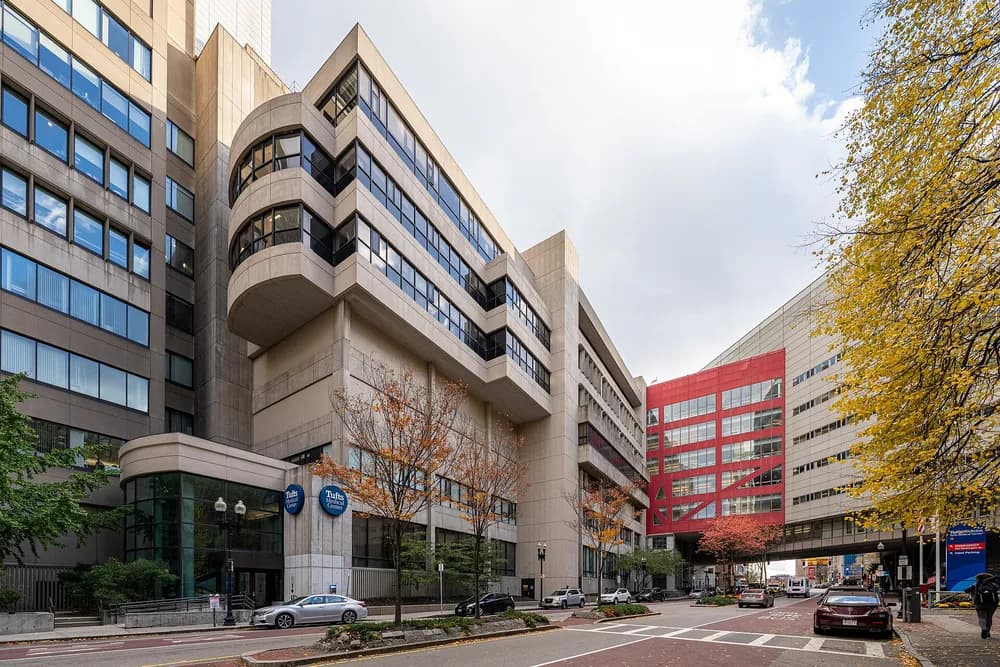



Photo: Ajay Suresh · CC BY 4.0 · cropped
Photo: Rhododendrites · CC BY-SA 4.0 · Photo: Sathiya raj · CC BY-SA 4.0 · Photo: Daderot · CC0
The Tufts University School of Medicine MD program at a glance (2027 entry)
Tufts University School of Medicine's MD is a four-year program on the Boston Health Sciences campus in the Chinatown neighborhood. Its principal teaching hospital, Tufts Medical Center, is next door. In 2026, 204 students entered: 163 on the Boston Track and 41 on the Maine Track, a track within the same MD rather than a separate degree.
The pre-clerkship phase, the classroom-based first part of the program, runs from August of year 1 to late January of year 2. Science is taught in integrated organ-system courses, with two parallel tracks for patient-care skills and for evidence and clinical reasoning. After a dedicated study period for Step 1 of the United States Medical Licensing Examination (USMLE), core clerkships, the required clinical rotations, begin in April of year 2.
Patients come early. In the second month you interview hospital patients in small groups. Mostly in year 2, the Competency-Based Apprenticeship in Primary Care (CAP) puts you in an outpatient office one day a week. From day one you also have a physician coach who stays with you through all four years. You join one of four learning communities, each anchored by small groups of students and their coaches.
Clinical training ranges from Boston to Maine. Besides Tufts Medical Center, the school's more than 20 clinical partners include community hospitals such as Faulkner and Lowell General, community health centers in Lawrence and Lynn, and Portsmouth Regional Hospital in New Hampshire. Maine Track students spend year 1 in Boston and then train mostly in Maine, where about half take a nine-month longitudinal integrated clerkship (LIC). In an LIC you cover the core specialties at the same time, following your own patients.
| Degree | MD |
|---|---|
| Program length | 4 years; classes to January of year 2, clerkships from April |
| Entering class (2026) | 204 students: 163 Boston Track, 41 Maine Track |
| Main campus | Boston Health Sciences campus, Chinatown, next to Tufts Medical Center |
| Teaching style | Integrated organ-system courses; small-group cases, team-based and problem-based learning |
| Anatomy | Cadaveric dissection within organ-system courses; prosections for neuroanatomy |
| First patient contact | Second month of year 1, interviewing hospital patients |
| Clinical sites | More than 20 partners in Massachusetts, New Hampshire and Maine |
| Step 1 timing | After classes end in late January of year 2, before clerkships |
| Grading | Pass/fail before clerkships; clerkships graded Honors, High Pass, Pass, Low Pass, Fail |
What makes the Tufts University School of Medicine MD program different
Clerkships from April of year 2
Classes end in late January of year 2 and core clerkships start in early April, after two months of Step 1 study.
A Maine Track within the same MD
The Maine Track is run with MaineHealth, the health system whose flagship is Maine Medical Center in Portland. After year 1 in Boston you move to Maine, where courses keep the same objectives and assessments. For core clerkships you choose block rotations at Maine Medical Center or the nine-month LIC, run mostly at rural sites.
A full nutrition course in year 1
Nutrition runs for seven weeks alongside the gastrointestinal course, covering nutritional assessment in clinic and hospital, counseling, obesity, malnutrition, eating disorders and food security. The school says it has taught a full nutrition course for decades, and in clerkships you counsel patients on diet and assess their nutrition.
A primary care apprenticeship before clerkships
In CAP you and a classmate spend one full day a week in a family medicine, general internal medicine or pediatrics office, taking histories, examining patients and presenting them. Students are expected to see about one patient an hour, do at least one observed exam a day and write one to three notes a day. Each listed skill must be observed and signed off.
A physician coach for all four years
Assigned on day one, your physician coach stays with you until graduation and co-leads your first-year problem-based learning group. Your pre-clerkship final grades are visible only to you and your coach.
How Tufts University School of Medicine teaches medicine
The curriculum is integrated at three levels. Basic and clinical sciences share each organ-system course, courses running at the same time reinforce each other, and every pre-clerkship course is built to prepare you for clerkships. In the respiratory course, for example, you learn the lung exam in the patient-care track, Foundations of Patient Care, and reason through a case of shortness of breath in Foundations of Clinical Reasoning.
Each organ-system course moves from normal structure and function to disease, prevention, diagnosis and treatment, with considerable time on case-based sessions about common symptoms and abnormal test results. Perspectives in Medicine threads, on health systems, population health, the patient experience and personal development, run through all of them. A faculty page says active learning, such as small groups and team-based learning, makes up at least half of every course.
The ways you will learn
| Interactive lectures and flipped classrooms | In a flipped classroom you work through the material beforehand, then spend class time applying it to problems and cases. |
|---|---|
| Small-group cases and team-based learning | Case-based small groups run in every organ-system course. In team-based learning, used from the first course, teams apply what they have prepared to realistic patient scenarios. |
| Problem-based learning | For one semester of year 1, five students meet for two hours a week with two faculty facilitators who alternate weeks. You work through virtual patient cases, research the questions they raise and teach each other. |
| Clinicopathological conferences and patient sessions | Some sessions pair two specialists: in the gastrointestinal course, a gastroenterologist and a pathologist co-teach, covering how a disease works before the tissue changes it causes. In the addiction medicine course, people who have overcome addiction talk with students. |
| Simulation and standardized patients | In the Thompson Sim Center you examine standardized patients, trained actors who play patients, and practice on manikins. In groups of five or six you diagnose and treat robotic patient simulators, then review the video in a debrief room. |
A typical week on the Tufts University School of Medicine program
The 2025-26 student handbook sets limits on the pre-clerkship week. Scheduled contact time should average no more than 25 hours a week over a month, counting class sessions, required pre-work, coaching and CAP. Over any two weeks you should also average at least two full mornings or afternoons a week free for self-study.
Preparing for an active-learning session should take no more than 40 minutes per hour of class, and that time counts toward the 25 hours.
- Wednesdays, late August into November of year 1: Interviewing, with demonstration interviews in the morning and small-group patient interviews in the afternoon.
- Once a week in the fall of year 1: a two-hour problem-based learning session with your group.
- Evenings in year 1: Physical Diagnosis practice in the Sim Center, 5 to 8:30 pm on a faculty page.
- Tuesday afternoons in year 1: optional Selectives for clinical shadowing, while MD/MPH students take their Master of Public Health classes.
How anatomy is taught at Tufts University School of Medicine
Anatomy is taught by cadaveric dissection within the organ-system courses. The musculoskeletal course introduces it with the lower limb, back and upper limb. You dissect the thorax and neck during the respiratory course and the kidneys, ureters and bladder during the renal course, linking each structure to how it works.
A faculty page describes lectures, lab dissections and small groups covering the limbs, thorax, abdomen, pelvis, and head and neck, and invites clinicians to help at the tables. The organ-system courses also use virtual anatomy. Neuroanatomy works differently: labs in the year 2 neuroscience course use computer programs written by the course directors and prosections, specimens already dissected for you.
The Michael Jaharis Jr. Anatomy Laboratory, opened in 2017 on the third floor of the M&V Building, has room for more than 200 students and faculty. Each of its 44 dissection tables has high-resolution imaging and a computer screen, and the lab has iPads and cameras. Anatomy practical exams are held there. Donated bodies come through the Tufts Anatomical Gift Program, run by the Department of Medical Education.
When you first meet patients at Tufts University School of Medicine
Your first patients come in the second month, through Medical Interviewing and the Doctor-Patient Relationship. A section leader supervises your small group as you interview patients. You spend six sessions in a hospital such as Tufts Medical Center, Lahey, Newton-Wellesley or South Shore, two at an elderly housing site and two in the Sim Center.
You also practice interviewing through an interpreter and with simulated patients. The course ends with an Objective Structured Clinical Examination (OSCE), a set of timed encounters with standardized patients, which you must pass before moving on.
Physical Diagnosis follows, timed to match the organ systems: November to May on the Curriculum page, December to June on a faculty page. In evening sessions you watch a demonstration, then practice under supervision on manikins and standardized patients, often with ultrasound, region by region from the limbs to the nervous system.
CAP then takes you into primary care. The Curriculum page says it starts in the last unit of year 1 and runs 18 weeks, to early January of year 2. The CAP page and the 2025-26 schematic place it in year 2, and the CAP page gives 15 Mondays from August. Its workshops cover office procedures, notes and presentations, lifestyle counseling, breast and pelvic exams and caring for children and adolescents.
Year by year at Tufts University School of Medicine
- Year 1
Foundations, the first organ systems and patient interviews
Classes start in early August after an orientation week; Maine Track students first attend an orientation at Maine Medical Center. The year moves from population health and core science into the first five organ systems, and classes end in late May.
- Population Health and Profession of Medicine (3 weeks), on the US health system, health inequities and prevention, including exploring Boston neighborhoods. Epidemiology and Biostatistics (3 weeks) runs alongside, and you write a critique of a published study.
- Scientific Foundations of Medicine (11 weeks), in four three-week sections that each end with a patient presentation. Molecules to Tissues covers biochemistry, cell biology and genetics; Microbes, Infectious Disease and the Immune System adds immunology and microbiology labs.
- Organ systems from November: Musculoskeletal (7 weeks), then after the winter break Cardiovascular (5), Respiratory (5), Renal (4), and Gastrointestinal with Nutrition (7 each). A faculty page shows an older order that starts with gastrointestinal.
- Medical Interviewing and the Doctor-Patient Relationship (12 weeks), ending in an OSCE, then Physical Diagnosis, plus problem-based learning (18 weeks) in the fall.
- Introduction to Clinical Reasoning starts in January on the Curriculum page, with 15 symptom-based weeks such as chest pain. A faculty page starts it in March, with five evidence-based medicine sessions and 14 cases. Both run into January of year 2.
- A one-week vacation in March, then a summer free for research fellowships, global health programs or MD/MPH fieldwork.
- Year 2, August to March
The remaining organ systems, CAP and Step 1
Year 2 starts in early August with the remaining organ systems, alongside CAP and the rest of Introduction to Clinical Reasoning. Classroom teaching ends in late January, and a dedicated Step 1 study period runs to late March. Maine Track students spend this year in Maine, taking the same courses with Maine-based faculty.
- Dermatology (2 weeks), which also reviews infectious disease topics such as fever, the immunocompromised patient and sexually transmitted infections.
- The Brain: Neuroscience (6 weeks), Introduction to Clinical Psychiatry (3 weeks) and Principles of Addiction Medicine (3 weeks), where you attend at least one recovery meeting as an observer.
- Hematology (5 weeks), Endocrine (4 weeks) and, in January, Reproductive (4 weeks), which includes LGBTQ health and transgender medicine.
- Community Service Learning with Tufts' Tisch College of Civic Life, across years 1 and 2. The Curriculum page asks for at least 40 hours; the program's requirements page asks for at least 50 before clerkships. It adds online modules, small-group discussion and a final reflection.
- The week before clerkships: Core Clerkship Orientation at Tufts and Maine Medical Center, and a simulation bootcamp on ward procedures such as airway management, lines and wound care.
- April of year 2 to May of year 3
Core clerkships and the Capstone block
Core clerkships run from early April of year 2 to late March of year 3. In each you work with a clinical team, take histories, examine patients, write notes in the electronic record and present your plans. The six-week Capstone block that follows is set aside for USMLE Step 2 Clinical Knowledge (CK), the second licensing exam, plus your scholarly project, MPH coursework and vacation.
- Internal medicine (8 weeks), at sites from community hospitals to tertiary centers in greater Boston, Portsmouth in New Hampshire and Portland in Maine. An online patient log lets the site director check that you have seen the required conditions.
- Surgery (8 weeks): operating cases, clinic visits and inpatient team work, plus on-call shifts with emergency consultations, emergency operations and trauma activations.
- Family medicine (6 weeks): about four days a week with a faculty preceptor in an outpatient practice, plus a weekly day of cohort workshops such as sports medicine.
- Pediatrics (6 weeks): mainly outpatient, in academic and community practices, with the same Aquifer online cases at every site; some students also have inpatient time in children's hospitals.
- Obstetrics and gynecology (6 weeks) at one of seven sites, with simulation at the school, and psychiatry (6 weeks) across inpatient, consultation, emergency and outpatient services for adults and children.
- Neurology (4 weeks) at one of four sites, with Monday teaching sessions; you take it this year or in year 4.
- Interclerkship Week in September, held in person in Boston and Maine, for health systems science, communication and reflection.
- Time off: two three-day weekends after medicine and surgery, up to four weeks in elective blocks, two weeks at winter break and one to two weeks in the Capstone block.
- May of year 3 to May of year 4
Advanced rotations, electives and the Match
From May of year 3 your schedule becomes four-week blocks that you plan around your career, with faculty advice and the approval of the Dean of Student Affairs. The block calendar counts May to July as the end of the core clerkship phase and August as the official start of the advanced phase.
- Acting internships, where you take on much of an intern's work under supervision, plus electives.
- Away rotations at other schools, and up to 12 weeks of unscheduled time for vacation and residency interviews, never three months in a row.
- Residency applications with Pathway to Residency support, and Match Day in March.
- Scholarly project presentations in April, then a one-week transition to residency course with simulation in May.
- Graduation requirements due in late April, and commencement on the Tufts Medford campus in late May.
How you are assessed at Tufts University School of Medicine
All pre-clerkship courses are graded pass/fail. You pass with a final course grade of 70% or more, and some courses also set minimum scores on particular exams. Grades come from multiple-choice and short-answer exams, lab exams, quizzes, written work and faculty observation. A failed course goes to the Student Ethics and Promotions Committee, which can approve a remediation exam at the end of the year.
Clinical skills are tested in OSCEs in the Sim Center in Boston or in Maine. You cannot appeal an OSCE score, but a failed OSCE gets an automatic faculty review. Faculty who teach you for more than 1.5 hours in a course must give you narrative feedback.
Clerkships are graded Honors, High Pass, Pass, Low Pass or Fail. Each core clerkship ends with an OSCE or oral exam plus an NBME shelf exam, a standardized national subject test from the National Board of Medical Examiners. LIC students take the same exams and online cases as block students. Any Low Pass or Fail goes to the promotions committee and may be grounds for dismissal.
The Liaison Committee on Medical Education (LCME) accredits MD programs in the United States. Its directory, updated July 22, 2026, lists Tufts with full accreditation and a next survey in 2029-30. For an MD program, LCME accreditation is what makes its students eligible for the USMLE. Step 1 has been reported only as pass or fail since January 26, 2022; Step 2 CK still gets a three-digit score.
School policy has you take Step 1 after the dedicated study period and before clerkship orientation. You must pass it before the advanced phase, within three attempts and two years of finishing year 2. Step 2 CK must be taken to graduate, and the calendars put its deadline just before the advanced phase begins (May 3, 2026, for one recent class). The 2025-26 handbook says May 1 of your fourth year, a year it counts from the start of that phase, so both point to about the same date.
In August 2026 the USMLE program announced a move to designated testing dates from January 2029, with Step exams offered less often each year. That announcement moved the start from 2028, the year set in June 2026. On the current schedule, a 2027 entrant would sit Step 1 by late March 2029, after the switch, and Step 2 CK in the Capstone block around April or early May 2030. The USMLE has urged schools to review rules on when students must test, so the school's rules may change before your exams.
- The End-of-Core-Clerkship OSCE, held March to June, has seven or eight video-recorded encounters with standardized patients, from headache to anxiety. Faculty rate your history, exam and communication and read your write-up. You must pass it to graduate.
- Surgery is also assessed through an oral exam in its last week, a brief oral presentation and ratings from faculty and residents.
- Maine LIC students sit their six shelf exams spread across the year; on the 2026-27 dates they run from psychiatry in June to medicine in January.
- Graduation also requires your scholarly project and the community service hours. The MD must be finished within seven years, or ten for MD/PhD students, including any leave.
Where you will actually train at Tufts University School of Medicine
Tufts Medical Center, the principal teaching hospital, is next to the school in downtown Boston: a 415-bed academic medical center on the Clinical Partners page, 400 beds on the program overview. The school's four other major academic partners are Lahey Hospital & Medical Center, Maine Medical Center, Newton-Wellesley Hospital and South Shore Hospital. Several Tufts pages, mostly department pages, still name St. Elizabeth's Medical Center; the current Clinical Partners page lists the sites below instead.
You choose your third-year schedule through the Registrar's web-based system between January and April of year 2; after that you can only swap a clerkship one-for-one with a classmate. Fourth-year rotations can be dropped up to 30 days before a block, though some have a no-drop rule and Maine clerkships a two-month add/drop rule.
The Family Medicine department says over 80% of its clerkship sites are within a 45-minute drive of Boston, though some are as far as Cape Cod, Vermont and Maine. Many partner sites require a current criminal background check, which the Registrar runs before years 2, 3 and 4, and a respirator mask fit test.
For core clerkships, Maine Track students choose block rotations at Maine Medical Center in Portland or the LIC, which is also open to Boston students when places allow. LIC students live in one Maine community for nine months, two to four per site, with weekly half-day clinics in six specialties and emergency department shifts. They follow their own patients into hospital, surgery and childbirth, and add one or two four-week immersion blocks of inpatient and elective rotations.
New England Baptist specializes in orthopedic surgery.
- Tufts Medical Center
- New England Baptist Hospital
- Faulkner Hospital, Jamaica Plain
- VA Boston Healthcare System: Jamaica Plain and West Roxbury
Lahey has a Level II Trauma Center. The Family Medicine department says many students do their clerkship at Cambridge Health Alliance, Greater Lawrence and Lynn health centers.
- Lahey Hospital & Medical Center, Burlington and Peabody
- Cambridge Health Alliance: Cambridge, Somerville and Whidden hospitals
- Winchester Hospital
- MelroseWakefield Hospital, Melrose
- Lowell General Hospital
- Lawrence General Hospital
- Greater Lawrence Family Health Center, Lawrence and Methuen
- Lynn Community Health Center
- Newton-Wellesley Hospital
- MetroWest Medical Center, Framingham and Natick
- South Shore Hospital, Weymouth
- Good Samaritan Medical Center, Brockton
- VA Boston Healthcare System, Brockton
A 220-bed hospital with a Level II Trauma Center. Internal medicine clerkship sites include Portsmouth.
- Portsmouth Regional Hospital
Maine Medical Center, MaineHealth's flagship, hosts Maine Track block clerkships. Tufts lists eight LIC sites, while MaineHealth's page lists the nine hospitals here. In year 4, Maine Track students must do some rotations in Maine.
- Maine Medical Center, Portland
- Mount Desert Island Hospital, Bar Harbor
- MaineHealth Mid Coast Hospital, Brunswick
- Cary Medical Center, Caribou
- MaineHealth Lincoln Hospital, Damariscotta
- MaineHealth Franklin Hospital, Farmington
- MaineHealth Stephens Hospital, Norway
- MaineHealth Pen Bay Hospital, Rockport
- Redington-Fairview General Hospital, Skowhegan
Electives, selectives and away rotations at Tufts University School of Medicine
Choice starts small. Selectives, optional in year 1, let you pick a clinical setting and shadow a preceptor for four afternoons of at least three hours each. Surgeons, for example, take students into the operating room. In the core clerkship year, the calendar includes two-week elective blocks.
The Fourth Year Catalog, given to third-year students in late January, describes the electives at affiliated hospitals. The Psychiatry department lists 14 electives, open in year 3 once you finish its clerkship, and the Surgery department says acting-intern electives are offered at all its partner sites. Any rotation beyond the school's required minimum can be taken at another hospital or medical school, with credit if the Dean of Student Affairs approves your schedule.
You can take up to three away rotations, four-week electives at other LCME-accredited US medical schools. Most host schools use Visiting Student Learning Opportunities (VSLO), the application service of the Association of American Medical Colleges. The Registrar must approve each rotation in advance, and credit needs a grade of Satisfactory or higher. Host hospitals sometimes bump visiting students, and Tufts cannot guarantee a replacement.
Global health electives come at two points. In the summer after year 1 you can spend at least six weeks abroad observing, doing community outreach or research. The school sponsors summer programs in Vellore, India, and in Accra, Ghana, where the program runs seven to eight weeks.
In the spring of year 4, January to April, clinical electives abroad earn credit after at least four weeks. They include an exchange in Panama City for up to six students, where good Spanish is essential.
Dual degrees and research years at Tufts University School of Medicine
Every student completes a scholarly project over the four years: you frame a question, use suitable methods and present your findings, with presentations in April of year 4. It can be basic science or clinical research, or focus on public health, civic engagement or quality improvement. Summer research fellowships after year 1 fund at least eight full-time weeks and end with a poster at a fall Poster Fair.
For deeper research, the Research Concentration Program gives you six months to a year of full-time research after the core clerkship year. You must have passed Step 1 and should already have taken Step 2 CK. You work at least 35 hours a week with a research preceptor and take no courses. The school also awards the MD with Research Honors for a substantial, original research contribution.
The MD/MPH adds a Master of Public Health within the same four years. MPH classes take Tuesday afternoons in years 1 and 2, and a 200-hour field experience fills the summer after year 1. Public health courses then take late winter and early spring of years 3 and 4. You usually give up two clinical electives, finish with an Integrative Learning Experience, and some students add a year.
The MD/PhD is a Medical Scientist Training Program (MSTP) with the Graduate School of Biomedical Sciences, supported partly by a National Institutes of Health grant. The program's FAQ page gives an average of 7 to 8 years, and Maine Track students cannot apply.
You start in mid-June with a research rotation. The Graduate School's curriculum page puts Step 1 in April of year 2, followed by one required clinical rotation. You then do a PhD in one of seven programs, with a family medicine rotation along the way, and return for the remaining clerkships.
With the Fletcher School of Law and Diplomacy you can add an MA in international relations; Fletcher describes this Mid-Career MAIA/MD as a five-year program. The four-year MD/MBA with Brandeis University's Heller School has been discontinued. The Sam W. Ho Health Justice Scholars Program, for a selected group of students committed to underserved communities, adds mentoring by community health center physicians and a longitudinal project in an underserved setting. The Active Citizenship Concentration Program lets students with clinical experience pause the curriculum for full-time volunteer work in the US or abroad.
Facilities and support at Tufts University School of Medicine
Where you will learn
Study spaces are spread across the Medical Education Building at 145 Harrison Avenue and the M&V Building at number 136. The four Learning Communities share two floors of the Medical Education Building, with a living room, kitchen, small-group classrooms and study spaces. Above them, the Hirsh Health Sciences Library fills floors 4 to 7, with quiet floors, study rooms and seven bookable collaboration rooms.
The Thompson Clinical Skills and Simulation Center opened in 2023 at 136 Harrison Avenue. Its 15,000 square feet hold 16 exam rooms wired for audio and video, so faculty can watch from monitoring rooms. Four simulation rooms use robotic manikins that can play an adult, a pregnant woman or an infant. A skills space with task trainers for suturing, central lines and intubation is open to students out of hours.
In Maine, MaineHealth's Katahdin Learning Center provides classrooms and study space. Maine Track students have services comparable to Boston's, including a simulation center, library support, student affairs and academic advising.
Support while you study
Your coach is the main faculty member responsible for your professional identity development, meeting you individually and in small groups, helping teach clinical skills and guiding reflection. Maine Track students are assigned a Maine faculty physician as their coach.
At orientation you are also assigned a Peer Preceptor, a second-year student who helps you settle in. For what it calls a high-volume learning environment, the Office of Student Affairs offers one-to-one academic counseling, including for Step 1 and Step 2, and trained peer tutors for pre-clerkship students. It also arranges accommodations for documented disabilities.
Wellness is built into year 1 through Practical Approaches to Wellness, talks and workshops, many of them required, on sleep, stress, money, relationships and impostor syndrome. COMPASS offers optional mindfulness groups in the fall, co-led by trained second-year students, and Healer's Art is an optional 15-hour elective on humanism in medicine. Free, confidential counseling is available in person in Boston and by phone on rotations.
Career advising runs through the Specialty Advising, Guidance and Exploration (SAGE) program and, in years 3 and 4, Pathway to Residency. It includes a Career Specialty Night in January of year 3, help planning your fourth year, CV and personal statement reviews, mock interviews, your dean's letter (the MSPE) and rank-list meetings.
Is the Tufts University School of Medicine program right for you?
This program may suit you if
- You want to reach full-time clinical work early: core clerkships start in April of year 2.
- You are drawn to Maine or rural practice and would welcome moving there from year 2, with the option of a nine-month LIC.
- You want regular primary care experience before clerkships, through a weekly day in an outpatient office in CAP.
- You want public health training without extending the program, through the four-year MD/MPH.
- You value a long-term mentor: a physician coach from your first day to graduation.
Things to think about
- Rotations spread across more than 20 partners, from Boston to Portsmouth, New Hampshire. Some family medicine sites are as far as Cape Cod or Vermont, though the department says over 80% are within a 45-minute drive of Boston.
- The classroom phase is compressed into about 18 months, ending in late January of year 2, so most organ-system courses last four to seven weeks.
- Clerkships are graded from Honors to Fail, and any Low Pass or Fail is reviewed by the promotions committee.
- Your Step exams fall after the USMLE's switch to designated testing dates in January 2029, so their timing may shift.
- Choosing the Maine Track means moving to Maine after year 1 and rules out the MD/PhD.
Tufts University School of Medicine MD program — frequently asked questions
Applying to Tufts University School of Medicine?
How to get into Tufts University School of Medicine
Prerequisites, MCAT, AMCAS personal statement, secondaries and interview, step by step.
Open the guide →Tufts University School of Medicine admissions profile
MCAT and GPA profile, acceptance rate, interview format and key dates.
See the profile →Compare Tufts University School of Medicine with other schools
Put the teaching style, anatomy teaching and clinical sites next to another school.
Open the comparison →Prepare for the Tufts University School of Medicine interview
Format breakdown, school-specific sample questions and prep tips from tutors who interviewed here.
Read the guide →Where this Tufts University School of Medicine program guide came from
This guide was written from 65 official sources — Tufts University School of Medicine's own program pages and curriculum documents, plus the accreditor and the hospitals and health systems the school trains students in where they publish detail — read on 2026-10-14, then checked claim by claim against those sources.
- Tufts University School of Medicine: MD Curriculum
- TUSM MD Curriculum 2025-26 schematic
- Doctor of Medicine program overview
- Maine Track MD
- Maine Track MD Program: structure and services in Maine
- 2026-2027 MD Programs Academic Calendar
- 2025-2026 MD Programs Academic Calendar
- Core Clerkship Dates 2026-2027
- Fourth-year block dates 2026-2027
- TUSM MD Student Handbook 2025-2026
- Registrar for MD Programs
- Course and Clerkship Scheduling
- Away Rotations
- Clinical Partners
- Department of Psychiatry: clerkships and electives
- Department of Surgery: student teaching
- Department of Family Medicine: clinical partners and clerkship
- Department of Obstetrics and Gynecology: clinical partners
- Department of Neurology: clinical partners
- Department of Emergency Medicine: clinical partners
- 2030 Class Profile
- MaineHealth: Tufts University School of Medicine MaineHealth Maine Track
- MaineHealth: Longitudinal Integrated Clerkship
- The Michael Jaharis Jr. Anatomy Laboratory
- Tufts Anatomical Gift Program
- Thompson Clinical Skills and Simulation Center
- Thompson Sim Center Spaces
- Clinical Simulation Programs
- Facilities and Study Spaces
- Learning Communities and Coaching
- Teaching Opportunities at TUSM: MD courses and programs
- Organ Systems Courses
- Competency-Based Apprenticeship in Primary Care
- End-of-Core-Clerkship Objective Structured Clinical Examination
- MD Academic Support
- Preparing for the USMLE Exams
- MD Accessibility Services
- Student Health and Wellness Resources
- Career Decisions and Pathway to Residency
- Professional Standards: criminal background checks
- Community Service Learning
- Community Service Curricular Requirements
- Global Health Programs
- Global Health Programs: Types of Programs
- Global Health Programs: Timing of Programs
- MD Student Research Concentration Program
- MD Student Summer Research Fellowships
- MD Degree with Research Honors
- 4-Year MD/MPH
- Dual MD Programs
- Graduate School of Biomedical Sciences: MD/PhD MSTP
- Graduate School of Biomedical Sciences: MD/PhD Curriculum
- Graduate School of Biomedical Sciences: MD/PhD FAQs
- MD/MA in International Relations
- The Fletcher School: Dual and Exchange Programs
- MD/MBA in Health Management (discontinued)
- Sam W. Ho Health Justice Scholars Program
- History of Tufts School of Medicine
- LCME: About the School Directory
- LCME: Accredited Programs (updated July 22, 2026)
- USMLE Designated Testing Dates Information Hub
- USMLE: Updated Timeline for Designated Testing Dates, January 2029 (August 6, 2026)
- USMLE: Transition to Limited Testing Dates Starting in 2028 (June 23, 2026, updated)
- USMLE Designated Testing Dates FAQs
- USMLE: Examination Results and Scoring
Curricula are restructured between cycles. Anything here that decides your application — how anatomy is taught, a clinical campus assignment, a required research year — should be confirmed against the official page for your entry year.
Applying to Tufts University School of Medicine?
We help US applicants with MCAT strategy, the AMCAS personal statement, secondary essays and interview prep — everything you need for a competitive Tufts University School of Medicine application.