
The Harvard Medical School MD program
What you actually study, and where you will be
Harvard Medical School's MD is a 4-year program taught through case-based learning in an integrated curriculum, with patient contact from September of year 1 and clinical rotations in Boston and Cambridge, Massachusetts (2027 entry). Harvard's MD runs on two tracks that share one clinical year. Pathways, the larger track, teaches the science through prepared case discussions and puts you in one of four affiliated hospitals in Boston or Cambridge every Wednesday from the first September. HST, run with MIT, is a smaller research-heavy track with a required thesis. Everyone then spends 12 months as a clerkship student at one hospital before a senior phase of electives, science courses and scholarship. A fifth year for research or a second degree is optional.
- Degree
- MD
- Length
- 4 years
- Teaching
- Case-based learning + Integrated
- Clinical contact
- September of year 1

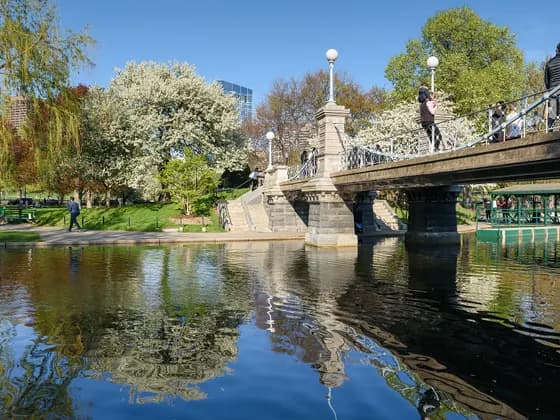
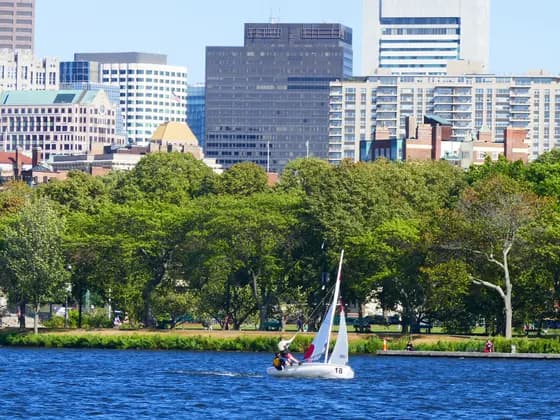
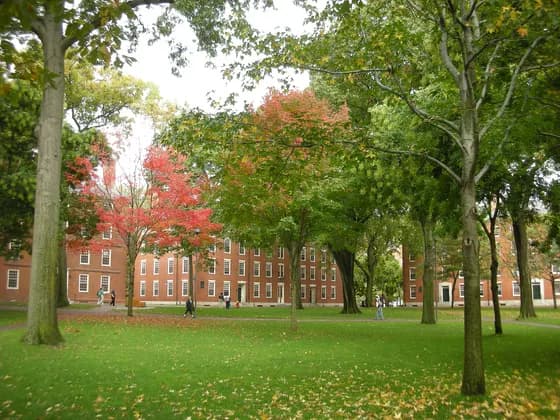
Photo: SBAmin · CC BY-SA 3.0 · cropped
Photo: King of Hearts · CC BY-SA 4.0 · Photo: NewtonCourt · CC BY-SA 4.0 · Photo: The original uploader was Billyau84 at Chinese Wikipedia . · Public domain
The Harvard Medical School MD program at a glance (2027 entry)
Harvard Medical School (HMS) awards a four-year MD from its campus in the Longwood Medical Area of Boston, a district of hospitals and research institutes in the Mission Hill neighborhood. The school's buildings sit around a green called the Quad, separate from the main Harvard campus across the Charles River in Cambridge. HMS owns no hospitals: your clinical training happens in independent affiliated hospitals nearby.
There are two ways through the degree. Pathways takes 135 students a year and is the track most students take. Health Sciences and Technology (HST) takes 30 and is run jointly with the Massachusetts Institute of Technology (MIT) for students who want a research career alongside clinical practice. You choose a track when you apply and can apply to both.
Both tracks have three phases. The preclerkship phase is the classroom and lab period: about 17 months in Pathways and 20 in HST. The Principal Clinical Experience (PCE) is the 12-month clerkship year of core clinical rotations at one hospital. The post-PCE phase lasts about 17 months in Pathways and 14 in HST. It is largely yours to design, from subinternships (a month working at the level of a first-year resident under supervision) to electives and research.
Patients arrive early. Pathways students spend every Wednesday from the first September in the hospital where they will later do their clerkships, and HST students start a patient-care course in January of year 1.
Two national exams sit inside the timeline. Step 1 of the United States Medical Licensing Examination (USMLE), a pass-or-fail test of the sciences behind medicine, comes before the clerkship year. Step 2 Clinical Knowledge (CK), which tests how you apply that knowledge to patient care, must be done by December 31 of your final year. The program is accredited by the Liaison Committee on Medical Education (LCME), which accredits US MD programs, most recently in 2019 for an eight-year term.
| Degree | MD |
|---|---|
| Program length | 4 years; an optional fifth year for research or a second degree |
| Class size | 165 a year: 135 in Pathways, 30 in HST |
| Main campus | HMS Quad, Longwood Medical Area, Boston; HST classes also at MIT |
| Teaching style | Flipped classroom with case discussions (Pathways); quantitative semester courses (HST) |
| Anatomy | Dissection of donated bodies in year 1, then the longitudinal Anatomy I course |
| First patient contact | Wednesdays from September of year 1 (Pathways); January of year 1 (HST) |
| Clinical sites | One of Beth Israel Deaconess, Brigham and Women's, Mass General or Cambridge Health Alliance |
| Step 1 timing | Before the clerkship year, in both tracks |
| Grading | Satisfactory or Unsatisfactory until the senior phase, where clinical courses add Honors tiers |
| Accreditation | LCME, fully accredited in 2019; next site visit April 5 to 7, 2027 |
What makes the Harvard Medical School MD program different
Two tracks to one MD
Pathways (135 places) teaches through integrated, case-based courses with a weekly hospital day from year 1. HST (30 places), run with MIT, adds semester courses, a research summer and a required thesis. Both join the same clerkship year and senior phase.
One hospital as your base for two years
In Pathways, the hospital that hosts your Wednesday course in year 1 also hosts your whole clerkship year. Many students keep the same primary care preceptor, the physician who supervises them in clinic, across both years, so you get to know one institution's teams and systems properly.
A longitudinal clerkship option at Cambridge Health Alliance
Twelve Pathways students a year take the Cambridge Integrated Clerkship, a longitudinal integrated clerkship (LIC). Instead of rotating through blocks, they follow their own patients all year across specialty and primary care clinics, supervised by faculty in every core discipline at once. HMS and Cambridge Health Alliance created the model in 2004.
Scholarship for everyone, and a senior phase you design
Pathways students complete a mentored scholarly project on any medical or health question, from bench science to the humanities, and HST students write a research thesis. After the clerkship year only a handful of courses are fixed. The rest is open for research, away electives, exchanges abroad or a second degree.
How Harvard Medical School teaches medicine
Pathways teaches through what HMS calls a flipped classroom. Before each session you work through preparatory material and check your own readiness. Class time then goes on case-based collaborative learning (CBCL): small groups reason through patient cases while faculty steer the discussion and later write a narrative assessment of you. The school caps class time plus required preparation at 68 hours a week in the preclerkship and post-PCE phases, and treats that as a ceiling rather than a target.
The science is organized by organ system rather than by discipline. After Foundations, three Integrated Human Pathophysiology courses take you through the body's systems, with anatomy, microbiology, nutrition and lifestyle medicine, pathology and pharmacology running as threads across them. Two Pillars of Practice, health equity and interprofessional collaborative care, run through courses and clerkships. So do five Frontiers of Health Care: aging and end-of-life care; climate, environment and health; sexual and gender minority health; substance use and pain; and trauma-informed care.
HST works differently. Its courses are semester-long and run at the same time, so a topic met in pathology one morning can be picked up in immunology or anatomy the same week. Teaching leans on quantitative problem-solving, labs, primary research papers and small groups of four to eight, in classes of 30 to 50 that include HST PhD students in medical engineering and medical physics.
Teaching shifts by phase. In the clerkship year you learn by working on hospital teams, while PCE Core Faculty observe you, give feedback and assess you over time. In the post-PCE phase you alternate four-week clinical rotations with month-long classroom courses such as the Advanced Integrated Science Courses, which mix discussion, clinical experiences and projects.
The ways you will learn
| Practice of Medicine (Pathways) | A weekly Wednesday course across year 1 at your assigned hospital. It covers interviewing, physical examination, clinical reasoning and how clinical teams work, and you see patients in a practice at or linked to the hospital under your primary care preceptor. |
|---|---|
| Clinical skills and simulation | Objective Structured Clinical Examinations (OSCEs), circuits of timed stations with actors trained to play patients, run in the TMEC Clinical Skills Center. You also train on simulation manikins, take Basic Life Support training and are video-recorded in required clinical exercises for assessment and your own review. |
A typical week on the Harvard Medical School program
For Pathways, the calendar shows the shape of a week rather than an hour-by-hour schedule. Most preclerkship courses run one at a time as full-time blocks of four to 13 weeks. Wednesdays belong to the Practice of Medicine course at your hospital, and preparation for flipped-classroom sessions counts inside the 68-hour ceiling.
HST publishes weekly slots for every course. In the fall of year 1, for example, Human Pathology meets on Tuesday and Thursday mornings, Human Functional Anatomy on Monday and Wednesday afternoons and Biochemistry on Thursday afternoons, with research fitted around them.
On clerkships the week is set by the team. HMS applies the residency standard of no more than 80 hours a week, averaged over four weeks and including overnight in-house call, with at least 14 hours off after a 24-hour call. Some rotations expect overnight call or early rounds, for example to be present for deliveries in obstetrics. You confirm your hours in a checklist at the midpoint and end of each clerkship.
How anatomy is taught at Harvard Medical School
Anatomy at HMS is learned on donated human bodies. The Anatomical Gift Program accepts private donations for medical and dental education, and first-year medical and dental students learn anatomy by dissecting and examining these donors. Bodies stay at HMS for up to about two years, and students hold a private memorial service for the donors when their studies end.
In Pathways the lab work starts early. The 2026-27 calendar lists anatomy practical exams on September 18, October 9 and November 5, during the opening Foundations course, then an Anatomy I practical on December 11. Anatomy I runs as a longitudinal course from November 16 to May 14 alongside the organ-system courses. Anatomy practical exams continue in September and October of year 2, alongside Immunity in Defense and Disease and Mind, Brain and Behavior.
Mind, Brain and Behavior teaches brain anatomy through hands-on dissection of human brain specimens, anatomical models and clinical neurology exercises. In HST, anatomy is Human Functional Anatomy, a fall course in year 1 taught in parallel with Human Pathology. Outside class, the Countway Library's Makerspace has an Anatomage Table, a life-size touchscreen for exploring virtual bodies and scans.
When you first meet patients at Harvard Medical School
Pathways students meet patients in the first weeks. Before the Practice of Medicine course begins you complete Basic Life Support training and N95 mask fitting, scheduled for August 17 and 18 in 2026. From September 2 you spend every Wednesday at your assigned hospital, learning to take a history and examine patients alongside your preceptor. A strand called the Developing Physician covers professional development and well-being.
In year 2, Mind, Brain and Behavior adds preceptor-led visits to mental health facilities. BRIDGES then closes the preclerkship phase with Wednesday sessions from August, four full-time weeks, an OSCE and an orientation to the clerkship year.
HST students meet patients in Introduction to the Care of Patients, which runs from January to May of year 1 with clinical preceptors. In February and March of year 2, Introduction to Clinical Medicine is a full-time eight-week course at Brigham and Women's Hospital. It runs four days a week from 8 to 5, with pediatrics at Boston Children's Hospital.
Year by year at Harvard Medical School
- Year 1 (Pathways)
Foundations, pathophysiology and Wednesdays in hospital
In the 2026-27 calendar the year opens on August 3 with orientation and a short Introduction to the Profession, then runs as a sequence of full-time courses. Foundations covers anatomy, histology, biochemistry, molecular and cellular biology, genetics, immunology and introductory pharmacology. The Integrated Human Pathophysiology courses then work through the organ systems. It ends on May 21, followed by a Summer Flex period to July 30 with no scheduled courses. Dates shift slightly each year, so check the calendar for your own entry year.
- Foundations, August 10 to November 6, with anatomy practicals alongside.
- Practice of Medicine every Wednesday from September 2 to May 19 at your assigned hospital.
- Integrated Human Pathophysiology I (November 9 to December 18), II (February 1 to March 19) and III (April 5 to May 21).
- Essentials of the Profession, January 4 to 29, taken with HST students: health care policy, social medicine, clinical epidemiology and medical ethics.
- Professional Development Week I, March 29 to April 2, including well-being sessions. Unsatisfactory grades must be cleared at four set checkpoints during the phase to stay on track for the clerkship year.
- Year 2, August to December (Pathways)
Immunity, the brain, BRIDGES and Step 1
The second year starts on August 3 and the classroom phase ends before winter break. After the last two system courses, BRIDGES prepares you for the wards and a four-week Step Prep block leads to USMLE Step 1. Clerkships begin on January 4 in the 2026-27 calendar.
- Professional Development Week II, August 3 to 7, then Immunity in Defense and Disease, August 10 to September 11.
- Mind, Brain and Behavior, September 14 to October 23: the nervous system and behavior, with brain dissection, psychiatric interviewing and visits to mental health facilities.
- BRIDGES on Wednesdays from August 12 to October 21, then full time from October 26 to November 20, with the BRIDGES OSCE across October and November.
- Anatomy II, a second longitudinal anatomy course, is added in year 2 for students entering from fall 2026; the curriculum map shows it starting in the 2027-28 year.
- Step Prep, November 23 to December 18, then winter recess; the last day to take Step 1 is January 3. Any Unsatisfactory grade must be cleared by the end of the second week after BRIDGES, or your clerkship start moves to April.
- Years 1 to 2 (HST)
Semester science at HMS and MIT, a research summer, then the clinic
HST students share Introduction to the Profession and the January Essentials course with Pathways, and otherwise take their own semester courses at HMS and MIT alongside HST PhD students. Summer research starts as soon as year 1 ends in late May. The dates below are from the 2026-27 calendar.
- Fall of year 1: Human Pathology, Human Functional Anatomy, Cellular and Molecular Immunology, and Biochemistry and Metabolism, after August short courses in biostatistics, biomedical imaging and artificial intelligence in health care.
- Spring of year 1: Introduction to the Care of Patients, Essentials of the Profession, and pathophysiology courses covering the musculoskeletal, cardiovascular, respiratory and renal systems, hematology and endocrinology.
- Summer after year 1: research begins on May 24 in a lab at MIT, Harvard or a teaching hospital, on a thesis project chosen with a faculty supervisor.
- Fall of year 2: pharmacology, microbial pathogenesis, neuroscience, reproductive biology, gastroenterology and clinical epidemiology.
- January to March of year 2: the Step 1 month, then Introduction to Clinical Medicine at Brigham and Women's from February 1 to March 26, with Psychopathology on Wednesdays.
- Principal Clinical Experience (12 months)
The clerkship year at one hospital
The PCE is a continuous 12-month block at one hospital, from January to December for Pathways students and April to March for HST. You rotate through eight core disciplines while a longitudinal PCE course, including The Developing Physician II, runs alongside. HMS has announced a redesign, HMSPCE2028, for students entering the PCE from 2028, which includes the class entering in 2027.
- Medicine I (12 weeks) and Surgery (12 weeks); three-month clerkships start in January, April, July and October.
- Obstetrics and Gynecology (6 weeks) and Pediatrics (6 weeks), paired as a three-month block; Beth Israel Deaconess and Brigham students go to Boston Children's Hospital for pediatrics.
- Neurology, Psychiatry and Radiology, four weeks each; Radiology runs longitudinally for Beth Israel Deaconess students.
- Six clerkships end with a shelf exam, the National Board of Medical Examiners' standardized end-of-rotation test: Medicine, Surgery, Pediatrics, Obstetrics and Gynecology, Neurology and Psychiatry. Radiology instead sets its own exam on the last day of the clerkship.
- The Primary Care Clerkship runs longitudinally across the year and is organized differently at each site.
- Post-PCE phase (to May of year 4)
Subinternship, electives, science courses and scholarship
The senior phase starts the January (Pathways) or April (HST) after your clerkship year and runs to graduation in May. You schedule it in four-week months through an online study-card process that begins in the spring of the clerkship year.
- Medicine II, the required four-week medicine subinternship, usually completed by July or August before graduation.
- 12 weeks of clinical electives at HMS affiliates, with no more than two in the same discipline counting for credit.
- Two months of Advanced Integrated Science Courses (AISCs) for Pathways students, at least one in year 3, offered January to April; HST and MD-PhD students are exempt.
- Essentials of the Profession II, one month in October or March of alternate years, and the Clinical Capstone, one month in March or April of the final year.
- The scholarly project (Pathways, at least two months) or the HST thesis, and the Comprehensive Clinical Skills Exam, an OSCE required for graduation.
- Step 2 CK by December 31 of the final year, and an interview in late spring or summer for your Medical Student Performance Evaluation (MSPE), the Dean's Letter sent to residency programs.
How you are assessed at Harvard Medical School
HMS assesses you against six core competencies: medical knowledge; critical thinking and inquiry; patient care; professionalism; interpersonal and communication skills; and organizational and social determinants of health care. Every course and clerkship must give you formal feedback that does not count toward a grade by its midpoint. The end-of-course judgment combines exam results with written narratives from small-group faculty and, on clerkships, from the faculty and residents you worked with.
Grading is deliberately low-key for the first two phases. Every preclerkship course and every core clerkship is graded Satisfactory or Unsatisfactory, which the school says supports a focus on growth over performance. In the post-PCE phase, subinternships and clinical electives are graded Honors with Distinction, Honors, Pass or Unsatisfactory, while AISCs, Essentials II and non-clinical electives stay Satisfactory or Unsatisfactory. Clinical assessment uses Entrustable Professional Activities (EPAs), which rate how far you can be trusted with core clinical tasks. Clerkship narratives go into your MSPE; preclerkship narratives do not.
Preclerkship exams fall on published dates and must be taken in person. Clerkship shelf exams fall on set Fridays or Mondays through the year. Fail one and the clerkship shows Unsatisfactory until you pass a retake. Retakes usually fall in a vacation period or within a month of the end of the PCE, and the year can stretch to 13 months to allow it.
Clinical skills are tested in OSCEs with standardized patients in the TMEC Clinical Skills Center. Pathways students sit BRIDGES, Winter and Spring Preclerkship OSCEs, HST students sit their own preclerkship OSCE, and everyone sits a Clinical Capstone OSCE. The Comprehensive Clinical Skills Exam runs in half-day sittings between May and November of the year after your clerkship year, which the handbook calls the summer following the PCE.
The licensing exams are built in. Step 1 has been reported nationally as pass or fail since January 2022, and HMS requires it before the clerkship year. Pathways students take it after the Step Prep block, by January 3 in the 2026-27 calendar, and HST students before Introduction to Clinical Medicine begins in February. Step 2 CK must be completed by December 31 of your final year. You get three attempts at each, and a third failure normally means withdrawal from the school.
- A review system called PROGRESS, whose committee looks at every student's trajectory at each transition point, aims to catch those who need extra support before problems become failures.
- A failed course or clerkship means re-examination or remedial work; a second failure on repetition goes to the Promotion and Review Board, which decides your future in the program.
- Grades can be appealed, first to the course or clerkship director within six weeks, then to a curriculum subcommittee that includes voting student members.
- Honors in a Special Field (cum laude, magna cum laude or summa cum laude) rewards an original thesis plus an oral exam. The statement of intent is due in the first week of October of your final year.
Where you will actually train at Harvard Medical School
HMS teaches on its own Quad but trains you clinically in 15 independent affiliated hospitals and institutes, plus two psychiatry teaching sites, all listed by area below. Each affiliate keeps its own governance, and its physicians hold HMS faculty appointments and teach you alongside residents and fellows. Four of them host the clerkship year: Beth Israel Deaconess Medical Center, Brigham and Women's Hospital, Massachusetts General Hospital and Cambridge Health Alliance.
Pathways students learn their site before they arrive. In mid-June before you start, you can enter a lottery for the 12 places at Cambridge Health Alliance, and everyone else is randomized to Beth Israel Deaconess, Brigham and Women's or Massachusetts General. You hear in early July, and that site hosts both the year 1 Practice of Medicine course and the whole clerkship year.
Changing site takes a written appeal to the Dean for Students and a compelling reason, such as a mobility need or a conflict of interest with a site director. Commuting, scheduling and employment reasons are not accepted. HST students are randomized among the three Boston sites in November of year 2, for a PCE starting in April.
There are no regional or rural campuses: core clerkships, the subinternship and the 12 weeks of clinical electives must all be done at HMS affiliates. Within a site, clerkships fan out to partner hospitals. Psychiatry, for example, runs at the Massachusetts Mental Health Center for Beth Israel Deaconess students and at Brigham and Women's Faulkner Hospital and McLean Hospital for Brigham students. Massachusetts General students stay on the MGH campus or go to Cambridge Health Alliance.
The HMS campus and two of the four clerkship-year sites. Beth Israel Deaconess and Brigham students do pediatrics at Boston Children's.
- HMS Quad and Tosteson Medical Education Center
- Beth Israel Deaconess Medical Center
- Brigham and Women's Hospital
- Boston Children's Hospital
- Dana-Farber Cancer Institute
- Joslin Diabetes Center
Massachusetts General is the third Boston clerkship-year site.
- Massachusetts General Hospital
- Massachusetts Eye and Ear
Cambridge Health Alliance hosts the Cambridge Integrated Clerkship, McLean takes Brigham students for psychiatry, and HST courses split between HMS and MIT.
- Cambridge Health Alliance
- Mount Auburn Hospital
- McLean Hospital
- MIT campus (HST classes)
Brigham and Women's Faulkner and the Massachusetts Mental Health Center are psychiatry clerkship locations for Brigham and Beth Israel Deaconess students, not HMS affiliates in their own right. The other five are HMS affiliates.
- Brigham and Women's Faulkner Hospital
- Massachusetts Mental Health Center
- Spaulding Rehabilitation Hospital
- Veterans Affairs Boston Healthcare System
- Hebrew SeniorLife
- Harvard Pilgrim Health Care Institute
- Baker Center for Children and Families
Electives, selectives and away rotations at Harvard Medical School
Electives live in the post-PCE phase. You need 12 weeks of clinical electives at HMS affiliates, chosen through study-card stages and add/drop windows. You cannot drop a clinical elective within 45 days of its start without the backing of your Academic Society, your advising group. The hospital has already committed faculty and patients to you by then. The Capstone month adds non-clinical options such as Training the Eye, Spirituality and Healing in Medicine, and We All Have Our Stories: Literature and Medicine.
Once the PCE is complete, up to five months of electives can be away rotations at other US medical schools accredited by the LCME. More than three months needs your Society Advisory Dean's approval. You apply through the host school, usually via the Association of American Medical Colleges' Visiting Student Learning Opportunities system, and the Registrar certifies your standing. An away rotation earns credit rather than a grade.
International electives go through the Office of Scholarly Engagement (OSE). It runs one- to two-month clinical exchanges in primary care, medicine, pediatrics, emergency medicine and specialty fields with partner schools in Chile, Colombia, Costa Rica, Guatemala, Brazil, Taiwan, Spain and Israel. Most sites require the local language, and some OSE travel funding is available.
HMS's Medical Language Program runs credit-bearing weekly courses in medical Spanish, Portuguese, Mandarin, French and Arabic, plus a four-week intensive medical Spanish elective. Pass its oral assessment, a score of 9 or above on the ALTA medical listening and speaking test, and you may see patients in that language without an interpreter.
Dual degrees and research years at Harvard Medical School
Every Pathways student completes a scholarly project: a mentored piece of original work on a medical or health question, anywhere from bench science and clinical research to health policy, ethics, history or the arts. You submit a proposal and a mentor agreement at least a month before starting, by September 1 at the latest, and a mentor-approved report by March 1 of your graduating year. Scholars in Medicine Fellows in each Society help you find a mentor, and you can request up to four months of optional course credit for the work.
HST students write a thesis instead, based on laboratory or clinical research with a Harvard or MIT faculty supervisor: at least four months of full-time research plus a month of writing. The HST MD Thesis Committee approves your proposal. The handbook's HST plan of instruction, last updated in 2018, set the proposal deadline at October 31 of year 2. The current thesis page gives only the final deadline, the first Monday in February of your last year.
A handbook page last updated in 2018 encourages HST students to take five or more years, for example by spreading the preclerkship courses over three years or spending whole years on research. Under handbook rules last updated in 2021, Pathways students can add a fifth year without a second degree after the PCE, once the Council of Academic Societies approves the plan. On both tracks you must show how you will support yourself that year, and HMS normally charges reduced tuition for it. You can compete for funding such as a research assistantship or traveling fellowship.
The Harvard/MIT MD-PhD Program takes 7 to 9 years and has been supported in part by the National Institutes of Health's Medical Scientist Training Program (MSTP) since 1974. You can apply on entry or affiliate later, from November 1 of year 1. On the map for Pathways students entering from 2023, you do the first six months of the clerkship year in year 2 and spend years 3 to 6 in graduate school. You re-enter the clerkship year in July of year 7 and take Step 2 CK by December 31 of year 8.
Master's degrees fit between years 3 and 4, only after the full clerkship year, and must be finished before your final year. You can take an MPH at the Harvard Chan School of Public Health or, through HMS, an SM in Bioethics, Clinical Research, or Media, Medicine and Health. HMS also offers an MMSc in Clinical Investigation, Global Health Delivery, Immunology, Medical Education or Therapeutic Sciences. For the MPH and the SM, you tell your Society and the Registrar by May 31 for a fall start or October 31 for a spring start.
The five-year MD-MBA with Harvard Business School (HBS) has run since 2004. Years 1 to 3 are at HMS, with a Medicine and Management block taught by HMS and HBS faculty in February of year 3. Year 4 is the HBS required curriculum, and year 5 mixes HBS electives with HMS courses. Most students apply in their second year. A handbook page last updated in 2016 also describes a five-year MD-MPP with a year at the Harvard Kennedy School.
Facilities and support at Harvard Medical School
Where you will learn
Most of your classroom time is in the Tosteson Medical Education Center (TMEC) at 260 Longwood Avenue. It holds the four learning studios where small-group sessions run, each with a simulation manikin, and small tutorial rooms you can book on the day for group study. The TMEC Clinical Skills Center, where every OSCE takes place, is here too.
TMEC's second floor has a 4,700-square-foot Student Study and Collaboration Center and the Computer Resource Center. Nearby, the Francis A. Countway Library of Medicine has study rooms, the Russell Reading Room for quiet study and a Makerspace with a 3D printer.
Vanderbilt Hall, the on-campus residence across the street from TMEC, has private rooms for about 320 residents, shared kitchens, study lounges and a gym. Incoming students get priority, and you may be asked to move out after your first year.
Support while you study
Your first support structure is your Academic Society, a learning community you belong to from year 1 to the residency application. Pathways students are placed in Cannon, Castle, Hinton or Peabody on arrival, and HST students join the London Society. Each is led by an Advisory Dean with a small group of physician Society Advisors. They are your first stop for course planning, specialty choice, schedule changes, approvals and personal issues.
The Office of Learning Resources and Support offers learning specialists, tutors drawn from senior students, residents, fellows and faculty, and Step 1 and Step 2 coaching with diagnostic tests. You can go directly or be referred by a course director or your Society. A Clinical Learning Coaching Program supports students in the clinical phases.
Well-being sessions are built into orientation, the Professional Development Weeks, the PCE and the Clinical Capstone, with flex days at each PCE site. If you are drawn to primary care, the Primary Care Leadership Scholars Program takes applications before you start and offers mentorship and longitudinal clinical experiences.
Is the Harvard Medical School program right for you?
This program may suit you if
- You want to learn science through prepared case discussions in small groups rather than lectures, and will prepare before every session.
- You like the idea of one hospital base for both your year 1 clinical course and your clerkship year, as Pathways offers, possibly with the same primary care preceptor throughout.
- You are set on research: HST offers courses with MIT, a research summer, a required thesis and encouragement to take five or more years.
- You would rather be graded Satisfactory or Unsatisfactory through the first two phases, with Honors tiers only in senior clinical courses.
- You want a long, flexible senior phase with room for a second Harvard degree, away electives or an exchange abroad.
Things to think about
- You cannot pick your hospital: Pathways students are assigned one before they arrive, and it is hard to change.
- The clerkship year is being redesigned for students entering it from 2028, which includes the 2027 entering class.
- Step 1 is a gate: miss the deadline without an accepted reason and your clerkship start slips by at least a quarter.
Harvard Medical School MD program — frequently asked questions
Applying to Harvard Medical School?
How to get into Harvard Medical School
Prerequisites, MCAT, AMCAS personal statement, secondaries and interview, step by step.
Open the guide →Harvard Medical School admissions profile
MCAT and GPA profile, acceptance rate, interview format and key dates.
See the profile →Compare Harvard Medical School with other schools
Put the teaching style, anatomy teaching and clinical sites next to another school.
Open the comparison →Prepare for the Harvard Medical School interview
Format breakdown, school-specific sample questions and prep tips from tutors who interviewed here.
Read the guide →Where this Harvard Medical School program guide came from
This guide was written from 50 official sources — Harvard Medical School's own program pages and curriculum documents, plus the accreditor and the hospitals and health systems the school trains students in where they publish detail — read on 2026-09-27, then checked claim by claim against those sources.
- HMS: MD Program curriculum overview
- HMS: Pathways curriculum
- HMS: Health Sciences and Technology (HST) curriculum
- HMS: Choosing an MD Track (Pathways and HST places)
- HMS: Pillars of Practice and Frontiers of Health Care
- HMS: MD Program academic calendars 2026-27 (course dates, OSCEs, shelf exams)
- HMS: Pathways curriculum map
- HMS: Primary Care Education
- HMS: Scholarly Project (Pathways)
- HMS: MD Research and Thesis Requirement (HST)
- HMS: Dual Degrees
- HMS: Academic Societies
- HMS: Well-being in the Curriculum
- HMS: Affiliated Hospitals and Research Institutes
- HMS: LCME Accreditation Status
- HMS: Our Campus
- HMS: Student Spaces (TMEC, Countway Library, Vanderbilt Hall)
- HMS: Housing and Dining
- HMS: Anatomical Gift Program
- HMS Anatomical Gift Program: Frequently Asked Questions (first-year dissection, donor retention, memorial service)
- HMS Office of Scholarly Engagement: Clinical Elective Exchange Programs
- HMS Office of Scholarly Engagement: Medical Language Program (credit courses, ALTA assessment)
- HMS Registrar: Away Rotations
- HMS Department of Psychiatry: Medical Student Education
- Harvard/MIT MD-PhD Program: Program overview (7 to 9 years; MSTP support since 1974)
- Harvard/MIT MD-PhD Program: Training Sequence and Pathways MD-PhD curriculum map for students entering 2023 or later
- Harvard/MIT MD-PhD Program: Principal Clinical Experience for MD-PhD students
- HMS Student Handbook 1.03: Course and Examination Requirements for the MD Degree
- HMS Student Handbook 1.04: Student Assessment in the MD Program
- HMS Student Handbook 2.03: Grading and Examination
- HMS Student Handbook 2.06: Licensure, USMLE
- HMS Student Handbook 2.20: Student Workload and Work Hours
- HMS Student Handbook 2.04: Course Registration Policies and Clinical Site Assignments
- HMS Student Handbook 2.14: Rules Governing Other Educational Experiences
- HMS Student Handbook 1.02: Plan of Instruction for the London Society (HST)
- HMS Student Handbook 1.05: Five-Year MD Program, Pathways
- HMS Student Handbook 1.06: Five-Year MD Program, HST
- HMS Student Handbook 5.00: Enrollment in Additional Degree Programs
- HMS Student Handbook 5.01: MD-PhD Program
- HMS Student Handbook 5.02: MD-MPH Program
- HMS Student Handbook 5.03: MD-MPP Program (last updated 2016)
- HMS Student Handbook 5.04: MD-MBA Program
- HMS Student Handbook 5.05: MD-SM
- HMS Student Handbook 5.06: MD-MMSc
- HMS Student Handbook 3.01: Tutoring and Exam Prep
- HMS Student Handbook 3.02: Advising and Career/Specialty Choice Advising
- HMS Student Handbook 3.03: Office of Scholarly Engagement
- HMS Student Handbook 3.05: Simulation
- HMS Student Handbook 8.01: Vanderbilt Hall
- Cambridge Health Alliance: Cambridge Integrated Clerkship
Curricula are restructured between cycles. Anything here that decides your application — how anatomy is taught, a clinical campus assignment, a required research year — should be confirmed against the official page for your entry year.
Applying to Harvard Medical School?
We help US applicants with MCAT strategy, the AMCAS personal statement, secondary essays and interview prep — everything you need for a competitive Harvard Medical School application.