
The University of Nevada, Reno School of Medicine MD program
What you actually study, and where you will be
University of Nevada, Reno School of Medicine's M.D. is a 4-year program with an integrated curriculum, with patient contact from Year 1 and clinical rotations in Reno and rural Nevada communities (2027 entry). UNR Med teaches years 1 and 2 as integrated, systems-based blocks, each built around a weekly patient case, while clinical skills courses and preceptorships with community physicians run alongside. After passing Step 1 you spend year 3 in full-time clerkships, with Renown Health and VA Sierra Nevada as the two primary teaching hospital affiliates. Year 4 combines at least 32 weeks of electives with a required four-week rotation in a small rural or frontier community.
- Degree
- M.D.
- Length
- 4 years
- Teaching
- Integrated
- Clinical contact
- Year 1

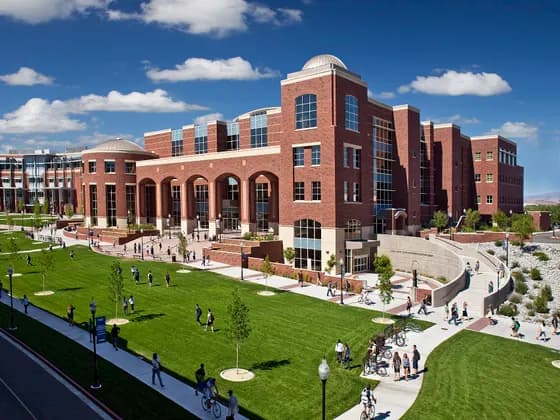


Photo: Wheeler Cowperthwaite · CC BY 2.0 · cropped
Photo: NevadaMarCom · CC BY-SA 4.0 · Photo: Wheeler Cowperthwaite · CC BY 2.0 · Photo: Missvain · CC BY 4.0
The University of Nevada, Reno School of Medicine MD program at a glance (2027 entry)
The University of Nevada, Reno School of Medicine (UNR Med), in Reno, awards the M.D. (Doctor of Medicine) after four years. Founded in 1969 as a two-year program, it was authorized by the state legislature in 1977 to become a four-year, degree-granting school. The Liaison Committee on Medical Education (LCME), which accredits MD programs in the United States, has fully accredited it since 1971. The Class of 2029, which entered in August 2025, had 72 students.
Years 1 and 2 form the pre-clerkship phase, the classroom-based stage before full-time clinical rotations, taught as ten integrated, systems-based blocks. You build the basic science of a group of organ systems in year 1, then return to the same systems in year 2 for their diseases, diagnosis and treatment. Each block is organized around a Case of the Week, a patient case that ties the science to a clinical problem. The school says this approach, part of what it calls its Foundations curriculum, cuts lecture hours.
Clinical skills start in year 1. Practice of Medicine teaches you to take a history and examine a patient, and in the spring you use those skills in a preceptorship, working alongside a physician in outpatient care. Advanced Clinical Skills continues in year 2 with community preceptorships. You must pass Step 1 of the United States Medical Licensing Examination (USMLE) before the clerkship year, which on the current calendar begins in early June.
Year 3 brings eight required clerkships, the full-time core clinical rotations, over 48 weeks. Year 4 is mostly electives, rotations you choose, plus four required weeks living and working alongside a preceptor in a small rural or frontier community.
| Degree | M.D. (Doctor of Medicine), four years |
|---|---|
| Class size | 72 students entered in August 2025 (Class of 2029) |
| Main campus | North end of the University of Nevada, Reno campus |
| Curriculum | Ten systems-based blocks in years 1-2, each built around a Case of the Week |
| Anatomy | Hands-on dissection and prosection (pre-dissected specimens) in year 1, plus a virtual Anatomage table |
| First patient contact | Year 1: Practice of Medicine, then a spring outpatient preceptorship |
| Clinical sites | Renown Health and VA Sierra Nevada in Reno; Carson Tahoe for surgery |
| Rural training | Required four-week rural rotation in year 4 |
| Step 1 timing | By the year 2 deadline (mid-May in 2026), before clerkships |
| Grading | Pass/Fail or Honors/High Pass/Pass/Fail, set course by course |
What makes the University of Nevada, Reno School of Medicine MD program different
Four weeks living and working in rural Nevada
Every student takes the Advanced Clinical Experience in Rural Health Care (MED 608M) in year 4. For four weeks you live and work alongside a preceptor in a small, rural or frontier community, handling complex problems with limited resources. The university noted in December 2025 that 11 of Nevada's 17 counties are frontier, the most remote category, and three are rural, and that residents there often lack access to care.
Free clinics run by medical students
The Student Outreach Clinic gives free care to uninsured and underinsured people, run by students under the direct supervision of licensed physicians. It holds clinics in Reno and, through the Rural Outreach Clinic, in Fallon, Silver Springs and Yerington, and a Street Medicine Clinic reaches people experiencing homelessness. University news in January 2026 said about 93% of students had volunteered at least once.
Clinical training inside Renown Health's network
Under a 50-year affiliation signed in 2021, Renown Health is UNR Med's primary teaching hospital. The network includes Renown Regional Medical Center, a Level II trauma center in Reno.
Ten scholarly concentrations to choose from
The voluntary Scholarly Concentration Program runs alongside the curriculum for all four years. With a mentor you research a question in one of ten fields, such as Rural and Tribal Medicine, Wilderness Medicine, Global Health or Culinary and Medical Nutrition. You can then present or publish the results.
How University of Nevada, Reno School of Medicine teaches medicine
The faculty's guiding principles shape the teaching: science and clinical knowledge are integrated across all four years, content is taught in a clinical context, and you get hands-on clinical experience every year. In years 1 and 2 that means a systems-based block curriculum, which the 2026-27 catalog says began rolling out with the Class of 2016.
Most blocks cover a group of organ systems, and every block uses the Case of the Week format, which aligns its content with clearly defined objectives. The approach keeps lecture hours limited and stresses learning strategies you will use for life. The pre-clerkship curriculum relies on active learning sessions, so attendance matters: an unexcused absence leads to a professionalism report.
Alongside the blocks run the longitudinal clinical skills courses, Practice of Medicine in year 1 and Advanced Clinical Skills in year 2. They teach history-taking and physical examination together with ethics, professionalism and communication. They also use a biopsychosocial-spiritual model, which means weighing a patient's psychological, social and spiritual life alongside the disease.
From year 3 you learn on clinical teams. In each clerkship you work full-time at a designated site, supervised by residents and faculty, and are sometimes on call on scheduled nights and weekends. Clinical Reasoning in Medicine runs alongside to sharpen your diagnostic reasoning, decision-making and communication. The guiding principles also build in three transition courses: into medical school, into clerkships and into residency.
The ways you will learn
| Case of the Week | Each pre-clerkship block works through weekly patient cases, so you meet the science in a clinical context. |
|---|---|
| Lectures, labs and active learning | Blocks combine lectures and labs with active learning sessions that depend on your participation. The year 1 neuroscience block, for example, uses lectures, labs and clinical experiences. |
| Standardized patients and simulation | Standardized patients, people trained to act as patients, let you practice interviews and examinations, then rate your communication and give feedback. Simulation manikins cover scenarios from heart and lung sounds to childbirth. |
| Preceptorships | In the spring of year 1 and the fall of year 2 you join a physician's outpatient practice to take histories and examine patients. |
How anatomy is taught at University of Nevada, Reno School of Medicine
In year 1 you study the whole body in the UNR Med Anatomy Lab. You learn through hands-on dissection, where you uncover the structures yourself, and prosection, where you study specimens already dissected for teaching. The lab sessions are aligned with the organ-system blocks, so the anatomy follows the system you are studying.
The 3,000-square-foot lab has 28 workstations with computers and ceiling-mounted LED lamps, eight alcohol immersion tanks and a full prep room and embalming suite. It also has an Anatomage virtual dissection table and ultrasound equipment, including portable Butterfly iQ+ devices. Its bodies come from the school's whole-body donation program.
Outside the lab, the Savitt Medical Library lends more than 50 anatomical models and has an Anatomage digital anatomy table you can book. In year 4, the two-week Selected Topics in Anatomy elective gives each accepted student dissection instruments, a shared cadaver and lab access, so you can dissect in preparation for your chosen residency.
When you first meet patients at University of Nevada, Reno School of Medicine
Clinical training starts in the fall of year 1, when Practice of Medicine introduces history-taking and physical examination. You also practice with standardized patients, who fill out history and examination checklists on your performance.
In the spring of year 1, Practice of Medicine moves into a preceptorship with outpatient care experiences, where you use these skills with patients. In the fall of year 2, Advanced Clinical Skills places you with community physicians. You take focused histories, examine patients, write SOAP notes (subjective, objective, assessment, plan) and begin planning care for common problems. In October 2026 the school said it and Renown had increased clinical experiences for first- and second-year students, so you work directly with physicians well before clerkships begin.
The Student Outreach Clinic adds patient contact outside the timetable, and first-year students can take part. Its free clinics offer screenings, lab tests, x-rays, EKGs, some treatments and referrals.
Outside the curriculum, you can request a summer preceptorship, extra clinical time with a practicing physician to explore a career. The school groups summer preceptorships with observerships, where you watch a physician at work, as co-curricular activities. For a preceptorship you must be in good academic standing, and one with UNR Med, Renown-affiliated or community faculty must be requested at least four weeks ahead. Research, summer preceptorships and other elective activities before year 3 do not count toward the weeks of instruction you need to graduate.
The University of Nevada, Reno School of Medicine curriculum, year by year
- Year 1
Systems I and Practice of Medicine
Year 1 has 40 weeks of instruction, running from early August to early June on the 2025-26 calendar. It opens with MedFIT, a one-week orientation, and the White Coat Ceremony. Five blocks follow, with Practice of Medicine building your clinical skills alongside them.
- Block 1, Foundations and Principles of Medical Science I (MED 631, 8 weeks): core principles of science and medicine and clinical problem-solving.
- Block 2, Cardiovascular, Respiratory and Renal Systems I (MED 632, 10 weeks), and Block 3, Gastrointestinal, Endocrine and Reproductive Systems I (MED 633, 8 weeks), which includes nutrition and metabolism.
- Block 4, Musculoskeletal and Integumentary Systems (MED 634, 6 weeks), on the back, limbs and skin. Block 5, Nervous System and Human Behavior I (MED 635, 8 weeks), covers neuroscience, the head and neck, and behavior.
- Practice of Medicine, Fall (MED 621, 18 weeks), on history-taking, examination, ethics and communication, then Spring (MED 622, 22 weeks), which applies those skills in a preceptorship.
- Hands-on dissection and prosection in the anatomy lab, aligned with the blocks.
- Remediation time is built in: on the 2025-26 calendar, two weeks in December for Blocks 1 and 2, and four weeks from early June for any year 1 block.
- Year 2
Systems II and Step 1 preparation
Year 2 has 31 weeks of instruction and returns to the organ systems, now for the diseases that affect them and how they are diagnosed and treated. Advanced Clinical Skills runs alongside. The year ends with a dedicated study period for USMLE Step 1.
- Block 6, Foundations and Principles of Medical Science II (MED 636, 7 weeks): microbiology, immunology and pathology, plus an introduction to population-based medicine.
- Block 7 (MED 637): the curriculum page lists it as Whole Body, four weeks on cancers and infections that affect the whole body, and the catalog describes it the same way. The 2025-26 calendar instead shows a five-week Block 7 on musculoskeletal, skin, rheumatology and hematology-oncology topics.
- Blocks 8 to 10 revisit the cardiovascular, respiratory and renal systems (MED 639, 7 weeks) and the gastrointestinal, endocrine and reproductive systems (MED 640, 6 weeks). They end with the nervous system and behavior (MED 638, 6 weeks).
- Advanced Clinical Skills, Fall (MED 623, 19 weeks), with community-based preceptorships, then Spring (MED 624, 12 weeks), with classroom and small-group work on advanced clinical skills.
- USMLE Independent Study: on the 2025-26 calendar it ran from March 30 to May 15, 2026, the Step 1 deadline and last day of year 2, with faculty-led workshops, review and practice blocks.
- Year 3
Context of Patient Care and core clerkships
Year 3 starts in early June, and you need a passing Step 1 score to begin. On the 2025-26 calendar it lasted 52 weeks, with the clerkships split into two 24-week halves and a week for remediation after each.
- Context of Patient Care (MED 641, 4 weeks) opens the year: life stages, community and preventive medicine, reporting violence, health policy and patient safety, to prepare you for clerkships.
- Eight required clerkships, 48 weeks in all: internal medicine and surgery, 8 weeks each; family medicine, obstetrics and gynecology, pediatrics and psychiatry, 6 weeks each; neurology and a Selectives clerkship, 4 weeks each.
- The Selectives clerkship is for career exploration, giving you time in several specialties that are not core clerkships.
- Clinical Reasoning in Medicine (MED 651O) runs alongside the clerkships. It is assessed with observed structured clinical exams (OSCEs), circuits of timed stations, often with standardized patients.
- In surgery you assist in the operating room, care for patients before and after operations and manage patients in acute care. You see general surgery and subspecialties such as orthopedics, ear, nose and throat, plastic surgery, neurosurgery and urology.
- Year 4
Electives, rural medicine and the Match
Year 4 requires 36 weeks: at least 32 weeks of electives and the four-week rural rotation. On the 2025-26 calendar it ran from mid-June to graduation in mid-May. You plan the schedule with your advisors while applying for residency, the specialty training that follows medical school.
- Advanced Clinical Experience in Rural Health Care (MED 608M, 4 weeks): you live and work alongside a rural physician and meet the full range of clinical and community health problems of a small community.
- Sub-internships, where you take on much of the work of a first-year resident, are offered in general internal medicine, hospital medicine, neurology and general surgery. The school advises a home sub-internship in your specialty early in the year.
- Step 2 CK (Clinical Knowledge), the second USMLE exam, must be taken by September 15. The school advises sitting it by the first week of September, so your score is ready before residency applications open.
- Your Medical Student Performance Evaluation (MSPE), the school's summary letter for residency programs, is released on the last Wednesday of September.
- Match Day, when you learn where you will do residency, falls on the third Friday in March.
How you are assessed at University of Nevada, Reno School of Medicine
Grades follow the Final Grade Assignment Policy, in effect since September 2, 2025. The M.D. program uses two scales, Pass/Fail and Honors/High Pass/Pass/Fail, and the Medical Education Steering Committee, which oversees the curriculum, decides which one each course uses. Course directors must post final grades within six weeks of a course ending.
In years 1 and 2, the 2026-27 catalog says each block ends with an assessment week of clinical skills testing and a comprehensive exam. Fail any requirement and you receive an Incomplete, meet the Student Promotion and Conduct Committee (SPCC), which oversees student progress, and remediate. A successful remediation turns the grade into a Pass but is noted in your MSPE, and you may remediate no more than two courses a year.
Clerkships award Honors. Grades come from the assessments in each syllabus, including a National Board of Medical Examiners (NBME) subject exam, a national multiple-choice test known as a shelf exam. Shelf scores are judged by national percentile. The 16th or above passes, the 5th to 15th is a marginal pass that flags a weak area before Step 2, and below the 5th means a retake. Failing shelf exams in two clerkships takes you off the schedule until you remediate.
The USMLE is the national exam series for medical licensure. Step 1 tests the sciences basic to medicine and has been reported only as pass or fail since January 26, 2022. Step 2 CK tests how you apply clinical knowledge to supervised patient care and still gives a three-digit score. LCME accreditation is what makes students of an M.D. program like this one eligible to sit them.
UNR Med requires you to pass both. You must pass Step 1 before you are placed in clerkships, and the deadline to take it is set in the year 2 calendar; in 2026 it was May 15. Sitting it later needs the SPCC's permission and is noted in your MSPE, and your first attempt must still come within four months of the deadline. Step 2 CK must be taken by September 15 of your final year and passed by May 1 of the year you graduate.
In August 2026 the USMLE program announced a move to designated testing dates from January 2029, with Step exams offered less often each year. Its June 2026 announcement had named 2028. On the current schedule, a student entering in 2027 would sit Step 1 by about mid-May 2029, at the end of the study period that closes year 2, a few months after the switch. Step 2 CK would be due by September 15, 2030, also after it.
- Clinical Reasoning in Medicine is assessed with OSCEs in year 3.
- Every required course and clerkship includes at least one activity with written feedback from a faculty member or resident.
- The projections above follow the 2025-26 calendar and the promotion policy effective July 1, 2026. The USMLE has encouraged schools to review rules on when students must sit Step exams, so timings could change.
- You get three attempts at each Step exam. A third failure, or four failures across Step 1 and Step 2 CK, makes you subject to dismissal.
- You must finish the M.D. within six calendar years of starting, with extensions possible for a dual degree, military service or approved accommodations.
- Your MSPE places you at one of five levels, from distinguished to good. The rubric covers pre-clerkship and clerkship performance, USMLE results and, where available, leadership, service, teaching and research.
University of Nevada, Reno School of Medicine clinical rotations: where you will actually train
UNR Med calls itself a community-based medical school: you rotate through partner hospitals, clinics and physicians' practices, supervised by residents and faculty. Its two primary teaching hospital affiliates are Renown Health and the VA Sierra Nevada Health Care System, and hundreds of community physicians also teach. In 2017 its southern clinical and teaching work moved to the new Kirk Kerkorian School of Medicine at the University of Nevada, Las Vegas (UNLV). Today UNR Med is based in Northern Nevada, with its main campus in Reno.
Renown is the primary teaching hospital. Under a 50-year affiliation signed in 2021, the two form what they call an integrated academic health system, and Renown now runs University Health, the school's former clinical practice. Renown Regional Medical Center in Reno is a Level II trauma center that, by Renown's count, treats more than 80,000 emergency and trauma patients a year. It includes Renown Children's Hospital and is the base of the obstetrics and gynecology department.
Renown's network also includes Renown South Meadows Medical Center in south Reno. By the university's July 2026 count, the network has more than 700 providers at 60 care sites, among them 20 primary care locations, 13 urgent care centers and 29 specialty clinics. The VA's main campus is the Ioannis A. Lougaris Veterans' Administration Medical Center in Reno, which the internal medicine department works closely with. The surgery department also names Carson Tahoe Health in Carson City and other Northern Nevada hospitals.
Beyond Reno, the school says years 3 and 4 take you from urban settings to rural locations across Nevada and northeastern California. Scheduling for the four-week rural rotation opens in February of year 3, and assignments come out in March. One preceptor, a family physician at Smith Valley Physicians Clinic, has hosted students on the rotation since 2019.
Emergency medicine is taught by the Department of Emergency Medicine, launched in January 2025 with Western Emergency Physicians, whose more than 60 emergency physicians work at Renown Regional and Renown South Meadows.
- In the clinical years, duty hours are capped at 80 a week and 16 in a row, with at least 10 hours between clinical activities. You get one day in seven free, averaged over four weeks, and no more than six overnight shifts in a row.
Home of both primary teaching hospital affiliates and of the main campus.
- Renown Regional Medical Center, including Renown Children's Hospital
- Renown South Meadows Medical Center
- Ioannis A. Lougaris Veterans' Administration Medical Center (VA Sierra Nevada Health Care System)
- Student Outreach Clinic, University Health Building, Moana Lane
Named by the surgery department, with other Northern Nevada hospitals, as a partner for surgical training.
- Carson Tahoe Health's 199-bed regional medical center
Every student spends four weeks with a rural preceptor in year 4; the outreach clinics are volunteer.
- Rural preceptor practices for the four-week rural rotation, such as Smith Valley Physicians Clinic
- Rural Outreach Clinic sites in Fallon, Silver Springs and Yerington
Year 4 electives away from Reno, at other schools' hospitals.
- Accredited residency programs across the country
Electives, selectives and away rotations at University of Nevada, Reno School of Medicine
Year 4 is built around at least 32 weeks of electives, taken in Reno and at accredited residency programs across the country. The school encourages a well-rounded clinical schedule, which you can supplement with non-clinical credit in research or other interests. Its year 4 advising page also mentions travel to other medical schools or abroad for learning experiences.
Examples on the current list include emergency medicine, cardiology, intensive care, neonatal-perinatal medicine, maternal-fetal medicine, forensic pathology, neurosurgery and ophthalmology. Other options include Wilderness Medicine, Culinary Medicine, Medical Spanish, Clinical Ethics, Radiology and Transition to Residency.
You apply for away electives through Visiting Student Learning Opportunities (VSLO), an online application service, or directly with programs outside it, from February of year 3. For competitive specialties the school suggests two to three away electives, including at least one outside the Western region.
In year 3, the four-week Selectives clerkship gives you time in specialties outside the core clerkships. Fourth-year students can also earn elective credit at the student outreach clinics, and Community Outreach Clinic appears among the family medicine electives.
Dual degrees and research years at University of Nevada, Reno School of Medicine
UNR Med offers three dual degrees: the M.D./Ph.D., the M.D./MPH and the M.D./MBA. If the second degree starts after year 2, you must pass Step 1 before beginning it.
The M.D./Ph.D. trains physician-scientists. In September 2026 the school said it takes seven to eight years: the first two years of medical school and Step 1, then doctoral research, then a return to finish clinical training. It had 10 students enrolled and takes two direct admits a year, and you can apply before or after starting medical school.
Ph.D. tracks are Biochemistry and Molecular Biology, Biomedical Engineering, Cellular and Molecular Pharmacology and Physiology, Cell and Molecular Biology, Speech Pathology and Audiology, and Integrative Neuroscience. Funding is guaranteed for three years through graduate research assistantships while you focus on dissertation research.
The M.D./MPH adds a Master of Public Health from the School of Public Health, with tracks in epidemiology, health administration and policy, and social and behavioral health. You apply after starting medical school and complete the MPH between years 2 and 3 or years 3 and 4, with 3 credits counting toward both degrees. It is not formally integrated: you are admitted to each program separately and usually enrolled in one at a time.
The M.D./MBA, a Master of Business Administration with the College of Business, is aimed at leadership roles in medical practices, government, healthcare companies or research. You finish years 1 and 2, complete the MBA, typically in one year, then return for the last two years, with selected fourth-year elective credits counting toward both degrees.
Students do research through the longitudinal Independent Data Exploration and Analysis (IDEA) Project, summer programs, independent projects and scholarly concentrations. The school points to the summer between years 1 and 2 as the time to start. Options include the eight-week VA Sierra Nevada Summer Research Program, which takes two students for 2027, and the Gerty Cori Fellowship in population health. Students present at the annual Medical Student Research Day.
- Scholarly concentrations are a voluntary four-year track. The ten fields are Clinical Ethics, Culinary and Medical Nutrition, Family Medicine, Global Health, Health Policy and Advocacy, Interprofessional Education, Medical Education, Population Health, Rural and Tribal Medicine, and Wilderness Medicine.
- With a mentor you research a question, through four weeks of work between years 1 and 2 and a four-week elective in year 4, about 320 hours in all.
- You apply while in good standing after your first semester and need SPCC approval by the end of year 1.
- Rural and Tribal Medicine adds a summer rural rotation, early rotations in partnered rural and tribal clinics across Nevada, community outreach and a scholarly project.
Facilities and support at University of Nevada, Reno School of Medicine
Where you will learn
The main UNR Med campus sits at the north end of the University of Nevada, Reno. The William N. Pennington Health Sciences building, opened in 2011, houses the Nevada Clinical Simulation Center. Its simulation lab has three separate labs, so up to three scenarios can run at once, with video and audio recording for debriefing.
The labs use high-fidelity manikins, including SimMan3G, SimBaby, SimJunior, Gaumard Victoria and Harvey, plus task trainers. The Standardized Patient Education Program recruits people of all ages and backgrounds to portray patients. The center also belongs to the Simulation Consortium of Northern Nevada with the Orvis School of Nursing and Renown Health's simulation lab.
The Savitt Medical Library offers bookable study pods, group study rooms and a Wellness Room. Its main campus library holds the Great Basin History of Medicine Museum, whose exhibits include a collection of more than 100 eyeglasses dating from the 18th century.
At Renown, learners have dedicated work and study space and the Savitt@Renown satellite library, open 24 hours with workstations and research help. A new simulation center under development in Renown's Sierra Tower is planned to include high-fidelity manikins, operating room simulation space and a da Vinci robotic surgery simulator.
Support while you study
The Learning and Wellness Resource Center covers both study and well-being. Its learning specialists meet students year-round to build learning plans, prepare for Step 1, Step 2 CK and shelf exams, and teach study strategies, time management and preparation for high-stakes exams.
Mental health support includes individual counseling, psychiatric care, group therapy, crisis intervention and anonymous screening. The wellness team runs community events and workshops on topics such as burnout and imposter syndrome, plus transition support at MedFIT, the start of clerkships and residency. An elected Student Wellness Committee plans further wellness initiatives.
Career advising runs through all four years, one-to-one and through workshops and specialty interest groups, and clinical advisors guide your specialty choice and applications. Year 3 brings required workshops on away rotations, specialty choice, year 4 planning and applying to residency. In year 4 you have monthly mock interview preparation and meetings with your advisor on your program list and rank list.
Is the University of Nevada, Reno School of Medicine program right for you?
This program may suit you if
- You like learning one group of organ systems at a time, with a weekly patient case tying the science to the clinic.
- You want early patient contact, through outpatient preceptorships with community physicians in years 1 and 2.
- You are curious about rural medicine: every student spends four weeks in a small rural or frontier community, and a Rural and Tribal Medicine concentration goes further.
- You would like to volunteer at free student-run clinics in Reno and rural towns from your first year.
- You want your clinical training rooted in one regional health system, Renown, alongside the VA.
Things to think about
- Step 1 is a gate: you must pass it before clerkships, so a delay or failure pushes back your clerkship start and possibly graduation.
- Grading scales are set course by course, so do not assume every pre-clerkship course is pass/fail.
- The rural rotation means four weeks living in a small community away from Reno.
- Shelf exams carry weight: below the 5th percentile means a retake, and failures in two clerkships pause your clerkship year until you remediate.
- The M.D./MPH is not formally integrated: you apply to each program separately and usually study one at a time.
University of Nevada, Reno School of Medicine MD program — frequently asked questions
Applying to University of Nevada, Reno School of Medicine?
How to get into University of Nevada, Reno School of Medicine
Prerequisites, MCAT, AMCAS personal statement, secondaries and interview, step by step.
Open the guide →University of Nevada, Reno School of Medicine admissions profile
MCAT and GPA profile, acceptance rate, interview format and key dates.
See the profile →Compare University of Nevada, Reno School of Medicine with other schools
Put the teaching style, anatomy teaching and clinical sites next to another school.
Open the comparison →Prepare for the University of Nevada, Reno School of Medicine interview
Format breakdown, school-specific sample questions and prep tips from tutors who interviewed here.
Read the guide →Where this University of Nevada, Reno School of Medicine program guide came from
This guide was written from 65 official sources — University of Nevada, Reno School of Medicine's own program pages and curriculum documents, plus the accreditor and the hospitals and health systems the school trains students in where they publish detail — read on 2026-10-25, then checked claim by claim against those sources.
- UNR Med: Doctor of Medicine Program
- UNR Med: M.D. Program Curriculum
- UNR Med Academic Calendar 2025-26 (revised November 13, 2024)
- UNR Med: Academic Progress and Promotion Policy (effective July 1, 2026)
- UNR Med: Final Grade Assignment Policy (effective September 2, 2025)
- UNR Med: M.D. Student Progress and Performance
- UNR Med: Medical Student Performance Evaluation Policy (effective August 4, 2025)
- UNR Med: Narrative Assessment Policy (effective July 1, 2025)
- UNR Med: Absence and Attendance Policy (effective July 1, 2025)
- UNR Med: Medical Student Clinical and Educational Work Hours Policy
- UNR Med: Graduation Requirements
- UNR Med: Goals and Guiding Principles for the M.D. Program
- University of Nevada, Reno General Course Catalog 2026-2027: Medicine, M.D.
- Catalog 2026-2027: MED 621, The Practice of Medicine, Fall
- Catalog 2026-2027: MED 623, Advanced Clinical Skills, Fall
- Catalog 2026-2027: MED 634, Musculoskeletal and Integumentary Systems
- Catalog 2026-2027: MED 651M, Selectives
- Catalog 2026-2027: MED 608M, Advanced Clinical Experience in Rural Health Care
- Catalog 2026-2027: Doctor of Medicine / Master of Public Health, M.D./MPH
- UNR Med: Dual Degree Programs
- UNR Med: Scholarly Concentrations
- UNR Med: Rural and Tribal Medicine Scholarly Concentration
- UNR Med: Medical Student Research Opportunities
- UNR Med Anatomy Lab
- UNR Med: Nevada Clinical Simulation Center
- UNR Med: University of Nevada Simulation Lab
- UNR Med: Standardized Patient Education
- University Libraries: Savitt Medical Library
- UNR Med: Our Campus
- UNR Med: History (2024-2029 Strategic Plan)
- UNR Med: Our Partners
- UNR Med: Integrated academic health system with Renown Health
- UNR Med: Affiliation Agreements for Medical Student Education
- UNR Med: Department of Surgery
- UNR Med: Department of Medicine
- UNR Med: Obstetrics and Gynecology, About the Department
- Nevada Today: Inside the integrated academic health system at UNR Med and Renown Health (July 28, 2026)
- Nevada Today: Investing in Nevada's future (October 23, 2026)
- Nevada Today: UNR Med launches Department of Emergency Medicine (January 16, 2025)
- Renown Health: Renown Regional Medical Center
- Renown Health: Renown South Meadows Medical Center
- Renown Health: Renown Children's Hospital
- Renown Health: University Health, operated by Renown Health
- VA Sierra Nevada Health Care: Ioannis A. Lougaris Veterans' Administration Medical Center
- Carson Tahoe Health: About Us
- UNR Med: Student Outreach Clinic
- UNR Med: Student Outreach Clinic locations
- Nevada Today: UNR Med students expand access to care through rural outreach (January 12, 2026)
- Nevada Today: UNR Med advances rural health initiatives (December 4, 2025)
- Nevada Today: Rooted in rural Nevada, a UNR Med rural rotation preceptor (October 7, 2026)
- Nevada Today: M.D./Ph.D. program trains Nevada's next generation of physician-scientists (September 16, 2026)
- Nevada Today: UNR Med celebrates the arrival of the M.D. Class of 2029 (August 13, 2025)
- UNR Med: Career Advising
- UNR Med: M.D. Year 3 Career Advising
- UNR Med: M.D. Year 4 Career Advising
- UNR Med: Learning and wellness support for M.D. students
- LCME: Accredited Programs directory (updated October 14, 2026)
- LCME: About the LCME
- USMLE: Designated Testing Dates Information Hub (dates the January 2029 announcement August 6, 2026)
- USMLE: Updated Timeline for Designated Testing Dates, transition in January 2029 (August 6, 2026)
- USMLE: Step 1 Transition to Pass/Fail Only Score Reporting
- USMLE Bulletin of Information: Eligibility
- USMLE: Step 1
- USMLE: Step 2 CK
- USMLE: Examination Results and Scoring
Curricula are restructured between cycles. Anything here that decides your application — how anatomy is taught, a clinical campus assignment, a required research year — should be confirmed against the official page for your entry year.
Applying to University of Nevada, Reno School of Medicine?
We help US applicants with MCAT strategy, the AMCAS personal statement, secondary essays and interview prep — everything you need for a competitive University of Nevada, Reno School of Medicine application.