
The UArizona College of Medicine – Tucson MD program
What you actually study, and where you will be
UArizona College of Medicine – Tucson's MD is a 4-year program taught through team-based learning in an integrated curriculum, with patient contact from Year 1 and clinical rotations in Tucson and rural and tribal communities across Arizona (2027 entry). UArizona Tucson's MD runs in three phases: 18 months of organ-system science blocks, a 12-month clerkship year starting in March of year 2, and a 14-month Transition to Residency phase. Through the first 18 months you meet weekly with your Society: no more than six students and a faculty mentor, together for all four years. Rotations center on Tucson's Banner and VA hospitals, with rural and tribal options across Arizona.
- Degree
- MD
- Length
- 4 years
- Teaching
- Integrated + Team-based learning
- Clinical contact
- Year 1

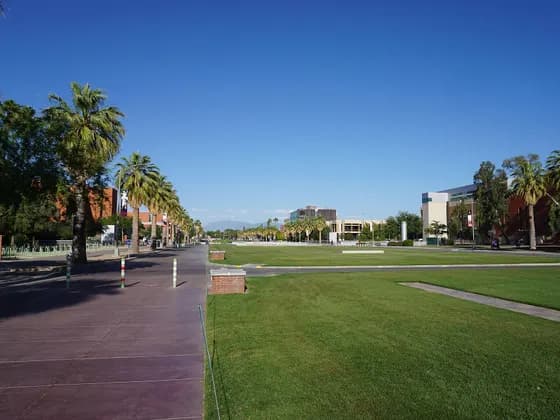


Photo: Michael Barera · CC BY-SA 4.0 · cropped
Photo: Michael Barera · CC BY-SA 4.0 · Photo: w_lemay · CC BY-SA 2.0 · Photo: Scotwriter21 · CC BY-SA 4.0
The UArizona College of Medicine – Tucson MD program at a glance (2027 entry)
The University of Arizona College of Medicine – Tucson (UArizona Tucson) runs a four-year MD program from the university's campus in Tucson. The college was founded there in 1967 with a first class of 32 students. The college says 480 students are currently enrolled in the MD program. Its clinical partners include Banner Health, which runs the Banner – University Medical Center hospitals in Tucson, and the Southern Arizona VA Health Care System, the local veterans' hospital system.
The program has three phases. The preclerkship (pre-clinical) phase fills the first 18 months with science blocks organized by organ system, ending with study for Step 1, the first exam of the United States Medical Licensing Examination (USMLE). Then come 12 months of clerkships, the core clinical rotations, where you work full time on hospital and clinic teams one specialty at a time. The final 14 months, Transition to Residency, prepare you for residency, the specialty training doctors complete after medical school.
Clinical skills start early and run alongside the science. Your anchor is a Society, the school's learning community: a small group of students with a faculty mentor. Small-group clinical reasoning and team-based learning balance the lectures, which school policy caps at half of all learning events. Everyone completes a four-year Scholarly Project, and eight optional Distinction Tracks let you go deeper in an interest such as medical Spanish or global health.
Rural and underserved care is a graduation requirement. You need at least two weeks of it, through a rural or underserved clerkship or elective, the Rural Health Professions Program, or 30 volunteer hours in the student-run Commitment to Underserved People (CUP) clinics. Later you can add electives with the Indian Health Service (the federal health service for American Indian and Alaska Native people) or on the US-Mexico border.
The Liaison Committee on Medical Education (LCME) accredits MD programs in the United States. Its directory, updated October 14, 2026, lists this program as fully accredited, with initial accreditation in 1965 and its next survey in 2029-30.
| Degree | MD |
|---|---|
| Program length | 4 years, in phases of 18, 12 and 14 months |
| Enrollment | 480 students currently enrolled in the MD program, per the college |
| Main campus | Tucson, on the University of Arizona campus |
| Teaching style | Integrated organ-system blocks, team-based learning and weekly clinical reasoning groups |
| Anatomy | Gross anatomy lab with bodies donated through the Willed Body Program |
| First patient contact | Year 1, in Society skills sessions; clerkships from March of year 2 |
| Step 1 timing | After year 2 blocks; about January–February 2029 for 2027 entrants, on current schedule |
| Grading | Pass/fail preclerkship; Honors, High Pass, Pass or Fail in clerkships |
| Accreditation | LCME: full; first accredited 1965; next survey 2029-30 (directory, October 14, 2026) |
What makes the UArizona College of Medicine – Tucson MD program different
A six-person Society that stays together all four years
Within the Doctor and Patient course you join a Society of no more than six students and one faculty mentor, an active clinician-educator. The group meets weekly through the preclerkship years for bedside skills and stays together until graduation. Career advising is built in.
Rural rotations with the same preceptor, year after year
The Rural Health Professions Program, set up after a 1996 state legislative mandate, matches selected students with physicians in small Arizona towns. You spend at least 10 weeks in residence, starting the summer after year 1, and may return to the same preceptor, the physician who supervises you, for two or more rotations.
Student-run clinics for patients with no other care
The CUP clinics began in 1979, when a few students met in faculty homes, and now involve over 90% of first- and second-year students. Supervised by volunteer attending physicians, students run a weekly family clinic plus dermatology, diabetes, women's, kids', wound, LGBTQ+ and asylum clinics for patients with no other source of care.
Electives with the Indian Health Service and on the border
In the final phase you can work with Indian Health Service physicians at hospitals across Arizona; most sites offer housing if you book early. A Border Health Care elective is designed as outpatient care for people of the US-Mexico borderlands, on both sides of the border where feasible.
Eight Distinction Tracks recorded on your transcript
Optional tracks in Bilingual Medical Spanish, Community Service, Global Health, Integrative Medicine, Leadership and Innovation in Health Care, Medical Education, Research and Rural Health are recorded on your transcript and dean's letter. They fit around the core curriculum and require good academic standing.
How UArizona College of Medicine – Tucson teaches medicine
The preclerkship curriculum follows the organ systems in a set sequence. Under the school's guiding principles, each block combines several disciplines and links basic science with clinical science, the social and behavioral sciences and the humanities. Twenty basic science disciplines, from gross anatomy to radiology and ultrasound, are coordinated by 12 discipline directors across all phases. Each block also sets aside two hours for spiraling, or revisiting earlier content.
Policy also shapes the format: no more than half of learning events may be lectures. Scheduled teaching runs between 8 a.m. and 5 p.m., with noon to 1 p.m. protected for lunch and enrichment activities. You get at least one day without new content before a high-stakes exam, and midterms fall on Mondays.
Three strands run beside the blocks. The Doctor and Patient course, home of the Societies, teaches interviewing, physical examination and professionalism. The Clinical Reasoning Course meets for two hours every Friday morning. A third strand, Pathways in Health and Medicine (the curriculum page also calls it In Practice), covers behavioral science, medical humanities and the social sciences.
From the clerkship year on, you learn mainly on wards and in clinics, with teaching such as the Department of Medicine's weekly academic half-day. Near graduation, a two-week Preparation for Residency Boot Camp offers a shared week of skills such as order entry and prescription writing, then specialty-specific training.
The ways you will learn
| Team-based learning | The school calls it Team Learning. Before each session you prepare and submit an individual readiness test; in class your group completes a group readiness test together. Missing either without an excuse earns a zero. |
|---|---|
| Clinical Reasoning Course | A weekly two-hour small group with a facilitator, working through selected clinical cases, plus large-group exercises. It builds a systematic approach to diagnosis and treatment decisions under uncertainty, and your facilitator writes a narrative assessment. |
| Doctor and Patient/Societies sessions | Small-group bedside teaching with your Society mentor, coordinated with the current block and using real and standardized patients (people trained to portray patients). Your mentor gives regular feedback and writes a narrative assessment. |
| Clerkship teaching | On rotations you learn on the team, log required patient conditions and attend didactics. Each week you also collect at least one workplace-based assessment, a rating from an attending or resident who watched you do a task. |
A typical week on the UArizona College of Medicine – Tucson program
The 2025-26 preclerkship manual shows a sample week. Monday to Thursday mornings, from about 8 a.m. to noon, hold lectures, labs, team learning and large-group sessions, as do Monday and Wednesday afternoons. On Tuesday and Thursday afternoons, half the class is in Doctor and Patient/Societies sessions while the other half has unscheduled time.
Friday opens with the Clinical Reasoning Course, followed by more teaching until about noon, and Friday afternoon is free. Policy guarantees two half days of protected unscheduled time a week, averaged over two weeks, including Friday afternoons.
Faculty-led contact hours may not exceed 32 a week, averaged over two weeks: up to 26 hours of block teaching, four of Doctor and Patient and two of Clinical Reasoning. Assigned work outside those hours, such as preparing for team sessions, is capped at eight hours a week.
How anatomy is taught at UArizona College of Medicine – Tucson
Gross anatomy, the study of body structures visible to the naked eye, is one of the 20 disciplines threaded through the blocks. Foundations introduces it, the Musculoskeletal block covers the bones, muscles, nerves and vessels of the limbs, and the Nervous System block teaches the anatomy of the central nervous system, head and neck.
Donated bodies come through the university's Willed Body Program, which the Department of Cellular and Molecular Medicine has run since 1967 and which also serves other Arizona schools. Each year medical students hold a memorial service for donors' families and friends; the 2027 service is on March 20, 2027.
The anatomy director's own research is on teaching methods that combine donor-based and digital techniques with clinical application. In the final year, the Gross Anatomy Lab Assistant elective lets you help teach first-years. Its course page, which still carries 2018-19 wording, describes assisting them during dissection exercises, after an orientation with a prosection demonstration (a prosection is a specimen already dissected by experts).
Another fourth-year option, Selected Topics in Gross Human Anatomy, is an independent study tied to your chosen specialty. You revisit regions such as the head and neck or thorax in two- or three-week units through dissection, reading and discussion, then present your dissection to anatomists.
When you first meet patients at UArizona College of Medicine – Tucson
School policy commits to patient care and other clinical experiences from the first week, which includes a day of community engagement. Doctor and Patient skills teaching starts on day one.
By the end of the preclerkship phase you will have done multiple histories and physical exams in Society sessions. You will also have written numerous SOAP notes, the standard subjective, objective, assessment and plan record, and presented patients aloud.
Outside scheduled teaching, most students volunteer in the CUP clinics in their first two years. An elective two-year Senior Mentor Program pairs you with a healthy older adult in Tucson.
The UArizona College of Medicine – Tucson curriculum, year by year
- Year 1
Foundations and the first organ systems
Year 1 runs from July to early June: a one-week Introduction to the Profession, then Foundations and four organ-system blocks. The Doctor and Patient course, the Clinical Reasoning Course and the Scholarly Project run alongside.
- Introduction to the Profession (1 week): meet college leaders, learn about the curriculum, professionalism and careers, spend a day on community engagement, and finish with the White Coat Ceremony.
- Foundations (6 weeks): anatomy, cell biology, genetics, embryology, biochemistry, histology, pathology, immunology, microbiology, pharmacology and biostatistics, plus evidence-based decision making and communication.
- Musculoskeletal System (6 weeks): bones, joints, muscles, limb nerves and vessels, most of the skin content needed for Step 1, and care for disability and chronic conditions.
- Nervous System (9 weeks): neuroscience, neuropathology, neurology, psychiatry and behavioral science, with the gross anatomy of the central nervous system, head and neck.
- Cardiovascular, Pulmonary and Renal Systems (11 weeks, after the winter break): heart, lungs, kidneys and lymphatics, integrating anatomy, physiology, pathology, pharmacology and clinical medicine through small-group cases and team learning.
- Digestion, Metabolism and Hormones (9 weeks, after a spring recess): digestion and absorption, nutrition, fuel metabolism and the endocrine system.
- Summer after year 1 (about eight weeks on the current pattern): marked Summer Research on the calendar, for Scholarly Project research, rural or global health rotations, or remediation.
- Year 2
Life Cycle, infection and Step 1
Year 2 starts in early August with the last three blocks, which end in mid-December. After the winter break comes a Step 1 study period; the preclerkship phase counts as complete once you first sit Step 1.
- Life Cycle (7 weeks): reproduction and development from conception and pregnancy through childhood, adulthood, aging and end of life, including cancers of the reproductive organs.
- Immunity and Infection (10 weeks in the calendars and manual; 8 on the curriculum page): immunology, microbiology, infectious disease, and public and global health.
- Advanced Topics (November 30 to December 18 in the 2026-27 calendar): case-based review of multi-system disease, ending with a USMLE practice exam that sets your Step 1 baseline.
- Two required practice exams from the National Board of Medical Examiners (NBME), often called mock USMLE exams, scheduled during year 2 to gauge your readiness for Step 1.
- Step 1 study period (January to late February): no course enrollment; any year 2 block remediation also happens in this window.
- Clerkship Phase
Eight core clerkships
The 12-month Clerkship Phase runs from a one-week Transition to Clerkships in late February of year 2 to Intersessions II in March of year 3. Eight core clerkships run on two parallel tracks, one of six-week rotations and one of eight- and four-week rotations.
- Transition to Clerkships (1 week): lectures, simulations and performance exercises on skills the clerkships demand, graded pass/fail on attendance and participation.
- Family and Community Medicine (6 weeks): mostly outpatient care with preceptors at urban and rural sites across Arizona.
- Medicine (8 weeks): two four-week inpatient blocks at Banner – University Medical Center Tucson or South, or the Southern Arizona VA, with weekly didactics and a simulated patient encounter.
- Ambulatory Medicine (4 weeks): new and returning patients in general and specialty outpatient clinics, plus inpatient consult services.
- Neurology (4 weeks): inpatient service and outpatient clinic, building a thorough neurologic history and examination.
- Obstetrics and Gynecology (6 weeks), Pediatrics (6 weeks), Psychiatry (6 weeks) and Surgery (8 weeks); their sites are described under clinical sites.
- Intersessions I (1 week, late August) and II (2 weeks, early March): patient safety, ethics, health care financing, wellness and skills such as bedside ultrasound. Intersessions II hosts the Year 3 OSCE (Objective Structured Clinical Examination), a hands-on exam with standardized patients.
- Option: a Rural Longitudinal Integrated Clerkship (LIC), taking surgery, internal medicine, family medicine, pediatrics and OB/GYN at one site with the same patients and faculty. Neurology and psychiatry stay standard rotations; apply through the LIC director.
- Transition to Residency
Sub-internship, emergency care and electives
The final 14 months run from mid-March of year 3 to graduation in May of year 4. You complete 44 units, where one unit is one week, and keep one four-week block free for residency interviews and another to study for Step 2 CK, the USMLE's clinical knowledge exam.
- Core sub-internship (4 weeks): internal medicine, general surgery, pediatrics, OB/GYN, emergency medicine or family medicine with a UArizona faculty preceptor, working like an intern (a first-year resident), including on-call or after-hours duty.
- Integrated Emergency Medicine/Critical Care clerkship (4 weeks): 14 clinical shifts in the emergency department and intensive care unit, simulation, splinting and ultrasound labs, and an NBME exam.
- Surgical subspecialty (4 weeks), chosen from 13 recognized fields, from anesthesiology and neurological surgery to urology and vascular surgery.
- Scholarly Project (4 units): in the 2026-27 calendar the final-year class has a four-week Scholarly Project block in March.
- Electives (28 units): at least 16 clinical and no more than 12 non-clinical, with research and independent study each capped at 8 units.
How you are assessed at UArizona College of Medicine – Tucson
Preclerkship blocks and courses are graded Pass or Fail under the school's Grading and Progression Policy. To pass a block you need an overall medical knowledge score of at least 70%, which is also the pass mark for each high-stakes written exam on the ExamSoft system. Any score under 75% triggers a required review with a learning specialist and an individualized study plan.
Clinical skills are graded without your own mentor deciding the result. In Doctor and Patient, a trained patient instructor grades a history and physical practicum in semester 1, and standardized patient encounters plus written histories count in semester 2. Semester 3 is graded on the Year 2 Clinical Thinking OSCE, scored by a different Societies mentor.
Clerkships and electives are graded Honors, High Pass, Pass or Fail. A clerkship grade is 15% knowledge exam, 15% clerkship activities, 50% clinical assessment and 20% workplace-based assessments (WBAs). The WBA share is all or nothing. You need one a week, covering at least four entrustable professional activities (core tasks such as taking a history or presenting a patient), from two faculty and two residents where possible. Honors goes to the top 30% of composite scores.
Every clerkship except Ambulatory Medicine ends, on its last day, with an NBME shelf exam: a national multiple-choice test of the specialty lasting 2 hours and 45 minutes. The Year 3 OSCE has two parts, the Arizona Clinical Interview Rating (modified) and the Integrated Clinical Encounter, each with a 65% pass mark. It is given in Intersessions II and again about six months later.
For MD students, LCME accreditation is what makes you eligible for the USMLE; DO and international medical students qualify through other routes. Step 1 covers the sciences behind medicine and has been reported pass/fail since January 26, 2022. In August 2026 the USMLE program announced a move to designated testing dates from January 2029, with Step exams offered less often each year. Its June 2026 notice had named 2028.
On the current schedule, a July 2027 entrant would finish the year 2 blocks in December 2028 and sit Step 1 in about January to February 2029, before clerkships start in early March. Step 2 CK would follow in 2030, with your first attempt due by the Friday of the third week of August of year 4. A later date needs your House Dean's approval, and the academic calendar says it must be taken before November 30. Both exams fall under the designated testing dates that begin in January 2029.
- The USMLE says it will publish each year's testing dates more than a year ahead, and it has urged schools to review rules on when students must test. Calendars for your class are not yet posted, so this timing may change.
- Retakes: if you fall below 70% overall after failing no more than one exam in a block (any number in Foundations), a retake exam is held on the Monday after the block.
- Remediation: one failed block a year can be remediated, in summer for year 1 or the Step 1 study period for year 2. Failing two blocks in a year means repeating the year.
- Graduation also requires every required course, your electives, the Scholarly Project, passes in Step 1 and Step 2 CK, the Year 3 OSCE and at least two weeks of rural or underserved clinical work.
- Time limits: take Step 1 within three years of starting and at least eight calendar days before your first clerkship. Pass it before Step 2 CK, and pass each Step within a year of your first attempt.
UArizona College of Medicine – Tucson clinical rotations: where you will actually train
For the first 18 months you are based on the Tucson campus. Clinical rotations then center on Banner – University Medical Center Tucson, Banner – University Medical Center South and the Southern Arizona VA Health Care System. Banner describes its Tucson hospital as Southern Arizona's only Level I trauma center, caring for the most critically injured patients. Inpatient pediatrics is at Banner Children's at Diamond Children's Medical Center, at the same Campbell Avenue address as the main hospital.
Each department uses its own mix of sites. Psychiatry opens with a week of orientation and teaching, then five weeks on consultation, inpatient, geriatric, emergency and substance-use services across the main hospital, South campus and VA. Surgery rotates through transplant, burn, robotic, oncology, thoracic, trauma and vascular services at the main hospital, general surgery at South and the VA, and a rural private practice.
Pediatrics splits into three weeks inpatient at Diamond Children's and three weeks in an outpatient clinic, from Banner clinics to private or rural practices. Newborn nursery time is at the main hospital unless you are at a rural site. The OB/GYN department says its clerkship runs from the University Campus and selected community sites.
Family medicine, per its 2025-26 syllabus, uses community health centers, residency clinics, private practices, and Indian Health Service and tribal clinics. Hours run about 8 a.m. to 5 p.m. on weekdays with no required call. Under a 2021 policy, you request your top site choices and clerkship offices in Tucson assign sites, weighing educational goals and geographic preference; changes need an extreme hardship.
The Rural Health Professions Program selects up to 30 first-years a year, according to its own page; the family medicine department describes 15 per class. Its preceptors work in family medicine, OB/GYN, internal medicine, pediatrics, general surgery or medicine-pediatrics. The program provides housing, a stipend for the first rotation and mileage for one round trip per rotation.
Medicine, surgery, neurology, OB/GYN, psychiatry consultation services and inpatient pediatrics, plus many fourth-year electives.
- Banner – University Medical Center Tucson
- Banner Children's at Diamond Children's Medical Center
Medicine, psychiatry, general surgery and neurology; the South Clinic family medicine residency, focused on rural medicine, takes two sub-interns per block.
- Banner – University Medical Center South
- Banner – University Medicine South Clinic
Inpatient medicine, psychiatry, general surgery and neurology, plus an internal medicine sub-internship and infectious diseases rotations.
- Southern Arizona VA Health Care System
Neurology at Tucson Medical Center, outpatient pediatrics and family medicine, and electives such as outpatient hematology-oncology and forensic pathology.
- Tucson Medical Center
- Banner – University Medical Center North Campus
- Banner clinics at North Hills, Pantano and Wilmot (pediatrics)
- Alvernon Clinic (family medicine)
- El Rio–Abrams South (family medicine, 2025-26 syllabus)
- Pima County Medical Examiner's Office (elective)
Rural time comes through the summer after year 1, rural clerkship sites, the Rural LIC and fourth-year rural electives in six specialties.
- Rural Health Professions Program practices: 60 sites in 43 communities
- Rural family medicine, pediatric and surgery practices
Fourth-year Indian Health Service electives need course director and site approval and two to three months' notice.
- Indian Health Service hospitals: Whiteriver, Sells, Polacca, Tuba City, Fort Defiance, Winslow
- Pascua Yaqui Indian Health Service clinic (rheumatology elective)
Fourth-year options; limits on time away are set out under electives.
- Away rotations (electives at other institutions) in 15 specialties
- Global Health Clinical Preceptorship sites
- International Away Elective sites
Electives, selectives and away rotations at UArizona College of Medicine – Tucson
Electives start in year 1 as optional enrichment courses. First-year options in 2026-27 include Care of the Older Adult, The Healer's Art, scrub training for the operating room, artificial intelligence in medicine, and a course on patients with Valley Fever and HIV.
Most elective time comes in the final phase: 28 units in two- and four-week periods. The 2026-27 fourth-year catalog lists 189 courses, from wilderness medicine, clinical toxicology and emergency ultrasound to forensic pathology, culinary medicine, and climate change and health. No more than 16 weeks may go to one subspecialty field.
Away rotations fall under a cap of 20 weeks at sites not directly supervised by College of Medicine – Tucson faculty. International electives must be linked to LCME-accredited institutions or listed in the school's catalog, unless approved as an exception through the Office of Global and Border Health or a department.
The Global Health Clinical Preceptorship places you for at least four weeks with supervising physicians in a low- or middle-income country, after a global health intensive course. Students outside the Global Health Distinction Track can apply for the International Away Elective, four to eight weeks in any approved country. It is capped at 10 students a year and graded partly on a GeoJournal about the country and a reflection essay.
Dual degrees and research years at UArizona College of Medicine – Tucson
Every student completes the Scholarly Project, a required four-year research course spread over eight semesters, each graded Pass or Incomplete. With a faculty mentor you write a proposal, complete research ethics training, submit progress reports and a final product, and present at the Scholarly Project Conference in year 4.
The Medical Student Research Program, based in the Department of Surgery, offers full-time summer fellowships of two to three months with faculty mentors. It also runs a Curriculum on Medical Ignorance, with seminars, field trips and rounds devoted to what medicine does not yet know. The Research Distinction Track asks for at least 240 hours of research on a continuing project or 400 on a new one, a paper of at least 10 pages and a 30-minute presentation.
The MD/PhD, called the Medical Scientist Training Program (MSTP), is run with the university's Graduate College, takes at least seven years and admits about 10 students a year. You complete the first two MD years and Step 1, do PhD research from year 3, defend your dissertation in the winter of year 6, then finish clerkships, Step 2 CK and electives. Twelve graduate programs have MSTP agreements, with public health under negotiation.
The MD/MPH, which adds a Master of Public Health, is run with the Mel and Enid Zuckerman College of Public Health. You take a public health course in the fall of year 1, apply that spring, join the MPH in year 2 and finish alongside the MD in year 4. Its 42 units, mostly online or hybrid, include about 225 hours of applied practice, with up to 11 units of dual credit for MD work. An MD/O-MBA with the Eller College of Management is being redesigned.
Among the other Distinction Tracks, Bilingual Medical Spanish is for students already at intermediate-high proficiency and adds weekly classes, Spanish-language patient interviews and a certification exam. Rural Health needs at least 16 weeks with rural preceptors, focused on American Indian, border or rural Arizona health care. Global Health includes a summer rotation abroad, and Community Service builds on 90-hour blocks of CUP volunteering.
Two pathways change the timeline. The Primary Care Accelerated Medical Pathway (PCAMP) pairs a three-year MD with three years in the university's family medicine residency; graduates then work in Arizona for three years to repay primary care scholarships. Its page gives the yearly intake as two students in one place and four in another. The Accelerated Pathway to Medical Education takes 10 high school seniors a year into three undergraduate years plus the MD.
Facilities and support at UArizona College of Medicine – Tucson
Where you will learn
Simulation happens at the Arizona Simulation Technology and Education Center (ASTEC), which opened in 2005. Since 2019 it has filled the whole seventh floor of the Health Sciences Innovation Building, 35,000 square feet, and it serves all of the university's health sciences colleges as well as Banner.
Standardized patient work takes place at the Interprofessional Clinical and Professional Skills Center (ICaPS), whose program began more than 50 years ago mainly for this college's students. Since 2019 it has had 30 exam rooms on the eighth floor of the same building. A March 2026 university article counted about 140 standardized patients, community members aged 19 to 92.
In 2019 the Program in Medical Humanities and the Arizona Health Sciences Library set up a medical humanities reading collection and a reflection room for quiet reflection or meditation. First-year narrative medicine courses meet at the University of Arizona Poetry Center.
Support while you study
Societies double as a support system, built on peer support and steady faculty mentoring. Each Society belongs to one of four Houses, Catalina, Rincon, Santa Rita and Tortolita, led by a House Dean from Student Affairs. House Deans also join in remediation and study plans.
The Office of Student Success provides learning specialists, peer tutoring, block exam reviews, Step 1 and Step 2 CK preparation and lunchtime workshops. Its page lists resources it arranges, including Amboss for years 1 to 3, a six-month UWorld Step 1 question bank and NBME practice exam vouchers.
Counseling is free and confidential for medical students, with records kept out of your academic file and a reply within two business days. Campus Counseling and Psych Services (CAPS) is also open to you. On clerkships, duty hours are capped at 80 a week averaged over the rotation, with at least one day off each week and in-house call no more than every fourth night.
Is the UArizona College of Medicine – Tucson program right for you?
This program may suit you if
- You want a small, stable mentor group: a Society of no more than six students and one clinician that lasts all four years.
- You are drawn to rural, tribal or border health, with a selective rural program that starts the summer after year 1 and Indian Health Service and border electives later.
- You already speak intermediate-high Spanish or better and want it trained and certified for clinical work.
- You like structure: organ-system blocks, team-based learning, a weekly clinical reasoning group and protected free afternoons, including Fridays.
- You want to volunteer early in student-run clinics, as over 90% of first- and second-year students do.
Things to think about
- Step 1 comes midway through year 2, after the last blocks and before clerkships; for 2027 entrants that is early 2029, just as USMLE designated testing dates begin, so timing may shift.
- Clerkship grades are tiered: Honors goes to the top 30% of composite scores, and the 20% workplace-based assessment share is all or nothing.
- Preclerkship standards are firm: under 75% on any high-stakes exam triggers a required study plan, and failing two blocks in a year means repeating it.
- The family medicine clerkship and rural programs can take you away from Tucson for weeks at a time.
UArizona College of Medicine – Tucson MD program — frequently asked questions
Applying to UArizona College of Medicine – Tucson?
How to get into UArizona College of Medicine – Tucson
Prerequisites, MCAT, AMCAS personal statement, secondaries and interview, step by step.
Open the guide →UArizona College of Medicine – Tucson admissions profile
MCAT and GPA profile, acceptance rate, interview format and key dates.
See the profile →Compare UArizona College of Medicine – Tucson with other schools
Put the teaching style, anatomy teaching and clinical sites next to another school.
Open the comparison →Prepare for the UArizona College of Medicine – Tucson interview
Format breakdown, school-specific sample questions and prep tips from tutors who interviewed here.
Read the guide →Where this UArizona College of Medicine – Tucson program guide came from
This guide was written from 88 official sources — University of Arizona College of Medicine – Tucson's own program pages and curriculum documents, plus the accreditor and the hospitals and health systems the school trains students in where they publish detail — read on 2026-10-14, then checked claim by claim against those sources.
- MD Curriculum: phases, blocks and clerkships
- College of Medicine – Tucson home page: clinical partners
- Doctor and Patient / Societies
- Scholarly Project
- Distinction Tracks
- Bilingual Medical Spanish Distinction Track
- Community Service Distinction Track
- Research Distinction Track
- Rural Health Distinction Track
- Global Health Program: Medical Student Global Health Distinction Track
- Dual-Degree MD Programs
- MD/PhD Program (Medical Scientist Training Program)
- MD/MPH Dual-Degree Program
- Three-Year MD Primary Care Accelerated Medical Pathway (PCAMP)
- University of Arizona Catalog: Accelerated Medicine MD (PCAMP)
- Accelerated Pathway to Medical Education (APME)
- MD Admissions: the two colleges of medicine and pathway programs
- MD Admissions FAQ: July 2027 matriculation
- Rural Health Professions Program
- Commitment to Underserved People (CUP) Clinics: About
- CUP Program History
- CUP Clinics: clinic list
- Program in Medical Humanities
- Curriculum Resources: index of academic calendars and student manuals
- Academic Calendar 2026-27: table views, schedules and deadlines
- Academic Calendar 2026-27: graphic view
- Academic Calendar 2025-26: table views
- Preclerkship Student Manual, Class of 2029 (2025-26)
- Clerkship Student Manual, Class of 2027 (2025-26)
- Societies House Deans and Mentors, 2026-27
- Grading and Progression Policy (revised March 25, 2026)
- Curriculum Enrollment and Graduation Requirements Policy (revised March 11, 2026)
- Guiding Principles for the Preclerkship Curriculum (July 2025)
- Preclerkship Student Workload Policy (May 2025)
- Protocols and Standards for Assessments in the Preclerkship and Clerkship Phases (October 2024)
- Preclerkship Narrative Assessment Policy (September 2025)
- Policy on Societies Mentors Conflict of Interest and Student Performance Assessment (September 2025)
- Medical Student Duty Hours Policy (April 2026)
- Policy for Student Assignments to Instructional Sites (2021 revision)
- University of Arizona Catalog: Doctor of Medicine program requirements
- University of Arizona Catalog: MED 801 Introduction to the Profession
- University of Arizona Catalog: MED 802 Foundations
- University of Arizona Catalog: MED 810A Clinical Reasoning 1
- University of Arizona Catalog: MED 813A Rural Longitudinal Integrated Clerkship
- University of Arizona Catalog: MED 882A Senior Mentor Program 1
- OASIS course catalog 2026-27: first-year courses
- OASIS course catalog 2026-27: fourth-year courses
- OASIS public catalog, 2026-27: CMM-896 Gross Anatomy Lab Assistant
- OASIS public catalog, 2026-27: CMM-899G Selected Topics in Gross Human Anatomy
- OASIS public catalog, 2026-27: EMD-845 Integrated Emergency Medicine/Critical Care Clerkship
- OASIS public catalog, 2026-27: MED-841 Preparation for Residency Boot Camp
- OASIS public catalog, 2026-27: MEDI-840A Internal Medicine Subinternship
- OASIS public catalog, 2026-27: FCM-840 Family Medicine Subinternship
- OASIS public catalog, 2026-27: FCM-850A Indian Health Service elective
- OASIS public catalog, 2026-27: FCM-850F Family Medicine, Border Health Care
- OASIS public catalog, 2026-27: MED-891A Global Health Clinical Preceptorship
- OASIS public catalog, 2026-27: MED-891D International Away Elective
- Department of Medicine: medical education program
- Family and Community Medicine: medical student education
- Psychiatry: medical education program
- Neurology: medical education program
- Emergency Medicine: medical education program
- Obstetrics and Gynecology: clerkship program
- Department of Surgery: surgery clerkship and rotation sites
- FCM-813C Family and Community Medicine Clerkship Syllabus (2025-26)
- Banner Health: Banner – University Medical Center Tucson
- Banner Health: Diamond Children's Medical Center
- ASTEC (Arizona Simulation Technology and Education Center): About
- Interprofessional Clinical and Professional Skills Center (ICaPS): Overview
- University of Arizona Health Sciences news, March 23, 2026: standardized patient program
- Willed Body Program
- Willed Body Program: memorial service
- Cellular and Molecular Medicine: profile of the Director of Anatomy
- College of Medicine – Tucson: Overview
- College of Medicine – Tucson: Degree Programs (MD enrollment)
- Office of Student Success
- Mental Health Services for medical students
- Department of Surgery: Medical Student Research Program
- Medical Student Research Program: Curriculum on Medical Ignorance
- Medical Student Research Program: opportunities
- LCME directory of accredited programs (updated October 14, 2026)
- About the LCME
- USMLE Designated Testing Dates Information Hub (lists the August 6, 2026 update)
- USMLE, August 6, 2026: designated testing dates move to January 2029
- USMLE, June 23, 2026: limited testing dates from 2028, since updated
- USMLE Designated Testing Dates FAQs (updated August 6, 2026)
- USMLE Common Questions: Step 1 pass/fail reporting
- USMLE Bulletin of Information: eligibility
Curricula are restructured between cycles. Anything here that decides your application — how anatomy is taught, a clinical campus assignment, a required research year — should be confirmed against the official page for your entry year.
Applying to UArizona College of Medicine – Tucson?
We help US applicants with MCAT strategy, the AMCAS personal statement, secondary essays and interview prep — everything you need for a competitive UArizona College of Medicine – Tucson application.