
The ASU Shufeldt School of Medicine MD program
What you actually study, and where you will be
ASU Shufeldt School of Medicine's MD is a 4-year program with an integrated curriculum, with patient contact from Year 1 and clinical rotations in Phoenix, Scottsdale and surrounding communities (2027 entry). Every student at this new downtown Phoenix school earns an MD and an MS in Medical Engineering in the same four years. The first class began the 16-month pre-clerkship (pre-clinical) phase in August 2026, studying biomedical science, clinical skills and medical engineering through small-group active learning. The school plans 12 months of clerkships, the core clinical rotations, with the Phoenix-area health system HonorHealth, then 18 months of advanced rotations, electives and an engineering capstone.
- Degree
- MD
- Length
- 4 years
- Teaching
- Integrated
- Clinical contact
- Year 1

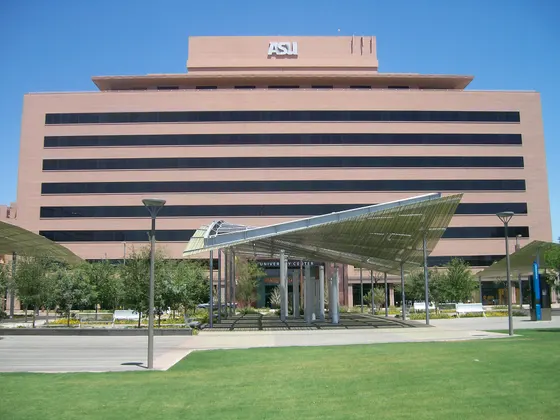

Photo: Cygnusloop99 · CC BY-SA 3.0 · cropped
Photo: Cygnusloop99 · CC BY-SA 3.0 · Photo: Domenico Convertini from Zurich, Schweiz · CC BY-SA 2.0 · Photo: Simeon87 · CC BY-SA 3.0
The ASU Shufeldt School of Medicine MD program at a glance (2027 entry)
This is the four-year MD program of the John Shufeldt School of Medicine and Medical Engineering at Arizona State University (ASU), on ASU's Downtown Phoenix campus. Every student also earns a Master of Science (MS) in Medical Engineering. The two degrees are not taken one after the other: their curricula are integrated across all four years, so engineering, artificial intelligence (AI) and design run alongside your medical training.
The school is new. On October 22, 2025, ASU named it after John Shufeldt, an emergency medicine physician and ASU alumnus, and announced his nine-figure gift to run it. That month it also received preliminary accreditation from the Liaison Committee on Medical Education (LCME), which accredits MD programs in the United States. Its first class, the Class of 2030, has 36 students and began classes on August 3, 2026. If you enter in 2027 you join the second class, and no class has yet reached the clerkship or post-clerkship phases.
The program runs in three phases worth 160 credit hours in all. They are a 16-month pre-clerkship phase, a 12-month clerkship phase of core clinical rotations, and a final 18-month post-clerkship phase of advanced rotations, electives and a medical engineering capstone. The school describes early and continuous patient contact through HonorHealth, its primary clinical affiliate.
Day to day, you study in the Mercado building until a new headquarters for ASU Health, the university's umbrella for its health schools, is due to open in 2028. Clinical training is planned mainly in HonorHealth hospitals and clinics across Phoenix, Scottsdale and nearby communities, with pediatric rotations through Phoenix Children's. To graduate, you must pass Step 1 and Step 2 CK of the United States Medical Licensing Examination (USMLE), the national licensing exams. You must also pass the school's Clinical Competency Assessment, a final clinical skills exam.
| Degree | MD, earned together with an MS in Medical Engineering |
|---|---|
| Program length | 4 years, 160 credit hours: 16-month pre-clerkship, 12-month clerkship, 18-month post-clerkship |
| Class size | 36 in the first class, which started in August 2026 |
| Main campus | The Mercado, ASU Downtown Phoenix campus; new building planned for 2028 |
| Teaching style | Integrated MD and MS curricula; small-group active learning |
| First patient contact | Year 1: outpatient and health-system experiences through HonorHealth |
| Clinical sites | HonorHealth, the primary affiliate; Phoenix Children's for pediatrics |
| Step 1 timing | After the 12-month clerkship phase, before post-clerkship rotations |
| Grading | Pass/fail pre-clerkship MD courses; Honors/Pass/Fail for clerkships, sub-internships and electives |
| Accreditation | LCME preliminary since October 2025; next survey visit early 2028 |
What makes the ASU Shufeldt School of Medicine MD program different
Two degrees in four years: MD and MS
Every student earns an MS in Medical Engineering from ASU's Ira A. Fulton Schools of Engineering alongside the MD, and the program still takes four years. The two are designed together: in Applications in Medical Engineering I and II, for example, you reverse-engineer physiological systems while your medical courses cover those same systems.
Engineering clerkships inside the clinical year
Alongside the core rotations, the clerkship year is planned to include four one-week engineering clinical clerkships. The school says engineering faculty will work within the clinical phases and that you will handle the diagnostic devices and imaging systems used in patient care. The point is to notice where care could be delivered better, as well as to build clinical skill.
A capstone that builds a prototype
The school plans a two-semester capstone in year 4. Industry-sponsored teams of medical and engineering students pick a clinical need and develop a technology-based solution, from design and prototyping to regulatory review and market analysis. Clinical advisors, engineering faculty and industry mentors guide each team, and the projects are tied to the development of the MedTech Innovation Suite.
A simulated hospital being built around an AI hub
The school describes a MedTech Innovation Suite, still being developed with the Fulton Schools of Engineering, as a simulated connected hospital. In the design, areas such as an operating room, imaging systems and diagnostic labs link through an AI control hub. With no patients present, the school says students will practice using intelligent systems for diagnosis and care management and help refine new tools from industry partners.
Innovation weeks built into the clinical phases
The clerkship year is planned to include innovation weeks, and the school describes them in the post-clerkship phase too. Beyond revisiting the science and taking clinical and engineering topics further, they leave room for service-learning, student-designed projects, coaching, wellness, remediation and health appointments.
How ASU Shufeldt School of Medicine teaches medicine
Five longitudinal threads, strands that run through the whole program, organize teaching for both degrees. Foundations of medicine takes a systems-based approach to the biomedical sciences and patient care. Clinical skills and anatomy brings hands-on practice. Medical engineering runs from biomedical signals to AI applications. Health humanities explores ethics, equity and the human experience of health, and health systems science prepares you to improve the quality, efficiency and equity of care.
The school describes pre-clerkship teaching as small-group active learning, in interactive classrooms built for team-based and case-based learning. Patient stories, explored in humanities discussions and in reflection, tie the science to real patients' lives and circumstances. Among its teaching tools the school lists mixed reality labs, digital patient avatars and point-of-care ultrasound (POCUS), meaning ultrasound scanning done by the clinician at the bedside.
In select courses, students on ASU's stand-alone MS in Medical Engineering learn alongside the medical students, as clinical and engineering teams do in practice. In the clerkship and post-clerkship phases, teaching is planned to move into HonorHealth hospitals and clinics. About 200 HonorHealth clinicians have joined the school's faculty to help develop the curriculum and teach.
The ways you will learn
| Small-group sessions | The core pre-clerkship format. If the same instructor teaches you three or more times in a course, in a small-group or clinical setting of 12 or fewer students, they write a narrative assessment midway and at the end. This is a written description of your performance. |
|---|---|
| Standardized patients | People trained to portray patients, so you can practice clinical skills in a controlled setting. They are part of the clinical skills and anatomy thread, and the final Clinical Competency Assessment uses them. |
| Simulation and extended reality | Simulation labs with AI-integrated manikins (lifelike patient models) and extended reality (XR) tools, which blend digital images with the real world or replace it with a virtual one. |
| Engineering courses | The MS courses mix recitation classes, lectures, a practicum and team projects. You study how the body generates signals and how they are analyzed, the basics of machine learning and its limits, and the engineering design process. |
A typical week on the ASU Shufeldt School of Medicine program
A school policy limits the pre-clerkship workload. Scheduled sessions across all courses can total no more than 28 hours a week, and out-of-class assignments are capped at 28 hours a week. Course directors must submit the predicted time each assignment takes. Two to three half-days a week are left unscheduled, which the school notes are useful for routine medical or wellness visits.
You are expected at every session and exam. You can, though, request seven flex half-days a year, the school's term for approved personal time, with no more than two in a calendar month and at least 30 days' notice. They cannot be used on exam days, in standardized patient, skills lab or simulation sessions, or during one-week courses such as Becoming a Physician-Engineer. In the clinical phases the allowance is two flex days a year.
How anatomy is taught at ASU Shufeldt School of Medicine
Anatomy belongs to the clinical skills and anatomy thread, which the school describes as hands-on learning with extended reality (XR) technology, medical imaging, standardized patients and early outpatient experience. It is also one of the biomedical sciences in the pre-clerkship organ-systems curriculum.
Your own computer must be able to run three digital anatomy platforms: VH Dissector Pro, Alensia HoloAnatomy and Complete Anatomy. The Mercado building has anatomy and procedural training suites, and the 2028 headquarters is planned to include an anatomy laboratory.
When you first meet patients at ASU Shufeldt School of Medicine
Patient contact is planned from the first year. The school describes regular outpatient and health-system experiences through HonorHealth from year 1, exposing you both to patient care and to engineering applied in practice. Alongside them, you practice clinical skills with standardized patients in the clinical skills and anatomy thread.
Community work starts early too. The first class's weeklong orientation in July 2026 included a panel on the state of health in Arizona and a talk from the Justa Center on older adults experiencing homelessness. Service-learning continues in the innovation weeks.
Full-time clinical work begins with the clerkship phase, after 16 months. Every attending physician (the senior doctor responsible for a patient) who supervises you must hold a faculty appointment at the school. Residents and fellows, doctors still in specialty training, must complete training on the school's objectives and policies. When you write in a patient's record, such as a progress note, your supervisor reviews and countersigns it and gives you feedback.
Year by year at ASU Shufeldt School of Medicine
- Pre-clerkship (first 16 months)
Foundations of medicine and engineering
The first 16 months, worth 69 credit hours, cover the biomedical sciences by organ system with clinical skills, medical engineering, health humanities and health systems science. MS instruction in systems thinking, engineering design and AI reinforces the medical courses. On the Class of 2030 calendar, the phase runs from orientation on July 27, 2026 to December 17, 2027.
- Introduction to becoming a physician, the opening course, brings together medical ethics, health humanities and physician identity. It ends at the White Coat Ceremony with an oath that each class writes for itself; the Class of 2030 recited its Oath of the Physician-Engineer on August 7, 2026.
- Study of the organ systems and the biomedical sciences, including anatomy, physiology, pharmacology, microbiology and pathology.
- MS courses Applied Signals and Systems for the Clinic (BME 501) and Fundamentals of AI for Medical Applications (BME 502), 2 credits each, which are prerequisites for the next two.
- Applications in Medical Engineering I and II (BME 503 and 504), 4 credits each, which run alongside the coursework on the body's physiological systems and analyze current clinical tools and treatments.
- Breaks on the Class of 2030 calendar include a winter break and a break from May 31 to June 27, 2027, followed by an intersession that runs to July 30, 2027.
- Clerkship (12 months)
Core clerkships with engineering built in
The school plans a 12-month clerkship phase, worth 48 credit hours, mostly in HonorHealth hospitals and clinics. ASU's degree listing describes six core clerkships paired with longitudinal family medicine experiences and four one-week engineering clinical clerkships, while the same listing names eight core clerkships. The phase culminates in USMLE Step 1.
- The eight core clerkships ASU names: internal medicine, surgery, obstetrics and gynecology, pediatrics, neurology, psychiatry, family medicine and the Engineering Clerkship.
- Family medicine is described as a longitudinal experience, one that continues alongside the other clerkships over the year.
- Four one-week engineering clinical clerkships. HonorHealth's chief academic officer has said clinical faculty will guide projects that examine the health care system, giving remote patient monitoring as one example.
- Innovation weeks, set aside within the year to go back over the underlying science, take clinical and engineering topics further, and make time for coaching, wellness and any remediation.
- Flex Time, a period after your clerkships in which you prepare for and sit Step 1. If you are remediating a failed clerkship during Flex Time, you must finish that before taking Step 1.
- Post-clerkship (final 18 months)
Advanced rotations, capstone and residency preparation
The final 18 months, worth 43 credit hours, are designed for personalizing your training while you complete a longitudinal medical engineering capstone. Alongside required rotations, you shape it with electives, selectives (generally choices from a set list within a required area) and advanced clerkships, which build on the core clerkships at a more senior level. Preparation for residency, the specialty training that follows medical school, runs through the phase and ends with a three-week Transition to Residency course before convocation, the graduation ceremony.
- Required four-week rotations in emergency medicine and in critical care.
- Two sub-internships, also called acting internships, in which you take on much of the day-to-day work of a first-year resident under supervision.
- Capstone Research I: Design (BME 528) and Capstone Research II: Implementation (BME 529), 4 credits each. The first covers needs assessment, concept generation, regulatory pathways and standardization; the second covers prototyping, quality control, intellectual property protection and presentation.
- The Clinical Competency Assessment, the school's final clinical skills exam, held in this phase so there is time to remediate before graduation.
- USMLE Step 2 CK, which must be taken by August 31 of your final year.
How you are assessed at ASU Shufeldt School of Medicine
Throughout both degrees you are assessed against seven competency areas, from patient care and professionalism to technology application and innovation, which covers applying AI, data science and engineering design to clinical problems. Under the school's grading policy, every pre-clerkship MD course is pass/fail. Clerkships and the post-clerkship sub-internships, selectives and electives are graded Honors, Pass or Fail, with Honors for exceptional performance against criteria in each syllabus. A Fail is recorded only after all retakes and remediation are used up, and passing through either caps your grade at Pass.
Clinical progress is tracked through 15 entrustable professional activities (EPAs), essential tasks you must learn to perform with less and less supervision. Faculty rate each on a five-point scale, from 0 (observe only) to 4 (minimal guidance required), mainly by watching you in clinical, simulated and engineering settings. Ratings start in year 1 and are formative, meaning feedback rather than grades. A Clinical Competency Committee reviews them to judge when you are ready for each next phase.
Before graduating you must pass the Clinical Competency Assessment (CCA), a comprehensive clinical skills exam using standardized patients. You can schedule it only after meeting the required EPA benchmarks, and it is held in the post-clerkship phase so that anyone who falls short has time to remediate. If you are referred for remediation and do not pass it, your case goes to the Student Promotions Committee, the faculty group that rules on progress.
The USMLE is the three-step exam series used for medical licensure in the United States. Step 1 tests the sciences basic to medicine and has been reported pass/fail since January 26, 2022. Step 2 CK tests clinical knowledge and keeps a three-digit score. School policy requires you to complete the clerkship phase before attempting either, take Step 1 before the post-clerkship phase starts, and take Step 2 CK by August 31 of your final year.
In August 2026 the USMLE program announced a move to designated testing dates from January 2029, with Step exams offered less often each year. Its June 2026 announcement had set the change for 2028. On the current schedule, a student entering in 2027 would finish clerkships around the end of 2029. Step 1 would then fall around the turn of 2029 to 2030, under the new model, and Step 2 CK would be due by August 31, 2030.
These dates are worked out from the published phase lengths. The USMLE says it will publish each year's testing dates more than a year in advance.
- Pre-clerkship retakes: you get up to three attempts at any summative exam or assignment, meaning one that counts toward passing the course. A passed exam retake counts as 70%, retake attempts stay off your transcript, and a course failed after three attempts must be retaken, likely by repeating the year.
- Required clerkships of four weeks or more include a formal mid-clerkship assessment, and every clerkship, elective and selective ends with a written narrative assessment.
- If your Step 1 readiness is not safely in the passing range by the end of Flex Time, you can request up to 12 extra weeks of study. You drop your first post-clerkship rotation and take an independent study elective worth up to eight credits.
- If you fail Step 1, you finish your current post-clerkship rotation, then pause coursework until you resit. A second failure means an academic leave of absence, of up to a year, until you pass.
- You need a passing Step 2 CK score before the school certifies you for the Match, the national process run by the National Resident Matching Program (NRMP) that places graduates in residency programs. Otherwise the school may have to withdraw your name.
- The Student Promotions Committee may consider dismissal if you fail more than three pre-clerkship courses, fail a course twice, or do not pass Step 1 or Step 2 CK in time. You must be eligible to graduate within six academic years, excluding approved leave.
- Generative AI tools may support studying, brainstorming, summarizing and drafting unless a course director says otherwise, but must not replace your own knowledge, reasoning or skill. They are banned in exams unless explicitly allowed, any use must be cited, and patient data must not be entered unless authorized.
Where you will actually train at ASU Shufeldt School of Medicine
HonorHealth, a locally owned nonprofit health system, is the school's primary clinical affiliate. It is planned to host most of your clinical training, with rotations in hospitals throughout Phoenix, Scottsdale and surrounding communities. Under the 2024 affiliation agreement, HonorHealth agreed to make its inpatient hospitals and outpatient facilities available, and every HonorHealth hospital where students rotate will be designated one of the school's official teaching hospitals.
Accounts of HonorHealth's size differ. The school's clinical affiliates page describes nine acute-care hospitals, 17,000 team members, 4,000 medical staff and more than 3 million patients a year, plus a medical group, a cancer care network and clinical research. HonorHealth's own page for visiting medical students calls it a five-hospital system. Its chief executive has also listed a behavioral health hospital, a rehabilitation hospital and primary and urgent care clinics among the settings open to students.
The school says you will have access to HonorHealth's 19 graduate medical education programs, the residencies and fellowships that train doctors after medical school. For pediatric training, the school describes a growing relationship with Phoenix Children's, with rotations in general pediatrics and in subspecialties such as pediatric oncology, cardiology and surgery. ASU's president has said the university will not run its own hospital, so clinical training is planned in partner health systems.
New sites are being added. St. Vincent de Paul opened its East Valley Medical Clinic in Mesa in October 2026, giving primary care to uninsured and underserved adults and children, with ASU Health among its community partners. ASU will provide faculty and clinicians, and the clinic will become a training site for student teams from across ASU Health, including the Shufeldt School. In May 2026, ASU News also reported that HonorHealth had received a rural health care grant and was developing a curriculum for it with ASU.
For getting around, the school says that although greater Phoenix has public transportation, a car may be more convenient for reaching classes and clinical sites. ASU has a graduate housing complex in downtown Phoenix, and many private apartment complexes are nearby.
HonorHealth is planned to host most clinical training, and the school describes a growing relationship with Phoenix Children's for pediatric training.
- HonorHealth hospitals
- HonorHealth outpatient, primary care and urgent care sites
- Phoenix Children's
Primary care clinic on Apache Road, just east of Loop 101, opened in October 2026 and planned as a training site for ASU Health student teams.
- St. Vincent de Paul East Valley Medical Clinic
Electives, selectives and away rotations at ASU Shufeldt School of Medicine
Alongside its required rotations, the post-clerkship phase lets you personalize your training with electives, selectives and advanced clerkships. Electives are rotations you choose, and school policies refer to both clinical and research electives.
Elective planning starts in year 3, when you choose a specialty advisor. With advance permission you can take up to five days away from a four-week elective, though a course director may set a lower limit, which must be listed in the elective course catalog.
Dual degrees and research years at ASU Shufeldt School of Medicine
The dual degree is built in, so there is nothing extra to apply for. You are admitted to the MS in Medical Engineering automatically with your acceptance to the school and complete it within the four years. The MS is a 30-credit-hour degree run by the School of Biological and Health Systems Engineering in ASU's Ira A. Fulton Schools of Engineering.
For medical students, ASU's degree listing sets out the 30 credits as follows. The 15-credit core is BME 501, 502, 503 and 504, Research in a Medically Integrated Experience (ReMIX, BME 515, 2 credits) and Medical Engineering Design Principles (BME 519, 1 credit). That last course prepares you for the capstone, covering regulatory considerations and market needs, and places you on a project team.
You also take Medical Engineering Design Methodology (BME 518, 2 credits), the option course for medical students. It covers the scientific method and engineering design and prepares you to apply AI through the design process in your clerkships. The rest is Capstone Research I (BME 528, 4 credits), a seminar (BME 591, 5 credits) and, as the culminating experience, Capstone Research II (BME 529, 4 credits).
ReMIX is described two ways. The school's MD/MS page calls it a four-week industry immersion in which you work with digital health companies on product design, validation and real-world testing. ASU's course catalog lists it as a 2-credit practicum, a short immersion in industry or research settings that prepares you for the capstone, graded pass/fail. The catalog lists standard grading for BME 501-504, 518, 519, 528 and 529, including the courses that run alongside the pre-clerkship phase.
Beyond the MS, students in good standing who have not previously been delayed can request a one-year special academic study leave after the clerkship phase, which the associate dean of student affairs may grant. It can be used for a dual or joint degree program, an advanced degree outside an official program, or a special program such as entrepreneurship. Winning a competitive research fellowship lets you keep full-time student status for a year, and extensions can be requested.
All student research must be registered with and reviewed by the school's Research Oversight Committee, from laboratory and data science work to quality improvement, case reports and industry projects. Approvals must be in place before work begins. The school's research areas include AI and medical engineering, mind and brain health, and tissue engineering and digital twins. The HonorHealth Research Institute, HonorHealth's research division, offers collaboration in fields such as oncology, cardiology and neurosciences.
Facilities and support at ASU Shufeldt School of Medicine
Where you will learn
Until its new headquarters opens, the school is based in the Mercado on ASU's Downtown Phoenix campus. The building has interactive classrooms, simulation labs, anatomy and procedural training suites and wellness spaces. The school also has its own medical library, open to Shufeldt students, faculty and staff, where a medical librarian helps with course projects, research, evidence synthesis and AI literacy.
The school is due to move into the new ASU Health headquarters in the Phoenix Bioscience Core, a 30-acre life sciences district in downtown Phoenix. ASU broke ground on April 9, 2026, and says the building is scheduled to open for the fall 2028 semester. On the current schedule, that is the last semester of a 2027 entrant's pre-clerkship phase, before clerkships begin. Plans include classrooms, study spaces, clinical skills and anatomy laboratories, exam and debrief rooms, and a simulation center recreating outpatient and inpatient operating rooms and emergency rooms.
The school describes a MedTech Innovation Suite, being developed with the Fulton Schools of Engineering, with five interconnected environments and a maker space. At its core is the Clinical AI Systems Engine (CASE), designed to link devices, imaging systems and data so teams can test technology under real clinical conditions, such as time pressure and care coordination. ASU News lists a medical-technology innovation suite among the features of the new headquarters.
Support while you study
Support is built around coaching. From matriculation to graduation you are paired with a professional development coach who keeps you accountable over the long term. With your coach you look back at what is and is not working, set goals, work through obstacles and find the right help. Coaches are MD and DO faculty members who can see your performance but will not assess you at any point. The coaches the school lists are HonorHealth physicians.
If you need academic help, your coach, a career advising dean or a course or clerkship director can refer you to the learning specialist, or you can refer yourself. The learning specialist trains you in study skills, efficiency and test-taking, coordinates study plans for coursework and the USMLE, and works with ASU Student Accessibility and Inclusive Learning Services on accommodations.
Career advising follows a four-year plan built on the Association of American Medical Colleges (AAMC) Careers in Medicine program, which you can use from orientation. Year 1 brings group sessions with career advising deans and help launching student specialty interest groups. In year 3 you choose a specialty advisor, a clinician from an affiliate site, and year 4 brings personal statement and CV workshops, mock residency interviews and support through the Match.
ASU Counseling Services runs a downtown Phoenix clinic about a quarter of a mile from the school, with five mental health providers, plus round-the-clock tele-counseling and a crisis line. None of its providers teach at the school, and medical students do not rotate at student health clinics, keeping your care separate from your training. Innovation weeks include well-being workshops on sleep, nutrition and resilience.
Is the ASU Shufeldt School of Medicine program right for you?
This program may suit you if
- You want engineering, AI and design to be a required part of your training, and to graduate with an MS as well as the MD.
- You would enjoy taking a digital health idea from a clinical need to a prototype, in a two-semester team capstone with industry mentors.
- You are comfortable with math and physics, or ready to work hard at them, since the school says the curriculum includes complex math and physics.
- You like the idea of a small class, 36 in the inaugural class, and of helping to shape a school that is still being built.
- You value protected time, such as a capped pre-clerkship week with unscheduled half-days and innovation weeks in the clinical phases.
Things to think about
- The school is new: no class has yet reached the clerkship or post-clerkship phases, so what is described for them is still a plan.
- Accreditation is preliminary. An LCME survey visit is scheduled for early 2028, ASU says full accreditation would follow after the first class graduates, and the school notes that moving between stages is not automatic.
- The MS in Medical Engineering is part of the program for everyone, so this is not the place for an MD without engineering coursework.
- Most clinical training is planned with one health system, HonorHealth, so your clinical experience will largely reflect its hospitals and clinics across the Phoenix area.
- Anatomy is described through XR, imaging and digital platforms. If learning from donor bodies matters to you, ask the school how its anatomy suites are used.
ASU Shufeldt School of Medicine MD program — frequently asked questions
Applying to ASU Shufeldt School of Medicine?
How to get into ASU Shufeldt School of Medicine
Prerequisites, MCAT, AMCAS personal statement, secondaries and interview, step by step.
Open the guide →ASU Shufeldt School of Medicine admissions profile
MCAT and GPA profile, acceptance rate, interview format and key dates.
See the profile →Compare ASU Shufeldt School of Medicine with other schools
Put the teaching style, anatomy teaching and clinical sites next to another school.
Open the comparison →Prepare for the ASU Shufeldt School of Medicine interview
Format breakdown, school-specific sample questions and prep tips from tutors who interviewed here.
Read the guide →Where this ASU Shufeldt School of Medicine program guide came from
This guide was written from 80 official sources — Arizona State University John Shufeldt School of Medicine and Medical Engineering's own program pages and curriculum documents, plus the accreditor and the hospitals and health systems the school trains students in where they publish detail — read on 2026-10-14, then checked claim by claim against those sources.
- Shufeldt School: Curriculum
- Shufeldt School: Medical education program objectives (competencies)
- Shufeldt School: MD with MS in medical engineering
- Shufeldt School: Degree program (older accreditation wording)
- ASU Degree Search: Medicine, MD
- ASU Degree Search: Medical Engineering, MS
- ASU Academic Catalog Archive Addendum 2025-26: Medicine, MD
- ASU Academic Catalog: Shufeldt School policies
- Shufeldt School: Academic calendar, Class of 2030
- Policy on USMLE Examinations and Clinical Competency Assessment (C|9.9.06)
- Grading Policy (C|9.4.1)
- Policy on Pre-clerkship Phase Schedule (C|8.8.2)
- Pre-clerkship Phase Retake and Remediation Policy (C|9.7.2)
- Policy on Requirements for Granting of the MD Degree (C|9.9.05)
- Policy on Standards for Performance and Satisfactory Academic Progress (C|9.9.03)
- Policy on Student Promotions and Progress (C|9.9.02)
- Policy on Time Limitations for Completing Portions of the MD Degree Program (C|9.9.07)
- Entrustable Professional Activities Policy (C|9.4.2)
- Policy on Medical Student Narrative Assessment in Courses and Clerkships (C|9.5.1)
- Policy on Mid-rotation Feedback (C|9.7.1)
- Policy on Absence Notification (C|12.4.3)
- Policy on Leave of Absence (C|9.9.08)
- Policy on Medical Student Use of Generative AI Tools (C|3.5.4)
- Policy on Faculty Appointments for Clinical Preceptors (PS|9.2.1)
- Policy on Resident and Fellow Preparation for Teaching (P|9.1.1)
- Policy on Countersignature of Medical Student Entries in Medical Records (C|9.3.2)
- ASU course catalog: BME 501 Applied Signals and Systems for the Clinic
- ASU course catalog: BME 502 Fundamentals of AI for Medical Applications
- ASU course catalog: BME 503 Applications in Medical Engineering I
- ASU course catalog: BME 504 Applications in Medical Engineering II
- ASU course catalog: BME 515 ReMIX
- ASU course catalog: BME 518 Medical Engineering Design Methodology
- ASU course catalog: BME 519 Medical Engineering Design Principles
- ASU course catalog: BME 528 Capstone Research I: Design
- ASU course catalog: BME 529 Capstone Research II: Implementation
- Shufeldt School: MedTech Innovation Suite
- Shufeldt School: Capstone research
- Shufeldt School: Student research projects
- Shufeldt School: Research
- Shufeldt School: Facilities
- Shufeldt School: Clinical affiliates
- Shufeldt School: Accreditation
- Shufeldt School: Meet the Class of 2030
- Shufeldt School: White Coat Ceremony and the Class of 2030 oath
- Shufeldt School: Admissions FAQs
- Shufeldt School: Admissions requirements (recommended preparation)
- Shufeldt School: Phoenix
- Shufeldt School: Learning resources
- Shufeldt School: Meet the coaches
- Shufeldt School: Careers and residency advising
- Shufeldt School: Well-being
- Shufeldt School: Student health services
- Shufeldt School: Student professionalism
- Shufeldt School: Student technology requirements
- Shufeldt School: Student organizations
- ASU Library: Shufeldt School of Medicine and Medical Engineering Library
- ASU News: HonorHealth named primary clinical affiliate (October 2024)
- ASU News: ASU Health alliance with HonorHealth (May 2026)
- ASU News: ASU medical school gains accreditation and a new name (October 2025)
- ASU press release: preliminary accreditation, gift and new name (October 2025)
- ASU News: Inaugural class receives white coats (August 2026)
- ASU News: ASU med school to serve community through partnerships (March 2026)
- ASU News: ASU breaks ground on the ASU Health headquarters, due to open for fall 2028 (April 2026)
- ASU News: ASU partners with St. Vincent de Paul on new East Valley clinic (October 2026)
- Fulton Schools News: ASU launches MS in medical engineering (March 2026)
- HonorHealth: HonorHealth and ASU collaborate
- HonorHealth: HonorHealth and ASU welcome first physician-engineer class
- HonorHealth: Undergraduate medical education (visiting students)
- LCME: Accredited programs directory
- LCME: Accreditation process overview
- LCME: For students
- LCME: Frequently asked questions
- USMLE: Updated timeline for designated testing dates, January 2029 (August 6, 2026)
- USMLE: Designated Testing Dates information hub
- USMLE: Transition to limited testing dates starting in 2028 (June 23, 2026, since updated)
- USMLE: Designated Testing Dates FAQs
- USMLE: Step exams
- USMLE: Step 1
- USMLE: Step 2 CK
- USMLE: Examination results and scoring
Curricula are restructured between cycles. Anything here that decides your application — how anatomy is taught, a clinical campus assignment, a required research year — should be confirmed against the official page for your entry year.
Applying to ASU Shufeldt School of Medicine?
We help US applicants with MCAT strategy, the AMCAS personal statement, secondary essays and interview prep — everything you need for a competitive ASU Shufeldt School of Medicine application.