
The Georgetown University School of Medicine MD program
What you actually study, and where you will be
Georgetown University School of Medicine's MD is a 4-year program with an integrated curriculum, with patient contact from Year 1 and clinical rotations in Washington, DC, Maryland and Virginia, including Baltimore (2027 entry). Georgetown's MD follows the Journeys Curriculum, in place since 2017: an 18-month Foundational Phase of organ-system modules, with a clinical skills course called Cura Personalis and a clinical skills exam every block. Core clerkships, the main clinical rotations, start in late March of year 2, after the Step 1 licensing exam, at MedStar Health and other hospitals. The final year brings intern-level acting internships, emergency medicine and 24 weeks of electives.
- Degree
- MD
- Length
- 4 years
- Teaching
- Integrated
- Clinical contact
- Year 1

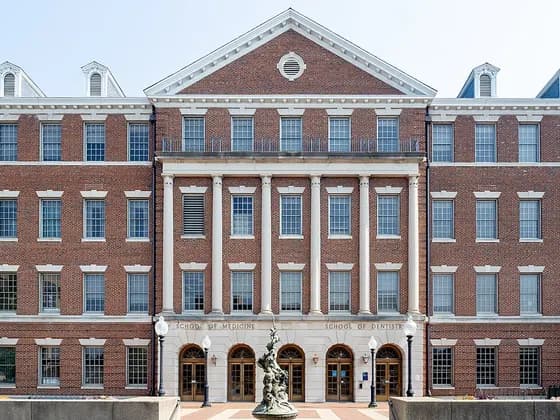


Photo: Ajay Suresh · CC BY 2.0 · cropped
Photo: Ajay Suresh · CC BY 2.0 · Photo: G. Edward Johnson · CC BY 4.0 · Photo: Ingfbruno · CC BY-SA 3.0
The Georgetown University School of Medicine MD program at a glance (2027 entry)
Georgetown University School of Medicine (GUSOM), Georgetown's medical school in Washington, DC, runs a four-year MD from its campus at 3900 Reservoir Road NW. Since August 2017 it has taught the Journeys Curriculum in three phases. An 18-month Foundational Phase (the pre-clerkship, or pre-clinical, phase) comes first, then a 48-week Core Clinical Phase of clerkships (the core clinical rotations) and a final Advanced Clinical Phase.
The school says its medical experience is centered in cura personalis, a Jesuit tradition it translates as care of the whole person. That means caring for a patient's psychological, spiritual and social well-being as well as their physical health. The same name belongs to the clinical skills course that runs through the Foundational Phase, where science is taught in organ-system modules.
Patients come early. From Block I you practice with standardized patients, people trained to act as patients. Every block ends with an OSCE (Objective Structured Clinical Examination), timed clinical encounters scored by examiners. Ambulatory Care then takes you into the clinic during year 1.
Clerkships begin in late March of year 2, once you have sat Step 1, the first part of the United States Medical Licensing Examination (USMLE). They run at MedStar Health hospitals and other affiliates in DC, Maryland and Virginia, in an order set by lottery. The final year brings two acting internships, also called sub-internships, where you carry a first-year resident's patient load, plus emergency medicine and electives.
| Degree | MD |
|---|---|
| Program length | 4 years, from orientation bootcamps in early August to graduation in May |
| Curriculum | Journeys Curriculum, since 2017: Foundational, Core Clinical and Advanced Clinical phases |
| Class size | 203 entering (admissions page profile); about 800 MD students (2026-27 fact sheet) |
| Teaching style | Integrated organ-system modules; lectures, flipped sessions, team-based learning and labs |
| Anatomy | Traditional cadaveric dissection by students, per the 2026-27 fact sheet |
| First patient contact | Year 1: standardized patients in Block I, then Ambulatory Care in the clinic |
| Clinical sites | Nine listed affiliates, including MedStar Georgetown and MedStar Washington Hospital Center |
| Step 1 timing | Year 2, after dedicated study in January and February, before clerkships |
| Grading | Satisfactory/Unsatisfactory through the core clerkships; Honors to Fail in the final year |
What makes the Georgetown University School of Medicine MD program different
Two longitudinal integrated clerkships, one in Baltimore
Instead of block rotations, up to 12 students a year spend 22 weeks at MedStar Franklin Square in Baltimore, with furnished housing nearby. There, family medicine, internal medicine, obstetrics and gynecology and pediatrics run side by side. Up to 10 take a DC Health Equity version, and both follow a panel of patients for months.
A clinical skills exam at the end of every block
Cura Personalis starts in Block I with the medical history and head-to-toe exam, then adds focused exams, point-of-care ultrasound and clinical reasoning. All six Foundational Phase blocks end with an OSCE, and the encounters grow more demanding as you advance.
Twelve optional tracks that end in a graduation distinction
In year 1 you can apply to join one of 12 longitudinal academic tracks, from clinical research and medical education to Clinical Medical Spanish and health justice. Each runs alongside the curriculum with its own requirements, usually including a capstone project, and completing one earns a distinction at graduation.
Community service is a graduation requirement
You must complete at least 20 hours of service with vulnerable or underserved communities at approved sites, and 75 or more hours earns a distinction. Students also manage the HOYA Clinic, a free clinic for vulnerable DC residents where only Georgetown medical students can volunteer clinically.
International electives in more than 20 countries
The Office of International Programs runs electives in over 20 countries on four continents, from Lima and Bogotá to Lesotho, London and Milan. In the summer after year 1, students can spend a month with Mission ILAC (Institute for Latin American Concern) in the Dominican Republic, examining patients in temporary rural clinics.
How Georgetown University School of Medicine teaches medicine
The Foundational Phase runs in six blocks of organ-system modules, from Cardiovascular, Renal and Respiratory in Block III to the Central Nervous System in Block VI. Each module brings together one system's anatomy, physiology, pathology, microbiology and drug treatment, with how to examine it and which tests to order.
Longitudinal courses run across the blocks: Cura Personalis (Clinical Skills), Ambulatory Care, Community-Based Learning, Health Care Ethics, Medical Student Grand Rounds and Patients, Populations and Policy. Between blocks come Bridges, short virtual courses that the curriculum pages also call intersessions. In the clinical years teaching moves to the wards, with case-based lectures, small groups and workshops. Five bootcamps, from orientation to pre-residency preparation, mark the transitions.
The ways you will learn
| Lectures and flipped sessions | Lectures are audio and video recorded. In Cardiovascular, normal physiology comes as shortened pre-recorded lectures. Flipped sessions follow, where you work through questions and problems with the instructors, then clinical sessions on topics such as shock and hypertension. |
|---|---|
| Team-based learning and small groups | Team-based learning (TBL), where small teams apply what they have prepared to problems, is mandatory, as are clinical case sessions and small groups. Hematologic Disorders, for example, adds pathology labs, clinicopathologic correlation sessions and a genetic patient panel, and Patients, Populations and Policy runs a TBL exercise on renal health disparities. |
| Cura Personalis and CURA sessions | The clinical skills course mixes large-group sessions, small groups and independent learning with practice alongside standardized patients and physical exam teaching assistants. Clinical Unified Reasoning Activity (CURA) sessions have you practice exams, communication and reasoning for the current system. |
| Community-Based Learning | In year 1, teams of 4 to 10 students guided by faculty leaders work in community, school, faith, clinic or health policy settings. Examples include shelters for survivors of domestic violence and after-school programs for children aged 5 to 12. |
| Medical Student Grand Rounds | Running through the first three years inside the Bridges weeks, this course has groups of students at different stages solve a clinical case. They then discuss it with an expert panel in a large group, often with the patient present. |
How anatomy is taught at Georgetown University School of Medicine
Georgetown's 2026-27 fact sheet says students perform traditional cadaveric dissection in the anatomy laboratories, guided by the Online Dissector. Gross anatomy runs through the year 1 modules and continues with histology and embryology in Block V of year 2. The labs are mandatory, and the absence rules allow one missed lab day per academic year.
Anatomy is taught inside each system. Scientific Foundations I introduces it, Cardiovascular includes gross anatomy and the gross pathology of the heart, and Reproduction includes gross anatomy labs. Head, Neck and Special Senses covers the gross and microscopic anatomy of the head, neck, eyes and ears. To finish the Foundational Phase you must pass the year 2 portion of anatomy as well as the course overall.
Almost all bodies studied at the medical center are donated through the Anatomical Donor Program, and students honor the donors at a Mass in Dahlgren Chapel. At the November 7, 2025 service, students shared Jewish and Hindu prayers and verses from the Quran and gave each family a white rose. In year 4, a Clinical Gross Anatomy elective, aimed at students entering residencies that need in-depth anatomy, lets you dissect a region you choose.
When you first meet patients at Georgetown University School of Medicine
Your first patient contact is with standardized patients. In Foundations of Patient Care, the Block I part of Cura Personalis, you learn basic communication, how a medical history is structured and a head-to-toe exam. The OSCE at the end of the block is the gateway to Ambulatory Care, where you keep building history and exam skills in the clinic.
From Block II the course moves on to focused histories and exams, point-of-care ultrasound and the differential diagnosis, the ranked list of possible causes of a patient's problem. In year 2, Block VI pairs Cura Personalis with hospital visits, which the handbook lists as mandatory.
The student-managed HOYA Clinic opened on September 17, 2019 at The Triumph, a Community of Hope temporary housing facility in Congress Heights, Southeast DC. Georgetown faculty physicians oversee care. It runs every Tuesday evening there and, since 2021, every Monday for Spanish-speaking patients at the Catholic Charities clinic on Monroe Street in Columbia Heights.
The Georgetown University School of Medicine curriculum, year by year
- Year 1
Foundational Phase, Blocks I to IV
Year 1 starts in early August with two orientation bootcamps and the White Coat Ceremony, then four blocks of organ-system modules. Summer break begins in mid-June.
- Block I (August to September): Scientific Foundations I, on biochemistry, physiology, anatomy, histology, embryology, medical neuroscience and evidence-based medicine, alongside Foundations of Patient Care.
- Block II (October to December): Scientific Foundations II (pharmacology, pathology, immunology, and diagnostic reasoning and testing), then Immunology, Rheumatology and Dermatology, and Infectious Diseases.
- Block III (January to March): Cardiovascular, Renal and Respiratory. Block IV (April to June): Gastrointestinal, Reproduction and Endocrine, with the Human Sexuality course inside Reproduction.
- Bridges I and II (October and January): health disparities and equity, then health policy and advocacy, for the Patients, Populations and Policy course. Bridges III, Principles of Research in Medicine, follows spring break.
- A mandatory orientation to the Independent Scholarly Project (ISP), and in May the National Board of Medical Examiners (NBME) Comprehensive Basic Science Exam.
- Year 2, August to March
Finishing the Foundational Phase, Step 1 and Journeys I
Two more blocks complete the 18-month Foundational Phase by December. About eight weeks of dedicated Step 1 study follow in January and February, then Journeys I, a four-week bootcamp that prepares you for the wards.
- Block V (August to early October): Musculoskeletal, Hematologic Disorders and Medical Genetics, and Head, Neck and Special Senses. Cura Personalis is paired with Selectives, courses you choose, which include complementary and alternative medicine.
- Bridges IV, Nutrition and Patient Health (October): diet, exercise, sleep and body weight, and motivational interviewing to help patients change habits.
- Block VI (October to December): Central Nervous System, combining medical neuroscience, pharmacology, pathology and psychiatric disorders, with a neuroscience lab and hospital visits.
- A second Comprehensive Basic Science Exam in November, and a required meeting before winter break with the Office of Student Learning and Academic Counseling (OSLAC) about your Step 1 plan.
- Journeys I, which the 2026-27 calendar calls Bootcamp III: Clinician Compass (March 1 to 26, 2027): workshops, pathophysiology for the wards, a clinical ethics intensive and time for tracks and the ISP.
- Late March of Year 2 to May of Year 3
Core Clinical Phase and Journeys II
The clerkship year runs in four quarters, from late March of year 2 to late March of year 3. Journeys II then closes it with Deep Dives, the Capstone OSCE and preparation for the final year.
- Required clerkships: internal medicine and surgery (10 weeks each), obstetrics and gynecology and pediatrics (6 weeks each), family medicine and psychiatry (4 weeks each) and neurology (2 weeks).
- Two-week selectives, whose number differs between school pages (see Electives).
- Bridges V, with Medical Student Grand Rounds, in June, and Bridges VI in April, on themes such as pain management and addiction and the business of medicine.
- Journeys II, which the calendar calls Bootcamp IV: Advanced Horizons (late March to mid-April): Deep Dives in subjects you choose, the Capstone OSCE, the Comprehensive Clinical Science Exam and an Advanced Clinical Phase seminar.
- A wellness week in late April, then about four weeks of protected time in May with no scheduled teaching, before the final year starts at the end of May.
- Year 4 (from late May of Year 3)
Advanced Clinical Phase
The final year runs in four-week blocks from the end of May to graduation the next May. You complete two acting internships and apply for residency, the specialty training that follows medical school.
- Required acting internship: four weeks on the internal medicine wards or in the medical intensive care unit, with first-call responsibility, in-house call and a patient load like a first-year resident's.
- Selective acting internship: four weeks in a specialty of your choice from an approved list; the 2026-27 catalog offers sub-internships in surgery, pediatrics, neurosurgery, psychiatry and obstetrics and gynecology, among others.
- Emergency medicine: four weeks at sites including MedStar Georgetown, Washington Hospital Center and Holy Cross Hospital, starting with a skills workshop at MedStar's SiTEL training center, 4000 Connecticut Avenue NW.
- Twenty-four weeks of electives, up to four of which can go to study for Step 2 CK (Clinical Knowledge). The 2026-27 calendar placed a variable interview month between late October and January. The 2027 Program Summary also lists a wellness month among the elective options.
- Residency applications through the Electronic Residency Application Service (ERAS) in September, and Match Day, when residency placements are announced, in March.
- Bootcamp V: Pathway Launch, a pre-residency course in late April, then your ISP presentation at the George M. Kober Student Research Day and graduation in May.
How you are assessed at Georgetown University School of Medicine
In the Foundational Phase, each block ends with a two-week study and exam period, with multiple-choice exams and an OSCE. Ungraded weekly quizzes and NBME practice exams give you feedback along the way, and faculty grade written reports and rate your small-group and preceptor work.
The Student Handbook dated October 14, 2026 grades the Foundational Phase, the Journeys phase, bootcamps and all Core Clinical Phase rotations Satisfactory/Unsatisfactory, the school's pass/fail scale. A Low Satisfactory flags work that only just passes and shows on the transcript as Satisfactory. Advanced Clinical Phase rotations are graded Honors, High Pass, Pass or Fail, and the 2027 Program Summary gives the same split. An undated prospectus page still describes the whole clinical curriculum as graded Honors to Fail, and refers readers to the handbook for fuller policies.
Clerkship grades rest on clinical evaluations plus each rotation's assessments. Internal medicine, surgery, pediatrics, obstetrics and gynecology and psychiatry use an NBME subject exam, known as a shelf exam, which you must pass. Family medicine sets a final exam, and neurology uses research presentations, reflections and an essay. Surgery and obstetrics and gynecology add an OSCE, and every clerkship includes a physical exam observed by faculty.
The USMLE is a three-step examination for medical licensure in the United States, and Georgetown requires passes in Step 1 and Step 2 CK to graduate. Step 1 has been reported pass/fail only since January 26, 2022. You sit it after passing the Foundational Phase and before Journeys I begins, and need a pass to continue in clerkships; a failure means a review elective and a retake.
Since August 2025, a readiness policy has scheduled NBME practice exams in weeks 1, 3, 5 and 7 of dedicated study. You may sit Step 1 within a week of one predicting at least an 85 percent chance of passing; 95 percent is recommended. If you fall short, you can ask for up to six more weeks after Journeys I and make up missed clerkships in the spring before the final year. Needing more than six extra weeks means taking the rest of the year off and graduating a year later.
Step 2 CK may be taken only after all third-year rotations and must be sat by December 31 of year 4. In August 2026 the USMLE program announced a move to designated testing dates from January 2029, with Step exams offered less often each year. A June 2026 notice had named 2028. On the current schedule, a 2027 entrant would study for Step 1 in January and February 2029, as the new model begins, and sit Step 2 CK by December 31, 2030.
- The Comprehensive Basic Science Exam, an in-person NBME exam with coverage and question format similar to Step 1, is mandatory in May of year 1 and November of year 2. The Comprehensive Clinical Science Exam follows in April of year 3.
- The Capstone OSCE closes the clerkship year: a standardized-patient assessment of history taking, examination and communication in the Integrated Learning Center, which you must pass before the final year. The Learner Assessments page also names a regional Mid-Atlantic Consortium OSCE.
- Graduation also requires passing scores on all regional and national exams, 20 hours of approved community service, the ISP with a Research Day presentation and 182 credits.
- The Liaison Committee on Medical Education (LCME) accredits MD programs in the United States. Its directory, updated October 14, 2026, lists Georgetown University School of Medicine (Washington, District of Columbia) with next survey date 2026-27, accreditation status Full and initial year of accreditation 1949.
- For MD students, enrollment in an LCME-accredited program is what makes you eligible to sit the USMLE; DO students and international graduates qualify through other routes.
- The school's accreditation pages say its February 2019 survey brought continuation of full accreditation. They list an LCME site visit on January 11 to 13, 2027 and a decision in June 2027, and name clerkship grading among the areas of focus, with a February 2026 special review.
Georgetown University School of Medicine clinical rotations: where you will actually train
Clinical teaching runs through Georgetown's partnership with MedStar Health; the school says the two signed new long-term agreements in 2017 that span a 50-year term. The Third Year Clerkships page names nine affiliates, and the 2026-27 fact sheet counts 10.
MedStar Georgetown University Hospital is a 609-bed teaching and research hospital in Northwest Washington. MedStar Washington Hospital Center, at 110 Irving Street NW, is a 912-bed teaching hospital with the MedSTAR level I trauma center and an adult burn center. MedStar Franklin Square Medical Center is a 381-bed hospital in eastern Baltimore County.
A lottery assigns clerkships. The first round sets your stream, a number linked to one sequence of clerkships for the year. Each quarter you then rank sites, such as MedStar Georgetown, Washington Hospital Center or Virginia Hospital Center, or particular rotations such as neurosurgery, plastic surgery or physical medicine and rehabilitation (PM&R). A 2021 clerkship-site policy, still linked from the policy page, adds a one-time STAR to raise your odds for one clerkship, one-to-one swaps and written appeals.
Instead of the block lottery, you can apply in year 2 for a longitudinal integrated clerkship (LIC). The Baltimore LIC combines family medicine, internal medicine, obstetrics and gynecology and pediatrics over 22 weeks at MedStar Franklin Square for up to 12 students, with furnished housing nearby. The DC Health Equity LIC combines family medicine, internal medicine, pediatrics and psychiatry over 20 weeks at Federally Qualified Health Centers and hospital affiliates, for up to 10.
LIC students join a care team for a panel of patients over about six months and follow them through different settings. In the school's example, a student saw a patient for a pre-operative visit, scrubbed in on the operation and attended the follow-up. You have a one-on-one mentor in each discipline and complete your other clerkships in the greater Washington area.
Clinical duty hours mirror the limits the Accreditation Council for Graduate Medical Education (ACGME) sets for residents. You work at most 80 hours a week, with one day in seven free on average. Continuous on-site duty is capped at 24 hours, plus up to four for handoffs and teaching.
The main clerkship hospitals in the city. The DC Health Equity LIC runs at Federally Qualified Health Centers, which are community health centers, and at hospital affiliates.
- MedStar Georgetown University Hospital
- MedStar Washington Hospital Center
- Veterans Affairs Medical Center, Washington, DC
- Federally Qualified Health Centers (DC Health Equity LIC)
The other affiliates on the Third Year Clerkships page. Walter Reed appears as the school lists it; the school's 2026-27 fourth-year catalog names it Walter Reed National Military Medical Center.
- Holy Cross Hospital
- Inova Fairfax Medical Campus
- Inova Loudoun Hospital
- Virginia Hospital Center
- Walter Reed (listed as Walter Reed Army Medical Center)
Franklin Square hosts the Baltimore LIC and fourth-year sub-internships in medicine, surgery and family medicine. Union Memorial offers a medicine sub-internship and an orthopaedic surgery elective.
- MedStar Franklin Square Medical Center
- Union Memorial Hospital (fourth-year rotations)
The PM&R sub-internship is at MedStar National Rehabilitation Hospital, and an Indian Health Service emergency medicine rotation in Gallup is arranged directly with the IHS as an away rotation.
- MedStar National Rehabilitation Hospital
- Children's National
- Whitman-Walker Health
- Gallup Indian Medical Center, New Mexico
Electives, selectives and away rotations at Georgetown University School of Medicine
Selectives are short rotations you pick from a menu, and school sources disagree on how many you take in the clerkship year. The Journeys Curriculum page says three two-week selectives and the October 2026 handbook three clinical selective rotations, while the Third Year Clerkships page lists one two-week selective. The Clerkship Selectives page describes 7 options and the Third Year Clerkships page lists 11, including anesthesia, child psychiatry, dermatology, emergency medicine, geriatrics, radiology, radiation oncology, PM&R, surgical pathology and extra neurology.
In the final year you choose 24 weeks of electives. Intramural electives run under Georgetown at its DC-area affiliates. Extramural electives, or away rotations, are at other institutions and need advance approval; most host programs take applications through VSLO, the Association of American Medical Colleges' visiting student platform. The 2026-27 catalog lists 141 intramural courses, from cardiology and transplant surgery to a teaching elective in which you prepare lectures for junior students.
A two-tier lottery fills the year. In late February or early March of year 3 you rank choices for acting internships and emergency medicine and name your intended specialty. In late April or early May you set dates for away rotations and rank intramural electives. Unusual options include Wilderness Medicine, a two-week course with virtual lectures, rock climbing, canoe safety and whitewater rescue training and a night of camping in West Virginia.
The Office of International Programs, part of the Office of Medical Education, offers four-week fourth-year electives in Chile, the Dominican Republic, Ecuador, Colombia, Argentina, Guatemala, Peru, Lesotho, England, Spain, Ireland and Italy. Several need basic Spanish, and you must be in good academic standing. In the summer after year 1, Mission ILAC takes students to the Dominican Republic; in 2026, eight spent a month running temporary rural clinics alongside Dominican physicians.
Dual degrees and research years at Georgetown University School of Medicine
Every student must complete an Independent Scholarly Project before graduating: a project that answers, or seeks to answer, a research question under a faculty mentor. Basic science, clinical research, quality improvement, medical education and population health projects all qualify, as do systematic and scoping reviews and case reports with a literature review. Plain literature reviews and opinion pieces do not. Since August 2026, a case report not already submitted to a peer-reviewed journal must be submitted to the Georgetown Medical Review, a Georgetown academic journal.
The ISP starts with the year 1 orientation and the Principles of Research in Medicine Bridges course. Many students begin in the summer after year 1: the Stephen R. Mitchell Research Scholars Program takes about 50, and MedStar Health programs and an oncology fellowship offer more places. You submit a proposal by early fall of year 4 and present at the George M. Kober Student Research Day in April.
Twelve longitudinal academic tracks are optional, run alongside the curriculum and require good academic standing. They are the Bioethics Academic Track, Clinical Medical Spanish, the Clinical Research Scholars Track, the Community Health Leadership Track and the Diversity, Equity, and Inclusion in Medicine Track. The others are the Environmental Health and Medicine, Health Justice Scholars, Healthcare Leadership, Literature and Medicine, Medical Education, Population Health Scholar and Spirituality in Medicine tracks. The track list also calls Community Health Leadership the Primary Care Leadership Track.
Tracks differ in size and load. The Clinical Research Scholars Track takes 10 first-year students a year for a four-year mentored project, with a funded local summer project and a National Institutes of Health (NIH) clinical research course. The Health Justice Scholars Track, founded in 2008, takes up to 12 per cohort, who work with law students through the Health Justice Alliance, a Georgetown and MedStar medical-legal partnership. Community Health Leadership students follow patients at one of six underserved clinics.
Dual-degree students usually take their graduate years between years 2 and 3 for a PhD, and between years 3 and 4 for one-year degrees. MD/PhD students pause medical studies at the end of year 2, after taking Step 1. The Pharmacology and Physiology department says its MD-PhD students start the PhD full time after the first 18 months.
The five-year MD/MPH with the Johns Hopkins Bloomberg School of Public Health puts the MPH year between years 3 and 4. MD/MBA students spend three years in medicine, switch to the McDonough School of Business in year 4 and complete the Global Business Experience in the final year. MD/MS (any Biomedical Graduate Education master's) and five-year MD/MALS in Ethics and Professionalism students take the master's before the MD or between years 2 and 3. Philosophy MD/MA or MD/PhD work starts after year 2.
Facilities and support at Georgetown University School of Medicine
Where you will learn
Clinical skills teaching and testing take place in the Integrated Learning Center. Its ten patient examination rooms are set up like physicians' offices, where standardized patients assess your history taking, examination and communication. Its nine multidisciplinary lab and seminar rooms host histology, microbiology and pathology teaching, and small groups there can watch a faculty member examine a patient over a digital audio feed.
The W. Proctor Harvey Clinical Teaching Amphitheater, a flexible clinical sciences teaching space, sits at the heart of the Medical-Dental Building on Reservoir Road, where the school moved in 1930. The school's Accreditation 2027 page reports a refitted Annex study space and upgrades to the Dahlgren Memorial Library. A new study and lounge space in the Lombardi Comprehensive Cancer Center serves students rotating at MedStar Georgetown.
Support while you study
You join one of five Learning Societies, Harley, Harvey, Hufnagel, Knowlan or Stewart, when you matriculate. The school describes them as mentor-rich communities for learning mindfulness, resiliency, professional authenticity and leadership. A student-led committee organizes community service and the Georgetown Student Mentorship Program.
OSLAC's learning specialists offer consultations on coursework, Step 1, shelf exams and Step 2. Free peer tutoring comes from second- to fourth-year students who scored at least 80 percent in the course, for up to two hours a week. Since 2026, the Clinical Peer Mentorship Program has paired third-year students with fourth-year mentors for each core clerkship.
Pre-clinical advisors support years 1 and 2, and clinical advisors help you plan the final year. Two Counseling and Psychiatric Service (CAPS) clinicians work in the Medical-Dental Building, free to medical students in person or by telehealth, with records kept separate from MedStar. The Mind-Body Medicine Program, set up with an NIH grant, teaches exercises for stress management, self-awareness and self-care.
Is the Georgetown University School of Medicine program right for you?
This program may suit you if
- You want clerkships to start early: the Foundational Phase lasts 18 months, and core rotations begin in late March of year 2.
- You would like to follow patients over months, through the Baltimore LIC or the DC Health Equity LIC.
- You want to learn anatomy by dissection: the 2026-27 fact sheet says students perform traditional cadaveric dissection.
- You want a structured extra interest, such as clinical research, Medical Spanish or health justice, that ends in a graduation distinction.
- You value service built into the degree, from the 20-hour requirement to the student-run HOYA Clinic.
Things to think about
- Step 1 is a firm gate: you need a pass to continue in clerkships, and more than six extra weeks of study means graduating a year later. On the current schedule, a 2027 entrant would test in the first months of designated testing dates.
- Clerkship order and sites come from a lottery, and the affiliates span DC, Maryland and Virginia, including Baltimore.
- Core clerkships are graded Satisfactory/Unsatisfactory, while final-year rotations are graded Honors to Fail, so tiered grades start only in year 4.
Georgetown University School of Medicine MD program — frequently asked questions
Applying to Georgetown University School of Medicine?
How to get into Georgetown University School of Medicine
Prerequisites, MCAT, AMCAS personal statement, secondaries and interview, step by step.
Open the guide →Georgetown University School of Medicine admissions profile
MCAT and GPA profile, acceptance rate, interview format and key dates.
See the profile →Compare Georgetown University School of Medicine with other schools
Put the teaching style, anatomy teaching and clinical sites next to another school.
Open the comparison →Prepare for the Georgetown University School of Medicine interview
Format breakdown, school-specific sample questions and prep tips from tutors who interviewed here.
Read the guide →Where this Georgetown University School of Medicine program guide came from
This guide was written from 74 official sources — Georgetown University School of Medicine's own program pages and curriculum documents, plus the accreditor and the hospitals and health systems the school trains students in where they publish detail — read on 2026-10-18, then checked claim by claim against those sources.
- Georgetown School of Medicine: Journeys Curriculum
- Georgetown School of Medicine: Curriculum and Education Program Objectives
- Georgetown School of Medicine: Foundational Phase
- Foundational Phase Module Descriptions 2025-2026
- Foundational Phase Bridges Descriptions 2025-2026
- Journeys Curriculum Foundational Phase Schematic, July 2026
- 2026-2027 Academic Year Important Dates, M1 to M4 (updated August 2026)
- Georgetown School of Medicine: Academic Year Important Dates 2026-27
- Georgetown School of Medicine: Third Year Clerkships, LICs and affiliates
- Georgetown School of Medicine: Family Medicine Clerkship
- Georgetown School of Medicine: Internal Medicine Clerkship
- Georgetown School of Medicine: General Surgery Clerkship
- Georgetown School of Medicine: Pediatrics Clerkship
- Georgetown School of Medicine: Obstetrics and Gynecology Clerkship
- Georgetown School of Medicine: Psychiatry Clerkship
- Georgetown School of Medicine: Neurology Clerkship
- Georgetown School of Medicine: Clerkship Selectives
- Georgetown School of Medicine: Fourth Year Curriculum
- Georgetown School of Medicine Fourth Year Course Catalog 2026-27
- 2026-2027 fourth-year block dates
- Policy on Clerkship Site Placement and Requesting an Alternative Site (2021)
- Georgetown School of Medicine: Learner Assessments
- Georgetown School of Medicine: Integrated Learning Center
- Georgetown School of Medicine: Independent Scholarly Project
- Independent Scholarly Project 2026 presentation
- Georgetown School of Medicine: Independent Scholarly Project Resources
- Georgetown School of Medicine: Longitudinal Academic Tracks
- Georgetown School of Medicine: Clinical Research Scholars Track
- Georgetown School of Medicine: Health Justice Scholars Track
- Georgetown School of Medicine: Community Health Leadership Track
- Georgetown School of Medicine: The Learning Societies
- Georgetown School of Medicine: International Programs
- Georgetown School of Medicine: International Programs of Study
- Georgetown School of Medicine: Applying for International Programs
- Where Medicine Meets Mission: students in the Dominican Republic (August 2026)
- Georgetown School of Medicine: Community Service requirement
- The HOYA Clinic
- Georgetown School of Medicine: Doctor of Medicine (MD) Program and class profile
- Georgetown School of Medicine MD Fact Sheet 2026-2027
- 2027 MD Program Summary
- Georgetown School of Medicine Prospectus: Policies and Procedures
- Georgetown School of Medicine Student Handbook, October 14, 2026
- Policy to Support Step 1 Success (effective August 2025)
- Georgetown School of Medicine: MD/PhD Program
- Georgetown Department of Pharmacology and Physiology: MD-PhD Program
- Georgetown School of Medicine: Dual Degree Programs
- Georgetown School of Medicine: Student research and summer programs
- Georgetown School of Medicine: Anatomical Donor Program
- Honoring the Gifts Shared by Anatomical Donors (November 2025)
- History of Georgetown University School of Medicine
- Georgetown School of Medicine: Our Mission
- Georgetown School of Medicine: First Year Orientation, Class of 2030
- Georgetown School of Medicine: Mind Body Medicine Program
- Office of Student Learning and Academic Counseling (OSLAC)
- Georgetown School of Medicine: Peer to Peer Tutoring
- Georgetown Clinical Peer Mentorship Program
- Georgetown School of Medicine: Career Development and Residency Advising
- Counseling and Psychiatric Service (CAPS) at GUMC
- Georgetown School of Medicine: LCME Accreditation
- Georgetown School of Medicine: Accreditation 2027
- Georgetown School of Medicine: Accreditation Timeline
- MedStar Georgetown University Hospital: About Our Hospital
- MedStar Washington Hospital Center: About Our Hospital
- MedStar Washington Hospital Center: location page
- MedStar Franklin Square Medical Center: About Our Hospital
- Inova Fairfax Hospital: location page
- LCME: Accredited Programs directory (updated October 14, 2026)
- USMLE Designated Testing Dates Information Hub
- USMLE: Transition to Designated Testing Dates will take place in January 2029 (August 6, 2026)
- USMLE: Examination Results and Scoring
- USMLE Bulletin of Information: Eligibility
- Policy on Monitoring of Core Clerkship Experiences (updated April 2021)
- Georgetown School of Medicine: Medical Education Track
- Georgetown School of Medicine: Degrees and Admissions
Curricula are restructured between cycles. Anything here that decides your application — how anatomy is taught, a clinical campus assignment, a required research year — should be confirmed against the official page for your entry year.
Applying to Georgetown University School of Medicine?
We help US applicants with MCAT strategy, the AMCAS personal statement, secondary essays and interview prep — everything you need for a competitive Georgetown University School of Medicine application.