
The GWU School of Medicine MD program
What you actually study, and where you will be
GWU School of Medicine's MD is a 4-year program taught through case-based learning in an integrated curriculum, with patient contact from Year 1 and clinical rotations in the Washington, DC region and Baltimore (2027 entry). GW's MD runs in three phases. From August of year 1 to January of year 2, after a foundations course, you study organ-system blocks, often in case-based small groups, with weekly clinical skills sessions and public health courses alongside. Clerkships start in the spring of year 2 at GW Hospital, Children's National and other affiliated hospitals, or at Sinai Hospital in Baltimore for up to 30 regional-campus students a year.
- Degree
- MD
- Length
- 4 years
- Teaching
- Integrated + Case-based learning
- Clinical contact
- Year 1

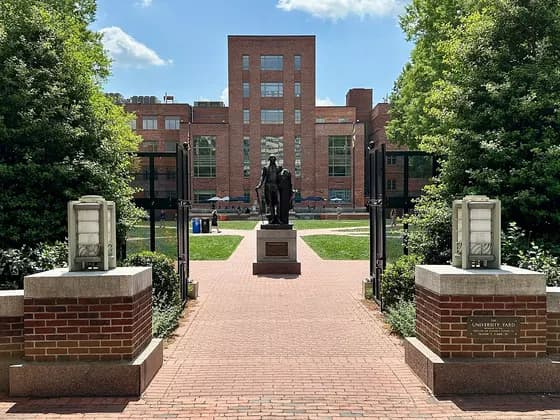


Photo: Ajay Suresh · CC BY 4.0 · cropped
Photo: APK · CC BY 4.0 · Photo: Leosmedley · CC BY-SA 3.0 · Photo: Djonesmhc · CC BY-SA 3.0
The GWU School of Medicine MD program at a glance (2027 entry)
The George Washington University School of Medicine and Health Sciences (GW SMHS, or GWU School of Medicine) offers a four-year Doctor of Medicine (MD) program based in Ross Hall in Foggy Bottom, Washington, DC. It has three phases: Fundamentals of Medicine, Fundamentals of Clinical Practice, and Transition to Advanced Clinical Practice.
The first, preclinical phase is classroom based: organ-system blocks combine the basic sciences, often taught in small groups using cases, while weekly Practice of Medicine groups teach interviewing and examination.
Public health runs through all four years. The Clinical Public Health curriculum, set up in 2014, includes Summits: multi-day field projects with public health, policy and community experts. The school also uses its location, with visits to Capitol Hill to learn about health care policy and to the United States Holocaust Memorial Museum to learn about medical ethics.
Clerkships, the core clinical rotations, begin in the spring of year 2, after a study period for Step 1, the first exam in the United States Medical Licensing Examination (USMLE) series. The final phase adds an acting internship, where you take primary responsibility for patients under supervision, plus emergency medicine, electives and a capstone. Up to 30 students a year spend their clinical years at a Regional Medical Campus in Baltimore.
Founded in 1824 as the National Medical College, the school is counted on its own history page as the 11th medical school in the United States. The Liaison Committee on Medical Education (LCME), which accredits MD programs in the United States, lists its accreditation status as Full. Its initial year of accreditation is given as on or prior to 1942, when the LCME was founded, and its next survey date as 2031-32 (directory updated October 14, 2026).
| Degree | MD |
|---|---|
| Program length | 4 years; five with the MD/Master of Public Health (MPH) or MD/MBA |
| Phases | Fundamentals of Medicine; Fundamentals of Clinical Practice; Transition to Advanced Clinical Practice |
| Main campus | Ross Hall, Foggy Bottom, Washington, DC |
| Teaching style | Integrated organ-system blocks with case-based small groups |
| Anatomy | Dissection, prosection or simulation within the organ-system blocks |
| First patient contact | Year 1, through standardized patients and a physician preceptor |
| Clinical sites | GW Hospital, Children's National and affiliates; up to 30 at Sinai, Baltimore |
| Grading | Pass/Conditional/Fail preclinical; Honors to Fail in clerkships |
| Step 1 timing | After preclinical courses, before clerkships; early 2029 for 2027 entrants, on current schedule |
What makes the GWU School of Medicine MD program different
Clinical public health in all four years
Public health, policy and health systems run from the first-semester Patients, Populations, and Systems course to a fourth-year action plan in your chosen specialty. Along the way, Summits put teams to work on real problems with public health, policy and community experts, who also judge the proposals.
Clerkships from the spring of year 2
Preclinical courses end at the turn of January and February of year 2, and clerkships run from May of year 2 to April of year 3. That leaves the final year for the acting internship, emergency medicine, electives and residency preparation.
A regional campus at Sinai Hospital, Baltimore
Students who choose the Regional Medical Campus spend their first 18 months in Washington, then take every required clerkship at one hospital, Sinai Hospital of Baltimore. The curriculum, assessments and degree match the main campus, in a group of up to 30 students a year.
Scholarly Concentrations nearly everyone joins
Eight optional concentrations, from Health Policy and Global Health to Disaster Medicine and Medical Humanities, add lectures, an 8-week project in the summer after year 1 and a related fourth-year elective.
How GWU School of Medicine teaches medicine
The preclinical phase opens with Foundations of Medicine, on core basic science principles and basic clinical skills. Organ-system blocks follow across the fall and spring of year 1 and the fall of year 2, each weaving together gross and microscopic anatomy, biochemistry and genetics, physiology, pathology, pharmacology and microbiology.
The school lists active learning in place of traditional large-class lectures as a feature of the curriculum, and content is often taught in small groups using cases. Its narrative assessment policy (reviewed November 2022) puts the integrated case-based sessions in the blocks at about 30 students per group. Practice of Medicine and Patients, Populations, and Systems (PPS) use groups of 12 or fewer with the same facilitators.
Practice of Medicine 1, 2 and 3 run alongside the blocks, meeting at least weekly in small groups with clinical faculty. The three PPS courses cover public health, population health, health policy and health systems. Both link their sessions to the block topics.
Five themes run through all four years: Climate Change and Health; Ethics and Professional Behavior; Health Equity, Diversity and Inclusion; Human Behavior and Development Across the Life Span; and Medical Humanities. In the clinical years, one-week Intersessions bring the class back together to reinforce basic science, clinical public health and the themes.
The ways you will learn
| Clinical Integration Sessions | Case-based Practice of Medicine sessions that combine history-taking and examination with clinical reasoning. Cases match the current organ block, and Practice of Medicine instructors and librarian instructors lead them. |
|---|---|
| Interview sessions | History-taking and communication practice with standardized patients, people trained to portray patients, co-led by Practice of Medicine instructors and psychosocial educators. |
| Physical diagnosis sessions | Examination skills taught by standardized patient instructors and peer instructors. |
| FOSCE simulations | Formative Observed Simulated Clinical Experience sessions take you through a series of simulated patient cases, combining history, examination and clinical reasoning. Standardized patient instructors play the patients. |
| PPS sessions | Interactive classes in the first three semesters, with mentored small-group case discussions and, in the first two courses, written case exams marked by mentors against a rubric. |
A typical week on the GWU School of Medicine program
In the preclinical phase an average day starts at 8 or 9 a.m. and has scheduled activities until 4 or 5 p.m., with a lunch break. About once a month there is also an evening physical diagnosis session, typically 4:30 to 7:30 p.m. Each week includes three half-days for independent study and self-directed learning.
Roughly one half-day a week rotates among Practice of Medicine small-group activities. A typical week also includes small-group Clinical Integration Sessions and about two hours of PPS.
Under the workload policy (October 2022, revised June 2023), required instruction, including online modules, averages 28 to 35 hours a week and should not exceed 35. The independent study half-days add 10 to 12 hours.
Attendance is expected at all sessions and required in person at patient and guest panels, Practice of Medicine and PPS small groups, designated labs and exams (policy revised June 2026). Every incoming first-year student receives an iPad, and block exams are taken on iPads.
How anatomy is taught at GWU School of Medicine
Anatomy has no stand-alone course. It is integrated into the organ-system blocks, so cardiac anatomy, for example, is taught in the Cardiovascular, Pulmonary, and Renal/Urinary Organ Systems block, using a combination of dissection, prosection or simulation. A prosection is a specimen dissected in advance to display the anatomy.
The Gross Anatomy Laboratory, on the second floor of Ross Hall, covers about 4,800 square feet with room for 200 people. Medical students use it in the fall and spring alongside graduate, undergraduate and physical therapy students. It has 41 dissecting cadaver tanks, a walk-in cold storage room and a newly installed 12-body locker for prosections.
The lab also has more than 40 iPads, virtual reality equipment, skeletons, 3-D models and radiographs. Among clinical-year electives, a two-week Anatomy Review for Residency is open to students who have identified a career path.
When you first meet patients at GWU School of Medicine
Your first patient encounters are simulated. From year 1, Practice of Medicine interview sessions have you take histories from standardized patients, who in the Clinical Learning and Simulation Skills (CLASS) Center also assess you against a faculty checklist. Encounters can be watched through one-way mirrors and recorded, so faculty can give feedback and you can review your performance.
Practice of Medicine also includes CAP, and the school's assessment policy names CAP preceptors among your instructors. A 2023 guide written by students and hosted by the school expands CAP as the Clinical Apprenticeship Program. It says each student is assigned a physician preceptor at the start of the first semester, then spends time in that doctor's clinical setting through the preclinical years. CAP sessions are required, with written feedback each semester.
Other programs add contact with patients and communities. ISCOPES, a service-learning program, puts first-year medical students on interprofessional teams for health promotion projects. Students also run the GW Healing Clinic, including the Bridge to Care free clinic in Seat Pleasant, Maryland, one evening a week. Rising second-year students can apply for observation-only summer shadowing.
The GWU School of Medicine curriculum, year by year
- Year 1
Foundations and the first organ systems
For the Class of 2030, year 1 began with orientation on July 29, 2026, the White Coat and Honor Code Ceremony followed on August 29, and the spring semester ends on May 21, 2027.
- Foundations of Medicine, then Infection, Inflammation, Immunohematology (I3) in the fall, and Cardiovascular, Pulmonary, and Renal/Urinary Organ Systems (CPR) and Gastrointestinal System and Liver (GIL) in the spring.
- Practice of Medicine 1 and 2, and PPS-1 and PPS-2, with topics from public health strategies and health systems to evidence-based medicine and patient safety.
- Recent Summits include one on ending the HIV epidemic, built with the National Alliance of State and Territorial AIDS Directors, where teams write state- or city-level action plans. Another, on childhood asthma in Washington, follows the spring semester.
- The first summer is a break or, for Scholarly Concentration students, an 8-week project.
- Year 2
Last blocks, Step 1 and the move to the wards
The fall finishes the organ-system blocks, and preclinical teaching ends in late January or early February. A Step 1 study period of about 10 weeks follows, including the exam, then spring break and Foundations of Clinical Practice. For the Class of 2029, the study period runs from February 3 to April 9, 2027.
- Musculoskeletal, Spinal Cord, Rheumatology (MSK); Brain and Behavior; and Reproduction and Endocrinology, which runs into January.
- Practice of Medicine 3 and PPS-3, Applied Population Health, which uses community violence as an extended case study before turning to the structural causes of health disparities.
- Foundations of Clinical Practice: two weeks on clinical reasoning and procedures such as IV placement and phlebotomy (drawing blood), before ward rotations.
- Clerkships begin in early May (May 4, 2026 for the Class of 2028). As they start, a Summit on injury prevention, first run in 2025, has teams write policy briefs alongside physician assistant students.
- Year 3
The core clerkships
The clerkship year runs from May to late April in one of six cohorts, which take the same clerkships in different orders. A lottery from January to March of year 2 sets your cohort, sites and electives. The year includes a two-week winter break.
- Internal medicine, surgery and pediatrics, 8 weeks each; psychiatry and obstetrics and gynecology, 6 weeks each; and Primary Care, 4 weeks in outpatient offices across the DC, Maryland and Virginia region.
- The Longitudinal Primary Care Clerkship: 10 half-days over 24 weeks, every other week, in general internal medicine, general pediatrics, family medicine or geriatrics offices across the region, whatever rotation you are on.
- Eight weeks of electives, which can also cover the neuroscience or anesthesiology requirement.
- Intersession III: a required week plus single days spread through the year.
- Year 4
Transition to Advanced Clinical Practice
The final phase starts in late April with Intersession IV and runs to graduation in May, with your schedule built by a lottery from January to April of year 3. The Class of 2028 graduates on May 21, 2028.
- A four-week acting internship, a mostly inpatient rotation where you admit patients and follow them to discharge, in medicine, pediatrics, surgery, critical care or, away from GW, inpatient family medicine.
- Four weeks of adult or pediatric emergency medicine, with day, evening and night shifts, ending with an exam and an OSCE, a clinical exam of timed stations (2023 description).
- The 4-week Clinical Neuroscience Clerkship, two 2-week blocks that can be at different adult neurology, pediatric neurology or neurosurgery sites, and 2 weeks of anesthesiology, unless taken in year 3.
- Intersession IV's longitudinal work: the scholarly project, a clinical public health action plan in your chosen specialty and a personal wellness and resilience plan.
- Transition to Residency, four weeks around Match Day in March, when seniors learn their residency appointments. Grouped by future specialty, you practice in simulation; the 2023 description lists admission orders, critical care scenarios and ultrasound-guided IV placement.
How you are assessed at GWU School of Medicine
Preclinical courses are graded Pass, Conditional or Fail. A Conditional (CN) means you missed the standard but should reach it with limited remedial work. A CN from an exam becomes a Pass if you pass the exam at the second attempt. Your record still notes the first attempt, and your Medical Student Performance Evaluation (MSPE), the dean's summary for residency applications, will say you remediated coursework.
Blocks set exams and some quizzes, and each ends with a customized National Board of Medical Examiners (NBME) subject exam that uses actual board questions and covers the whole block. Practice of Medicine adds performance-based exams of clinical skills.
Required clerkships are graded Honors, High Pass, Pass, Conditional or Fail; Foundations of Clinical Practice, the Intersessions and Transition to Residency are Pass, Conditional or Fail. Clerkship grades combine evaluations from residents and attending physicians with NBME subject exams, known as shelf exams. Some clerkships add in-house written exams, standardized patient exams or OSCEs.
Fail a core clerkship's shelf exam at the first attempt and you receive a CN; passing at the second attempt turns it into a Pass, never High Pass or Honors. Supervising faculty give you feedback midway through each clerkship. Your MSPE gives one of five summary adjectives, from outstanding to satisfactory, based only on your seven core clerkship grades.
To graduate you must pass all required coursework, USMLE Step 1 and Step 2 Clinical Knowledge (CK), and the End-of-Third Year Clinical Skills Assessment (CSA), within seven years. The USMLE is the exam series used for medical licensure in the United States. Step 1 covers the sciences basic to medicine and has been reported only as pass or fail since January 26, 2022. Step 2 CK, which still gives a score, tests clinical knowledge applied to patient care. Failing either exam twice puts you at risk of dismissal.
GW expects you to take Step 1 after the preclinical courses and before Foundations of Clinical Practice, and passing it is required for promotion to the clinical phase. Under its USMLE policy, an approved extension or a failure allows only two later windows: a third-year elective period registered as independent study, or after year 3 and by July 1. Step 2 CK must be taken by December 31 of year 4 and passed before graduation. The advising office's guide for the Class of 2027 says November 1, so check your class's date.
- On the current schedule, a student starting in summer 2027 would finish the preclinical courses in early February 2029 and take Step 1 in a study period running to about early April. Clerkships would start in early May 2029, and Step 2 CK would be due by December 31, 2030, before graduation in May 2031.
- In August 2026 the USMLE program announced a move to designated testing dates from January 2029, with Step exams offered less often each year. Its June 2026 notice had named 2028. For a 2027 entrant, both Step 1 and Step 2 CK would fall after the change.
- For MD students, enrollment in an LCME-accredited program is what makes you eligible for Step 1 and Step 2 CK; DO students and students at international schools qualify through other routes.
GWU School of Medicine clinical rotations: where you will actually train
On the main campus, your clinical years are spent at George Washington University Hospital and affiliated hospitals, including, the school says, the area's large military hospitals and facilities. Its undated affiliated-hospitals page gives only a partial, representative list. In the 2026-27 catalog, internal medicine is two 4-week blocks at GW Hospital, the DC Veterans Affairs (VA) Medical Center, Sinai Hospital or Anne Arundel Medical Center. At least 4 weeks must be at GW Hospital or the VA.
Psychiatry uses the four internal medicine hospitals plus St. Elizabeth's Hospital, Children's National, the Martinsburg VA, the Northern Virginia Mental Health Institute and the Psychiatric Institute of Washington. Obstetrics and gynecology is 3 outpatient weeks at GW Medical Faculty Associates clinics or community sites and 3 inpatient weeks at GW Hospital, Anne Arundel, Inova Alexandria Hospital, Holy Cross Hospital or Sinai. Adult emergency medicine (EMED 302) is in GW Hospital's emergency department, a Level I trauma center, and pediatric emergency medicine (PED 405) in the emergency department at Children's National.
In the school's December 2023 clerkship descriptions, pediatrics combines four inpatient weeks at Children's National or Sinai with three outpatient weeks and a newborn nursery week at GW Hospital or Holy Cross. In the same document, surgery is two four-week stints on general surgical teams at GW Hospital, Children's National, the VA, Sinai or Anne Arundel.
A multi-round lottery from January to March of year 2 sets your clerkship cohort, order and sites; neuroscience sites have their own lottery. You arrange your own transportation (site policy revised November 2022), though a weekday shuttle links GW and Children's National (schedule as of January 2024). You can petition for another site for reasons such as a supervising physician having treated you. Core clerkships must stay within the GW system and its direct affiliates.
The Regional Medical Campus (RMC) at LifeBridge Health, based at Sinai Hospital of Baltimore, opened in April 2023 and takes up to 30 students a year. Since August 2024, new students have been admitted to one campus or the other. Regional students spend their first 18 months in Washington, then take all required third- and fourth-year clerkships at Sinai, a single site, unlike the main campus. The curriculum, assessments, grading and degree are the same.
Campus assignment follows the preference you give when applying, RMC-only, RMC-preferred, main campus-only or main campus-preferred, with a lottery if interest exceeds places. You are expected to finish at your assigned campus, but after starting you can petition to switch for a compelling reason if a place is open (policy revised March 2023, reviewed November 2025). Regional students can take electives elsewhere and get Baltimore housing information at least six months ahead. The campus has its own course catalog, including acting internships in medicine, pediatrics, trauma surgery and intensive care at Sinai.
Since a 1968 partnership based the school's Department of Pediatrics at Children's National Hospital, students have trained in pediatrics at a children's hospital.
- George Washington University Hospital
- GW Medical Faculty Associates
- Children's National Hospital
- Veterans Affairs Medical Center
- St. Elizabeth's Hospital
- Psychiatric Institute of Washington
- Holy Cross Hospital, Silver Spring
- Anne Arundel Medical Center, Annapolis
- Inova Fairfax Hospital, Falls Church
- Inova Alexandria Hospital
- Northern Virginia Mental Health Institute, Falls Church
- Mary Washington Healthcare, Fredericksburg
- Veterans Affairs Medical Center, Martinsburg
A 483-bed teaching hospital with seven residency programs and more than 15,000 admissions a year. Regional students can also join LifeBridge programs such as Family Violence Prevention and Perinatal Depression Outreach.
- Sinai Hospital of Baltimore, LifeBridge Health
Electives, selectives and away rotations at GWU School of Medicine
You need at least 26 weeks of electives across years 3 and 4: up to 8 in the clerkship year and normally 18 in year 4. No more than 12 weeks in any one specialty count. Third-year electives are for exploring specialties, building skills, research or time off, and their grades do not count toward your MSPE adjective.
Up to 14 weeks of independent study across years 3 and 4 is separate, for Step 2 CK preparation, interviews, vacation or making up missed time. Many electives come in 2- or 4-week versions, and many have prerequisites.
The 2026-27 catalog goes beyond hospital specialties, with options such as Wilderness Medicine, Point-of-care Ultrasound, Culinary Medicine, Medical Spanish, Artificial Intelligence Applications in Healthcare and Hospital Administration. Introduction to Correctional Medicine is based at District of Columbia Department of Corrections facilities. In the Community Health Healing Clinic elective, fourth-year students work 12 shifts at the student-run clinic and teach preclinical students.
Away rotations, also called audition rotations, are electives at other institutions, open once you have passed all core clerkships. You apply through Visiting Student Learning Opportunities (VSLO), a service of the Association of American Medical Colleges, or directly, with approval from the matching GW course director. Hosts outside VSLO need an affiliation agreement, which takes 3 to 6 months and is not guaranteed.
The Office of International Medicine Programs (IMP), with about 120 partnerships in more than 45 countries, offers international clinical electives of 2 to 8 weeks after the core clerkships. Most students take four weeks in a clinical specialty at a teaching hospital abroad, alongside local students; others join medical or surgical missions or international research.
IMP nominates you to partner sites, first come first served, and the host makes the final decision. Current partners include the University of Ghana, Nippon Medical School in Tokyo, Seoul National University, Universidad San Francisco de Quito and the American University of Beirut.
Dual degrees and research years at GWU School of Medicine
Every MD student completes a scholarly project before graduation, as part of Intersession IV. The research concentration lists ways to meet it, such as a Research Day poster, a systematic review with a Himmelfarb librarian, a case series of at least five patients or a peer-reviewed paper. Research electives, the W.T. Gill Summer Fellowship for first-year research and Fusion, the student-led research journal, offer more.
The Scholarly Concentration Program is optional, but the school's FAQ says 98% of students choose one on average. You apply to one in the fall of year 1. The eight are Clinical and Translational Research, Clinical Practice Innovation and Entrepreneurship, Community/Urban Health, Disaster Medicine, Global Health, Health Policy, Medical Education and Leadership, and Medical Humanities. Global Health takes 25 per class, and the Class of 2031 application opens in fall 2027.
Concentration students attend lectures, typically monthly, through the fall of year 2 and complete an 8-week summer project after year 1, which can be anywhere. They propose a scholarly project in year 3 and finish it, with an elective in their area, in year 4. Global Health students spend the summer project abroad. You can withdraw without penalty, and completion appears on your transcript.
The MD/MPH, with GW's Milken Institute School of Public Health, adds one year, taken as a leave between years 3 and 4 or after year 4. You complete 30 credits in three online 10-week terms, with 15 more counted from your MD studies, plus an Applied Practice Experience and a Culminating Experience building on the Population Health Summit.
The MD/Graduate Certificate in Public Health stays within four years: four online courses in year 4, with 5 credits counted from your MD studies. The new MD/MBA takes five years: three MD years, a year from May to May in the GW School of Business Global MBA, ending with the Consulting Abroad Program, then your final MD year.
Two entry routes lead into the same MD: the eight-year 4+4 BA/BS-MD with GW's Columbian College of Arts and Sciences, for high school seniors, and Early Selection. College sophomores apply to it from GW or partner schools such as George Mason University and Morgan State University.
Facilities and support at GWU School of Medicine
Where you will learn
Ross Hall, opened in 1972 at 23rd and Eye Streets, is the center of medical student life, with its own library, cafe and student lounge. The Foggy Bottom/GWU Metro stop is immediately outside.
The CLASS Center, opened on March 1, 2014, covers more than 17,000 square feet on Ross Hall's fourth floor. It has 14 examination rooms for standardized patient encounters, two of them inpatient rooms. It also has a labor and delivery suite, two mock operating rooms, two high-fidelity simulation rooms and a procedural skills lab.
Computer-controlled manikins and task trainers are used to practice airway management, resuscitation, trauma care and obstetric management, with instructors watching and talking to you from control rooms.
At the Regional Medical Campus, Sinai Hospital's renovated and expanded simulation center runs a standardized patient program similar to the main campus, and students have a lounge, computer labs and a medical library. Regional students keep full remote access to GW's Himmelfarb Health Sciences Library.
Support while you study
The school's FAQ says each class is divided into four learning communities, which provide longitudinal mentoring from physicians, basic scientists and librarian mentors. Practice of Medicine's Coaching Program pairs formally trained faculty coaches with psychosocial educators for small-group and one-on-one sessions. The Big Sib program connects each incoming student with a student in the year above.
Every student is linked to a Student Affairs Dean, and the regional campus has its own assistant dean for student affairs. Career advising runs from year 1, with Roadmap to Residency sessions, specialty nights twice a year and a specialty advisor chosen in February of year 3. Learning-skills support, peer tutoring and peer coaching are also available.
For confidential help, the school's October 2023 resource list names the Office of Student Support in Ross Hall and the SMHS Resiliency and Well-Being Center. In the school's May 2026 syllabus appendix, the office's free services include one-on-one academic support, a writing coach, help with test-taking and time management, and a subscription to Talkspace, an online therapy platform. The university's Counseling and Psychological Services also has a counselor on call 24/7.
Clinical duty hours average no more than 80 a week over four weeks, with shifts capped at 30 hours and at least one day off in seven, or two in 14.
Is the GWU School of Medicine program right for you?
This program may suit you if
- You want public health and policy built into the required curriculum, with Summits from your first semester.
- You would like clerkships to start in the spring of year 2.
- You would like to do every required clerkship at one hospital, in a group of up to 30 at Sinai Hospital in Baltimore.
- You want a structured interest track: nearly all students join a Scholarly Concentration.
- You are weighing an MPH in one extra year, or a public health certificate within the four years.
Things to think about
- Step 1 falls in early spring of year 2, before clerkships. On the current schedule, a 2027 entrant would take it in early 2029, after the USMLE's January 2029 move to designated testing dates, when Step exams will be offered less often each year.
- Main campus clerkship sites are spread across Washington, Maryland, Virginia and West Virginia, and you arrange your own transportation.
- You choose your clinical campus when you apply, and switching later needs a compelling reason and an open place.
- Clerkships are graded from Honors to Fail, shelf exams count, and the seven core clerkship grades alone set your MSPE adjective.
GWU School of Medicine MD program — frequently asked questions
Applying to GWU School of Medicine?
How to get into GWU School of Medicine
Prerequisites, MCAT, AMCAS personal statement, secondaries and interview, step by step.
Open the guide →GWU School of Medicine admissions profile
MCAT and GPA profile, acceptance rate, interview format and key dates.
See the profile →Compare GWU School of Medicine with other schools
Put the teaching style, anatomy teaching and clinical sites next to another school.
Open the comparison →Prepare for the GWU School of Medicine interview
Format breakdown, school-specific sample questions and prep tips from tutors who interviewed here.
Read the guide →Where this GWU School of Medicine program guide came from
This guide was written from 84 official sources — George Washington University School of Medicine and Health Sciences's own program pages and curriculum documents, plus the accreditor and the hospitals and health systems the school trains students in where they publish detail — read on 2026-10-18, then checked claim by claim against those sources.
- GW SMHS: MD program curriculum
- GW SMHS: MD Program Guiding Principles and Learning Objectives
- GW SMHS: MD Program home page (Regional Medical Campus announcement)
- GW SMHS: Structure and Schedule
- GW SMHS: Practice of Medicine curriculum and CLASS Center
- GW SMHS: Affiliated Hospitals (partial, representative list)
- GW SMHS: MD Program Curriculum Schematic, March 2026
- GW SMHS: Regulations for M.D. Candidates for Classes of 2027 and Beyond, effective July 1, 2026
- GW SMHS: Class of 2030 Academic Calendar
- GW SMHS: Class of 2029 Academic Calendar
- GW SMHS: Class of 2028 Academic Calendar
- GW SMHS: Clinical Curriculum Cohort Schedule, Class of 2028
- GW SMHS: Fourth Year Calendar 2027-28, Class of 2028
- GW SMHS: Guide to the 4th Year, Class of 2027
- GW SMHS: Guide to Selecting Third-Year Electives, July 2026
- GW SMHS: Required Clinical Course Details and Descriptions, December 2023
- GW SMHS: Coursework Requirements for the MD Degree, Classes of 2023 and Beyond
- GW SMHS: Clinical Course Catalog, academic year 2026-27
- GW SMHS Course Catalog: 3rd Year Internal Medicine Clerkship (MED 305)
- GW SMHS Course Catalog: 3rd Year Psychiatry Clerkship (PCHI 302)
- GW SMHS Course Catalog: 3rd Year Obstetrics and Gynecology Clerkship (OB&G 303)
- GW SMHS Course Catalog: 3rd Year Ambulatory Primary Care Clerkship (MED 301)
- GW SMHS Course Catalog: 3rd Year Longitudinal Primary Care Clerkship (MED 302)
- GW SMHS Course Catalog: Clinical Neuroscience Clerkship (NEUR 380)
- GW SMHS Course Catalog: Emergency Medicine (EMED 302)
- GW SMHS Course Catalog: Pediatric Emergency Medicine (PED 405)
- GW SMHS: Office of the MD Registrar (registration lotteries)
- GW SMHS: Policy on Assignment to a Clinical Years Regional Medical Campus
- GW SMHS: Policy on Clerkship Site Assignments, revised November 2022
- GW SMHS: Policy on Approval of Extramural Electives
- GW SMHS: Policies and Procedures for Pre-Clinical International Summer Experiences and International Electives
- GW SMHS: Policy on Medical Student Workload in Pre-Clinical Years
- GW SMHS: Policy on MD Program Narrative Assessment
- GW SMHS: Policy on Formative Assessment and Feedback in the Preclinical Curriculum
- GW SMHS: Policy on Mid-Clerkship Feedback
- GW SMHS: Policy on Medical Student Clinical Duty Hours, December 2023
- GW SMHS: General Attendance Policy, revised June 2026
- GW SMHS: Resources for Students Needing Academic, Personal, or Mental Health Counseling, October 2023
- GW SMHS: MD Program Syllabus Appendix, last updated May 2026
- GW SMHS: student-written Health Professions Scholarship Program guide for HPSP students, Class of 2027 edition (2023)
- GW SMHS: Clinical Public Health and Population Health Practice
- GW SMHS: Clinical Public Health curriculum and electives
- GW SMHS: Patients, Populations, and Systems courses
- GW SMHS: Clinical Public Health Summits
- GW SMHS: Combined, Dual, and Joint Programs
- GW SMHS: Combined MD/Public Health Degree Programs
- GW SMHS: Dual Degree MD/MBA Program
- GW SMHS: 4+4 Dual BA/BS-MD Program with Columbian College of Arts and Sciences
- GW SMHS: Early Selection
- GW SMHS: MD Program Frequently Asked Questions (curriculum and opportunities)
- GW SMHS: Opportunities for Students
- GW SMHS: Extramural Elective and Visiting Away Rotations
- GW SMHS: Annual Events
- GW SMHS News: GW Welcomes Its Newest Medical Students at White Coat Ceremony (September 1, 2026)
- GW SMHS: Life as a GW Medical Student
- GW SMHS: Shuttle between GW SMHS and Children's National
- GW SMHS: History
- Regional Medical Campus at LifeBridge Health: Welcome
- Regional Medical Campus at LifeBridge Health: About
- Regional Medical Campus at LifeBridge Health: FAQs
- Regional Medical Campus at LifeBridge Health: Is the RMC right for you?
- Regional Medical Campus at LifeBridge Health: Welcome letter to prospective applicants
- Regional Medical Campus at LifeBridge Health: Course Catalog
- GW SMHS Office of Student Affairs: Advising overview
- GW SMHS Office of Student Affairs: Meet the Student Affairs Deans
- GW SMHS Office of Student Affairs: Preclinical Exploration (M1 and M2)
- GW SMHS Office of Student Professional Enrichment: Scholarly Concentration Expectations
- GW SMHS Office of Student Professional Enrichment: FAQs
- GW SMHS Office of Student Professional Enrichment: Clinical and Translational Research concentration
- GW SMHS Office of Student Professional Enrichment: Annual Summer Shadowing Program
- GW SMHS International Medicine Programs: Global Health Scholarly Concentration
- GW SMHS International Medicine Programs: International Clinical Electives Program
- GW SMHS: About the CLASS Center
- GW SMHS CLASS Center: Non-Human Simulation Rooms
- GW SMHS CLASS Center: Outpatient Education Rooms
- GW Department of Anatomy and Cell Biology: Gross Anatomy Laboratory
- GW Healing Clinic
- LCME: Accredited Programs directory, updated October 14, 2026
- USMLE: Updated Timeline for Designated Testing Dates, transition in January 2029 (August 6, 2026)
- USMLE: Designated Testing Dates Information Hub
- USMLE: Transition to Limited Testing Dates Each Year Starting in 2028 (June 23, 2026, since updated)
- USMLE Bulletin of Information: Eligibility
- USMLE: Step 1 Transition to Pass/Fail Only Score Reporting
- USMLE: Step 1 overview and Step exams descriptions
Curricula are restructured between cycles. Anything here that decides your application — how anatomy is taught, a clinical campus assignment, a required research year — should be confirmed against the official page for your entry year.
Applying to GWU School of Medicine?
We help US applicants with MCAT strategy, the AMCAS personal statement, secondary essays and interview prep — everything you need for a competitive GWU School of Medicine application.