
The Howard University College of Medicine MD program
What you actually study, and where you will be
Howard University College of Medicine's MD is a 4-year program with an integrated curriculum, with patient contact from Year 2 and clinical rotations in Washington, DC (2027 entry). Howard's MD starts with two years of integrated science units, taught alongside Population Health+ and Introduction to Clinical Medicine, which cover population health and clinical skills. After passing USMLE Step 1, you spend year 3 on clerkships based at Howard University Hospital, just south of the College. Year 4 brings acting internships in medicine and surgery, an Intern Readiness Course and 16 to 20 weeks of electives.
- Degree
- MD
- Length
- 4 years
- Teaching
- Integrated
- Clinical contact
- Year 2

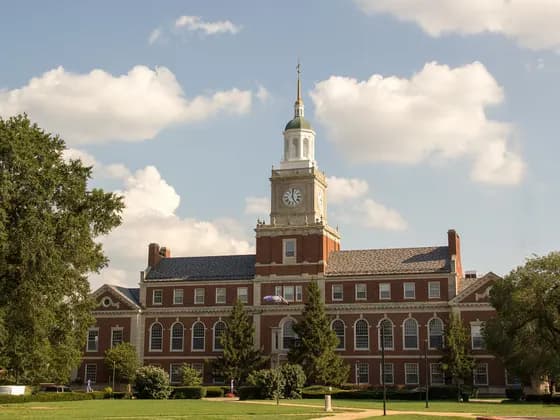
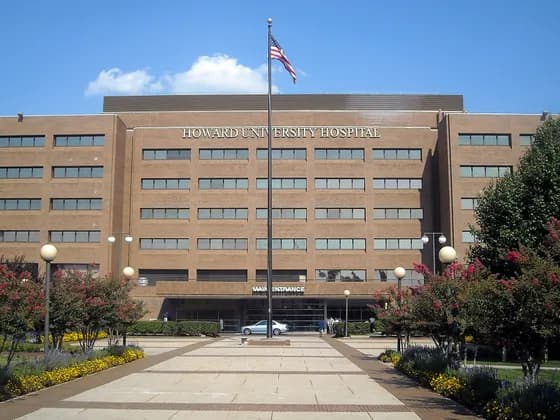

Photo: Ted Eytan · CC BY-SA 2.0 · cropped
Photo: Derek E. Morton · CC BY-SA 4.0 · Photo: AgnosticPreachersKid · CC BY-SA 3.0 · Photo: United_States_Capitol_-_west_front.jpg : Architect of the Capitol derivative wor · Public domain
The Howard University College of Medicine MD program at a glance (2027 entry)
Howard University College of Medicine (HUCM), in Washington, DC, offers a four-year Doctor of Medicine (MD) program. The College dates from 1868, and each class has 130 students. Its stated mission is to prepare physicians and other health professionals to serve the underserved. It puts particular focus on educating disadvantaged students for careers in medicine, with special attention to teaching and research on health care disparities.
Years 1 and 2, from mid-July of year 1 to mid-April of year 2, are the pre-clerkship, or pre-clinical, phase. You study the sciences in integrated units: Molecules and Cells, Structure and Function, and Organ Systems. Population Health+ and Introduction to Clinical Medicine teach population health, health systems and clinical skills alongside them. Anatomy uses donated bodies. You must then pass USMLE Step 1, the first part of the United States Medical Licensing Examination, to start year 3.
Year 3 is a year of clerkships, the core clinical rotations, based at Howard University Hospital, the College's major teaching facility. Year 4 brings acting internships in medicine and surgery, where you take on much of the work of an intern, or first-year resident, under supervision. It also has a four-week Intern Readiness Course and electives. You must pass Step 2 CK (Clinical Knowledge), the next licensing exam, to enter the residency Match and to graduate.
The structure, dates and rules in this guide come from the College's 2025-26 Schedules Booklet and Policies and Procedures Manual, the latest editions posted, so details may differ for 2027 entrants. In a February 2026 statement the College listed curriculum enhancements among recent changes, and a transfer notice on its admissions page cites several curriculum schedule adjustments.
The Liaison Committee on Medical Education (LCME) accredits MD programs in the United States. Its directory, updated October 14, 2026, lists the College's status as Full, on probation, with the next survey in 2027-28. It gives initial accreditation as on or prior to 1942, the year the LCME was founded. In a statement of February 27, 2026, the College said the LCME had granted full accreditation with probationary status, meaning close monitoring until the next review in February 2028.
| Degree | MD |
|---|---|
| Program length | 4 years; 5 with the MD/MBA, about 7 to 8 with the MD/PhD |
| Class size | 130 students |
| Teaching style | Integrated units taught through lectures, team-based and small-group learning |
| Anatomy | Cadaver-based, with practical exams in the Gross Anatomy Lab in year 1 |
| First patient contact | Clinical skills from year 1; real patients in year 2 |
| Clinical sites | Howard University Hospital, with Children's National and the Washington DC VA |
| Grading | Honors, Satisfactory or Unsatisfactory; High Pass in most core clerkships |
| Step 1 timing | End of year 2; around June 2029 for 2027 entrants, on current schedule |
| Accreditation | LCME: Full, on probation; next survey 2027-28 (directory, October 14, 2026) |
What makes the Howard University College of Medicine MD program different
Clinical training at a safety-net hospital
Clerkships are based at Howard University Hospital, the College's major teaching facility. By its own account it has been the District of Columbia's safety-net hospital since DC General Hospital closed in 2001, caring for residents regardless of ability to pay. It has been a Level I trauma center since 1990.
Population health taught alongside the sciences
Population Health+ meets on Tuesday afternoons through year 1 and returns as a short unit in year 2. Its three units cover population health, the social determinants of health, health systems science, global and environmental health, biostatistics and behavioral medicine, alongside clinical and communication skills, and include a lifelong-learning group project.
A final year built around residency preparation
Year 4 requires acting internships in medicine and surgery and the Intern Readiness Course, on the clinical and procedural skills first-year residents are expected to perform. The other 16 to 20 weeks are electives, at Howard University Hospital or, with approval, elsewhere in the United States or abroad.
A College dating from 1868
Classes began on November 9, 1868, with eight students and five faculty members. By the College's account, Howard and Meharry were the only two of seven Black medical schools of the time to survive the 1910 Flexner Report, which raised standards for US medical education. Charles R. Drew, known for his research on banked blood, headed the College's Department of Surgery from 1941 until his death in 1950.
How Howard University College of Medicine teaches medicine
The College describes years 1 and 2 as an integrated curriculum. Rather than a separate course for each science, you take units that combine them: Molecules and Cells and Structure and Function in year 1, then six Organ Systems units in year 2.
Scheduled class time in years 1 and 2 is lectures, team-based learning (TBL) and small-group learning (SGL). The College's list of teaching methods also includes problem-based learning, case-based discussions, standardized patients, simulation and self-directed learning. Each course starts with learning objectives that you research and study on your own.
Alongside the science units, Population Health+ teaches population health, health systems, and clinical and communication skills, and Introduction to Clinical Medicine teaches physical diagnosis. One of the College's 13 educational objectives for the MD is awareness of the need to address and resolve health disparities at all levels.
From year 3 you learn on clinical teams. An attending physician keeps medical and legal responsibility for every patient, though some day-to-day supervision may pass to residents. By graduation the College aims for every student to be able to perform the 13 Core Entrustable Professional Activities of the Association of American Medical Colleges (AAMC). These include handing over a patient, obtaining informed consent and placing an intravenous catheter.
The ways you will learn
| Team-based and small-group learning | You prepare in advance, then work through problems or cases with classmates. Attendance is compulsory, and arriving 10 or more minutes late without an excuse counts as an absence. |
|---|---|
| Anatomy and laboratory sessions | Structure and Function uses donated bodies, with lab exams in the Gross Anatomy Lab. Other units have lab exams too, from histology to the organ systems. |
| Clinical skills with standardized patients | Standardized patients are people trained to portray patients so you can practice history taking and examination. You are tested in OSCEs, objective structured clinical examinations, rotating through timed stations that each test one clinical task. |
| Clerkships and acting internships | In years 3 and 4 you work on hospital teams under supervision. Each clerkship ends with an exam, and in year 4 you serve as an acting intern in medicine and in surgery. |
A typical week on the Howard University College of Medicine program
In years 1 and 2, scheduled class time, meaning lectures, team-based and small-group sessions and other required contact with faculty, is limited to about 24 hours a week, averaged over each unit. On top of that, Population Health+ meets on Tuesday afternoons in year 1, and Introduction to Clinical Medicine meets for about four hours a week in year 2. Attendance is required at all of these sessions, lectures included, and every educational and clinical session in years 3 and 4 is mandatory.
The College estimates two hours of preparation for every hour of lecture, team-based or small-group learning, and one hour for every hour of lab. That time goes on assigned reading, cases for class discussion, flipped-classroom preparation and online modules.
Exams are frequent. In 2025-26, year 1 and 2 students sat a written exam every two to three weeks, mostly at the testing center on the fourth floor of the Louis Stokes Health Sciences Library.
In years 3 and 4, each department sets the daily hours. Duty is capped at 80 hours a week averaged over four weeks, including in-house call. You get one day in seven free and at least 8 hours between shifts, with call no more than every third night. A shift can last 24 hours, plus four for handover, followed by at least 14 hours off. Some public holidays and spring recess are off only for years 1 and 2.
How anatomy is taught at Howard University College of Medicine
Anatomy is taught in year 1 through three Structure and Function units, from late October to late April: bones, muscles and skin; then head, neck and nervous system; then the thorax, abdomen and pelvis. Tissue histology is part of Molecules and Cells 1 at the start of the year, and Structure and Function 3 has its own histology exam.
The teaching is cadaver-based. The Department of Anatomy's Anatomical Gifts Program, a whole-body donation program, provides donors for hands-on learning by future physicians, dentists and other health professionals. Most Structure and Function exam days pair a morning written paper with an afternoon lab exam in the Gross Anatomy Lab. To be eligible for a reexamination, you need a weighted average of at least 65% on that course's cadaver lab exams.
The Anatomical Gifts Program describes donors as students' first teachers. Each year the department holds a memorial service to honor donors and their families, with students taking part; the 2026 service was on April 26.
When you first meet patients at Howard University College of Medicine
Clinical skills start in year 1, when Population Health+ includes clinical and communication skills development and its first unit is examined partly by a case presentation. In year 2, Introduction to Clinical Medicine brings you together with faculty, standardized patients and real patients, and is examined through OSCEs.
In years 1 and 2, a physician on the College's medical staff, or a resident they delegate, supervises you at all times. Under direct supervision you may take histories, examine patients, analyze clinical data and read records, and you may observe surgery with the patient's and surgeon's consent. You may not write in the permanent medical record or give orders.
Full-time clinical work starts with clerkships in mid-July of year 3, once you have passed Step 1. From then on you can take part in patient care, including procedures, under direct supervision, and write progress notes, histories and physicals, operative notes and discharge summaries marked as student notes.
The Howard University College of Medicine curriculum, year by year
- Year 1 (M1)
Molecules, structure and population health
Year 1 starts with a week of orientation in July, with classes from mid-July, and runs to late April. Its seven units carried 57 credit hours in 2025-26.
- Molecules and Cells 1 (mid-July to mid-September, 12 credits): molecules and metabolism, molecular and cell biology, and tissue histology.
- Molecules and Cells 2 (mid-September to late October, 8 credits): nutrition, basic microbiology, genetics and immunology.
- Structure and Function 1 to 3 (late October to late April; 5, 10 and 15 credits), the anatomy units, each with written and lab exams.
- Population Health+ 1 (Tuesday afternoons, July to December, 4 credits): clinical skills, health care systems and population health.
- Population Health+ 2 (Tuesday afternoons, January to April, 3 credits): nutrition, and global and environmental health.
- Year 2 (M2)
Organ systems and clinical medicine
Year 2 runs from mid-July to mid-April: six Organ Systems units, with Introduction to Clinical Medicine all year, worth 56 credit hours in 2025-26. It ends with USMLE Step 1, which you must pass to start year 3.
- Organ Systems 1 to 4 (fall): general principles; the blood-forming and lymphatic systems, musculoskeletal system and skin; the cardiopulmonary and vascular systems; and the endocrine, renal and genitourinary systems.
- Organ Systems 5 and 6 (spring): the reproductive and gastrointestinal systems, then the central and peripheral nervous system, psychopathological conditions and the special senses.
- Introduction to Clinical Medicine 1 and 2 (4 and 8 credits): physical diagnosis and clinical medicine, with OSCEs and a final exam each semester.
- Population Health+ 3 (February to March, 4 credits): biostatistics and epidemiology, behavioral medicine, and complementary and alternative medicine, plus a lifelong-learning group project.
- The NBME Comprehensive Basic Science Exam, a compulsory day-long exam in mid-April from the National Board of Medical Examiners (NBME), which co-sponsors the USMLE.
- A study period from mid-April to early June, with a recommended Step 1 date in June (June 10 in 2026), so a pass arrives before year 3 starts in July.
- Year 3 (M3)
Core clerkships
Year 3 runs from mid-July to mid-July, with 48 weeks of clerkships and 50 credit hours in 2025-26. The class is split into groups that take the clerkships in different orders. Each clerkship ends with an exam, usually after a two-day weekend reading period.
- A compulsory Basic Life Support and Essential Clinical and Technical Skills course in the first week of the year.
- Internal medicine, inpatient and outpatient, combined with neurology and physical medicine and rehabilitation (12 weeks).
- Surgery, pediatrics, and obstetrics and gynecology (8 weeks each).
- Psychiatry (6 weeks) and emergency medicine (2 weeks), taken as one block, and family medicine and community health (4 weeks).
- Interdisciplinary Health Care Ethics and Jurisprudence, a virtual course on Wednesday evenings for one semester, which you must pass to move on to year 4.
- A compulsory in-house clinical skills assessment for third-year students, held from late April to mid-May in 2026.
- Year 4 (M4)
Acting internships and electives
Year 4 opens in mid-July with orientation and about 10 days of structured study for Step 2 CK, then runs as four-week rotations until late April. The required rotations are acting internships in medicine and surgery and the Intern Readiness Course; the rest are electives. Graduation is in May.
- Senior Medicine and Senior Surgery (4 weeks each): acting internships with an exam on a set date in each rotation period, after which you return to the team.
- The Intern Readiness Course (4 weeks, in the spring): clinical and procedural skills that first-year residents are expected to perform, graded only Satisfactory or Unsatisfactory.
- Step 2 CK within six to eight weeks of finishing year 3.
- Match Day in March, held together with the Long White Coat Ceremony in 2026, then Honors and Oath Day and commencement in May.
How you are assessed at Howard University College of Medicine
Grades are tied to fixed scores, not a curve, so in principle every student can earn Honors. A final score of 85 or more is Honors (H), 70 to 84 is Satisfactory (S) and under 70 is Unsatisfactory (U). The College does not issue a grade point average, and professionalism is graded separately, Pass or Fail, each semester.
In years 1 and 2, every exam, from faculty-written papers to customized NBME exams, has a pass mark of 70 and an Honors mark of 85. Faculty set how exams, quizzes and assignments are weighted in each unit.
Clerkship grades combine clinical performance, judged against each department's competencies, with an NBME subject exam, often called a shelf exam, which you must pass with 70. Failing the clinical part means failing the clerkship. Honors requires Honors in every part, shelf exam included. If you reach Honors in the clinical work but not on the shelf exam and average 85 or more, you get High Pass (HP), recorded as 84. HP exists in internal medicine, family medicine, psychiatry, pediatrics, surgery, and obstetrics and gynecology.
Missing more than 10% of active-learning sessions without an excuse costs four points from the final grade and rules out Honors.
Step 1 has been reported only as pass or fail since January 26, 2022. You must pass it to start year 3. With an approved extension you can start in September instead, if your pass arrives a week before clerkships begin. No one starts year 3 after September, and a later pass means waiting until the next July. Step 2 CK must be passed before the rank-list deadline of the National Resident Matching Program (NRMP), or you are withdrawn from the Match. It must also be passed at least 14 days before graduation.
On the current schedule, a 2027 entrant would sit Step 1 around June 2029 and Step 2 CK around August or September 2030, six to eight weeks after year 3 ends. That projection rests on the 2025-26 Schedules Booklet and Policies Manual. In August 2026 the USMLE program announced a move to designated testing dates from January 2029, with Step exams offered less often each year. Its June 2026 notice had named 2028. On that schedule, both exams would fall after the change.
- Reexaminations in years 1 and 2: up to two a semester, in early January for fall units and about 10 days after the last spring exam. A pass on a reexamination is capped at 70.
- Three or more final failing grades in year 1 or year 2 mean dismissal. With one or two, you may be offered the Summer Directed Study Program (late May to early July in 2026), with the grade capped at 70.
- In years 3 and 4 you may be offered one reexamination for a failed clerkship exam, at its next sitting, capped at 70. Failing two clerkships in one year means dismissal or repeating the year.
- In year 3 you must pass a clinical skills exam run with other regional medical schools. If you fail, you join an enhancement program and must pass a retake before graduating.
- Failing Step 1 or Step 2 CK three times means dismissal.
- You must finish the MD within seven years of starting, leaves of absence included, or you are dismissed. The limit is eight years for the MD/MBA and ten for the MD/PhD.
Howard University College of Medicine clinical rotations: where you will actually train
Howard University Hospital is the College's major teaching facility. It opened in 1975 in the Shaw neighborhood, just south of the College, on the former grounds of Griffith Stadium, once home to the Washington Senators and the Homestead Grays of baseball's Negro leagues. It replaced Freedmen's Hospital, founded in 1862, which moved to the Howard campus in 1869.
The hospital describes itself as a private, nonprofit teaching hospital and a Level I trauma center since 1990. It says it has been the safety-net hospital for the District of Columbia since DC General Hospital closed in 2001. It gives care regardless of ability to pay, including to the uninsured, the underinsured and Medicaid recipients.
Two partner hospitals name Howard on their own sites. Children's National Hospital calls itself the pediatric partner for Howard and George Washington University and accepts third-year students from those two schools into its pediatric clerkship. The Washington DC VA Medical Center offers its internal medicine rotations, with pages for clerkship and acting internship students, only to its four affiliated schools, Howard among them.
You take each rotation at the site you are approved for. To change an assigned site, you ask the clerkship director, who weighs space and feasibility. You can appeal the director's decision to the Senior Associate Dean for Academic Affairs. Changing a rotation without permission means no credit and no liability coverage.
Main base: Howard University Hospital. Partners: Children's National for the year 3 pediatric clerkship and the VA for internal medicine rotations.
- Howard University Hospital (Shaw)
- Children's National Hospital
- Washington DC VA Medical Center
Electives, selectives and away rotations at Howard University College of Medicine
Elective time is not part of year 3. In year 4 you take 16 to 20 weeks of electives, as four or five four-week rotations in clinical specialties or research. You can spend no more than 8 weeks on research and, if you take 16 weeks of electives, no more than 8 in any one specialty or subspecialty.
Electives can be at Howard University Hospital or, with approval, at another institution in the United States, known as away rotations. Most applications for away rotations go through the Visiting Student Learning Opportunities (VSLO) service. International electives are possible too, with applications due in June before year 4 (June 15 in 2026). The Senior Associate Dean for Academic Affairs approves every elective.
You plan year 4 during year 3, from a senior-year orientation in January to a final schedule due in May (2026 dates). Howard's own electives are listed in a Senior Elective Courses booklet published each year.
Dual degrees and research years at Howard University College of Medicine
The College encourages research throughout the four years. Through the Medical Student Research Program (MSRP), its Office of Research connects students with faculty mentors for basic, clinical, translational and collaborative research. Its resources include the Howard University Cancer Center, the Center for Sickle Cell Disease and the Georgetown-Howard Universities Center for Clinical and Translational Science.
The Medical Student Summer Research Program (MSSRP) is open to first-year students in good academic standing who have passed all their first-year exams. The 2026 program was set for seven weeks, May 14 to July 3, and listed 29 faculty projects, from stroke and gestational diabetes to seafood allergy among African Americans in the Washington area. A separate program offers Howard medical students eight weeks of summer research in Stanford Medicine labs.
The MD/PhD, run by the College and the Graduate School, takes about seven or eight years; the College allows up to ten. The PhD runs through the Interdisciplinary Biomedical Sciences (IBMS) program: core courses and at least two lab rotations, then one of five research tracks, in anatomy, biochemistry, microbiology, pharmacology or physiology. You must pass Step 1 before taking leave for the PhD. In August 2026 the IBMS reported four MD/PhD matriculants by April 2026, with one MD/PhD student joining its cohorts in fall 2025 and another in fall 2026.
MD/PhD students, like other Howard PhD students in the biomedical sciences, can also join the HU-CCR Cancer Track, run with the National Cancer Institute's Center for Cancer Research (CCR). You first do at least one lab rotation there, typically 6 to 10 weeks. Then, if the lab's head and your program director agree, you can do all or part of your dissertation research in a CCR lab. CCR's labs are on the National Institutes of Health campuses in Bethesda and Frederick, Maryland.
The five-year MD/MBA with the School of Business is open to a limited number of students. After two or three years of the MD and a pass in Step 1, you take a one-year leave to complete the MBA, then return to finish the MD.
The BS/MD is for students entering Howard's College of Arts and Sciences from high school as biology or chemistry majors, by invitation. Phase I, four semesters and a summer, covers general education, medical school prerequisites, clinical and volunteer experience, seminars and projects. Moving on to the MD is conditional on set grade point averages, an AMCAS medical school application with a minimum MCAT score and an interview. BS/MD students join the regular entering class, the first medical year counts toward the BS, and the MD comes in year six.
Facilities and support at Howard University College of Medicine
Where you will learn
The Howard University Simulation and Clinical Skills Center, opened in 2009, is a 12,000-square-foot facility shared by the health sciences colleges. It uses standardized patients, manikins from low to high fidelity, task trainers, computer simulations and virtual reality. Training covers history taking, examination, bedside procedures for adults and children, laparoscopic and ultrasound skills, and neonatal resuscitation.
Sessions are recorded for observation and feedback, and after a clinical skills exam your course or clerkship director asks the center to release the video to you for review. The center has been accredited by the American College of Surgeons as an education institute since 2016 and, from 2026, in human simulation by the Association of Standardized Patient Educators.
The Louis Stokes Health Sciences Library, at 501 W Street NW, covers 80,000 square feet over four floors, with seats for 600. It has eight problem-based learning rooms for up to 10 people, 11 small study rooms, two single rooms for board-exam study and the College of Medicine's Class of 1955 Student Lounge. Its fourth floor holds the Health Science Testing Center, with 130 workstations.
Support while you study
Before year 1, some incoming students chosen by the Admissions Committee take the six-week Preliminary Academic Reinforcement Program (PARP). It covers first-year material, learning skills, counseling and tutoring, and in 2026 was scheduled for May 18 to June 26. For everyone, the Office of Medical Education (OME) gives workshops in orientation week and early in year 1 on problem solving, critical thinking, learning styles and concept mapping, and individual sessions all year. Students who need reinforcement are referred to the OME for academic counseling or group tutoring.
Anyone in academic difficulty must meet the Senior Associate Dean for Academic Affairs and the OME's learning specialist. MedSTAR (Medical Student Taught Academic Review) provides student tutors, chosen for their academic record and personal qualities, mainly for years 1 and 2. In years 3 and 4, clerkship directors and the OME draw up individual plans for students who struggle, and an administrator, a faculty member or you can make the referral.
The College's Spiritual Health and Wellness Center offers brief, short-term therapy, in person or online, only for medical students, alongside University Counseling Services. It is temporarily in room 533 of the Seeley G. Mudd Building, with a new location expected in 2026. The OME can also give you a list of outside psychiatrists and psychologists.
At the Student Health Center on Georgia Avenue, one or more physicians see only medical students. Any clinician who treats you takes no part in assessing you or deciding on your promotion. The Office of Student Affairs and Admissions keeps a list of service-learning opportunities and oversees student organizations.
Is the Howard University College of Medicine program right for you?
This program may suit you if
- You want your clinical training at a safety-net hospital: Howard University Hospital cares for District residents regardless of ability to pay.
- You want population health and health systems taught alongside the sciences, through Population Health+ in years 1 and 2.
- You are drawn to the College's stated mission of serving the underserved, with particular focus on educating disadvantaged students for careers in medicine.
- You want to start research early, with summer research after year 1 in faculty labs or at Stanford Medicine.
- You want a final year built around residency preparation, with two acting internships and the Intern Readiness Course.
Things to think about
- Grades are not pass/fail: units are graded Honors, Satisfactory or Unsatisfactory against fixed scores, and most core clerkships add High Pass.
- Step 1 is a firm gate: you need a pass to start year 3, and three failures mean dismissal.
- Clinical years can run to 80 duty hours a week, averaged over four weeks, including in-house call.
- Dates and rules here come from the 2025-26 booklet and manual, and the College mentions curriculum schedule adjustments, so details may change for 2027 entrants.
Howard University College of Medicine MD program — frequently asked questions
Applying to Howard University College of Medicine?
How to get into Howard University College of Medicine
Prerequisites, MCAT, AMCAS personal statement, secondaries and interview, step by step.
Open the guide →Howard University College of Medicine admissions profile
MCAT and GPA profile, acceptance rate, interview format and key dates.
See the profile →Compare Howard University College of Medicine with other schools
Put the teaching style, anatomy teaching and clinical sites next to another school.
Open the comparison →Prepare for the Howard University College of Medicine interview
Format breakdown, school-specific sample questions and prep tips from tutors who interviewed here.
Read the guide →Where this Howard University College of Medicine program guide came from
This guide was written from 30 official sources — Howard University College of Medicine's own program pages and curriculum documents, plus the accreditor and the hospitals and health systems the school trains students in where they publish detail — read on 2026-10-18, then checked claim by claim against those sources.
- HUCM Schedules Booklet 2025-2026
- HUCM Policies and Procedures Manual 2025-2026
- HUCM: Admission and Aid
- HUCM: statement on accreditation status
- Howard newsroom: accreditation statement, February 27, 2026
- LCME: Accredited Programs directory, updated October 14, 2026
- LCME: Rules of Procedure, March 2026
- USMLE: Designated Testing Dates Information Hub
- USMLE announcement, August 6, 2026: transition in January 2029
- USMLE notice, June 23, 2026: limited testing dates from 2028
- USMLE: Step 1 pass/fail only score reporting
- Howard University Hospital: About Us
- Children's National Hospital: Third Year Pediatric Clerkship
- Washington DC VA Medical Center: Internal Medicine Clerkship
- HUCM: Anatomical Gifts Program
- HUCM Department of Anatomy: donor program brochure
- HUCM: Office of Research
- HUCM: Medical Student Summer Research Program 2026
- HUCM: Howard and Stanford Medicine summer research program
- HUCM: Interdisciplinary Biomedical Sciences graduate program
- IBMS Ph.D. Program Progress Report, August 2026
- NCI Center for Cancer Research: Howard University-CCR Cancer Track
- Howard BS/MD and BS/DDS booklet, Fall 2026
- HUCM: Pipeline Programs (academic support programs)
- HUCM: Mentoring and Counseling
- HUCM: Spiritual Health and Wellness Center
- Howard Simulation and Clinical Skills Center: About
- Howard Simulation and Clinical Skills Center: home page
- Howard newsroom, May 18, 2026: simulation center accreditation
- Louis Stokes Health Sciences Library: Library Info
Curricula are restructured between cycles. Anything here that decides your application — how anatomy is taught, a clinical campus assignment, a required research year — should be confirmed against the official page for your entry year.
Applying to Howard University College of Medicine?
We help US applicants with MCAT strategy, the AMCAS personal statement, secondary essays and interview prep — everything you need for a competitive Howard University College of Medicine application.