
The Oregon Health & Science University School of Medicine MD program
What you actually study, and where you will be
Oregon Health & Science University School of Medicine's MD is a 4-year program with an integrated curriculum, with patient contact from Year 1 and clinical rotations in Portland, regional hospitals and rural Oregon communities (2027 entry). OHSU's YourMD curriculum opens with 18 months of integrated organ-system blocks in Portland, graded Pass/No Pass, with a weekly half-day preceptorship in a clinician's clinic from the winter of year 1. Step 1 of the national licensing exams comes in the winter of year 2, then clerkships, the core clinical rotations, scheduled through a lottery at OHSU, the VA and community and rural sites. The standard MD also requires a scholarly project and at least four weeks in a rural Oregon community.
- Degree
- MD
- Length
- 4 years
- Teaching
- Integrated
- Clinical contact
- Year 1

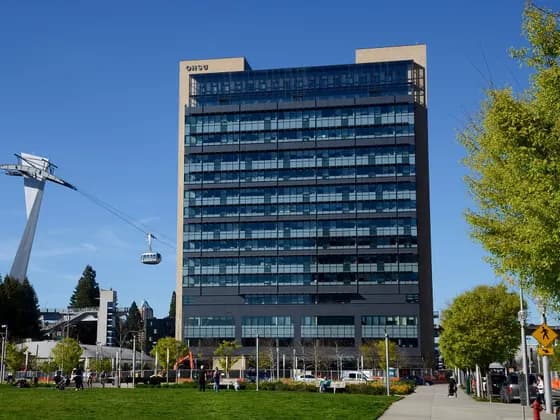

Photo: Cacophony · CC BY-SA 3.0 · cropped
Photo: Steve Morgan · CC BY-SA 3.0 · Photo: Truflip99 · CC BY-SA 4.0 · Photo: Vulturesong · CC0
The Oregon Health & Science University School of Medicine MD program at a glance (2027 entry)
The Oregon Health & Science University (OHSU) School of Medicine in Portland runs a four-year MD through a curriculum called YourMD, introduced in 2014. OHSU describes itself as Oregon's only academic health center, an institution that combines patient care, teaching and research. The entering class is about 150, and the typical student meets every graduation requirement in 3 years and 10 months. The Liaison Committee on Medical Education (LCME), which accredits MD programs in the United States, lists the program as fully accredited, with its next survey in 2027-28.
YourMD has two phases: Foundations of Medicine, OHSU's pre-clerkship stretch before full-time clinical work, and the Clinical Experience phase that follows. Foundations fills the first 18 months with integrated blocks built around organ systems. Each block ties a body system's normal structure and function to its diseases, their treatment and how to examine patients, alongside health systems science, the study of how care is delivered and improved.
Clinical work starts early: a weekly half-day with a preceptor, the clinician who hosts you, begins in the winter term of year 1. You take Step 1 of the United States Medical Licensing Examination (USMLE) in the winter of year 2. That February, Transition to Clinical Experiences, a two-week course that prepares you for clinical teams, leads into the Clinical Experience phase. Clerkships, which OHSU calls core clinical experiences, are due by the end of year 3, mixed with electives, rotations you choose yourself, and short integrative courses called intersessions.
Two requirements shape where most students train. One is at least four weeks in a rural Oregon community. The other is a continuity experience of at least eight weeks, which must keep at least two of three things the same: your patient population, health system and preceptors.
Day to day, expect structure first and choice later. Foundations is lock-step, with your whole class moving together through required in-person sessions and frequent assessment, though every course is graded Pass/No Pass. In the clinical phase a lottery sets your schedule, and 34 elective credits let you shape it toward residency, the specialty training that follows medical school.
| Degree | MD |
|---|---|
| Program length | 4 years; typical student finishes in 3 years 10 months |
| Curriculum | YourMD: 18 months of integrated organ-system blocks, then a clinical phase |
| Class size | About 150 |
| Main campus | South Waterfront classrooms and Marquam Hill hospitals, Portland |
| Anatomy | Labs, prosections (specimens already dissected for study) and human cadaver dissection |
| First patient contact | Weekly half-day preceptorship from the winter term of year 1 |
| Clinical sites | OHSU, Portland VA, community hospitals and rural Oregon communities |
| Step 1 timing | Winter of year 2, before Transition to Clinical Experiences in February |
| Grading | Pass/No Pass in every course; no class quartiles |
What makes the Oregon Health & Science University School of Medicine MD program different
A required rural rotation
Unless you are an MD/PhD or MD-OMS (oral and maxillofacial surgery) student, you spend at least four full-time weeks in a rural Oregon community. Any clinical discipline counts, as does community-focused work such as health policy. Sites in OHSU's Campus for Rural Health, its network of rural training locations, add a project the community has identified.
At least eight weeks of continuity
A core rotation can double up as your continuity experience. Eight-week family medicine and internal medicine options count. The eight-week rural family medicine core and the 12-week Family Medicine Rural Immersive each meet the family medicine, rural and continuity requirements at once.
Pass/No Pass in all four years
Residency programs read narrative comments on your performance from course directors and see your progress on entrustable professional activities, the core tasks a new resident should be able to perform. Those sit beside a transcript showing Pass or No Pass for every course, clerkships included.
A scholarly project from proposal to capstone
With a faculty mentor, you carry out a project on a health or medical question of your own. Most are research studies, though engineering, informatics and arts projects also count if they meet the standards of their field. You present at a capstone event in the winter of your final year.
Oregon FIRST: a final year in Klamath Falls
Oregon FIRST (Family Medicine Integrated Rural Student Training) places selected students for 30 to 34 weeks of their last year with the Cascades East family medicine residency. The aim is to ease the step from student to intern, a first-year resident, for future family physicians in under-resourced areas.
One hundred workplace assessments
At least 100 times, you ask a supervisor to assess you during real clinical work, using a short form on your phone. At least 51 must come from attending physicians, the senior doctors who supervise care. Students entering from summer 2025 on must also reach set milestones in all 17 program competencies.
How Oregon Health & Science University School of Medicine teaches medicine
Foundations teaching runs in seven blocks, each built around a body system or theme. Subjects such as anatomy, physiology, pharmacology and ethics are threads, running through the whole curriculum instead of ending with one course. In Cardiopulmonary & Renal, for example, you study how the heart, lungs and kidneys work together, then learn to read clinical data and use it to choose treatment.
The school picks the format to fit the goal. Its handbook says these may include presentations, team-based and problem-based learning (small groups working through problems together), case discussions, simulation, online modules and service learning. Traditional lectures are limited in favor of small groups and self-directed study. In-person attendance is expected, sessions marked as required are tracked, and time-off requests of more than a full week are routinely denied because the phase is lock-step.
Each block ends with an enrichment week after the final assessments, for firming up core concepts, retaking anything you did not pass and self-directed learning. If you have no retakes, you pick at least three sessions from a schedule, and you can propose your own.
In the clinical phase you learn mainly on clinical teams, with formal midpoint feedback on every core rotation. Intersessions pull you back for two weeks at a time to join basic, clinical and health systems science around one topic, through patient cases, group projects and reflective writing.
The ways you will learn
| Large-group sessions | Held in learning studios in the Robertson Life Sciences Building. Block content is typically recorded and posted afterward, while sessions led by clinical thread directors are required and usually not recorded. |
|---|---|
| Clinical Skill Labs | Weekly small groups of 10 to 14 students. Clinical Context sessions cover communication, ethics, health policy and informatics. Clinical Assessment and Management sessions cover interviewing, physical exams, diagnostic reasoning and case presentations. |
| Narrative medicine | During preceptorships you write field notes, short reflections on what you have seen, and trained readers give written feedback. Notes are not shared with your preceptor or academic advisors. |
| Simulation and standardized patients | Standardized patients are trained actors who portray a case so you can practice interviews and exams; OHSU's program includes over 70. Simulation centers also use manikins, task trainers and virtual reality. |
| Interprofessional education | Foundations of Patient Safety and Interprofessional Practice is a 1-credit course shared with learners from OHSU's other health programs, covering teamwork, communication and safe care. |
A typical week on the Oregon Health & Science University School of Medicine program
Required Foundations work, including set pre-reading, is held to 32 hours a week or less, averaged over a block, and every regular instructional week keeps at least 8 hours free for independent learning. The pattern below comes from the Foundations template in the September 2026 teachers handbook, stamped as updated in March 2021.
- Mornings, 8 to 12: large and small groups, Monday to Thursday in the first two blocks and Monday to Wednesday after that.
- Afternoons: one weekly Clinical Skill Lab from 1 to 4, on Monday or Tuesday in the first two blocks and on Tuesday after that.
- Preceptorship: from the winter of year 1, half the class goes on Monday afternoons and half on Thursday mornings.
- Wednesday afternoons: sessions from OASIS, OHSU's advising system.
- Fridays: assessments averaging two hours in the morning, then patient panels or active-learning sessions.
How anatomy is taught at Oregon Health & Science University School of Medicine
Foundations of Medical Anatomy (FOMA) runs inside the Foundations blocks. Sessions are in person, required and tracked, and are typically taught at the VirtuOHSU Simulation Center in Richard Jones Hall on Marquam Hill. The handbook names three settings: FOMA labs, prosections and human cadaver dissection in the second-floor anatomy lab.
The anatomy follows the blocks. Fundamentals covers terminology and the major organ systems, and Skin, Bones & Musculature covers the spine and limbs. Hormones & Digestion covers the digestive tract and endocrine system, and Developing Human covers the pelvis and reproductive anatomy. Missing more than one anatomy session in a block, or more than two overall, triggers a required check-in with an assistant dean.
Peer tutors run small-group sessions in the anatomy lab. Supporting anatomy teaching is the main purpose of OHSU's Body Donation Program. Later, a two-week Anatomy Teaching Elective lets advanced students teach classmates.
When you first meet patients at Oregon Health & Science University School of Medicine
You get access to Epic, the electronic health record, in your first week. Introduction to Preceptorship follows in the fall of year 1. Before the winter term you state your preferences and OHSU assigns you a preceptor, a physician or advanced practice provider, for four hours, one half-day a week.
This is your first authentic clinical experience, where you interact with patients and learn to join a health care team. Preceptors work across specialties, and many are based away from OHSU, so you arrange your own transport. Preceptorship continues through Foundations, pausing for about six weeks each summer.
Full-time clinical work starts after Transition to Clinical Experiences in February of year 2. On rotations you take histories, examine patients, write notes and pend orders, meaning you draft them for a supervising physician to review and sign. An attending physician stays responsible for every patient. Each core keeps a log of required encounters and skills, such as a newborn exam in pediatrics.
Clinical weeks are longer. The AY2025-26 catalog counts a core rotation as 72 hours of work a week. Duty-hour rules limit you to 80 hours a week on site, averaged over four weeks, with at least one full day off a week, averaged over a month. A single shift should ideally stay within 24 hours, though a clerkship can extend it to 30.
You do not log your hours, but each clerkship evaluation asks whether the limits were broken. Thanksgiving Day is the only scheduled holiday in the clinical phase.
The Oregon Health & Science University School of Medicine curriculum, year by year
- First 12 months
Foundations of Medicine: the first five blocks
You start in August with a one-week Transition to Medical School, then move through five blocks, each closing with assessments and an enrichment week. Preceptorship starts in the winter term, and your scholarly project course begins in the spring.
- Transition to Medical School (1 week, 2 credits): meet your class and second-year students, join an interprofessional orientation, certify in Basic Life Support, get Epic access and receive your white coat.
- Fundamentals (10 weeks, 18 credits): core anatomy, biochemistry, cell biology, embryology, genetics, histology, pathology, microbiology and pharmacology, plus your first interviewing and physical exam skills.
- Blood & Host Defense (7 weeks, 13 credits): the blood and immune systems and their diseases. Skills labs add sharing serious news and disclosing medical errors.
- Skin, Bones & Musculature (7 weeks, 13 credits): the musculoskeletal system, skin and rheumatologic disease, and how to approach a patient with joint pain or a rash.
- Cardiopulmonary & Renal (13 weeks, 27 credits): the heart, lungs and kidneys, separately and working together. This is the longest block.
- Hormones & Digestion (9 weeks, 18 credits): the digestive tract and endocrine organs, nutrition, the body's interactions with microorganisms, and common diseases and their management.
- Months 13 to 18
Foundations of Medicine: the brain and the life cycle
The last two blocks cover the nervous system and human development, and Foundations ends in the fall of year 2. In the summer you also get details of the lottery that sets your clinical schedule.
- Nervous System & Function (10 weeks, 22 credits): neuroanatomy, neurophysiology and neuropharmacology, with the common disorders seen in both neurology and psychiatry.
- Developing Human (8 weeks, 12 credits): the life cycle from conception through childhood, adulthood and aging, with reproductive health, palliative care and gender-affirming care.
- Scholarly project proposal (1 credit across spring, summer and fall): pick a topic, complete a literature search with a librarian, secure a mentor and submit your proposal.
- Winter of year 2
Step 1 and the move into clinical work
Once Foundations is complete, winter term opens with Preparation for Step 1, five weeks of independent study worth 5 credits, in which you prepare for and take the exam. The two-week Transition to Clinical Experiences follows in February, a course offered only once a year. After that you join clinical teams.
- Extra study time: you can request it for documented illness or injury, or evidence you are at risk of failing.
- Transition to Clinical Experiences (2 weeks, 2 credits): unstable vital signs, CPR and airway basics, oral presentations, handoffs and calling for urgent help. It ends in a capstone Objective Structured Clinical Examination (OSCE), a hands-on exam where you are observed handling a clinical encounter.
- Waiting for a score: if you sat Step 1 before the course, you can start rotations while your result is pending. A No Pass stops further clinical courses until you pass.
- February of year 2 to end of year 3
Clinical Experience phase: clerkships and requirements
Clerkships take center stage, in blocks of about four weeks set through the lottery and mixed with electives. All seven core clinical experiences are due by the last spring block of year 3, which ends in June. On the current schedule, that means June 2030 for a 2027 entrant.
- Seven core clinical experiences, each at least four weeks and 6 credits: family medicine, internal medicine, neurology, obstetrics and gynecology, pediatrics, psychiatry and surgery. Emergency medicine is an elective.
- Internal medicine is inpatient work at a single hospital site, and family medicine puts you in a family physician's practice for about 80 percent of your time. OB/GYN includes surgery, labor and delivery, complex family planning and a faculty clinic, and pediatrics mixes inpatient and outpatient work, general and specialty.
- Longer core options: eight-week continuity versions of family medicine and internal medicine, and the 12-week Family Medicine Rural Immersive. The Rural Immersive is outside the lottery, so you arrange it with the course coordinator, and your preferred site is not guaranteed.
- Two core intersessions of two weeks each, chosen from Cancer, Cognitive Impairment, Infection, Pain, Dissection of the Coronavirus and (Dis)ability.
- Seven testing intersessions, one per core subject, each built around a National Board of Medical Examiners (NBME) self-assessment, sometimes called a shelf exam.
- Rural experience (at least four weeks) and continuity experience (at least eight weeks, or seven in winter term), each met through a core or an elective.
- Clinical Performance Examination (CPX): a four-hour exam with standardized patients, best taken once your core rotations are mostly or entirely done.
- Scholarly project work: at least 6 credits, at 36 hours of work per credit, finished by the fall of your final year.
- Final year
Electives, residency applications and the capstone
Your last year is built around residency. You apply and interview, finish the remaining requirements, and take electives and sub-internships, also called acting internships: intensive rotations with hours, on-call duty and hands-on patient care similar to an intern's. Graduation typically comes in June. On the current schedule, that means June 2031 for a 2027 entrant.
- Electives and sub-internships, using any credits left from the 34 required.
- Medical Student Performance Evaluation (MSPE): your dean's letter goes to residency programs in September, covering your record through the first summer block of your final year.
- Residency interviews: up to two days off per four-week rotation.
- Transition to Residency (3 weeks, 1 credit): two remote weeks and one in person, with OSCEs and practice in hard conversations and in reading EKGs and x-rays.
- Scholarly Project Capstone (1 credit): present your poster to peers and the OHSU community in the winter term.
How you are assessed at Oregon Health & Science University School of Medicine
Every course in YourMD goes on your transcript as Pass or No Pass, so there are no class quartiles. The MSPE carries narrative comments from course directors, your course results and your progress on core tasks. It leaves out your Step scores.
In Foundations, each block's assessment components must be passed separately, at 70 percent for graded work. For students entering from Summer 2026 on, weekly computer-based quizzes of about 25 to 35 questions count toward passing, with your lowest score dropped. About one to three skills assessments a week cover clinical, health systems and basic science. Midway through a block, a formative exam, for feedback only, replaces that week's quiz.
On core rotations you are assessed on clinical performance, skills and knowledge, self-directed learning and professionalism. Each part must be passed, so failing one means a No Pass. Testing intersessions add the seven NBME shelf exams, taken remotely in terms you register for and finished by week 6 of summer term in your final year. Each is graded Pass/No Pass against a set threshold, a fail must be remediated to a passing score, and the results are listed on your MSPE.
USMLE Step 1 has been reported as pass/fail only since January 2022. You sit it during the five-week study course at the start of winter term in year 2. You must post a pass to continue in the clinical phase, and within a year of finishing Foundations.
In August 2026 the USMLE program announced a move to designated testing dates from January 2029, with Step exams offered less often each year. Its June 2026 announcement had named 2028. On the current schedule, a 2027 entrant would sit Step 1 in late January or early February 2029, shortly after the switch.
Step 2 Clinical Knowledge (CK), the next exam in the series, has a school deadline: a pass by December 31 before a June graduation, so December 31, 2030 for a 2031 graduate. On the current schedule, the curriculum template shows the exam near the end of the third 12 months, about summer 2030. OHSU strongly encourages a posted score before residency applications; results can take up to eight weeks. An optional 1-credit course adds study time in your test term, and you can request up to two days off.
- Block exams: each block ends with an OHSU exam of about 50 questions and a final skills exam, which typically includes one OSCE. A formative NBME exam of about 100 questions guides your Step 1 preparation.
- Retests: these nearly always happen in the enrichment week, and a passed retest leaves only a Pass on your transcript. Needing retests in two or more Foundations components brings a referral that can lead to an Academic Warning. Failing a retest means a No Pass and repeating the block the next year.
- A failed Step 1 means Academic Probation and usually a leave of absence while you study for the retake. A third failed attempt, or no pass by the start of winter term a year after your study period began, brings you before the Medical Student Progress Board for a possible dismissal hearing. The board reviews academic progress and professional behavior.
- A failed Step 2 CK also means Academic Probation. Three failed attempts, or no pass by your graduation term, bring the same review.
- A No Pass on a core rotation goes to the Progress Board, which approves an individual remediation plan.
- Core intersessions have four separate parts: attendance, written reflection, a quiz of about 50 questions with a 70 percent pass mark, and presentations or group projects.
- The Clinical Performance Examination is required to graduate and tests history taking, physical exam, communication and clinical reasoning.
Oregon Health & Science University School of Medicine clinical rotations: where you will actually train
Rotations run at OHSU and the Portland Veterans Affairs (VA) Medical Center, and at community and regional sites. A lottery sets your schedule, and you can swap a core with a classmate up to 12 weeks ahead. Some core places at residency partners are arranged with OHSU's Office of Curriculum and Student Affairs before the lottery.
Before each rotation you submit site preferences, and the clinical coordinator makes the final assignment, balancing schedules and site availability. You can ask to change for hardship, such as caring for a family member, but lack of transportation and pet care do not qualify. The September 2026 teachers handbook gives you two business days from your assignment to ask. A refusal can be appealed within two business days to the Associate Dean for Undergraduate Medical Education, whose decision is final.
Expect some weeks away from Portland. A rural site must be at least 10 miles from the center of a population center of 40,000 or more, the Oregon Office of Rural Health definition. Assigned housing comes at no extra cost for sites 40 miles or more, or a one-hour drive, from the Portland area. The Office of Undergraduate Medical Education does not pay travel or mileage, though the AY2025-26 catalog says rural family medicine rotations may offer reimbursement, depending on availability.
At the Campus for Rural Health, in Klamath Falls, Northeast Oregon or the South Coast, you live and work alongside students from other OHSU programs. On your first rotation there you also take a 1-credit interprofessional course of about 36 hours, helping develop and evaluate a project the community has identified, such as a Union County warming station.
The VA connects to OHSU Hospital by a pedestrian skybridge. OHSU says it is one of two designated Level 1 Trauma Centers in Oregon.
- OHSU Hospital
- OHSU Doernbecher Children's Hospital
- Portland VA Medical Center
Listed by the Department of Surgery as student rotation sites, with OHSU and the VA. The AY2025-26 catalog's list of residency-partner rotations shows the internal medicine core at Providence St. Vincent, arranged before the lottery.
- Providence St. Vincent Medical Center
- Providence Portland Medical Center
- Legacy Emanuel Medical Center
- Kaiser Permanente Sunnyside Medical Center
- Kaiser Permanente Westside Medical Center
Surgery rotation sites outside Portland.
- PeaceHealth Sacred Heart Medical Center at RiverBend
- St. Charles Medical Center
Family medicine core sites on the AY2025-26 catalog's list of residency-partner rotations, arranged before the core lottery.
- OHSU Hillsboro
- Samaritan Health Services, Corvallis
- Aviva Health Roseburg Family Medicine Residency
About five hours from Portland. Campus for Rural Health location and home of Oregon FIRST.
- Cascades East Family Medicine
- Sky Lakes Medical Center
Campus for Rural Health cities are Enterprise, La Grande and Baker City, about five hours from Portland by road.
- Grande Ronde Hospital and Clinics, La Grande
Campus for Rural Health cities are Coos Bay, Coquille, Bandon and Myrtle Point, in a county about four hours from Portland by road.
- Bay Area Hospital
- Coquille Valley Hospital
Grants Pass and Gold Beach are surgery sites that meet the rural requirement. The catalog also lists rural emergency medicine in Astoria and Seaside.
- Asante Three Rivers Medical Center, Grants Pass
- Curry General Hospital, Gold Beach
- Columbia Memorial Hospital, Astoria
- Providence Seaside Hospital
Sites for family medicine electives in Native American health in the AY2025-26 catalog, subject to availability.
- Warm Springs Health and Wellness Center
- Yellowhawk Tribal Health Center
- Grand Ronde Health and Wellness Center
Electives, selectives and away rotations at Oregon Health & Science University School of Medicine
You need at least 34 elective credits, and at least 22 must be clinical. The rest can be clinical, non-clinical, research or extra scholarly project work. Up to 4 credits of non-clinical electives from Foundations count, with options in the 2025-26 Program Requirements Guide such as street medicine, medical Spanish and labor and delivery skills.
The AY2025-26 elective catalog, the copy linked from the MD curriculum page, has 368 elective listings, most lasting two or four weeks, including 51 sub-internships. You can also design a special elective with a faculty sponsor, at OHSU or the VA.
Away rotations, typically at institutions outside Oregon, are electives too. Up to three count, at 1 credit a week, but they cannot replace a core and they do not appear on your MSPE. Submit the request form at least six months ahead.
International electives for credit come after Foundations and Step 1, and usually after all seven cores. They need multiple approvals and an OHSU faculty sponsor, and locations under State Department travel advisories are excluded. Up to 9 clinical elective credits can count, and you buy your own malpractice insurance. OHSU's global health programs include a four-week clinical rotation in Bangkok, Thailand.
- Oregon FIRST: applications typically open in the summer of year 3, with selection in December and a start around late August of your final year.
- AHEC Scholars: a two-year Area Health Education Center certificate program for future work in rural and urban underserved communities, with 40 hours of teaching and 40 hours of community-based learning a year.
- Native Health Experience: for selected students, this runs from the spring of year 1 to graduation. It includes a 2-credit American Indian and Alaska Native health course and at least four weeks at tribal health sites.
- Bridges Collaborative Care Clinic: a student-run interprofessional clinic for underserved people in the Portland area, open since 2017. The 2025-26 Program Requirements Guide lists a pre-clinical elective based there.
Dual degrees and research years at Oregon Health & Science University School of Medicine
Every standard MD student completes a scholarly project. You work with a lead from one of five areas: basic research and biomedical engineering; clinical research; epidemiology, community and global health; ethics, quality improvement and education; or health law, business and health policy.
The MD/PhD is a fully funded Medical Scientist Training Program of seven to eight years. You complete Foundations, pass Step 1 and take Transition to Clinical Experiences, then join a graduate program in Behavioral Systems Neuroscience, Biomedical Engineering, Biomedical Informatics, Neuroscience or Biomedical Sciences. After your dissertation you return for clinical training, including an eight-week Clinical and Translational Research Experience.
The five-year MD-MPH runs with the OHSU-PSU School of Public Health, with a concentration in Epidemiology or Health Management and Policy. You can only join at first admission to the MD, and you begin with an epidemiology course the summer before medical school. After passing Step 1 you spend a concentrated MPH year, typically from September of your third academic year, then finish your clinical work and a practice project.
The six-year MD-OMS program admits two to three students a year and combines the MD with oral and maxillofacial surgery residency training through the School of Dentistry, with its own modified MD requirements.
The Physician-Scientist Experience offers extended research time, with applications opening each November. The five-month option fits inside four years and earns 18 credits, 6 of them toward the scholarly project. The one-year option is a leave of absence to earn a Master of Clinical Research, so you graduate five years after entry. Both follow Step 1.
The Pathology Year Experience is a one-year leave of absence, typically starting in the spring of your second or third year, once you have passed Step 1. You work at the level of a first-year resident in anatomic pathology, studying surgical pathology and autopsy cases with pathologists. Three students take part each year, with a salary stipend, and the year earns no credit toward the MD.
Facilities and support at Oregon Health & Science University School of Medicine
Where you will learn
Foundations classes meet in the Robertson Life Sciences Building on the South Waterfront, which OHSU shares with Oregon State University and Portland State University. The MD program's main office is there too. The Portland Aerial Tram, a six-minute walk away, connects the waterfront to Marquam Hill.
The Mark Richardson Interprofessional Simulation Center on the Portland waterfront covers 20,000 square feet, with eight simulation suites and 20 clinical exam rooms. On Marquam Hill, the 7,500-square-foot VirtuOHSU center in Richard Jones Hall has a 16-table anatomy dissection lab, a microsurgery suite, laparoscopy stations and virtual reality simulators.
In Portland you arrange your own off-campus housing, with OHSU classifieds to help you search. For rotations, the Office of Learner Placement and Housing coordinates furnished accommodation.
Support while you study
OASIS, short for Outreach, Advising, Support, and Identity formation for Students, was set up in January 2021. Faculty advisors cover academics, careers, life and wellness, and diversity, equity, inclusion and belonging. You must meet an academic advisor at least twice each academic year, and a career advisor at least twice a year from July of year 2. Before the end of the Fundamentals enrichment week, you also meet a wellness or diversity advisor.
Life and wellness conversations stay out of your academic record and are confidential, unless they raise a reportable issue such as harassment or a risk of harm. Academic advisors never grade you. If your Foundations scores slip, they email you with an offer of help, and you decide what to use.
Career advising runs through six pods grouped by specialty, and your career advisor helps you find a residency specialty advisor in the relevant department. Formal peer tutoring runs across the program, with block previews, exam reviews, Step 1 and Step 2 CK sessions and anatomy lab tutoring. More than 40 student interest groups are open to medical students.
Is the Oregon Health & Science University School of Medicine program right for you?
This program may suit you if
- You want Pass/No Pass grading in all four years, with narrative comments instead of class quartiles.
- You want time in a real clinic from the winter of year 1, long before full-time clerkships.
- You are drawn to rural or underserved care and would value a required rural rotation, the 12-week Rural Immersive or Oregon FIRST.
- You want a schedule you can shape, with 34 elective credits and a scholarly project of your own design.
- You want research options beyond the project, such as the five-month or one-year Physician-Scientist Experience.
Things to think about
- Foundations is lock-step and in person, with little room for extended time off.
- Step 1 acts as a gate to the clinical phase, and the USMLE's January 2029 change could affect how this timing works for your class.
- You will need dependable transport for preceptorships and clinical sites.
- The clinical phase has just one scheduled holiday, so personal plans need flexibility.
- A rural rotation can mean weeks four or five hours from Portland.
Oregon Health & Science University School of Medicine MD program — frequently asked questions
Applying to Oregon Health & Science University School of Medicine?
How to get into Oregon Health & Science University School of Medicine
Prerequisites, MCAT, AMCAS personal statement, secondaries and interview, step by step.
Open the guide →Oregon Health & Science University School of Medicine admissions profile
MCAT and GPA profile, acceptance rate, interview format and key dates.
See the profile →Compare Oregon Health & Science University School of Medicine with other schools
Put the teaching style, anatomy teaching and clinical sites next to another school.
Open the comparison →Prepare for the Oregon Health & Science University School of Medicine interview
Format breakdown, school-specific sample questions and prep tips from tutors who interviewed here.
Read the guide →Where this Oregon Health & Science University School of Medicine program guide came from
This guide was written from 43 official sources — Oregon Health & Science University School of Medicine's own program pages and curriculum documents, plus the accreditor and the hospitals and health systems the school trains students in where they publish detail — read on 2026-11-07, then checked claim by claim against those sources.
- OHSU MD Program: Curriculum
- OHSU School of Medicine home page
- OHSU MD Program home page
- OHSU Medical Student Handbook 2026-27
- OHSU Handbook for Teachers of Medical Students, September 2026
- YourMD Clinical Experiences block calendar, AY2025-26 to AY2027-28
- OHSU MD Course Catalog, AY2025-26
- OHSU Course Guide 2025-2026
- OHSU Program Requirements Guide 2025-2026
- OHSU MSPE FAQ for Qualified Assessors, March 2025
- OHSU Core EPAs: Workplace Based Assessments logistics, October 2025
- OHSU Academic Calendar, 2026-27 and 2027-28
- OHSU MD Program admissions page: class size and orientation
- OHSU Teachers of MD Students: preceptorship and clinical skills lab
- About OHSU Undergraduate Medical Education
- OHSU MD Program OASIS advising
- OHSU Academic Support and Tutoring
- OHSU MD/PhD Program: Curriculum
- OHSU MD-MPH Program overview
- OHSU Physician-Scientist Experience
- OHSU Department of Pathology: medical student education
- OHSU Department of Surgery: medical student education and rotation sites
- OHSU Family Medicine: student education
- OHSU Department of Medicine: core and elective clinical experiences
- OHSU Doernbecher Pediatric Medical Education Program
- OHSU OB/GYN medical student clerkship
- OHSU Rural Health Programs and Campus for Rural Health
- Oregon AHEC Scholars
- Oregon FIRST at Cascades East Family Medicine
- OHSU Simulation Centers
- OHSU Types of Clinical Simulation Training
- OHSU Student Housing
- OHSU Robertson Life Sciences Building
- OHSU Body Donation Program
- OHSU School of Medicine history
- About OHSU Health Care
- OHSU Department of Medicine: training sites
- LCME Directory of Accredited Programs
- USMLE Designated Testing Dates Information Hub
- USMLE: Updated Timeline for Designated Testing Dates, Transition Will Take Place in January 2029
- USMLE to Transition to Limited Testing Dates Each Year Starting in 2028, June 2026
- USMLE Step 1 Transition to Pass/Fail Only Score Reporting
- USMLE score reporting timeline update, March 2024
Curricula are restructured between cycles. Anything here that decides your application — how anatomy is taught, a clinical campus assignment, a required research year — should be confirmed against the official page for your entry year.
Applying to Oregon Health & Science University School of Medicine?
We help US applicants with MCAT strategy, the AMCAS personal statement, secondary essays and interview prep — everything you need for a competitive Oregon Health & Science University School of Medicine application.