
The Saint Louis University School of Medicine MD program
What you actually study, and where you will be
Saint Louis University School of Medicine's M.D. is a 4-year program taught through team-based learning in an integrated curriculum, with patient contact from Year 1 and clinical rotations in the St. Louis area, including O'Fallon, Illinois (2027 entry). SLU fits its pre-clerkship phase into 18 months, so full-time clerkships at St. Louis-area hospitals start in January of year 2, with 18 months afterwards for electives, an acting internship and residency preparation. Year 1 pairs cadaver dissection with organ-system modules taught through team-based learning and simulation, graded pass/fail. Step 1 follows a study block of about four weeks before clerkships begin.
- Degree
- M.D.
- Length
- 4 years
- Teaching
- Integrated + Team-based learning
- Clinical contact
- Year 1

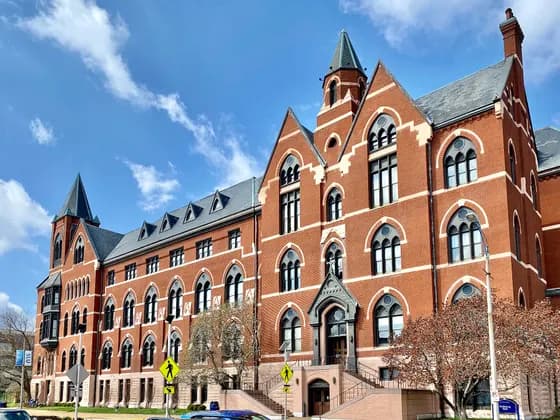


Photo: w_lemay · CC BY-SA 2.0 · cropped
Photo: w_lemay · CC BY-SA 2.0 · Photo: Teemu008 from Palatine, Illinois · CC BY-SA 2.0 · Photo: Brian Zinnel · CC BY-SA 4.0
The Saint Louis University School of Medicine MD program at a glance (2027 entry)
Saint Louis University School of Medicine (SLU School of Medicine, or SLU SOM) runs a four-year Doctor of Medicine (M.D.) program in SLU's Medical Center on South Grand Boulevard in St. Louis, Missouri. The curriculum has three phases: 18 months of pre-clerkship (pre-clinical) classroom, lab and clinical skills teaching, 12 months of clerkships, the required clinical rotations, and 18 months of post-clerkship training.
The timing is what defines the program. Because the pre-clerkship phase ends in December of year 2, clerkships start that January. Before then, you study the body one organ system at a time. Lectures sit alongside team-based learning, where small teams apply material prepared in advance, peer instruction and simulation.
You sit Step 1 of the United States Medical Licensing Examination (USMLE), the national licensing exam series, just before clerkships, and Step 2 CK (Clinical Knowledge) just after them. Clerkships run at hospitals in and around St. Louis, led by SSM Health Saint Louis University Hospital across Grand Boulevard. The Liaison Committee on Medical Education (LCME), which accredits M.D. programs in the United States, renewed the school's full accreditation in March 2025 for eight years.
SLU is a Jesuit university, and the school frames its mission around cura personalis, caring for the whole person. That shows in teaching on the social causes of ill health and in service through the SLU mobile health clinic and Casa de Salud, a clinic for immigrant patients. The school was established in 1836 and says it awarded the first medical degree west of the Mississippi River.
| Degree | M.D. (Doctor of Medicine), four years, starting in late July |
|---|---|
| Curriculum | Three phases: 18-month pre-clerkship, 12-month clerkship, 18-month post-clerkship |
| Class size | 180 first-year seats; 174 students entered in 2025 |
| Main campus | SLU Medical Center on South Grand Boulevard, St. Louis, Missouri |
| Teaching style | Organ-system modules with team-based learning, peer instruction and simulation |
| Anatomy | Cadaver dissection in year 1 Normal Structure and Function |
| First patient contact | Standardized patients from year 1; full-time clerkships from January of year 2 |
| Grading | Pass/fail for three semesters; Honors, Near Honors, Pass or Fail afterwards |
| Step 1 timing | End of the fall of year 2, before January clerkship orientation |
| Accreditation | Full LCME accreditation, renewed March 2025; next survey 2032-33 |
What makes the Saint Louis University School of Medicine MD program different
Clerkships start in January of year 2
The pre-clerkship phase ends after 18 months, so full-time clinical rotations begin halfway through year 2. The catalog says this adds six months of clinical experience before graduation.
Longitudinal ethics and business of medicine courses
Health care ethics is taught longitudinally, with Foundations in Health Care Ethics in year 1 and Clinical Reasoning in Health Care Ethics woven into the other year 2 courses. Leadership in the Business of Medicine also spans the pre-clerkship phase, covering how the US health care industry works, and some second-year students go on to lead its first-year small groups.
Standardized patients and OSCEs in every phase
The Clinical Skills Center, open since 1977, has a pool of more than 80 standardized patients, community members trained to portray patients. You use it in all four years, including for objective structured clinical examinations (OSCEs), skills exams marked against set criteria, in select organ modules, six core clerkships and the capstone.
Optional distinctions alongside the M.D.
Optional medical distinctions add electives, mentoring and other opportunities in one area, such as Community Health, Medical Spanish, Global Health or Research. The school's 2025 report counted about 275 students pursuing one, 67 of them in Community Health, and 40 members of the Class of 2025 graduated with a distinction.
Service through a mobile clinic and Casa de Salud
SLU runs two mobile health clinics that bring exams, immunizations and screenings to people without housing, transport or nearby care, and students train on them. Students also volunteer at Casa de Salud, a clinic for St. Louis's foreign-born residents on SLU's campus. The school says about half its medical students do community outreach each year.
How Saint Louis University School of Medicine teaches medicine
The curriculum rests on three pillars: basic science, health systems science (how health care is organized, paid for and made safer) and clinical medicine. The school emphasizes active learning, where you apply concepts with classmates in class. Besides the methods below, its curriculum pages list case-based tutorials and virtual patients that use AI and virtual reality to give instant feedback.
Foundation courses come first, from molecular biology and anatomy to pathology, immunology and pharmacology. From the spring of year 1 you study one organ system at a time. Each organ module ends with a National Board of Medical Examiners (NBME) exam. Organ modules include simulation scenarios in which you turn a history and examination into a diagnosis and treatment plan.
Longitudinal courses run in parallel: interviewing and physical diagnosis, ethics, medicine and society, patient safety, quality improvement and leadership in the business of medicine. From the class entering in fall 2026, a nutrition thread on food as medicine runs through the organ modules, especially cardiovascular, pulmonary and renal. It is part of at least 40 hours of nutrition education, or a competency-based equivalent.
In the clerkships, teaching moves to wards and clinics, with sessions such as weekly evidence-based medicine teaching in internal medicine.
The ways you will learn
| Lectures and question banks | Lectures, some pre-recorded, carry each course's core content, and every pre-clerkship student gets question banks such as AMBOSS for practice. |
|---|---|
| Team-based learning | You prepare before class, then solve problems in small teams. The sessions show you how well you know the material before graded exams. |
| Peer instruction | In peer-led sessions you explain difficult concepts to classmates, and many courses hold faculty-led peer-instruction exam reviews. |
| Small groups | Bench to Bedside groups of 10 read and present a high-impact research paper tied to the current course. In required small groups that meet several times with the same teacher, you get a written narrative assessment of your strengths and areas to improve. |
| Clinical skills with standardized patients | In the Clinical Skills Center you interview and examine standardized patients, who give you feedback, and encounters can be recorded for review. |
| Simulation | Small groups manage a responsive manikin through a clinical scenario, then a physician educator leads a debrief. Electives teach procedures, from IV insertion and suturing before clerkships to central lines and lumbar punctures later. |
A typical week on the Saint Louis University School of Medicine program
In the pre-clerkship phase, teaching usually runs from 8am to 5pm, Monday to Friday, with on average 8 hours a week set aside for unscheduled study. Pre-recorded lectures and reading are blocked into the schedule. No week may include more than 4 hours of required activity outside those hours, for example when standardized patients are only available then.
Attendance is required at clinical and standardized patient sessions, at active learning such as team-based learning and simulation, and at small groups and lectures marked required. So are faculty sessions in your learning community, one of six houses. Vacations must fall in designated breaks, with at most 4 days of non-medical planned absence in year 1 and 2 days in the fall of year 2.
In clerkships, duty-hour rules cap clinical and educational work at 80 hours a week, averaged over four weeks, with at least one day off a week on average.
How anatomy is taught at Saint Louis University School of Medicine
Anatomy is part of Normal Structure and Function (NSF), which runs from about August to mid-November of year 1 on the school's 2025 curriculum map. NSF combines gross anatomy, histology (tissues under the microscope), embryology, neuroscience and physiology in three modules, Musculoskeletal, Thorax and Head, and Abdomen and Pelvis, each graded separately.
You learn gross anatomy by cadaveric dissection of bodies donated through SLU's Gift Body Program, run by the Center for Anatomical Science and Education (CASE). An October 2024 SLU News story described first-year students' hours in the anatomy lab with donated bodies, and in October 2025 the program's director stressed the anatomy learned through cadaveric dissection. Faculty letters about fall 2020 describe first-years dissecting a whole-body donor with dissecting partners.
Graduate students in an advanced CASE dissection course also prepare prosections, specimens dissected in advance to display particular structures, for medical, graduate and allied health anatomy courses. In the spring, Brain and Behavior revisits the nervous system, combining clinical neuroanatomy with neurology and psychiatry.
Each fall, first-year students organize an interfaith memorial service for the donors; the 2025 service honored 355. Donors' remains are later cremated and buried in SLU's plot at Saints Peter and Paul Cemetery.
When you first meet patients at Saint Louis University School of Medicine
Your first patients are standardized patients. In Clinical Interviewing, in the fall of year 1, you interview them and learn to adapt a history to a patient's social circumstances. Clinical Diagnosis, from about February of year 1 into year 2, teaches the physical examination system by system, from neurologic to pelvic exams. Phase 1 also brings cardiovascular, thoracic, gallbladder and vessel ultrasound in the Clinical Skills Center.
The school says you treat real patients during your first two years, and clinical electives are one route. Urban Community Health, a first-year elective tied to the community health distinction, uses elective half-days from January for clinical work at local community health centers. An Elective in Women's Health covers labor and delivery, the operating room and clinics, and Neonatology puts you on newborn intensive care rounds.
The school's 2023 strategic plan report described first-year students rotating with third-year students, and its 2025 curriculum map labels the year 2 strand Clinical Diagnosis and Preceptorship, meaning time alongside a practicing physician. You can also volunteer with the mobile health clinic and at Casa de Salud before clerkships begin.
The Saint Louis University School of Medicine curriculum, year by year
- Year 1 (Phase 1: Pre-Clerkship)
Foundations, anatomy and the first organ systems
Year 1 runs from orientation in late July to early June. The fall builds the scientific base, including anatomy with dissection. From January you move into immunology and pharmacology, then the first organ systems.
- Orientation ends with the White Coat Ceremony, where you receive your first clinical white coat; the 2026 ceremony was set for July 26 at St. Francis Xavier College Church.
- Molecular Foundations in Medicine: three weeks on molecular biology and genetics, biochemistry and metabolism, and lipid transport and signaling.
- Normal Structure and Function, from about August to mid-November, then Introduction to Pathology and Epidemiology and Biostatistics in late November and December.
- From January, in roughly this order on the 2025 map: Principles of Immunology, Pharmacology and Therapeutics; Brain and Behavior; Cardiovascular System; Respiratory System; and Hematology.
- Alongside run Clinical Interviewing, Clinical Diagnosis, Foundations in Health Care Ethics, Medicine and Society, and Leadership in the Business of Medicine. So do Foundations of Patient Safety, Professional and Personal Development I, Medical Information Management, Introduction to Research and Bench to Bedside.
- Summer break from early June to early August, when you can do the six-week Summer Research Fellowship. Any year 1 course remediation also happens then, as does a required Step 1 preparation program for students below both year 1 benchmarks, a first practice-test score and an NBME exam average.
- Year 2, August to December (Phase 1: Pre-Clerkship)
The last organ systems, then Step 1
The last pre-clerkship semester finishes the organ systems. After the final module's exam comes a dedicated Step 1 study block of about four weeks, November 23 to December 20 in 2026, which the 2026-27 calendar keeps free of scheduled teaching. Winter break follows, then clerkship orientation in early January.
- Four organ modules in turn: Renal-Urinary System, Gastrointestinal System, Endocrine and Reproductive System, and Skin, Bone and Joint, which includes a skin biopsy lab.
- Longitudinal courses: Clinical Diagnosis, Clinical Reasoning in Health Care Ethics, Fundamentals of Quality Improvement, Leadership in the Business of Medicine, Medicine and Society, Professional and Personal Development II and Bench to Bedside.
- NBME-customized exams for each organ module, and Comprehensive Basic Science Exams (CBSEs), NBME practice tests for Step 1, during the semester and in November.
- Special Study for Exams, a required course that the 2026-27 catalog lists with the rule that you must take and pass Step 1.
- January of year 2 to December of year 3 (Phase 2: Clerkship)
Seven core clerkships
Twelve months of full-time clinical work on hospital and clinic teams. After a one-week introduction to core clerkships, you rotate through seven clerkships in an order set by lottery, with two career exploration electives and a two-week vacation block. The calendar calls you an M3 from that January.
- Family medicine, 6 weeks: four days a week with family physicians in outpatient care and one on-campus teaching day.
- Internal medicine, 8 weeks: an inpatient team with an attending (senior) physician and residents, no overnight call, and written and online exams at the end.
- Neurology, 4 weeks: your own inpatients, in-house call on two evenings and one weekend, rounds six days a week, weekly quizzes and a final exam.
- Obstetrics, gynecology and women's health, 6 weeks: two-week blocks, one weekend day of labor and delivery call, a weekly half-day clinic, an OSCE and the NBME exam.
- Pediatrics, 8 weeks: four weeks inpatient and four in clinics, five days attending cesarean sections and caring for newborns, and two written admission histories and physicals for critique.
- Psychiatry, 4 weeks: adult, geriatric and veteran patients, inpatient and outpatient, on a team serving the whole hospital, including the emergency and transplant services.
- Surgery, 8 weeks: mainly general surgery, with pre- and post-operative care, sterile technique, suturing and wound care, and time in the operating room.
- Professional and Personal Development III and an evidence-based medicine information skills course run through the year.
- January of year 3 to May of year 4 (Phase 3: Post-Clerkship)
Step 2 CK, acting internship, electives and the Match
The final 18 months turn to career choice and readiness for residency, the specialty training after medical school. Step 2 CK study comes first, then required rotations fitted around 36 weeks of electives. You apply through the Match, the national system that pairs students with residency programs, and finish with a capstone course.
- A required four-week Step 2 study block straight after the clerkships, which a four-week non-direct patient care elective can stretch to eight weeks.
- Some students are selected as a department's student chief (catalog courses such as IM 0499). As the next class starts clerkships, chiefs learn to teach and give feedback, then help the new students move from classroom to clinic. They get 10 weeks rather than 8 to sit Step 2 CK.
- At least one four-week acting internship, also called a sub-internship, on a department team with the duties of an intern (a first-year resident), from ward work and admissions to transfers and consultations.
- An ambulatory medicine clerkship in outpatient internal medicine or pediatrics, and a four-week emergency medicine clerkship covering days, nights and weekends.
- Residency applications: an ERAS (Electronic Residency Application Service) preparation week in August and your Medical Student Performance Evaluation (MSPE, the dean's letter), drafted over the summer and early fall. The 2026-27 calendar sets interview season from November 16 to January 3.
- Match Day in March, then the capstone, with OSCEs on communication and consent and a night-on-call simulation. In 2027 these fall on March 19 and March 22 to April 11, before commencement on May 15.
How you are assessed at Saint Louis University School of Medicine
The first three semesters are pass/fail. Each course weights its assessments to a score out of 100%. A Pass needs a score of 75% or more, 65% to 74.99% is In Progress and needs remediation, and below 65% is a Fail. Organ system courses have at least a mid-course and a final exam, the final is always an NBME exam, and NBME exams make up at least half the grade.
To track Step 1 readiness you take CBSEs: a baseline in the spring of year 1, two in the fall of year 2 and a final one in November. You report all practice test scores, which learning specialists check weekly against readiness benchmarks. Under the 2026-27 handbook, you also need a first CBSE score above 40 or an NBME exam average above 85 before moving into year 2. Meet neither and you must join a Step 1 preparation program in the summer before year 2; meet only one and you are strongly encouraged to.
In the core clerkships you receive two grades, and both go on your transcript. One comes only from the NBME subject exam, or shelf exam, a national multiple-choice test in that specialty. The 75th national percentile or higher earns Honors, the 50th to 74th Near Honors and the 5th to 49th Pass. The other is for clinical performance, which can include professionalism and an OSCE, and directors aim for about 30% Honors, 40% Near Honors and 30% Pass.
A shelf score below the 5th percentile becomes In Progress. You then study for two weeks in the next free slot in your schedule, which can be a career exploration block, and retake the exam. If no slot is left, this happens at the end of the clerkship phase. Failing it a second time means repeating the clerkship. Post-clerkship grades rest mainly on evaluations from attendings and residents.
Step 1, the basic science exam, has been reported only as pass or fail since January 26, 2022. Step 2 CK tests the clinical science needed for patient care, and you must pass both to graduate. LCME accreditation is what makes students of an M.D. program like this one eligible to sit them. You sit Step 1 after your last pre-clerkship exam and before January's clerkship orientation, and Step 2 CK within 8 weeks of finishing the clerkship year.
In August 2026 the USMLE program announced a move to designated testing dates from January 2029, with Step exams offered less often each year. Its June 2026 announcement had named 2028. On the current schedule, a student entering in 2027 would have the dedicated Step 1 block from late November to about December 20, 2028. You must sit Step 1 before clerkship orientation in early January 2029, so it would fall just before the switch, or at the latest right as it begins. Step 2 CK would come in about January or February 2030, after it.
- These dates are projected from the 2026-27 calendar and the 2026-27 student handbook, the newest the school has posted, and the USMLE has encouraged schools to review rules on when students must test.
- Students who have not sat Step 1 by the end of the dedicated block are monitored on Academic Watch. Sitting it more than six weeks after clerkship orientation shows as a gap on your MSPE and costs you your lottery-set schedule and the chance to be a student chief. More than 12 weeks moves you to the next graduating class.
- OSCEs in select organ modules and in clerkships end in a graded write-up of the history and examination.
- Clerkship grades also decide eligibility for Alpha Omega Alpha, the national medical honor society: students in the top 30% are eligible, and 20% of the class is elected.
Saint Louis University School of Medicine clinical rotations: where you will actually train
All the core clerkship sites the school lists are in the St. Louis area. The main teaching hospital, SSM Health Saint Louis University Hospital, opened across Grand Boulevard from the school in September 2020. It has 365 beds, is a Level I trauma center in both Missouri and Illinois, and is staffed exclusively by SLUCare Physician Group, SSM Health's academic medical group.
SSM Health Cardinal Glennon Children's Hospital, a Level I pediatric trauma center within walking distance, is the main pediatrics site. SSM Health St. Mary's Hospital – St. Louis, a 525-bed hospital in Richmond Heights with a Level III neonatal intensive care unit, is home to the school's obstetrics and gynecology department and its family medicine residency.
A student lottery, which the handbook calls the grid lottery, sets your rotation order. Each rotation starts with a one-day orientation, and an education coordinator manages your schedule and evaluations. Pediatrics uses an online intake form and site availability to build a more personalized schedule.
Most electives are expected to be at SSM Health Saint Louis University Hospital and elsewhere in the SSM Health network. Acting internships also run at St. Luke's Hospital (internal medicine) and at Mercy Hospital St. Louis (burn surgery, critical care and family medicine). The catalog still calls Mercy by its pre-2011 name, St. John's Mercy Medical Center, or Mercy Medical Center for short.
Next to the school: internal medicine, neurology, psychiatry and surgery at SLU Hospital; pediatrics and parts of neurology and surgery at Cardinal Glennon.
- SSM Health Saint Louis University Hospital
- SSM Health Cardinal Glennon Children's Hospital
Internal medicine, neurology and surgery clerkships.
- John J. Cochran VA Medical Center
Obstetrics and gynecology, family medicine, internal medicine and the pediatrics well-baby nursery.
- SSM Health St. Mary's Hospital – St. Louis
Mercy, a 979-bed hospital, for family medicine and internal medicine; Jefferson Barracks for psychiatry; the rehabilitation program for neurology; Danis Midtown for pediatrics.
- Mercy Hospital St. Louis
- St. Louis VA Medical Center – Jefferson Barracks
- SSM Health Physical Therapy's Neurological Rehabilitation Program
- Danis Midtown general ambulatory clinic
Family medicine clerkship and sub-internship site.
- HSHS St. Elizabeth's Hospital
Named by the school among its affiliated hospitals, acting internship sites or the handbook's clinical sites.
- Mercy Hospital South
- St. Luke's Hospital
- SSM Health DePaul Hospital – St. Louis
Electives, selectives and away rotations at Saint Louis University School of Medicine
Pre-clerkship electives fill elective periods in years 1 and 2 and cover shadowing, research and department courses. Besides the clinical electives above, the 2026-27 catalog lists Introduction to Surgery, with skills labs, a cadaver lab on intra-abdominal anatomy and operating room observation. It also offers sports medicine shadowing and Acting Like a Doctor, which compares becoming a physician to an actor taking on a role.
In the clerkship year, two separate two-week career exploration electives, graded credit or no credit, let you try fields outside the core clerkships. Common choices are anesthesiology, dermatology, diagnostic radiology, emergency medicine, radiation oncology, physical medicine and rehabilitation, and research.
The post-clerkship phase holds 36 weeks of electives. At least 24 must be direct patient care, and up to 12 can be non-direct patient care, often structured research with a principal investigator. Options range from Wilderness Medicine, two weeks of field skills with an overnight camping trip, to point-of-care ultrasound and a fourth-year nutrition elective with 19 hours of teaching.
In your final year you can take away rotations at other US academic hospitals through Visiting Student Learning Opportunities (VSLO), a service of the Association of American Medical Colleges (AAMC). For an international elective, the school encourages its Global Health: Cross Cultural/International Experiences elective, spent at a site abroad that you choose. It also points you to two scholarships, the Dr. Tom Dooley Memorial International Elective Scholarship and the Everett M. Sugarbaker School of Medicine Scholarship.
The medical distinctions on the school's site are Community Health, Global Health, Healthcare Ethics, Medical Education, Medical Spanish, Research, Wellness and Arts in Medicine, with details of the last still to come. The school's 2025 report says the distinction pathways running that year each offered first- and second-year electives, seminars, experiential activities and summer opportunities.
Dual degrees and research years at Saint Louis University School of Medicine
Research is encouraged but optional, apart from one course. From the Class of 2029, which entered in July 2025, everyone takes Introduction to Research in year 1, on research in evidence-based medicine, clinical research principles, regulatory requirements and research ethics. Optional projects range from lab and clinical studies to case reports, reviews and quality improvement work.
The six-week Summer Research Fellowship between years 1 and 2 pairs you with a faculty mentor on a project you design, with 30 to 40 stipends available; 28 students took part in 2025. Research electives run in every phase, and the school funds up to $750 per student for conference presentations.
The Research Distinction spans all four years and ends with a presentation at the Alpha Omega Alpha Student Research Forum in year 4. That forum, held since 1966, starts with posters. Five or six finalists then give 15-minute talks, and the first-prize winner goes on to the National Student Research Forum in Galveston, Texas.
The M.D./Ph.D. program trains physician-scientists in Biochemistry and Molecular Biology, Molecular Microbiology and Immunology, Pharmacology and Physiology, or Health Care Ethics. Its timeline is about 1.5 years of medical school, including Step 1, then four years of Ph.D. study and 2.5 years of clinical training; the handbook expects both degrees in 7 to 9 years. The ethics Ph.D. is expected to take three to five years.
The M.D./MBA and M.D./M.P.H. each add one year. You apply in your first two years of medical school. After the first three years, including the clerkships and Steps 1 and 2, you spend a year on the second degree, then return to finish the M.D. The MBA is SLU's one-year, 48-credit program, with a seven-day study trip abroad. The Master of Public Health is an accelerated 42-credit degree over four consecutive semesters.
Facilities and support at Saint Louis University School of Medicine
Where you will learn
The school sits on SLU's health campus south of the main campus, beside the nursing and allied health schools, with Schwitalla Hall as its administrative home. The 30,000-square-foot Health Sciences Education Union brings medical, nursing, allied health, public health and graduate dental students together. Its tiered 225-seat auditorium lets students move around to form teams.
The Clinical Skills Center moved in 2011 to a 5,200-square-foot space in the Education Union, with ten exam rooms equipped like a clinic.
The Simulation Center, in the Margaret McCormick Doisy Learning Resources Center, gained 700 square feet of high-fidelity space in a 2024 remodel. It has adult and pediatric manikins with realistic vital signs and examination findings, task trainers for procedures from central lines to lumbar punctures, and American Heart Association life support courses.
The Medical Center Library has two liaison librarians for the School of Medicine, and the Doisy Research Center has 80 research labs on eight floors. The Caroline Building holds a wellness lounge and two fitness spaces. The school's strategic plan calls for a new Health Education Center for active learning and simulation.
Support while you study
You join one of six learning communities, called houses, named after figures from the school's history: Irene D. Long, Michael T. Railey, James Swierkosz, Cindy Fairchild, William Sly and Edward Doisy. Each has five or six physician faculty mentors and third-year student leads, and houses mix students across classes.
On arrival you are assigned a faculty mentor, a practicing physician from your house, who stays with you through medical school; you meet at least twice a year. Before residency interviews, every student also does a mock interview with learning community faculty.
The Office of Learning Services has learning specialists for one-to-one help with study strategies, time management, test-taking and stress. It runs course previews, Step 1 reviews and weekly small-group tutoring led by upper-year students. One-to-one tutoring is available for up to an hour a week and ten hours a year, with more on request.
Professional and Personal Development is a required series over the first three years on study skills, test anxiety, professionalism, wellness and Step preparation. In the clerkship year it meets every 8 weeks, with small groups to discuss hard experiences on rotations.
The Behavioral Health Program offers confidential counseling at no out-of-pocket cost, by telehealth, on campus or at the St. Louis Behavioral Medicine Institute. A Director of Well-Being joined in April 2025, and the school surveys student well-being twice a year.
Career advising adds specialty advisors in each department, interest groups, AAMC Careers in Medicine workshops in years 1 and 2, and an individual meeting with a dean of student affairs to prepare your MSPE.
Is the Saint Louis University School of Medicine program right for you?
This program may suit you if
- You want full-time clinical rotations early: clerkships begin in January of year 2, followed by 18 months for electives and residency preparation.
- You like active classes, with team-based learning, peer instruction and simulation, standardized patients from your first semester and OSCEs in select organ modules.
- You want ethics, the business of medicine and the social side of health taught as longitudinal courses.
- You want to learn anatomy by dissecting donated bodies in your first semester.
- You would value optional pathways such as Medical Spanish, Community Health or Global Health, or service with the mobile health clinic and Casa de Salud.
Things to think about
- Step 1 comes after only 18 months of pre-clerkship study, and a delay of more than six weeks costs you your lottery-set schedule.
- Each core clerkship carries a separate grade set purely by your NBME shelf exam percentile, so national exam results show directly on your transcript.
- Your core clerkships stay in the St. Louis area, at hospitals in and around the city and one family medicine site in O'Fallon, Illinois, in an order set by lottery.
- Research is optional beyond one first-year course, so a substantial project depends on you seeking out the fellowship, electives or Research Distinction.
- For a 2027 entrant, Step 1 falls just before the USMLE's January 2029 switch to designated testing dates, or at the latest right as it begins. The USMLE has encouraged schools to review testing rules.
Saint Louis University School of Medicine MD program — frequently asked questions
Applying to Saint Louis University School of Medicine?
How to get into Saint Louis University School of Medicine
Prerequisites, MCAT, AMCAS personal statement, secondaries and interview, step by step.
Open the guide →Saint Louis University School of Medicine admissions profile
MCAT and GPA profile, acceptance rate, interview format and key dates.
See the profile →Compare Saint Louis University School of Medicine with other schools
Put the teaching style, anatomy teaching and clinical sites next to another school.
Open the comparison →Prepare for the Saint Louis University School of Medicine interview
Format breakdown, school-specific sample questions and prep tips from tutors who interviewed here.
Read the guide →Where this Saint Louis University School of Medicine program guide came from
This guide was written from 60 official sources — Saint Louis University School of Medicine's own program pages and curriculum documents, plus the accreditor and the hospitals and health systems the school trains students in where they publish detail — read on 2026-10-25, then checked claim by claim against those sources.
- SLU School of Medicine: M.D. Program
- SLU School of Medicine: M.D. Curriculum
- SLU School of Medicine: M.D. Curriculum by Year
- SLU School of Medicine: Required Clerkships
- SLU School of Medicine: Medical Distinctions
- SLU School of Medicine: Nutrition Education in Medical Training
- Saint Louis University Academic Catalog 2026-2027: Medicine, M.D.
- School of Medicine Academic Calendar, 2026-27 dates
- SLU School of Medicine 2026-2027 Student Handbook
- SLU School of Medicine admissions brochure, 2025 edition (curriculum map)
- Academic Catalog 2026-2027: Medicine (MED) courses
- Academic Catalog 2026-2027: Multi-Disciplinary (MD) courses
- Academic Catalog 2026-2027: Research in Medicine (RMED) courses
- Academic Catalog 2026-2027: Health Care Ethics (HCE) courses
- Academic Catalog 2026-2027: Family and Community Medicine (FCM) courses
- Academic Catalog 2026-2027: Internal Medicine (IM) courses
- Academic Catalog 2026-2027: Obstetrics and Gynecology (OB) courses
- Academic Catalog 2026-2027: Pediatrics (PED) courses
- Academic Catalog 2026-2027: Surgery (S) courses
- Academic Catalog 2026-2027: Emergency Medicine (EM) courses
- Academic Catalog 2026-2027: Capstone (CAP) courses
- SLU School of Medicine: Clinical Skills Center
- SLU School of Medicine: Standardized Patient Program
- SLU School of Medicine: Simulation Center
- SLU School of Medicine: Facilities and Affiliated Hospitals
- Center for Anatomical Science and Education: Gift Body Program
- SLU News, October 28, 2025: students commemorate gift body donors
- SLU News, October 29, 2024: medical students honor body donors
- Match Day 2024 letters from faculty (written December 2020)
- Center for Anatomical Science and Education: courses (ANAT 5500 prosections)
- SLU School of Medicine: Learning Communities
- SLU School of Medicine: Student Research Opportunities
- SLU School of Medicine: Office of Student Affairs
- SLU School of Medicine: Insurance and Wellness
- SLU School of Medicine: M.D. Student Life
- SLU School of Medicine: M.D. Orientation 2026
- SLU School of Medicine: M.D./Ph.D. Program
- SLU School of Medicine: Dual-Degree Programs
- Business Administration, M.B.A. and Medicine, M.D., Dual Degree
- Public Health, M.P.H. and Medicine, M.D. Dual Degree
- Health Care Ethics, Ph.D. and Medicine, M.D. Dual Degree
- SLU Mobile Health Clinic
- SLU School of Medicine: Community Service and Casa de Salud
- About the SLU School of Medicine
- SLU School of Medicine strategic plan: Goal One, Education
- SLU School of Medicine 2025 Strategic Plan Annual Report
- SLU School of Medicine 2023 Strategic Plan Annual Report
- Family and Community Medicine: Division of Medical Student Education
- LCME: Accredited Programs directory
- USMLE: Updated timeline for designated testing dates, January 2029 (August 6, 2026)
- USMLE: Designated Testing Dates Information Hub
- USMLE: Transition to limited testing dates starting in 2028 (June 23, 2026, since updated)
- USMLE Bulletin of Information: Eligibility
- USMLE: Step 1 transition to pass/fail only score reporting
- AAMC: Visiting Student Learning Opportunities (VSLO)
- SSM Health Saint Louis University Hospital
- SSM Health St. Mary's Hospital - St. Louis
- HSHS St. Elizabeth's Hospital, O'Fallon, Illinois
- Mercy: History of Mercy in St. Louis (Mercy Hospital St. Louis, renamed in 2011)
- SSM Health DePaul Hospital - St. Louis
Curricula are restructured between cycles. Anything here that decides your application — how anatomy is taught, a clinical campus assignment, a required research year — should be confirmed against the official page for your entry year.
Applying to Saint Louis University School of Medicine?
We help US applicants with MCAT strategy, the AMCAS personal statement, secondary essays and interview prep — everything you need for a competitive Saint Louis University School of Medicine application.