
The UMKC School of Medicine MD program
What you actually study, and where you will be
UMKC School of Medicine's M.D. is a 4-year (graduate entry) program with an integrated curriculum, with patient contact from Year 1 and clinical rotations in Kansas City, St. Joseph and rural Missouri and Kansas (2027 entry). You start in January with four organ-system science courses, alongside the school's six-year B.A./M.D. students, whose program merges with yours from then on. A physician docent and a small team guide you, and from your first fall you spend half a day a week in a continuity clinic. Clerkships begin in year 2, in Kansas City or at the St. Joseph campus, which trains students for rural practice.
- Degree
- M.D.
- Length
- 4 years (graduate entry)
- Teaching
- Integrated
- Clinical contact
- Year 1

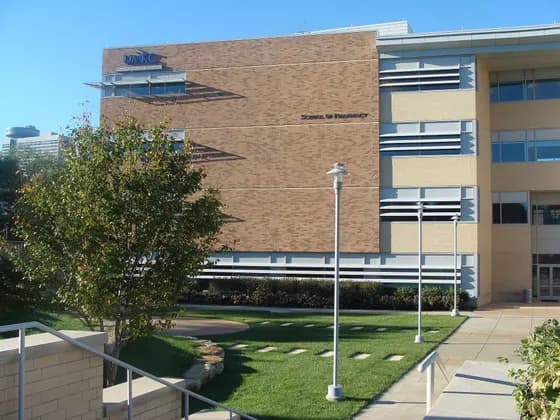
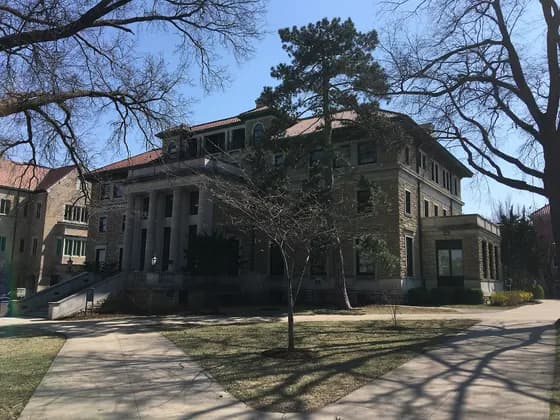

Photo: Voidxor · CC BY-SA 3.0 · cropped
Photo: Nightryder84 · CC BY-SA 3.0 · Photo: 1mikegrn · CC BY-SA 4.0 · Photo: User:Charvex · Public domain
The UMKC School of Medicine MD program at a glance (2027 entry)
The University of Missouri-Kansas City (UMKC) School of Medicine runs a four-year M.D. program for students who hold, or will soon earn, a bachelor's degree, starting in January. The school also runs a six-year B.A./M.D. that admits students straight from high school. The two programs merge in your first semester, and in Kansas City you then take the same required courses and rotations as B.A./M.D. students.
The program is built around the docent system, which the school has used since it opened in 1971. A docent is a physician who teaches and mentors a small team. From your first fall in Kansas City you belong to a team of about 12 students from all four years (the school's pages give sizes from 10 to 15). It also includes a clinical pharmacologist, a clinical medical librarian and an Education Team Coordinator (ETC), your academic advisor.
Science and clinical work run side by side. The pre-clerkship (pre-clinical) science courses fill your first year and a half. Four Human Structure Function courses teach the basic sciences one organ system at a time, followed by pathology, neuroscience, microbiology and clinical skills. Meanwhile clinical work runs every week, first in on-site docent sessions and then in a half-day continuity clinic. The last two science courses, Pharmacology and Behavioral Science, share year 2 with your first clerkships, the required clinical rotations. Step 1, the first exam in the national licensing series, follows.
You train in one of two places. The Kansas City campus is on Hospital Hill in the UMKC Health Sciences District. The school does not run its own hospital, so students train with partners such as University Health Truman Medical Center, Saint Luke's Hospital of Kansas City and Children's Mercy Kansas City. The St. Joseph regional campus, based at Mosaic Life Care about 50 miles north, shares the pre-clinical curriculum but aims its clinical years at rural practice.
The pre-clerkship science courses carry letter grades rather than pass/fail. After the first year and a half, the calendar switches from semesters to 13 four-week blocks a year, with one vacation block in each.
| Degree | M.D., four years full time, starting in January |
|---|---|
| Classmates | You merge with the six-year B.A./M.D. class in your first semester |
| Campuses | Kansas City on Hospital Hill, or the St. Joseph regional campus for rural medicine |
| Class sizes | St. Joseph designed for 20 a class; six-year B.A./M.D. admits 105 to 110 yearly |
| Teaching style | Organ-system science first, with weekly clinical work from the start |
| Docent team | About 12 students in Kansas City, led by a physician docent |
| First patient contact | Weekly docent sessions from January; clinic half-day weekly from September |
| Grading | Letter grades in pre-clerkship science; clerkships Credit/Pass or five tiers |
| Step 1 timing | Year 2, after Pharmacology, Behavioral Science and a qualifying practice exam |
| Accreditation | Full, in the Liaison Committee on Medical Education directory, October 2026 |
What makes the UMKC School of Medicine MD program different
A docent team that stays with you to graduation
In Kansas City you keep the same docent team from your first fall to graduation. The team shares a weekly clinic and, on the Docent Rotation, makes daily ward rounds together for two four-week blocks a year in your last three years.
Half a day in the same clinic every week
In Kansas City the Continuing Care Clinic starts in September of your first fall and runs until you graduate, about three and a half years. Under your docent's supervision you see and follow your own panel of patients, so you watch illnesses develop and learn what an ongoing doctor-patient relationship involves.
Ward work before Step 1
In year 2, alongside Pharmacology and Behavioral Science, you can take the eight-week Docent Rotation on internal medicine wards and the Family Medicine clerkship. Apart from the weekly clinic, these are the only required clerkships you may start before sitting Step 1.
A rural-medicine campus with a longitudinal clerkship
The St. Joseph regional campus is designed for 20 students a class. In year 3 its students spend three blocks at one of five rural partners in a longitudinal integrated clerkship. There they care for a community of patients across primary care, emergency care, surgery, women's health and behavioral medicine.
A five-block break or a December finish
You follow one of three plans through the program's 52 four-week blocks: a five-block leave straight after Step 1, the same leave midway through your clerkships, or no leave and a December finish. The 2022-23 student handbook says St. Joseph students typically graduate in December, and the campus's first class graduated in December 2024.
How UMKC School of Medicine teaches medicine
Science is taught through lectures, labs and small groups, and clinical skills through workshops and standardized patients, people trained to play patients or relatives. The school describes the docent system as apprenticeship combined with small-group teaching, mentoring and peer coaching, with nurses, pharmacists, librarians and social workers joining the docent in teaching. The curriculum is designed and managed by the school's Council on Curriculum.
In the Human Structure Function series, team-taught lectures are sequenced so that you study one organ system through five disciplines at once: anatomy, histology, embryology, physiology and biochemistry. Each course ends with a final exam.
From your first fall the teaching shifts to discipline courses. Pathology II, for example, combines lectures, digital labs, small groups and self-directed learning, and Clinical Practice of Medicine II teaches examination skills system by system in step with it. In year 2 the remaining science comes in compact block courses, while Patient, Physician and Society runs alongside your clerkships. A required nutrition thread of at least 40 hours runs through years 1 to 3.
St. Joseph students take the same pre-clinical courses but join most lectures remotely from Kansas City, while labs, team-based and problem-based learning, clinical skills and workshops happen in person on their campus.
The ways you will learn
| Lectures | Lectures carry most of the pre-clerkship science. In Human Structure Function IV every basic science lecture includes clinical faculty, and in Medical Neurosciences clinicians link specific diseases to the lectures. |
|---|---|
| Clinical Correlations | Case discussions led by clinicians, running for six months across the spring and summer, that reinforce the science of Human Structure Function I to III. |
| Small-group workshops | Clinical Practice of Medicine I and II teach history taking, communication and examination in small-group workshops, including motivational interviewing and handling challenging patient interactions. Pharmacology includes extensive small-group work, and Behavioral Science uses case studies and a problem-centered approach. |
| Standardized patients and OSCEs | Standardized patients also assess you from the patient's side. Sensitive-exam standardized patients teach breast, pelvic, male genitourinary and rectal examinations on their own bodies, with feedback in real time. Clinical Practice of Medicine includes high-stakes OSCEs (Objective Structured Clinical Examinations), timed stations each testing one clinical task. |
| Docent team | Your docent teaches in clinic and during Docent Rotations, through rounds, conferences and consultations alongside residents. On Docent Rotations and the obstetrics and gynecology clerkship you also complete a peer assessment of each student on the rotation. |
| Self-paced pharmacology series | Four short self-paced courses, one a year and taken in order: Introduction to Pharmacology, Ambulatory Care Pharmacology, Prescribing for Special Populations, and Rational and Safe Drug Prescribing. They run from drug information and prescription writing to outpatient treatment, prescribing for groups such as children and pregnant patients, and medication safety. |
A typical week on the UMKC School of Medicine program
In a typical pre-clerkship week, scheduled teaching and assessments, including online work done on your own schedule, should not exceed 25 hours under the school's workload policy. You are expected to spend about 15 more hours on self-directed learning, and the policy tells students in a professional program to be ready for a 60-hour working week.
On clerkships, duty hours are capped at 60 a week averaged over four weeks, including call, with one day in seven free. You should have 10 hours off between shifts and must have 8, and scheduled teaching on top of patient care averages no more than 12 hours a week. Your weekly half-day clinic continues during study blocks and during electives within 25 miles of the school.
How anatomy is taught at UMKC School of Medicine
Anatomy is taught inside the four Human Structure Function courses, with histology, embryology, physiology and biochemistry, so you learn each region's structure alongside how it works. The topics of each course are listed under Year 1 below.
The nervous system gets its own course in your first fall. Medical Neurosciences is lecture-based, but its laboratory is organized around brain dissection sessions that show gross lesions and connect them to clinical symptoms. Pathology I then returns to gross and microscopic anatomy through the lens of disease.
On the St. Joseph campus, the curriculum page lists anatomy labs, a cadaver lab and histology labs among the activities taught in person there. In Kansas City, the Experiential Learning Center holds more than 100 anatomical models and the Harvey simulator for pre-clinical courses.
When you first meet patients at UMKC School of Medicine
Clinical experience starts in your first semester. Fundamentals of Medical Practice IV, beside the first three science courses, includes a standardized patient experience and weekly on-site docent sessions, where you tackle medical problems as a team with B.A./M.D. classmates. It also covers screening, health disparities, healthcare quality and safety, and physician wellness.
In Kansas City you join your docent team the August after you start. The 2022-23 handbook describes a White Coat Ceremony each August, where new students learn their team, docent, senior partner (a student two years ahead) and advisor. It also says you need Basic Life Support certification before clinic begins in September.
Year 2 brings your first full-time clinical work. On the Docent Rotation you round daily on internal medicine wards with your docent, residents and attending staff, paired with a senior partner. Family Medicine covers patients of every age in the context of their families and communities. Behavioral Science adds home health visits, supervised interviewing and time on an inpatient chemical dependency unit.
At St. Joseph, physicians at Mosaic Medical Center lead the first-semester docent experience. The Rural Continuing Care Clinic Clerkship then provides a weekly continuity clinic in years 1 and 2, mostly in St. Joseph but sometimes in nearby communities.
Service learning adds more patient contact. Medical students developed and run the Sojourner Clinic, a free outpatient clinic, and students also help at the Kansas City Free Eye Clinic. In the National Diabetes Prevention Program, students coach participants through a 22-session lifestyle and nutrition program.
The UMKC School of Medicine curriculum, year by year
- Year 1: January to July
Human Structure Function, system by system
On the current calendar, orientation is on January 4, 2027, and Human Structure Function I starts the next day, with B.A./M.D. students in their second year. Break weeks separate the four courses.
- Human Structure Function I (January 5 to February 12, 2027): introductory principles and the musculoskeletal system.
- Human Structure Function II (February 22 to April 2): blood, the autonomic nervous system, and the lungs and heart.
- Human Structure Function III (April 12 to May 21): the gastrointestinal, endocrine and reproductive systems.
- Human Structure Function IV (May 31 to July 25, tentative): the head and neck. It includes a comprehensive exam on the whole series, and its final is set for July 19.
- Fundamentals of Medical Practice IV and Clinical Correlations alongside, then History of Medicine in the summer, on how disease has shaped history.
- Year 1: August to May
Disease, the brain and clinical skills
The fall and spring semesters move from normal structure to disease. On the 2026-27 pattern, fall runs from early August to mid-December and spring from January to mid-May.
- Pathology I (fall): general pathology, genetics and immunology, laboratory tests and diagnosis from pathologic findings, plus global health and forensic pathology.
- Medical Neurosciences (fall): major neurological disorders and disease states.
- Pathology II (spring): systems-based pathology and pathophysiology, from molecular changes to their effects on organs and symptoms.
- Medical Microbiology (spring): viruses, bacteria, fungi and parasites, then how infections present and are treated, with case studies and antimicrobial stewardship.
- Clinical Practice of Medicine I and II, Introduction to Pharmacology, and a 20-hour core nutrition module on metabolism and nutrition in disease.
- Year 2
Blocks, first clerkships and Step 1
From late May the calendar switches to 13 four-week blocks. You finish the pre-clinical courses, start clerkships and prepare for Step 1 of the United States Medical Licensing Examination (USMLE). About five blocks are electives, and your Step 1 study blocks come out of these.
- Pharmacology (two blocks, in blocks 1 and 2 or 5 and 6): how drugs interact with the body.
- Behavioral Science in Medicine (one block, in block 3, 4, 7 or 8): psychiatric disorders, chemical dependence, ethics and communication, as preparation for psychiatry.
- The Docent Rotation (two blocks) and the Family Medicine clerkship (one block).
- Patient, Physician and Society I in the fall, on medical decision making and epidemiology, and II in the spring, on medical ethics and palliative care.
- The weekly clinic, and a five-hour small-group project on how nutrition and drugs interact.
- Year 3
Core clerkships
In Kansas City, year 3 is mostly core clerkships, in different orders for different students; the catalog places them here, though some can fall in year 4. You must pass Step 1 before moving into year 4.
- Pediatrics (eight weeks): normal and abnormal development and behavior from newborns to children, with history taking and examination in outpatient settings.
- General Surgery (eight weeks): care around operations, the operating room, clinics and night call; you practice scrubbing, knot tying and suturing and assist with chest tubes and central venous catheters.
- Obstetrics and Gynecology (eight weeks): outpatient gynecology, family planning, early detection of gynecologic cancer, prenatal care, and normal labor and delivery.
- Psychiatry (four weeks): supervised care on the adult inpatient service and in clinic, with seminars on psychopathology, psychopharmacology and substance use.
- A second Docent Rotation, about three elective blocks, and 15 hours of nutrition teaching built into clerkships.
- A one-block medical humanities or social science course, taken in year 3 or 4 and offered four times a year (blocks 1, 5, 10 and 11 on the 2026-27 calendar). Catalog options include Medicine and Literature, Medicine and Film, Medicine and Music, Medicine and Philosophy, and Medicine, Law and Bioethics.
- Year 4
Emergency medicine, electives and Step 2 CK
You complete the last required rotations, take USMLE Step 2 CK (Clinical Knowledge) and apply for residency, finishing in December or, after a five-block break, in May.
- A third Docent Rotation and the four-week Emergency Medicine clerkship, on the first care of medical and surgical emergencies, from lacerations and burns to life-threatening illness.
- About three elective blocks, including the required critical care elective if you have not taken it already.
- Graduation also requires current Advanced Cardiac Life Support (ACLS) certification and a year-end interview with your docent.
- Years 3 and 4 at St. Joseph
Rural clinical training
St. Joseph students take a parallel clinical curriculum built for rural practice. They do not join the continuity clinic in years 3 and 4, because the longitudinal clerkship and specialty rotations provide that continuity and mentoring.
- A longitudinal integrated clerkship (LIC): rather than one specialty at a time, you learn core clerkship objectives across several fields over three blocks at one of five rural partners. It centers on family medicine, with primary care physicians as teachers and mentors and housing at some locations.
- One-block clerkships in general surgery, internal medicine, pediatrics and obstetrics and gynecology, plus psychiatry, at the campus's clinical affiliates.
- Emergency Medicine at Mosaic Life Care in year 4, with most of the rest of the year in electives.
- Rural Medical Humanities, a longitudinal course you take on your own schedule, on the arts, medicine and rural communities.
How you are assessed at UMKC School of Medicine
The pre-clerkship science courses are graded A to F: the four Human Structure Function courses, Clinical Correlations, Medical Neurosciences, Medical Microbiology, and Pathology I and II. Their grades form a cumulative science GPA, and you need at least 2.8 in it, and overall, to move into year 2. The 2.8 overall GPA also applies at each later promotion and at graduation.
Clinical rotations and electives are graded either Credit/Pass or on a five-point scale: Fail, Marginal Pass, Satisfactory Pass, High Pass and Honors. The Docent Rotation, pediatrics, obstetrics and gynecology, surgery, psychiatry, emergency medicine and Behavioral Science each end with a National Board of Medical Examiners (NBME) subject exam. This shelf exam is a national multiple-choice test in that field. Fail one the first time and you cannot earn Honors or High Pass in that rotation.
Clinical skills are tested in high-stakes standardized patient exams and OSCEs in the Clinical Practice of Medicine courses, and core clerkships hold their own in the Clinical Training Facility. On the USMLE, Step 1 covers the basic sciences behind medicine and has been reported only as pass or fail since January 26, 2022. Step 2 CK tests clinical knowledge and keeps a three-digit score. You must pass both to graduate.
Step 1 comes in year 2. To sit it you must pass Pharmacology and Behavioral Science and score at least 66 (equated percent correct) on the NBME Comprehensive Basic Science Exam (CBSE). The school offers this practice exam in every block on both campuses. Four-year M.D. students have no undergraduate campus semester, so your timing follows your own pair of back-to-back study blocks. You take the CBSE in the first week of the first, and your first-attempt deadline is two blocks after the second ends.
Step 2 CK can be taken once you have passed Step 1 and completed your second Docent Rotation and the pediatrics, surgery, obstetrics and gynecology and psychiatry clerkships. Passing four of those five subject exams first time clears you to sit it; otherwise you take the NBME Comprehensive Clinical Science Exam (CCSE), where 218 or more clears you. You must sit Step 2 CK by December 31 of your final year, and the school strongly recommends mid-September.
In August 2026 the USMLE program announced a move to designated testing dates from January 2029, with Step exams offered less often each year. Its June 2026 announcement had named 2028. On the current schedule, a January 2027 entrant would start year 2 in late May 2028 and sit Step 1 between about autumn 2028 and spring 2029. So Step 1 could fall before or after the switch, depending on your schedule, while Step 2 CK would come around September 2030, after it.
- Most subject exams allow one retake within four blocks; failing again means repeating the rotation. The attempts you needed appear in your Medical Student Performance Evaluation (MSPE), the dean's letter sent to residency programs.
- Clinical evaluations rate your professionalism; the lowest rating on 20% or more of them, or Marginal Pass or lower on more than half, fails the clerkship.
- You log your patient encounters weekly, and missing the end-of-clerkship deadline drops your grade one level, such as Honors to High Pass.
- If you do not sit Step 1 within six weeks of qualifying, you must qualify again, and you have three attempts to pass each Step.
- The Liaison Committee on Medical Education (LCME) accredits M.D. programs in the United States, and its accreditation is what makes students of an M.D. program like this one eligible to sit the USMLE. Its directory, updated October 14, 2026, lists this program as fully accredited, with its next survey shown as 2025-26.
- The school's own page says it was granted full accreditation for eight years in October 2018 and that its next site review would take place in April 2026.
- The 2027-28 and 2028-29 calendars are not yet published, and the USMLE has encouraged schools to review rules on when students must sit Step exams, so these timings could change.
UMKC School of Medicine clinical rotations: where you will actually train
In Kansas City your docent team rounds daily at University Health Truman Medical Center or Saint Luke's Hospital of Kansas City during Docent Rotations, and the weekly clinic runs at partner hospitals. Many doctors at the partner hospitals also hold faculty posts at the school.
University Health was called Truman Medical Centers until 2021. Its Truman Medical Center is a safety-net academic medical center treating patients with or without insurance, with 258 staffed beds and a Level 1 trauma center verified by the American College of Surgeons. Saint Luke's, founded in 1882, is a tertiary hospital with more than 630 beds and a Level I trauma center.
Children's Mercy Kansas City, a freestanding children's hospital, is a primary affiliate, as are the Kansas City VA Medical Center and the 590-bed Research Medical Center. The school names the Center for Behavioral Medicine, a 65-bed state psychiatric hospital on Hospital Hill, as a core psychiatry clerkship site.
St. Joseph students are based at Mosaic Life Care, whose 352-bed tertiary hospital anchors a system serving 35 counties across four states. Outside the LIC, their core clerkships and emergency medicine take place mainly at Mosaic Hospital in St. Joseph. They come to Kansas City for Family Medicine, alongside the school's family medicine residents.
Four-year M.D. students may ask to change campus after one semester. A committee meets twice a year to review requests, and they are considered only where the other campus has room.
Docent rounds at Truman or Saint Luke's, the weekly clinic, and psychiatry at the Center for Behavioral Medicine among other sites.
- University Health Truman Medical Center
- Saint Luke's Hospital of Kansas City
- Children's Mercy Kansas City
- Center for Behavioral Medicine
- Kansas City VA Medical Center
- Research Medical Center
- University Health Behavioral Health Crossroads
- University Health Bess Truman Family Medicine Center
A 110-bed community hospital in a Kansas City suburb, focused on primary care, with obstetrics, orthopedics and geriatrics.
- University Health Lakewood Medical Center
Home of the regional campus: core clerkships, emergency medicine and the campus simulation center.
- Mosaic Life Care at St. Joseph
- St. Joseph Medical Education Building
Other major clinical sites of the St. Joseph campus; the LIC runs at five rural partners.
- Mosaic Health, Maryville, Missouri
- Mosaic Health, Albany, Missouri
- Hedrick Medical Center, Chillicothe, Missouri
- Carroll County Memorial Hospital, Carrollton, Missouri
- Harrison County Community Hospital, Bethany, Missouri
- Amberwell Health, Atchison, Kansas
- White Cloud Indian Services, White Cloud, Kansas
Electives, selectives and away rotations at UMKC School of Medicine
In Kansas City the course list sets aside about five elective blocks in year 2 and three in each of years 3 and 4, plus a humanities or social science course. To graduate you need at least three clinical electives from three categories, one of them in critical care. The current policy, updated in February 2026, lists ten categories, with neurology and psychiatry counted separately.
A clinical elective earns credit only if it fills a full four-week block, with at least 160 hours (20 eight-hour days) and more than half of that time spent seeing patients. An approved clinical elective of about three weeks can be taken only not for credit. You can also take up to four supervised study or readings blocks. Non-clinical electives in research, academic topics or the humanities earn block credit but do not meet the clinical requirement.
The catalog lists sub-internships, in which you take on much of the work of a first-year resident. They cover family medicine, internal medicine, neurology, pediatrics, neonatal intensive care, obstetrics and gynecology, internal medicine-pediatrics, anesthesiology, emergency medicine and three surgical fields. Other options include pediatric subspecialties, trauma surgery, a Family Medicine Preceptorship with a rural Missouri physician and a four-week culinary medicine elective run with Saint Luke's Muriel I. Kauffman Women's Heart Center.
You arrange away (out-of-town) electives yourself, and any elective not already approved needs Council on Curriculum approval before it starts. In years 3 and 4 you may miss up to four blocks of clinic a year, enough for three away electives and a vacation. In year 2 you can take one. UMKC students are placed in local electives in March and October, ahead of visiting students.
Under the 2022-23 handbook, international clinical electives are open from year 2 to students in good standing, with docent, advisor and Council on Curriculum approval. The school has affiliated institutions in China, Austria and Mexico.
Dual degrees and research years at UMKC School of Medicine
You can take two one-month research electives for credit, and many students also research on their own time. The Student Research Committee helps you find a mentor, either one you approach yourself or a guided match after a meeting with the associate dean for research or a committee member. The school recommends starting before your final year.
The Sarah Morrison Research Award has funded student projects since 2007, with up to $3,000 held by your mentor for expenses; applications close on November 15. Award holders present at the Health Sciences Student Research Summit, held each spring, or a similar event. The UMKC Rural Research Award funds student research in rural health.
For a full research year or an outside degree, you take an Academic Enrichment Leave, which covers research programs, advanced degrees and professional certification. It is noted on your MSPE but does not pause school deadlines, including the six-year limit for finishing the M.D. The school's research pages list outside year-long options such as the National Institutes of Health (NIH) Medical Research Scholars Program and a Frontiers TL1 year with a Master of Science in Clinical Research.
Facilities and support at UMKC School of Medicine
Where you will learn
Clinical skills teaching in Kansas City centers on the Clinical Training Facility, a 5,100-square-foot space on the lower level of the campus parking structure on Hospital Hill and home to the Standardized Patient Program. It has four recorded exam rooms for OSCEs, two classrooms and the Youngblood Medical Skills Laboratory, whose four simulation areas are set up like emergency or intensive care rooms.
Inside the School of Medicine building, the 1,300-square-foot Experiential Learning Center has a patient exam room and a combined classroom and high-fidelity manikin room for up to 30, watched from a control room. A larger simulation center of about 12,000 square feet, with 14 exam rooms and a simulated operating room, is being built in the Healthcare Delivery and Innovation Building, due to open in spring 2027.
The St. Joseph Medical Education Building opened in August 2025 across the street from Mosaic's hospital, and St. Joseph classes moved there from Mosaic. Its 3,000-square-foot simulation center has four exam rooms, an acute care simulation room and a debriefing room, so St. Joseph students train without traveling to Kansas City. In Kansas City, the four docent units in the School of Medicine building and the Purple unit at Saint Luke's give each team offices and a meeting space.
Support while you study
Your ETC, a trained academic advisor attached to your docent unit, helps with scheduling, degree progress and policies and connects you with other help. Your docent mentors you clinically and professionally, and your senior partner adds peer mentoring; later you take that role for a new student.
Academic support covers tutoring and supplemental instruction, coaching from learning specialists and focused help with licensing exams. If you miss a readiness score or fail a Step exam, a USMLE counselor sets a preparation plan with you before your next attempt.
A wellness coordinator runs the wellness program, and the school offers free or low-cost medical services, including psychological and psychiatric care. Career Services guides you from choosing a specialty to the residency application, with free access to the Association of American Medical Colleges (AAMC) Careers in Medicine program from your first fall.
Is the UMKC School of Medicine program right for you?
This program may suit you if
- You want patients every week from your first year, a physician docent who knows you, and a clinic where you follow your own patients for years.
- You want ward experience early: the Docent Rotation and Family Medicine are open to you in year 2, before Step 1.
- You are drawn to rural practice and would value a three-block longitudinal clerkship based from the St. Joseph campus.
- You want varied settings, from a safety-net academic medical center and a children's hospital to a VA hospital and a state psychiatric hospital.
- You want a say in pacing: a five-block break or a straight run to a December finish.
Things to think about
- The pre-clerkship science courses are letter-graded, and you need a 2.8 science GPA to move into year 2.
- You start in January, joining B.A./M.D. classmates who have already spent a year and a half in the program.
- Your Step 1 date depends on your own year 2 schedule, so as a 2027 entrant you could sit it before or after the January 2029 USMLE switch.
- A full research year or outside degree means an Academic Enrichment Leave, which does not pause deadlines such as the six-year limit.
UMKC School of Medicine MD program — frequently asked questions
Applying to UMKC School of Medicine?
How to get into UMKC School of Medicine
Prerequisites, MCAT, AMCAS personal statement, secondaries and interview, step by step.
Open the guide →UMKC School of Medicine admissions profile
MCAT and GPA profile, acceptance rate, interview format and key dates.
See the profile →Compare UMKC School of Medicine with other schools
Put the teaching style, anatomy teaching and clinical sites next to another school.
Open the comparison →Prepare for the UMKC School of Medicine interview
Format breakdown, school-specific sample questions and prep tips from tutors who interviewed here.
Read the guide →Where this UMKC School of Medicine program guide came from
This guide was written from 70 official sources — University of Missouri-Kansas City School of Medicine's own program pages and curriculum documents, plus the accreditor and the hospitals and health systems the school trains students in where they publish detail — read on 2026-10-25, then checked claim by claim against those sources.
- UMKC School of Medicine: M.D. Program
- UMKC School of Medicine: M.D. Program Overview
- UMKC School of Medicine: B.A./M.D. and M.D. Curriculum
- UMKC 2026-2027 Catalog: M.D. Program
- UMKC 2026-2027 Catalog: B.A./M.D. Program
- UMKC 2026-2027 Catalog: Medicine course descriptions and electives
- UMKC 2026-2027 Catalog: Basic Medical Science course descriptions
- UMKC School of Medicine: B.A./M.D. Frequently Asked Questions
- UMKC School of Medicine: Our School
- UMKC School of Medicine: About Us (campuses)
- UMKC School of Medicine: LCME Accreditation
- UMKC School of Medicine: Council on Curriculum
- 2026-2027 B.A./M.D. and M.D. Curriculum Calendar
- UMKC USMLE Step 1 Policy, updated June 2024
- UMKC USMLE Step 2 CK Policy, October 2025
- UMKC 2026-2027 CBSE and CCSE Schedule
- UMKC Council on Curriculum Policy Manual and Guidelines
- UMKC Required Medicine Courses and Rotations, Years 3-6 (updated 2024)
- UMKC Council on Evaluation Policy Manual and Guidelines, effective December 2024
- UMKC School of Medicine MD Student Handbook 2022-23
- UMKC Subject Examination Policy
- UMKC Clinical Electives Policy
- UMKC Clinical Electives Hours Policy (January 2025)
- UMKC Electives with a Timeframe of Three Weeks or Less policy (January 2025)
- UMKC Elective Study and Reading Blocks policy
- UMKC Scheduling Out-of-Town Electives policy
- UMKC School of Medicine Visiting Student Policy
- UMKC Policy on Student Workload Hours for Preclinical Coursework
- UMKC Policy on Student Workload and Clinical Duty Hours for Clerkships
- UMKC Professionalism Competency Assessment for Clerkships
- UMKC School of Medicine: Hospital Affiliates
- UMKC School of Medicine: University Health Truman Medical Center
- UMKC School of Medicine: Saint Luke's Hospital of Kansas City
- UMKC School of Medicine: Children's Mercy Hospital, Kansas City
- UMKC School of Medicine: Center for Behavioral Medicine
- UMKC School of Medicine: Research Medical Center
- UMKC School of Medicine: University Health Lakewood Medical Center
- UMKC School of Medicine: Mosaic Life Care at St. Joseph
- Missouri Department of Mental Health: Center for Behavioral Medicine
- Children's Mercy Kansas City: About Children's Mercy
- UMKC News: Truman Medical Centers changes name to University Health (October 2021)
- UMKC News: School of Medicine expands its program to St. Joseph (June 2020)
- UMKC News: St. Joseph students celebrate the campus's first Match Day (March 2025)
- UMKC News: Grand opening of the new St. Joseph medical school building (August 2025)
- UMKC Medicine Magazine 2025: If You Build It, They Will Come
- UMKC News: How UMKC is building Missouri's rural healthcare workforce (February 2026)
- UMKC School of Medicine: St. Joseph M.D. program
- UMKC School of Medicine: St. Joseph Regional Campus M.D. Curriculum
- UMKC School of Medicine: St. Joseph Rural M.D. Program welcome letter
- UMKC School of Medicine: Learning in Docent Teams
- UMKC School of Medicine: Docent Units
- UMKC School of Medicine: Clinical Training Facility
- UMKC School of Medicine: Simulation Locations and Facilities
- UMKC School of Medicine: Standardized Patient Program
- UMKC School of Medicine: Clinical Practice of Medicine Open Hours
- UMKC School of Medicine: Nutrition Curriculum
- UMKC School of Medicine: Student Research
- UMKC School of Medicine: Student Research, Getting Started
- UMKC School of Medicine: Student Research FAQs
- UMKC School of Medicine: Sarah Morrison Research Award
- UMKC School of Medicine: Extramural Fellowships and Opportunities
- UMKC School of Medicine: Academic Advising
- UMKC School of Medicine: Academic Support
- UMKC School of Medicine: Wellness Program
- UMKC School of Medicine: Career Services
- LCME: Accredited Programs directory (updated October 14, 2026)
- USMLE Bulletin of Information: Eligibility
- USMLE: Examination Results and Scoring
- USMLE: Updated Timeline for Designated Testing Dates, Transition in January 2029
- USMLE: Designated Testing Dates Information Hub
Curricula are restructured between cycles. Anything here that decides your application — how anatomy is taught, a clinical campus assignment, a required research year — should be confirmed against the official page for your entry year.
Applying to UMKC School of Medicine?
We help US applicants with MCAT strategy, the AMCAS personal statement, secondary essays and interview prep — everything you need for a competitive UMKC School of Medicine application.