
The University of Central Florida College of Medicine MD program
What you actually study, and where you will be
University of Central Florida College of Medicine's M.D. is a 4-year program taught through case-based learning in an integrated curriculum, with patient contact from Year 1 and clinical rotations in the Orlando area, plus Florida sites from Naples to Tallahassee (2027 entry). UCF's M.D. program is taught at the Health Sciences Campus at Lake Nona in Orlando. Years 1 and 2 run through a Foundations course and five Integrated Sciences courses organized by body system, with case-directed and team-based learning, cadaver labs and simulated patients. You join community preceptors from Year 1 and complete your own research project, then spend Year 3 in block clerkships across Orlando and other Florida sites.
- Degree
- M.D.
- Length
- 4 years
- Teaching
- Integrated + Case-based learning
- Clinical contact
- Year 1

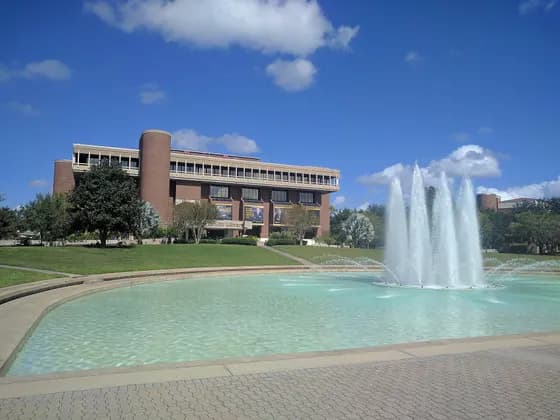
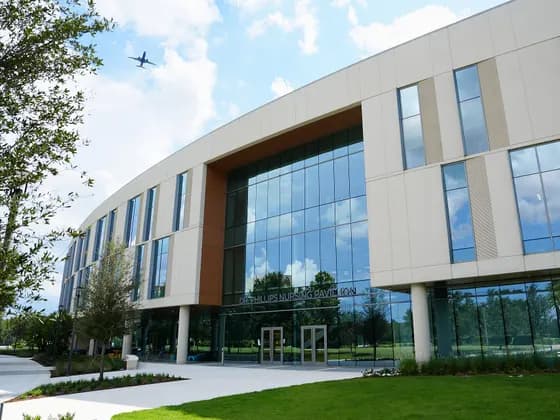
Photo: Ferrara29 · CC0 · cropped
Photo: elisfkc from Orlando, FL, United States · CC BY-SA 2.0 · Photo: UCF College of Nursing · CC BY-SA 4.0 · Photo: Visitor7 · CC BY-SA 3.0
The University of Central Florida College of Medicine MD program at a glance (2027 entry)
The University of Central Florida College of Medicine (UCF College of Medicine, or UCF COM) runs a four-year Doctor of Medicine (M.D.) program in Orlando, Florida. Teaching is based in the Medical Education Building on the 50-acre Health Sciences Campus at Lake Nona, about 25 miles south of UCF's main campus. Each entering class has 120 students.
A new curriculum began with the students who entered in 2024; the legacy curriculum now applies only to the Class of 2027 and earlier. Years 1 and 2 form the pre-clerkship phase, the classroom-based stage before full-time clinical work. It opens with an 8-week Foundations course, followed by five Integrated Sciences courses that each take a group of body systems from normal function to disease and treatment.
Patients appear early, through community preceptors (local physicians who host you in their practices) from Year 1 and through simulated encounters with standardized patients, people trained to act as patients. Every student also completes the Focused Individualized Research Experience (FIRE), a mentored research project that runs through the first two years.
Year 3 is spent in clerkships, the core clinical rotations, taken in blocks from June after Year 2 at hospitals around Orlando and at distant Florida sites. Year 4 centers on an acting internship, a month of intern-level responsibility for patients, and electives.
The Liaison Committee on Medical Education (LCME) accredits MD programs in the United States. Its directory, updated October 14, 2026, lists the program as fully accredited, with 2008 as the initial year of accreditation and 2033-34 for the next survey. March 2026 minutes of the college's M3/M4 subcommittee, which oversees Years 3 and 4, record that accreditation was renewed for eight years.
| Degree | M.D. (Doctor of Medicine) |
|---|---|
| Program length | 4 years, full time, starting in August |
| Class size | 120 students per entering class |
| Main campus | Health Sciences Campus at Lake Nona, Orlando |
| Curriculum | New since 2024: Foundations, then five Integrated Sciences courses |
| Teaching style | Case-directed and team-based learning, flipped classrooms, simulated patient encounters |
| Anatomy | Cadaver dissection, with prosection demonstrations and a virtual cadaver table |
| First patient contact | Year 1, with Community of Practice preceptors |
| USMLE Step 1 timing | End of Year 2, before clerkships start in June |
| Grading | Tiered grades in Years 1 to 3; no GPA or numerical class rank |
What makes the University of Central Florida College of Medicine MD program different
Your own research project, from proposal to poster
Through Years 1 and 2 you work with a faculty mentor on a research study, quality improvement project or literature review. Faculty, statisticians, librarians and classmates review your proposal, poster and manuscript, and you present a poster at the annual FIRE conference, graded by faculty and peers.
Community preceptors and simulated patients from Year 1
The Community of Practice, which has drawn on more than 80 preceptors, places you with physicians across Central Florida. On campus, a feedback plan the Curriculum Committee approved in June 2026 reviews the scoring checklist with you after each of 14 graded simulated encounters and adds communication coaching in both years.
Three hospitals within walking distance of class
UCF Lake Nona Hospital, run in partnership with HCA Healthcare, sits beside the Medical Education Building, with the Orlando Veterans Affairs (VA) Medical Center and Nemours Children's Hospital also within walking distance. All three are clerkship sites, and between them they cover every core specialty.
Electives from aerospace medicine to culinary medicine
The 2026-27 directory has 157 elective and selective listings. They run from Principles of Aerospace Medicine, with time at NASA's Kennedy Space Center, to Culinary Medicine with chefs and dietitians, Medical Spanish and public health in Peru.
Primary Care Scholars: a year exploring primary care
This federally funded program gives selected students in Years 1 to 3 between 50 and 100 hours of workshops, mentoring, underserved care and simulations, ending in a scholarly project.
How University of Central Florida College of Medicine teaches medicine
Every course is built on three domains. Basic sciences explain how the body works and how disease disrupts it. Clinical sciences teach you to communicate with patients, examine them and reason toward a diagnosis. Health system sciences cover ethics, patient safety, medical informatics and systems thinking.
The Integrated Sciences course pages describe a case-based, clinical problem-solving approach, with anatomy and clinical skills taught together. The college describes its teaching model as case-directed learning (CDL), flipped classrooms and clinical teaching. September 2026 M1/M2 minutes also report two team-based learning (TBL) sessions each in Foundations and Integrated Sciences 3 so far. Some content comes as online self-learning modules (SLMs), and July 2026 M1/M2 minutes mention ScholarRx online lessons called Bricks.
Narrative medicine, which uses close reading and reflective writing, is built into the pediatrics, internal medicine and psychiatry clerkships, and nutrition teaching runs through all four years. According to July 2026 M3/M4 minutes, a new Advanced Clinical Skills and Professional Development course runs across Years 3 and 4. It merges the Year 3 to 4 transition course, the Year 3 intersession weeks and the Year 4 boot camp, and adds residency career advice.
The ways you will learn
| Team-based learning (TBL) | You prepare before class, take a short readiness test alone and then with your team, and spend the session applying the material to problems. |
|---|---|
| Case-directed learning (CDL) | The college's name for faculty-facilitated sessions built around clinical cases. Under a plan the Curriculum Committee approved in July 2026, biostatistics and epidemiology are being threaded through them. |
| Flipped classroom and self-learning modules | In a flipped classroom you study the material beforehand and use class time to apply it. You work through SLMs at your own pace; FIRE uses them alongside scheduled sessions. |
| Simulated clinical encounters | Consultations with standardized patients in the Clinical Skills and Simulation Center, used for practice and for graded assessment. Specially trained teaching associates also teach the physical exam and the breast, pelvic and male genital-rectal exams, acting as your practice models. |
| Clerkship teaching | Supervised work on inpatient and outpatient teams, with clerkship lectures, standardized patients and simulations. Surgery adds grand rounds, journal clubs, morbidity and mortality conferences, tumor boards, simulator and animal labs, and in-hospital call. |
How anatomy is taught at University of Central Florida College of Medicine
Anatomy is built into the Integrated Sciences courses and taught mainly through cadaveric dissection in the 8,100-square-foot Anatomy Lab, which has 22 dissection tables. Screens beside the tables give access to a digital dissection manual, and a virtual cadaver table shows normal anatomy, CT images and hundreds of examples of pathology in 3D.
In Integrated Sciences 1, dissection labs cover the bones, joints, muscles, ligaments and tendons. September 2026 M1/M2 minutes report that the course now has cadaver labs in weeks 7, 9 and 10, an anatomy-focused CDL and a separate anatomy assessment. Integrated Sciences 4 includes gross brain dissections. From 2026-27, a pathology-led autopsy and clinical correlation project, approved by the Curriculum Committee in August 2026, runs through Integrated Sciences 1 to 5 and ends in a graded report in Integrated Sciences 5.
In June 2026 the Curriculum Committee approved an Anatomy Education Taskforce plan. Labs are split so half the teams attend each session, giving faculty more time at every table. Dissection is targeted at high-yield structures and supplemented by instructor-guided prosection demonstrations, using specimens already dissected by staff. Buddy tables are paired by donor sex to widen what you see, and the plan adds a pre-lab package, imaging sessions, lab practical exams and optional after-hours dissections.
More change may come for 2027 entrants: April 2026 Curriculum Committee minutes report a consensus to propose moving basic anatomy into Foundations, keeping detailed cadaveric dissection in the Integrated Sciences courses, for 2027-28. August 2026 M1/M2 minutes add that a Foundations taskforce is weighing two proposals: keeping the course at 8 weeks with more anatomy, or extending it to 10 weeks. Senior electives include Clinical Teaching Anatomy and an online Advanced Clinical Anatomy course.
When you first meet patients at University of Central Florida College of Medicine
Your first patient contact comes in Year 1 through the Community of Practice, a longitudinal program that assigns you to faculty preceptors in practices across Central Florida. As role models, they help you practice patient communication and the physical exam and apply your classroom science to real patients.
You meet standardized patients from Foundations onward, first taking histories and later adding vital signs, focused exams and write-ups of simulated and real encounters. You can also volunteer at the KNIGHTS Clinic, a free clinic coordinated by UCF medical students under licensed supervision.
The University of Central Florida College of Medicine curriculum, year by year
- Year 1 (M1)
Foundations, then the first body systems
Year 1 runs from orientation and the White Coat Ceremony in early August to late May, with 37 weeks of instruction.
- Foundations (8 weeks, to early October): cell biology, biochemistry, genetics, histology, pathology, epidemiology, biostatistics and drug action, plus the medical interview, professionalism and ethics.
- Integrated Sciences 1 (13 weeks, to late January): the blood, immune system, skin and musculoskeletal system, with dissection labs, imaging and the exam for each system.
- Integrated Sciences 2 (16 weeks, to late May): the heart, lungs and gut, with heart, lung and abdominal exams, ECGs, blood gases, lung function tests, X-rays and motivational interviewing.
- FIRE I: you choose a mentor and design your study, then submit a proposal at the end of the year.
- Year 2 (M2)
More systems, then Step 1
Year 2 starts in August with three more Integrated Sciences courses, ending in late March. Then you prepare for USMLE Step 1, the first national licensing exam (explained under Assessment), which you must take before the Transition to Clerkships course begins in May.
- Integrated Sciences 3 (14 weeks, to mid-November): endocrine, reproductive and renal systems, including sexual and reproductive health histories, the genitourinary exam and healthcare financing.
- Integrated Sciences 4 (10 weeks, to mid-February): the nervous system and behavioral health, with gross brain dissections, neuroimaging and high-fidelity simulation.
- Integrated Sciences 5 (6 weeks, to late March): multisystem disorders and diagnostic reasoning, taught through cases and simulated encounters.
- FIRE II: you obtain approvals, collect and analyze data and present a poster at the FIRE conference, on May 10, 2027 on the current calendar.
- The National Board of Medical Examiners (NBME) Comprehensive Basic Sciences Examination (CBSE), an in-person readiness check, falls on March 29, 2027 on the current calendar. About six weeks of Step 1 study follow.
- Year 3 (M3)
Core clerkships
Year 3 runs from early June to late May in blocks of 4 to 12 weeks, taken with your class as a cohort. Beside the six core clerkships you have a 4-week clinical selective, a 4-week off block and a one-week course at midyear and at the end.
- Internal and family medicine (12 weeks): inpatient and outpatient care of adults with common conditions, health promotion and screening, with standardized patients and simulation.
- Surgery and surgical selectives (8 weeks): 4 weeks of general surgery and 4 weeks in one surgical specialty, such as colorectal, orthopedic, pediatric, thoracic or vascular surgery, urology, or plastics and wound healing.
- Obstetrics and gynecology (6 weeks): labor and delivery, the operating room, clinics and inpatient wards, plus lectures, skills workshops and case seminars.
- Pediatrics (6 weeks): the newborn nursery, well-child and sick visits, and inpatient care of patients from newborns to young adults.
- Neurology and psychiatry (4 weeks each): neurology sets minimum patient numbers, such as two with stroke, and has you review EEG, CT and MRI with a mentor.
- The Advanced Clinical Skills and Professional Development course covers advanced communication and clinical reasoning, career planning and hospital credentialing. The year ends with a must-pass OSCE (objective structured clinical examination), a timed circuit of clinical stations.
- Year 4 (M4)
Acting internship and electives
Year 4 is eleven 4-week blocks from June to April, with Match Day in March, when residency places are announced, and graduation in May. You need 32 weeks of coursework, at least 16 of them in UCF's own rotations, scheduled through the registrar in 2- or 4-week units.
- One 4-week acting internship, also called a sub-internship, in a core specialty. You take primary responsibility for patients and report to faculty, fellows or senior residents rather than interns.
- One 4-week emergency medicine or critical care rotation.
- 24 weeks of electives: no more than 16 in one specialty, at most 12 non-clinical (up to 8 of them research) and at least 4 of clinical work in the spring.
- Up to 12 optional weeks for more electives, research, independent study, residency interviews, make-up or vacation.
- A one-week capstone with specialty boot camps, which the catalog calls Transition to Internship, held April 26 to 30, 2027 on the current calendar.
- September 2026 M3/M4 minutes tentatively approve, from next academic year, a 4-week Transition to Internship course in Block 10, around Match Day, in place of the capstone. It would include at least two weeks on site for simulation and procedural skills, and still needs Curriculum Committee approval.
How you are assessed at University of Central Florida College of Medicine
Policy 9.9.3 lists the methods: multiple-choice exams, written work, projects, OSCEs, direct observation and workplace-based ratings. The college reports no GPA or numerical class rank. Instead, your credit-weighted percentage scores from Years 1 to 3 place you in one of four categories, from Outstanding to Good. That goes into your Medical Student Performance Evaluation (MSPE), the dean's letter sent to residency programs.
Pre-clerkship courses are graded in four tiers, Honors, High Pass, Pass and Fail, with cutoffs at 90%, 80% and 70%, according to June 2026 M1/M2 subcommittee minutes. Almost all students earn Honors or High Pass, the minutes note, and a proposal to raise the Honors and High Pass cutoffs was put on hold for more research. Policy 9.9.3 (February 2025) makes A, B, C and F letter grades the default but lets the Curriculum Committee approve such tiers.
In the clerkships you sit NBME subject exams, known as shelf exams: national multiple-choice tests in each specialty. Failing more than one during the core clerkships removes you from your current clerkship until the promotions committee reviews your case. Psychiatry, for example, grades on preceptor evaluations, the shelf exam and two observed diagnostic interviews.
The United States Medical Licensing Examination (USMLE) is the three-step exam series that state medical boards use in licensing decisions; you take the first two steps during the M.D. program. Step 1 has been reported only as pass or fail since January 26, 2022; you must pass it to enter Year 3, and pass Step 2 CK (Clinical Knowledge) to graduate. Enrollment in an LCME-accredited MD program makes you eligible for both. Students at osteopathic (DO) schools accredited by the Commission on Osteopathic College Accreditation (COCA), and at non-US schools meeting Educational Commission for Foreign Medical Graduates (ECFMG) requirements, qualify through other routes.
In August 2026 the USMLE program announced a move to designated testing dates from January 2029, with Step exams offered less often each year. Its June 2026 notice had named 2028. The college's M3/M4 subcommittee noted the delay in August 2026 and is monitoring the effects on curriculum planning and on students' access to local testing centers.
On the current schedule, a student entering in August 2027 would take Step 1 in spring 2029 and start clerkships in early June 2029. Step 2 CK would come after Year 3 ends in late May 2030, due by August 31, 2030 under college policy. This follows the 2026-27 calendars, the latest posted. Both exams would fall after the January 2029 change.
- For 2026-27, weights the Curriculum Committee approved in June 2026 make clinical sciences 25% of the Foundations grade, 30% in Integrated Sciences 1 to 4 and 35% in Integrated Sciences 5.
- September 2026 M1/M2 minutes put each simulated encounter in Integrated Sciences 1 at 10% of the grade. July 2026 M1/M2 minutes set new anatomy practicals at 5% of the grade in Integrated Sciences 2 and 3% in Integrated Sciences 4.
- A T grade is a temporary grade for passing work that needs remediation in one area, or for a clerkship where the NBME exam was failed while other parts were passed. Under a rule the Curriculum Committee approved in April 2026, remediating a T restores your earlier grade, though not Honors.
- January 2026 M3/M4 minutes record approval of a reflective essay, tied to health system sciences, worth 5% of every clerkship grade.
- A surgery clerkship review the Curriculum Committee approved in July 2026 supports planned changes toward one grade make-up for all clerkships. Graded quizzes and the case report would go, while direct observations and two patient write-ups called histories and physicals (H&Ps) would count.
- The end-of-year M3 OSCE is a must-pass exam for graduation. Standardized patients score your communication, history taking and examination; faculty score skills stations such as notes, test interpretation, oral presentations and orders. Falling short means at least two weeks of remediation, finished before Block 4 of Year 4.
- Before Step 1 you meet Student Academic Support Services (SASS) one-on-one to plan your study. A CBSE score below 49% estimated correct means a required SASS program with weekly practice exams. Practice scores below 65% two weeks before Transition to Clerkships bring a four-week study extension that delays Year 3.
- Step 2 CK must be taken by August 31 of Year 4 under Policies 9.9.7 and 9.9.1 and the 2026-27 catalog; Policy 9.9.7 also sets registration by June 30. The 2026-27 curriculum schematic shows it as due by December.
- Attendance Policy 8.8.2 (July 2026), restated in August 2026 M3/M4 minutes, makes taking Step 2 during clinical duties an unexcused absence. May 2026 M3/M4 minutes told third-year students to take it after the post-clerkship week that ends Year 3, a rule they noted was under review.
University of Central Florida College of Medicine clinical rotations: where you will actually train
Clerkships run at hospitals, clinics and private practices around Orlando and at several distant Florida sites. The Curriculum Directors page lists 15 sites for internal and family medicine alone, from HCA Florida hospitals to UCF Health, the UCF Student Health Center and community practices.
Bay Pines VA, HCA Florida North Florida Hospital in Gainesville, HCA Florida Ocala Hospital and NCH Healthcare System in Naples host core clerkships farther away. Each has a UCF Academic Assistant Dean. August and September 2026 M3/M4 minutes report a new psychiatry site at HCA Florida Capital Hospital in Tallahassee, now running, with possible expansion to other clerkships.
Policy 10.9.1 (June 2025) and the 2026-27 catalog describe an online lottery in Year 2: you rank clerkship orders, then locations, with swap periods after each round. Limited hardship requests, decided first, can secure an Orlando Area-Only schedule (which includes Sanford and Lake Mary), a chosen off block or the same order as a partner. The M3/M4 subcommittee's January 2026 minutes instead record no lottery for scheduling, with a worksheet and survey due January 27, 2026 and a separate housing lottery.
Housing Policy 13 (version 3, June 19, 2026) says the college provides housing for third-year students on approved rotations at Bay Pines, HCA North Florida, Jacksonville and HCA Ocala. Year 4 housing depends on availability, and the college does not manage housing at Naples.
In Year 4 you book UCF, VA and private-office electives through the registrar. HCA Florida Osceola Hospital courses go through Clinician Nexus, an HCA platform. Courses at AdventHealth and Orlando Health must be booked through VSLO, the Visiting Student Learning Opportunities service also used for away rotations at other institutions.
Within walking distance of the college.
- UCF Lake Nona Hospital
- Orlando VA Medical Center
- Nemours Children's Hospital
Hospitals, clinics and practices used across the clerkships.
- HCA Florida Osceola Hospital
- HCA Florida Oviedo Medical Center
- HCA Florida Lake Monroe Hospital
- UCF Health (the college's faculty practice, with offices in East Orlando and Lake Nona)
- Orange County Department of Health
- Community practices and clinics
Neurology and surgery clerkships and Year 4 electives.
- Bay Pines VA Healthcare System
Internal medicine, family medicine and obstetrics and gynecology clerkships.
- HCA Florida North Florida Hospital
Internal and family medicine, neurology and surgery clerkships.
- HCA Florida Ocala Hospital
Internal and family medicine clerkship.
- NCH Healthcare System
Pediatric specialty selectives and electives.
- Nemours, Jacksonville
Psychiatry clerkship site since 2026, according to August and September 2026 M3/M4 minutes, plus a Year 4 dermatology elective.
- HCA Florida Capital Hospital
Electives, selectives and away rotations at University of Central Florida College of Medicine
Year 3 includes a 4-week clinical selective, chosen from the approved list or arranged as an independent study with UCF-affiliated faculty at an affiliated site. Year 3 selectives cannot be away rotations; those come in Year 4.
The 2026-27 directory, updated August 27, 2026, has 157 course listings, the most at Nemours Children's Hospital in Orlando (35) and the Lake Nona VA (24). They range from acting internships in the neonatal ICU or adult orthopedic surgery to Correctional Medicine, Health Care for the Homeless, Narrative Medicine, Arts in Medicine and Programming for Biomedical Data Science with Python.
Principles of Aerospace Medicine, a 4-week April elective approved by the Curriculum Committee in June 2026, combines lectures and simulation-based ultrasound training with operational exposure at NASA's Kennedy Space Center. Culinary Medicine teaches cooking and disease-specific diets with physicians, dietitians and chefs, through a partnership that includes UCF's Rosen College of Hospitality Management. UCF in Peru: Public Health in the Andean Region fits a Year 3 off block or Year 4.
Up to 16 weeks of Year 4 can be away rotations, arranged through VSLO, Clinician Nexus or a petition, and an international elective is possible with approval. Medical Spanish electives, in the summer before Year 2 or in Year 4, include practice in Spanish with standardized patients. In March 2026 the college reported three students passing a national medical Spanish exam.
In September 2026 the M3/M4 subcommittee tentatively approved cutting required electives from 24 to 20 weeks from next academic year, as five 4-week electives or a mix of 2- and 4-week ones. The freed time would go to a 4-week Transition to Internship course, which still needs Curriculum Committee approval. The three optional 4-week blocks would stay.
Dual degrees and research years at University of Central Florida College of Medicine
Research beyond FIRE, such as continuing your FIRE project in Years 3 and 4 or work at another institution, goes through FIRE+. It approves and tracks projects and may help first authors with manuscript, conference or lab fees.
The MD/PhD is a track within the PhD in Biomedical Sciences at the college's Burnett School of Biomedical Sciences. In Years 1 and 2, lab rotations, doctoral research and a graduate seminar replace FIRE. After passing Step 1 you study full time for the PhD, entering as the equivalent of a second-year PhD student, while some clinical training continues. You then return for Years 3 and 4 of the M.D.
The MD/PhD can be finished in as few as six years, though the college's year-by-year plan runs to seven and the Burnett School expects most students to need seven to eight.
Three master's degrees each add a year between Years 2 and 3. The UCF Professional MD/MBA, with the College of Business, is a cohort MBA year at UCF Downtown, taught all day Mondays and Tuesday to Thursday mornings. The MS in Hospitality and Tourism Management (MD track), with the Rosen College, needs at least 33 credit hours. The MD/MSBME is a thesis-only biomedical engineering track for growing your FIRE project into a master's thesis.
The Primary Care Scholars Program, funded by a federal Health Resources and Services Administration grant, is a one-year option for selected M1, M2 and M3 students. Over 50 to 100 hours you choose among workshops, mentoring, underserved care, simulations and clinical work, then complete a scholarly project, such as a policy brief. Its first cohort, in 2025-26, had 30 scholars: 15 from the Class of 2029, 12 from 2028 and 3 from 2027.
Facilities and support at University of Central Florida College of Medicine
Where you will learn
The four-story, 170,000-square-foot Medical Education Building opened in summer 2010. It holds the Harriet F. Ginsburg Health Sciences Library, the Anatomy Lab, a Microscopy Lab where you study tissue on virtual slides and a ten-headed microscope, and the Clinical Skills and Simulation Center. The Burnett Biomedical Sciences research building and the UCF College of Nursing share the campus.
The Clinical Skills and Simulation Center has 16 exam rooms, each video-equipped with a one-way glass viewing station, and more than 100 standardized patients. Simulators and manikins teach heart, lung and bowel sounds, drawing blood and placing catheters. For housing, the admissions FAQ points to apartments in the Lake Nona Medical City area and nearby communities.
Support while you study
Advising runs through COMPASS, which combines academic advising, residency career advising, financial advising and personal wellness. At M1 orientation you are assigned a Dean's Advising Academy Leader, who stays your advisor for all four years and guides you one-on-one on academics, career and wellbeing, with structured check-ups. You also choose Residency Career Advisors in specialties you are considering, and must have met at least one by Year 3.
Student Academic Support Services (SASS) offers study-skills and test-taking help, accommodations, Step planning and Peer Academic Coaching from fellow students.
September 2026 M3/M4 minutes describe a Student Development Committee of seven faculty that reviews performance monthly and offers students at risk of a T grade confidential coaching, kept separate from grades and promotion. You can refer yourself. August 2026 M1/M2 minutes add that, after fewer than half of those invited took part, flagged students will be expected to attend at least one mandatory, non-punitive meeting with the coaching director.
Counseling and Wellness Services, at the Lake Nona Cancer Center within walking distance, gives medical students free, confidential counseling, kept separate from academic records. It offers individual, group and couples therapy, psychiatry referrals and crisis help, plus wellness sessions timed to each year, from Step 1 stress to the Match. Trained M2 to M4 students in the Peer Support Program hold walk-in hours every Wednesday at noon.
Is the University of Central Florida College of Medicine program right for you?
This program may suit you if
- You want to run your own research project, with mentoring, statistical and library support, and present it at a conference before clerkships.
- You want to work with community physicians from Year 1 and practice on standardized patients throughout the pre-clerkship years.
- You learn well in case-directed and team-based sessions and want cadaver dissection built into the body-system courses.
- You would like a teaching hospital, a VA medical center and a children's hospital within walking distance of class.
- Electives such as aerospace medicine at Kennedy Space Center, culinary medicine or medical Spanish appeal to you.
Things to think about
- Clerkships can take you to Gainesville, Ocala, Bay Pines, Naples or Tallahassee. College housing covers some sites, and under Policy 10.9.1 an Orlando-only schedule needs an approved hardship request.
- Pre-clerkship courses are graded in four tiers rather than pass/fail, and a proposal to raise the cutoffs was put on hold by the M1/M2 subcommittee in June 2026.
- Begun in 2024, the curriculum is still changing. June 2026 Curriculum Committee decisions changed anatomy labs and grade weights; in September 2026 the M3/M4 subcommittee tentatively approved a reshaped Year 4.
- April 2026 Curriculum Committee minutes report a plan to propose moving basic anatomy into Foundations from 2027-28.
- You must pass Step 1 to start Year 3, and on the current schedule both Step exams for a 2027 entrant fall after designated testing dates begin in January 2029.
University of Central Florida College of Medicine MD program — frequently asked questions
Applying to University of Central Florida College of Medicine?
How to get into University of Central Florida College of Medicine
Prerequisites, MCAT, AMCAS personal statement, secondaries and interview, step by step.
Open the guide →University of Central Florida College of Medicine admissions profile
MCAT and GPA profile, acceptance rate, interview format and key dates.
See the profile →Compare University of Central Florida College of Medicine with other schools
Put the teaching style, anatomy teaching and clinical sites next to another school.
Open the comparison →Prepare for the University of Central Florida College of Medicine interview
Format breakdown, school-specific sample questions and prep tips from tutors who interviewed here.
Read the guide →Where this University of Central Florida College of Medicine program guide came from
This guide was written from 84 official sources — University of Central Florida College of Medicine's own program pages and curriculum documents, plus the accreditor and the hospitals and health systems the school trains students in where they publish detail — read on 2026-10-19, then checked claim by claim against those sources.
- UCF College of Medicine: M.D. Program
- UCF College of Medicine: Integrated Curriculum
- 2026-2027 M.D. Educational Program Curriculum schematic, M1 to M4
- UCF College of Medicine: M.D. Program Timeline
- UCF College of Medicine: M1 First Year Courses
- UCF College of Medicine: M2 Second Year Courses
- UCF College of Medicine: M3 Third Year Clerkships
- UCF College of Medicine: Neurology clerkship
- UCF College of Medicine: Surgery clerkship
- UCF College of Medicine: M4 Fourth Year Clerkships
- UCF College of Medicine M.D. Program Student Catalog 2026-2027
- Dates of Courses, M.D. Program 1st Year, 2026-2027
- Dates of Courses, M.D. Program 2nd Year, 2026-2027
- Third Year Academic Calendar 2026-2027
- Fourth Year Academic Calendar 2026-2027
- College of Medicine One Year Calendar 2026-2027
- UCF College of Medicine: Curriculum Directors and clerkship site directors
- UCF College of Medicine: Community of Practice
- UCF College of Medicine: Joint Degrees
- UCF College of Medicine: MD/PhD Joint Degree
- Burnett School of Biomedical Sciences: MD/PhD Biomedical Sciences
- UCF College of Medicine: UCF Professional MD/MBA
- UCF College of Medicine: MD/MS in Hospitality and Tourism Management
- UCF College of Medicine: MD/MSBME Program
- UCF College of Medicine: Primary Care Scholars Program
- UCF College of Medicine: About the Primary Care Scholars Program
- UCF College of Medicine: Primary Care Scholars Students, 2025-2026
- UCF College of Medicine: Primary Care Scholars Cohort 1 (2025-2026)
- UCF College of Medicine: Narrative Medicine
- UCF College of Medicine: Nutrition Education
- UCF College of Medicine: FIRE Course
- UCF College of Medicine: FIRE+ Program
- M4 Elective and M3 Selective Course Directory, 2026-27 (August 27, 2026)
- UCF College of Medicine: 4th Year GPS (electives, scheduling and graduation requirements)
- UCF COM Policy 9.9.7: USMLE Step 1 and Step 2 Registration, Preparation and Completion
- UCF COM Policy 9.9.3: Academic/Professionalism, Grading and Assessment
- UCF COM Policy 9.9.1: Standards for Promotion and Graduation (Class of 2028 onward)
- UCF COM Policy: Determination of Class Rank for the MSPE
- UCF COM End-of-Year M3 OSCE Policy (revised 2021)
- UCF COM Policy 10.9.1: Student Assignment to Clinical Sites
- UCF COM Policy 13: Housing Policy (version 3, June 19, 2026)
- UCF COM Policy 8.8.2: Attendance Policy
- M1/M2 Subcommittee minutes, June 12, 2026
- M1/M2 Subcommittee minutes, July 10, 2026
- M1/M2 Subcommittee minutes, September 11, 2026
- M3/M4 Subcommittee minutes, January 7, 2026
- M3/M4 Subcommittee minutes, March 11, 2026
- M3/M4 Subcommittee minutes, May 6, 2026
- M3/M4 Subcommittee minutes, July 8, 2026
- M3/M4 Subcommittee minutes, August 12, 2026
- M3/M4 Subcommittee minutes, September 9, 2026
- M.D. Program Curriculum Committee minutes, April 17, 2026
- M.D. Program Curriculum Committee minutes, June 16, 2026
- M.D. Program Curriculum Committee minutes, July 17, 2026
- M1/M2 Subcommittee minutes, August 14, 2026
- M.D. Program Curriculum Committee minutes, August 21, 2026
- UCF College of Medicine: Curriculum Transformation (new curriculum from 2024)
- UCF College of Medicine: Learning Centers
- UCF College of Medicine: Anatomy Lab
- UCF College of Medicine: Clinical Skills and Simulation Center
- UCF College of Medicine: Standardized Patients
- UCF College of Medicine: Our Locations
- UCF College of Medicine: Academic Health Sciences Campus
- UCF College of Medicine: Medical Education Building
- UCF College of Medicine: UCF Lake Nona Hospital
- KNIGHTS Clinic at UCF College of Medicine
- UCF College of Medicine: COMPASS advising program
- UCF College of Medicine: Academic Advising
- UCF College of Medicine: Residency Career Advising
- UCF College of Medicine: Student Academic Support Services
- UCF College of Medicine: Peer Academic Coaching
- UCF College of Medicine: Counseling and Wellness Services
- UCF College of Medicine: Wellness Programs
- UCF College of Medicine: Peer Support Program
- UCF College of Medicine: Admissions FAQ (class size and housing)
- UCF College of Medicine: Required Program Disclosures
- UCF College of Medicine news: 120 Students Join UCF to Become Physician Knights (August 3, 2026)
- UCF College of Medicine news: New Language Certification Prepares UCF Med Students to Care for All (March 24, 2026)
- Liaison Committee on Medical Education: Accredited Programs directory (updated October 14, 2026)
- USMLE Designated Testing Dates Information Hub
- USMLE: Updated Timeline for Designated Testing Dates, Transition in January 2029 (August 6, 2026)
- USMLE to Transition to Limited Testing Dates Each Year Starting in 2028 (June 23, 2026, since updated)
- USMLE Step 1 Transition to Pass/Fail Only Score Reporting
- USMLE Bulletin of Information: Eligibility
Curricula are restructured between cycles. Anything here that decides your application — how anatomy is taught, a clinical campus assignment, a required research year — should be confirmed against the official page for your entry year.
Applying to University of Central Florida College of Medicine?
We help US applicants with MCAT strategy, the AMCAS personal statement, secondary essays and interview prep — everything you need for a competitive University of Central Florida College of Medicine application.