
The FAU Schmidt College of Medicine MD program
What you actually study, and where you will be
FAU Schmidt College of Medicine's M.D. is a 4-year program taught through problem-based learning in an integrated curriculum, with patient contact from Year 1 and clinical rotations in Palm Beach and Broward counties in South Florida (2027 entry). FAU's Integrated Patient Focused Curriculum teaches the sciences of Years 1 and 2 largely through problem-based learning, with no more than 10 hours of lectures in a typical week. From the spring of Year 1 you see patients with community physician preceptors. Year 3 is two 24-week longitudinal integrated clerkships at affiliated hospitals in Palm Beach and Broward counties.
- Degree
- M.D.
- Length
- 4 years
- Teaching
- Problem-based learning + Integrated
- Clinical contact
- Year 1


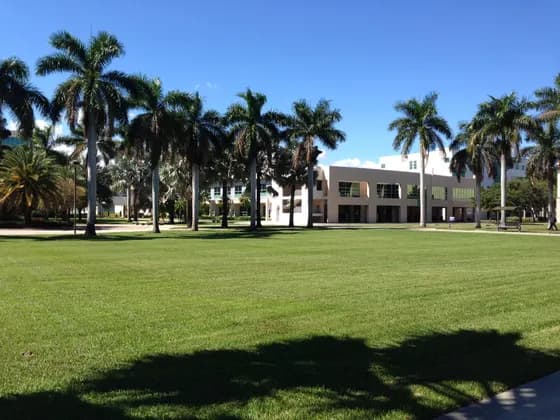
Photo: KnightLago (English Wikipedia) · CC BY-SA 3.0 · cropped
Photo: Quintin Soloviev · CC BY 4.0 · Photo: Kmgcoolguy4 · CC BY-SA 3.0 · Photo: Juliancolton · Public domain
The FAU Schmidt College of Medicine MD program at a glance (2027 entry)
The Charles E. Schmidt College of Medicine at Florida Atlantic University (FAU Schmidt College of Medicine) runs a four-year M.D. program in Boca Raton, Florida. Most on-campus teaching happens in the College of Medicine building and the Clinical Skills Simulation Center. The college lists a small class size among the program's features; its entering class profile shows 78 students matriculated, without naming the year.
The college calls its approach the Integrated Patient Focused Curriculum: you learn basic science in the context of patient care, patient cases and clinical skills. In Years 1 and 2 the sciences are taught largely through problem-based learning (PBL), in which a small, student-directed group works through a patient case.
Clinical skills run alongside the science in four Foundations of Medicine (FOM) courses. You learn interviewing and examination with standardized patients, people trained to portray patients. From the spring of Year 1 you also care for real patients under the supervision of community physicians. The college describes itself as community-based, and its catalog highlights a geriatric medicine curriculum that spans all four years.
Clerkships are the required clinical rotations. The pre-clerkship (pre-clinical) phase before them is mostly classroom-based and ends with study for Step 1, the first national licensing exam, in the spring of Year 2. Year 3 is two longitudinal integrated clerkships (LICs) at affiliated community hospitals, in place of a string of short single-specialty clerkships at different sites. By the end of Year 3 you have completed the core clerkships in medicine, surgery, obstetrics and gynecology, pediatrics, psychiatry, and community and preventive medicine. Year 4 brings acting internships, selectives, electives and Transition to Residency.
The Liaison Committee on Medical Education (LCME), which accredits MD programs in the United States, lists the program as fully accredited. Its directory, updated October 14, 2026, gives 2011 as the initial year of accreditation and 2027-28 for the next survey. To graduate you must pass Step 1 and Step 2 CK (Clinical Knowledge) of the United States Medical Licensing Examination (USMLE).
| Degree | M.D. |
|---|---|
| Program length | 4 years; the Ph.D. phase of the M.D./Ph.D. typically takes 4 to 5 years |
| Curriculum | Integrated Patient Focused Curriculum |
| Class size | 78 matriculated, per the college's class profile (year not stated) |
| Main campus | FAU's Boca Raton campus (College of Medicine building and simulation center) |
| Teaching style | Problem-based learning and Inquiry cases, with up to 10 lecture hours weekly |
| First patient contact | Standardized patients in fall of Year 1; community preceptors from spring |
| Clinical sites | Year 3 LICs at seven affiliated hospitals in Palm Beach and Broward counties |
| Step 1 timing | End of Year 2: spring 2029 for 2027 entrants, on the current schedule |
| Grading | Satisfactory/Unsatisfactory in Years 1, 2 and 4; Honors tiers in Year 3 |
What makes the FAU Schmidt College of Medicine MD program different
Year 3 as two 24-week integrated clerkships
Each LIC lasts 24 weeks with a group of physicians at affiliated community hospitals. Medical and Surgical Sciences covers internal medicine and surgery, with geriatrics and palliative care. Family and Community Health Sciences covers obstetrics and gynecology, pediatrics and psychiatry. Both LICs mix inpatient rotations with outpatient blocks.
Your own panel of patients for a whole year
In the Community and Preventive Medicine clerkship you are paired one-on-one with a primary care physician in the community, an internist or a family physician, for all of Year 3. You build your own panel of patients, get to know them over time and follow them to other parts of their care.
Science learned through patient cases
Much of the science in Years 1 and 2 runs through small-group patient cases: PBL in the first courses, then Inquiry (IQ) cases in the Pathophysiology and Therapeutics (PT) courses. In PT 1, for example, IQ cases cover learning objectives the lectures leave out, so the two formats complement each other.
Geriatrics woven through all four years
The Geriatrics and Healthy Aging thread follows the 5Ms of age-friendly care: Mobility, Mind, Matters Most, Medications and Multicomplexity. Year 3 includes geriatrics and palliative care, and optional summer research tracks after Year 1 cover geriatrics and falls in older adults.
An M.D./Ph.D. in Max Planck neuroscience labs
The M.D./Ph.D. is run with the Max Planck Florida Institute for Neuroscience (MPFI), on FAU's Jupiter campus. The Ph.D., done in an MPFI lab, typically takes 4 to 5 years, starting the summer after Year 1.
How FAU Schmidt College of Medicine teaches medicine
Under the Integrated Patient Focused Curriculum, anatomy, physiology, pharmacology and pathology are woven through the courses. Most of the science comes through small-group cases and your own study, backed up by labs, simulations, sessions linking science to clinical problems, and lectures kept to core ideas.
Years 1 and 2 run two strands side by side. The science strand is Fundamentals of Biomedical Science (FBS), Neuroscience and Behavior (NSB) and four Pathophysiology and Therapeutics (PT) courses, each covering a group of body systems. In the four FOM courses you learn interviewing, examination and clinical reasoning: forming possible diagnoses and testing them against the best evidence.
Five threads run through all four years: Health Systems Science; Ethics, Professionalism and Professional Identity; Geriatrics and Healthy Aging; Lifelong Learning and Discovery; and Technology in Medicine, including artificial intelligence. Nutrition is built into courses and clerkships too. In FOM 2 you join interprofessional sessions with students from FAU's College of Nursing and School of Social Work.
From Year 3, learning moves onto clinical teams, with didactic (classroom-style) teaching built into each LIC. Transition to Residency in Year 4 uses simulated scenarios, team-based learning exercises and larger group lectures.
The ways you will learn
| Problem-based learning and Inquiry cases | Small, student-directed groups work through patient cases: PBL in FBS and NSB, Inquiry (IQ) cases, a form of PBL, in the PT courses, and in Year 2 also student-led inquiry cases (SLIQ). In FBS, NSB, PT 1 and the first half of PT 2, groups have six to nine students and a facilitator at 80% or more of sessions. In those courses you also get a written narrative assessment. |
|---|---|
| Lectures and team-based learning | Team-based learning (TBL), in which you prepare beforehand and then solve problems with a team in class, appears in FBS and in PT 1 to PT 3. Several PT courses add take-home mini cases that reinforce the main ideas of the lectures. |
| Laboratories | Year 1 includes anatomy labs and quizzes. PT 1 and PT 3 add pathology labs, and PT 4 a lab on flow cytometry, a technique used to diagnose and monitor immune disorders. |
| Standardized patient sessions | Standardized patients are trained to recreate a real patient's history, personality, physical findings and emotions consistently. Sessions come in three types: basic exams taught by faculty, scripted advanced exams with faculty guidance, and graded testing sessions without guidance, which are always video recorded. |
| Simulation center sessions | PT 1, PT 2 and PT 3 include Clinical Skills Simulation Center sessions tied to their systems. In PT 2, for example, you work from history, examination and tests to a differential diagnosis, the list of conditions that could explain the findings, and then to treatment. High-fidelity mannequins breathe, bleed and react to the drugs you give, and sessions are recorded for debriefing. |
| Clinical learning groups | In clinical learning groups, part of FOM, you reflect on recent clinical experiences with preceptors and standardized patients. You practice oral case presentations, note writing and clinical reasoning, with ethics, cultural competency, geriatrics and community advocacy woven in. |
| Science of Clinical Practice | Science of Clinical Practice (SCP) is a small group within FOM in Years 1 and 2, held once a week in both sample weeks, where you reflect on what being a physician involves. Topics include difficult conversations, ethics, cultural competency, geriatrics and public health, with time to practice compassionate communication. |
A typical week on the FAU Schmidt College of Medicine program
The M.D. program page says a typical week in Years 1 and 2 combines dedicated independent study time, no more than 10 hours of lectures and two to three half days of clinical experiences. The handbook adds that, on average, three half days a week are kept free for independent study.
The college's sample Year 1 week puts lectures on most mornings, with anatomy quizzes and lectures on Monday and an anatomy lab on Tuesday. PBL groups meet on Monday, Wednesday and Friday, and Science of Clinical Practice on Thursday. Afternoons are for clinical skills, on Monday and Wednesday, or independent study, and a Friday lunch hour is kept for career planning, wellness or student events.
In the sample Year 2 week, Inquiry cases meet on Monday, Wednesday and Friday mornings, around lectures, Science of Clinical Practice on Tuesday, and lectures or a pathology lab on Thursday. Monday and Wednesday afternoons go to a preceptor or independent study, and Tuesday afternoon to clinical experiences, service learning (community service tied to your coursework) or independent study. Thursday afternoon brings a clinical learning group or advanced clinical skills, and Friday afternoon is for independent study.
How anatomy is taught at FAU Schmidt College of Medicine
Anatomy is taught inside the science courses rather than as a course of its own. FBS includes an introduction to the anatomical sciences, along with histology and embryology, and PT 4 in Year 2 builds on the gross anatomy taught there.
In NSB, in the spring of Year 1, lectures and PBL are combined with anatomy laboratory instruction. Neuroanatomy is taught through clinical cases that lead you to work out where a brain lesion is, and the gross anatomy of the head and neck is tied to clinical problems. Each PT course then covers the anatomy of its body systems, together with histology, physiology and pathology.
When you first meet patients at FAU Schmidt College of Medicine
Your first patient encounters are with standardized patients in the FOM courses, from your first semester, mostly at the Clinical Skills Simulation Center. The Year 1 calendar adds a Mini-OSCE in October and a history and physical (H&P) OSCE in December. An OSCE (Objective Structured Clinical Examination) is a structured exam with standardized patients that tests your clinical skills.
From the spring semester of Year 1 you regularly take part in direct patient care under the supervision of physician preceptors in the community. PT 3 includes a visit to a dialysis center, and FOM 4's Introduction to Hospital Medicine prepares you for inpatient work.
Full-time clinical work starts with the first LIC in May. On every clerkship you work under a faculty supervisor or a designee, such as a resident. Duty hours follow the limits the Accreditation Council for Graduate Medical Education (ACGME) sets for first-year residents: no more than 80 hours a week, averaged over four weeks, with one day off in seven.
The FAU Schmidt College of Medicine curriculum, year by year
- Year 1
Biomedical science, neuroscience and first patients
On the 2026-27 calendar, Year 1 starts with orientation on August 3-7 and the White Coat Ceremony on August 7, 2026. It ends with the Year 1 Institutional Competency Assessment (ICA), a clinical skills assessment, in May, then a 10-week summer break.
- FBS (19 weeks): biochemistry, molecular and cell biology, genetics, pharmacology and introductory anatomy, then microbiology, immunology and pathology, in two nine-week PBL blocks.
- FOM 1 (19 weeks), alongside FBS: interviewing and examining patients, answering clinical questions, prevention, and the ethical and legal framework of patient care.
- NSB (9 weeks, from January): neuroanatomy, neurophysiology, sensory systems, neurochemistry, neuropharmacology, neuropathology, neurology and psychiatry.
- FOM 2 (17 weeks, from January): advanced clinical skills, barriers to health care and interprofessional sessions.
- PT 1 (8 weeks): the gastrointestinal and hepatic systems, red blood cell hematology and nutrition.
- Optional summer research after Year 1, a prerequisite for the Research Distinction Track.
- Year 2
Body systems, clinical reasoning and Step 1
On the 2026-27 calendar, Year 2 starts on July 31, 2026. Three PT courses finish the body systems while FOM 3 and 4 build clinical reasoning, and a six-week Step 1 course ends the pre-clerkship phase.
- PT 2 (11 weeks): the cardiovascular and respiratory systems and related hematology.
- PT 3 (9 weeks): the renal, endocrine and reproductive systems, including a dialysis center visit.
- PT 4 (6 weeks): infection, immune disorders and blood cancers, plus core skin and eye disorders.
- FOM 3 (20 weeks), which the catalog lists as an Academic Service Learning course, covers patient-centered care at all life stages; FOM 4 (6 weeks) introduces hospital medicine.
- Year 2 ICA in February, which includes a Step 1 practice exam from the National Board of Medical Examiners (NBME).
- USMLE Step 1 Review (6 weeks): directed independent study with faculty support, ending with the exam.
- Year 3
Synthesis and two longitudinal integrated clerkships
Year 3 begins in April with the three-week Synthesis and Transition course, and the first LIC starts in May. On the 2026-27 calendar, each LIC is followed by a period for NBME shelf exams, national subject tests, lasting two weeks in October and three weeks from late March. The ICA comes in two parts, in October and April.
- Synthesis and Transition: a complex PBL/IQ case seminar on differential diagnosis and treatment decisions, Simulation Center work on clinical reasoning and skills, and orientation to the clerkships.
- Medical and Surgical Sciences (MSS) LIC: internal medicine and surgery, with geriatrics and palliative care.
- Family and Community Health Sciences (FCHS) LIC: obstetrics and gynecology, pediatrics and psychiatry, each graded separately. Psychiatry includes a four-week inpatient experience.
- Both LICs add ungraded experiences in anesthesia, critical care, emergency medicine, neurology, pathology and radiology.
- Community and Preventive Medicine: a year-long, one-on-one pairing with a primary care physician.
- White space time for subspecialty experiences, research or community health projects, and the elective rotation course if you take it this year rather than in Year 4.
- Year 3 ends with an introductory week for Year 4 and Transition to Residency.
- Year 4
Acting internships, selectives and electives
Year 4 runs in 13 blocks from early May. On the 2026-27 calendar, Match Day, when students learn where they will train in residency, falls on March 19, and commencement on May 11, 2027, a date the calendar marks TBD. The Year 4 team is flexible about residency interviews and Step 2 CK.
- Required acting internships (AIs), in which you carry a high level of responsibility for a group of patients, much like an intern.
- Selective and elective rotations.
- Transition to Residency (TTR): the catalog and the M.D. program page describe it as running through Year 4, while the courses page calls it a two-week capstone in March. The calendar shows an introductory week at the end of Year 3 and a TTR Immersion block in March.
- TTR covers rapid response scenarios, central line insertion, airway management, prioritizing tasks, advanced communication and teaching skills, plus preparation for Step 2 and residency applications.
- Step 2 CK: your first attempt is due by September 1 of the year before graduation, early in Year 4.
How you are assessed at FAU Schmidt College of Medicine
Years 1, 2 and 4 are pass/fail: your transcript shows Satisfactory or Unsatisfactory. Year 3 clerkships are graded Honors, High Satisfactory or Satisfactory, with Unsatisfactory as a fail. Every course, clerkship and rotation is mapped to the eight competencies of the Association of American Medical Colleges (AAMC) Physician Competency Reference Set, and each syllabus sets out which of them it grades. An Unsatisfactory in any graded competency means failing the course.
A single Satisfactory with Concern grade brings a support plan but shows as Satisfactory on your transcript. Most written exams are secure, timed web-based exams, proctored in a classroom. Formative feedback, which guides you without counting much toward your grade, includes mid-block PBL feedback, low-stakes quizzes worth no more than 5% each and practice OSCE stations.
Clinical skills are checked in ICAs at the end of Years 1 and 2 and twice in Year 3, and you must pass each to progress. Small-group facilitators and clinical preceptors write narrative assessments of your performance. Each Year 3 clerkship director's summary of them goes almost word for word into your Medical Student Performance Evaluation (MSPE), the dean's letter for residency applications.
In Year 3 you sit NBME subject exams, or shelf exams, after each LIC. The Year 2 ICA includes the NBME Comprehensive Basic Science Examination, a required self-check for Step 1 that does not affect grades, and you get up to three self-assessment vouchers.
The USMLE is the national licensing exam series for M.D. students. Step 1 covers the sciences behind medicine and has been pass/fail since January 2022; Step 2 CK covers clinical medicine. You must sit Step 1 at least 10 days before Synthesis and Transition starts and pass it to be promoted to Year 3. You may start the first LIC while your score is pending, but a fail withdraws you.
Your first Step 2 CK attempt is due by September 1 of the year before graduation. If you have not passed by the deadline for certifying your residency rank order list, you may be withdrawn from the Match. To graduate on time you need a passing score by April 15.
- On the current schedule, a student who starts in 2027 would sit Step 1 in spring 2029, at the end of Year 2. The first Step 2 CK attempt would be due by September 1, 2030. Both dates follow the 2026-27 calendar, the latest one posted, and the 2026-27 handbook.
- In August 2026 the USMLE program announced a move to designated testing dates from January 2029, with Step exams offered less often each year. Its June 2026 notice had named 2028. Both of your Step exams would fall after the change.
- The USMLE program has encouraged schools to review policies that restrict when students take the Step exams.
- Delaying Step 1 past the deadline means waiting until the following May to start Year 3, on a one-year leave of absence, with the exam due by July 15. Failing a first attempt also means a year's leave, with the retake due by September 30.
- You may take each Step at most four times. Any failure goes to the Medical Student Promotions and Professional Standards Committee (MSPPSC), and four failures mean dismissal.
- To graduate you must also pass every summative ICA, hold Advanced Cardiac Life Support (ACLS) and Basic Life Support (BLS) certification and show consistent professionalism. Everything must be finished within six years of starting, except for M.D./Ph.D. students.
- Numeric medical knowledge scores still count in the pass/fail years. Students whose weighted scores over Years 1 and 2 are in the top 25% of the class are eligible for an Academic Honors commendation in the MSPE.
- For M.D. students, attending an LCME-accredited program is what makes you eligible to sit the USMLE; DO students and international graduates qualify through other routes.
FAU Schmidt College of Medicine clinical rotations: where you will actually train
The college calls itself a community-based medical school. The 2026-27 catalog says the Year 3 LICs run at seven affiliated hospitals in Palm Beach and Broward counties.
Year 3 and 4 schedules are built through a lottery, within the academic calendar and curriculum rules. Information sessions in the late fall of Year 2 help you plan your Year 3 LIC schedule, and the handbook asks you to flag planned absences and religious accommodations before you choose.
The LIC outpatient blocks mostly have no night or weekend call. On clerkships and Year 4 rotations, university holidays can still be working days, including call, depending on your clinical site.
The 2026-27 student handbook lists 17 FAU affiliate hospitals and clinics in its protocol for needlestick and other exposure incidents. Five of those hospitals also form the FAU Consortium for Graduate Medical Education, set up in 2011 to train residents: Boca Raton Regional Hospital, Bethesda Hospital East, and Tenet Healthcare's Delray Medical Center, St. Mary's Medical Center and West Boca Medical Center. FAU's residencies with them cover emergency medicine, general surgery, internal medicine, neurology and psychiatry.
FAU residency (graduate medical education) consortium hospitals, both also on the handbook's exposure-protocol affiliate list. The consortium page puts Boca Raton Regional one mile from the College of Medicine facility at FAU.
- Boca Raton Regional Hospital (Baptist Health)
- West Boca Medical Center (Tenet Healthcare)
FAU residency (graduate medical education) consortium hospital, also on the handbook's exposure-protocol affiliate list. The emergency medicine acting internship FAU lists for visiting students includes a weekly didactic conference here.
- Bethesda Hospital East (Baptist Health)
FAU residency (graduate medical education) consortium hospital, also on the handbook's exposure-protocol affiliate list. Its consortium profile describes a Level I trauma center for adults and children.
- Delray Medical Center (Tenet Healthcare)
FAU residency (graduate medical education) consortium hospital, also on the handbook's exposure-protocol affiliate list. Its consortium profile describes a dedicated Children's Hospital with a pediatric trauma center and a pediatric emergency department.
- St. Mary's Medical Center (Tenet Healthcare)
Listed as FAU affiliate hospitals and clinics in the 2026-27 handbook's protocol for needlestick and other exposure incidents.
- Bethesda Hospital West (Baptist Health)
- Caridad Center
- Cleveland Clinic Florida
- Good Samaritan Medical Center
- Holy Cross
- JFK Medical Center
- Jupiter Medical Center
- Mission Medical Clinic
- Palms West Hospital
- South County Mental Health Center
- Wellington Regional Medical Center
- West Palm Beach VA Medical Center
Electives, selectives and away rotations at FAU Schmidt College of Medicine
Year 3 includes white space time, set aside for your own interests, such as clinical experiences in subspecialties, research or community health projects. The handbook calls these significant periods of unstructured time and suggests planning personal events in them. The catalog lists the elective rotation course (6 to 12 credits) in Year 3, or in Year 4 if you do not take it in Year 3.
Year 4 combines required acting internships with a wide range of selective and elective rotations. Acting internships are called sub-internships at some schools. Selectives give hands-on patient care, under supervision, in specialties you choose, and electives let you explore other fields of medicine. The handbook refers to two- and four-week rotations.
For fourth-year students visiting from other schools, FAU lists four-week acting internships in general surgery and internal medicine. Both place the student on an inpatient team, with admissions, rounds, consultations and discharges, a panel of patients, possible night shifts and one or two weekends a month. The emergency medicine acting internship for visitors is worked in shifts, some at night.
If you take an away rotation, a rotation at another institution, you follow the host's supervision policy. In Year 4 you cannot take personal days during an AI or on blackout dates, and other rotations allow at most 1.5 days in two weeks or three in four.
Dual degrees and research years at FAU Schmidt College of Medicine
The M.D./Ph.D. joins FAU's colleges of medicine and science with the Max Planck Florida Institute for Neuroscience (MPFI), on FAU's Jupiter campus. You take the Year 1 pre-clinical curriculum at the College of Medicine and start Ph.D. research at MPFI that summer. Coursework and the dissertation, in an MPFI lab, typically take 4 to 5 years, and you then return for the last three years of the M.D.
The Ph.D. is in Integrative Biology, concentrating in Biomedical Sciences or Neuroscience. The M.D./M.B.A. and M.D./M.H.A. are taken with FAU's College of Business, each with at least 30 credits, or 36 for the M.B.A. without its finance and accounting prerequisites. The Graduate Management Admission Test (GMAT) or Graduate Record Examination (GRE) is waived, and business classes can start as early as the summer after Year 1.
On the M.D./M.S. Biomedical Science thesis track, 24 credits from Years 1 and 2 count toward the master's, and you add at least 6 thesis credits. The college also runs Bachelor's/M.D. programs completed in seven to eight years: Med Direct on the Boca Raton campus, Wilkes Medical Scholars on the Jupiter campus and the FAU High School M.D. Direct Program.
The Research Distinction Track (RDT) is an optional parallel curriculum for up to six students a year. Prerequisites include research training modules and eight weeks of full-time mentored research in the summer after Year 1. You apply in January of Year 2. You then need a manuscript submitted to a peer-reviewed journal by December 1 of Year 4, ideally as first author, and presentations at one local and one regional or national meeting. Completing the RDT earns a Distinction in Research in the commencement program.
You can work with college faculty on research at any time. The Summer M1 Fast Track offers ready-approved summer projects in six tracks: discovery and translational research, cancer prevention, emergency medicine, epidemiology, geriatrics, and physical medicine and rehabilitation. Each track includes a poster at the Medical Student Research and Scholarship Day each February.
Facilities and support at FAU Schmidt College of Medicine
Where you will learn
The Charles E. Schmidt College of Medicine building (BC-71) holds lecture halls, small-group rooms, the anatomy lab and clinical skills rooms. A second building next door (ME-104) has offices, study space and lounges, including the Sam W. Klein Student Hub, with a lounge, wellness room and study rooms for medical students only.
The Clinical Skills Simulation Center (CSSC), on FAU Boulevard in Boca Raton, trains students in all four years. Its labs are set up as hospital patient rooms, exam rooms, intensive care and emergency rooms, surgical suites and skilled nursing units, with more than 20 simulators, including birthing, pediatric and neonatal models.
Medical students use venipuncture trainers to learn to draw blood, skin pads for suturing, intubation heads, and rectal, pelvic, breast and testicular exam trainers, plus the Harvey simulator for heart sounds. The center also runs American Heart Association ACLS, BLS and PALS (Pediatric Advanced Life Support) courses.
FAU's medical library collection is online and in the S.E. Wimberly Library on the Boca Raton campus, and medical librarians keep offices in the College of Medicine.
Support while you study
Learning communities are smaller groups within a class that give you a base for community and mentoring. Every student is assigned at the start to one of two Academic Parliaments, named by the college's first class, the Class of 2015, after Dr. Elizabeth Blackwell and Dr. Charles Drew. They support your personal and professional development, peer relationships and self-care.
The faculty handbook calls them Academic Societies, the Elizabeth Blackwell Society and the Charles R. Drew Academic Society, each with a Society Dean. Every new student also gets a second-year peer mentor, matched on goals, specialty interests and outside interests, and you meet at least three times in the year.
Early in Year 1, the Student Affairs deans and the Director of Student Success Services hold check-in meetings with students. The director runs study skills sessions and Step 1, NBME subject exam and Step 2 CK preparation sessions, and oversees free tutoring by upperclassmen for Years 1 and 2.
In Year 3, each clerkship director meets assigned students every two months as a Feedback Mentor. Career advising runs through the MedOwls N.E.S.T. (Navigating and Exploring Specialties and Transitions) program in all four years. It offers career advisors, alumni mentors, Visioning Night in January of Year 3, Mock Interview Day and specialty faculty mentors in 16 fields.
For well-being, the HealthFirst initiative offers wellness resources and activities in the college and around Boca Raton, and duty-hour violations or mistreatment can be reported anonymously. Project Grow, a student-led initiative funded by the Arnold P. Gold Foundation, runs a community garden that gives local residents produce and nutrition education.
Is the FAU Schmidt College of Medicine program right for you?
This program may suit you if
- You learn well by working through patient cases in small, student-directed groups rather than mostly from lectures.
- You want supervised time with real patients and community physician preceptors from the spring of your first year.
- You would rather spend Year 3 with the same physicians and your own panel of patients for months than rotate through short, separate specialty clerkships at different sites.
- You are interested in caring for older adults, with geriatrics taught across all four years and in the Year 3 LIC.
- You want structured research, such as the Research Distinction Track or an M.D./Ph.D. in Max Planck neuroscience labs.
Things to think about
- PBL and Inquiry cases ask you to direct much of your own learning; if you prefer lecture-led teaching, weigh that carefully.
- Year 3 runs at affiliated hospitals across Palm Beach and Broward counties, with schedules set by lottery, so you may train some distance from the Boca Raton campus.
- Year 3 is graded in tiers, Honors, High Satisfactory or Satisfactory, unlike the pass/fail Years 1, 2 and 4.
- Step 1 rules are strict: delaying past the deadline or failing a first attempt means a year's leave before you can start clerkships.
- On the current schedule, a 2027 entrant would sit both Step exams under the USMLE's designated testing dates, which start in January 2029.
FAU Schmidt College of Medicine MD program — frequently asked questions
Applying to FAU Schmidt College of Medicine?
How to get into FAU Schmidt College of Medicine
Prerequisites, MCAT, AMCAS personal statement, secondaries and interview, step by step.
Open the guide →FAU Schmidt College of Medicine admissions profile
MCAT and GPA profile, acceptance rate, interview format and key dates.
See the profile →Compare FAU Schmidt College of Medicine with other schools
Put the teaching style, anatomy teaching and clinical sites next to another school.
Open the comparison →Prepare for the FAU Schmidt College of Medicine interview
Format breakdown, school-specific sample questions and prep tips from tutors who interviewed here.
Read the guide →Where this FAU Schmidt College of Medicine program guide came from
This guide was written from 48 official sources — Charles E. Schmidt College of Medicine at Florida Atlantic University's own program pages and curriculum documents, plus the accreditor and the hospitals and health systems the school trains students in where they publish detail — read on 2026-10-18, then checked claim by claim against those sources.
- FAU Schmidt College of Medicine: M.D. Degree Program
- FAU Schmidt College of Medicine: Medical Student Courses
- FAU Schmidt College of Medicine: Nutrition Education in the M.D. program
- Academic Calendar Years 1, 2, 3 and 4 for 2026-2027
- Academic Calendar Years 1, 2, 3 and 4 for 2025-2026
- Integrated Patient Focused Curriculum chart
- Sample typical week for M.D. M1 students
- Sample typical week for M.D. M2 students
- Medical Student Handbook 2026-2027
- FAU Catalog 2026-2027: Doctor of Medicine (MD in Medicine) program
- FAU Catalog 2026-2027: M.D. course descriptions (BMS, MDC, MDE, MDI and MDS courses)
- FAU Catalog 2026-2027: MDC 7011 Family and Community Health Sciences Longitudinal Integrated Clerkship
- FAU Catalog 2026-2027: MDC 7012 Medical and Surgical Sciences Longitudinal Integrated Clerkship
- FAU Catalog 2026-2027: MDC 7120 Community and Preventative Medicine Clerkship
- FAU Catalog 2026-2027: MDE 8067 Transition to Residency
- FAU Catalog 2026-2027: BMS 6405 Synthesis and Transition
- FAU Schmidt College of Medicine: Visiting M.D. Students and Electives
- FAU Emergency Medicine Residency: Medical Student Rotations
- FAU Schmidt College of Medicine: Dual Degree Programs
- FAU Schmidt College of Medicine: M.D./Ph.D. Dual Degree Program
- FAU Schmidt College of Medicine: M.D./M.B.A. Dual Degree Program
- FAU Schmidt College of Medicine: M.D./M.H.A. Dual Degree Program
- FAU Schmidt College of Medicine: M.D./M.S. Biomedical Science Program
- FAU Schmidt College of Medicine: Bachelor's/M.D. Dual Degree Programs
- FAU Schmidt College of Medicine: FAU High School M.D. Direct Program
- FAU Clinical Skills Simulation Center
- FAU Clinical Skills Simulation Center: Standardized Patient Program
- FAU Clinical Skills Simulation Center: Specialized Training
- FAU Clinical Skills Simulation Center: Certifications and Courses
- FAU Schmidt College of Medicine: About the College
- FAU Schmidt College of Medicine: Entering M.D. Class Profile
- FAU Consortium for Graduate Medical Education: Consortium Hospitals
- FAU Schmidt College of Medicine: Residency and Fellowship Programs
- FAU Schmidt College of Medicine: Research Opportunities
- FAU Schmidt College of Medicine: Medical Student Summer Research
- FAU Schmidt College of Medicine: Research Distinction Track
- FAU Schmidt College of Medicine: Research Distinction Track Requirements
- FAU Schmidt College of Medicine: M.D. Student Events
- FAU Schmidt College of Medicine: Medical Student Peer Mentorship Program
- FAU Schmidt College of Medicine: Career Advising for Medical Students
- FAU Schmidt College of Medicine: Specialty Faculty Mentoring
- FAU Schmidt College of Medicine: M.D. Student Well-Being
- FAU Schmidt College of Medicine: M.D. Student Resources
- FAU Schmidt College of Medicine: Faculty Handbook
- FAU Schmidt College of Medicine: New Employee Information (curriculum glossary)
- LCME: Accredited Programs directory (updated October 14, 2026)
- USMLE Designated Testing Dates Information Hub
- USMLE: Updated Timeline for Designated Testing Dates, Transition Will Take Place in January 2029 (August 6, 2026)
Curricula are restructured between cycles. Anything here that decides your application — how anatomy is taught, a clinical campus assignment, a required research year — should be confirmed against the official page for your entry year.
Applying to FAU Schmidt College of Medicine?
We help US applicants with MCAT strategy, the AMCAS personal statement, secondary essays and interview prep — everything you need for a competitive FAU Schmidt College of Medicine application.