
FAU Schmidt College of Medicine Interview
Format, Questions & Prep Tips
FAU Schmidt College of Medicine medicine interviews for 2027 entry are a traditional interview. Published figures: Annual MD class size ~78; Applications received ~3,000–5,000 per cycle; Interview format Traditional — 1–2 sessions, ~30–45 min each.
- Institution
- Charles E. Schmidt College of Medicine at Florida Atlantic University
- Interview (2027 entry)
- October through March; rolling invitations after secondary review
- Decisions (2027 entry)
- Rolling decisions; final by March 30; waitlist movement through summer


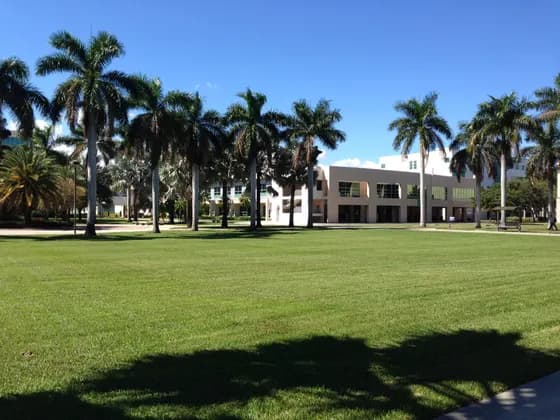

Photo: KnightLago (English Wikipedia) · CC BY-SA 3.0 · cropped
Photo: Quintin Soloviev · CC BY 4.0 · Photo: Kmgcoolguy4 · CC BY-SA 3.0 · Photo: Juliancolton · Public domain
How to get into FAU Schmidt College of Medicine (MD) medicine
Step-by-step: entry requirements, admission tests, personal statement, interview format and the key deadlines.
Open the guide →FAU Schmidt College of Medicine (MD) entry requirements
Admission profile, interview format, decision dates and what makes FAU Schmidt College of Medicine (MD) different.
See the profile →The FAU Schmidt College of Medicine MD program
Problem-based learning + Integrated, 4 years, clinical rotations across Palm Beach and Broward counties in South Florida.
See the program →The FAU Schmidt College of Medicine (MD) medicine interview
FAU Schmidt College of Medicine uses a traditional interview format — typically one or two one-on-one sessions of approximately 30–45 minutes each with faculty, community physicians, and/or current students. Interviews are non-blind.
The school’s community-based educational model shapes what interviewers look for: candidates who are comfortable with distributed, small-hospital training in South Florida rather than large academic medical center environments, and who have a genuine interest in primary care, geriatric medicine, and serving Palm Beach County’s aging and diverse population.
With only ~64 students per class — one of the smallest public medical school cohorts in the US — the interview is intimate and relationship-focused.
FAU Schmidt College of Medicine (MD) interview at a glance (2027 entry)
| Annual MD class size | ~78 |
|---|---|
| Applications received | ~3,000–5,000 per cycle |
| Interview format | Traditional — 1–2 sessions, ~30–45 min each |
| Curriculum | Integrated — community-based distributed model |
| Application system | AMCAS + FAU secondary |
| Interview window | October–March |
| Strength | Geriatrics, primary care, community medicine in South Florida |
Interview format
- Traditional format — one or two separate one-on-one sessions.
- Non-blind: interviewers have reviewed your full application.
- Community physicians often serve as interviewers — practicing clinicians, not just academics.
- Sessions probe community-medicine orientation, geriatrics interest, and South Florida ties.
- Interview day includes campus tour at the Boca Raton FAU campus and curriculum information session.
- Rolling admission — earlier dates generally receive earlier decisions.
Working towards the MCAT score FAU Schmidt College of Medicine (MD) expects? Build a week-by-week plan from your test date — free for the first two weeks.
Sample interview questions
Why FAU Schmidt — what is it about the community-based model and South Florida setting that draws you to this program over a larger academic medical center?
Be honest and specific. Reference the small class size, community physician mentorship, the Palm Beach County patient population, and geriatric medicine opportunities. If you are choosing FAU Schmidt over larger Florida schools, explain why the model resonates with your learning style.
Tell me about a formative clinical experience in a community or outpatient setting rather than a hospital. What did you learn about primary care practice?
FAU Schmidt trains students primarily in community and outpatient settings — this question screens for genuine primary care orientation. Show you found the community setting rich and not just a fallback from hospital training.
An elderly patient with early-stage dementia tells you she wants to manage her own medication and finances. Her daughter believes she is incapable and asks you to file for guardianship. How do you navigate this?
Assess decision-making capacity — capacity is task-specific and fluctuating in early dementia. A formal capacity assessment should precede any guardianship action. Respect patient autonomy as long as capacity is maintained. Involve geriatric social work.
A patient in your community clinic practice has missed three appointments and is not taking his diabetes medication. He finally comes in after an emergency room visit. How do you approach the encounter?
Use motivational interviewing:
- non-judgmental exploration of barriers (cost, side effects, beliefs, social circumstance)
- collaborative problem-solving
- simplified regimen if possible
Avoid lecturing. Document a shared care plan.
South Florida has a large elderly population, many of whom are enrolled in Medicare Advantage plans. A community physician you shadow recommends procedures that you believe may be driven by plan reimbursement rather than patient need. What do you do?
Appropriate student response: observe, note your concern, discuss with a trusted faculty mentor, understand the billing structure, and document. Do not confront directly as a student — but do not ignore the pattern if it becomes a clear patient safety concern.
Florida has not expanded Medicaid under the ACA. How does this affect the uninsured population in Palm Beach and Broward counties, and what are the practical implications for community physicians?
Reference the Medicaid coverage gap (income too low for ACA subsidies, too high for traditional Medicaid in non-expansion states), the safety-net burden on FQHCs and community health centers, and the uncompensated care challenge for small hospitals.
An 82-year-old patient says she does not want to discuss end-of-life planning — 'I’ll cross that bridge when I come to it.' How do you respond?
Respect her autonomy while gently explaining the value of advance care planning for her peace of mind and her family’s ability to honor her wishes. Don’t force it; plant the seed. FAU Schmidt’s geriatrics emphasis means this type of scenario is highly relevant.
A pharmaceutical representative offers a community clinic a free electronic health record software upgrade, customized for their patient population, in exchange for prescribing data anonymized by patient ID. Is this arrangement ethical?
Even anonymized data has re-identification risks and commercial value. The arrangement creates a conflict of interest. Reference HIPAA data use agreements, FDA and FTC oversight of health data, and the duty to patients not to monetize their information without genuine informed consent.
Describe a time you worked with an elderly or seriously ill patient or family member. What did it teach you about end-of-life care?
Connect personal or clinical experience to the principles of palliative medicine: comfort, dignity, communication, and the limits of curative intervention. FAU Schmidt’s geriatric focus makes this a high-value story.
Should physicians be required to perform house calls or telehealth visits for homebound elderly patients who cannot travel to clinics? Defend your position.
Argue a position. Reference Medicare home health benefits, the evidence for reduced hospitalizations with house-call programs (e.g. Independence at Home), barriers (physician time, reimbursement), and the ethical argument for equitable access.
A station shows you that one of FAU's affiliated community practices has notably higher 30-day readmission rates among elderly heart-failure patients than its peers. Before judging the practice, what would you want to examine?
Interrogate before concluding:
- patient acuity and age mix
- social supports and home situation
- follow-up access
- medication affordability
- whether the practice serves a sicker or more isolated population
Tie it to FAU's geriatrics focus — readmissions in the elderly are often social and systemic, not a sign of poor clinicians.
Role play: You are a student on a community-clinic rotation. An elderly patient who lives alone is tearful and embarrassed, admitting she sometimes skips meals and can't always afford her medications. (The interviewer plays the patient.)
Lead with warmth and dignity, never blame. Gently assess safety and capacity, normalize the difficulty, and connect her to concrete resources — meal programs, low-cost pharmacy options, social work, home health. FAU's geriatrics and community emphasis makes this empathetic, resource-aware approach central.
A Haitian Creole-speaking patient in your Palm Beach County clinic relies on her adult son to interpret and seems to defer all answers to him. How do you ensure you hear from her directly?
Use a professional interpreter rather than the family member for clinical communication, and create space to hear the patient's own voice and consent. Respect family-centered cultural norms while protecting her autonomy. South Florida's large Haitian and Caribbean communities make this a realistic, FAU-relevant scenario.
FAU Schmidt trains roughly 64 students per class across distributed community sites rather than one flagship academic center. Why does that intimate, community-based model fit how you want to learn, and what are its trade-offs?
Be specific and honest. Speak to close mentorship, continuity, and real community practice as genuine draws, and acknowledge the trade-offs (less large-center subspecialty immersion, no single flagship hospital). Show this is a deliberate fit, not a fallback from larger Florida schools.
Florida has not expanded Medicaid, leaving many of your community-clinic patients in a coverage gap. As a future community physician, what is your responsibility toward patients who can't pay and toward advocating on the structural issue?
Address both the individual duty (sliding-scale and charity care, FQHC navigation, not turning patients away) and the structural advocacy role. Engage the coverage-gap mechanics specifically — too poor for ACA subsidies, ineligible for traditional Medicaid in a non-expansion state — which defines community practice across Florida.
Practise the FAU Schmidt College of Medicine (MD) interview
Rehearse the real format before the day — on demand with our AI interviewers, or live with a tutor.
Sit a mock with photoreal AI interviewers — any time
A timed MMI or panel interview on video — American & international voices — with interviewers who listen, react and press with follow-ups. Rubric-scored feedback and a replay the moment you finish.






Live mocks with a tutor who’s been in the room
A full FAU Schmidt College of Medicine (MD)-style mock with a medic or dentist tutor — honest scoring against real marking criteria, a station-by-station debrief and a written action plan.
Book a mock interviewHow to prepare for the FAU Schmidt College of Medicine (MD) interview
Common pitfalls to avoid
FAU Schmidt College of Medicine (MD) interview — frequently asked questions
Sources & official admissions information
Ready to nail your FAU Schmidt College of Medicine (MD) interview?
Book a mock interview with a tutor who knows the US interview formats, orpractice unlimited stations from our interview question bank.