
FIU Wertheim College of Medicine Interview
Format, Questions & Prep Tips
FIU Wertheim College of Medicine medicine interviews for 2027 entry are a traditional interview. Published figures: Annual MD class size ~120; Applications received ~4,000–6,000 per cycle; Interview format Traditional — 2 sessions, ~30–45 min each.
- Institution
- Florida International University Herbert Wertheim College of Medicine
- Interview (2027 entry)
- October through March; rolling invitations after secondary review
- Decisions (2027 entry)
- Rolling decisions; final by March 30; waitlist movement through summer



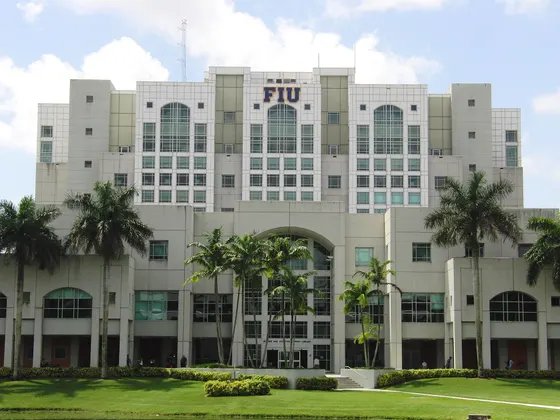
Photo: Comayagua99 at English Wikipedia · CC BY 3.0 · cropped
Photo: Comayagua99 at English Wikipedia · CC BY 3.0 · Photo: Robbschultz69 · CC BY-SA 4.0 · Photo: Andres Limones Cruz · CC BY 2.0
How to get into FIU Wertheim College of Medicine (MD) medicine
Step-by-step: entry requirements, admission tests, personal statement, interview format and the key deadlines.
Open the guide →FIU Wertheim College of Medicine (MD) entry requirements
Admission profile, interview format, decision dates and what makes FIU Wertheim College of Medicine (MD) different.
See the profile →The FIU Wertheim College of Medicine MD program
Integrated + Case-based learning, 4 years, clinical rotations across Miami-Dade and Broward counties, South Florida.
See the program →The FIU Wertheim College of Medicine (MD) medicine interview
FIU Herbert Wertheim College of Medicine uses a traditional interview format — typically two one-on-one sessions of approximately 30–45 minutes each with faculty and/or current students. Interviews are non-blind.
FIU Wertheim’s identity is built around the StepUp Curriculum — a competency-based framework that integrates social determinants of health, community partnership, and health disparities into every year of training. Interviewers specifically assess whether candidates understand and genuinely align with this community-health mission, not just the clinical medicine elements.
Miami’s extraordinary demographic diversity — the most ethnically diverse major city in the US — makes cross-cultural competency and knowledge of immigrant health, tropical medicine, and bilingual care central to what FIU trains.
FIU Wertheim College of Medicine (MD) interview at a glance (2027 entry)
| Annual MD class size | ~120 |
|---|---|
| Applications received | ~4,000–6,000 per cycle |
| Interview format | Traditional — 2 sessions, ~30–45 min each |
| Curriculum | StepUp Curriculum — competency-based, community-integrated |
| Application system | AMCAS + FIU secondary |
| Interview window | October–March |
| Notable feature | Miami’s diversity — largest Cuban, Haitian, and Caribbean communities in the US |
Interview format
- Traditional format — two separate one-on-one sessions with faculty and/or students.
- Non-blind: interviewers have reviewed your full application.
- Sessions probe StepUp Curriculum alignment, community health mission, and Miami cultural competency.
- Student interviewer session focuses on program fit and student life in Miami.
- Interview day includes campus tour at FIU University Park campus and admissions information session.
- Rolling admission — earlier interview dates generally receive earlier decisions.
Working towards the MCAT score FIU Wertheim College of Medicine (MD) expects? Build a week-by-week plan from your test date — free for the first two weeks.
Sample interview questions
Why FIU Wertheim — what is it about the StepUp Curriculum and Miami’s health landscape that draws you to this program specifically?
Explain what the StepUp Curriculum is (competency-based, community-integrated, social determinants of health) and why that pedagogical approach resonates with your career goals. Reference Miami’s demographics specifically.
Tell me about an experience working with a community that faced health barriers due to language, culture, immigration status, or poverty. What did you learn?
FIU’s Miami context makes this a central question. Go beyond clinical observation — show you understand the structural factors (insurance, legal status, trust, transportation, health literacy) that shape access, not just that the barriers exist.
An undocumented immigrant patient presents to a federally qualified health center with symptoms that suggest a serious illness. She is afraid to return because her neighbor was detained by ICE near the clinic. What do you do?
FQHC confidentiality protections and HIPAA apply — patient health information cannot be shared with immigration authorities without a court order. Reassure the patient about their rights, address the presenting complaint, and connect her with patient advocacy resources. Sensitive and important in a Miami context.
Type 2 diabetes prevalence among Cuban and Puerto Rican adults in Miami-Dade is significantly higher than in the general Florida population. What cultural, dietary, and structural factors contribute to this?
Reference acculturation and dietary transition, economic stress, access to culturally appropriate care, language barriers, insurance coverage gaps, and the evidence on Cuban-American and Puerto Rican health trajectories. FIU expects Miami-specific health literacy.
Role play: You are seeing a patient who speaks no English. The only person available is her 10-year-old granddaughter. You need to take a history. What do you do? (Interviewer may play the patient or granddaughter.)
Do not use a child as an interpreter for clinical purposes — CLAS standards and ethical guidelines prohibit this. Request a professional interpreter (phone or in-person). If truly unavailable and there is an emergency, use only to gather critical safety information, not a full history.
FIU has explicit goals around training primary care physicians for underserved Miami communities. If a student receives a scholarship tied to this mission and later decides to pursue a competitive sub-specialty in another city, what are the ethical obligations?
Transparency in the application process is required. If there is a formal service commitment attached to a scholarship, it creates legal and ethical obligations. More broadly, reflect on the tension between individual career freedom and the public investment in medical education.
The StepUp Curriculum assesses you on competencies rather than traditional grades alone. Does this approach concern you, and why do you think it is or is not better preparation for practice?
Show you have genuinely researched and reflected on competency-based medical education (CBME). Reference the evidence base for CBME, its implications for residency preparation, and honest self-reflection about how you learn best.
Should all US medical schools require cultural competency and structural racism training? Defend your position.
Argue a position with nuance. Reference the AAMC and LCME accreditation requirements, the evidence that cultural competency training reduces disparate care, and the concern about performative vs. substantive training. FIU leads in this area — show you’ve thought carefully about it.
You are a medical student at a community health fair. A middle-aged man asks you whether he should see a doctor about a skin lesion he shows you. It looks concerning. What do you say?
You are a student — do not diagnose. Express genuine concern, advise him to see a physician soon, explain why (lesion characteristics warrant evaluation), and offer to connect him to a free or low-cost clinic if access is a barrier. Do not provide false reassurance.
HIV rates in Miami-Dade County are among the highest in the continental US. What structural and social factors explain this, and how can primary care physicians address it?
Reference high rates among Haitian-American, Black Caribbean, and MSM communities in Miami, stigma barriers to testing, PrEP uptake disparities, immigration status and healthcare access, and the role of primary care in routine HIV testing, PrEP prescribing, and linkage to care.
A station shows Miami-Dade data: HIV diagnosis rates are among the highest in the continental US, concentrated in Haitian-American, Black Caribbean, and MSM communities, with low PrEP uptake. How do you read this data and what does it imply for primary care?
Connect epidemiology to structure: stigma and trust barriers to testing, immigration-status fears, PrEP-access and insurance disparities, and language. Note data caveats (under-testing undercounts incidence). Translate into primary-care action — routine opt-out HIV testing, PrEP prescribing, linkage to care — consistent with FIU's community mission.
Role play: You are a student at an FQHC. An undocumented patient with worrying symptoms is terrified to stay, having heard about an ICE detention near the clinic. (The interviewer plays the patient.)
Reassure within your role: FQHC and HIPAA protections mean her health information is not shared with immigration authorities without a court order. Calm the immediate fear, address the clinical concern, and connect her to patient-advocacy resources. This Miami-specific scenario tests trust-building with vulnerable immigrant patients.
A Cuban-American patient with poorly controlled diabetes tells you he trusts his family's traditional remedies more than the regimen you propose. How do you respond?
Cultural humility, not confrontation. Ask what he uses and why, screen genuinely for interactions, and find shared ground rather than dismissing his framework. Tailor the plan to his beliefs and resources. FIU's StepUp Curriculum emphasis on cultural competency rewards meeting patients within their worldview.
FIU's StepUp Curriculum is a competency-based curriculum co-developed with the Miami community that threads social determinants of health through all four years. Why does that explicit community-partnership and equity framework draw you, versus a more conventional curriculum?
Show genuine research into what the StepUp Curriculum is and why competency-based, community-co-designed education fits you. Connect to specific experiences with diverse or underserved communities. Vague enthusiasm without grasping the StepUp Curriculum is a documented FIU pitfall.
You are part of a StepUp Curriculum community project, and residents tell you the topic the school chose isn't the priority they care about. How do you handle the tension between the curriculum's goals and the community's stated needs?
Privilege the community's voice — that is the point of co-designed, partnership-based education. Bring the mismatch back to faculty, advocate for adjusting the project, and resist extractive 'we know best' framing. Demonstrate the community-as-partner ethos FIU is built on.
Practise the FIU Wertheim College of Medicine (MD) interview
Rehearse the real format before the day — on demand with our AI interviewers, or live with a tutor.
Sit a mock with photoreal AI interviewers — any time
A timed MMI or panel interview on video — American & international voices — with interviewers who listen, react and press with follow-ups. Rubric-scored feedback and a replay the moment you finish.






Live mocks with a tutor who’s been in the room
A full FIU Wertheim College of Medicine (MD)-style mock with a medic or dentist tutor — honest scoring against real marking criteria, a station-by-station debrief and a written action plan.
Book a mock interviewHow to prepare for the FIU Wertheim College of Medicine (MD) interview
Common pitfalls to avoid
FIU Wertheim College of Medicine (MD) interview — frequently asked questions
Sources & official admissions information
Ready to nail your FIU Wertheim College of Medicine (MD) interview?
Book a mock interview with a tutor who knows the US interview formats, orpractice unlimited stations from our interview question bank.