
The FIU Wertheim College of Medicine MD program
What you actually study, and where you will be
FIU Wertheim College of Medicine's MD is a 4-year program taught through case-based learning in an integrated curriculum, with patient contact from Year 1 and clinical rotations in Miami-Dade and Broward counties, South Florida (2027 entry). FIU's StepUp Curriculum teaches the sciences of Years 1 and 2 in integrated Foundations and Organ Systems courses, with half-day primary care clinic visits from your first semester. For your last three years you also visit households in underserved South Florida neighborhoods on a NeighborhoodHELP team that can include FIU nursing and social work students. Year 3 is core clerkships across affiliated health systems in Miami-Dade and Broward counties, and Year 4 centers on a sub-internship and electives.
- Degree
- MD
- Length
- 4 years
- Teaching
- Integrated + Case-based learning
- Clinical contact
- Year 1

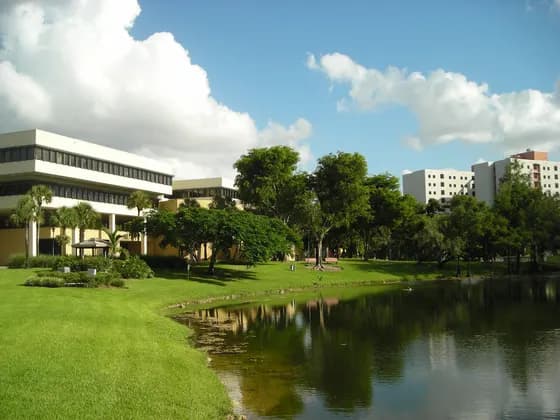

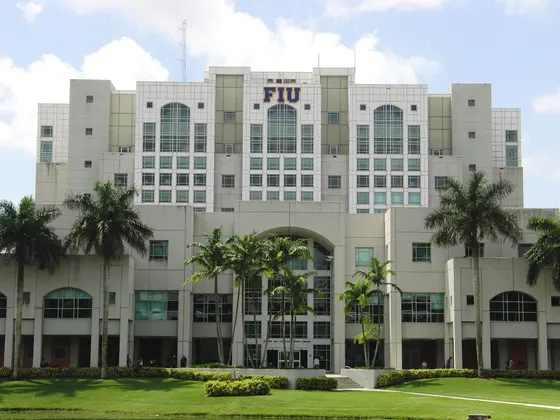
Photo: Comayagua99 at English Wikipedia · CC BY 3.0 · cropped
Photo: Comayagua99 at English Wikipedia · CC BY 3.0 · Photo: Robbschultz69 · CC BY-SA 4.0 · Photo: Andres Limones Cruz · CC BY 2.0
The FIU Wertheim College of Medicine MD program at a glance (2027 entry)
Florida International University Herbert Wertheim College of Medicine, known as FIU Wertheim or FIU Medicine, runs a four-year MD program in Miami, Florida. Teaching is based in the Academic Health Center 2 (AHC2) building on FIU's Modesto A. Maidique Campus in west Miami-Dade. The college took its first medical students in 2009, and FIU News reported 128 students in the Class of 2030, who started in August 2026.
The curriculum is called StepUp and began with the class that entered in 2023. Its four Steps are stages of the program, not the Step exams of the United States Medical Licensing Examination (USMLE), the national licensing exams. USMLE Step 1 covers the basic sciences and is reported only as pass or fail. The program's Steps 1 and 2 form the pre-clerkship (pre-clinical) phase of the first two years. Steps 3 and 4 are the clerkship phase: clerkships are core clinical rotations on hospital and clinic teams.
Every course also belongs to one of five longitudinal strands, themes that run through all four years: Human Biology and Disease, Clinical Medicine, Medicine and Society, Professional Development, and Research. Medicine and Society carries the community focus. Through its Community Engaged Physician courses and the Green Family Foundation Neighborhood Health Education Learning Program (NeighborhoodHELP), you help care for families in their homes.
In Years 1 and 2, science fills most mornings, with clinical skills, community and research sessions on set afternoons and several afternoons free for self-study. Half-day primary care clinic visits start in your first semester. Year 3 takes you to affiliated hospitals and clinics across Miami-Dade and Broward counties. Year 4 brings electives (rotations you choose) and a sub-internship, where you work at close to the level of a first-year resident: a doctor in residency, the specialty training after medical school.
| Degree | MD |
|---|---|
| Program length | 4 years; combined master's degrees take 5 |
| Curriculum | StepUp: four Steps and five longitudinal strands |
| Class size | 128 students in the Class of 2030, according to FIU News |
| Main campus | AHC2, Modesto A. Maidique Campus, west Miami-Dade |
| Anatomy | Donor bodies, plastinated specimens and 3D models in a 17-station lab (FIU News, 2025) |
| First patient contact | Half-day primary care clinic visits in your first semester |
| Clinical sites | Baptist Health, Jackson, Memorial, Mount Sinai, Nicklaus Children's, Miami VA and others |
| Step 1 timing | Before Year 3: spring 2029 for 2027 entrants, on the current schedule |
| Grading | Years 1, 2 and 4 pass/fail; Year 3 core clerkships Honors to Fail |
What makes the FIU Wertheim College of Medicine MD program different
Three years of household visits through NeighborhoodHELP
From Year 2 you join an interprofessional team that can include FIU nursing, social work, physician assistant, public health, law and education students, depending on each household's needs. Supervised by faculty, the team visits households in medically underserved South Florida neighborhoods and plans for their health and social needs. Mobile health centers staffed by primary care providers back up the visits.
Learning communities tied to Miami-Dade neighborhoods
On entry you join one of four Panther Communities, the college's learning communities: small faculty-led groups named Anderson, Hippocrates, Pasteur and Semmelweis. You stay in yours until graduation and learn clinical skills in its smaller groups in Years 1 and 2. Each serves its own NeighborhoodHELP region, from Miami Gardens and Hialeah to Opa-locka and Little Haiti.
Clerkships across public, private, VA and children's hospitals
Jackson Health System is Miami-Dade's public hospital system, and Memorial Healthcare System a public network in southern Broward County. Mount Sinai Medical Center is a private nonprofit teaching hospital. Citrus Health Network is a federally qualified health center, a federally funded clinic for underserved areas. Nicklaus Children's Hospital is the primary pediatrics site, and Baptist Health South Florida and the Miami VA (Veterans Affairs) Healthcare System host several clerkships.
A rebuilt anatomy lab with its own 3D printing lab
The anatomy lab was renovated by early 2025 to 7,000 square feet, double the old space, with room for up to 66 students at 17 cadaver stations. A camera above the demonstration table streams close-ups to 98-inch screens, and the suite includes active learning spaces and a 3D printing lab.
Optional Focus Tracks, including Medical Spanish
At the end of Year 1 you can join one of eight Focus Tracks: Teaching Skills, Narrative Medicine, Leadership, Advocacy, Bioethics, Medical Spanish, Population Health or Evidence-based Lifestyle Medicine. Each needs about 10 hours in the summer after Year 1, in Year 2 and Year 3, plus a two-week capstone elective in Year 4. Completion goes in your Medical Student Performance Evaluation (MSPE), the dean's letter to residency programs.
How FIU Wertheim College of Medicine teaches medicine
StepUp is built to connect subjects. Its five strands are planned horizontally, linking courses that run at the same time, and vertically, building each theme year on year. Clinical Skills II, for example, teaches the heart examination during the cardiovascular block. You must show the competencies set out by the Association of American Medical Colleges (AAMC), plus one the college added: social accountability, working to meet community health needs and reduce disparities.
In Years 1 and 2, Foundations I is taught through lectures, small groups and whole-class discussion, and the Organ Systems courses through cases, group discussions, simulations and lectures. Sessions that cannot be repeated outside class are compulsory: anatomy labs, small-group case-based learning, Meet the Patient sessions, simulations and encounters with standardized patients, actors trained to play patients.
Year 1 and 2 workload is capped at 25 hours a week averaged over four weeks, and 35 in any single week, counting class, preparation and assessments. The guideline is about 16 hours a week for the Foundations or Organ Systems course, 3 for clinical skills, and 2 each for professional development, research and Medicine and Society.
In Year 3, learning moves to patient care, supported by simulation, case-based teaching sessions, virtual cases and problem-based learning. In Core Concepts in Medicine, small groups work through problems, then consult specialists in a large-group session. In Years 3 and 4, duty hours are capped at 80 a week averaged over four weeks.
The ways you will learn
| Lectures | Mainly for the science in Years 1 and 2. Attendance is optional, and recordings are released within 24 hours unless a lecture includes patient videos or other sensitive material. |
|---|---|
| Small-group case-based learning | Groups of fewer than 15 students work through a clinical case with a faculty facilitator. Short readiness quizzes can check your preparation beforehand. |
| Clinical skills and simulation | Clinical Skills I and II take one afternoon a week in Years 1 and 2, using standardized patients and manikins. Skills are tested in Objective Structured Clinical Examinations (OSCEs), where you rotate through timed stations, each testing one task. |
| Primary care preceptorship | Part of Clinical Skills I and II: half-day visits to primary care practices in the community, where a supervising clinician, your preceptor, oversees you as you take histories and examine patients. |
| Household visits | NeighborhoodHELP teams assess health, give health education, find barriers to care and connect families with services, then reflect on the visits in Community Engaged Physician class sessions. |
A typical week on the FIU Wertheim College of Medicine program
The college publishes 2026-27 sample weeks. In the fall of Year 1, weekday mornings from 8am to noon are Foundations teaching, with research on some Wednesday mornings. Tuesday afternoon, 1pm to 5pm, is clinical skills, alternating on some Tuesdays with Foundations III anatomy. Wednesday afternoons hold research on set dates, and Medicine and Society from December.
Monday, Thursday and Friday afternoons are unscheduled, for self-directed study. Year 2 has the same shape, with clinical skills on Wednesday afternoons and Medicine and Society or research on some Tuesdays. Year 1 is taught in AHC2 room 170 and Year 2 in room 180.
Final exams fall on the last day of each course, and midterms on a Friday or Monday. Before a major Friday exam no new material is taught on Thursday, which the college suggests keeping as a study day.
How anatomy is taught at FIU Wertheim College of Medicine
Anatomy starts in Year 1 with Foundations III, a functional anatomy course on set Tuesday afternoons from August to early December. It is linked with Clinical Skills, so you learn structures alongside the physical examination. It also prepares you for Organ Systems, which teaches anatomy with physiology, pathology and pharmacology.
The technical standards list gross anatomy dissection as an integral part of the basic science curriculum. FIU News said in 2023 that students in the new lab would do hands-on dissection, exposing structures themselves. The 2024 college magazine added prosection, studying specimens already dissected by experts. A January 2025 report listed donor bodies, plastinated specimens (real tissue preserved with plastic), projected microscope slides, models and 3D-printed models of complex diseases.
According to the 2025 report, Year 2 lab sessions are mandatory, the new lab allows more time for each organ system, and third-year students use it to review clinically relevant anatomy. Those heading for surgery can do advanced dissection. The four-week Year 4 Anatomy Elective has you dissect every relevant body region in groups of four to six and help teach lab sessions.
Students held the college's first Ceremony of Gratitude for donors in 2024, and phones and cameras are banned near donors unless authorized.
When you first meet patients at FIU Wertheim College of Medicine
In your first semester you join half-day primary care clinic visits through the Clinical Skills I preceptorship, alongside simulations and standardized patient sessions. Meet the Patient sessions also bring patients into class. In Years 1 and 2 a faculty supervisor is with you at all times, and you may take histories and do limited examinations, excluding breast, rectal and genital exams.
From January of Year 1, continued preceptorship visits build your examination skills, your use of lab and imaging results and your differential diagnosis, the list of possible causes of a patient's problem. In Year 2 your geriatrics primary care preceptorship is at Leon Medical Centers, which serves Medicare patients around Miami. In Years 1 and 2 you can also choose emergency medicine shifts at Baptist Hospital and South Miami Hospital, or an approved observership shadowing faculty.
NeighborhoodHELP adds another kind of contact. After the concepts are introduced in Year 1, you join an interprofessional team for your last three years and make regular household visits under faculty supervision. During clerkships, your clerkship director or coordinator approves any visit in clinical hours, and you give your preceptor 48 hours' notice.
From Year 3, supervision can be indirect at your supervisor's discretion, with a physician immediately available. You can write progress notes and draft orders for co-signature and, under direct supervision, place IV lines and urinary catheters. In the operating room you may retract, hold instruments and close skin if your preceptor allows.
The FIU Wertheim College of Medicine curriculum, year by year
- Year 1
Foundations, then the first organ systems
The first semester is Step 1, Foundations, covering the core sciences. Step 2, Organ Systems, starts in January. Clinical skills, research, community health and professional development courses run alongside, and classes end in early June, followed by a summer break until mid-July.
- Foundations I (8 weeks, August to September): cell biology, molecular biology and genetics, and metabolism.
- Foundations II (12 weeks, to mid-December): microbiology, immunology, pathology and pharmacology, three weeks each.
- Foundations III: functional anatomy, August to early December.
- Organ Systems I (12 weeks, January to March): musculoskeletal (6 weeks), dermatology (2) and hematology (4).
- Organ Systems II (10 weeks, April to early June): endocrine (4 weeks) and reproductive (6).
- Clinical Skills I all year: communication, physical examination and documentation, with the primary care preceptorship.
- Foundations of Clinical Research and Evidence-Based Medicine in the fall; the Research Scholarship Course starts in late September.
- Community Engaged Physician I from December: health equity, patients' cultures and values, teamwork across professions, and the social determinants of health, conditions such as housing, income, language and transport that shape health.
- Profession of Medicine I in the spring: professional identity, ethics, end-of-life care and health systems science, how care is delivered and made safer and better value.
- Year 2
Organ systems and USMLE Step 1
Step 2 continues through three 11-week Organ Systems courses, each pairing two body systems. Classes run from late July to mid-March, followed by spring break and dedicated study for USMLE Step 1.
- Organ Systems III (late July to early October): the gastrointestinal system and nutrition (6 weeks) and renal (5).
- Organ Systems IV (October to December): cardiovascular (6 weeks) and pulmonary (5).
- Organ Systems V (January to March): clinical neuroscience (8 weeks) and behavior (3), including psychiatric diagnosis, psychopharmacology and psychotherapy.
- Clinical Skills II on Wednesday afternoons: advanced interviewing, examination and clinical reasoning, timed to each organ system.
- Clinical Research and Evidence-Based Medicine II: randomized trials, systematic reviews and diagnostic tests, plus complementary and integrative therapies.
- Community Engaged Physician II: household visits with class sessions on health promotion, screening and chronic disease, ending in a community-based group project.
- Profession of Medicine II: professional identity, ethics consultation committees, end-of-life care and health systems science.
- Year 3
Core clerkships
Step 3 is the clerkship year, in two six-month blocks. It starts in spring: the promotion policy dates Years 3 and 4 from April to April, while the July 2026 curriculum diagram shows May to April.
- Core clerkships in family medicine, internal medicine, neurology, obstetrics and gynecology, pediatrics, psychiatry and surgery. The Clerkship Phase page also lists radiology as core; the 2026-27 handbook calls it a required two-week, pass/fail course.
- The absence policy describes clerkships as eight or six weeks long, and counts radiology together with neurology (or an elective in its place) as one six-week clerkship. The catalog gives obstetrics and gynecology six weeks, and neurology can fall in Year 3 or 4.
- Internal medicine runs as consecutive ambulatory and hospital rotations, and internal medicine and surgery include selectives, chosen experiences in a subspecialty.
- Psychiatry covers emergency, inpatient, outpatient and consultation-liaison work with patients on other services. Obstetrics and gynecology includes clinics, wards, the operating room and labor and delivery.
- Principles of Radiology is largely self-directed online study with multiple-choice exams. The Diagnostic Radiology department says it runs eight times a year, for 15 students each time.
- Core Concepts in Medicine runs all year, as does Community Engaged Physician III, in which your team develops household care plans. The Research Scholarship Course continues.
- The End of Third Year promotional OSCE and USMLE Step 2 CK (Clinical Knowledge), both required before Year 4 rotations begin.
- Year 4
Advanced Clinicals
Step 4 follows your career plans. You build an individual schedule through a computerized system, apply for residency and enter the National Resident Matching Program (the Match).
- Career Advising and Professional Development course: clinical skills review and residency application preparation. The Clerkship Phase page calls it two weeks; the July 2026 diagram shows one.
- Geriatrics (2 weeks) on an interdisciplinary team, from admission assessments to discharge planning.
- Emergency medicine (4 weeks), which needs a passing Step 1 score and Basic Life Support certification.
- One four-week sub-internship in a specialty you choose, at an FIU-affiliated site under FIU faculty.
- Electives: 16 weeks for the Class of 2028 and later, so 2027 entrants (the Class of 2031) need 16; the Class of 2027 needs 14.
- Transition to Residency Capstone: two weeks on the July 2026 diagram, but in the catalog a yearlong course of monthly online modules ending in a week-long internship bootcamp.
- The Community Medicine Practicum, a longitudinal course in population health with a health promotion plan and a service-learning portfolio, and Community Engaged Physician IV, as household visits continue.
How you are assessed at FIU Wertheim College of Medicine
Year 1 and 2 courses are scored from 0 to 100, with 72 to pass, but your transcript shows only pass or fail. The scores feed a weighted GPA for class rank, excluding Medicine and Society. In each of Years 1 and 2, up to the top 10% of the class can be named Honors and the next 15% Near Honors, noted in your MSPE.
Apart from Medicine and Society and professional development courses, each Year 1 and 2 course ends with a cumulative final exam, worth at least 40% of the grade for courses over three weeks. Multiple-choice questions come from the National Board of Medical Examiners (NBME), which writes national medical exams, or from faculty. Human Biology and Disease courses add a critical thinking or diagnostic reasoning exam, and clinical skills courses include an OSCE.
In Year 3, core clerkships are graded Honors, Near Honors, Pass or Fail and count toward class rank; radiology and electives are pass/fail. At least 35% of each clerkship grade is the Clinical Assessment of Student Performance (CASP), your supervisors' rating of your clinical work. Clerkships also use NBME subject exams, or shelf exams, national tests in each specialty, with the pass mark at the 5th percentile. Clerkships include OSCEs as well, according to the college's Strand Honors policy. A failed clerkship is repeated.
The End of Third Year promotional OSCE tests history taking, examination, communication and diagnostic reasoning and is required to move into Year 4. Every Year 4 rotation is pass/fail.
The USMLE is the exam series state medical boards use in licensing decisions. Step 1 has been reported only as pass or fail for exams taken since January 26, 2022. Step 2 CK tests how you apply clinical knowledge to patient care. FIU's policy, revised in August 2026, requires Step 1 before Year 3 orientation and Step 2 CK before Year 4 rotations.
In August 2026 the USMLE program announced a move to designated testing dates from January 2029, with Step exams offered less often each year. Its June 2026 notice had named 2028. On the current schedule, a student entering in August 2027 (the Class of 2031) would take Step 1 in spring 2029, after Year 2 classes end in March. Step 2 CK would follow in spring 2030, so both fall after the change. This follows the 2026-27 schedules, the latest posted.
- A unit scored below 72 is reassessed in the next break, then remediated if needed. A course failure, or several low units, sends you to the Medical Student Evaluation and Promotion Committee (MSEPC), which decides on promotion, remediation and dismissal.
- In Year 3, two first-time shelf exam failures in different clerkships also mean an MSEPC review.
- With approval you can delay Step 1 by one rotation. If it is still not taken by your second scheduled Year 3 rotation, you take leave until the next Year 3.
- Passing Step 1 is required for promotion to Year 3 and Step 2 CK for Year 4, with provisional promotion possible while a score is pending. Both must be passed before the deadline for ranking residency programs in the Match.
- All requirements, including both Step exams, must be finished within six years.
- Seven to 10 days before each Step exam you take a school-sponsored NBME self-assessment. If it predicts below a 97% chance of passing, you are offered targeted support.
- The USMLE program has encouraged schools to review rules restricting when students take Step exams.
- The Liaison Committee on Medical Education (LCME) accredits MD programs in the United States. For MD students, LCME accreditation is what makes you eligible to sit the USMLE; DO (osteopathic) students and international graduates qualify through other routes.
- The LCME directory, updated October 14, 2026, lists the program as fully accredited, with initial accreditation in 2007 and the next survey due in 2033-34.
FIU Wertheim College of Medicine clinical rotations: where you will actually train
Clinical teaching takes place across affiliated health systems, hospitals, clinics and private practices, which the college says are spread across Miami-Dade and Broward counties. Each system teaches particular clerkships, listed below, and several also host Year 4 sub-internships and electives.
The Office of Medical Education builds Year 3 schedules in January of Year 2, and you then have a week to swap rotations one-for-one with a classmate. With a good reason, you can request a different site or sequence in an October to December window. Some clerkships also ask for site preferences several weeks ahead, first come, first served.
Year 4 schedules come from a computerized optimization, with a one-week add-drop window before sites are told. After that, changes are limited to a change of specialty or an accepted elective at another institution. Some sites need longer notice to drop a rotation: 8 weeks at Nicklaus and 12 at Cleveland Clinic.
Jackson and Mount Sinai teach internal medicine and surgery, and Mount Sinai also obstetrics and gynecology. The VA covers internal medicine, family medicine, psychiatry and surgery, Citrus psychiatry, and Leon the Year 2 geriatrics preceptorship.
- Jackson Health System
- Mount Sinai Medical Center
- Miami VA Healthcare System
- Citrus Health Network
- Leon Medical Centers
Baptist facilities are key sites for internal medicine, surgery, family medicine, obstetrics and gynecology, neurology, geriatrics and emergency medicine. Nicklaus is the primary pediatrics site.
- Baptist Health South Florida, including Baptist Hospital of Miami and South Miami Hospital
- Nicklaus Children's Hospital
Memorial, which serves southern Broward, teaches internal medicine, surgery, neurology, obstetrics and gynecology and psychiatry. Broward Health teaches psychiatry, internal medicine and surgery.
- Broward Health
- Memorial Healthcare System
Its hospitals and outpatient centers sit in Broward, Palm Beach, Martin, St. Lucie and Indian River counties. It is a Year 3 neurology site and a site for the Year 4 internal medicine sub-internship.
- Cleveland Clinic Florida
Electives, selectives and away rotations at FIU Wertheim College of Medicine
A Year 4 policy caps the weeks you can spend in one field, counting the sub-internship, emergency medicine and electives: 20 for pediatrics, internal medicine or general surgery, and 16 for any other specialty. The 2026-27 catalog lists sub-internships from family medicine to intensive care, urology and trauma surgery, and four-week selectives such as gynecologic oncology.
Away rotations, or extramural electives, are electives at other institutions. You can apply through the AAMC's Visiting Student Learning Opportunities (VSLO) system or propose an elective at another accredited medical school in the United States or Canada. Abroad, FIU has vetted host schools, mostly in Central and South America, and other sites need advance approval.
For-credit international applications are due 9 months ahead, and non-credit trips 6 months. FIU does not allow travel to countries under a Level 4 State Department advisory. Past students have gone to countries including Colombia, the Dominican Republic, Haiti, India, Japan, Kenya, Peru and Uganda.
Focus Track capstone electives in the 2026-27 catalog include Medical Spanish, with a practice OSCE and a project, and Policy and Advocacy. The catalog also lists an Evidence-Based Lifestyle Medicine elective. Other electives range from Narrative Medicine, a two-week writing rotation, to Teaching Skills, Medical Ethics and Humanism, Fundamentals of Population Health and a Community Medicine Elective in a public health clinic.
Dual degrees and research years at FIU Wertheim College of Medicine
Research is required. The Research Scholarship Course starts in the fall of Year 1 and, on the Class of 2030's schedule, runs into Year 3. You lead a mentored project much as a principal investigator would, from research question and proposal to data collection, analysis and a short write-up, aiming for presentation or publication before residency.
Year 1 and 2 students can also apply for the competitive five-week Summer Research Fellowship, working 30 hours a week in person with a faculty mentor. In 2026 it ran from June 15 to July 17.
Three combined degrees add a master's. The MD/MPH (Master of Public Health) is run with the Robert Stempel College of Public Health and Social Work. The MD/MSHIA (Master of Science in Health Informatics and Analytics) and MD/Healthcare MBA are run with the FIU College of Business. You apply in Year 3, and each college admits you separately. You need good academic standing and approval from the MSEPC, the Office of Student Affairs and the Office of Academic Affairs.
After Year 3 you pause the MD for a year of master's study, then return for Year 4 and graduate with both degrees after five years. Some MD credits count toward the master's: in the catalog, 9 of the MPH's 45 credits, 10 of the MSHIA's 37 and 9 of the MBA's 42.
Facilities and support at FIU Wertheim College of Medicine
Where you will learn
AHC2's fourth and fifth floors hold the Albert and Debbie Taño Medical Simulation Center. It has 20 clinical skills and assessment rooms with cameras and recording, including two high-fidelity simulation suites, plus two large procedural skills suites. Simulators include SimMan 3G, the Harvey cardiopulmonary simulator, childbirth and pediatric manikins and portable ultrasound, and you can book equipment to practice skills already taught.
In the anatomy suite, the 3D printing lab led by Dr. Tracy Cassagnol has made practice bones for surgical drilling and a bronchial tree model for second-year teaching.
The college's medical library is for medical students only. It covers about 5,500 square feet on the third floor of the Steven and Dorothea Green Library, with three group study rooms and a resting and meditation room. AHC2 has a student lounge, the Panther Commons, and lockers on its third floor.
The Helen and Jacob Shaham Academic Medical Center, built with Baptist Health, is due to open on the main campus in 2028. The seven-story, 163,000-square-foot center will combine learning spaces for medical students and residents with outpatient care such as diagnostic imaging and same-day surgery.
Support while you study
Your Panther Community runs three signature programs. MedLEAD builds leadership skills, with peer mentoring from older students from day one. Community Service Learning works in NeighborhoodHELP partner communities, and Culinary Medicine teaches nutrition as a way to tackle the social determinants of health.
From Year 1 you meet an assigned academic advisor at least twice a year about your progress, residency plans, electives, research and combined degrees. Academic Counseling and Enrichment Services (ACES) counselors help with study skills and test-taking, and free peer tutoring comes from trained, paid students in Years 2 to 4. ACES also runs Step exam preparation sessions, practice exams and study plans.
Student Well-being and Mental Health Services offers free, confidential counseling from licensed professionals who play no part in grading. The college also runs more than 40 wellness events a year.
Career advising runs through the four-year Road to Residency (R2R) program of advising, specialty workshops, mentoring and reflective writing, plus specialty mentors and a career specialist. The college says on-campus housing is not available for medical students, but admissions staff can put incoming students in touch with current students.
Is the FIU Wertheim College of Medicine program right for you?
This program may suit you if
- You want community health built into the required curriculum, with three years of NeighborhoodHELP household visits on an interprofessional team.
- You like learning science organ system by organ system through cases, with optional recorded lectures and free afternoons for self-study.
- You want patients early: primary care clinic visits from your first semester and a geriatrics preceptorship in Year 2.
- You would value very different settings, from Jackson's public hospitals and the Miami VA to Nicklaus Children's Hospital.
- You want optional extras, such as a Medical Spanish Focus Track within the four years, or a combined master's that adds a fifth year.
Things to think about
- Clinical sites are spread across several health systems in Miami-Dade and Broward, with Cleveland Clinic Florida hospitals farther north, so expect to move between sites.
- Step 1 must be taken before Year 3 and Step 2 CK before Year 4, and on the current schedule a 2027 entrant would take both under designated testing dates.
- The Year 1 and 2 transcript is pass/fail, but numeric scores still feed class rank and Honors, and Year 3 core clerkships are graded.
- Combined master's degrees add a fifth year, and you can apply only once you reach Year 3.
FIU Wertheim College of Medicine MD program — frequently asked questions
Applying to FIU Wertheim College of Medicine?
How to get into FIU Wertheim College of Medicine
Prerequisites, MCAT, AMCAS personal statement, secondaries and interview, step by step.
Open the guide →FIU Wertheim College of Medicine admissions profile
MCAT and GPA profile, acceptance rate, interview format and key dates.
See the profile →Compare FIU Wertheim College of Medicine with other schools
Put the teaching style, anatomy teaching and clinical sites next to another school.
Open the comparison →Prepare for the FIU Wertheim College of Medicine interview
Format breakdown, school-specific sample questions and prep tips from tutors who interviewed here.
Read the guide →Where this FIU Wertheim College of Medicine program guide came from
This guide was written from 79 official sources — Florida International University Herbert Wertheim College of Medicine's own program pages and curriculum documents, plus the accreditor and the hospitals and health systems the school trains students in where they publish detail — read on 2026-10-18, then checked claim by claim against those sources.
- FIU Herbert Wertheim College of Medicine: Doctor of Medicine (M.D.) program page
- FIU Medicine: StepUp Curriculum overview
- FIU Medicine: Integrated Curriculum, competencies and social accountability
- FIU Medicine: the four academic Steps
- FIU Medicine: the five longitudinal strands
- FIU Medicine: Pre-Clerkship Phase (Steps 1 and 2)
- FIU Medicine: Clerkship Phase (Steps 3 and 4) and core clerkships
- FIU Medicine: Clinical Experience and affiliated clinical sites
- FIU Medicine: Department of Diagnostic Radiology, education and training (Year 3 radiology clerkship)
- FIU Medicine: M.D. Curriculum Calendar, Classes of 2027 to 2030
- FIU Medicine: StepUp curriculum structure diagram, July 2026
- FIU Medicine: MD Curriculum Year 1, Class of 2030, 2026-27
- FIU Medicine: MD Curriculum Year 2, Class of 2029, 2026-27
- FIU Medicine: Class of 2030 course dates, 2026-27
- FIU Medicine: Class of 2029 Year 2 course dates, 2026-27
- FIU Medicine: Year 1 sample weekly curriculum, 2026-27
- FIU Medicine: Year 2 sample weekly curriculum, 2026-27
- FIU Herbert Wertheim College of Medicine Medical Student Handbook 2026-2027
- FIU University Catalog 2026-2027: Doctor of Medicine program requirements
- FIU University Catalog 2026-2027: College of Medicine course descriptions
- FIU Medicine policy AA.040: Timing of USMLE Step 1 and Step 2CK (revised August 21, 2026)
- FIU Medicine policy AA.150: Mandatory Self-Assessments Prior to USMLE Step Exams
- FIU Medicine policy AA.062: Pass/Fail Grade Reporting
- FIU Medicine policy AA.098: Passing Grade for Academic Years 1 and 2
- FIU Medicine policy AA.124: Passing Grade for Academic Years 3 and 4
- FIU Medicine policy AA.121: Clerkship Grading, Clinical Assessment of Student Performance
- FIU Medicine policy AA.050: Academic Year Honors Criteria
- FIU Medicine policy AA.048: Strand Honors Criteria
- FIU Medicine policy AA.066: Standards for Promotion and Graduation
- FIU Medicine policy AA.122: Extramural Electives in Academic Year 4
- FIU Medicine policy AA.119: Adding and Dropping Rotations in Academic Year 4
- FIU Medicine policy AA.127: Specialty Study during Academic Year 4
- FIU Medicine policy AA.125: Requesting an Alternative Site or Changing Rotations in Academic Year 3
- FIU Medicine policy AA.018: International Study and Experiences
- FIU Medicine policy AA.111: Student Workload during Academic Years 1 and 2
- FIU Medicine policy AA.128: Student Workload during Academic Years 3 and 4
- FIU Medicine policy AA.064: Prohibition of Photography and Imaging of Cadaveric Donors
- FIU Medicine policy AA.020: Main Residency Match Eligibility and Participation Requirements
- FIU Medicine policy AA.148: Medical Student Observership
- FIU Medicine policy AA.087: Final Exams
- FIU Medicine policy AA.091: Low Stakes Summative Assessments
- FIU Medicine policy AA.095: Mandatory Sessions and teaching formats
- FIU Medicine policy AA.073: Assessment Administration, including NBME shelf exams
- FIU Medicine policy AA.013: Excused Absence (Clinical Years)
- FIU Medicine policy AA.065: Reassessment, Remediation and MSEPC Referral
- FIU Medicine policy AA.070: Supervision of Medical Students
- FIU Medicine policy AA.079: Course Exam Schedules
- FIU Medicine: Green Family Foundation NeighborhoodHELP
- FIU Medicine: Combined Degree Programs
- FIU Medicine: Combined MD and MPH Degree
- FIU Medicine: Combined MD and MSHIA Degree
- FIU Medicine: Combined MD and Healthcare MBA Degree
- FIU Medicine: Student Life
- FIU Medicine: Panther Communities
- FIU Medicine: Panther Communities signature programs
- FIU Medicine: Albert and Debbie Taño Medical Simulation Center
- FIU Medicine: Academic Counseling and Enrichment Services (ACES)
- FIU Medicine: International Experiences for medical students
- FIU Medicine: Technical Standards
- FIU Medicine: Summer Research Fellowship Program, 2026
- FIU Medicine: About the college
- FIU Herbert Wertheim College of Medicine home page
- FIU Medicine: M.D. program FAQs
- FIU News: Inside the new anatomy lab (January 30, 2025)
- FIU News: Curriculum reboot, the StepUp Curriculum launch (April 19, 2023)
- FIU Medicine magazine 2024: FIU Medicine curriculum reboot
- FIU News: Ceremony of Gratitude for body donors (March 8, 2024)
- FIU News: The college's 3D printing lab (May 11, 2026)
- FIU News: Green Family Foundation gift to expand NeighborhoodHELP (June 2, 2026)
- FIU News: White Coat Ceremony for the M.D. Class of 2030 (August 4, 2026)
- FIU News: Groundbreaking for the on-campus academic medical center (May 27, 2026)
- FIU Medicine: LCME accreditation process and history
- LCME directory of accredited MD programs (updated October 14, 2026)
- USMLE Designated Testing Dates Information Hub
- USMLE: Designated Testing Dates transition will take place in January 2029 (August 6, 2026)
- USMLE: Transition to limited testing dates starting in 2028 (June 23, 2026 notice)
- USMLE: Step 1 transition to pass/fail only score reporting
- USMLE: Step exams overview
- HealthCare.gov (U.S. Centers for Medicare and Medicaid Services) glossary: Federally Qualified Health Center (FQHC)
Curricula are restructured between cycles. Anything here that decides your application — how anatomy is taught, a clinical campus assignment, a required research year — should be confirmed against the official page for your entry year.
Applying to FIU Wertheim College of Medicine?
We help US applicants with MCAT strategy, the AMCAS personal statement, secondary essays and interview prep — everything you need for a competitive FIU Wertheim College of Medicine application.