
The Wayne State University School of Medicine MD program
What you actually study, and where you will be
Wayne State University School of Medicine's M.D. is a 4-year program with an integrated curriculum, with patient contact from Year 1 and clinical rotations in Detroit and suburban hospitals across southeast Michigan (2027 entry). Wayne State's Highways to Excellence curriculum teaches the body one organ system at a time, with full-body cadaver dissection in year 1 and a community preceptor in primary care from April of year 1. You sit USMLE Step 1 by early March of year 2, after a dedicated study period, then start a 12-month clerkship year in April at hospitals across Detroit and its suburbs.
- Degree
- M.D.
- Length
- 4 years
- Teaching
- Integrated
- Clinical contact
- Year 1
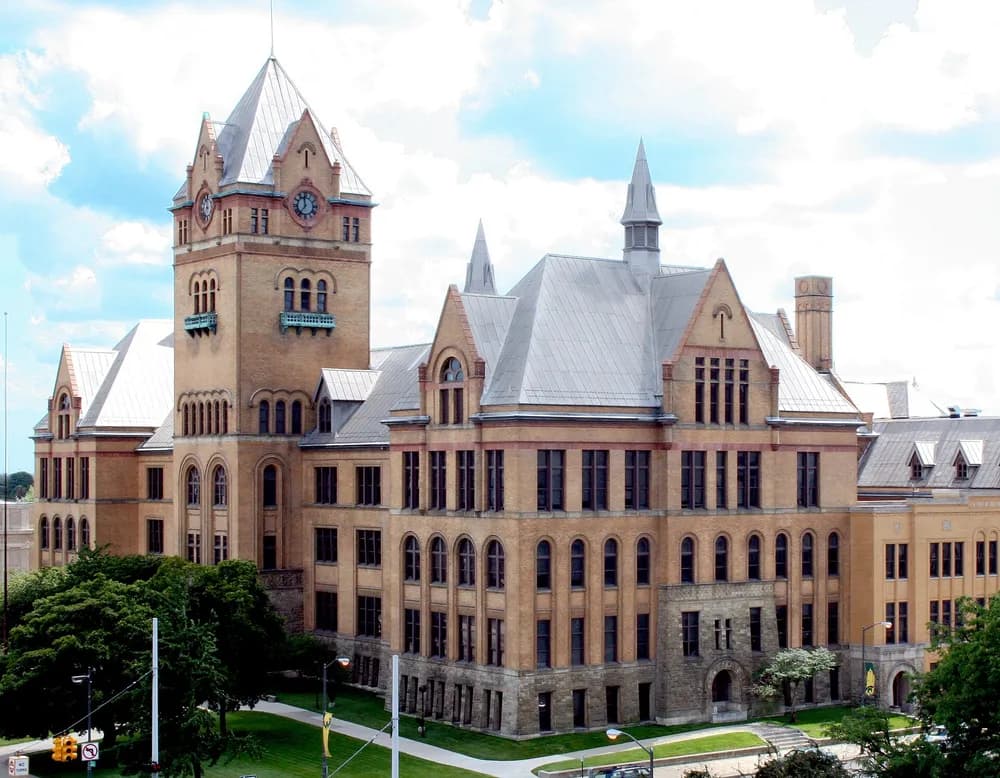

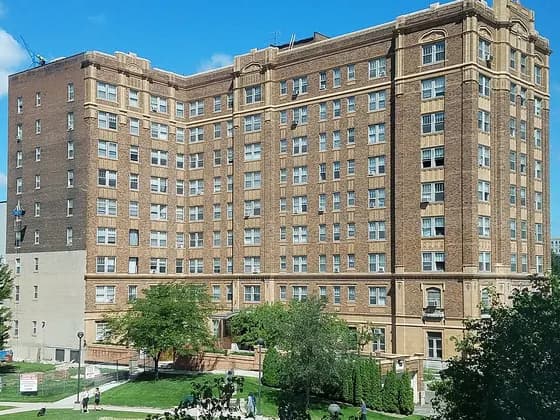

Photo: Del arte at English Wikipedia · CC BY-SA 3.0 · cropped
Photo: Matt Joseph · CC BY-SA 4.0 · Photo: Koen Kleine · CC BY-SA 4.0 · Photo: Andrew Heneen · CC BY 4.0
The Wayne State University School of Medicine MD program at a glance (2027 entry)
The Wayne State University School of Medicine (WSU School of Medicine, or WSUSOM) runs a four-year Doctor of Medicine (M.D.) program from its campus in Midtown Detroit. Its curriculum, Highways to Excellence, has four segments: two pre-clerkship segments of mainly classroom and lab study, a 12-month year of clerkships (core clinical rotations) and a post-clerkship segment that prepares you for residency. Classes are large: 299 students started in July 2026.
Teaching is organized by organ system. Year 1 covers how each system is built and works, with full-body cadaver dissection, and from April of year 1 you study the same systems in disease. In year 1, clinical skills teaching follows the same order, so the examination you practice matches the system you are studying.
Detroit is part of the curriculum from the start. Every student completes 35 hours of service learning, and the Population, Patient, Physician and Professionalism (P4) course takes on topics such as food insecurity, housing insecurity and correctional health care.
Clerkships run from April of year 2 to March of year 3, once you have passed Step 1 of the United States Medical Licensing Examination (USMLE), the national licensing exam series. The school's 2023-2030 strategic plan names the Detroit Medical Center (DMC) as its principal clinical affiliate and describes clinical education partnerships with six major health systems in southeast Michigan.
The school began in 1868 as the Detroit Medical College, founded by five physicians who had served in the Civil War. Its timeline says the Post-Baccalaureate Program, created in 1969, put Wayne State first among the nation's 125 medical schools, apart from Howard and Meharry, in the number of African-American graduates from 1981 to 1997.
| Degree | M.D. (Doctor of Medicine), four years, starting in July |
|---|---|
| Curriculum | Highways to Excellence: organ systems-based, introduced with year 1 in 2018 |
| Class size | 299 students entered in July 2026 (Class of 2030) |
| Main campus | Midtown Detroit: Mazurek Medical Education Commons and Gordon H. Scott Hall |
| Anatomy | Full-body cadaver dissection across the three year 1 Human Body Foundations courses |
| First patient contact | Standardized patients in year 1; community preceptor from April of year 1 |
| Clinical sites | Six southeast Michigan health systems; the DMC is the principal affiliate |
| Grading | Satisfactory or Unsatisfactory before clerkships; Honors, S+, S or U in clerkships |
| Step 1 timing | Year 2, by an early-March deadline; pass before April clerkships |
| Accreditation | Fully accredited by the Liaison Committee on Medical Education (LCME); next survey 2030-31 |
What makes the Wayne State University School of Medicine MD program different
Full-body dissection runs through all of year 1
Each of the three Human Body Foundations courses includes full-body cadaver dissection, so you dissect in every term of year 1, from July to March.
Your own primary care preceptor from April of year 1
From April of year 1 to December of year 2, the Clinical Experiential Course pairs you with a community preceptor in primary care. You see patients in practice a year before clerkships begin.
Clerkships across Detroit's major health systems
Clerkship campuses come from the school's clinical partners, from Level I trauma hospitals in Detroit to community preceptors' offices. The neurology clerkship, for example, lists sites at DMC and Henry Ford hospitals in Detroit, St. Joseph Mercy sites in Pontiac and Clinton Township, and the VA medical center.
Service in Detroit is built into the coursework
Service Learning and P4 run through years 1 and 2, with sessions on food and housing insecurity, veterans' health, disability and correctional health care. The admissions pages also count 13 student-run free clinics.
A three-year route or a four-year M.D./M.B.A.
The Three-Year M.D. takes up to 20 students a class and leads into a Wayne State residency in one of six specialties. The M.D./M.B.A. fits both degrees into four years.
How Wayne State University School of Medicine teaches medicine
The pre-clerkship phase runs from July of year 1 to March of year 2 in terms of about 12 weeks. Until the Step 1 period, each term pairs one 10-credit basic science course with longitudinal courses: Clinical Skills, P4 and Service Learning, joined in Segment 2 by the Clinical Experiential Course. This block structure, with breaks between terms, dates from April 2021 and kept the systems-based model first introduced in 2018.
Within each course, the sciences are taught together for one system at a time. In Human Body Foundations you study the anatomy, physiology, biochemistry, histology and genetics of each organ system alongside dissection. Human Disease Foundations covers pathology, pathophysiology, microbiology, immunology, genetics and pharmacology for the same systems.
In the clerkship year, the longitudinal Clinical Reasoning, Integration, Skills for Practice (CRISP) course meets monthly on clinical reasoning, interprofessional care, ultrasound, leadership, career planning and wellness. In Segment 4, Clinical Reasoning Using Integrated Skills in Education (CRUISE) continues that work. Teaching and Learning in Medical Education (TLMed) trains you to teach medical students through teaching assignments, live online workshops and a capstone project.
The ways you will learn
| Pre-recorded and live lectures | Faculty record lectures for you to watch at your own pace; they are not required, and the workload policy budgets 2.5 hours of your time for each lecture hour. Some live lectures, in person or on Zoom, are added. |
|---|---|
| Case-based and problem-based learning | Physiology case-based learning (CBL) sessions run through year 1, and case-based small groups cover each system in Segment 2. Year 1 also has five problem-based learning (PBL) cases on Zoom: your group reads a case and writes learning objectives, researches them in set self-study time, then presents what it found. |
| Team practice, Synergize and other small groups | Year 1 has biochemistry team practice sessions, pharmacology sessions called Pharmacovigilance, and evidence-based medicine small groups. In Segment 2, Synergize sessions, several of them exam reviews, sit alongside Patient Connect small groups on topics such as infectious, renal and neurological disease. |
| Laboratory sessions | Year 1 labs cover gross anatomy, histology and neuroscience, alongside embryology small groups and hands-on ultrasound sessions; Segment 2 adds microbiology, immunology and pathology labs. |
| Clinical Skills, P4 and Service Learning | Clinical Skills teaches history taking, examination, oral case presentation and clinical reasoning with standardized patients (people trained to act as patients). P4 meets on Thursday mornings for sessions on professionalism and the social context of care, including panel discussions, and Service Learning connects you with Detroit organizations. |
A typical week on the Wayne State University School of Medicine program
The school caps the pre-clerkship workload at an average of 50 hours a week across a term, excluding breaks. That total counts watching lectures, preparation, required sessions, clinical assignments and set self-directed study time, but not extra exam preparation, electives or personal time.
In a year 1 week on the 2026-27 schedule, you might have a three-hour gross anatomy lab in the afternoon, 90-minute histology and physiology sessions in the mornings, and P4 on some Thursday mornings. Interactive radiological anatomy runs on Zoom from 4:30 to 6 p.m. on some evenings, and each term you attend three or four assigned Clinical Skills sessions.
Exams set the rhythm. Each year 1 course has three cumulative three-hour morning exams, the last in its final week alongside a National Board of Medical Examiners (NBME) exam and the gross anatomy practical. In Segment 2, your Clinical Experiential Course visits fall on Tuesday mornings, Wednesdays or Thursday afternoons.
How anatomy is taught at Wayne State University School of Medicine
Anatomy is taught through full-body cadaver dissection across all three Human Body Foundations courses in year 1. Human Body Foundations I starts with the musculoskeletal system, working through the upper limb and back and then the lower limb. Human Body Foundations II moves to the chest, heart and abdomen, and Human Body Foundations III finishes with the pelvis, neck, skull, orbit and head.
The 2026-27 year 1 schedule lists 30 numbered three-hour dissection labs after an introductory session, with the class divided into two lab groups. Interactive radiological anatomy sessions on Zoom and ultrasound sessions cover the same body regions.
Each term ends with a gross anatomy practical exam that runs from 9 a.m. to 3 p.m. on the 2026-27 schedule. Classmates in the dissection lab also rate each other's preparation, participation and professionalism, with written comments. Anatomy is taught by the Department of Ophthalmology, Visual and Anatomical Sciences, which also oversees the Body Bequest Program.
In year 4, the Gross Anatomy Teaching Lab elective has you teach first-year students dissection skills while reviewing anatomy before residency. The May 2026 course list placed it in Gordon H. Scott Hall and said it was open to students who had joined the prosector program after their own first-year anatomy course.
When you first meet patients at Wayne State University School of Medicine
Patient contact starts in a simulated setting. Clinical Skills begins in your first term, and in year 1 you practice history taking and the physical examination with standardized patients at the school's clinical skills center. Service Learning also begins in July; in 2026 the first term included a Detroit clean-up project with Better Way and the City of Detroit.
Through the Wayne Trained program, launched in 2024, family physicians, many of them Wayne State graduates, take you through six clinical scenarios across years 1 and 2. Small-group discussions with faculty coaches follow the clinical sessions.
From April of year 1 to December of year 2, the Clinical Experiential Course pairs each student with a community preceptor in primary care clinics. The workload policy budgets two to three and a half hours a week for it, with small-group sessions at school. Clinical Skills in this period covers focused exams through pediatrics, general surgery, emergency medicine, urology and internal medicine.
Full-time clinical work begins with clerkships in April of year 2, after a Clinical Investiture ceremony at which students recite the Wayne State Pledge of Ethics and Professionalism. Outside the curriculum, students also run free clinics such as Street Medicine Detroit, which cares for people experiencing homelessness on the streets.
The Wayne State University School of Medicine curriculum, year by year
- Segment 1: year 1, July to March
Normal Structure and Function
Year 1 opens with orientation in early July and follows the healthy body one organ system at a time. Three 10-credit Human Body Foundations courses carry the science and the dissection, while Clinical Skills, P4 and Service Learning run all year. A break of about three weeks (March 20 to April 11 in 2027) precedes Segment 2.
- Human Body Foundations I (July to September): biochemistry, cell biology, embryology, histology, genetics, physiology and pharmacology, plus the musculoskeletal and peripheral nervous systems.
- Human Body Foundations II (October to December): the cardiovascular and respiratory, renal and urinary, and gastrointestinal systems.
- Human Body Foundations III (January to March): the reproductive and endocrine systems and the central nervous system.
- P4 1 and Service Learning 1: patient-centered care, professional identity and health disparities.
- An optional elective track from October to March.
- Segment 2: April of year 1 to March of year 2
Abnormal Structure and Function
Segment 2 starts in April of year 1 and returns to each system to study disease, while you begin seeing patients with your community preceptor.
- Human Disease Foundations I (April to June): disease mechanisms, clinical genetics, immunology, microbiology and infectious disease, and the musculoskeletal, peripheral nervous and integumentary (skin) systems, plus blood and lymphatic disease on the 2026-27 schedule.
- Human Disease Foundations II (July to September) covers the cardiopulmonary, gastrointestinal and urinary systems; III (October to December) covers the endocrine, reproductive and central nervous systems, with neurology and psychiatry.
- Longitudinal courses continue, including Service Learning 2 on groups such as veterans, people experiencing homelessness and people with disabilities in Detroit.
- Step 1 Preparation 2A to 2C, a structured course beside the disease courses, with practice exams in October. The NBME Comprehensive Basic Science Exam (CBSE) follows Human Disease Foundations III in December.
- January to March: Clinical Synthesis and Integration (CSI), then Step 1 Enhancement, the two courses of the dedicated Step 1 study period, followed by Preparation for Clerkships at the end of the segment.
- Preparation for Clerkships: workshops on rounds presentations and basic procedures, plus training in electronic health records, infection control, basic life support (BLS) and HIPAA privacy rules. The 2026-27 three-year M.D. handbook puts it at seven weeks for four-year students.
- Segment 3: April of year 2 to March of year 3
Clerkships
Clerkships have a single start date, April 1, and you must have passed Step 1 to begin. You spend 12 months in seven core clerkships, with the CRISP course running through the year; several clerkships vary by clinical campus. You are also assigned a faculty coach for your clinical development.
- Internal medicine (12 weeks): inpatient teams with residents and faculty, plus three to four weeks of general and specialty ambulatory medicine.
- Surgery (12 weeks): general, trauma and subspecialty services depending on your site, including two to three weeks on the anesthesiology service.
- Pediatrics (6 weeks): inpatient, outpatient and newborn nursery time. Obstetrics and gynecology (6 weeks): three weeks in obstetrics and three in gynecologic surgery.
- Family medicine, psychiatry and neurology (4 weeks each). Family medicine is in community preceptors' offices, with weekly teaching sessions and a one-day palliative and hospice care visit.
- Each clerkship includes a mid-clerkship feedback evaluation and ends with an NBME subject exam, often called a shelf exam.
- Segment 4: April of year 3 to April of year 4
Post-Clerkship
Segment 4 runs from the April after clerkships to the end of April the following year, with graduation in May. Under the policy effective October 2026, you need at least 10 months of coursework, leaving three unscheduled months for study or residency interviews.
- Emergency Medicine Core Clerkship (4 weeks), required of all students. It ends with an NBME shelf exam and an objective structured clinical examination (OSCE), a hands-on test of clinical skills.
- One acting internship, a month in which you work much like an intern, in family medicine, internal medicine or pediatrics.
- Seven electives (courses you choose), with at least one in-person clinical elective in each term.
- CRUISE and TLMed, graded Satisfactory or Unsatisfactory in each 12-week block.
- Step 2 CK, the USMLE's clinical knowledge exam (deadlines under Assessment).
- Residency Preparation in the April before graduation: a month of full-day, in-person classes and labs on campus, required from the Class of 2028.
How you are assessed at Wayne State University School of Medicine
Each pre-clerkship basic science course has at least three summative exams and ends with an NBME exam customized to what was taught. Faculty-written questions include multiple-choice clinical and lab vignettes, fill-in-the-blank and short answers. Optional weekly practice quizzes, posted on Friday afternoons, do not count toward your grade.
To pass a Segment 1 or 2 course you need a combined score of at least 70%. Grades go on your transcript as Satisfactory or Unsatisfactory, and Honors grades are reserved for Segments 3 and 4. Your percentages still count: averaged across the Foundations courses, they form an end-of-segment score, and students one standard deviation or more above the class mean earn End of Segment Honors.
Clerkship grades are Honors, Satisfactory with commendation (S+), Satisfactory, Unsatisfactory or Incomplete. You must pass every component: the clinical evaluation, assignments and the NBME subject exam. Honors requires outstanding work in all of them. Preceptors rate you on a five-point scale, and some clerkships add oral exams, OSCEs or written assignments. Segment 4 electives are graded Honors, Satisfactory or Unsatisfactory.
Step 1, which tests the basic sciences, has been reported only as pass or fail since January 26, 2022. The LCME, which accredits MD programs in the United States, lists Wayne State's program as fully accredited, with its next survey in 2030-31. That accreditation makes its students eligible for Step 1 and Step 2 CK; students at osteopathic (DO) and international schools qualify through other routes.
You must pass Step 1 to start clerkships, in no more than four attempts and within a year of finishing Human Disease Foundations III. If you miss the April 1 start, you join clerkships a year later. You register for a January-to-March window in year 2 (January to March 2027 for the Class of 2029). You take a Comprehensive Basic Science Self-Assessment (CBSSA) practice exam during CSI. You then sit Step 1 after Step 1 Enhancement, by the school's sit-by date in early March (March 2 in 2026).
In August 2026 the USMLE program announced a move to designated testing dates from January 2029, with Step exams offered less often each year. Its June 2026 announcement had named 2028. On the current schedule, a student entering in 2027 would begin dedicated Step 1 study in January 2029 and sit the exam in about February or early March, shortly after the switch. Step 2 CK, due by October 31, 2030, would also fall under the new model. These are projections from the current calendar, not published dates.
- Step 2 CK must be taken by October 31 after the clerkship year and passed by April 1 of your graduation year. The pass must be posted by February 1 for the school to certify you for the National Resident Matching Program (NRMP) Match, the national residency match.
- You can re-sit one failed Human Body or Human Disease Foundations course by re-examination; the pre-clerkship phase allows at most two course failures.
- Acting internships are graded on six assessments of Entrustable Professional Activities (EPAs), core tasks of a new resident such as patient handovers, plus a narrative evaluation.
- The Medical Student Performance Evaluation (MSPE) is the school's letter for residency applications. It places you in one of five groups, from Exceptional (about 5%) to Good (about 20%), based on pre-clerkship scores, clerkship grades and honors.
- You must complete every degree requirement within seven years of starting.
Wayne State University School of Medicine clinical rotations: where you will actually train
Your clinical training is spread across Detroit and its suburbs rather than one teaching hospital, and the school says it trains students at more than 70 clinical sites. Its clinical partners page lists the DMC, a system with more than 2,000 licensed beds, and Henry Ford Health. It also lists Corewell Health Dearborn Hospital, Trinity Health's Livonia and Oakland hospitals, the John D. Dingell VA Medical Center, the Barbara Ann Karmanos Cancer Institute and Michigan Healthcare Professionals (MHP).
For the clerkship year you are assigned to a clinical campus, by availability after the school surveys your ranked preferences, and you cannot swap with classmates. Your family medicine preceptor depends on your campus, though you can take that clerkship elsewhere in Michigan if you arrange your own transport and housing.
Department pages list clerkship sites, some under older hospital names. The neurology clerkship lists four DMC hospitals (Detroit Receiving, Harper, Sinai-Grace and Children's Hospital of Michigan), Henry Ford Hospital, St. John Hospital (now Henry Ford St. John) and the VA medical center. It also lists St. Joseph Mercy Oakland (now Trinity Health Oakland) in Pontiac and a St. Joseph Mercy site in Clinton Township.
Trauma care varies by site. The partners page lists Level I trauma centers, the highest level, at Henry Ford Hospital, an 877-bed hospital in Detroit's New Center area, and at the 612-bed Henry Ford St. John Hospital in Detroit. The emergency medicine department describes the DMC's Detroit Receiving Hospital as an urban Level I trauma center. The suburban hospitals on the partners page are Level II trauma centers.
A May 15, 2026 web-archive copy of the fourth-year course list placed the emergency medicine clerkship at Detroit Receiving, Sinai-Grace, Henry Ford and Henry Ford St. John hospitals, and the pediatric acting internship at Children's Hospital of Michigan. In both clinical segments, duty hours are capped at 80 a week, averaged over four weeks, with one day off in seven.
Detroit Receiving, Harper, Hutzel, Sinai-Grace and Children's Hospital of Michigan appear as sites in the May 2026 fourth-year course list.
- Detroit Receiving Hospital
- Harper Hospital
- Hutzel Hospital
- Sinai-Grace Hospital
- Children's Hospital of Michigan
- Henry Ford Hospital
- Henry Ford St. John Hospital
- John D. Dingell VA Medical Center
- Barbara Ann Karmanos Cancer Institute
Corewell Health Dearborn is home to five residency programs and a cardiology fellowship run with Wayne State.
- Corewell Health Dearborn Hospital
- Trinity Health Livonia Hospital
Trinity Health Oakland is a 497-bed community teaching hospital.
- Trinity Health Oakland Hospital, Pontiac
- Henry Ford Providence Southfield Hospital
- Henry Ford Providence Novi Hospital
MHP had 169 outpatient offices and diagnostic centers when the affiliation began in 2021. In year 4, ambulatory medicine students rank three MHP sites and are assigned one.
- Michigan Healthcare Professionals offices
- Family medicine preceptors' offices
Electives, selectives and away rotations at Wayne State University School of Medicine
In Segments 1 and 2 you can add one optional elective track if you are in good academic standing. Choices include research, medical education research, community engagement, medical quality improvement, Business of Medicine and the Leadership and External Affairs Development/Medical Political Action (LEAD/MPAC) advocacy elective. Year 1 electives run from October to March and year 2 electives from July to December, and failing a course drops you from yours.
Most elective choice comes in Segment 4. You need two home clinical months outside your intended specialty and at least one in-person clinical elective each term. You can take no more than five months in your specialty, three away months at institutions not affiliated with the school, one research or independent study month and one non-patient-care elective. Inpatient clinical electives are now called sub-internships.
Away electives go through the Visiting Student Learning Opportunities (VSLO) service of the Association of American Medical Colleges (AAMC), or need an affiliation agreement requested 60 to 90 days ahead. One away month can be an international elective, approved by the Director of Global Health and Education; allow six months to arrange it. Through the Cooperative Electives Exchange, electives at the University of Michigan, Michigan State University and Michigan State's osteopathic college earn full credit.
In the 2026-27 catalog, Street Medicine: Detroit includes 120 clinical hours caring for people experiencing homelessness. Culinary Medicine runs with the national group Health Meets Food. Mi-ABLE, a disability care elective, runs with the Henry Ford Health GROW Center and University of Michigan MDisability. Others include Rural Family Medicine, Forensic Pathology, Emergency Medical Services and dozens of specialty sub-internships.
Dual degrees and research years at Wayne State University School of Medicine
In the research elective track, you find a mentor, learn to critique papers and write a mini-review and research proposal in year 1. In year 2 you do supervised lab research and give a research presentation. The admissions office says about 60% of students take part in research, supported by the Office of Medical Student Research.
Scholarly Concentrations are optional longitudinal projects with a mentor in one of six areas: basic biomedical research; population health; public health, advocacy and community engagement; global health; medical education; and women's health. You declare by January 10 of year 2, then present a poster at research day and a talk at the annual Scholarly Concentrations event. Recognition runs from a notation in your residency application letters to Distinction, which needs honors in two related year 4 rotations and a submitted publication.
The M.D./Ph.D. program takes up to six students a year and averages seven to eight years. You take Step 1 by the end of February of year 2. Once you pass, you leave the medical curriculum for research rotations and a Ph.D. in a Wayne State doctoral program doing biomedical research. You return to clerkships in March of the year you defend. The M.D./M.S. in Medical Research, open to second- and third-year students, requires 30 credits, including an 8-credit thesis, and leaves the M.D. requirements unchanged.
The four-year M.D./M.B.A. with the Mike Ilitch School of Business starts with the Business of Medicine elective in year 1; you apply in January and begin business courses in April. M.B.A. classes meet on Thursday evenings and many Saturdays in year 2. You finish all but three core courses before clerkships, and the rest fall in Segment 4. The 2026-27 handbook puts the ideal cohort at about 30. The five-year M.D./M.P.H. adds a master's in public health accredited by the Council on Education for Public Health (CEPH).
The Three-Year M.D. takes up to 20 students a class who already know their specialty: anesthesiology, dermatology, family medicine, internal medicine, otolaryngology or preventive medicine. You apply after acceptance to the four-year M.D. and take a research or medical education research elective in years 1 and 2. Clerkship preparation lasts three weeks instead of seven, and clerkships start four weeks early. Graduates are ranked to match by their chosen Wayne State residency program, and the track cannot be combined with a joint degree.
Facilities and support at Wayne State University School of Medicine
Where you will learn
The Richard J. Mazurek, M.D., Medical Education Commons opened in June 2009 at 320 E. Canfield St. It houses the Shiffman Medical Library, classrooms and labs, the computer labs where you take exams, and the Kado Family Clinical Skills Center, where you train with standardized patients and high-fidelity simulation.
Gordon H. Scott Hall of Basic Medical Sciences, opened in 1971, holds facilities for pre-clinical and basic science teaching.
Support while you study
Every student is assigned to one of eight color-coded Warrior M.D. Houses, learning communities that stay with you from orientation to graduation. Houses bring all four classes together for social events and Mentor Meet-Ups on Detroit's leading health disparities, and student peer mentors and house coordinators help new students settle in.
Coaching runs through the houses. In the one-credit Wayne Trained and Coaching Professional Development course, faculty coaches meet you in small groups to discuss professionalism, professional identity, the MSPE and career goals, and one-on-one coaching is available. The approach follows the American Medical Association's Master Adaptive Learner framework for becoming a self-directed, lifelong learner.
Each class has designated counselors who stay with you for all four years and meet you at least once a year. They arrange referrals for mental health care rather than providing therapy themselves. The Office of Learning and Teaching offers learning skills support. After Human Disease Foundations II, students judged at high risk of failing Step 1 must meet the Vice Dean of Medical Education and that office.
Career advising runs across all four years, with specialty interest groups, CV and personal statement clinics, an annual regional residency recruitment fair, year 3 specialty advising, mock interviews and a rank order list workshop. In Segment 4, a dedicated faculty advisor helps you build your schedule.
Is the Wayne State University School of Medicine program right for you?
This program may suit you if
- You want hands-on, full-body cadaver dissection spread across all of year 1.
- You want medical school rooted in Detroit, with required service learning and P4 sessions on issues such as housing and food insecurity.
- You would like your own community preceptor from April of year 1, a year before clerkships.
- You want clerkships across several health systems, from Level I trauma hospitals to community practices.
- You already know your specialty and want a three-year route into a Wayne State residency, or an M.B.A. without an extra year.
Things to think about
- Classes are large, with 299 students in the Class of 2030; the eight Warrior M.D. Houses exist to break that into smaller groups.
- You do not pick your clerkship campus outright: sites are assigned by availability after a survey of preferences, and partner hospitals stretch from Detroit to suburbs such as Pontiac.
- Step 1 is a hard gate. Clerkships start only on April 1, so if you have not been promoted in time you begin a year later.
- Pre-clerkship courses are pass/fail on your transcript, but your percentage scores still shape End of Segment Honors and your MSPE group.
- Most lectures are recorded rather than live, so you need to keep pace on your own between required small groups and labs.
Wayne State University School of Medicine MD program — frequently asked questions
Applying to Wayne State University School of Medicine?
How to get into Wayne State University School of Medicine
Prerequisites, MCAT, AMCAS personal statement, secondaries and interview, step by step.
Open the guide →Wayne State University School of Medicine admissions profile
MCAT and GPA profile, acceptance rate, interview format and key dates.
See the profile →Compare Wayne State University School of Medicine with other schools
Put the teaching style, anatomy teaching and clinical sites next to another school.
Open the comparison →Prepare for the Wayne State University School of Medicine interview
Format breakdown, school-specific sample questions and prep tips from tutors who interviewed here.
Read the guide →Where this Wayne State University School of Medicine program guide came from
This guide was written from 72 official sources — Wayne State University School of Medicine's own program pages and curriculum documents, plus the accreditor and the hospitals and health systems the school trains students in where they publish detail — read on 2026-10-25, then checked claim by claim against those sources.
- Highways to Excellence: Curriculum Overview
- Highways to Excellence curriculum site home
- Highways to Excellence: Pre-Clerkship phase
- Highways to Excellence: Clerkship phase
- Highways to Excellence: Strategies
- Highways to Excellence: Our process (July 2018 implementation)
- Medical Doctor curriculum 2026-27, four-year track (chart revised April 27, 2026)
- Wayne State University Academic Catalog 2026-2027: Medicine (M.D.)
- Academic Catalog 2026-2027: M.D. course descriptions, years 1 to 4
- Academic Catalog 2026-2027: Medicine (M.D.) Three-Year
- Academic Catalog 2026-2027 (Undergraduate): School of Medicine facilities
- Records and Registration: 2026-27 Academic Calendar
- Segment 1 Schedule Overview 2026/2027, Class of 2030
- Segment 2 Schedule Overview 2026/2027, Class of 2029
- Records and Registration: USMLE registration and Step 1 window
- MD Student Handbook: USMLE Policy (effective February 28, 2026)
- MD Student Handbook: Grading and Grade Appeals (effective April 20, 2026)
- MD Student Handbook: Transcript Grades
- MD Student Handbook: Promotion and Graduation
- MD Student Handbook: Assessment
- MD Student Handbook: Remediation and Repeating Failed Courses or Clerkships
- MD Student Handbook: Medical Student Performance Evaluation (MSPE)
- MD Student Handbook: Clerkships Scheduling and Duty Hours
- MD Student Handbook: Segment 4 Policies (effective October 12, 2026)
- MD Student Handbook: Electives Policy, Segment 4 (effective October 12, 2026)
- MD Student Handbook: Electives Policy, Segments 1 and 2
- MD Student Handbook: Pre-Clerkship Student Workload Policy
- MD Student Handbook: Attendance and Absenteeism Policies
- School of Medicine: Clinical partners
- Fourth year course information by site (web-archive copy of May 15, 2026)
- Department of Emergency Medicine: Senior medical student EM clerkship
- Department of Emergency Medicine home (Detroit Receiving Hospital)
- Family Medicine and Public Health Sciences: Year 3 Clerkship
- Department of Neurology: Clerkship faculty and clerkship rotation sites
- School of Medicine News: Clinician Investiture for the Class of 2028 (April 3, 2026)
- School of Medicine 2023-2030 Strategic Plan
- School of Medicine: Historic timeline
- M.D. Admissions: Why choose the Wayne State University School of Medicine
- M.D. Admissions: M.D. degree
- M.D. Admissions: Train in Detroit, Serve and Excel Anywhere (student-run free clinics)
- M.D. Admissions: Class data and admissions snapshots
- M.D. Admissions: Student involvement and student-run clinics
- UME and Curricular Affairs: Service learning and community engagement
- M.D. Admissions: Learning communities
- Student Affairs: Warrior MD houses
- Student Affairs: Mentor program
- School of Medicine News: Wayne Trained launch (August 23, 2024)
- UME and Curricular Affairs: Clinical faculty, Wayne Trained and coaching
- UME and Curricular Affairs: M4 Acting Internships
- Office of Medical Student Research: Scholarly Concentrations
- Office of Medical Student Research: Scholarly Concentrations application and participation
- M.D. Admissions: Research and Scholarly Concentrations
- M.D. Admissions: Three-year M.D.
- Three-Year M.D. Handbook and Policies, 2026-27
- M.D. Admissions: M.D./M.B.A.
- M.D./M.B.A. frequently asked questions
- M.D./M.B.A. Handbook and Policies, 2026-27
- M.D. Admissions: M.D./M.P.H.
- Office of Medical Student Research: MD/MS Program
- Biomedical Graduate Programs: M.D./Ph.D. program admissions
- M.D./Ph.D. Program Handbook and Policies, 2025-26
- Kado Family Clinical Skills Center
- Ophthalmology, Visual and Anatomical Sciences: Education
- Student Affairs: Student support services
- Office of Learning and Teaching
- Student Affairs: Career planning
- LCME: Accredited Programs directory
- USMLE: Transition to Designated Testing Dates will take place in January 2029
- USMLE: Designated Testing Dates Information Hub (August 6, 2026 announcement)
- USMLE: June 23, 2026 announcement naming 2028
- USMLE: Common questions (Step 1 pass/fail reporting)
- USMLE Bulletin of Information: Eligibility
Curricula are restructured between cycles. Anything here that decides your application — how anatomy is taught, a clinical campus assignment, a required research year — should be confirmed against the official page for your entry year.
Applying to Wayne State University School of Medicine?
We help US applicants with MCAT strategy, the AMCAS personal statement, secondary essays and interview prep — everything you need for a competitive Wayne State University School of Medicine application.