
The MSU College of Human Medicine MD program
What you actually study, and where you will be
MSU College of Human Medicine's MD is a 4-year program with an integrated curriculum, with patient contact from Year 1 and clinical rotations in eight Michigan communities, from Detroit to the Upper Peninsula (2027 entry). Clinical experience runs through every phase of this MD. Based in East Lansing or Grand Rapids, you complete a focused primary care clinical block in the spring of year 1, then clinical and non-clinical rotations in year 2. After USMLE Step 1 you spend years 3 and 4 at one of eight community campuses across Michigan. Optional certificate programs add rural medicine or community and public health.
- Degree
- MD
- Length
- 4 years
- Teaching
- Integrated
- Clinical contact
- Year 1

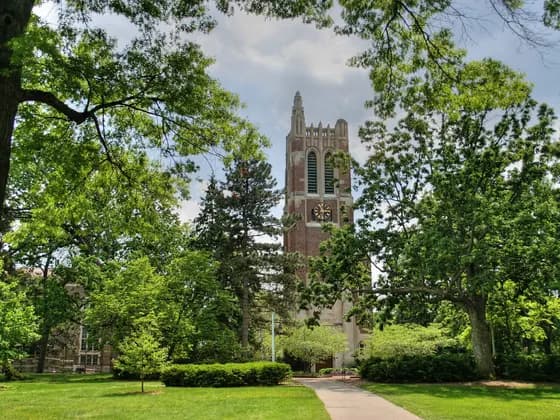

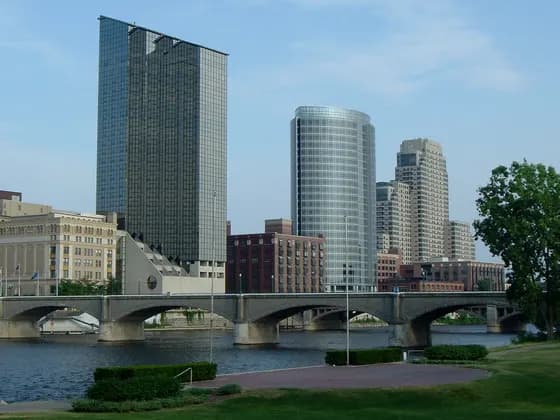
Photo: Scottb211 · CC BY 2.0 · cropped
Photo: The original uploader was Jeffness at English Wikipedia . · CC BY-SA 2.5 · Photo: WMrapids · CC0 · Photo: Grguy2011 · Public domain
The MSU College of Human Medicine MD program at a glance (2027 entry)
Michigan State University College of Human Medicine, often shortened to MSU CHM, runs a four-year MD program built on its Shared Discovery Curriculum, introduced in 2016. According to the 2026-27 MSU catalog, each entering class has 190 students. Years 1 and 2 are taught in East Lansing, on the MSU campus, or in Grand Rapids, at the Secchia Center, with about 200 first- and second-year students at each site.
The college calls itself the nation's pioneer community-based medical school. MSU founded it in 1964, and in 1966 it introduced a program to train students in a range of community settings. For years 3 and 4 you are based at one of eight community campuses, from Detroit to Marquette in the Upper Peninsula, for your clerkships, the core clinical rotations in each specialty.
Clinical work begins in year 1, when the spring course includes a focused clinical block at a primary care clinic. Year 2 adds clinical rotations alongside non-clinical ones, and the sciences are taught together with clinical skills throughout. These first two years form the pre-clerkship phase, the part of medical school before full-time clerkships.
Between year 2 and your clerkships you sit USMLE Step 1, the first of the US licensing exams, and you take Step 2 CK, the clinical knowledge exam, before graduating. From your first semester, regular progress tests and clinical skills exams track your growth.
The Liaison Committee on Medical Education (LCME), which accredits MD programs in the United States, completed its review in fall 2025 with full accreditation for six years. Its directory lists the program's next survey for 2030-31.
In April 2026 MSU's Board of Trustees approved combining the College of Human Medicine and the College of Osteopathic Medicine into one college, MSU Medicine, which will offer both the MD and the DO. The university has committed to keeping each program's separate accreditation, by the LCME for the MD and by the Commission on Osteopathic College Accreditation (COCA) for the DO.
| Degree | MD, a four-year program |
|---|---|
| Curriculum | Shared Discovery Curriculum, introduced in 2016 and revised from fall 2025 |
| Class size | 190 students in each entering class (2026-27 catalog) |
| Where you study | East Lansing or Grand Rapids, then one of eight community campuses |
| Teaching style | Scholar groups, basic science sessions, labs and weekly clinical simulation |
| First patient contact | A focused primary care clinical block in the spring of year 1 |
| Anatomy | Weekly anatomy lab sessions in year 1 |
| Grading | Pass-No Grade (pass/fail) grading approved for the college's courses |
| Step 1 timing | After the year 2 courses, before clerkships begin |
| Accreditation | LCME, full accreditation; next survey 2030-31 |
What makes the MSU College of Human Medicine MD program different
A primary care clinical block in year 1
In the spring of year 1 you complete a focused clinical block as part of the team at a primary care clinic, with the biomedical and social sciences built around that experience.
Clinical and non-clinical rotations in year 2
The Middle Clinical Experience takes you through a series of clinical rotations, each with its own goals and a weekly small group led by a faculty preceptor. Six non-clinical rotations are built around patients' stories.
Clerkships at one of eight community campuses
For years 3 and 4 you train in one community's hospitals and clinics, from Detroit to the Upper Peninsula. Campus staff, led by a community assistant dean, schedule your rotations, oversee your degree requirements and support you.
Progress testing from your first semester
Progress tests of scientific and clinical knowledge and a clinical skills exam with standardized patients run from your first semester. You must pass them to advance, and the college treats progress testing as its graduation test for the MD.
Rural programs with up to 26 weeks in one town
The Leadership in Rural Medicine certificate covers two programs. The Upper Peninsula's Rural Physician Program includes four weeks of rural family medicine. In Traverse City's Rural Community Health Program you also train in a rural hospital town, returning through year 3 and living there for up to 26 weeks. Midland runs a Rural Community Health Program too.
Community and public health training in Flint
Leadership in Community and Public Health (LCPH), formed from two older certificate programs, prepares you to care for underserved and vulnerable populations and guarantees you Flint for years 3 and 4. It adds community-based electives, and you must reach conversational ability in a second language by year 3. By late September 2026, 30 first-year students had joined LCPH.
How MSU College of Human Medicine teaches medicine
The Shared Discovery Curriculum (SDC) puts the patient at the center of teaching and includes clinical experiences in every phase. The Early Clinical Experience falls in year 1, the Middle Clinical Experience in year 2 and the Late Clinical Experience in years 3 and 4. Basic, clinical and social science themes are integrated throughout, and service is built in: every student completes 40 hours of structured service learning, with preparation and reflection.
The SCRIPT competencies set what you must be able to do: Service, Care of Patients, Rationality, Integration, Professionalism and Transformation. All but service are based on residency competencies adopted by the Accreditation Council for Graduate Medical Education (ACGME). In February 2026 the college said its curriculum and evaluation are now organized around its educational program objectives. These fall into six groups: Serving the People, Care of Patients, Reflective and Rational Approach to Learning, Integrating into Systems, Professionalism and Transforming Knowledge.
The SDC was revised with new courses from fall 2025, and a 2027 entrant takes the new version. In MSU's course catalog, new versions of the year 1 courses took effect in fall 2025 and spring 2026, new year 2 courses from summer 2026 and new clerkship versions from spring 2027. In February 2026 the college said updates to the basic science curriculum and improvements to clerkships had shaped this next version.
The ways you will learn
| Scholar groups | You are assigned to one of four learning societies, and within it you meet regularly through years 1 and 2 in a smaller scholar group. There you solve problems together, debrief and reflect on your clinical experiences, connect them with the underlying science and keep an ongoing learning plan. |
|---|---|
| Basic science sessions | Sessions on the basic sciences run each week in year 1. In year 2 they continue as basic science-focused large-group sessions. |
| Anatomy and integrative biomedical labs | Every week of year 1 includes laboratory sessions in anatomy and in integrative biomedical science. |
| Clinical simulation and simulated patients | Clinical simulation is part of every week in year 1 and continues in year 2. You also work with simulated (or standardized) patients: people trained to portray a patient's history, physical findings and emotions consistently, who then give you feedback. |
| Rotation-based small groups | In year 2 each clinical rotation has its own goals and objectives, supported by a weekly small group session on that rotation, precepted by faculty. |
A typical week on the MSU College of Human Medicine program
A year 1 week includes scholar group sessions, basic science sessions, labs and clinical simulation. You also take part regularly in assessment activities that check your understanding and skills, and in sessions on health and wellness, career advising and study skills.
College policy caps your hours. In years 1 and 2, scheduled activities average no more than 28 hours a week over the semester, or 38 including required preparation. In clerkships, work hours are limited to 80 a week averaged over four weeks, with one day in seven free. Continuous duty is capped at 28 hours, with at least 14 hours off after 24 hours in the hospital.
How anatomy is taught at MSU College of Human Medicine
Anatomy is taught within the integrated first-year courses, with anatomy and integrative biomedical laboratory sessions every week of year 1. The Division of Human Anatomy teaches both MSU medical colleges, human and osteopathic, and its Willed Body Program receives the donated bodies that make anatomy study possible.
The anatomy laboratory is restricted to medical students, faculty, staff and students of health professions. At the Grand Rapids campus, the anatomy site director works with the clinical simulation team to bring anatomy into simulated patient care.
In years 3 and 4 you can return to anatomy through Directed Study in Clinical Prosection, an elective worth 3 or 6 credits. It covers anatomical prosection (the dissection of specimens to display anatomy for teaching) and the diseases of particular body regions.
When you first meet patients at MSU College of Human Medicine
In year 1 the fall course, Medical School I (HM 552), builds foundations in the sciences and clinical skills. In the spring, Medical School II (HM 553) is the primary care clinical experience: a focused clinical block in which you work as part of the team at a primary care clinic.
College policy sets how closely you are supervised. You never provide care without supervision. You can take a history or check vital signs while your supervisor is immediately available rather than in the room. Once you have completed HM 552, the same applies to most physical exams, but breast and genital exams and all procedures need a supervisor present.
Year 2 adds a series of clinical rotations in the Middle Clinical Experience. In the year 3 family medicine, internal medicine and pediatrics clerkships, you take primary responsibility for managing patients' care under the supervision of attending physicians or senior residents.
The MSU College of Human Medicine curriculum, year by year
- Year 1 (M1)
Foundations and a primary care clinical block
The M1 phase is your first two semesters, starting in late August, and includes the Early Clinical Experience. It builds a foundation in the basic and social sciences together with clinical skills: patient-centered interviewing, the core physical exam, clinical reasoning and other patient care skills.
- HM 552 Medical School I (fall, 16 credits): the foundations, combining biomedical and social sciences and humanities with clinical skills and professional development.
- HM 553 Medical School II (spring, 13 credits): the primary care clinical experience, with biomedical and social science built around it, and your scholarly project.
- LCPH students start early, meeting monthly through one semester in each of years 1 and 2.
- As of November 2024, the Indigenous Pathway, launched in 2022, offered first-year students a two-week immersion in a tribal health setting.
- Year 2 (M2)
Middle Clinical Experience and Step 1
The M2 phase starts in the summer semester straight after year 1. Its Middle Clinical Experience is a series of clinical rotations, alongside non-clinical rotations. You sit USMLE Step 1 after the phase, then move to your clerkship campus.
- Six non-clinical rotations take place in classroom, lab and simulation settings, each built around patients' stories, teaching the underlying basic, social and clinical sciences.
- The 2026-27 catalog offers year 2 either as a two-semester series (summer and fall, 16 credits each) or as a three-semester series (13 credits each in summer and fall, then a 6-credit spring course). Both combine clinical rotations with organ system and topic rotations.
- Intensive Step 1 study typically begins in the spring of year 2, supported by Step 1 Slam question review sessions.
- Year 3 (M3)
Core clerkships at your community campus
The Late Clinical Experience covers years 3 and 4 at your community campus. Year 3 opens with a Transition to Clerkships course, then the six required clerkships, with a two-semester Advanced Skills and Knowledge (ASK) course alongside.
- Required clerkships: family medicine, internal medicine, obstetrics and gynecology, pediatrics, psychiatry and surgery. The 2026-27 catalog gives psychiatry 6 credits and each of the others 9; the college counts 4 weeks of electives as 6 credits.
- The Department of Medicine gives internal medicine as six weeks, all on inpatient services, focusing on adult diseases evaluated in hospital. The Department of Psychiatry gives psychiatry as four weeks; it covers inpatient, outpatient, emergency and community mental health services.
- Surgery is now a single clerkship (SUR 651) on common problems in general surgical and trauma settings, in place of the earlier Surgery I and II.
- ASK, listed in the 2026-27 catalog as HM 651 and HM 652, combines teaching, workplace-based assessments, progress testing and a two-week block with faculty. It also uses checklists for core entrustable professional activities, tasks you should be trusted with on day one of residency.
- LCPH students spend two weeks each fall and spring with a community partner organization.
- Year 4 (M4)
Critical care, electives and residency preparation
In year 4 you complete a critical care selective and a Transition to Residency course, finish the 28 weeks of electives, and take USMLE Step 2 CK before graduation.
- Critical care selective in medicine, pediatrics or surgery; the medicine version is a four-week clerkship on managing critically ill patients.
- Sub-internships, where you work much as a first-year resident would under supervision, in family medicine, internal medicine, OB/GYN, pediatrics, general surgery and neurosurgery.
- A spring Ready for Residency simulation event for all graduating students: recognizing sick patients, consent, breaking bad news, procedures such as a lumbar puncture or central line, and intern-level scenarios.
- Mock residency interviews with volunteer preceptors each August to October.
- In the 2027 TIP pilot, third-years aiming for internal medicine can apply for a fourth year that continues into a participating college residency program, without a guaranteed position.
- LCPH students take a consecutive four-week elective in an underserved area; most go abroad, to countries such as Peru, Costa Rica, Ecuador and India.
How you are assessed at MSU College of Human Medicine
Assessment is competency-based, measured against the SCRIPT competencies. From your first semester a progress suite checks your growth at regular intervals. It combines the Comprehensive Necessary Science Examinations, progress tests of scientific and clinical knowledge, with the Progress Clinical Skills Examination (PCSE), which tests your skills with standardized patients twice a semester. You must pass these to advance, and the college calls progress testing its graduation test for the MD.
The MSU catalog records that Pass-No Grade (P-N) grading, a pass/fail system, is approved for College of Human Medicine students in the college's 500- and 600-level courses, which include HM 552 and HM 553. If you narrowly miss a pass, or fall short in one definable part of a course, you may receive a Conditional Pass. You then have a deadline, usually the middle of your next semester, to fix the gap instead of repeating the course.
Core clerkships of four weeks or more include oral and written feedback at the midpoint, and clerkships and rotations of two weeks or more end with written feedback on the SCRIPT competencies. Only comments from end-of-semester letters, final clerkship evaluations and clinical preceptor evaluations can go into your Medical Student Performance Evaluation (MSPE), the school's summary letter for residency applications.
USMLE Step 1 tests how you apply the science behind medicine, and has been reported only as pass or fail since January 26, 2022. Step 2 CK is a multiple-choice exam on applying clinical knowledge. LCME accreditation is what makes students in MD programs like this one eligible to sit both; DO students and international medical students and graduates qualify by other routes.
In August 2026 the USMLE program announced a move to designated testing dates from January 2029, with Step exams offered less often each year. Its June 2026 announcement had named 2028. On the current schedule, a student entering in August 2027 would finish the year 2 courses in December 2028 on the two-semester series, or in May 2029 on the three-semester series.
The college says intensive Step 1 study typically begins in the spring of year 2, and the spring 2029 semester starts on January 8, 2029. So you would sit Step 1 shortly after the USMLE moves to designated testing dates, or a few months after it on the three-semester series. Step 2 CK comes later, in years 3 and 4, before graduation. These dates are projections from the college's sequence and calendar.
- Faculty, peers and health care team members give you feedback, and faculty observe you in clinics and review portfolios of your essays, reflections and scholarly work. A Student Competence Committee recommends grades for the core HM courses.
- The internal medicine clerkship includes formative (practice) exercises on chest X-rays and electrocardiograms.
- Elective preceptors submit a clinical performance evaluation at the end, and some electives add written or oral exams, presentations, papers or observed clinical assessments.
MSU College of Human Medicine clinical rotations: where you will actually train
For years 1 and 2 you are based in East Lansing or Grand Rapids, and clinic time in the Early and Middle Clinical Experiences takes place at more than 90 clinics. For years 3 and 4 you join one of the eight community campuses listed below, which between them use nine primary teaching hospitals and 57 community hospitals.
Each campus is led by a community assistant dean and a student programs administrator, and campuses range from about 20 to about 140 third- and fourth-year students. The campus pages describe students working in street medicine, free clinics, food banks, shelters and refugee services, and mentoring premedical students.
Grand Rapids hosts all four years, as does the Lansing campus, which teaches years 1 and 2 in East Lansing. But the LCPH program says only a minority of East Lansing and Grand Rapids students stay put for years 3 and 4. Some routes set your campus or give you priority for one. LCPH students are guaranteed Flint. MSU MD/PhD students are placed in East Lansing or Grand Rapids for years 1 and 2 by where their research mentor will be, and their clerkship community is set individually. VAI-CHM MD/PhD students, whose PhD is at the Van Andel Institute Graduate School, get priority for the Grand Rapids campus throughout.
Students selected for the Rural Community Health Program are assigned to a community campus and a rural educational site: a rural hospital, its local medical community and the public health department. Traverse City's sites are Alpena, Cadillac, Charlevoix, Grayling and Ludington, where students live and work for up to 26 weeks over four years.
The newest campus, based at Henry Ford Hospital, with about 30 third- and fourth-year students. Henry Ford Hospital is a Level I Trauma Center with a simulation center and anatomy lab for medical education.
- Henry Ford Hospital
- Henry Ford hospitals in Bloomfield and Ferndale
Established in 1971 and based downtown, with about 80 students. Home of the LCPH program and the Charles Stewart Mott Department of Public Health.
- Hurley Medical Center
- McLaren Flint
- Providers across Genesee County
A clerkship campus since 1971 and a years 1 and 2 campus since 2010, with about 140 third- and fourth-year students.
- Corewell Health, including Butterworth, Helen DeVos Children's and Blodgett hospitals
- Trinity Health
- Pine Rest
The founding campus, established in 1966. Years 1 and 2 are taught in East Lansing, and about 26 third- and fourth-years train in greater Lansing, with a large choice of specialty and subspecialty rotations.
- MSU Health Care
- McLaren Healthcare Greater Lansing
- University of Michigan-Sparrow
Established in 2010, with about 20 students training in urban and rural settings. Its Rural Community Health Program splits training between the full-service hospital and rural education sites.
- MyMichigan Health
- Hospitals and clinics in Midland, Clare, Gladwin and Alma
Established in 2014, with about 40 students.
- Henry Ford Providence Southfield Hospital
- Henry Ford Providence Novi Hospital
Established in 2009, with about 24 students. Rural Community Health Program sites are Alpena, Cadillac, Charlevoix, Grayling and Ludington.
- Munson Medical Center, a 442-bed regional referral center
- Munson Healthcare hospitals in Cadillac, Charlevoix, Grayling, Kalkaska, Manistee, Gaylord and Frankfort
- MyMichigan Medical Center Alpena
- Corewell Health Ludington Hospital
Started in Escanaba in January 1974 and moved to Marquette in 1986; about 20 students today, most of them living in Marquette County. Home of the Rural Physician Program, with four weeks of rural family medicine, which had graduated 350 doctors by 2025, and an Indigenous Pathway elective site.
- UP Health System–Marquette, a 222-bed Level II Trauma Center
- Community hospitals and clinics across the Upper Peninsula
- Keweenaw Bay Indian Community Health System
Electives, selectives and away rotations at MSU College of Human Medicine
Electives make up 28 weeks (42 credits) of the degree. At least 16 weeks must be clinical electives with direct patient care. At least 4 weeks of clinical electives must be at your own community campus, and at least 4 weeks in your final two semesters. One 4-week clinical elective must involve caring for medically underserved patients, with approval and reflective work required to graduate.
Elective clerkships are normally four weeks long and are scheduled through your community assistant dean's office. The 2026-27 catalog lists 126 elective courses, emergency medicine and neurology among them. They range from cardiology and neonatology to a Veterans Affairs elective, one on the care of migrant and seasonal agricultural workers and one called Northern Wilderness, Emergency and Sports Medicine. You can also design your own clinical or non-clinical elective, or take a research clerkship.
You can take electives at other medical schools, arranged through the AAMC's Visiting Student Learning Opportunities (VSLO) service, and the college covers you with professional liability insurance on away electives.
Students in years 1 and 2 can join a college program in Costa Rica over spring break. In years 3 and 4 you can seek approval for an international elective through your campus's student programs administrator, applying through MSU's Office for Education Abroad at least 8 weeks before you leave. The catalog's Global Health Experience in India covers rural health delivery, with pre-travel preparation and work in pediatrics, women's health, mental health and tropical disease.
The Indigenous Pathway offers third- and fourth-years a two-week elective with tribal health partners. They include the clinic of the Little Traverse Bay Bands of Odawa Indians and, since 2024, the Keweenaw Bay Indian Community Health System in the Upper Peninsula.
Dual degrees and research years at MSU College of Human Medicine
Research starts in year 1, when every student completes a scholarly project as part of HM 553. The Early Mentors for Research Program matches first- and second-year students with research mentors each fall and spring. The college's Medical Student Research Group also runs three open enrollment periods a year for mentor matching, once you have completed training in the responsible conduct of research.
In years 3 and 4, research electives are full-time clerkships of 40 hours a week. You need a research mentor, an application and proposal 30 days before the start, and a final research summary. A research elective in the summer before clerkships earns credit only once you pass Step 1. In 2026 the college offered 13 research awards: 12 scholarships in oncology, breast cancer, innovation and neurology, and one supplement for a student taking a year off for cancer research.
The Human Medicine Research graduate certificate is for students who want a long research commitment. It adds 6 to 10 weeks of full-time research, a regional or national conference presentation, a manuscript for the certificate's advisory committee and 12 credits of research clerkship.
The MSU MD/PhD program began in 1985. You take medical and graduate courses on a tailored schedule for three years and sit Step 1 by the end of year 3. Years 4 and 5, or more, go to dissertation research, with a monthly continuity clinic to keep up your clinical training, and clerkships follow the PhD.
In the VAI-CHM MD/PhD, you complete years 1 and 2 and Step 1, then earn a PhD in molecular and cellular biology at the Van Andel Institute Graduate School in Grand Rapids. You return for the final two years of clinical training. In both routes, PhD research counts as three two-week research electives, shortening medical school by six weeks. The college's MD/PhD FAQ gives seven to eight years as the average time to complete both degrees.
- MD/MBA with MSU's Broad College of Business: a 61-credit MBA, 12 credits of which transfer from medical school, designed to take five years. You take the MBA classroom year either before medical school or after year 2, and the remaining MBA courses online.
- MD with MPH: MSU's online 43-credit Master of Public Health, with sample plans that start it before medical school or in a gap year. One MD clinical experience can serve as the MPH applied practice experience if it is public health related and approved.
- MD/OMFS with Henry Ford Health: for dentists who hold a DDS and have been accepted to Henry Ford Hospital's oral and maxillofacial surgery residency. They start at the M2 year, spend three semesters in East Lansing, must pass Step 1 and finish the MD and residency in six years.
Facilities and support at MSU College of Human Medicine
Where you will learn
The Secchia Center on the Grand Rapids Medical Mile is the college's headquarters. The privately funded $90 million building opened in 2010 and has a simulation center where students practice skills for clinical settings. Nearby, the MSU Grand Rapids Innovation Park holds the Grand Rapids Research Center, opened in 2017 and home to 33 biomedical research teams, and the Doug Meijer Medical Innovation Center, opened in 2021.
Research also centers on East Lansing, where MSU's Institute for Quantitative Health (IQ) brings engineering into biomedicine, and on the Flint campus, home to community-participatory public health research.
Simulated patients come through MSU's Simulated Patient Program, which employs more than 300 people to portray cases for the human medicine, osteopathic medicine, veterinary medicine and nursing colleges at four locations. Some sessions teach breast, pelvic, genital and rectal examinations with simulated patients.
Support while you study
In your learning society, a group of faculty act as your coaches, advisors and mentors for the first two years. The four societies are named after John Dewey, Daniel Hale Williams, Jane Addams and Justin Smith Morrill, architect of the Morrill Land Grant Act.
The Office of Academic Achievement offers free one-on-one and small-group coaching, peer tutoring of up to two hours a week, and peer-led Question Review Sessions on Zoom that teach you to use board-style questions. Coaches usually meet online but can meet in person in East Lansing or Grand Rapids.
Career advising runs through all four years. In years 1 and 2 you meet physician career advisors in small groups and use the AAMC's Careers in Medicine curriculum. In years 3 and 4 your campus's community assistant dean and a subspecialty career advisor help you build your residency applications.
For well-being, the Office of Student Affairs and Services has an assistant dean for student wellness and engagement and assistant directors of student counseling and wellness. In February 2026 the college said a new dean for wellness and extra counselors had doubled its personal counseling capacity. By April 2025 it also had a central system for reporting mistreatment, with an oversight committee.
Is the MSU College of Human Medicine program right for you?
This program may suit you if
- You want patient contact in year 1, through a focused primary care clinical block in the spring, then clinical rotations in year 2.
- You learn well in small groups that debrief clinical experiences and connect them to the science, with weekly labs and simulation.
- You want your clerkships based in one Michigan community's hospitals and clinics, whether in a city such as Detroit, Flint or Grand Rapids or in northern Michigan.
- Rural or underserved care appeals to you, through the rural programs, the Flint-based LCPH certificate and the required underserved elective.
- You like being assessed through progress tests, standardized patient exams and written feedback, with pass/fail course grading.
Things to think about
- Most students change city after year 2; only a minority stay in East Lansing or Grand Rapids for years 3 and 4.
- Campuses range from about 20 to about 140 third- and fourth-year students. LCPH guarantees Flint, the Rural Community Health Program assigns you a campus and a rural site, and VAI-CHM MD/PhD students get priority for Grand Rapids.
- Year 2 begins in the summer semester straight after the spring of year 1.
- MSU is merging this college with its osteopathic college into MSU Medicine, approved in April 2026, so names and structures may change during your degree. The university has committed to keeping the MD's LCME accreditation.
- On the current schedule, a 2027 entrant would start intensive Step 1 study in January 2029. You would sit the exam shortly after the USMLE moves to designated testing dates, with Step exams offered less often each year.
MSU College of Human Medicine MD program — frequently asked questions
Applying to MSU College of Human Medicine?
How to get into MSU College of Human Medicine
Prerequisites, MCAT, AMCAS personal statement, secondaries and interview, step by step.
Open the guide →MSU College of Human Medicine admissions profile
MCAT and GPA profile, acceptance rate, interview format and key dates.
See the profile →Compare MSU College of Human Medicine with other schools
Put the teaching style, anatomy teaching and clinical sites next to another school.
Open the comparison →Prepare for the MSU College of Human Medicine interview
Format breakdown, school-specific sample questions and prep tips from tutors who interviewed here.
Read the guide →Where this MSU College of Human Medicine program guide came from
This guide was written from 71 official sources — Michigan State University College of Human Medicine's own program pages and curriculum documents, plus the accreditor and the hospitals and health systems the school trains students in where they publish detail — read on 2026-10-25, then checked claim by claim against those sources.
- MSU College of Human Medicine: Shared Discovery Curriculum
- MSU Academic Programs Catalog 2026-27: College of Human Medicine
- MSU Registrar: Course Descriptions (HM, clerkship and elective courses)
- MSU Academic Programs Catalog: College of Human Medicine (Internet Archive copy, September 17, 2024)
- MSU Academic Programs Catalog 2026-27: grading systems and the Conditional Pass marker
- MSU College of Human Medicine: Shared Discovery Curriculum overview, version 1.0
- MSU College of Human Medicine: The Learning Societies
- MSU College of Human Medicine: Community Campuses
- MSU College of Human Medicine: Detroit campus
- MSU College of Human Medicine: Flint campus
- MSU College of Human Medicine: Grand Rapids campus
- MSU College of Human Medicine: Lansing campus
- MSU College of Human Medicine: Midland Regional campus
- MSU College of Human Medicine: Southeast Michigan campus
- MSU College of Human Medicine: Traverse City campus
- MSU College of Human Medicine: Upper Peninsula Region campus
- MSU College of Human Medicine: About
- MSU College of Human Medicine: History and Timeline
- MSU College of Human Medicine: Medical Education
- MSU College of Human Medicine: Our Partnership with Henry Ford Health
- MSU College of Human Medicine: Our Partnership with Corewell Health
- MSU College of Human Medicine receives six-year LCME accreditation (February 11, 2026)
- LCME: Accredited Programs directory
- MSU Office of the President: MSU Medicine (Board of Trustees approval of April 10, 2026)
- MSU Office of the President: Advancing One Health, A Shared Vision for Michigan State (March 11, 2026)
- USMLE: Designated Testing Dates Information Hub
- USMLE: Transition to Designated Testing Dates will take place in January 2029 (August 6, 2026)
- USMLE: Transition to limited testing dates each year starting in 2028 (June 23, 2026, since updated)
- USMLE: Step 1 transition to pass/fail only score reporting
- USMLE Bulletin of Information: Eligibility
- MSU College of Human Medicine: Academic Calendar, AY 2025-26 to 2029-30
- MSU College of Human Medicine: Academic Achievement
- MSU College of Human Medicine: Office of Assessment
- MSU College of Human Medicine: Clinical Elective Clerkships
- MSU College of Human Medicine: Global Health
- MSU Simulated Patient Program
- MSU College of Human Medicine: Service Learning
- MSU Department of Medicine: Internal Medicine Clerkship (MED 641)
- MSU Department of Psychiatry: Human Medicine Clerkship (PSC 641)
- MSU Department of Medicine: Medicine Critical Care Clerkship (MED 643)
- MSU Department of Medicine: TIP information and application, 2027 pilot year
- MSU College of Human Medicine Lansing Campus: Preceptors
- ResearchCHM: Research Elective Guidelines and Forms
- ResearchCHM: Access to Research Opportunities
- ResearchCHM: Early Mentors for Research Program
- ResearchCHM: 2026 MSU-CHM Research Scholarships
- MSU College of Human Medicine: MD/PhD Program
- MSU College of Human Medicine: MD/PhD FAQ
- MSU College of Human Medicine: MD program
- MSU College of Human Medicine: Program Information (MD/OMFS)
- MSU Broad College of Business: MD-MBA dual degree
- MSU Master of Public Health: Public Health and Medicine
- MSU Master of Public Health: MD with MPH sample curriculum plans
- MSU College of Human Medicine Flint: Leadership in Community and Public Health
- MSU College of Human Medicine Flint: LCPH frequently asked questions
- MSU College of Human Medicine: LCPH program news (September 30, 2026)
- Munson Healthcare: MSU College of Human Medicine Traverse City Campus
- Munson Healthcare: Rural Community Health Program
- UP Health System: MSU College of Human Medicine, UP Campus
- MSU College of Human Medicine: U.P. Campus marks fifty years of rural medicine (April 23, 2025)
- MSU College of Human Medicine: Indigenous Pathway news (November 5, 2024)
- MSU Division of Human Anatomy: About
- MSU Division of Human Anatomy: Faculty directory
- MSU Division of Human Anatomy: Body Donation (Willed Body Program)
- MSU College of Human Medicine: Policy on Medical Student Work Hours (revised April 7, 2025)
- MSU College of Human Medicine: Policy on Narrative Assessment
- MSU College of Human Medicine: Policy on Clinical Supervision
- MSU College of Human Medicine: Career Advising
- MSU College of Human Medicine: Office of Student Affairs and Services
- MSU College of Human Medicine: Dean's Update, April 4, 2025
- Henry Ford Health: Henry Ford Hospital undergraduate medical education programs
Curricula are restructured between cycles. Anything here that decides your application — how anatomy is taught, a clinical campus assignment, a required research year — should be confirmed against the official page for your entry year.
Applying to MSU College of Human Medicine?
We help US applicants with MCAT strategy, the AMCAS personal statement, secondary essays and interview prep — everything you need for a competitive MSU College of Human Medicine application.