
MSU College of Human Medicine Interview
Format, Questions & Prep Tips
MSU College of Human Medicine medicine interviews for 2027 entry are multiple mini interviews (MMI). MSU College of Human Medicine describes the format as: Virtual MMI on Zoom: 8 stations of 10 minutes (1–2 minutes to read the scenario, 8–9 minutes with the rater). Published figures: Annual MD class size ~185–200 (across all campuses); Interview format MMI — 8 stations, ~8 min each.
- Institution
- Michigan State University College of Human Medicine
- Interview (2027 entry)
- October through February; rolling invitations after secondary review
- Decisions (2027 entry)
- Rolling decisions; final offers by late March; campus match decisions communicated separately

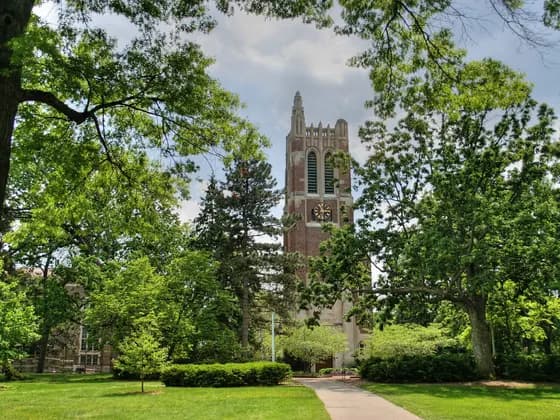


Photo: Scottb211 · CC BY 2.0 · cropped
Photo: The original uploader was Jeffness at English Wikipedia . · CC BY-SA 2.5 · Photo: WMrapids · CC0 · Photo: Grguy2011 · Public domain
How to get into MSU College of Human Medicine (MD) medicine
Step-by-step: entry requirements, admission tests, personal statement, interview format and the key deadlines.
Open the guide →MSU College of Human Medicine (MD) entry requirements
Admission profile, interview format, decision dates and what makes MSU College of Human Medicine (MD) different.
See the profile →The MSU College of Human Medicine (MD) medicine interview
Michigan State University College of Human Medicine uses an **MMI (Multiple Mini-Interview)** format with 8 stations of approximately 8 minutes each. As one of the largest public MD programs in the US, MSU Human Medicine pioneered the community-based distributed campus model — students train at one of seven Michigan campuses during clinical years.
The MMI is held primarily at the Grand Rapids Secchia Center or East Lansing, and its stations probe the AAMC Premed Competencies. MSU’s interview culture is heavily oriented toward health equity and social determinants of health — expect at least one station that explicitly tests your ability to reason through population-level health disparities.
With ~185–200 students per year and a strong in-state preference, MSU interviews are competitive even for Michigan residents. The school screens for candidates with genuine commitment to community medicine, primary care, and diverse patient populations.
MSU College of Human Medicine (MD) interview at a glance (2027 entry)
| Annual MD class size | ~185–200 (across all campuses) |
|---|---|
| Interview format | MMI — 8 stations, ~8 min each |
| Application system | AMCAS + MSU secondary |
| Interview window | October–February |
| Clinical campuses | Grand Rapids, East Lansing, Flint, Lansing, Saginaw, Traverse City, Upper Peninsula |
| CASPer required | SJT required — Casper or AAMC PREview |
Interview format
- MMI with 8 stations; each approximately 8 minutes; brief preparation time at each station door.
- Station types: ethical dilemma, communication role-play, collaborative task, critical thinking, and personal reflection.
- Interviewers include faculty physicians, community clinicians, and standardized patients.
- Full interview day: campus tour (Grand Rapids Secchia Center or East Lansing), admissions briefing, student Q&A panel.
- Health equity and social determinants of health are recurring MMI themes.
- Campus preference matching process is discussed on interview day.
Working towards the MCAT score MSU College of Human Medicine (MD) expects? Build a week-by-week plan from your test date — free for the first two weeks.
Sample interview questions
MSU Human Medicine trains physicians across seven Michigan campuses — many in smaller, underserved communities. Why is that model appealing to you?
Show awareness of the specific campuses and the populations they serve. Reference any personal ties to Michigan regions or community health experience.
A low-income patient is non-adherent to their diabetes medications because of cost. You know a more expensive but more effective medication would better control their disease. How do you approach their care?
Social determinants framework: address cost barriers, pharmaceutical assistance programs, community health workers, and shared decision-making. Avoid blaming patient non-adherence without exploring structural context.
Should Medicaid cover gender-affirming surgery? Defend your position.
Evidence-based mental health outcomes for gender-affirming care vs. cost concerns. Address the Affordable Care Act Section 1557 anti-discrimination protections and Medicaid coverage evolution.
Role play: A patient's family member is angry that their elderly relative's care is being "given up on" by the palliative care team. You are the medical student. How do you respond?
Empathy first, clarification second. Do not defend the care team until you understand the family's specific concern. Use open-ended questions. Offer to connect them with the physician.
Flint, Michigan experienced a public health crisis when the water supply was contaminated with lead. What are the long-term health consequences, and how should the healthcare system have responded?
Demonstrates Michigan-specific health systems knowledge. Address lead neurotoxicity, systemic racism in environmental health policy, and the physician's role in public health advocacy.
Which of MSU's seven clinical campuses would you prefer and why?
Answer specifically. Show that you have researched the campus (Grand Rapids, Flint, Traverse City, Upper Peninsula, etc.) and the health challenges of that community.
A colleague asks you to cover for them during a shift they missed because of a personal crisis. You barely know the patients. How do you handle this?
Patient safety vs. colleague support. Address handoff protocols, documentation, informing the attending, and the limits of competency when unfamiliar with the patient.
You are presenting in a student case conference and you realize mid-presentation that you made a factual error in your assessment. What do you do?
What they are listening for:
- Intellectual honesty
- error correction in real time
- professional composure
Do not minimize — acknowledge, correct, and continue.
What does health equity mean to you, and can you describe a time when you personally worked to reduce a health disparity?
Be specific — name the disparity, the intervention, and the outcome. MSU strongly values candidates who have moved beyond awareness to action on health equity.
A 17-year-old patient discloses to you that they are sexually active and requests STI testing and contraception without parental notification. What do you do?
Address Michigan minor consent laws for sexual health services, Title X confidentiality, and the physician's ethical duty to protect both patient autonomy and wellbeing.
Station: you are shown blood-lead-level data for Flint children before, during, and after the water crisis, alongside data on follow-up developmental screening rates. In your station time, interpret what the data does and does not establish about long-term harm.
Be concise for the 8-minute station: distinguish exposure data from causal claims about individual outcomes, note the importance of long-term follow-up, and avoid overstating certainty. Connect to MSU's health-equity and Michigan-specific focus.
Station role play: a patient from a Flint family is angry and distrustful, telling you 'the system poisoned us and then moved on.' You are the medical student. How do you engage with them?
Demonstrate the encounter live. Validate the legitimate anger, do not defend institutions reflexively, and focus on what you can concretely offer now. Tests communication and humility under emotional pressure in MMI format.
Station: MSU emphasizes social determinants of health as an analytical framework, not a slogan. Walk me through how you would use it to explain why two patients with identical diagnoses might have very different outcomes.
Thinking & Reasoning. Apply the framework structurally — housing, food security, transportation, insurance, health literacy, discrimination — to show you can reason with SDOH rather than merely name it, which MSU explicitly screens for.
Station role play: you are explaining a new asthma action plan to a parent who is overwhelmed, juggling three children, and has told you they 'don't have time for all this.' How do you proceed?
Demonstrate prioritization and teach-back live. Identify the one or two most critical points, check understanding, and adapt to the parent's constraints rather than delivering the full plan verbatim.
Station: MSU trains across seven Michigan campuses serving very different communities. Tell me which campus and community you would choose, and what specific health challenge there you would want to address.
Be specific and decisive given the station format. Name the campus (Grand Rapids, Flint, Traverse City, Upper Peninsula, etc.) and a real regional challenge, showing you understand the distributed model rather than treating campuses as interchangeable.
Practise the MSU College of Human Medicine (MD) interview
Rehearse the real format before the day — on demand with our AI interviewers, or live with a tutor.
Sit a mock with photoreal AI interviewers — any time
A timed MMI or panel interview on video — American & international voices — with interviewers who listen, react and press with follow-ups. Rubric-scored feedback and a replay the moment you finish.






Live mocks with a tutor who’s been in the room
A full MSU College of Human Medicine (MD)-style mock with a medic or dentist tutor — honest scoring against real marking criteria, a station-by-station debrief and a written action plan.
Book a mock interviewHow to prepare for the MSU College of Human Medicine (MD) interview
Common pitfalls to avoid
MSU College of Human Medicine (MD) interview — frequently asked questions
Sources & official admissions information
Ready to nail your MSU College of Human Medicine (MD) interview?
Book a mock interview with a tutor who knows the US interview formats, orpractice unlimited stations from our interview question bank.