
The Hackensack Meridian School of Medicine MD program
What you actually study, and where you will be
Hackensack Meridian School of Medicine's MD is a 4-year program taught through problem-based learning in an integrated curriculum, with patient contact from Year 1 and clinical rotations in northern and central New Jersey, from Englewood to Brick (2027 entry). Hackensack Meridian's 3+1 curriculum opens with 16 months of integrated courses framed by a weekly patient case, plus a three-year community course that pairs you and a classmate with a local individual or family. A clerkship year in New Jersey hospitals comes next, then the Step 1 licensing exam and advanced rotations. The fourth year is individualized, for research, a dual degree or electives, or you can start a Hackensack Meridian Health residency a year early.
- Degree
- MD
- Length
- 4 years
- Teaching
- Integrated + Problem-based learning
- Clinical contact
- Year 1
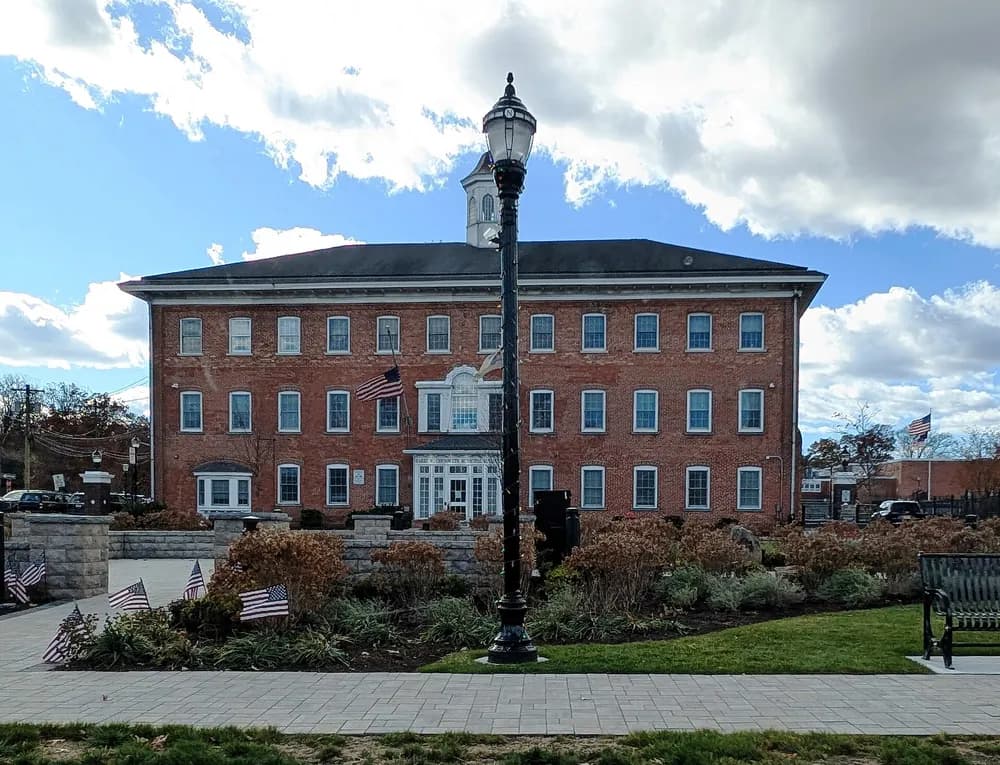

Photo: Mr. Matté (if there is an issue with this image, contact me using this image's C · CC BY-SA 4.0 · cropped
Photo: JERRYE & ROY KLOTZ, M.D. · CC BY-SA 4.0 · Photo: Tony Fischer · CC BY 2.0 · Photo: JERRYE & ROY KLOTZ, M.D. · CC BY-SA 4.0
The Hackensack Meridian School of Medicine MD program at a glance (2027 entry)
The Hackensack Meridian School of Medicine (HMSOM), in Nutley, New Jersey, awards the MD (Doctor of Medicine). Its 3+1 curriculum is a three-year core that every student completes, then an individualized fourth year called Phase 3. Students who take the Phase 3-Residency (P3R) option instead enter residency, the specialty training that follows medical school, a year early in the Hackensack Meridian Health network.
Phase 1, the first 16 months, is built from seven integrated courses taken one after another. Each week is organized around a patient case presented on Monday, which small groups also work through in problem-based learning sessions. Health systems science, the study of how health care is organized, paid for and improved, runs through the whole phase.
Community work sits at the center of the program. In the three-year Human Dimension course, you and a classmate visit a local individual or family at home over two years. Your small group also carries out a Community Health Project with community partners. Clinical skills start in year 1 with standardized patients, actors trained to play patients, and visits to a primary care practice begin in January of year 1.
Phase 2 begins in late October of year 2 with clerkships, the core clinical rotations. Most clerkship hospitals belong to Hackensack Meridian Health, and the school's clerkship-site map groups ten of them into North, Central and South regions. Step 1 of the United States Medical Licensing Examination (USMLE) comes after the clerkship year, the reverse of the order at many schools. Advanced Clinical Rotations, senior rotations and electives starting in January of year 3, follow it.
The school was incorporated in 2015, admitted its first 60 students in 2018 and has been independent of Seton Hall University, its original partner, since July 2020. The Liaison Committee on Medical Education (LCME), which accredits MD programs in the United States, granted preliminary accreditation in March 2018, provisional in February 2021 and full accreditation in February 2023. Its directory, updated October 14, 2026, lists the program as fully accredited, with the next survey in 2027-28.
| Degree | MD (Doctor of Medicine) |
|---|---|
| Curriculum | 3+1: a three-year core, then an individualized Phase 3 |
| Program length | 4 years; P3R students enter residency after the three-year core |
| Class size | 162 in the 2026 cohort, which entered in July 2026 |
| Main campus | Interprofessional Health Sciences Campus, on the Nutley-Clifton border |
| Anatomy | Dissection, mainly in the Structural Principles course in the fall of year 1 |
| First patient contact | Year 1: clinical skills, then primary care practice visits from January |
| Clinical sites | 13 inpatient teaching sites, mostly Hackensack Meridian Health hospitals, from Englewood to Brick |
| Step 1 timing | After the clerkship year, before the Advanced Clinical Rotations |
| Grading | Pass/fail in Phase 1; Honors to Fail in clerkships |
What makes the Hackensack Meridian School of Medicine MD program different
Two years visiting a local individual or family
You make these home visits with a classmate as part of the Human Dimension Voices Program. The school calls them relationships, not clinical encounters. You share health information, connect the people you visit with resources, help them prepare for medical visits and may go along.
Step 1 after a full year of clerkships
At many schools Step 1 comes before clerkships. Here you prepare for and take it straight after the clerkship year, in a six-week study block. Step 2 CK, the clinical knowledge exam, follows during the Advanced Clinical Rotations.
A fourth year shaped around your own plan
Phase 3 follows the three-year core, with objectives set for each student. With your advisor you build a Phase 3 Plan, reviewed by your specialty mentor, that might combine electives, 12-week clinical specialty immersions, research, a community project or a master's degree.
Residency a year early through P3R
Through the Phase 3-Residency (P3R) option, you complete the three-year core, then enter a residency program in the Hackensack Meridian Health network instead of spending a fourth year at school. It means planning early: you need a specialty mentor by the spring of year 1, and the advising schedule covers P3R decisions and applications in year 2.
A transitional clerkship and outpatient time in every rotation
The clerkship year opens with a four-week Transitional Clerkship. You join rounds and outpatient work, practice in simulation and with standardized patients, and learn skills such as writing notes and orders, handing off patients and drawing blood. Because most health care happens outside hospitals, the school gives every clerkship a significant share of outpatient time.
How Hackensack Meridian School of Medicine teaches medicine
The school describes its curriculum as integrated and competency-based, with science presented in its clinical context. It is organized around 18 Entrustable Professional Activities (EPAs), tasks you should be trusted to do when you start residency, such as taking a history, handing off a patient or obtaining informed consent. Thirteen come from the Association of American Medical Colleges (AAMC) and five are the school's own.
Competency-based means progress depends more on mastering skills than on fixed time. School news from May 2024 and October 2025 says this gives students who need it extra time on core skills. Faster learners can take on intensive research or a master's degree such as an MBA.
Phase 1's seven Sciences/Skills/Reasoning (SSR) courses each mix biomedical, behavioral and health systems science; the first two lay foundations and the other five are systems courses. Health systems science covers three areas: how health systems are structured and paid for, how to use data and evidence, and systems-based practice such as quality improvement and population health. Some subjects are threads rather than courses. Pharmacology is taught across all 16 months of Phase 1, tied to the week's clinical presentation.
Nutrition also runs through Phase 1, concentrated in the digestion course. The school's 2025 Human Dimension annual report says second-year students that year joined a Teaching Kitchen immersion with the Culinary Institute of America (CIA), cooking plant-forward meals with chefs and CIA students. It adds that joint capstone projects with CIA master's students are planned.
The strands connect. In the school's own example, one week might cover the anatomy of the heart, the cardiac exam and the causes and treatment of heart disease. You might also map healthy food sources and safe places to exercise around your Human Dimension family's neighborhood.
Because you share a campus with Seton Hall University's nursing and health sciences students, some learning is interprofessional. In the clerkship year, which the school treats as one integrated whole, your competencies and goals carry from rotation to rotation, and residents count among your teachers. Your Individualized Learning Plan, kept with your advisor from year 1, then shapes your final rotations and Phase 3.
The ways you will learn
| Large-group active learning | Sessions use a flipped classroom: you study the material beforehand and spend class time applying it, with faculty questioning and audience-response checks. A school policy protects unscheduled time in your week for this preparation. |
|---|---|
| Team-based learning (TBL) | Some courses use TBL. You prepare in advance, take a short readiness test on your own, then take it again with your team, and those individual and team scores count toward the course result. |
| Patient Presentation Problem-Based Learning Curriculum (PPPC) | This weekly problem-based learning course runs through all of Phase 1. With a faculty facilitator, your small group discusses the week's case and pulls together what you have learned, building clinical reasoning, self-directed learning and teamwork. It includes research presentations. |
| Clinical skills small groups | A faculty facilitator coaches your small group in communication, history taking, physical examination, clinical reasoning, counseling and motivational interviewing, diagnostic testing and care plans. You work with standardized patients and task trainers, and your facilitator regularly reviews your skills growth plan with you. |
| Human Dimension small groups | A group of eight students meets a faculty mentor to debrief community experiences through case presentations, workshops and reflection. Monthly themes include professional identity, social determinants of health, barriers to care, community systems, substance use and mental illness. |
A typical week on the Hackensack Meridian School of Medicine program
Phase 1 weeks follow a set pattern built around the case of the week. Expect at least 40 hours of academic work a week, counting class time and preparation; the school sets that expectation for every phase.
- Monday: the week's patient presentation, in the first session of the day.
- Large-group sessions for the current course, plus weekly practice multiple-choice questions that give feedback but do not count.
- Tuesday or Wednesday: a half-day Human Dimension small group roughly every other week, and clinical skills small groups two or three times a month, for about four to six hours each.
- Friday morning: your PPPC small group meets to discuss the week's case.
How anatomy is taught at Hackensack Meridian School of Medicine
Anatomy is taught mainly in Structural Principles, the second course of year 1, an eight-week introduction to anatomy, histology (tissues under the microscope) and medical imaging. On the 2027 cohort calendar it runs from September 13 to November 7, 2027. Lab teaching is in small groups on the Nutley campus, in sessions that typically run from 8am to noon.
You learn by dissection. Faculty work with your group as you dissect, identify structures and discuss their clinical relevance, often by questioning you. The wet and dry gross anatomy lab can also be set up for prosections, which are specimens dissected in advance, and for computer-based imaging. It is used to teach imaging, histology and pathology too.
Donated bodies make this teaching possible. The school runs an Anatomical Donation Program, whose donations are used to educate medical and other health students. The student handbook asks everyone in the lab to treat donors, specimens and equipment with the utmost care.
When you first meet patients at Hackensack Meridian School of Medicine
Community contact starts in your first week with the Human Dimension Immersion Orientation, a service-learning experience. A March 2025 school article said it had recently offered 21 community experiences across eight cities for the whole entering class. The Human Dimension's home visits then put you alongside people as they manage their health and health care. The school's 2025 Human Dimension annual report counts 709 families who have worked directly with students since the program began.
Clinical skills teaching starts with Phase 1. The first 18 weeks focus on communication: building rapport, gathering information, reaching a shared plan of care with patients and families, and a basic physical examination. You learn with standardized patients and real patients, in workshops and in simulation. Over the next 12 months, sessions turn to more detailed examination and to common symptoms, matched to the systems course you are taking.
Your first official clinical experience is the Longitudinal Clinical Placement, from January to September. You are paired one-to-one with a physician preceptor, a doctor who teaches you in their own practice, in an outpatient primary care setting, ideally internal medicine, family medicine or pediatrics. Over ten visits you see at least two patients each time, taking histories and examining them yourself, and write one patient note per visit for your preceptor to review.
You can also arrange optional shadowing with faculty physicians once grades for Molecular and Cellular Principles, the first SSR course, are posted. It must never clash with scheduled teaching.
The Hackensack Meridian School of Medicine curriculum, year by year
- Year 1 (Phase 1)
Foundations, then the first systems courses
Year 1 starts in July with Becoming a Physician, a required two-week orientation, then moves through five of the seven SSR courses. Clinical skills and the Human Dimension run alongside, and the Longitudinal Clinical Placement begins in January. Dates here come from the 2027 cohort calendar, which the school says may change.
- Molecular and Cellular Principles (eight weeks, from July 19, 2027): genetics and epigenetics, molecular biology, immunology, pathology and pharmacology.
- Structural Principles (eight weeks, from September 13): anatomy, histology and medical imaging, taught with dissection.
- Immunity, Infection and Cancer (11 weeks, November to early February): the immune system, rheumatology and dermatology, microbiology and infectious disease, then cancer from the molecular to the social level.
- The Developing Human (eight weeks, February to April): growth and development, genetics, and the reproductive, endocrine and blood systems, with pediatrics and geriatrics.
- Homeostasis and Allostasis (11 weeks, April to June): the heart, lungs and kidneys, and how the body keeps its balance through change, up to the level of society.
- A Block OSCE (Objective Structured Clinical Examination) at the end of the year: you rotate through timed stations, each testing a clinical skill.
- Year 2, July to October (Phase 1)
Last systems courses and the end of Phase 1
After a two-week summer break, the last two systems courses complete Phase 1. The phase ends with a high-stakes Block OSCE that you must pass to move on to clerkships, and your Community Health Project is assessed.
- Nutrition, Metabolism and Digestion (eight weeks, July 10 to September 3, 2028): the digestive system, biochemistry and metabolic disease, and the main concentration of the nutrition thread.
- Neurosciences and Behavior (eight weeks, to October 29, 2028): the nervous system from cells to society, with neuroscience and psychiatry taught together.
- The Longitudinal Clinical Placement continues to September.
- The NBME Comprehensive Basic Science Examination, a standardized exam from the National Board of Medical Examiners, gives you feedback without counting. Your advisor goes over the results with you in August or September.
- Late year 2 to late year 3 (Phase 2)
The clerkship year
On the 2027 cohort calendar the clerkship year runs from October 30, 2028 to November 11, 2029. After the four-week Transitional Clerkship, you move through the block clerkships. The Human Dimension continues alongside.
- Internal medicine, surgery and family medicine: eight weeks each.
- Pediatrics, obstetrics and gynecology, psychiatry and neurology: six weeks each.
- Emergency medicine is a longitudinal clerkship, spread alongside the block clerkships rather than taught as a block of its own.
- Where one is available, each clerkship ends with an NBME subject exam, a national multiple-choice test in that specialty known as a shelf exam. Every clerkship also includes an OSCE with standardized patients.
- Formal feedback at the midpoint of every clerkship, set against your own self-assessment.
- Year 3, November to June (Phase 2)
Step 1, then Advanced Clinical Rotations
A six-week Step 1 study block follows straight on, from November 12 to December 23, 2029 on the 2027 cohort calendar. You must pass Step 1 to start the Advanced Clinical Rotations, which run from January 7 to about June 9, 2030. Phase 3 work, such as intensive research, can begin during them.
- A four-week sub-internship, also called an acting internship, in which you take on much of the work of a first-year resident under supervision.
- A two-week critical care selective, a required rotation in which you choose among options.
- Two four-week electives from the school's catalog.
- Up to four weeks of flexible time to prepare for and take Step 2 CK, which the school encourages you to sit as early as possible.
- The sub-internship and critical care selective can instead come at the start of Phase 3.
- Capstone Scholarship Day in May, when all third-year students present their required Human Dimension capstones; nearly 200 projects were shown in 2026.
- With your advisor, you finalize your Phase 3 Plan between January and March.
- Year 4 (Phase 3)
Individualization, or residency through P3R
Phase 3 begins on June 10, 2030 on the 2027 cohort calendar and runs about a year. Its objectives are set for each student through a Phase 3 Plan. Students on the P3R route instead start residency in the Hackensack Meridian Health network.
- Electives, including 12-week clinical specialty immersions, and credit-bearing research with a mentor.
- Community immersion projects; one recent project worked on establishing and sustaining a student-run free clinic for uninsured residents of Bergen County.
- A dual degree or certificate program.
- If you are not on the P3R route, residency applications through the National Resident Matching Program (NRMP), known as the Match, with a Residency Advisor's support.
How you are assessed at Hackensack Meridian School of Medicine
Phase 1 courses are graded Pass or Fail. Each course and unit has several components, and on each you receive Meets Expectations, Meets Expectations with Recommendations or Does Not Meet Expectations. You pass only if every component reaches at least Meets Expectations with Recommendations. A shortfall shows as a temporary remediation grade until you make it up, or a Fail if you do not.
Summative assessments, the ones that count, include NBME-style written exams, lab practicals in some courses, TBL readiness-test scores and a clinical skills OSCE. Most fall in the Reflection and Assessment Week that ends each course. Phase 1 is also split into three units, and at the end of each your work in health systems science, professional behaviors, the Human Dimension and your Longitudinal Clinical Placement is assessed.
Four Block OSCEs test your clinical skills: at the end of year 1, at the end of Phase 1, midway through the clerkship year and at its end. They mix standardized patient encounters, simulation, electronic medical record use and tasks such as a patient hand-off, and you must reach at least Meets Expectations with Recommendations in every domain. Under the handbook's Block OSCE rules, failing the end-of-Phase-1 or end-of-clerkship exam means leaving the curriculum for focused remediation.
Clerkships and sub-internships are graded Honors, High Pass, Pass or Fail from a combined score drawing on the shelf exam where one exists, an OSCE, clinical evaluations, written work and your EPA performance. To pass you also need minimum performance on EPA 1 (history and physical examination) and EPA 17 (professionalism and growth), and a shelf score above a minimum set from recent national data. Electives, selectives and the Human Dimension are pass/fail.
The USMLE is the national exam series for a US medical license. Step 1 tests the sciences behind medicine and has been reported only as pass or fail since January 26, 2022; Step 2 CK (Clinical Knowledge) tests how you apply clinical knowledge to patient care. LCME accreditation is what makes students of an MD program like this one eligible to sit them. Here you must pass Step 1 to begin the Advanced Clinical Rotations, and Step 2 CK before Phase 3.
In August 2026 the USMLE program announced a move to designated testing dates from January 2029, with Step exams offered less often each year. Its June 2026 announcement had named 2028. On the current schedule, a student entering in July 2027 would study for Step 1 from November 12 to December 23, 2029, and sit it around the end of 2029. Step 2 CK would follow in the first half of 2030, during the Advanced Clinical Rotations that start on January 7. Both sittings would come well after the switch.
- These are projections. The calendar prints no exam days and is subject to change, and under designated testing dates your sitting day will depend on the dates the USMLE offers.
- You have three attempts at each Step exam, and failing either three times means dismissal. Every graduation requirement, including both exams, must be met within six years of starting.
Hackensack Meridian School of Medicine clinical rotations: where you will actually train
Clinical training happens mainly in hospitals of Hackensack Meridian Health (HMH), which describes itself as New Jersey's largest health network, with 18 hospitals and more than 500 patient care locations. In a lottery you give your preferences for the order of your rotations and for the region and site where you do them.
The school's December 2025 Data Book lists 13 inpatient teaching sites, and every clerkship includes outpatient time at sites across the network. The school's clerkship-site map, with 2021 map data, puts ten of these hospitals into North, Central and South regions, some under older names. The map's JFK Medical Center is now JFK University Medical Center, Ocean Medical Center is Ocean University Medical Center, and Raritan Bay - Old Bridge is Old Bridge Medical Center. Englewood Health, on the North list, is a separate health system, not part of HMH.
You arrange your own travel to sites, some of which have no public transportation; most parking at HMH and affiliated sites is covered by student fees. Clerkship hours follow the duty-hour rules of HMH's residency programs. You work no more than 80 hours a week, averaged over four weeks, with at least one day off a week and in-house call no more often than every fourth night.
The school's community engagement began with the areas around its campus, Hackensack University Medical Center and Jersey Shore University Medical Center. Its Human Dimension communities of focus for 2025-26 are listed below.
Hackensack University Medical Center is an 803-bed teaching and research hospital with a Level I adult trauma center and a Level II pediatric trauma center. Joseph M. Sanzari Children's Hospital is also located there. HMH's January 2026 news calls the Montclair hospital Hackensack Meridian Mountainside Medical Center.
- Hackensack University Medical Center, Hackensack
- Palisades Medical Center, North Bergen
- Mountainside Medical Center, Montclair
- Englewood Health, Englewood
JFK University Medical Center houses a Neuroscience Institute and the Johnson Rehabilitation Institute.
- JFK University Medical Center, Edison
- Raritan Bay Medical Center, Perth Amboy
- Old Bridge Medical Center, Old Bridge
- Riverview Medical Center, Red Bank
Jersey Shore University Medical Center has Level I adult and pediatric trauma centers and more than 1,200 physicians across 60 specialty areas. K. Hovnanian Children's Hospital is also located there.
- Jersey Shore University Medical Center, Neptune
- Ocean University Medical Center, Brick
Listed in the December 2025 Data Book but not on the regional map.
- Bayshore Medical Center, Holmdel
- Clifton
- Garfield
- Hackensack
- Montclair
- Nutley
- Paterson
- Passaic
- Union City
Electives, selectives and away rotations at Hackensack Meridian School of Medicine
Electives come in two stretches. During the Advanced Clinical Rotations in year 3 you take two four-week electives from the school's catalog. The rest come in Phase 3. Most electives can be taken in either stretch once you have the prerequisites, though some, such as the Phase 3 specialty immersions, are meant for the final year.
Phase 3 electives run for two or four weeks full time, or part time over a longer period, and clinical specialty immersions last 12 weeks. You can also take research or medical education research electives with a mentor. Your specialty mentor helps you schedule electives, including away electives at other institutions. The school lists global health electives among the fourth-year options, and it has run a Health Care Strategy elective created by an HMH strategy vice president.
Dual degrees and research years at Hackensack Meridian School of Medicine
Every student completes the Human Dimension Scholarly Capstone, a required project that pulls the three-year course together. Starting from a clinical experience in your clerkship year, you pick a health-equity challenge tied to one determinant of health, research it with a faculty or community mentor, and propose a systems-level solution.
Two dual degrees fit into Phase 3. Through Thomas Jefferson University's College of Population Health you can earn a Master of Public Health (MPH), starting in its pre-fall semester and finishing in spring, with the degree conferred that May.
With Stevens Institute of Technology in Hoboken you can earn a 30-credit MS in Biomedical Engineering, designed to take HMSOM students 12 months. Up to nine credits transfer from your medical courses, and you take seven in-person courses at Stevens over the summer, fall and spring. Concentrations range from medical devices and biomaterials to medical imaging and artificial intelligence. The first HMSOM students started in summer 2025.
Seton Hall University's Stillman School of Business offers a joint M.B.A./M.D. to third-year HMSOM students. You complete 30 credits at Stillman and receive 10 credits for your medical courses toward the 40-credit MBA, and the GMAT is not required.
The school's own Master of Medical Sciences, listed by the state as an M.S. in Medical Sciences, adds a year in a research lab of your choice. Coursework in translational science, biomedical methods and grant writing leads to an original research thesis, and the first cohort was set to begin in summer 2026.
Research is extracurricular in Phases 1 and 2 and earns academic credit only in Phase 3. The Office of Research and Graduate Studies keeps a list of researchers and projects, and a mentoring program writes a research plan into your Individualized Learning Plan. Dean's Award grants offer up to $5,000 for student groups in the second half of Phase 1 and up to $10,000 for Phase 3 research. Travel funds of up to $2,000 help once with presenting your work.
- Each spring, Medical Student Research Day shows more than 200 student research posters; the sixth is on May 7, 2027.
Facilities and support at Hackensack Meridian School of Medicine
Where you will learn
The school is based on the Interprofessional Health Sciences (IHS) Campus, the renovated former headquarters of Hoffmann-La Roche on Route 3, on the Nutley-Clifton border. It shares the campus with Seton Hall University's College of Nursing and School of Health and Medical Sciences, and with Hackensack Meridian Health's Center for Discovery and Innovation, a research center. Hackensack University Medical Center is about 15 minutes away.
About 30,000 square feet are set aside for teaching and assessing clinical skills. The Clinical Skills Center has 16 exam rooms built to look and work like outpatient offices, all recorded so faculty can observe from a control room. The Medical Simulation Center recreates inpatient units, intensive care units, a post-anesthesia care unit, an operating room and a labor and delivery room that can simulate newborn care, with mannequins run from control rooms.
Large-group sessions use an amphitheater and learning studios. The IHS Library on the first floor is open to students around the clock and has 20 individual and group study rooms. Its four health sciences librarians help teach information mastery and evidence-based medicine within the curriculum. An annex next to the parking structure adds six more study rooms.
Support while you study
A Senior Advisor is assigned to you when you arrive and stays with you through the program. You have at least 12 required meetings over the first three years, roughly one a quarter, plus more in Phase 3, and your advisor also holds weekly drop-in hours. The meetings build your Individualized Learning Plan, which tracks your learning goals, specialty thoughts, wellbeing and, in year 3, your Phase 3 Plan.
In year 3 you also get a Residency Advisor matched to your specialty interest. The Road to Residency program starts with Residency 101 in year 1, and each class's application cycle launches in April of year 3.
Every student is paired with a specialty mentor, a practicing physician on the faculty in their chosen specialty. Under the 2026-2027 handbook you can choose one from the fall of year 2, and one is assigned if you have not chosen by the third quarter of Phase 2. P3R students get one during Phase 1, by the spring of year 1 according to the school's mentoring page. You meet at least every three months, and your mentor reviews your Phase 3 Plan.
Academic Coaching and Enrichment (ACE) learning specialists meet you one-to-one and build study plans for shelf exams, Step 1 and Step 2 CK. Upper-year students run weekly small-group peer tutoring for Phase 1, with individual tutoring available in Phases 1 and 2.
For wellbeing, a Student Assistance Program gives you and your dependents free counseling. It includes a 24/7 crisis line and licensed clinicians in a private office on campus, and TimelyCare offers free virtual health and mental health care. Clinicians who treat you play no part in assessing or promoting you.
Is the Hackensack Meridian School of Medicine program right for you?
This program may suit you if
- You want community work built into all three core years, from home visits with a local individual or family to a group health project and a required capstone.
- You learn well from cases: every Phase 1 week is organized around a Monday patient presentation and worked through in problem-based learning groups.
- You may be ready to commit to a specialty early and would like to start a Hackensack Meridian Health residency a year early through P3R.
- You want a flexible fourth year for research, electives or a master's degree such as an MPH, an MBA or a biomedical engineering MS.
- You would rather have a full clerkship year behind you before you sit Step 1.
Things to think about
- Clerkship hospitals stretch from Englewood to Brick and are assigned partly by lottery, and you arrange your own travel, sometimes to sites without public transportation.
- Step 1 study follows straight on from a graded clerkship year, and you must pass Step 1 before the Advanced Clinical Rotations.
- P3R residencies are within the Hackensack Meridian Health network, and the route needs early decisions: a specialty mentor by the spring of year 1 and P3R choices in year 2.
- On the current schedule, a 2027 entrant would sit both Step exams after the USMLE moves to designated testing dates in January 2029, with exams offered less often each year.
- Block OSCEs act as gates: not passing the end-of-Phase-1 or end-of-clerkship exam means leaving the curriculum for remediation.
Hackensack Meridian School of Medicine MD program — frequently asked questions
Applying to Hackensack Meridian School of Medicine?
How to get into Hackensack Meridian School of Medicine
Prerequisites, MCAT, AMCAS personal statement, secondaries and interview, step by step.
Open the guide →Hackensack Meridian School of Medicine admissions profile
MCAT and GPA profile, acceptance rate, interview format and key dates.
See the profile →Compare Hackensack Meridian School of Medicine with other schools
Put the teaching style, anatomy teaching and clinical sites next to another school.
Open the comparison →Prepare for the Hackensack Meridian School of Medicine interview
Format breakdown, school-specific sample questions and prep tips from tutors who interviewed here.
Read the guide →Where this Hackensack Meridian School of Medicine program guide came from
This guide was written from 71 official sources — Hackensack Meridian School of Medicine's own program pages and curriculum documents, plus the accreditor and the hospitals and health systems the school trains students in where they publish detail — read on 2026-10-25, then checked claim by claim against those sources.
- HMSOM: Curriculum (the 3+1 structure)
- HMSOM: Phase 1 Fundamentals
- HMSOM: Phase 2 Immersion
- HMSOM: Phase 2 clerkship sites (map with 2021 map data)
- HMSOM: Phase 3 Individualization
- HMSOM: Clinical Skills Training
- HMSOM: Human Dimension overview
- HMSOM: Community Programs and Partnerships
- HMSOM: Health Systems Science
- HMSOM: Entrustable Professional Activities
- HMSOM: Interprofessional Education
- HMSOM: About Us (mission and curriculum approach)
- HMSOM: Education overview (including the Anatomical Donation Program)
- HMSOM: History and timeline
- HMSOM: Accreditation
- HMSOM: Graduate Medical Education (residency entry through Phase 3)
- HMSOM: Admissions page, 3+1 curriculum section
- HMSOM: Campus Facilities
- HMSOM: IHS Library
- HMSOM: Becoming a Physician orientation
- HMSOM: Medical Student Research Day
- HMSOM Student Handbook 2026-2027
- HMSOM 2027 Cohort Calendar (updated June 24, 2026)
- HMSOM Human Dimension and Community Programs Annual Report 2025
- HMSOM Data Book 2025 (PDF created December 4, 2025): inpatient clinical teaching sites, p. 22
- HMSOM Data Book 2024 (PDF created September 25, 2024): clinical sites, p. 21
- HMSOM faculty pages: Longitudinal Clinical Placements
- HMSOM faculty pages: Small Group Anatomy
- HMSOM faculty pages: Small Group Facilitation (Clinical Skills, Human Dimension, PPPC)
- HMSOM faculty pages: Large Group Active Learning
- HMSOM faculty pages: Phase 2 Teaching
- HMSOM faculty pages: Phase 3 Teaching (elective formats)
- HMSOM faculty pages: research mentoring, specialty mentoring and shadowing
- HMSOM: Advising and Career Development
- HMSOM: Academic Coaching and Enrichment (ACE)
- HMSOM: Individualized Learning Plan and advising schedule
- HMSOM: Physician Specialty Mentoring Program
- HMSOM: Pre-Clerkship Career Exploration (shadowing)
- HMSOM news: paper on the competency-based 3+1 curriculum (May 16, 2024)
- HMSOM news: vice dean presents the 3+1 curriculum at AMEE 2025 (October 20, 2025)
- HMSOM news: White Coat Ceremony for the 2026 cohort (July 17, 2026)
- HMSOM news: The Human Dimension at seven years (March 27, 2025)
- HMSOM news: Medical Education Week 2026 and Capstone Scholarship Day (May 27, 2026)
- HMSOM news: gift for a virtual patient platform, naming the Health Care Strategy elective (May 16, 2025)
- HMSOM news: Master of Medical Sciences dual degree approved (October 16, 2025)
- New Jersey Office of the Secretary of Higher Education: degrees offered by Hackensack Meridian School of Medicine
- HMSOM news: Stevens biomedical engineering master's announced as part of Phase 3 (July 31, 2023)
- HMSOM news: HMSOM-Stevens partnership (March 10, 2026)
- Stevens Institute of Technology: Stevens-HMSOM Partnership (MS in Biomedical Engineering)
- Seton Hall University Catalogue 2026-2027: M.B.A./M.D. Joint Degree
- Thomas Jefferson University: MD/MPH for HMSOM students
- LCME: Accredited Programs directory (updated October 14, 2026)
- LCME: About the LCME
- USMLE: Designated Testing Dates Information Hub (lists the August 6, 2026 announcement)
- USMLE: Updated timeline, transition to designated testing dates in January 2029 (August 6, 2026)
- USMLE: Transition to limited testing dates starting in 2028 (June 23, 2026, since updated)
- USMLE: Step 1 transition to pass/fail only score reporting
- Hackensack Meridian Health: About Us (network figures)
- Hackensack Meridian Health: Hackensack University Medical Center
- Hackensack Meridian Health: Joseph M. Sanzari Children's Hospital, at Hackensack University Medical Center
- Hackensack Meridian Health: Palisades Medical Center
- Hackensack Meridian Health news: Mountainside Medical Center, Montclair (January 2, 2026)
- Englewood Health
- Hackensack Meridian Health: JFK University Medical Center
- Hackensack Meridian Health: Raritan Bay Medical Center
- Hackensack Meridian Health: Old Bridge Medical Center
- Hackensack Meridian Health: Riverview Medical Center
- Hackensack Meridian Health: Bayshore Medical Center, Holmdel
- Hackensack Meridian Health: Jersey Shore University Medical Center
- Hackensack Meridian Health: K. Hovnanian Children's Hospital, at Jersey Shore University Medical Center
- Hackensack Meridian Health: Ocean University Medical Center
Curricula are restructured between cycles. Anything here that decides your application — how anatomy is taught, a clinical campus assignment, a required research year — should be confirmed against the official page for your entry year.
Applying to Hackensack Meridian School of Medicine?
We help US applicants with MCAT strategy, the AMCAS personal statement, secondary essays and interview prep — everything you need for a competitive Hackensack Meridian School of Medicine application.