
Hackensack Meridian School of Medicine Interview
Format, Questions & Prep Tips
Hackensack Meridian School of Medicine medicine interviews for 2027 entry are a traditional interview. Hackensack Meridian School of Medicine describes the format as: Virtual, open-file interview: about 30 minutes with an Admissions Committee member who has reviewed your application. Published figures: Annual MD class size ~162; Interview format MMI — ~6–8 stations, 7–10 min each; MCAT median ~515.
- Institution
- Hackensack Meridian School of Medicine
- Interview (2027 entry)
- October through February; rolling invitations
- Decisions (2027 entry)
- Rolling decisions; most offers by March 30; waitlist movement through summer
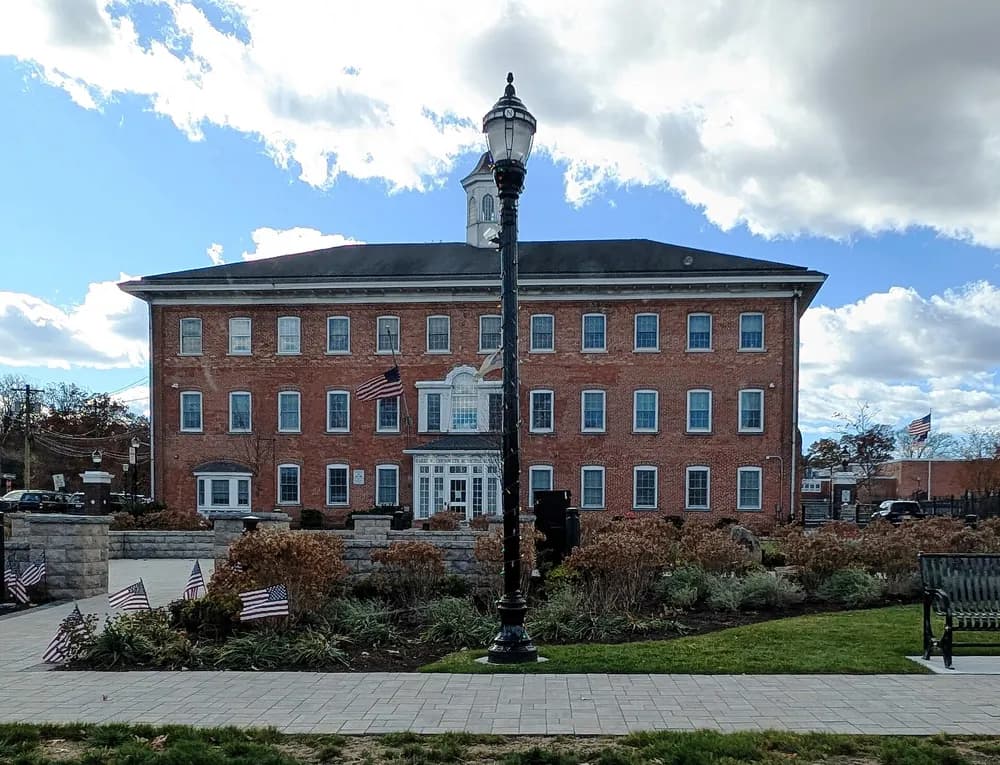



Photo: Mr. Matté (if there is an issue with this image, contact me using this image's C · CC BY-SA 4.0 · cropped
Photo: JERRYE & ROY KLOTZ, M.D. · CC BY-SA 4.0 · Photo: Tony Fischer · CC BY 2.0 · Photo: JERRYE & ROY KLOTZ, M.D. · CC BY-SA 4.0
How to get into Hackensack Meridian School of Medicine (MD) medicine
Step-by-step: entry requirements, admission tests, personal statement, interview format and the key deadlines.
Open the guide →Hackensack Meridian School of Medicine (MD) entry requirements
Admission profile, interview format, decision dates and what makes Hackensack Meridian School of Medicine (MD) different.
See the profile →The Hackensack Meridian School of Medicine (MD) medicine interview
Hackensack Meridian School of Medicine uses an **MMI (Multiple Mini-Interview) format with approximately 6–8 stations, each lasting 7–10 minutes after a brief preparation window. Stations are designed to assess communication, ethical reasoning, teamwork, and — distinctively — systems thinking and health system leadership**.
HMSOM is built on a Health System Science model, embedded within Hackensack Meridian Health, New Jersey’s largest hospital network. MMI scenarios frequently reflect real health system challenges: resource allocation, interprofessional conflict, quality improvement, and patient safety — not just classic isolated ethical dilemmas.
As one of the newest US medical schools, HMSOM actively seeks candidates who are excited about contributing to an institution still building its culture and reputation. Candidates who prefer a more established, traditional academic environment may not be the right fit.
Hackensack Meridian School of Medicine (MD) interview at a glance (2027 entry)
| Annual MD class size | ~162 |
|---|---|
| Interview format | MMI — ~6–8 stations, 7–10 min each |
| MCAT median | ~515 |
| GPA median | ~3.83 |
| Application system | AMCAS |
| Interview window | October–February |
| Notable feature | Health System Science + HMH network integration |
Interview format
- MMI with ~6–8 stations, each 7–10 minutes.
- Preparation time ~1–2 min before each station.
- Station types: ethical dilemmas, health systems scenarios, communication role-plays, collaboration/teamwork, and opinion questions.
- Interview day includes simulation center tour and innovation showcase.
- Student panels and interprofessional Q&A sessions are part of the day.
Working towards the MCAT score Hackensack Meridian School of Medicine (MD) expects? Build a week-by-week plan from your test date — free for the first two weeks.
Sample interview questions
HMSOM is built around Health System Science. What does that concept mean to you, and why does training within a large integrated health network appeal to you?
Show you have researched Health System Science as a discipline — not just clinical medicine. Reference Hackensack Meridian Health's scale, the interprofessional model, and how systems knowledge will make you a better physician.
A hospital is considering cutting a social work program to save money, despite evidence that it reduces readmissions. You are a medical student on the quality committee. What do you say?
This is a health systems scenario. Argue with the evidence (social determinants, readmission costs vs. social work costs). Reference the Triple Aim framework: quality, experience, cost. Show you can engage constructively within institutional decision-making.
Role play: you are on a care team and you notice that the physician has made what you believe is a medication dosing error. How do you address this?
Patient safety first. Use SBAR (Situation, Background, Assessment, Recommendation). Escalate respectfully without deference-based silence. Show you understand the hierarchy while putting patient safety above it.
An electronic health record alert fires every time a physician prescribes a specific medication, even in appropriate cases. Physicians are starting to dismiss all alerts without reading them. What should be done?
Alert fatigue is a real patient safety problem. Discuss quality improvement approaches, alert optimization, human factors engineering, and shared responsibility between IT, clinical informatics, and individual clinicians.
HMSOM was founded in 2018. What do you see as the unique opportunity — and the unique challenge — of training at a medical school still building its identity?
Be honest. The opportunity: contribution to culture, proximity to leadership, early alumni networks. The challenge: fewer established traditions, evolving residency match outcomes. Show you have genuinely weighed this.
Healthcare in the US is increasingly delivered within large integrated health systems rather than by independent physicians. Is that a good development? Why or why not?
Argue a position but acknowledge trade-offs. Integration benefits: care coordination, data, economies of scale. Downsides: reduced physician autonomy, potential for profit-driven decision-making, consolidation effects on competition.
A colleague on your clinical team has a habit of using dismissive language about patients from lower socioeconomic backgrounds — not in front of patients, but in team discussions. What do you do?
Address implicit bias, psychological safety on teams, and your professional responsibility. Approach the colleague directly first; know when and how to escalate.
You are part of an interprofessional team that includes a nurse, pharmacist, social worker, and you as a medical student. The nurse disagrees with the physician's discharge plan. How do you navigate this?
Interprofessional collaboration is central to HMSOM's model. Show respect for all team members' expertise, structured communication, and patient-centered focus as the tiebreaker.
If you could create one innovation in US healthcare, what would it be and how would you bring it to scale?
HMSOM's innovation and entrepreneurship curriculum invites this kind of thinking. Ground your idea in a real problem with a plausible mechanism. Show evidence-based thinking, not just enthusiasm.
A patient's family members approach you asking what the physician said in a private consultation. The patient has not given consent to share this. How do you respond?
What they are listening for:
- HIPAA
- patient confidentiality
- family dynamics
Acknowledge the family's concern, decline to disclose without patient consent, offer to facilitate a family meeting WITH the patient present.
Roughly one in five hospitalized patients is readmitted within 30 days, and a large fraction of those readmissions is considered potentially preventable. As a future physician in an integrated system like HMH, what does that statistic tell you about where care breaks down, and where would you intervene?
Locate failure points in transitions of care: discharge communication, medication reconciliation, follow-up access, and social needs. Reference the Triple Aim and system-level levers (care coordination, social work) — this is HMSOM's Health System Science territory.
MMI role-play station: you are a medical student on a care team. The discharge plan assumes the patient can pick up and afford new medications and attend follow-up within 48 hours, but you have just learned they have no transport and limited funds. Raise this with the team.
Use structured communication (SBAR), surface the social barrier as a safety and readmission risk, and propose concrete alternatives (pharmacy delivery, telehealth follow-up, social-work referral). Demonstrate systems thinking and respectful team escalation.
Tell me about a time you contributed to improving a process or fixing a recurring problem in a team or organization. What was your role?
STAR. HMSOM's quality-improvement and innovation identity rewards candidates who think in systems. Emphasize diagnosing the root cause, engaging stakeholders, and measuring whether the change worked.
MMI station: a quality dashboard shows your unit's metrics improving, but you suspect the improvement comes partly from coding changes and selecting healthier patients rather than better care. You are a student on the committee. What do you say?
Engage metric gaming, the risk of teaching to the measure, and the ethics of honest performance reporting. Argue for validity and patient-centered outcomes constructively within the institution's decision-making.
MMI station: describe one change you would make to how a hospital or health system operates, and walk me through how you would actually implement and scale it.
HMSOM's innovation thread invites this. Ground the idea in a real problem with a plausible mechanism, stakeholders, and a way to evaluate impact — show evidence-based reasoning rather than enthusiasm alone.
Practise the Hackensack Meridian School of Medicine (MD) interview
Rehearse the real format before the day — on demand with our AI interviewers, or live with a tutor.
Sit a mock with photoreal AI interviewers — any time
A timed MMI or panel interview on video — American & international voices — with interviewers who listen, react and press with follow-ups. Rubric-scored feedback and a replay the moment you finish.






Live mocks with a tutor who’s been in the room
A full Hackensack Meridian School of Medicine (MD)-style mock with a medic or dentist tutor — honest scoring against real marking criteria, a station-by-station debrief and a written action plan.
Book a mock interviewHow to prepare for the Hackensack Meridian School of Medicine (MD) interview
Common pitfalls to avoid
Hackensack Meridian School of Medicine (MD) interview — frequently asked questions
Sources & official admissions information
Ready to nail your Hackensack Meridian School of Medicine (MD) interview?
Book a mock interview with a tutor who knows the US interview formats, orpractice unlimited stations from our interview question bank.