
The Geisel School of Medicine at Dartmouth MD program
What you actually study, and where you will be
Geisel School of Medicine at Dartmouth's MD is a 4-year program with an integrated curriculum, with patient contact from Year 1 and clinical rotations in Lebanon, NH, wider New England, California and other states (2027 entry). Geisel's MD runs in three phases. Phase 1 spans about 20 months, including a summer break and six weeks of USMLE Step 1 study, and teaches organ-system courses with problem-based learning cases. On Doctoring puts you with standardized patients and in a preceptor's office from year 1. Clerkships, the core clinical rotations, start in late March of year 2 at Dartmouth Hitchcock Medical Center, the White River Junction VA and sites set by a lottery. Phase 3 then gives you a year of advanced rotations, electives and a sub-internship.
- Degree
- MD
- Length
- 4 years
- Teaching
- Integrated
- Clinical contact
- Year 1

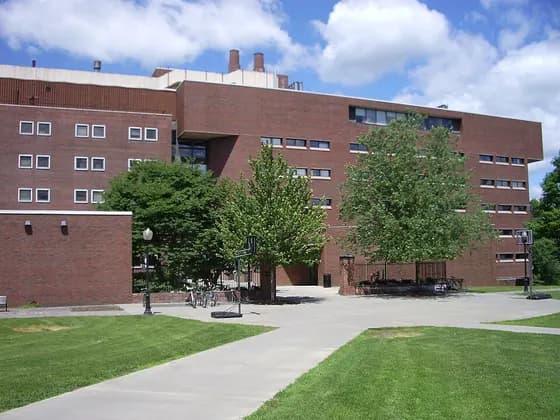
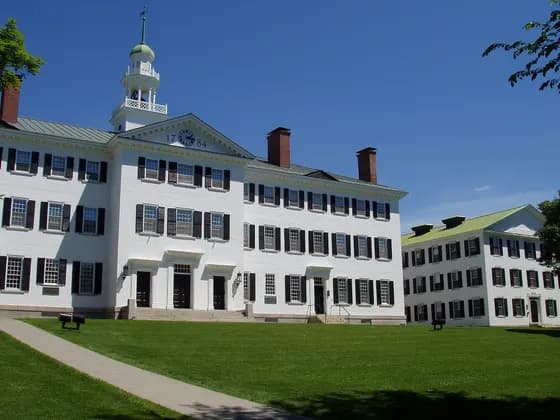
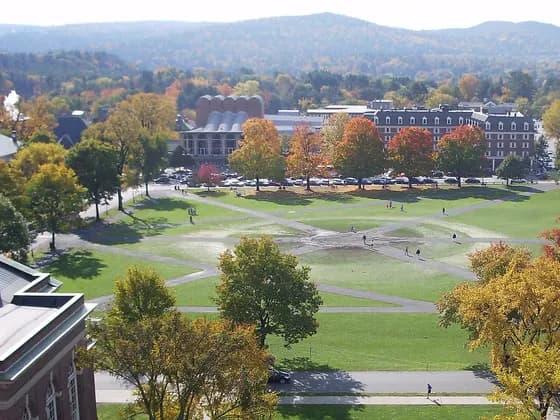
Photo: Gunnar Klack · CC BY-SA 4.0 · cropped
Photo: Kane5187 · Public domain · Photo: Daderot · Public domain · Photo: Kane5187 · Public domain
The Geisel School of Medicine at Dartmouth MD program at a glance (2027 entry)
The Geisel School of Medicine at Dartmouth, usually shortened to Geisel or Dartmouth Geisel, awards the MD after four years. It is Dartmouth's medical school, based in Hanover, New Hampshire. Its main teaching hospital is Dartmouth Hitchcock Medical Center (DHMC) in neighboring Lebanon, and its other main clinical site is the White River Junction VA Medical Center, a Veterans Affairs hospital in Vermont.
The curriculum has three phases. Phase 1, Foundations of Medicine, is the pre-clerkship (pre-clinical) phase of classroom, lab and clinical skills teaching. It runs about 20 months, from August of year 1 to March of year 2, including an eight-and-a-half-week summer break and six weeks of dedicated study for the first licensing exam. Phase 2, Clinical Immersion, starts in late March of year 2 with six clerkships, the core clinical rotations in which you work on hospital and clinic teams. Phase 3, Exploration and Differentiation, runs from April of year 3 to graduation.
Phase 1 teaches the body a few organ systems at a time, in seven blocks. Every course includes problem-based learning (PBL) cases, in which a small group works through a patient's problem and decides what it needs to learn. On Doctoring, a clinical skills course alongside the blocks, has you practicing on standardized patients, actors trained to play patients. From year 1 it also places you with a preceptor, a practicing doctor who teaches you in their own office.
You must take Step 1 of the United States Medical Licensing Examination (USMLE), the national exam series for licensing MD physicians, by the end of Phase 1. Classes are just under 100: 96 first-years received white coats in September 2026, and the school's 2024-25 annual report counted 97, 97, 96 and 101 across the four years.
The Liaison Committee on Medical Education (LCME), which accredits MD programs in the United States, gave Geisel full accreditation for the maximum eight-year term after its last review. Its directory marks the program as accredited before the LCME was founded in 1942. Geisel's 2024-25 annual report says the LCME's March 2025 findings left six of its 19 original citations open as areas of concern, with a status report due in fall 2026.
| Degree | MD, four years in three phases |
|---|---|
| Curriculum | Foundations of Medicine, Clinical Immersion, Exploration and Differentiation |
| Class size | 96 in the latest incoming class, per Geisel's admissions page |
| Main campus | Hanover, NH, with clinical training centered on DHMC in Lebanon |
| Teaching style | Organ-system blocks with PBL cases, team-based learning (team problem-solving sessions), lectures and labs |
| Anatomy | Dissection laboratory with donated bodies; lab practical exams |
| First patient contact | Year 1: standardized patients and a preceptor's office |
| Clerkships begin | Late March of year 2, after a dedicated study period |
| Step 1 timing | By Phase 1's end: around March 2029 for 2027 entrants, on the current schedule |
| Step 2 Clinical Knowledge (CK) | By January 31 of the final year; pass required from the Class of 2030 |
| Grading | Phase 1 pass/fail; core clerkships Honors, Pass or Fail since April 2025 |
What makes the Geisel School of Medicine at Dartmouth MD program different
Clerkships start in late March of year 2
Geisel redesigned its curriculum for students entering from August 2019, building pre-clerkship teaching from organ-system courses in a phase of about 20 months. The school said in 2018 that finishing clerkships earlier would leave more room for career exploration, electives (courses and rotations you choose) and sub-internships. A sub-internship, also called an acting internship, gives you an intern's responsibilities under supervision.
On Doctoring builds clinical skills from year 1
On Doctoring runs through both years of Phase 1. You learn to interview and examine patients, write up and present cases, and handle ethical questions.
A research thread from year 1 to graduation
Since 2025 a Research and Scholarship thread has linked the year 1 Population Health course, where you launch a scholarly project, to the Scholarly Project in Medicine in Phase 3. Every student finishes with original, mentored work.
Clerkships in California, the Southwest and Alaska
Through the clerkship lottery, inpatient medicine can be spent in San Francisco or San Jose and pediatrics at Children's Hospital of Orange County. Family medicine sites include Indian Health Service sites in Arizona and New Mexico and a clinic in Valdez, Alaska.
Four houses with mentors for all four years
Since July 2025 every student has belonged to one of four houses, the Learning Collaboratives. Each has clinical mentors and career advisors, and peer mentoring links clinical-year students with first- and second-years.
How Geisel School of Medicine at Dartmouth teaches medicine
Within each organ-system course you study the system's normal structure and function, the diseases that affect it, how they are diagnosed and the drugs used to treat them. Cardiovascular Medicine, for example, covers the heart's anatomy and embryology, reading a 12-lead electrocardiogram (ECG), cardiac imaging and the ethics of end-of-life care.
Ten curricular threads run through the courses and clerkships instead of being taught on their own. They are Anatomy and Embryology, Child and Adolescent Health, Ethics and Human Values, Health Equity, Histology, Imaging, Nutrition, Pathology, Pharmacology, and Research and Scholarship. Each has its own leader and objectives but no separate exam; its content is tested in course and clerkship assessments.
Health care delivery science is taught throughout the first two years, mainly in Population Health: study design, statistics, health disparities, the US health care system, patient safety and quality improvement. Medical Learning Science covers evidence-based study methods, a personal wellness plan and your own Step 1 study plan.
In 2026 a review of Phase 1 went to the Medical Education Committee (MEC), the faculty committee with student members that oversees the curriculum. It recommended easing the load in Block 3 and aligning teaching more closely with Step 1 topics. In July 2026 the MEC also heard that its Phase 1 subcommittee had voted to add artificial intelligence and digital health content to Phase 1.
From Phase 2 you learn on hospital and clinic teams, with seminars and written assignments. Every required clerkship except Acute Care Medicine ends with an NBME subject exam, a national multiple-choice test in that specialty from the National Board of Medical Examiners. Short Clinical Education Intersessions bring the class back together at the start, middle and end of Phase 2.
The ways you will learn
| Problem-based learning (PBL) cases | PBL cases are chosen to show the clinical relevance of the science. In the Psychiatry course, for example, PBL runs alongside lectures and small-group interviewing sessions. |
|---|---|
| Team-based learning (TBL) | You usually prepare before class, take a readiness test alone and then with your team, and spend the session applying it to problems. Geisel uses TBL in Phase 1. |
| Lectures, labs and case conferences | Large-group sessions present core material, backed by labs and case conferences, as in Respiratory Medicine. |
| Standardized patients and simulation | You practice interviews and examinations with standardized patients in On Doctoring, meet them again in clinical skills exams, and train on manikins at DHMC's Patient Safety Training Center. |
| Preceptorships | After the On Doctoring preceptorship, the Family Medicine and Advanced Ambulatory Medicine clerkships are built around preceptorships in community and outpatient practices. |
A typical week on the Geisel School of Medicine at Dartmouth program
In Phase 1, a school policy last approved in May 2026 caps scheduled contact hours at 24 a week on average across a block, and 26 in any one week. Contact hours count lectures, labs, PBL and TBL sessions, small groups, simulation, preceptor visits, online modules and exams. Required activities outside courses add at most 4 hours a week, and each 40-hour week keeps at least 12 unscheduled hours for self-directed study and career exploration.
From Phase 2, a policy last approved in November 2025 limits you to 80 hours a week in the hospital or clinic and 30 hours in a row. Call comes no more than one night in three, and on average one full day a week is free of patient care and teaching.
How anatomy is taught at Geisel School of Medicine at Dartmouth
Anatomy is taught through the Anatomy and Embryology thread rather than as a separate course. You meet the general layout of each body system in the opening Foundations course, then study each system's anatomy in more detail inside its organ-system course. The thread also covers human development, death and dying, and the ethics of learning from body donors.
Lab teaching takes place in the school's dissection laboratory, with bodies given through Geisel's own Anatomical Gifts Program, run by the Department of Medical Education. Donors are people in New Hampshire and Vermont who registered before they died, and the school says its studies may take up to two academic years. Communication and teamwork, practiced in the lab and in case-based sessions, are a major part of the thread.
Anatomy is tested in course exams and in anatomy lab practical exams. A pilot reported to the MEC in June 2026 required the Class of 2028 to score at least 70% across Phase 1's 313 anatomy and embryology questions, with multiple-choice and practical questions counted equally. The school found that the lab practicals, more than the threshold, drove students to study anatomy, and students below 70% took remedial sessions in Block 7.
When you first meet patients at Geisel School of Medicine at Dartmouth
Your first patient contact comes through On Doctoring. In year 1 it combines large and small group sessions, interviewing and examination practice with standardized patients, and work in a preceptor's office. Its Psychology of Illness portion meets mainly in two-hour blocks: an hour of panel discussion, then an hour of small groups led by mental health professionals.
In year 2, On Doctoring continues with interviewing, examination, case presentations and more preceptor work. The course also includes extensive note writing and two sessions on the electronic medical record. The Derm-Rheum-Ortho course adds a two-hour clinic session in which small groups see dermatology patients with a dermatologist or resident. Psychiatry runs weekly small groups where you observe and join patient interviews.
Students and faculty also volunteer at the Good Neighbor Health Clinic in White River Junction, which gives free care.
The Geisel School of Medicine at Dartmouth curriculum, year by year
- Year 1
Phase 1: Blocks 1 to 4
For students entering in 2027, orientation begins on July 26, 2027, Block 1 on August 2 and classes end on June 2, 2028, with a White Coat Ceremony on September 24. After Block 4 comes a summer break of about eight and a half weeks, which the school suggests for research, quality improvement, clinical experience or other interests.
- Block 1, Foundations of Medical Science and Practice: Application to Cancer, covers cell and molecular biology, biochemistry, genetics, functional anatomy, pharmacology and pathology, then applies them to cancer diagnosis and treatment.
- Block 2, from September 20, pairs Infection, Inflammation, and Immunity, on microbes, immunity, vaccines and anti-microbial drugs, with Hematology, on blood cells, clotting, leukemias, lymphomas and transfusion.
- Block 3, from January 3, 2028, covers Cardiovascular Medicine and Respiratory Medicine, including lung function, acid-base balance and end-of-life decisions about ventilator support.
- Block 4, from March 13, covers GI, Metabolism, and Nutrition, home to obesity and metabolic disease; Endocrinology, with a unit on transgender medicine; and Reproductive Medicine.
- On Doctoring, Population Health and Medical Learning Science run all year, with breaks at Thanksgiving, over the holidays and in early March.
- Year 2
Phase 1: Blocks 5 to 7, then Step 1
The Step 1 projection for 2027 entrants uses the 2026-27 and 2027-28 second-year calendars. On the 2027-28 calendar, year 2 opens with orientation on August 2, 2027, and a transition ceremony on February 11, 2028 follows Block 7. Six weeks of dedicated Step 1 study then run from February 14 to March 24, and Phase 2 begins on March 27.
- Block 5 covers Derm-Rheum-Ortho, on skin, systemic inflammatory and musculoskeletal disease, and Fluids, Electrolytes, and Renal Medicine. Derm-Rheum-Ortho was redesigned after a 2025 review that planned anatomy for its first half.
- Block 6, from late October, covers Neuroscience and Neurology, with an emphasis on localizing lesions, and Psychiatry, from diagnosis with the DSM-5-TR, the standard psychiatric manual, and suicide risk assessment to the main psychotherapies.
- Block 7, Medical Science Integrations, starts in late January and revisits Phase 1 science through the kinds of cases you will manage on clerkships, including content central to Step 1.
- Population Health has a smaller footprint in year 2 and centers on a longitudinal research project; On Doctoring and Medical Learning Science continue.
- Phase 2 (years 2 and 3)
Clinical Immersion: the core clerkships
Phase 2 lasts about a year, from late March of year 2 to late March of year 3. You complete six required clerkships in an order set by the lottery: three of eight weeks and three of six weeks.
- Inpatient Medicine (8 weeks): seven weeks on a general medicine ward team, plus a week split between orientation, wrap-up and the NBME exam. You write up at least 16 new patients and get specific teaching on ECGs and chest X-rays.
- Surgery (8 weeks): two rotations of three and a half weeks on two of 15 services, from colorectal, trauma and surgical oncology to neurosurgery, urology and vascular surgery, plus outpatient time on preoperative evaluation.
- Pediatrics (8 weeks): inpatient work on a ward team, where you admit patients, write progress notes and present on rounds, and outpatient visits with community pediatricians at regional and remote sites.
- Family Medicine (6 weeks): two days of seminars, then a five-week outpatient preceptorship with family physicians, with videoconferences and a simulated patient exercise. You are not expected to take call.
- OB/GYN (6 weeks): orientation at DHMC, then obstetrics, gynecology and surgery in hospitals, a midwifery program and private offices, alongside obstetrician-gynecologists, family physicians, certified nurse midwives and nurse practitioners.
- Psychiatry (6 weeks): longitudinal treatment teams covering inpatient, consultation-liaison and outpatient care, with evening and possibly weekend call at New Hampshire and Vermont sites, write-ups and a simulated interview.
- Phase 3 (years 3 and 4)
Exploration and Differentiation
Phase 3 starts in April of year 3 and runs in four-week blocks until graduation in early May of year 4. Under the 2026-27 requirements it carries 41 credits: three required clerkships, a sub-internship, elective time, Transition to Residency and the Scholarly Project in Medicine (SPIM).
- Advanced Ambulatory Medicine (4 weeks): four days a week in an outpatient internal medicine practice, from DHMC and VA clinics to rural sites, plus Friday-morning Zoom teaching led mostly by students.
- Neurology (4 weeks): inpatients and outpatients at DHMC, the White River Junction VA, Dartmouth Hitchcock Manchester or California Pacific Medical Center, with sites set by a mini-lottery in year 3.
- Acute Care Medicine (4 weeks): required from the Class of 2027 and first run in 2026-27. You assess critically ill patients and those who arrive without a diagnosis, manage shock and respiratory support, and practice airway management and ultrasound-guided needle procedures.
- Transition to Residency (4 weeks) falls in late February and March, around Match Day, when residency results arrive. It covers prescribing, writing orders and managing common diseases and emergencies before internship.
- SPIM, a one-credit pass/fail course, asks for original scholarly work with a faculty mentor in almost any field, from the sciences to the humanities and arts, with a written proposal and a final report.
- On the 2027-28 calendar, Match Day is March 17, and graduation, called Investiture, is May 6.
How you are assessed at Geisel School of Medicine at Dartmouth
Phase 1 courses are graded pass/fail. Course exams use multiple-choice questions. For students entering from fall 2026, failing up to two of the year-1 foundational and organ-system courses earns an Incomplete, and passing a retest turns it into a Pass. The failure then leaves no record on your transcript or MSPE, the Medical Student Performance Evaluation sent with residency applications. This second chance ends after year one and does not cover On Doctoring, Population Health or Medical Learning Science.
Clinical skills are tested in Objective Structured Clinical Examinations (OSCEs), in which you move through timed stations, each with a task such as taking a history from a standardized patient. You sit several OSCEs in each of the first three years at the Patient Safety Training Center at DHMC. The Clinical Education Intersessions course is pass/fail, and you must pass it, including its year-end OSCEs, to progress through Phase 3.
The USMLE has three Steps, and MD students take the first two in medical school. Step 1, on the science behind medicine, has been pass/fail since January 2022; Step 2 Clinical Knowledge (CK) tests clinical medicine and is still scored. Because the program is LCME-accredited, its students are eligible to sit the USMLE. Geisel requires a passing Step 1 score to graduate, and its Step 2 policy, last approved on March 18, 2026, adds a passing Step 2 CK score from the Class of 2030.
Under Geisel's Step 1 policy, last approved on July 16, 2025, the calendar gives you a six-week dedicated study period at the end of Phase 1. You must take the exam by the last day of Phase 1, before clerkships, unless an exception is approved. On the 2026-27 and 2027-28 second-year calendars that period runs from mid-February to late March. You must also complete a school-sponsored NBME practice exam by December 1 of year 2.
In August 2026 the USMLE program announced a move to designated testing dates from January 2029, with Step exams offered less often each year. Its June 2026 announcement had named 2028. On the current schedule, a student entering in 2027 would sit Step 1 around March 2029, shortly after the switch. Step 2 CK must be taken by January 31 of your final year: January 31, 2031 for a 2027 entrant on the current policy, well after the switch. You need a passing score by February 25 to enter the residency Match.
Core clerkships have been graded Honors, Pass or Fail since April 2025, replacing a four-tier scale that also had High Pass. A clerkship grading committee weighs your Student Performance Evaluation, the form supervisors complete, the clerkship's assignments and your NBME subject exam, often called the shelf exam. As the MEC heard in June 2026, the shelf now counts for 20 to 25% of the grade, and Honors requires at least the 50th percentile on it.
- If Geisel's review of your Phase 1 results and NBME practice tests finds you need more Step 1 time, your Phase 2 schedule opens with a six-week elective block. You must also enroll in an approved non-clinical elective. If you fail Step 1, you cannot start a clerkship or clinical elective until you pass.
- You must pass Step 1 before starting a dual-degree year such as the MBA or MPH, the PhD phase of the MD-PhD, or an Academic Scholar Year of research.
- To pass a clerkship you must score above the 5th percentile on its NBME exam; across all required clerkships you get one shelf retest without a transcript note.
- In 2025-26, the first year of the new system, Honors fell from 59% to 42% of core clerkship grades.
- Acute Care Medicine is pass/fail in 2026-27, since no NBME exam exists for it; it is assessed on clinical performance, case write-ups and simulation.
- Transition to Residency and SPIM are pass/fail. Sub-internships and clinical electives longer than two weeks are graded Honors, High Pass, Pass or Fail; shorter clinical electives are pass/fail.
Geisel School of Medicine at Dartmouth clinical rotations: where you will actually train
Geisel calls DHMC and the White River Junction VA its two affiliated academic medical centers. DHMC, which describes itself as New Hampshire's only academic medical center and only Level I adult trauma center, the top tier of trauma care, also houses Golisano Children's Hospital. Surgery adds Concord Hospital and two Dartmouth Health community hospitals, Alice Peck Day in Lebanon and Mt. Ascutney in Windsor, Vermont.
Clerkship registration runs through a lottery in OASIS, the school's online scheduling system. The lottery sets your clerkship order and, together with site preference forms for some clerkships, your sites. Students placed at California Pacific Medical Center or Santa Clara Valley Medical Center for inpatient medicine spend all seven clinical weeks there. Those staying local rank VA general medicine, DHMC general medicine and DHMC cardiology, then rotate at two of them.
If you have dependent children or a child on the way, or health needs that require frequent appointments, the Office of Clinical Education gives special consideration to your site requests. Contact it before the lottery if you can. Not having a car or driver's license does not usually qualify, and neither do a partner, pets or research plans.
Family medicine practices across New Hampshire, Vermont and Massachusetts can be up to two and a half hours from the Upper Valley, the area around Hanover and Lebanon. Students placed more than an hour away are given housing. Distant sites, chosen through the lottery, can include Valdez, Alaska; Belfast, Stockton Springs and Waterville, Maine; Missoula, Montana; and Shiprock, New Mexico.
Some sub-internships also take you away. Family medicine sub-internships run at three sites: the New Hampshire Dartmouth Family Medicine Residency at Concord Hospital, the Maine-Dartmouth Family Medicine Residency in Augusta, Maine, and the Greater Lawrence Family Health Center in Massachusetts. Geisel provides or helps with housing for each, the Augusta and Lawrence options require a car, and travel costs are yours.
The base for most clerkships and the main teaching hospital.
- Dartmouth Hitchcock Medical Center (DHMC)
- Golisano Children's Hospital at Dartmouth Health
- White River Junction VA Medical Center, Vermont
- Alice Peck Day Memorial Hospital
- Mt. Ascutney Hospital and Health Center, Windsor, VT
Surgery, OB/GYN, psychiatry, pediatrics, neurology and Advanced Ambulatory Medicine sites.
- Concord Hospital
- New Hampshire Hospital, Concord
- Dartmouth Hitchcock Clinics Manchester and Nashua
- Manchester VA Medical Center
- Cheshire Medical Center, Keene
- Southern New Hampshire Medical Center, Nashua
- Monadnock Community Hospital, Peterborough
Psychiatry, OB/GYN, pediatrics, family medicine and sub-internship sites.
- Brattleboro Retreat and Brattleboro Memorial Hospital, Vermont
- Southwestern Vermont Medical Center, Bennington
- Dorothea Dix Psychiatric Center, Bangor, Maine
- Maine-Dartmouth Family Medicine Residency, Augusta and Waterville
- Greater Lawrence Family Health Center, Massachusetts
California Pacific hosts most of the clerkships and some sub-internships; Santa Clara Valley hosts inpatient medicine and a medical sub-internship; CHOC hosts pediatrics.
- California Pacific Medical Center, San Francisco
- Santa Clara Valley Medical Center, San Jose
- Children's Hospital of Orange County (CHOC)
Indian Health Service sites used for family medicine, and Fort Defiance also for pediatrics.
- Fort Defiance Indian Hospital (Tséhootsooí Medical Center), Arizona
- Northern Navajo Medical Center, Shiprock, New Mexico
Distant OB/GYN, family medicine, pediatrics and Advanced Ambulatory Medicine sites.
- Anchorage, Alaska
- Valdez Medical Clinic, Alaska
- Family Medicine Residency of Western Montana, Missoula
- Sanford Bemidji Medical Center, Minnesota
- Practices in Columbus, MS, Watertown, NY, and Midland, MI
Electives, selectives and away rotations at Geisel School of Medicine at Dartmouth
Optional M1 and M2 Enrichment Opportunities run alongside Phase 1. Examples include Deaf Health, Reproductive Choices, Introduction to Medical Device Innovation, an ophthalmology clinical experience in Keene, and Medical Care and the Corporation at the Tuck School of Business.
Phase 2 leaves room for up to six weeks of clinical electives, and Phase 3 holds most of the rest. Across the two phases you need a four-week sub-internship and 20 elective credits. Twelve must be clinical, eight can be clinical or non-clinical, and at least six must be outside the specialty you plan to enter.
The 2026-27 catalog lists 30 sub-internships, from neurology and pediatric intensive care to colorectal, plastic and thoracic surgery. On the DHMC medical sub-internship you are the primary caregiver for four to seven inpatients, supervised by a hospitalist, a doctor who looks after hospital inpatients. At California Pacific Medical Center it is four to six, on a five-day call cycle.
The same fourth-year catalog lists about 75 clinical electives (97 listings, counting separate two-week versions) and 27 non-clinical electives. Examples range from Street Medicine with Pittsburgh Mercy and forensic pathology at New Hampshire's Office of the Chief Medical Examiner to a radiology bootcamp and Tuck courses on health economics.
Away rotations, electives at other institutions, go through Visiting Student Learning Opportunities (VSLO), the national application service, with invitations to third-year students in December. Away and other non-catalog electives need approval and OASIS registration before they start, requested at least four weeks ahead. International ones also need travel registration.
Students in the optional Global Health Equity Pathway of Concentration can take four-week fourth-year exchange electives through the Center for Global Health Equity, each with travel funding. Options include inpatient care at Chongqing Medical University hospitals in China and a national tertiary care hospital in Kigali, Rwanda. In Dar es Salaam, Tanzania, you can work at Muhimbili National Hospital or join HIV and tuberculosis research.
Dual degrees and research years at Geisel School of Medicine at Dartmouth
Research is part of the MD for everyone. Population Health in year 1 includes launching a scholarly project and a workshop on the IRB, the board that reviews research involving people, and SPIM completes the work in Phase 3. You can also apply for funded summer research between years 1 and 2, though you may accept only one competitive program.
The MD Research Scholars program, named for Dean Emeritus Duane Compton, selects five students each September of year 2. Scholars attend monthly evening meetings, work with a formal research mentor, present at department grand rounds in year 4 and submit a manuscript to a fourth-year paper contest. The program fulfills the research requirement for graduation, and the designation appears on your transcript.
For more time, the Academic Scholar Year (ASY) adds at least nine months, usually a year, of approved research or scholarship, during which you remain a full-time student. Under the policy for the Class of 2028 onward, you must first finish the Phase 2 clerkships and pass Step 1, and the year starts no earlier than the first Phase 3 block. It earns pass/fail credit on your transcript and fulfills SPIM. Fellowships for it include the Stephen Marsh Tenney Fellowship and others in pathology, radiology and radiation oncology.
Dual degrees combine the MD with another Dartmouth degree. The MD/MBA with the Tuck School of Business takes five or six years; you apply in year 2 and take the MBA year between MD phases. An MD/MEng with Thayer School of Engineering, an MD/MHA, and one-year MD/MPH and MD/MS options are also offered, the last two often after the clerkships. In 2024-25, 11 students were in the MD-MBA and one in the MD-MPH.
The MD-PhD takes about seven to eight years and had 20 students in 2024-25. You complete years 1 and 2 of the MD, spend typically three to five years on the PhD through Guarini or Thayer, then return for the clinical years. Geisel notes it is not a Medical Scientist Training Program (MSTP), the MD-PhD training program funded by the National Institutes of Health, though its trainees get comparable benefits.
Pathways of Concentration are optional four-year programs alongside the MD in Rural Health, Urban Health, Medical Spanish and Global Health Equity; you apply in the fall and may join one. Each ends in a community-engaged scholarly project. The Rural Health Pathway, still being refined, steers you to clerkships at DHMC and community hospitals in places such as Keene and Rutland, then a rural elective, and its project fulfills SPIM.
Facilities and support at Geisel School of Medicine at Dartmouth
Where you will learn
The Patient Safety Training Center, also called the Sim Center, occupies 8,000 square feet on level two of DHMC. Besides standardized patients and OSCEs, it has lifelike computerized manikins that show vital signs on a bedside monitor, reproduce heart and lung sounds and can be intubated. They come in adult, birthing, child, infant and newborn versions. Makeup called moulage creates realistic wounds.
Support while you study
The Learning Collaboratives, launched in July 2025, are Geisel's learning communities. Each student joins one of four houses and stays in it from matriculation to graduation. Every house has elected student leaders and clinical mentors who guide you through all four years, teach clinical skills through On Doctoring, help you set goals and hold regular one-to-one check-ins. Community service now also runs through the houses.
Senior career advisors meet you one to one and in small groups from Phase 2, helping with residency applications, CVs, personal statements and dual-degree, couples and military matches. Specialty advisors run group sessions in every phase and meet you one to one in Phase 3 about specialty choice, away rotations and letters of recommendation.
The Office of Academic Advising and Accessibility has academic coaches for time management, study strategies, test-taking and the Step exams. It also runs free peer tutoring, usually from second-year students, and a weekly group review session for first-years. Preclinical and clinical Committees for Academic Advancement and Growth monitor performance and set up tailored support plans.
The Navigator Program offers voluntary, confidential coaching from coaches trained to International Coaching Federation standards: 30 to 45 minutes every two weeks for two to three months, with limited places. Geisel Counseling gives free, confidential mental health support at two Hanover locations and online, and the Counseling Center at Dick's House offers 24-hour crisis support.
Is the Geisel School of Medicine at Dartmouth program right for you?
This program may suit you if
- You want clinical skills from year 1, practicing on standardized patients and working in a preceptor's office through On Doctoring.
- You would like clerkships to start in late March of year 2, leaving Phase 3 for advanced rotations, electives and a sub-internship.
- You are drawn to research, quality improvement and how health systems work, which Population Health and SPIM build into the MD.
- You would welcome the chance of clerkships in San Francisco, at Indian Health Service sites or in Alaska through the lottery.
- You want mentoring that lasts all four years, through one of four houses.
Things to think about
- You must take Step 1 by the end of Phase 1; on the current schedule a 2027 entrant would sit it around March 2029, shortly after the USMLE's switch to designated testing dates.
- A lottery sets your clerkship order and many of your sites; family medicine sites can be hours away, some sub-internships require a car, and lacking one does not usually earn special consideration for sites.
- Core clerkships give Honors, Pass or Fail, with the shelf exam counting for 20 to 25% of the grade and a 50th-percentile bar for Honors.
- Expect change: since 2024 the school has added a required Acute Care Medicine clerkship, changed clerkship grading and revised its Step 1 and Step 2 rules.
Geisel School of Medicine at Dartmouth MD program — frequently asked questions
Applying to Geisel School of Medicine at Dartmouth?
How to get into Geisel School of Medicine at Dartmouth
Prerequisites, MCAT, AMCAS personal statement, secondaries and interview, step by step.
Open the guide →Geisel School of Medicine at Dartmouth admissions profile
MCAT and GPA profile, acceptance rate, interview format and key dates.
See the profile →Compare Geisel School of Medicine at Dartmouth with other schools
Put the teaching style, anatomy teaching and clinical sites next to another school.
Open the comparison →Prepare for the Geisel School of Medicine at Dartmouth interview
Format breakdown, school-specific sample questions and prep tips from tutors who interviewed here.
Read the guide →Where this Geisel School of Medicine at Dartmouth program guide came from
This guide was written from 70 official sources — Geisel School of Medicine at Dartmouth's own program pages and curriculum documents, plus the accreditor and the hospitals and health systems the school trains students in where they publish detail — read on 2026-10-25, then checked claim by claim against those sources.
- Geisel MD Program home page and program menu
- Geisel MD Curriculum Overview: three phases
- Geisel MD Program: Curricular Threads
- Geisel MD Program: On Doctoring
- Geisel MD Program: Population Health
- Geisel 2026-2027 Courses and Credits (updated April 20, 2026)
- Geisel Graduation Checklist for 2026-2027 (revised February 6, 2026)
- Geisel USMLE Step 1 Policy, UME-CNTRL-0001 (last approved July 16, 2025)
- Geisel USMLE Step 2 Policy, UME-CNTRL-0002 (last approved March 18, 2026)
- Geisel MD Grading Policy, UME-CNTRL-0015 (last approved November 12, 2025)
- Geisel Pre-Clerkship Student Contact Hours Policy, UME-CURR.PCE-0002 (last approved May 20, 2026)
- Geisel Clinical Student Work Hour Policy, UME-CURR.CE-0001 (last approved November 19, 2025)
- Geisel Clinical Rotation Placement Policy, UME-CURR.CE-0002 (approved October 15, 2019; new template May 23, 2025)
- Geisel Academic Scholar Year Policy, UME-REG-0002 (last approved October 19, 2026)
- Geisel MD Admissions: Why Geisel, Fast Facts (class size)
- Geisel News, September 2026: White Coat Ceremony for the MD Class of 2030
- Geisel MD Term Dates for 2027-28
- Geisel M1 Calendar 2027-2028
- Geisel M2 Calendar 2027-2028
- Geisel M2 Calendar 2026-2027
- Geisel Phase 2 six-week clerkship calendar 2027-2028
- Geisel Phase 2 eight-week clerkship calendar 2027-2028
- Geisel Phase 3 four-week block calendar 2027-2028
- Geisel News, June 2018: Geisel embarks on a new integrated curriculum
- Medical Education Committee minutes, September 18, 2024 (grading discussion)
- Medical Education Committee minutes, November 20, 2024 (core clerkship grading change)
- Medical Education Committee minutes, December 18, 2024 (PBL and TBL)
- Medical Education Committee minutes, May 21, 2025 (research curriculum)
- Medical Education Committee minutes, July 16, 2025 (Step 1 policy, course retests)
- Medical Education Committee minutes, August 20, 2025 (curriculum review actions)
- Medical Education Committee minutes, September 17, 2025 (Acute Care Medicine, course reviews)
- Medical Education Committee minutes, December 17, 2025 (Acute Care Medicine grading)
- Medical Education Committee minutes, March 18, 2026 (Step 2 policy, Phase 1 review)
- Medical Education Committee minutes, June 17, 2026 (anatomy pilot, Phase 2 grading)
- Medical Education Committee minutes, July 15, 2026 (State of the Med School)
- Geisel OASIS public course catalog, 2026-2027
- OASIS 2026-2027: Phase 1 year 1 core courses
- OASIS 2026-2027: Phase 1 year 2 core courses
- OASIS 2026-2027: Phase 2 required clerkships
- OASIS 2026-2027: Phase 3 required courses
- OASIS 2026-2027: sub-internship course pages
- Geisel Clerkships Database: core clerkship descriptions
- Geisel Clerkship Sites Database
- Geisel admissions: Clerkship Opportunities
- Geisel Registrar: How to Register and Registration Policies
- Geisel: MD Accreditation by LCME
- LCME directory of accredited programs
- Geisel Office of Educational Affairs Annual Report 2024-2025
- Geisel Learning Collaboratives (houses) and the August 2025 launch news
- Geisel Pathways of Concentration, including the Global Health pathway electives
- Rural Health Pathway of Concentration Program Guide (revised August 2026)
- Geisel Office of Medical Student Research, Academic Scholar Year, MD Research Scholars and summer research
- Geisel Dual Degree Programs and the MD-MBA Program
- Geisel MD-PhD Program: training structure, curriculum and FAQ
- Geisel Office of Academic Advising and Accessibility, and the Navigator Program
- Geisel Office of Student Life and Well-Being Resources
- Geisel Anatomical Gifts Program
- DHMC Patient Safety Training Center: standardized patients, programs, orientation and equipment
- Dartmouth Health: Our System, with member hospitals
- About Dartmouth Hitchcock Medical Center and Clinics
- VA White River Junction Healthcare System: about us
- Manchester VA Medical Center
- New Hampshire Hospital medical staff
- Concord Hospital Health System: about us
- Children's Hospital of Orange County
- Indian Health Service: Northern Navajo Medical Center, Shiprock
- Fort Defiance Indian Hospital Board: Tséhootsooí Medical Center
- Brattleboro Retreat
- USMLE: Updated timeline for Designated Testing Dates, transition in January 2029
- USMLE Designated Testing Dates Information Hub
Curricula are restructured between cycles. Anything here that decides your application — how anatomy is taught, a clinical campus assignment, a required research year — should be confirmed against the official page for your entry year.
Applying to Geisel School of Medicine at Dartmouth?
We help US applicants with MCAT strategy, the AMCAS personal statement, secondary essays and interview prep — everything you need for a competitive Geisel School of Medicine at Dartmouth application.