
Geisel School of Medicine at Dartmouth Interview
Format, Questions & Prep Tips
Geisel School of Medicine at Dartmouth medicine interviews for 2027 entry are a traditional interview. Geisel School of Medicine at Dartmouth describes the format as: Virtual interview day: a 20-minute group exercise, then two 30-minute interviews with Admissions Committee members. Published figures: Annual MD class size ~90; Interview format Traditional — 1 faculty + 1 student interviewer, ~30 min each; MCAT median ~519.
- Institution
- Geisel School of Medicine at Dartmouth
- Interview (2027 entry)
- September through February; rolling invitations
- Decisions (2027 entry)
- Rolling decisions; most offers by March 30; waitlist movement through summer

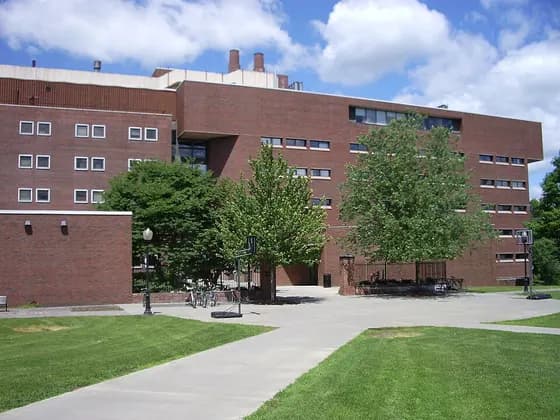


Photo: Gunnar Klack · CC BY-SA 4.0 · cropped
Photo: Kane5187 · Public domain · Photo: Daderot · Public domain · Photo: Kane5187 · Public domain
How to get into Geisel School of Medicine at Dartmouth (MD) medicine
Step-by-step: entry requirements, admission tests, personal statement, interview format and the key deadlines.
Open the guide →Geisel School of Medicine at Dartmouth (MD) entry requirements
Admission profile, interview format, decision dates and what makes Geisel School of Medicine at Dartmouth (MD) different.
See the profile →The Geisel School of Medicine at Dartmouth (MD) medicine interview
Geisel School of Medicine at Dartmouth uses a traditional two-interview format: one session with a faculty member or clinician (~30 min) and one with a current medical student (~30 min). Both interviewers read your application in advance and conduct non-blind, conversational interviews.
Geisel’s small class (~90 students) places enormous weight on individual character and fit. Interviewers probe intellectual depth, collaborative spirit, and genuine alignment with Dartmouth’s health policy and outcomes research identity. Academic strength alone does not distinguish candidates — you need a compelling narrative.
The Dartmouth Institute for Health Policy and Clinical Practice is central to Geisel’s academic identity. Candidates who can discuss shared decision-making, healthcare variation, or outcomes science — even briefly — demonstrate a level of engagement that resonates strongly with the committee.
Geisel School of Medicine at Dartmouth (MD) interview at a glance (2027 entry)
| Annual MD class size | ~90 |
|---|---|
| Interview format | Traditional — 1 faculty + 1 student interviewer, ~30 min each |
| MCAT median | ~519 |
| GPA median | ~3.87 |
| Application system | AMCAS |
| Interview window | September–February |
| Notable program | The Dartmouth Institute for Health Policy |
Interview format
- Two traditional one-on-one sessions: one faculty/clinician + one medical student.
- Each session ~30 minutes; full interview day spans ~5–7 hours.
- Non-blind interviews — interviewers have read your full application.
- Conversational style; expect follow-up questions probing depth on specific experiences.
- Lunch and campus tour of Dartmouth-Hitchcock Medical Center are part of the day and informally evaluated.
Working towards the MCAT score Geisel School of Medicine at Dartmouth (MD) expects? Build a week-by-week plan from your test date — free for the first two weeks.
Sample interview questions
Why Geisel specifically? What about a small medical school in rural New Hampshire appeals to you?
Reference the small-class community, Dartmouth-Hitchcock as a training environment, and The Dartmouth Institute. Be honest about fit with the rural setting. Interviewers identify candidates who have not genuinely considered what Hanover, NH means day-to-day.
Tell me about your research experience. What was your question, what did you find, and what was most intellectually challenging about it?
Geisel expects research experience. Show intellectual ownership — what YOU contributed to the question and methodology, not just what the lab did. The challenge question assesses scientific maturity.
A physician in your hospital system consistently orders more diagnostic tests than colleagues for the same presentations. You know this drives up costs without improving outcomes. What, if any, action do you take?
This is squarely in Dartmouth's wheelhouse — practice variation and overtreatment. Reference quality improvement processes, shared decision-making frameworks, and how to raise concerns constructively within a system.
The Dartmouth Atlas has documented that where you live in the US significantly affects how much care you receive — but not necessarily your outcomes. What do you make of that?
This is a Dartmouth-specific question. Engage with practice variation, resource allocation, evidence-based guidelines, and patient preferences. Show you have genuinely engaged with outcomes science.
Geisel requires every student to complete a Scholarly Project. What topic would you pursue, and why?
Have a genuine answer ready. Connect to your research background or clinical interests. Show intellectual initiative — interviewers probe whether you have thought about this or are giving a generic answer.
A patient with terminal cancer asks you to help them die. How do you respond, and how does your personal view inform your professional obligation?
Address New Hampshire's legal framework (no death-with-dignity law as of 2026 — verify), palliative care obligations, referral to appropriate colleagues, and the distinction between personal and professional ethics.
Describe a time you had to change your mind based on evidence or feedback. How did that experience shape how you approach disagreement now?
Geisel values evidence-based thinking and intellectual humility. Show genuine flexibility — not just capitulation — and connect to how you would engage with clinical evidence updating.
How has your background shaped your perspective on health equity, and how do you anticipate that perspective influencing your practice?
Be specific and concrete. Post-SCOTUS holistic review applies here. Connect lived experience to intended practice patterns — not just general statements about caring for diverse populations.
Shared decision-making is a central value at Geisel. Describe a clinical scenario where shared decision-making might be difficult to implement and how you would approach it.
Choose a challenging scenario: a patient in distress, a time-sensitive condition, a patient with low health literacy. Show you understand SDM principles AND their real-world limits.
What is one major challenge facing the US healthcare system today that evidence-based medicine or health policy research could most directly improve?
Choose one well-reasoned challenge. Reference relevant evidence. Argue how physician-scientists or health policy researchers can drive change. Show the connection between research and practice.
The Dartmouth Atlas showed that Medicare spending per beneficiary can differ two- to three-fold across US regions with little corresponding difference in outcomes or satisfaction. If higher spending does not buy better health, what is the money buying, and what should be done about it?
Engage supply-sensitive care, capacity-driven utilization, and the difference between effective, preference-sensitive, and supply-sensitive care. Discuss shared decision-making and payment reform — this is Dartmouth's intellectual home turf, so reason rigorously.
Role play: a patient with early-stage prostate cancer has read that 'more treatment is better' and is anxious to start aggressive therapy immediately. The evidence supports active surveillance as a reasonable option. Walk them through a shared-decision conversation.
Model genuine shared decision-making: elicit values and fears, present options and uncertainty honestly (including surveillance), use decision aids, and avoid steering. Show you grasp both the principle and its real-world difficulty under patient anxiety.
Tell me about a time you were genuinely persuaded to change your position by someone else's argument or new evidence. How did it feel, and what did it teach you about disagreement?
STAR. Geisel prizes intellectual humility. Show authentic mind-changing — not mere capitulation — and connect it to how you would update clinical practice as evidence evolves.
A widely used screening test is offered routinely in your health system, but you have read that for low-risk patients it leads to more harm from false positives and overdiagnosis than benefit. A patient asks for it 'just to be safe.' What do you do?
Engage overdiagnosis, the cascade of downstream harm, and the ethics of honoring autonomy while informing it. Discuss how you would explain the evidence and uncertainty, and respect a decision made after genuine understanding.
Geisel is a small school in rural Hanover, and students spend years in that community. Be honest about how you expect to experience that setting day-to-day, and what you would do to thrive there.
Fabricated enthusiasm for rurality is easily detected. Acknowledge the realities candidly, identify what genuinely appeals (community, mentorship, focus), and show a concrete plan rather than glossing over the trade-offs.
Practise the Geisel School of Medicine at Dartmouth (MD) interview
Rehearse the real format before the day — on demand with our AI interviewers, or live with a tutor.
Sit a mock with photoreal AI interviewers — any time
A timed MMI or panel interview on video — American & international voices — with interviewers who listen, react and press with follow-ups. Rubric-scored feedback and a replay the moment you finish.






Live mocks with a tutor who’s been in the room
A full Geisel School of Medicine at Dartmouth (MD)-style mock with a medic or dentist tutor — honest scoring against real marking criteria, a station-by-station debrief and a written action plan.
Book a mock interviewHow to prepare for the Geisel School of Medicine at Dartmouth (MD) interview
Common pitfalls to avoid
Geisel School of Medicine at Dartmouth (MD) interview — frequently asked questions
Sources & official admissions information
Ready to nail your Geisel School of Medicine at Dartmouth (MD) interview?
Book a mock interview with a tutor who knows the US interview formats, orpractice unlimited stations from our interview question bank.