
The UAB Heersink School of Medicine MD program
What you actually study, and where you will be
UAB Heersink School of Medicine's MD is a 4-year program with an integrated curriculum, with patient contact from Year 1 and clinical rotations in Birmingham, Huntsville, Montgomery, Tuscaloosa and rural Alabama (2027 entry). You spend the pre-clerkship years in Birmingham, where a foundations course leads into organ-system modules, with clinical skills built into every course and pass/fail grades. Clerkships start in the spring of year 2 (May for current classes) on one of four Alabama campuses, assigned before you enroll; Tuscaloosa runs a longitudinal integrated clerkship. Year 4 brings three acting internships, 22 weeks of electives and the end of a required scholarly project.
- Degree
- MD
- Length
- 4 years
- Teaching
- Integrated
- Clinical contact
- Year 1

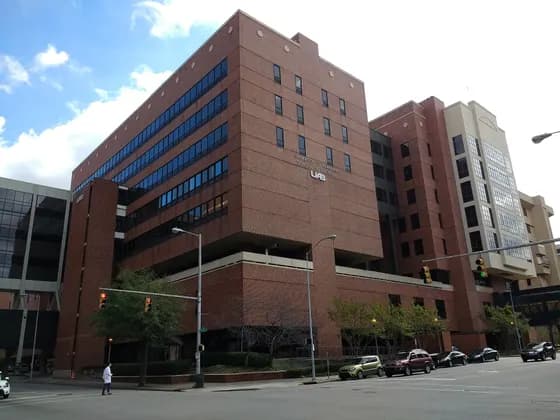


Photo: University of Alabama at Birmingham · Public domain · cropped
Photo: Mx. Granger · CC0 · Photo: Tepp01 · CC BY-SA 4.0 · Photo: Jrbawden · CC BY-SA 4.0
The UAB Heersink School of Medicine MD program at a glance (2027 entry)
The University of Alabama at Birmingham (UAB) Marnix E. Heersink School of Medicine runs a four-year MD program. Everyone spends the pre-clerkship years on the main campus in Birmingham, next to UAB Hospital, The Kirklin Clinic and Children's of Alabama. The class entering in 2026 had 194 students (196 in 2025), and 845 medical students were enrolled in 2025-26.
The pre-clerkship (pre-clinical) phase, about 18 months of courses from July of year 1 into the spring of year 2, is integrated. After a 17-week Fundamentals of Medicine course you study one organ system at a time, with clinical cases woven in. Clinical skills are built into every course through the Clinical Reasoning and Integrated Skills Program (CRISP), and courses are graded pass/fail. You also join a learning community, a mentoring group with its own faculty mentor that you stay in for all four years.
The clinical years are on one of four campuses, settled before you enroll: Birmingham, Huntsville, Montgomery or Tuscaloosa. Clerkships, the core rotations in each major specialty, start in the spring of year 2 (in May for current classes). Before they begin, you sit Step 1 of the United States Medical Licensing Examination (USMLE), its pass/fail exam on the science behind medicine. Tuscaloosa's Primary Care Track teaches the clerkships as a longitudinal integrated clerkship, in which you follow patients across specialties for months.
Year 4 brings acting internships, rotations in which you take on much of the work of an intern, or first-year resident, under supervision. It also brings electives and Step 2 CK, the USMLE's clinical knowledge exam. The class entering in 2027 is the first on a revised calendar.
| Degree | MD |
|---|---|
| Program length | 4 years; pre-clerkship years in Birmingham for everyone |
| Class size | 194 entered in 2026; 196 in 2025 |
| Clinical campuses | Birmingham, Huntsville, Montgomery or Tuscaloosa, assigned before you enroll |
| Teaching style | Integrated organ-system modules with clinical skills built into every course |
| Anatomy | Cadaver dissection and prosections (specimens dissected in advance), with ultrasound and CT images |
| First patient contact | Year 1 clinical skills sessions; clerkships from May of year 2 for current classes |
| Step 1 timing | Sat before clerkships; school deadline in late April of year 2 for current classes |
| Grading | Pass/fail pre-clerkship; clerkships graded Honors, High Pass, Pass or Fail |
| Accreditation | Liaison Committee on Medical Education (LCME): full, next survey 2029-30 |
What makes the UAB Heersink School of Medicine MD program different
Clinical years on one of four Alabama campuses
After the pre-clerkship years together in Birmingham, you train in Birmingham or on a regional campus in Huntsville, Montgomery or Tuscaloosa. Every campus teaches the seven core clerkships to the same objectives and assessments. On the regional campuses the catalog caps each internal medicine clerkship block at 4 to 6 students, against 20 in Birmingham, and community physicians serve as clinical faculty.
A longitudinal integrated clerkship in Tuscaloosa
Tuscaloosa's Primary Care Track pairs 24 weeks of block rotations with a 24-week integrated block in which you work in several specialty clinics each week. Seeing the same patients for months, you can follow a pregnancy through delivery and watch a chronic illness change.
Clinical reasoning and ultrasound built into every course
CRISP, launched in 2023, sits inside each pre-clerkship course. Faculty Clinical Skills Scholars coach small groups over years 1 and 2. Point-of-care ultrasound, quick scans at the bedside, is taught as the fifth pillar of the physical exam. You can borrow a device for your whole third year, and fourth-year students can borrow one for acting internships.
Rural medicine options in the clinical years
In Huntsville and Montgomery, a rural medicine acting internship can fill the 4-week slot paired with family medicine, required in the school's overview but optional in campus scheduling guides. Birmingham students can choose rural rotations around the state, and two five-year programs add a year before medical school for students committed to rural Alabama.
Service learning tied to the science modules
Several modules come with service projects, most of them optional. After nutrition teaching in Fundamentals you can give cooking demonstrations at the East Lake Farmers Market. In Cardiovascular you can counsel patients on exercise at Cooper Green Mercy Hospital. Renal takes students to dialysis centers to talk with patients about diet, and in Neurosciences you can screen young children's vision with FocusFirst.
How UAB Heersink School of Medicine teaches medicine
The school says its curriculum integrates basic science with clinical knowledge and encourages active, case-based learning and teamwork. Pre-clerkship teaching mixes large-group discussions, face-to-face and online lectures, demonstrations, imaging and dissection labs, simulation, team-based and case-based sessions, patient presentations and self-directed study.
Fundamentals of Medicine opens year 1 with five blocks: Biomolecules and Bioenergetics; Development and Anatomic Structure; Cells and Foundations of Pharmacology; Pathology and Immunology; and Microbiology and Infectious Diseases. From January the organ-system modules take over. Each covers one system's structure, normal function, disease, drug treatment and prevention, with clinical correlates.
Threads run alongside. CRISP teaches interviewing, physical examination, clinical reasoning, communication and professionalism. Project AHEAD, the four-year health equity curriculum, covers bias, inclusion and the social determinants of health in every pre-clerkship course and in monthly grand rounds during clerkships. Nutrition and interprofessional simulation with students from other health professions also recur.
Once clerkships start in year 2, you learn mainly on clinical teams, with a longitudinal Clerkship Core Curriculum alongside. Some teaching links the campuses: Huntsville's pediatrics clerkship, for example, holds morning report by Zoom with students on the other campuses.
The ways you will learn
| Lectures | Face-to-face and online lectures carry much of each module's core content; Evidence-Based Medicine is taught through six web-based modules. |
|---|---|
| Case-based and team-based learning | Case-based sessions tie the science to patient scenarios. In team-based learning you prepare before class, then solve problems as a team. |
| CRISP small groups | Faculty lead small groups, helped by fourth-year students, in a see one, do one, teach one rhythm: you watch a skill, practice it, then teach it or give classmates feedback. |
| Standardized patients and simulation | Trained actors from the Office of Standardized Patient Education portray the same patient for every student and give feedback on your communication. After simulations, including interprofessional ones, faculty debrief you in real time. |
| Clinical teams | On clerkships you join teams of attendings, residents and interns, present patients on rounds, write notes and take call, with lectures and conferences alongside. |
A typical week on the UAB Heersink School of Medicine program
A school policy caps scheduled time in the pre-clerkship years. Averaged over a module, face-to-face learning should not exceed 20 contact hours a week and asynchronous work 10, with a contact hour usually 50 minutes. Face-to-face time covers lectures, labs, case-based and team-based learning, learning community sessions, simulations, clinical skills and assessments.
Asynchronous work means assigned reading, videos and problems done outside class, and your own independent study comes on top, uncounted. Attendance is generally required at active learning sessions and assessments, while lecture attendance is optional. The Medical Education Committee checks contact hours when it reviews each module.
How anatomy is taught at UAB Heersink School of Medicine
Gross anatomy is taught in conjunction with Fundamentals of Medicine and the organ modules, through labs, lectures, small groups, cases, team-based learning and self-directed study. The labs center on cadaver dissections and prosections, complemented by radiological and surgical anatomy, including ultrasound and CT images. The Gross Anatomy Lab in Volker Hall uses formalin-embalmed donors and also serves UAB's dentistry, optometry, health professions and nursing schools.
Anatomy follows the systems. Fundamentals Block 2, Development and Anatomic Structure, covers the major vessels, peripheral nerves, and the chest and abdomen in cross-section and imaging. Its assessments include anatomy and histology practicals, hands-on exams on specimens and slides. Neurosciences adds the neck, cranial cavity, face and orbit, with its own lab practical. Musculoskeletal and Skin has practicals on the lower and upper limbs.
Fourth-year anatomy teaching associates each choose 6 of the year 1 and 2 dissections to teach. They perform each dissection in advance so it can be shown in your lab, then help your group link it to clinical practice.
When you first meet patients at UAB Heersink School of Medicine
Clinical skills start in orientation week, when CRISP begins. In the first Fundamentals block you practice taking the history of a presenting illness, and in Block 2 you learn to obtain an ultrasound image. Sessions use clinic practice rooms on the second floor of Volker Hall, standardized patients and simulation. The school says students also work with real patients alongside the pre-clerkship courses.
Optional programs add real patients early. SHARP lets CRISP students follow patients over time in a precepted, interprofessional clinic. Students also volunteer at Equal Access Birmingham, a student-run free clinic for uninsured and underinsured people, open on Wednesday evenings and Sunday afternoons.
Primary Care Track students add four half-day sessions in a mentor's Tuscaloosa clinic in year 1, and 11 in total by the end of year 2. Before year 2 they spend two to three weeks in Tuscaloosa on SCOPE, the Summer Community Oriented Primary Care Experience. For everyone, full-time clinical work starts with clerkships in the spring of year 2 (May for current classes), always under supervision.
Year by year at UAB Heersink School of Medicine
- Year 1
Fundamentals, then the organ systems
The school's tentative 2027-28 calendar starts your year on July 12, 2027, about two weeks earlier than in 2026, with a White Coat Ceremony on July 24. It reflects three changes planned from fall 2027: the earlier start, one week of Patient, Doctor & Society moved to year 4, and Hematology/Oncology moved into the fall. The school says together they add about a month before residency applications.
- Orientation week, then Patient, Doctor & Society (one week, July 19 to 25, 2027): professionalism, ethics, evidence-based medicine, communication, health systems and the history of medicine.
- Fundamentals of Medicine (17 weeks, to late November): biochemistry, genetics, histology, cell biology, physiology, immunology, pathology, pharmacology and microbiology, with gross anatomy.
- Hematology/Oncology (3 weeks, to mid-December), half a week shorter than before and placed right after Fundamentals so you can apply the immunology you have just learned.
- Cardiovascular (5 weeks), Pulmonary (5), Gastrointestinal (6) and Renal (5), January to early June. On the 2026-27 schedule each ends with a final from the National Board of Medical Examiners (NBME), a USMLE co-sponsor.
- CRISP, Learning Communities 1 and Project AHEAD run all year; co-enrolled electives open to you in the spring.
- In May, your first objective structured clinical examination (OSCE), a clinical skills exam taken at a series of timed stations.
- Year 2
The remaining systems and Step 1
Year 2 finishes the organ modules in Birmingham and ends with Step 1 study. Dates here are for current classes, from the 2026-27 and 2027-28 calendars, the latest posted. The summer before brings online research training and a chance to take some of your required Special Topics, one-week mini-courses. Modules then run from early August to February, with assessments in March.
- Neurosciences (10 weeks, August to mid-October): neuroanatomy, the brain basis of behavior and psychiatric illness, diagnosis and nervous-system drugs.
- Musculoskeletal and Skin (6 weeks) and Endocrine (3 weeks) in the fall; Reproductive (4 weeks) after winter break.
- Evidence-Based Medicine (about 1.5 weeks): statistics, test accuracy and applying studies to individual patients.
- In March, the year 2 OSCE and the CBSE, the NBME's Comprehensive Basic Science Examination, which schools use to gauge readiness for Step 1.
- At least six weeks of dedicated Step 1 study (seven in 2027-28); the school recommends testing between March and May.
- In late April, a voluntary online Clerkship Bootcamp and required orientation on your clinical campus, including shadowing and life-support training.
- Clerkship year
Seven core clerkships in blocks
Clerkships begin in the spring of year 2 (in May for current classes), and the school counts them as third-year curriculum. In Birmingham, Huntsville and Montgomery they run as 4- to 8-week blocks. Their order comes from a lottery in which you rank six fixed tracks early in the spring of year 2. Every campus uses the same objectives and assessments.
- Internal medicine, surgery, obstetrics and gynecology (OB/GYN) and pediatrics (8 weeks each); neurology, psychiatry and family medicine (4 weeks each): 44 weeks in all.
- A 4-week slot paired with family medicine. The school's overview makes it a required rural medicine acting internship in Huntsville and Montgomery, as does Montgomery's catalog record. Both campuses' scheduling guides call it an elective block, and Huntsville's lists the rural acting internship as one of nine choices.
- An NBME subject exam, usually called a shelf exam, closes each clerkship: a national multiple-choice test in that specialty.
- Two OSCEs, in November and April.
- Work hours follow first-year resident rules: at most 80 a week averaged over a month, one day off a week on average, and four personal days in the year.
- You may defer one clerkship to year 4, replacing it with an acting internship or elective, once you have passed medicine and surgery.
- Clerkship year, Tuscaloosa
Primary Care Track: a longitudinal integrated clerkship
Primary Care Track and Rural Medical Scholars students spend the clinical years at the Tuscaloosa Regional Campus, part of The University of Alabama's College of Community Health Sciences. Year 3 is a longitudinal integrated clerkship in two 24-week halves; the class is split between them, and you can say which you would like first.
- Immersion half: block rotations in internal medicine (8 weeks) and surgery, OB/GYN, pediatrics and neurology (4 weeks each).
- Integrated half: full or half days in specialty clinics with faculty preceptors, in Tuscaloosa or, if chosen through a year 2 application, at an approved community site.
- A two-week template spreads half-days of psychiatry, family medicine, pediatrics, OB/GYN and surgery across the week, with flex time for optional experiences or study.
- Leadership in Community and Population Medicine (LCPM), a longitudinal course on community health assessment and physician leadership, worth 4 weeks of elective credit.
- Weekly lunchtime Relate sessions on personal and professional development; shelf exams spaced through the year; grading as on other campuses, mostly by faculty.
- Year 4: inpatient, acute care and community medicine acting internships through the Tuscaloosa campus, 18 weeks of electives and residency preparation.
- Year 4
Acting internships, electives and the Match
Acting internships begin once your clerkships are done, in May of year 3 for current classes, and year 4 runs in four-week blocks to graduation in May. The school lists May 24, 2031 as the expected May diploma date for the class entering in 2027. You choose courses in a fourth-year lottery.
- Three required acting internships (4 weeks each): medicine or pediatrics; ambulatory care; and surgery, critical care or emergency medicine, or OB/GYN.
- 22 weeks of electives, at least 12 of them clinical; up to 4 weeks may come from co-enrolled electives and 4 from teaching associate courses.
- Preparation for Residency (2 weeks, March or early April), in surgical or medical tracks: airway management, IV and intraosseous lines, ultrasound, suturing and simulated emergencies.
- Step 2 CK attempted by November 1, the Scholarly Activity manuscript in February and Match Day in March. If you enter the residency Match, school policy requires a Step 2 CK pass before the school confirms your eligibility with the National Resident Matching Program (NRMP).
- Up to 12 weeks of unscheduled time in the fall term and 10 in the spring term.
- From the class entering in 2027, one week of Patient, Doctor & Society, moved here because its topics may mean more after caring for patients.
How you are assessed at UAB Heersink School of Medicine
Pre-clerkship courses show as pass/fail on your transcript, but each is scored from 0 to 100, with 70 to pass. Many modules have a knowledge component (exams and quizzes) and an individual and group performance component (skills, participation, professionalism, small groups and labs), and you must pass both. A weighted average of 92.0 or higher earns Preclinical Honors; Patient, Doctor & Society, Fundamentals and Evidence-Based Medicine are excluded.
Tests come often: on the 2026-27 schedule, about three per Fundamentals block and quizzes or exams before each organ module's NBME final. Courses of four weeks or more give formal feedback by their midpoint. Failed Fundamentals blocks are remediated over winter break, and failed organ modules in the spring or summer break. Failing two Fundamentals blocks, or two courses in a year, typically means repeating the year.
Clerkships are graded Honors, High Pass, Pass or Fail on two components: clinical performance, which may include an oral exam, and the NBME subject exam. Honors in both earns Honors, and Honors in one earns High Pass, assuming you pass the shelf exam at the first attempt. Each clerkship's raw score weights clinical work 65 percent and the shelf 35, or 70 and 30 in family medicine and, under the Class of 2027 criteria, OB/GYN.
These numbers feed a ranking. Raw scores are kept for internal use and feedback, not printed on your transcript or Medical Student Performance Evaluation (MSPE), the dean's letter for residency applications. Converted to T-scores, which place you relative to classmates, they produce an overall average. That average decides honors, Alpha Omega Alpha (AOA) honor society nominations and the class rank reported in residency applications, and you see your quartile.
Step 1 of the USMLE tests the science behind medicine in one day and has been pass/fail only since January 26, 2022. The school's USMLE policy, the governing rule, requires you to sit it before clerkships; the August 2025 core-components overview says you must pass it first. The same USMLE policy has you attempt Step 2 CK, which keeps a three-digit score, by November 1 of year 4. You must pass it at least a week before graduation or, if you enter the Match, by the earlier date the school confirms your eligibility with the NRMP.
In August 2026 the USMLE program announced a move to designated testing dates from January 2029, with Step exams offered less often each year. Its June 2026 notice had said 2028. The calendar for your year 2 (2028-29) is not yet posted. The school says its fall 2027 changes add time for clinical training, so you may sit Step 1 earlier than current classes, who test by late April. Either way, it would fall in 2029, after designated testing dates begin, and your Step 2 CK attempt deadline would be November 1, 2030.
- The USMLE has urged schools to review rules on when students must test. The school's policy, effective March 2025, still sets fixed deadlines, and its curriculum page still lists Step 2 Clinical Skills, which the USMLE discontinued in January 2021.
- Fail Step 1 at the first attempt and you may finish the clerkship in progress, but not start another until you retake it. Three failed attempts at a Step can lead to dismissal.
- OSCE results count: an average below 70 at the end of year 2 means remediation before your first clerkship, and a failed clerkship-year OSCE must be remediated before acting internships.
- The LCME accredits MD programs in the United States, and its accreditation makes students in this program eligible for the USMLE. Its directory, updated October 14, 2026, lists the program as fully accredited, first in 1946, with the next survey in 2029-30.
- In July 2025 the Medical Education Committee approved a Clinical Commendation designation to recognize outstanding clinical performance in years 1 to 3.
Where you will actually train at UAB Heersink School of Medicine
After the pre-clerkship years you start clerkships on your assigned campus; students assigned to Huntsville, Montgomery or Tuscaloosa move there. Applicants rank Birmingham, Huntsville and Montgomery by March 2, and campuses are assigned by preference and capacity in early April. Tuscaloosa cannot be ranked; it takes Primary Care Track and Rural Medical Scholars students. Medical Scientist Training Program (MSTP) students, on the MD/PhD track, are placed in Birmingham and Rural Medicine Program students in Huntsville.
Assignments are final and binding. In year 2 you may request a switch if your assigned campus would cause substantial personal or educational hardship and another has room. A Campus Change Committee takes requests each fall and interviews applicants. Regional campus staff meet you early, with lunch-and-learns at orientation, then immersion camps and campus visits in year 1.
The catalog caps each medicine clerkship block at 20 students in Birmingham, 6 in Huntsville and Tuscaloosa and 4 in Montgomery. Birmingham, Huntsville and Montgomery students take the medicine (or pediatrics) and ambulatory acting internships on their own campus, plus 8 weeks of clinical electives or acting internships there. Surgery and critical care acting internships can be on any campus with room, and Tuscaloosa students take all three through Tuscaloosa.
Community physicians serve as clinical faculty on the regional campuses, and Montgomery's campus page counts more than 150 community-based preceptors. The school reviews each clerkship every four years. Its July 2026 internal medicine review found the clerkship comparable across campuses, with feedback, learning environment and shelf preparation to strengthen in Tuscaloosa and Montgomery.
UAB Hospital has 1,207 licensed beds. Internal medicine is two four-week inpatient rotations at University Hospital (UAB Hospital), Cooper Green and the VA; pediatrics is at Children's of Alabama, UAB's pediatric teaching hospital.
- UAB Hospital
- The Kirklin Clinic
- Children's of Alabama
- Birmingham VA Medical Center
- Cooper Green Mercy Hospital
- Center for Psychiatric Medicine
- UAB Hospital-Highlands
- UAB St. Vincent's
The school describes Huntsville Hospital as a 941-bed hospital founded in 1895, linked by tram to Women & Children, with sleep rooms and study space. A Family Medicine Integrated Residency recruits students in year 3, who manage a patient panel in year 4.
- Huntsville Hospital
- Huntsville Hospital for Women & Children
- UAB Huntsville Regional Medical Center
- Huntsville Free Clinic
Baptist Medical Center South has 492 beds, per Baptist Health; Baptist East hosts inpatient pediatrics and obstetrics, and Crossbridge inpatient psychiatry. The rural medicine acting internship is at the UAB Selma Family Medicine Clinic. An ambulatory acting internship at Maxwell Air Force Base spends two of its four weeks with family physicians assigned to operational military units.
- Baptist Medical Center South
- Baptist Medical Center East
- Baptist Medical Center's Prattville location
- Crossbridge Behavioral Health
- UAB Selma Family Medicine Clinic
- Maxwell Air Force Base clinic
The College of Community Health Sciences runs University Medical Center, and students are dual enrolled at The University of Alabama. In the longitudinal clerkship, psychiatry includes consultation work at DCH Regional Medical Center, Bryce Hospital and the Tuscaloosa VA.
- University Medical Center
- DCH Regional Medical Center
- Bryce Hospital
- Tuscaloosa VA Hospital
- Northport Medical Center
- Approved community practice sites
Birmingham's rural rotations place you with a family physician away from Birmingham, Mobile, Huntsville, Montgomery, Tuscaloosa and Auburn, with housing provided where possible and stipends available.
- Family physicians' practices outside the state's larger cities
Electives, selectives and away rotations at UAB Heersink School of Medicine
Your first elective can come in the clerkship year, chosen by lottery for a 4-week slot; the catalog lists 26 courses designed as third-year electives. Year 4 then requires 22 weeks of electives, mostly in 2- to 4-week rotations, from a catalog listing 198 electives across the four campuses. A career advisor in your chosen field helps you build a schedule aimed at residency.
Away rotations, called away or visiting electives, are short courses at other teaching hospitals, often booked through the Association of American Medical Colleges' (AAMC) Visiting Student Learning Opportunities (VSLO) service. You can take them only in year 4, after all clerkships. Each earns up to 4 weeks of credit, is graded pass or fail and is optional. International electives, such as the International Clinical Elective, need school approval.
Special Topics are one-week mini-courses, and you need four, taken in set weeks such as mid-October or in the summer after year 1. The catalog lists 105, from Wilderness Medicine and Introduction to Narrative Medicine to an agromedicine field experience in Tuscaloosa and clinical medicine in the Dominican Republic from Huntsville. You can also propose your own course for approval.
Co-enrolled electives are optional semester-long courses taken alongside other classes from the second term of year 1, such as Spanish for Healthcare Professionals or emergency medical technician training. Each is worth 2 weeks of credit, and two count at most. In year 4, teaching associate courses let you teach anatomy labs, simulation sessions or clinical skills small groups for elective credit.
Dual degrees and research years at UAB Heersink School of Medicine
Scholarly Activity is required of everyone except MSTP students and those on a research year. In the summer before year 2 you complete online research ethics and human-subjects training, then choose a project and faculty mentor, ideally on your own campus. Three benchmarks follow: a proposal with a question or hypothesis, a progress report, and a final report written as a manuscript, due in February of year 4.
Further research is optional. Many students do summer research after year 1, mostly through the Physician-Scientist Development Office. After the preclinical years you can take a research year at UAB or elsewhere, often on a competitive fellowship. Two Areas of Distinction recognize focused work. Global Health graduated its first two students in 2026 and took 23 first-year students; Health Equity combines coursework, clinical work with underserved patients, teaching, scholarship and community service.
The MSTP, founded in 1987 and a National Institutes of Health (NIH) training program since 1991, normally takes about eight years and covers tuition, a stipend and health insurance. After a summer lab rotation, you take graduate courses alongside medicine, then spend several years on PhD research while a continuing clinical education course keeps your skills current. Clinical training, 14 to 18 months, is in Birmingham.
The MD/MPH with the School of Public Health needs 42 credit hours, 12 credited from the MD. You can finish in four years, starting the summer before medical school, or in five with a year's leave, and its community internship can count as your ambulatory acting internship. The MD/MSPH in Outcomes Research shares 12 of its 43 hours, and one scholarly project, with the MD.
The four-year MD/MBA with the Collat School of Business adds 10 business courses, four in the summer before medical school and the rest after year 2 and Step 1. The MD/MSHA with the School of Health Professions adds health administration training.
Two five-year programs for future rural primary care doctors in Alabama add a year before medical school. Rural Medical Scholars earn a master's in Rural Community Health at The University of Alabama, then train in Tuscaloosa; about 11 enter a year. The school counts about 200 participants since 1996, and the College of Community Health Sciences more than 270. Rural Medicine Program students spend their year at Auburn University and train in Huntsville.
Facilities and support at UAB Heersink School of Medicine
Where you will learn
Volker Hall is the pre-clerkship base. Its Lecture Tower, with five lecture rooms, reopened in March 2026 after more than a year of renovation. The building also holds the Gross Anatomy Lab, the Volker Hall Simulation Center and the second-floor clinic practice rooms used for CRISP.
UAB's Center for Interprofessional Education and Simulation runs simulation and standardized patient sessions; its simulation and standardized patient offices were both re-accredited by the Society for Simulation in Healthcare in 2021. Huntsville's 93,000-square-foot Regional Medical Center, opened in 2003, holds clinics, student lounges, a 128-seat auditorium for weekly grand rounds and the J. Ellis Sparks Medical Library, open around the clock. Montgomery has the Institute for Patient Safety and Medical Simulation.
Support while you study
Learning communities anchor support. There are 12, each named for a figure from the school's history: Barfield-Carter, Elopre, Finley, Hamilton, Harrison, Hill, Hirschowitz, Kirklin, Lyons, McCallum, Oparil and Pittman. The twelfth, Elopre, was added in fall 2025. You are placed by clinical campus and stay in the same community for four years.
Each community has a faculty mentor and meets monthly in small groups on wellness, professional development, health disparities, ethics, teamwork and community engagement. The course is pass/fail and needs 80 percent attendance. It runs Careers in Medicine in year 3 and a residency interview workshop in year 4.
Medical Student Services keeps a dean or director on call around the clock and runs ReportIt, for raising concerns or commendations, anonymously if you choose. Each regional campus has its own dean and student affairs office and holds regular dean's conferences, where students hear updates and give feedback. The UAB Medicine Office of Wellness offers confidential consultations, with no referral needed.
Academic Success learning specialists help with study skills and Step preparation, and trained peer educators run tutoring, reviews, mock anatomy practicals and question-based small groups. Career advising starts in year 1; staff meet every third-year student about Step 2 CK and offer two 30-minute mock residency interviews with faculty.
Is the UAB Heersink School of Medicine program right for you?
This program may suit you if
- You want the option of a regional campus, with far lower clerkship enrollment caps than Birmingham and community physicians among the clinical faculty.
- You want continuity: Tuscaloosa's longitudinal integrated clerkship has you following patients across specialties for months, assessed mostly by faculty.
- You want clinical reasoning and bedside ultrasound coached in small groups by faculty across your first two years.
- You hope to practice in rural Alabama: Huntsville and Montgomery offer a rural medicine acting internship right after family medicine, and two five-year programs focus on rural primary care.
- You want to dissect, since cadaver dissection runs through years 1 and 2.
Things to think about
- Your clinical campus, fixed before you start and binding apart from a year 2 hardship request, may mean moving away from Birmingham; Tuscaloosa is open only through its two programs.
- Pass/fail is not the whole story: raw scores feed Preclinical Honors and the class rank reported in residency applications.
- Your class is the first on a revised calendar, so older school documents will not match your schedule exactly; Step 1 still comes before clerkships, in 2029, after designated testing dates begin.
UAB Heersink School of Medicine MD program — frequently asked questions
Applying to UAB Heersink School of Medicine?
How to get into UAB Heersink School of Medicine
Prerequisites, MCAT, AMCAS personal statement, secondaries and interview, step by step.
Open the guide →UAB Heersink School of Medicine admissions profile
MCAT and GPA profile, acceptance rate, interview format and key dates.
See the profile →Compare UAB Heersink School of Medicine with other schools
Put the teaching style, anatomy teaching and clinical sites next to another school.
Open the comparison →Prepare for the UAB Heersink School of Medicine interview
Format breakdown, school-specific sample questions and prep tips from tutors who interviewed here.
Read the guide →Where this UAB Heersink School of Medicine program guide came from
This guide was written from 102 official sources — University of Alabama at Birmingham Marnix E. Heersink School of Medicine's own program pages and curriculum documents, plus the accreditor and the hospitals and health systems the school trains students in where they publish detail — read on 2026-10-14, then checked claim by claim against those sources.
- UAB Heersink School of Medicine: MD Program
- MD curriculum overview, year by year
- MD Degree Educational Program: Overview of Core Curriculum Components (revised August 2025)
- MD Educational Program: Graduation Requirements (February 2025)
- Core curriculum schematics, all tracks, 2025-26
- Pre-clerkship course objectives (revised May 2026)
- 2026-2027 Calendar Overview
- MD Academic Calendar 2026-2027
- MD Academic Calendar 2027-2028 (tentative)
- Calendars: posted academic, clinical and exam calendars
- MS1 and MS2 examination dates, 2026-2027
- MS3 clerkship examination dates, 2026-2027
- Clinical course calendar, 2026-2027
- Heersink School of Medicine online course catalog (preclinical courses, clerkships, acting internships, electives, Special Topics, teaching associate courses)
- United States Medical Licensing Examination Policy
- Medical Student Grading Policy
- Grades Other Than Passing Policy
- Raw Scores, T-Scores, and Ranking
- Formative Feedback Policy
- Contact Hours and Clinical Work Hours Policy
- Attendance Policy for Clinical Rotations
- Leave of Absence Policy
- Medical Student Supervision Policy
- Campus Change Policy
- Clerkship Grading Criteria for the NRMP Class of 2027
- Clerkship Grading Criteria for the NRMP Class of 2028
- Step 1 Registration
- Learning Communities
- Scholarly Activity
- MD program: Research
- Areas of Distinction
- Service learning opportunities in the curriculum
- Distinction in Health Equity
- Medical Student Services
- Current Students: academic success, peer education and ceremony dates
- UAB Medicine Office of Wellness
- Residency Application Resources and Timeline
- Nutrition and Health Objectives (including Equal Access Birmingham)
- Campuses
- Campus Preference
- Admissions: class profiles
- About the school: at a glance
- Clinical Facilities (Birmingham)
- Huntsville Regional Medical Campus
- Huntsville campus: Facilities
- Montgomery Regional Medical Campus
- Montgomery campus: Clinical Clerkships
- Montgomery campus: Facilities
- Tuscaloosa campus: Clinical Clerkships
- Scheduling: clerkship, fourth-year, Special Topics and co-enrolled course rules
- Clerkship and Third Year Elective Lotteries
- Clerkship tracks, 2026-2027
- 3rd Year Scheduling Lottery: Montgomery Campus Student Instructions (2026 lottery)
- 3rd Year Scheduling Lottery Instructions: Huntsville Campus (2025 lottery)
- Third-year scheduling information for the Tuscaloosa campus
- Fourth-Year Scheduling Lottery
- Special Topics
- Co-enrolled Courses
- Away Electives
- Primary Care Track
- Rural Medicine programs
- Rural Medicine Program
- Rural Medical Scholars Program
- Dual Degrees
- UAB School of Public Health: MD/MPH
- UAB School of Public Health: MD/MSPH
- UAB Collat School of Business: MD/MBA
- UAB School of Health Professions: coordinated MSHA/MD
- Medical Scientist Training Program (MSTP)
- MSTP Curriculum
- UAB Catalog 2026-2027: Medical Scientist Training Program
- Anatomy Education and Training
- Clinical Skills Scholars Program
- School news, November 2024: CRISP clinical skills curriculum
- School news, October 2025: From Classroom to Clinic, CRISP
- Center for Interprofessional Education and Simulation
- Office of Standardized Patient Education
- School news, January 2026: Curriculum updates from the Medical Education Committee
- School news, July 2025: Clinical Commendation for MS1-3 students
- School news, October 2025: residency preparation and career advising
- School news, August 2025: regional campus directors
- School news, October 2025: acting internship review
- School news, July 2026: internal medicine clerkship review
- School news, September 2025: twelfth learning community
- School news, May 2026: Recognition of Distinction in Global Health
- School news, March 2026: Volker Hall Lecture Tower reopens
- School news, November 2025: Huntsville Family Medicine Integrated Residency
- Accreditation
- College of Community Health Sciences: Primary Care Track curriculum
- College of Community Health Sciences: Primary Care Track and regular MD side by side (2026)
- College of Community Health Sciences: Rural Medical Scholars
- UAB Medicine: UAB Hospital
- Children's of Alabama: About Children's
- Baptist Health: Baptist Medical Center South
- LCME directory of accredited programs (updated October 14, 2026)
- About the LCME
- USMLE Designated Testing Dates Information Hub
- USMLE announcement, August 6, 2026: designated testing dates move to January 2029
- USMLE announcement, June 2026: limited testing dates from 2028 (since updated)
- USMLE Common Questions: Step 1 pass/fail reporting
- USMLE, January 2021: Step 2 CS discontinued
- National Resident Matching Program: About the NRMP
Curricula are restructured between cycles. Anything here that decides your application — how anatomy is taught, a clinical campus assignment, a required research year — should be confirmed against the official page for your entry year.
Applying to UAB Heersink School of Medicine?
We help US applicants with MCAT strategy, the AMCAS personal statement, secondary essays and interview prep — everything you need for a competitive UAB Heersink School of Medicine application.