
The Roseman University College of Medicine MD program
What you actually study, and where you will be
Roseman University College of Medicine's MD is a 4-year program with an integrated curriculum, with patient contact from Year 1 and clinical rotations in Las Vegas, Henderson, North Las Vegas and Mesquite, Nevada (2027 entry). The program starts with 18 months of organ-system science blocks on Roseman's Summerlin campus in Las Vegas. A weekly half-day goes to early clinical experience and to GENESIS, the school's household-centered care program, in which you care for assigned households with faculty physicians. The 53-week clerkship phase at southern Nevada hospitals then begins in January of year 2, followed by an advanced phase of rotations that runs to graduation.
- Degree
- MD
- Length
- 4 years
- Teaching
- Integrated
- Clinical contact
- Year 1



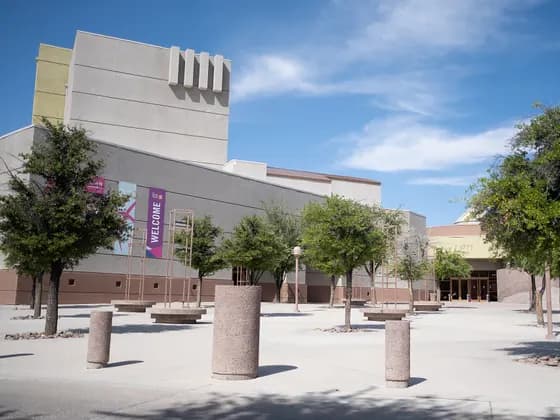
Photo: Frank Schulenburg · CC BY-SA 4.0 · cropped
Photo: C1200d · CC BY-SA 4.0 · Photo: Renee Grayson · CC BY 2.0 · Photo: Halfhog · CC BY-SA 4.0
The Roseman University College of Medicine MD program at a glance (2027 entry)
Roseman University College of Medicine (RUCOM) runs a four-year Doctor of Medicine (MD) program on Roseman University of Health Sciences' Summerlin campus, on the west side of the Las Vegas Valley. Its curriculum is called the Roseman Readiness Curriculum. The College took its first students, a class of 64, in July 2025. The MD program page lists a class size of 60 for the class starting on July 19, 2027, which will be the Class of 2031.
The program holds preliminary accreditation from the Liaison Committee on Medical Education (LCME), which accredits MD programs in the United States. The LCME granted it at its February 13, 2025 meeting. Preliminary is the first accredited stage for a new program and allows it to recruit and admit students; provisional and then full accreditation are the later stages.
The program runs in three phases. The first 18 months are the foundational phase, the pre-clerkship (pre-clinical) stage, in which course blocks of 6 to 8 weeks teach the body by organ system. A 53-week clerkship phase of core clinical rotations, called clerkships, follows from January of year 2. An advanced phase then runs to graduation. It includes a sub-internship, in which you work as an acting intern on a resident team. You also take selectives, which are required rotations where you pick the setting, and electives, which you choose yourself.
The thread running through all four years is GENESIS, Roseman's household-centered care program. You provide care and home visits for assigned households in the community, working with faculty physicians and teams of other health professionals. The households are grouped into practices aligned with six learning communities, smaller groups of students who share advising, clinical practice and community service.
Twenty-three partner hospitals and mental health facilities in southern Nevada have agreed to host clerkships. Most are in the Las Vegas Valley, and one, Mesa View Regional Hospital, is in Mesquite. You take Step 1 of the United States Medical Licensing Examination (USMLE) after the clerkship year rather than before it, a different order from many schools.
| Degree | MD (Doctor of Medicine) |
|---|---|
| Program length | 4 years; school policy allows up to six to finish |
| Class size | 60 listed for July 2027 entry; 64 in the first class (2025) |
| Main campus | Summerlin campus, 10530 Discovery Drive, Las Vegas |
| Curriculum | Roseman Readiness Curriculum: integrated, competency-based, organ-system blocks |
| First patient contact | Year 1: GENESIS household visits and a preceptorship observing local clinicians |
| Clerkships | 53 weeks from January of year 2, at southern Nevada hospitals |
| Step 1 timing | After the 53-week clerkship phase, before the advanced phase |
| Grading | Pass/fail foundational and advanced phases; Honors to Fail in clerkships |
| Accreditation | LCME preliminary since February 2025; next survey 2026-27 |
What makes the Roseman University College of Medicine MD program different
Your own households to care for from year 1
Through GENESIS, every student is assigned households in the community from year 1 and provides care and home visits under faculty supervision. You keep up those households through the clerkship year. In the advanced phase you become a practice manager and consultant for your learning community's whole panel of households.
A full clinical year before you sit Step 1
At many schools Step 1 comes before clerkships. Here you start full-time clerkships after 18 months. The school then requires you to take Step 1 at the end of the 53-week clerkship phase, with a year of clinical work behind you.
Problem-based learning on campus during the clerkship year
Your clerkship year keeps a link to campus. Advanced Clinical Practice 1 runs through the clerkship phase and brings all clerkship students back for problem-based learning. In these small groups you work through cases that tie what you see on rotations to basic science, ethics, professionalism and systems-based practice, meaning how to work within the wider health care system.
Clerkship partners across 23 southern Nevada sites
The partner list spans several health systems and kinds of care. Among them are a VA medical center, a military medical center, a children's hospital and several psychiatric hospitals. The list also includes University Medical Center Southern Nevada, which the school lists as a Level I trauma center, the top tier of trauma care.
Character assessed alongside knowledge
The school describes a character-based curriculum meant to develop students' character, ethics and virtue. Twelve professional behaviors are assessed for every student, among them respect, curiosity, compassion, discernment, humility and adaptability. Professional identity formation is one of the eight competency domains you must meet to graduate.
How Roseman University College of Medicine teaches medicine
The Roseman Readiness Curriculum is competency-based and taught in active learning formats, which the school says require you to take charge of your own learning. Diagnostic and treatment skills are taught from the start, alongside basic science and health systems science, the study of how care is organized and delivered. The program is built around eight competency domains adapted from frameworks of the Association of American Medical Colleges (AAMC) and the Accreditation Council for Graduate Medical Education (ACGME).
The foundational phase has ten required courses, taken in a set order. Each of its seven Foundations blocks covers a group of organ systems, with basic science, clinical science, ethics and health systems science taught together. The content is mapped across the blocks so that every learning objective is covered without gaps or repeats. Objectives on ethics and justice are built into every pre-clerkship course, and nutrition is threaded through all phases.
Alongside the blocks, each foundational phase has a Clinical Practice course. It teaches history taking, communication, physical examination, documentation and clinical reasoning, plus topics such as social determinants of health (the living and working conditions that shape health), population health, quality improvement and patient safety. It runs through dedicated focus weeks of skills practice and one half-day a week for GENESIS, early patient contact and systems-based practice. Roseman physician faculty teach the clinical skills and supervise your GENESIS work.
Teaching moves to hospitals and clinics in the clerkship phase, but you still come back to campus. Each clerkship opens with an introductory week of teaching on that specialty. Advanced Clinical Practice 1 runs through the clerkship year with problem-based learning and GENESIS work, and Advanced Clinical Practice 2 adds a practice management curriculum in the advanced phase.
The ways you will learn
| Foundations course blocks | Seven courses over the first 18 months, each covering a set of organ systems and topics, such as nutrition, the gastrointestinal system and the endocrine system in Foundations 1B. Each combines biomedical and social sciences, humanities and professional development. |
|---|---|
| Clinical skills focus weeks | Weeks within the Clinical Practice courses given over to concentrated practice of clinical skills, taught by Roseman physician faculty. |
| Standardized patients and simulation | On Standardized Patient days in the Medical Simulation Center, trained actors play patients in scenarios written by clinical faculty. Task trainers let you practice skills such as IV insertion, suturing and airway management, and manikins can be programmed to show conditions such as a heart attack or stroke. |
| GENESIS household care | Home visits, care coordination and help navigating social services for your assigned households, supervised by faculty physicians and supported by your learning community's outreach workers. |
| Community preceptorship | Time observing practicing clinicians in the local community, part of the Clinical Practice courses in Foundational Phases 1 and 2. |
| Problem-based learning | Small-group case sessions on campus in Advanced Clinical Practice 1, during the clerkship year, linking clinical care with systems-based practice, basic science, ethics and professionalism. |
A typical week on the Roseman University College of Medicine program
In the foundational phase, each week holds about 25 hours of assigned time, including the preparation you do for class sessions. One half-day each week is set aside for GENESIS, early exposure to patient care and systems-based practice, and some weeks are focus weeks for clinical skills. You are expected to attend all required sessions. Exams, clinical experiences and other core activities can be missed only with approval.
The Class of 2030's calendar shows the shape of year 1. After orientation and a White Coat Ceremony, Foundational Phase 1 runs from July 27 to December 18, 2026. Phase 2 runs from January 4 to June 25, 2027, with an independent study week starting March 29. A summer break follows until July 23.
In clerkships, the school's duty-hours policy limits your time. Averaged over four weeks, you work no more than 80 hours a week, including in-house call (time on call at the hospital). You also take call no more often than every third day and get one day in seven free. No continuous shift may exceed 24 hours, and you get 14 hours off between duty periods. Holidays depend on the clerkship and site.
When you first meet patients at Roseman University College of Medicine
Your first patient contact comes in year 1, through GENESIS. You provide household-centered care and home visits for your assigned households, supervised by Roseman physician faculty. Outreach workers assigned to each learning community recruit and manage the households and keep up relationships with the community partners that refer them. The curriculum page says GENESIS has recruited more than 140 households and involved more than 75 community partners.
GENESIS launched in March 2022 on the steps of Las Vegas City Hall, before the medical school opened. As a May 2025 school article described it, the households are medically underserved, and GENESIS tracks their social risks across nine areas, among them income, nutrition, housing, transportation and employment. A digital profile lets the team build care plans and track progress, and students, faculty and community health workers meet periodically in class to review them. The same article said GENESIS staff spoke English, Spanish, Tagalog, French and Haitian Creole.
In Foundational Phases 1 and 2, a preceptorship gives you early exposure to practicing clinicians in the local community. Full-time clinical work starts with the clerkship phase in January of year 2, after an orientation week. You may not care for any patient without faculty supervision: your supervisor is either with you throughout or on site and immediately available. You may take part in procedures only with the patient's consent and under direct supervision.
The Roseman University College of Medicine curriculum, year by year
- Foundational Phase 1
Blood, infection, nutrition and hormones
This first phase runs from July to mid-December of year 1. You begin the integrated sciences curriculum and Clinical Practice 1 side by side, and start GENESIS household care. You must pass every course in the phase to move on.
- Foundations 1A (12 credits): orientation to the school, then the blood, microbiology, infectious disease, the body's immune response, and epidemiology and evidence-based medicine.
- Foundations 1B (10.5 credits): nutrition and the gastrointestinal system, and the endocrine system.
- Clinical Practice 1 (7.5 credits): history taking, communication, physical examination, documentation and clinical reasoning, plus systems thinking, social determinants of health, health disparities, teamwork, population health, quality improvement and patient safety.
- GENESIS household care, social service navigation and care coordination, and a preceptorship observing practicing clinicians in the community.
- Foundational Phase 2
From reproduction to the musculoskeletal system
From early January to late June of year 1, three blocks cover the reproductive and nervous systems, the heart, lungs and kidneys, and the musculoskeletal system, skin and immune system. Clinical Practice 2 continues alongside them. A summer break of about four weeks follows.
- Foundations 2A (9 credits): the reproductive system, and an introduction to the nervous system, behavior and psychiatry.
- Foundations 2B (10.5 credits): the cardiovascular, pulmonary and renal systems.
- Foundations 2C (9 credits): the musculoskeletal system, dermatology and immunology.
- Clinical Practice 2 (7.5 credits): further clinical skills, GENESIS household care and the community preceptorship.
- Foundational Phase 3
Advanced systems, cancer and the life cycle
The last pre-clerkship phase runs from late July to mid-December of year 2. It returns to the nervous system and the heart, lungs and kidneys at a more advanced level, and adds cancer and the human life cycle.
- Foundations 3A (10.5 credits): the advanced nervous system and psychiatry, and advanced cardiovascular, pulmonary and renal topics.
- Foundations 3B (12 credits): the human life cycle, covering development (including embryology), cancer, disorders that involve several body systems, and geriatrics, the care of older adults.
- Clinical Practice 3 (7.5 credits): the last Clinical Practice course, with GENESIS household care continuing.
- Before clerkships: a second Level 2 criminal background check and a 10-panel drug test.
- Clerkship phase
Six core clerkships, electives and Step 1 preparation
After an orientation week, the clerkship phase starts in January of year 2 and spans 53 weeks, roughly a year. Each core clerkship opens with a week of teaching on that specialty. The phase ends with a promotional OSCE (Objective Structured Clinical Examination) and study time for Step 1. In an OSCE you rotate through timed stations, each testing a clinical skill such as taking a history or examining a patient, often with standardized patients.
- Internal medicine (9 credits): eight weeks of clinical time with outpatient and hospital-based parts, caring for adults under preceptors from the community, the public health system and the academic setting.
- Surgery (9 credits): eight weeks of clinical time in preoperative care, operations, outpatient surgery clinics and postoperative recovery.
- Family medicine (7 credits): six weeks in the specialty that cares for the whole person, whatever their age, taking and documenting histories, examinations and management plans under Roseman clinical faculty.
- Obstetrics and gynecology (7 credits): six weeks across clinics, wards, the operating room, emergency consults, radiology and the labor and delivery suite.
- Pediatrics and psychiatry (7 credits each): six weeks each. Pediatrics spans inpatient and outpatient care plus simulated cases; psychiatry covers emergency, inpatient, outpatient and specialty settings.
- Electives: two required weeks and up to three more, in specialty rotations you want to explore.
- Advanced Clinical Practice 1 (two parts, 1.5 credits each): problem-based learning on campus, plus home visits and care coordination for your GENESIS households.
- Advanced phase
Sub-internship, selectives, electives and residency preparation
The curriculum page says you take Step 1 before this phase starts and must pass it to continue. The phase runs to graduation and mixes required rotations with electives chosen around your interests and residency plans. Step 2 CK, the USMLE's clinical knowledge exam, is due by September. In the published calendars, Match Day, when you learn where you will train in residency, falls in March of the final year.
- Sub-internship (4 credits): in internal medicine, general surgery or pediatrics, working on a resident team as an acting intern, taking on much of a first-year resident's work under supervision.
- Neurosciences selective: a required two-week rotation in general or subspecialty neurology.
- Emergency and critical care selective: a required two-week rotation in urgent care, emergency care or critical care.
- Electives: 34 credits in all, in 2- or 4-credit rotations across specialties and subspecialties.
- Advanced Clinical Practice 2 (two parts, 0.5 credits each): a practice management curriculum in which you act as practice manager and consultant for your learning community's GENESIS households.
- Residency Readiness (1 credit): communication, key patient care concerns, clinical skills, well-being, quality improvement and patient safety, tailored to your chosen specialty.
- Review and Prep (1 credit): listed in the 2026-27 catalog among the advanced phase's required courses, for final Step 1 preparation.
- Before the phase: a third Level 2 background check and another 10-panel drug test.
How you are assessed at Roseman University College of Medicine
Courses in the foundational and advanced phases are graded pass/fail. The six clerkships are graded Honors, High Pass, Pass or Fail. Honors is for outstanding performance and High Pass for performance significantly above expectations, and both also need the set threshold on the clerkship's NBME subject exam. An NBME subject exam, often called a shelf exam, is a standardized end-of-rotation exam from the National Board of Medical Examiners. A failed course you later remediate shows on your transcript as Fail/Pass.
Course grades rest on competency on designated assessments and on faculty-written or nationally standardized exams designed to prepare you for NBME licensing exams. The school requires that you are given formative assessments, practice tests that give feedback without counting toward your grade. You must pass every course in a foundational phase to move on. The Medical Student Promotion and Review Committee (MedSPARC) reviews each student's progress during and between phases and rules on promotion, remediation and dismissal. The standard program is four years, and policy allows up to six.
You need at least 194 credits to graduate, and you must also pass promotional OSCEs (Objective Structured Clinical Examinations), which test clinical skills. Graduation also requires passing Step 1 and Step 2 CK of the USMLE, the national exam series for medical licensure in the United States. Step 1 tests whether you understand and can apply the sciences basic to medicine, and has been reported only as pass or fail for exams taken since January 26, 2022. Step 2 CK tests the medical knowledge, skills and clinical science needed to care for patients under supervision.
Here Step 1 comes after the core clerkships. The curriculum page says the clerkship phase ends with a promotional OSCE and dedicated study time, and that you must take Step 1 before entering the advanced phase and pass it to continue. The 2026-27 catalog also lists a 1-credit Review and Prep course for final Step 1 preparation among the advanced phase's required courses. Step 2 CK must be taken by September of the advanced phase.
In August 2026 the USMLE program announced a move to designated testing dates from January 2029, with Step exams offered less often each year. Its June 2026 announcement had named 2028. On the current schedule, a student entering on July 19, 2027 would finish the foundational phase around December 2028 and the clerkship phase around January 2030. Step 1 would then fall in early 2030 and Step 2 CK by September 2030, both after the switch. These are projections from the published phase lengths, not dates set for your class.
- Your Medical Student Performance Evaluation (MSPE), the school's summary letter for residency applications, reports only if you are in the top quartile or the top half of your class.
- If you have had to repeat a foundational phase, you cannot repeat any later phase.
- Professional behavior is assessed throughout, and lapses can lead to a professionalism incident report and review by MedSPARC.
- Roseman's university-wide Six-Point Mastery Learning Model describes a 90 percent pass standard, and the catalog's grading rules apply it to pharmacy, nursing, dental medicine and graduate studies. The College of Medicine has its own scale, described above.
Roseman University College of Medicine clinical rotations: where you will actually train
The school says a majority of southern Nevada's hospitals, hospital systems and inpatient mental health facilities have agreed to host its clerkship students. Together, it says, they reflect the region's geographic, ethnic and cultural diversity. Its partner list names 23 sites, grouped below, most of them in the Las Vegas Valley.
The sites cover many kinds of care. UMC, University Medical Center Southern Nevada, is listed by the school as a Level I trauma center. The list also includes a children's hospital, a VA medical center for veterans, a military medical center at Nellis Air Force Base and several psychiatric hospitals. Residents who teach you at these sites must take part in Roseman's Resident as Teacher training, which covers clerkship objectives and the list of required clinical encounters and skills.
The Office of Medical Education schedules the core clerkships, and students take them in different sequences. Roseman Medical Group, the College's clinic beside Spring Valley Hospital, expanded in 2026 to care for patients of all ages. Its medical director, who also directs the pediatrics clerkship, says the practice is integrating learners.
Three campuses of St. Rose Dominican Hospital. The Siena Campus lists a Level III trauma center and a Level III neonatal intensive care unit among its services.
- St. Rose Dominican Hospital, Rose de Lima Campus, Henderson
- St. Rose Dominican Hospital, Siena Campus, Henderson
- St. Rose Dominican Hospital, San Martin Campus, Las Vegas
- Sunrise Hospital and Medical Center
- Sunrise Children's Hospital
- MountainView Hospital
- Southern Hills Hospital and Medical Center
Six hospitals run by a subsidiary of Universal Health Services (UHS).
- Spring Valley Hospital Medical Center
- Summerlin Hospital Medical Center
- Henderson Hospital
- Centennial Hills Hospital Medical Center
- Valley Hospital Medical Center
- West Henderson Hospital
- University Medical Center Southern Nevada (UMC), Las Vegas
- North Las Vegas VA Medical Center
- Mike O'Callaghan Military Medical Center, Nellis Air Force Base
- North Vista Hospital, North Las Vegas
- Mesa View Regional Hospital, Mesquite
- Desert Parkway Behavioral Healthcare Hospital, Las Vegas
- Rawson-Neal Psychiatric Hospital, Southern Nevada Adult Mental Health Services, Las Vegas
- Seven Hills Behavioral Health Hospital, Henderson
- Spring Mountain Treatment Center
- Spring Mountain Sahara
Electives, selectives and away rotations at Roseman University College of Medicine
Electives come in both clinical phases. In the clerkship year you must take two elective weeks and can add up to three more, choosing from a list of specialty rotations you want to explore before the advanced phase. Clerkship-phase electives carry 1 to 5 credits, and 2 credits are required.
Most of the advanced phase is yours to choose: you need 34 elective credits, taken in 2- or 4-credit rotations in specialties and subspecialties that fit your interests and residency plans. The phase also has two required selectives of two weeks each, one in general or subspecialty neurology and one in urgent, emergency or critical care.
Under the school's supervision policy, clinicians who supervise you must hold a faculty appointment at Roseman or at a host institution in the Visiting Student Learning Opportunities (VSLO) program. VSLO is the AAMC's application service for away rotations, which are electives taken at other institutions.
Facilities and support at Roseman University College of Medicine
Where you will learn
The College of Medicine teaches in three buildings on Roseman's Summerlin campus at 10530 Discovery Drive, near the 215 Beltway: the Discovery Building, the Breakthrough Building and Innovation Hall. The campus also houses the College's research programs. The College has an anatomy lab, led by an anatomy lab director in the Department of Basic Sciences. A 2024 research symposium abstract by College faculty, written while the school was being set up, said the lab would combine plastinated human organs, anatomical models, simulators and virtual anatomy tools.
The Medical Simulation Center is a 12,000-square-foot facility with patient rooms for standardized patient encounters, clinical skills rooms and high-fidelity immersive simulation rooms, used across all four years. Its task trainers cover physical examination, venipuncture, central lines, lumbar punctures, airway management, pelvic and rectal examinations, catheterization and childbirth. Its manikins include SimMan 3G PLUS, the MamaAnne birthing simulator, SimJunior and SimNewB.
Outside class you can book practice time on the equipment through your clinical sciences faculty. You can also sign up through Canvas, the online course platform, for Resuscitation Quality Improvement (RQI), an American Heart Association program for building and keeping CPR skills.
The Medical Library is on the first floor of Innovation Hall, staffed from 8 a.m. to 7 p.m. Monday to Thursday and to 5 p.m. on Friday, with keycard access after hours and round-the-clock online chat. Its College of Medicine guide offers two 3D virtual dissection programs, Complete Anatomy and VH Dissector. It also lists Step 1 resources from ScholarRx and Pathoma, and the Sectra Educational Portal, which has real patient cases with CT and MRI images.
Personal lockers for laptops, medical equipment and white coats are in Innovation Hall near the Roadrunner Learning Community suites. College faculty research cancer, genetics, artificial intelligence, ethics and health policy, epidemiology and public health, and substance use disorder. The university's 64,400 square feet of research laboratories are open to faculty and students, with technician support.
Support while you study
Students belong to six Roadrunner Learning Communities, which combine student support and advising, clinical practice and community service learning. Each community's GENESIS households are run as a practice, with faculty physicians and outreach workers assigned to it, and specialty interest groups are open across communities.
Academic advisors in the Office of Academic and Career Advising each take primary responsibility for students in the learning communities, and act as both advisor and counselor. You must meet yours at least once per curricular phase to review your progress and draw up a study plan, and your advisor may contact you if your results slip. The office also offers tutoring and academic coaching, workshops on study skills and test-taking, and peer-assisted learning and study groups.
Counseling is free and confidential at the Medical Student Counseling and Wellness Center, whose licensed clinicians play no part in grading or promoting students. Primary care is available at Roseman Medical Group, where the providers for students include primary care nurse practitioners who do not teach or assess medical students. Appointments run on weekdays, and same-day walk-in visits are often available.
Career guidance comes from deans, department chairs, course and clerkship directors and advisors, an annual list of clinical faculty by specialty, and the AAMC's Careers in Medicine resources. The Medical Student Council, elected each year with representatives from every class, gives students a forum to raise concerns and shape their education. Students also feed into accreditation through surveys, course and clerkship evaluations, an independent student analysis and meetings with LCME survey teams.
Is the Roseman University College of Medicine program right for you?
This program may suit you if
- You want to work with real households in the community from year 1 and stay with them through the clerkship year, as GENESIS requires of every student.
- You want training that stresses preventive medicine, primary care and the social factors behind ill health, the focus of GENESIS household care.
- You would like full-time clerkships after 18 months and a year of clinical work behind you before you sit Step 1.
- You want clerkship partners that range from a Level I trauma center to VA, military, children's and psychiatric hospitals, across the 23 sites on the school's list.
- You would enjoy joining one of a new school's first classes, with a listed class size of 60 and student input into its accreditation reviews.
Things to think about
- The school is new. Its first class is scheduled to start clerkships on January 11, 2027 and reach Match Day on March 16, 2029, so the clinical phases will be run for the first time.
- Accreditation is at the preliminary stage. Under the LCME's process, provisional and then full accreditation each follow a later survey visit and review.
- GENESIS is required throughout, with a weekly half-day in the foundational phase and household work continuing in both clinical phases, so community care is a fixed part of your schedule.
- Clerkships are graded Honors, High Pass, Pass or Fail, and the top two grades depend on NBME subject exam thresholds, so the clerkship year carries more grading pressure than the pass/fail phases.
Roseman University College of Medicine MD program — frequently asked questions
Applying to Roseman University College of Medicine?
How to get into Roseman University College of Medicine
Prerequisites, MCAT, AMCAS personal statement, secondaries and interview, step by step.
Open the guide →Roseman University College of Medicine admissions profile
MCAT and GPA profile, acceptance rate, interview format and key dates.
See the profile →Compare Roseman University College of Medicine with other schools
Put the teaching style, anatomy teaching and clinical sites next to another school.
Open the comparison →Prepare for the Roseman University College of Medicine interview
Format breakdown, school-specific sample questions and prep tips from tutors who interviewed here.
Read the guide →Where this Roseman University College of Medicine program guide came from
This guide was written from 51 official sources — Roseman University College of Medicine's own program pages and curriculum documents, plus the accreditor and the hospitals and health systems the school trains students in where they publish detail — read on 2026-10-25, then checked claim by claim against those sources.
- Roseman University: Doctor of Medicine (MD) Degree Program
- Roseman University: Curriculum and Educational Program Objectives
- Roseman University: MD Program Academic Calendar 2026-2027
- Roseman University: MD Program Clinical Partnerships
- Roseman University: Educational Spaces and Learning Communities
- Roseman University: Professional Attributes and Learning Environment
- RUCOM Medical Student Handbook 2026-2027
- Roseman University Student Catalog 2026-2027, effective July 1, 2026 (College of Medicine sections)
- Roseman University Registrar: Student Catalogs and Handbooks
- RUCOM Clinical Duty Hours Policy (effective April 2026)
- RUCOM Clinical Supervision of Medical Students Policy (effective August 2026)
- RUCOM Resident as Teacher Policy (effective October 2026)
- Roseman University College of Medicine: Medical Simulation Center
- Roseman University College of Medicine: Department of Basic Sciences
- Roseman eCommons: 2024 Annual Research Symposium abstract, Establishing Optimal Tools for an Anatomy Laboratory (online February 20, 2024)
- Roseman University faculty profile: Dietrich Lorke, MD, PhD, Professor of Anatomy (profile updated June 2023)
- Roseman University Library: College of Medicine Program Guide, Student Resources Spotlight
- Roseman University: Summerlin, Las Vegas, Nevada Campus
- Roseman University: College of Medicine Research
- Roseman University College of Medicine: Office of the Dean
- Roseman University: College of Medicine
- Roseman news: College of Medicine granted preliminary LCME accreditation (February 14, 2025)
- Roseman news: the GENESIS program (May 16, 2025)
- Roseman news: College of Medicine welcomes its inaugural class (September 23, 2025)
- Roseman news: National Doctors' Day and the inaugural class (March 30, 2026)
- Roseman news: Roseman Medical Group expands its Spring Valley clinic (April 27, 2026)
- LCME: Accredited programs directory (updated October 14, 2026)
- LCME: Accreditation process overview
- LCME: About the school directory
- USMLE: Updated timeline for designated testing dates, transition in January 2029 (August 6, 2026)
- USMLE: Designated Testing Dates information hub
- USMLE: Step 1 transition to pass/fail only score reporting
- USMLE: Step 1
- USMLE: Step 2 CK
- Dignity Health St. Rose Dominican Hospital, Rose de Lima Campus
- Dignity Health St. Rose Dominican Hospital, Siena Campus
- Dignity Health St. Rose Dominican Hospital, San Martin Campus
- Spring Valley Hospital Medical Center
- Summerlin Hospital Medical Center
- Henderson Hospital
- Centennial Hills Hospital Medical Center
- Valley Hospital Medical Center
- Valley Health System: hospital list, including West Henderson Hospital
- University Medical Center Southern Nevada (UMC)
- North Las Vegas VA Medical Center, VA Southern Nevada Health Care
- Mike O'Callaghan Military Medical Center, Nellis Air Force Base
- North Vista Hospital, North Las Vegas
- Mesa View Regional Hospital, Mesquite
- Desert Parkway Behavioral Healthcare Hospital
- Seven Hills Behavioral Health Hospital, Henderson
- Nevada Division of Public and Behavioral Health: Southern Nevada Adult Mental Health Services (Rawson Neal Hospital Building)
Curricula are restructured between cycles. Anything here that decides your application — how anatomy is taught, a clinical campus assignment, a required research year — should be confirmed against the official page for your entry year.
Applying to Roseman University College of Medicine?
We help US applicants with MCAT strategy, the AMCAS personal statement, secondary essays and interview prep — everything you need for a competitive Roseman University College of Medicine application.