
The Yale School of Medicine MD program
What you actually study, and where you will be
Yale School of Medicine's MD is a 4-year program taught through case-based learning in an integrated curriculum, with patient contact from Year 1 and clinical rotations in New Haven and nearby towns, plus four more distant hospitals (2027 entry). Yale's MD runs on the Yale System: no grades in the first 18 months, no class rank at any point, anonymous pass/fail exams and a required research thesis. Integrated courses with weekly patient contact lead into a year of clerkships (core clinical rotations), mostly in and around New Haven. A flexible 17-month final phase follows, and many students add an optional year, often for research or a second degree.
- Degree
- MD
- Length
- 4 years
- Teaching
- Integrated + Case-based learning
- Clinical contact
- Year 1

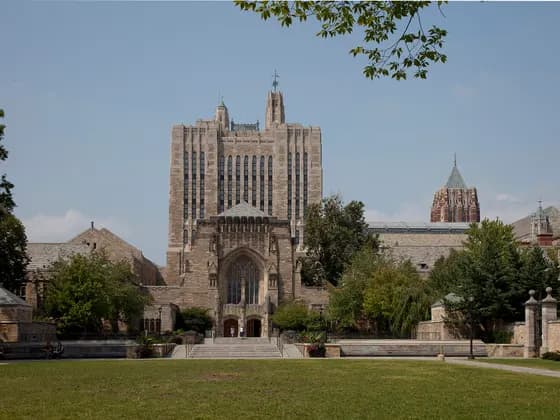
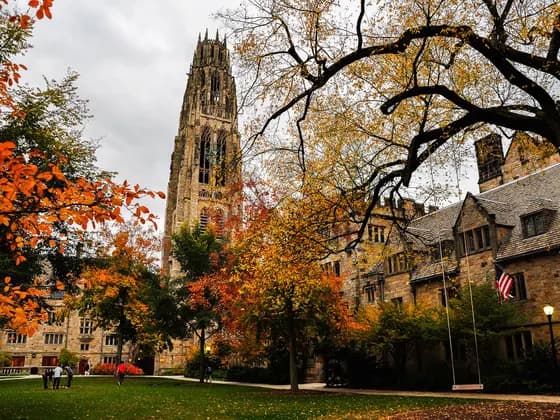

Photo: Raf2016 · CC BY-SA 4.0 · cropped
Photo: Carol M. Highsmith · Public domain · Photo: Namkota · CC BY-SA 4.0 · Photo: Christian David · CC BY-SA 4.0
The Yale School of Medicine MD program at a glance (2027 entry)
Yale School of Medicine's MD is a four-year program on a medical campus in New Haven, Connecticut, that adjoins Yale New Haven Hospital. The class that entered in August 2026 has 104 students. The Liaison Committee on Medical Education (LCME), which accredits US MD programs, continued Yale's full accreditation in March 2024 after an October 2023 visit; the next is due in 2031-32.
The program runs on what the school calls the Yale System, dated to the 1920s on the program website and to 1931 in the 2026-27 Bulletin. It treats students as motivated adults who need guidance rather than competition. There are no grades in the first 18 months and no class rank at any point, and exams are pass/fail and anonymous. You also take more than the usual responsibility for your own learning.
The pre-clerkship phase, also called pre-clinical, fills the first 18 months with integrated courses, clinical skills and weekly patient care. Clerkships, the core clinical rotations on hospital and clinic teams, then run for 12 months from January of year 2. The final 17 months, the Advanced Training Period (ATP), hold electives, research and applications for residency, the specialty training that follows medical school. They also include a sub-internship, four weeks of working close to the level of a first-year resident.
On the standard route, the ATP is also when you take Step 1 and Step 2 CK of the United States Medical Licensing Examination (USMLE), the national licensing exams. Research is built in, from a year 1 course to a required thesis. Clinical training is based in New Haven, mainly at Yale New Haven Hospital (YNHH), the primary teaching hospital, and the Veterans Affairs (VA) medical center in nearby West Haven. Some rotations are at four more distant affiliated hospitals.
| Degree | MD, fully accredited by the LCME; next survey 2031-32 |
|---|---|
| Program length | 4 years, plus an optional extended study year between years 3 and 4 |
| Class size | 104 students in the class that entered in August 2026 |
| Main campus | Medical campus beside Yale New Haven Hospital, New Haven, Connecticut |
| Teaching style | Integrated courses, mostly small-group case workshops, team-based learning and labs |
| Anatomy | Cadaver dissection, four students per body, plus real and virtual prosections |
| First patient contact | First days of year 1, then weekly through the pre-clerkship phase |
| Clinical sites | Yale New Haven Hospital, West Haven VA and four more distant hospitals |
| Step 1 timing | In the Advanced Training Period after clerkships, or before them on the early option |
| Grading | Pass/fail, no class rank; tiered grades only in four-week clinical electives and sub-internships |
What makes the Yale School of Medicine MD program different
Pass/fail courses, anonymous exams and no class rank
Pre-clerkship course exams, called qualifiers, are pass/fail and anonymous. Clerkships are graded Pass or Unsatisfactory with a written narrative. The school's view is that without competition for grades, students learn for their future rather than for tests.
A research thesis required to graduate
A year 1 course ends in a research proposal, followed by a mentored summer project and research blocks in the ATP. It all leads to a thesis of at least 30 pages.
Four clerkship blocks that pair related specialties
The clerkship year runs as four 12-week blocks: internal medicine with neurology, surgery with emergency medicine, pediatrics with obstetrics and gynecology, and primary care with psychiatry. The paired specialties share teaching and simulation.
Step 1 after clerkships on the standard route
On the standard route you take USMLE Step 1 after a full year of clerkships, in the Advanced Training Period alongside Step 2 CK.
A long, flexible final phase and an optional year
Beyond a sub-internship and a capstone course, you fill the 17-month Advanced Training Period with your choice of electives, away rotations, global health and research. An optional extended study year between years 3 and 4 adds time for research or a joint degree.
How Yale School of Medicine teaches medicine
The pre-clerkship curriculum is built from eight master courses of two to 11 weeks, taken one after another. Four longitudinal courses of four to eight months run alongside: Professional Responsibility, Human Anatomy, Scientific Inquiry, and Populations and Methods. Clinical Skills and Foundations of Patient Care continue throughout, and threads such as pharmacology, pathology and health equity run through all the master courses.
Lectures are deliberately few. You meet new material through videos, online modules and large-group sessions, then practice it in small-group case workshops, team-based learning, labs and sessions with patients. Expect faculty to question you directly. Attendance is compulsory only for sessions with patients or community guests, clinical skills, simulation, required trainings and transition courses such as Introduction to the Profession.
Progress is measured against nine competencies, from patient care to the creation of new knowledge, each with milestones for every phase. The curriculum dates from 2015 and was updated in 2026.
In March 2026 the school announced a redesigned, competency-based curriculum launching that summer. The announcement describes courses broken into learning units with measurable goals, each ending in review and practice assessment, and faculty acting more as mentors and facilitators. The course pages, checked in October 2026, still list the courses described here.
In the clerkships, most learning happens on the wards and in clinics as part of the care team. Block teaching adds simulation, Top Ten workshops on common complaints or shared topics and, in some blocks, a weekly Thursday-afternoon session.
The ways you will learn
| Small-group case workshops | The core of most courses: a small group works through patient cases with faculty. |
|---|---|
| Team-based learning | Used in most master courses: the class works in teams to apply what it has learned to real medical problems. |
| Recorded and self-paced material | Videos and online tools carry much first-pass content, such as EKG modules on TeachingMedicine.com and the Stanford Heart virtual reality program. |
| Clinical Skills sessions | Weekly hands-on sessions for 18 months, often with simulated participants, people trained to play patients. You practice interviewing, up to communicating serious news, and physical examination. You also take at least four point-of-care ultrasound sessions and work through clinical reasoning cases. |
A typical week on the Yale School of Medicine program
The school's workload guideline, approved in 2023, caps scheduled classroom time at 32 hours a week, with up to 20 more hours of preparation such as readings and videos. Two afternoons a week stay free, with few required evening or weekend sessions.
A year 1 week mixes the current master course with the longitudinal courses running alongside it. It also holds a Clinical Skills session, a Foundations of Patient Care session and, for much of the year, an anatomy lab. Studying for qualifiers comes on top, and in year 2 many students keep up research part-time.
How anatomy is taught at Yale School of Medicine
Human Anatomy is one of the longitudinal courses, built around dissection; the Bulletin says four students share each cadaver and work as a team. Its three threads are dissection, lectures and embryology, with particular weight on diagnostic imaging and the musculoskeletal system.
Each weekly lab combines a drawing exercise, dissection, small-group discussion and skills such as physical diagnosis and ultrasound. Guides, quizzes and video lectures sit on the course's Guided Anatomy website, with imaging modules on X-ray, CT and MRI. Real and virtual prosections, specimens already dissected by experts, include 3D prosections explored with augmented reality.
The two official descriptions differ on timing. The anatomy web page and Year 1 schedule show weekly labs from September to April of year 1, with more anatomy folded into two year 2 courses. The 2026-27 Bulletin says the course runs from the second term of year 1 to the end of the first term of year 2.
From year 3, the four-week Advanced Surgical Anatomy elective takes up to 10 students through surgical dissections and procedures.
When you first meet patients at Yale School of Medicine
Patient contact starts in the opening course, Introduction to the Profession (iPro). In its first days you join care teams in several clinical settings at YNHH. The course also includes simulation, time with New Haven community organizations and small-group sessions at a museum. The Bulletin says every first-year student attends a session at the Yale museums.
Foundations of Patient Care, formed in 2026 from two earlier courses, then gives you weekly clinical time through the pre-clerkship phase. In Part 1 you learn with first-year students from Yale's Physician Associate (PA) program, in small groups led by a faculty tutor. You also observe professionals such as physical therapists, spiritual care providers and clinical nutritionists.
Part 2 runs from mid-March of year 1 to the end of November of year 2. Groups of three or four see patients weekly with a physician tutor, about 24 sessions in all. Clinical Skills classes also include interviews with real patients.
Year by year at Yale School of Medicine
- Year 1
Foundations and the first organ systems
Year 1 opens in August with Introduction to the Profession, then runs through five more master courses in sequence, with longitudinal courses alongside. For the Class of 2030 it runs from August 10, 2026 to June 13, 2027, followed by a summer break.
- Scientific Foundations (September): biochemistry, cell biology and histology, pathology, physiology and pharmacology, in six learning units such as Fluids and Gradients and Life and Death of a Cell.
- Genes and Development (October to November): genetics and embryology, then blood as the first organ system, then cancer biology through to clinical oncology.
- Attacks and Defenses (December to January): immunology, microbiology and infectious diseases, then rheumatology, allergy and dermatology.
- Homeostasis (February to April): the heart, lungs and kidneys in roughly equal thirds.
- Energy and Metabolism (April to June): digestive diseases, nutrition, the liver and endocrinology.
- Professional Responsibility (September to December): ethics, law and how US health care is organized and paid for, in small groups that students take turns leading.
- Scientific Inquiry (November to June): seven sessions on choosing a mentor and project. It ends in a research proposal of up to four pages, which you must submit to enter year 2.
- Populations and Methods starts in February, and Human Anatomy runs through much of the year.
- Year 2, September to December
The nervous system, the life cycle and Transition
The last four months of the pre-clerkship phase bring two more master courses, while Populations and Methods, Clinical Skills and Foundations of Patient Care continue. For the Class of 2029 the term runs from August 31 to December 18, 2026.
- Connection to the World (September to November): the nervous system from spinal cord to cortex, joining neuroscience and behavioral science with neurology, psychiatry, ophthalmology and otolaryngology, with neuroanatomy labs.
- Across the Lifespan (November to December): life stages from conception and birth through childhood and the reproductive years to aging, covering obstetrics and gynecology, pediatrics and geriatrics.
- Populations and Methods: epidemiology and biostatistics applied to public health in forty-two 50-minute sessions, including software labs and a journal article discussion that each student leads.
- The P-OSCE, a standardized history and physical exam you must pass, or remediate, before clerkships.
- Transition to Clerkships (two weeks in December): training in patient privacy, needlestick safety and the Epic health record, plus phlebotomy, scrub and surgical skills, simulations and ATP career planning.
- Clerkships, January of year 2 to December of year 3
Four integrated clerkship blocks
Four 12-week blocks, taken in any order and scheduled through the MedHub system from your preferences. Each opens with a shared session for the whole class, the Precede. In 2027 the blocks start on January 4, March 29, early July and September 27.
- Medical Approach to the Patient: eight weeks of inpatient internal medicine and four weeks of neurology. Medicine runs in four-week blocks at YNHH's York Street or Saint Raphael campus, the West Haven VA or Bridgeport Hospital, and one block can be on a subspecialty team.
- Surgical Approach to the Patient: nine weeks of surgery and three of emergency medicine at YNHH's two emergency departments. The web page splits surgery into three three-week blocks from core and subspecialty services; the Bulletin lists six weeks of general surgery and three of specialties.
- Pediatrics, Obstetrics and Gynecology: six weeks of ob-gyn, four inpatient at York Street and two outpatient. Six weeks of pediatrics span an inpatient team, a specialty service, the pediatric intensive care unit, the emergency department and the newborn nursery.
- Biopsychosocial Approach to Health: six weeks of primary care, with nine clinic sessions a week split between adult and pediatric practices. Six weeks of psychiatry cover two three-week services plus a weekly half-day subspecialty clinic.
- There is no overnight call on required clerkships, and any night shifts replace day shifts. Hours follow the limits that the Accreditation Council for Graduate Medical Education (ACGME) sets for residents.
- Advanced Training Period, January of year 3 to May of year 4
Electives, sub-internships, research and the Step exams
The final 17 months follow a plan you make with your advisers. You need 40 weeks of study, including one four-week sub-internship and a four-week capstone; the rest can be electives, more sub-internships, approved joint-degree coursework or supervised research.
- In a sub-internship you take primary responsibility for patients under supervision. Listings include internal medicine, pediatrics, neurology, psychiatry, ob-gyn subspecialties and 14 surgical services.
- Beyond the sub-internship and capstone, the ATP page and school policies require 32 weeks of electives or research; the 2026-27 Bulletin says 33 weeks.
- Step 1, unless taken early, and Step 2 CK, with up to eight and four weeks of study time respectively under the Bulletin's guidelines.
- Full-time research blocks for credit: for the class that graduated in 2026, ATP research averaged six months, most of it forming the basis of the thesis.
- Residency applications: the Medical Student Performance Evaluation (MSPE), the school's summary letter to residency programs, goes out on October 1. Sub-internships you want included belong at the end of year 3 or in the first three elective blocks of year 4.
- The capstone, in March of year 4: specialty boot camps and review before internship. It falls around Match Day, when you learn where you will do residency. In the 2026-27 calendar it runs March 1 to 26, with Match Day on March 19.
How you are assessed at Yale School of Medicine
There are no grades in the pre-clerkship phase. Each course's knowledge exams, called qualifiers, are pass/fail, and you pass by scoring above a minimum the course directors set. You sit them under a random code number known only to you, so faculty never see an individual student's score. Results come within a week, with the reasoning behind correct answers.
If you fail a qualifier, you complete a remediation plan with the course director, usually within 10 days; passing it passes the course. A single failure stays with your faculty coach and the head of your advisory house, your faculty adviser. Repeated failures go to the Progress Committee, which reviews student progress: three usually bring supervised remediation, and four or more academic probation, which appears in your MSPE.
Faculty who teach you in consistent small groups, Clinical Skills instructors and Foundations of Patient Care tutors also write narrative commentaries on your progress toward the milestones. You, your coach and your head of advisory house can read them. The Progress Committee formally reviews every student at the end of each pre-clerkship year, at the end of clerkships and in April of the graduation year.
Two OSCEs (Objective Structured Clinical Examinations, hands-on exams with simulated patients) are graduation requirements, both held at the University of Connecticut's clinical skills center. The P-OSCE, at the end of the pre-clerkship phase, tests a complete history and physical examination. The C-OSCE, taken as close to the end of clerkships as possible, tests problem-focused history taking, examination and communication. You must pass it to start the ATP, and a first failure brings remediation and two more attempts within 12 months.
Clerkships are graded Pass or Unsatisfactory with a narrative, under the policy approved in April 2026; some school pages call the lower grade Fail. The grade reflects your level in five domains, from professional attitudes to responsibility to society, and a critical deficiency in any one can mean Unsatisfactory. You must also complete logs, workplace-based assessments and required teaching, and pass an anonymous, pass/fail end-of-clerkship knowledge exam that does not feed the narrative.
Directors write that exam locally or borrow it from their discipline's national education organization. Many US schools instead use National Board of Medical Examiners (NBME) subject exams, called shelf exams, and Yale's clerkship page links a 2022 video on why Yale does not. Tiered grades appear only in the ATP, under a policy effective August 2026. Four-week clinical electives and sub-internships are graded Honors, High Pass, Pass or Unsatisfactory; two-week and non-clinical electives are Pass or Unsatisfactory.
- Step 1 tests how you apply the basic sciences and Step 2 CK your clinical knowledge. Both are one-day computer-based exams you must pass to graduate, and Step 1 has been reported pass/fail since January 2022.
- The school's USMLE policy (effective December 2025) has you take Step 1 after finishing the pre-clerkship phase, either in a testing period before clerkships or during the ATP. Step 2 CK falls in the ATP, and both must be taken by December 31 of your final year.
- The 2026-27 Bulletin strongly suggests finishing both by June 30 of your first ATP year, and you get up to three attempts at each.
- On the early option you take Step 1 in January of year 2 and do two-week electives before starting clerkships in the second block. You finish clerkships three months after classmates and begin the ATP in April.
- In August 2026 the USMLE program announced a move to designated testing dates from January 2029, with Step exams offered less often each year. On the current schedule, if you enter in August 2027, Step 1 normally falls in the ATP from January 2030.
- On the early option, if it is still offered, you would sit Step 1 in January 2029. Step 2 CK comes later, so both Steps would fall under the new model.
Where you will actually train at Yale School of Medicine
Clerkships take place mainly on the wards and in the clinics of YNHH's two campuses and the West Haven VA Medical Center. Some time is spent in private physicians' offices and other affiliated institutions. The 2026-27 Bulletin describes YNHH as a 1,554-bed hospital on two New Haven campuses, including Yale New Haven Children's Hospital, Yale New Haven Psychiatric Hospital and Smilow Cancer Hospital.
The school sorts sites into local and non-local. A December 2025 article lists YNHH, the West Haven VA, two community health center networks and practices in New Haven and eight nearby towns as local. Bridgeport, Middlesex, Lawrence and Memorial and Greenwich hospitals are non-local, as are practices in any other town, and the school spreads time there fairly across students.
Each department assigns clerkship sites from a preference form you return within seven days. Priority goes to approved disability accommodations, then to how often you have already been placed at an away site, then to special requests. Lotteries settle oversubscribed sites, and later changes need significant circumstances.
You arrange your own transport, and not having a car does not rule out a site outside New Haven. The student budget includes $3,418 a year for travel to rotations during the clerkship period, and a few affiliated institutions provide apartments near their sites.
Much of the clerkship year, including inpatient medicine, ob-gyn, emergency medicine and psychiatry, plus the Wednesday Evening Clinic.
- Yale New Haven Hospital, York Street Campus
- Yale New Haven Hospital, Saint Raphael Campus
- Yale New Haven Psychiatric Hospital
- Connecticut Mental Health Center
- New Haven Primary Care Consortium, 150 Sargent Drive
A major teaching affiliate, part of VA Connecticut Healthcare System, used for internal medicine, neurology, psychiatry and primary care.
- West Haven VA Medical Center
Counted as local, so time here does not count toward the distant travel the school spreads across the class.
- Cornell Scott-Hill Health Center (all locations)
- Fair Haven Community Health Center (all locations)
- Practices in Hamden, North Haven, Branford, North Branford, Orange, East Haven and Woodbridge
Bridgeport Hospital is one of four inpatient medicine sites, and Middlesex Hospital is a psychiatry site. Middlesex's family medicine elective, says the Bulletin, combines offices in Middletown, Portland and East Hampton with the hospital's inpatient service.
- Bridgeport Hospital
- Middlesex Hospital
- Lawrence and Memorial Hospital
- Greenwich Hospital
Electives, selectives and away rotations at Yale School of Medicine
For the ATP the school lists more than 100 clinical electives and sub-internships, overseen by more than 65 faculty. In a clinical elective you help care for patients alongside a resident or fellow, often in a subspecialty you want to explore; most last four weeks. A suggested-electives page and specialty advisers help you match choices to your residency plans.
Away rotations, electives taken at other institutions, are allowed in the ATP once core clerkships are done. You apply through the Visiting Student Learning Opportunities (VSLO) service of the Association of American Medical Colleges (AAMC) and arrange your own housing. The limit is four away rotations, with no more than two away sub-internships in one specialty without permission.
The Bulletin lists electives far beyond New Haven: month-long primary care rotations at Chinle Health Center on the Navajo reservation in Arizona and at the San Francisco Free Clinic. It also lists six weeks in Appalachia and family and transgender medicine in Oneonta, New York. Global clinical electives after the clerkship year include sites in Africa, Changsha in China, Mettapracharak Hospital in Thailand, Cordoba in Argentina and Santiago in Chile. Endowed travel fellowships cover pre-trip care, airfare and some living costs.
Non-clinical electives include Clinical Informatics and Data Science, Spanish for Health Care Professionals, the Healer's Art on professional values and a health equity advocacy elective first run in spring 2026. Early Step 1 students fill the weeks before clerkships with two-week electives such as Diagnostic Procedures and Methods or Culinary Medicine, or full-time research without a stipend.
The Wednesday Evening Clinic is a year-long elective, also offered as a sub-internship, at the New Haven Primary Care Consortium, which serves mainly Medicaid and Medicare patients. Up to 15 students beyond year 3 each act as primary care physician for 20 to 30 adults under faculty supervision. They see patients on Wednesday evenings and follow up results between sessions.
Dual degrees and research years at Yale School of Medicine
After the year 1 Scientific Inquiry course, most students spend 8 to 11 weeks of the following summer on mentored research, with stipends for full-time work. In summer 2026 more than 99% of eligible first-years did so. Admitted students can start earlier through START@Yale, an eight-week research program before matriculation.
The thesis reports original research under a full-time Yale faculty mentor; case reports do not count and projects cannot be shared. It may be laboratory, clinical, health equity, education or humanities research and must run to at least 30 pages. You aim to finish the research by September of your final year. Your mentor, a departmental reviewer and the Office of Student Research then review the thesis before final approval in March.
Extended study is one optional year between years 3 and 4. In a research flex year you work full time on research and can apply for a One-Year Research Fellowship with a stipend. About 15 to 25 students a year receive one. The MD-MHS (Master of Health Science) is completed in such a year, on one of these fellowships.
A hybrid flex year mixes research blocks, which can carry short-term stipends for 4 to 12 weeks, with clinical electives, global health or other projects. Neither kind of flex year adds a year of MD tuition. Estimates of take-up differ. The Yale System page says about half of students in recent years, and the 2026-27 thesis guide says about 65% of eligible students have used flex-year research.
About 20% of Yale MD students earn an MD-PhD, which averages seven to eight years, with the PhD fitted between the first two clerkship blocks and the last two. Other options include the MD/MPH (usually five years), MD/MBA (five), MD/JD (six), MD/MDiv (six) and MD/MS in Personalized Medicine and Applied Engineering. Joint-degree students other than MD-PhD students complete three years of the MD first and must take both Step exams by June 30 of the year the second degree starts.
Three scholarly concentrations, in biomedical ethics, medical education and medical humanities, each combine seminars, a practicum and a scholarly project. The Certificate in Global Medicine, declared by June 30 of year 1, builds a portfolio from coursework, research and a clinical elective abroad or in the US. It also requires language or culture work and a year in a leadership role; 38 students have earned it since 2013. The nutrition discipline page also lists a concentration in nutrition, launched in July 2026.
Facilities and support at Yale School of Medicine
Where you will learn
Edward S. Harkness Memorial Hall, at 367 Cedar Street, houses a student dormitory, lounge, gym, dining facilities and childcare center, plus the student affairs and student research offices. Its lower level holds the Clinical Skills Suite, where every practice room has ultrasound equipment.
Sterling Hall of Medicine, at 333 Cedar Street, holds the 450-seat Mary S. Harkness Auditorium and the Harvey Cushing/John Hay Whitney Medical Library. A 2019 renovation gave the library a large team-based learning classroom and eight small-group and study rooms. The Anlyan Center holds the anatomy and histology teaching space.
The Yale Center for Healthcare Simulation, at 728 and 730 Howard Avenue, has 13,000 square feet. Its rooms replicate an emergency department, ICU, ward, trauma bay, pediatric and newborn unit and operating room, with full-body manikins and video recording. It runs the Simulated Participant Program and is accredited by the Society for Simulation in Healthcare in all five categories.
Culinary medicine electives use Yale New Haven Health's Irving and Alice Brown Teaching Kitchen in North Haven.
Support while you study
Yale's learning communities are six advisory houses, Creed, Hamburg, Horstmann, Palade, Slayman and Yan, with MD, MD-PhD and PA students assigned at random for their whole program. The head of your house is your faculty academic adviser and writes your MSPE, and houses run social, service and community events.
Starting with the Class of 2027, every student also has a longitudinal coach, a faculty physician who follows 10 to 12 students from matriculation to graduation. You meet one-on-one at least four times a year to review your feedback against the milestones. Coaching is mandatory, and course and clerkship directors cannot coach students whose final grade they decide.
The associate dean for student affairs meets every first-year student and helps with problems of any kind, especially personal ones. The Academic Support Program offers a learning specialist for courses and USMLE preparation, and confidential peer tutoring that stays off your record. Trained Peer Advocates are classmates you can consult in confidence.
The Student Mental Health and Wellness Program offers short-term help, in person or online, with issues such as low mood, anxiety, stress or grief. Its social worker, psychologist and wellness counselor can also arrange longer-term care through Yale Health.
Is the Yale School of Medicine program right for you?
This program may suit you if
- You are self-motivated and would rather be judged against milestones and written narratives than ranked against classmates.
- You want research at the heart of your degree, from a mentored summer project after year 1 to a required thesis.
- You want flexibility: two free afternoons a week before clerkships, a 17-month final phase you largely plan, and the option of an extra year.
- You want weekly patient contact from year 1, part of it alongside Physician Associate students.
Things to think about
- Without grades or rank you must pace yourself, and on the standard route Step 1 shares the ATP with Step 2 CK, research and residency applications.
- Some rotations are at more distant hospitals such as Bridgeport or Greenwich, and you arrange your own transport even without a car.
- The early Step 1 route is still called a pilot. Its electives are listed only for early 2026, though the clerkship schedule has a January 2028 block for early-option students. Do not count on it for your class.
- Thesis research should be finished by September of your final year, while you are applying for residency.
Yale School of Medicine MD program — frequently asked questions
Applying to Yale School of Medicine?
How to get into Yale School of Medicine
Prerequisites, MCAT, AMCAS personal statement, secondaries and interview, step by step.
Open the guide →Yale School of Medicine admissions profile
MCAT and GPA profile, acceptance rate, interview format and key dates.
See the profile →Compare Yale School of Medicine with other schools
Put the teaching style, anatomy teaching and clinical sites next to another school.
Open the comparison →Prepare for the Yale School of Medicine interview
Format breakdown, school-specific sample questions and prep tips from tutors who interviewed here.
Read the guide →Where this Yale School of Medicine program guide came from
This guide was written from 118 official sources — Yale School of Medicine's own program pages and curriculum documents, plus the accreditor and the hospitals and health systems the school trains students in where they publish detail — read on 2026-10-10, then checked claim by claim against those sources.
- Yale MD Program: MD Curriculum (phases and timeline)
- Yale School of Medicine news: MD Curriculum Redesign Update (March 25, 2026)
- Yale MD Program: The Yale System
- Yale MD Program: Guiding Principles
- Yale MD Program: Graduation Requirements
- Yale MD Program: YSM Competencies and Milestones
- Bulletin of Yale University, School of Medicine 2026-2027: Educational Philosophy, The Yale System
- Bulletin of Yale University, School of Medicine 2026-2027: M.D. Program Curriculum
- Yale MD Program: Pre-clerkship Curriculum
- Yale MD Program: Year 1 Curriculum
- Yale MD Program: Year 2 Curriculum
- Yale MD Program: Eight Master Courses
- Yale MD Program: Introduction to the Profession (iPro)
- Yale MD Program: Scientific Foundations
- Yale MD Program: Genes and Development
- Yale MD Program: Attacks and Defenses
- Yale MD Program: Homeostasis
- Yale MD Program: Energy and Metabolism
- Yale MD Program: Connection to the World
- Yale MD Program: Across the Lifespan
- Yale MD Program: Four Longitudinal Courses
- Yale MD Program: Anatomy
- Yale MD Program: Professional Responsibility
- Yale MD Program: Scientific Inquiry
- Yale MD Program: Populations and Methods
- Yale MD Program: Health Equity discipline
- Yale MD Program: Nutrition discipline
- Yale MD Program: Clinical Skills
- Yale MD Program: Communication Skills
- Yale MD Program: Physical Examination
- Yale MD Program: Clinical Reasoning
- Yale MD Program: Point of Care Ultrasound
- Yale MD Program: Foundations of Patient Care
- Yale MD Program: Transition to Clerkships Course
- Yale MD Program: Clerkship Curriculum
- Yale MD Program video: Why Doesn't Yale Have SHELF Exams During Clerkships? (July 7, 2022)
- NBME: Subject Examinations (national context on end-of-clerkship subject exams)
- Yale MD Program: Surgery Component
- Yale MD Program: Emergency Medicine Component
- Yale MD Program: Obstetrics and Gynecology Component
- Yale MD Program: Pediatrics Component
- Yale MD Program: Primary Care Component
- Yale MD Program: Psychiatry Component
- Yale MD Program: Internal Medicine Component
- Yale MD Program: Neurology Component
- Yale MD Program: Clerkship Guide (2027 block dates and site assignments)
- Yale MD Program news: Local v. Non-local Clinical Sites (December 5, 2025)
- Yale MD Program registrar: Scheduling Clerkships
- Yale MD Program: 2026-2027 Academic Calendar
- Yale MD Program: Advanced Training
- Yale MD Program: Elective and Subinternship Listing
- Yale MD Program: Definitions of Subinternships and Clinical Electives
- Yale MD Program: Clinical Electives at Yale
- Yale MD Program: Step 1 Pilot Electives
- Yale MD Program: Non-Clinical Electives
- Yale MD Program: Yale Wednesday Evening Clinic
- Yale MD Program: Suggested Electives for Residency Specialties
- Yale MD Program registrar: Scheduling Electives and Subinternships
- Yale MD Program: Global Clinical Electives
- Yale MD Program registrar: USMLE Scheduling and Guidelines
- Yale MD Program: MD Thesis
- Yale MD Program: Short-Term Research
- Yale MD Program: One-Year Research Fellowships
- Yale MD Program: MD-Master of Health Science Program (MD-MHS)
- Yale MD Program: START@Yale
- Yale MD Program registrar: Extended Study at YSM
- Yale MD Program: Joint MD Programs
- Yale MD Program: Certificate in Global Medicine
- Yale MD Program: Concentrations
- Yale MD Program news: Scholarly Concentrations and Certificate Program at YSM (September 10, 2026)
- Yale MD Program news: New Elective Prepares Physicians to Be Agents of Change (September 11, 2026)
- Yale MD Program news: Preparing MD Students for the Final Phase of Medical Training (August 25, 2026)
- Yale Office of Student Research: Medical Student Research Program and MD Thesis Guide, 2026-2027
- Yale School of Medicine policy: USMLE Step Graduation Requirements (effective December 7, 2025)
- Yale School of Medicine policy: Clinical Skills Assessment (C-OSCE) Requirements for Graduation (effective May 27, 2026)
- Yale School of Medicine policy: Advancement and Graduation Requirements
- Yale School of Medicine policy: Assessment, Course Exams and Qualifiers
- Yale School of Medicine policy: Assessment, Clerkship Exams
- Yale School of Medicine policy: Clerkship Evaluation (approved April 23, 2026)
- Yale School of Medicine policy: Elective and Sub-Internship Evaluations (revised August 2026; approved August 20, 2026)
- Yale School of Medicine policy: Narrative Assessment
- Yale School of Medicine policy: Away Elective
- Yale School of Medicine procedure: Assignment of Clerkship Component Rotations for Students
- Yale School of Medicine policy: Mandatory Attendance in Pre-Clerkship Curriculum and Capstone
- Yale School of Medicine policy: Medical Student Clinical Work Hours
- Yale School of Medicine guideline: Pre-Clerkship Academic Workload (approved July 2023)
- Yale School of Medicine policy: Longitudinal Coaching Program
- Yale School of Medicine policy: Academic Advising
- Yale School of Medicine policy: Academic Credit for Joint or Dual Degree Students
- Yale MD Program: LCME Accreditation
- Yale MD Program: Academic and Career Advising in Advisory Houses
- Yale MD Program: YSM Advisory Houses
- Yale MD Program: Longitudinal Coaching Program
- Yale MD Program: Academic Support Program
- Yale MD Program: Yale Center for Healthcare Simulation
- Yale MD Program: Healthcare Simulation Services and Facilities
- Bulletin of Yale University, School of Medicine 2026-2027: History, Mission, and Facilities
- Bulletin of Yale University, School of Medicine 2026-2027: Required Thesis
- Bulletin of Yale University, School of Medicine 2026-2027: Eligibility for the M.D. Degree
- Bulletin of Yale University, School of Medicine 2026-2027: Advising in the M.D. Program
- Bulletin of Yale University, School of Medicine 2026-2027: USMLE
- Bulletin of Yale University, School of Medicine 2026-2027: Review of Medical Student Progress
- Bulletin of Yale University, School of Medicine 2026-2027: Satisfactory Academic Progress
- Bulletin of Yale University, School of Medicine 2026-2027: Joint Academic Programs
- Bulletin of Yale University, School of Medicine 2026-2027: Office of Global Health Education and Visiting Student Programs
- Bulletin of Yale University, School of Medicine 2026-2027: Program for Humanities in Medicine
- Bulletin of Yale University, School of Medicine 2026-2027: Yale Center for Healthcare Simulation
- Bulletin of Yale University, School of Medicine 2026-2027: Student Mental Health and Wellness Program
- Bulletin of Yale University, School of Medicine 2026-2027: Medical Education course listings
- LCME Directory of Accredited Programs (updated July 22, 2026)
- VA Connecticut Healthcare System: About Us
- Yale MD Program news: Yale School of Medicine Welcomes MD Class of 2030 (August 17, 2026)
- USMLE: Step 1 Transition to Pass/Fail Only Score Reporting
- USMLE: Step 1 overview
- USMLE: Step 2 CK overview
- USMLE: Updated Timeline for Designated Testing Dates, Transition in January 2029 (August 2026)
- USMLE: Designated Testing Dates FAQs (updated August 6, 2026)
- USMLE: Designated Testing Dates Information Hub (announcement dated August 6, 2026)
Curricula are restructured between cycles. Anything here that decides your application — how anatomy is taught, a clinical campus assignment, a required research year — should be confirmed against the official page for your entry year.
Applying to Yale School of Medicine?
We help US applicants with MCAT strategy, the AMCAS personal statement, secondary essays and interview prep — everything you need for a competitive Yale School of Medicine application.