
Contextual Routes into Dentistry
Offers & Gateway Courses
Most UK dental schools make a contextual offer one or two grades below standard, usually AAB or ABB. A contextual flag rarely changes the UCAT bar in dentistry, and a few schools run a separate widening-participation course instead.
- Courses compared
- 14
- Usual reduction
- 1–2 A-level grades
- Dedicated WP courses
- 4
- Gateway entry (Bristol, Plymouth)
- BBC–BBB


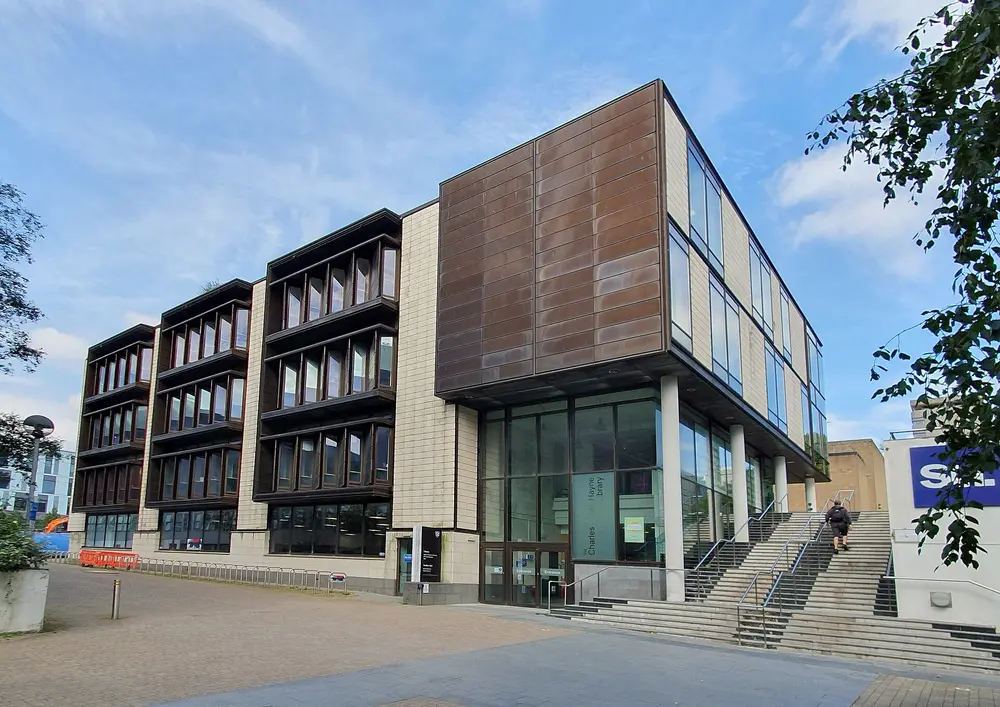

Photo: Suicasmo · CC BY-SA 4.0 · cropped
Photo: K Ulysses-Ono · CC BY-SA 4.0 · Photo: Mutney · CC BY 4.0 · Photo: Rodhullandemu / Wikimedia Commons · CC BY-SA 4.0
What contextual routes are, and what they can change
A contextual route is any way a UK dental school adjusts its entry bar for applicants whose circumstances made the standard bar harder to reach: living in an area where few young people go to university, attending a school that performs below the national average, receiving free school meals, or growing up in care. The Dental Schools Council notes that many standard dentistry courses use contextual admissions.
In dentistry the change is almost always to the A-level offer, by one or two grades; the UCAT bar rarely moves. What a school will lower, and how many flags you need, differs from one school to the next.
Alongside contextual offers, some schools run separate widening-participation dentistry courses with their own UCAS codes, and several run sixth-form programmes that carry their own offer. Both are covered below.
The flags dental schools look at
Dental schools use the same kinds of evidence as medical schools: where you live, where you went to school, and your personal circumstances. The first two reach the school automatically; the third mostly comes from questions on your UCAS form, which UCAS treats as self-declared.
| Flag | What it measures | How the school finds out |
|---|---|---|
| POLAR4 and TUNDRA | The share of young people in your area who go on to higher education, in quintiles; quintile 1 is the lowest. TUNDRA counts state-school pupils only. | Your home postcode, automatically |
| IMD, SIMD, WIMD, NIMDM | How deprived your home area is, on each nation's own index. Scottish schools often use SIMD20 or SIMD40: the most deprived 20% or 40% of areas. | Your home postcode, automatically |
| School performance | Whether your school scores below the national average, for example on Attainment 8 or progression to university. | The school named on your UCAS form |
| Free school meals | Whether you received free school meals during secondary school. | A UCAS form question; Bristol checks it against the National Pupil Database |
| Care experience | Time in local-authority care; Bristol, for example, sets three months or more. | A UCAS form question; evidence may be requested |
| Estrangement, caring, refugee status | No contact with or support from your parents; unpaid care for a family member; refugee status or an asylum claim. | UCAS form questions; evidence may be requested |
| First generation | Neither parent has a degree. | A UCAS form question |
| A widening-participation programme | You completed a named outreach programme, such as PARTNERS, Pathways to Birmingham or Access to Sheffield (Dentistry). | The programme confirms it |
How many flags you need
Each school sets its own rule, from any one flag at Bristol to all three of Manchester’s criteria.
Any one flag.
An aspiring state school, an IMD quintile 1–2 postcode, a Bristol outreach programme, 3+ months in care, or free school meals.
At least three indicators.
Both the AAB widening-access offer and the A205 foundation-year course need three or more contextual indicators.
All three, not any one.
UK and under 21, living in a disadvantaged or low-progression area, and a school below the national average over several years.
What a contextual route can give you
Dental schools mainly adjust the offer. The other routes are narrower, and tied to named programmes.
A lower A-level offer
One grade at Birmingham (AAB), Queen Mary (AAA from A*AA) and Manchester (AAB); up to two at Bristol, Leeds, Liverpool and Newcastle (ABB). Plymouth’s widening-access offer is AAB with two science As.
A lower UCAT bar, at a few schools
Only a few dental schools move the UCAT bar for contextual applicants, Newcastle and Manchester among them. Others, including Bristol and Plymouth, leave it where it is.
A guaranteed interview or extra consideration
Queen’s Belfast guarantees an interview to successful Pathway Opportunity Programme students, and Birmingham’s Routes to the Professions does the same. Liverpool gives contextual applicants additional consideration for interview.
A different course
Bristol A208 (six years, BBC), King’s A206 (five years, AAB), Liverpool’s Year 0 for mature students, and Plymouth A205 (six years, BBB).
Every school's contextual route compared
Every standard-entry dentistry course that takes UK applicants, A to Z. The offer column shows the standard offer and the contextual one where the school publishes it; the last column says what else changes. Confirm on the school’s own page before you use a UCAS choice.
| School | Route | Standard → contextual offer | What else changes |
|---|---|---|---|
| Birmingham | Contextual Offer scheme; Pathways to Birmingham | AAA → AAB, or ABB via Pathways | The Contextual Offer scheme is one grade below standard; the ABB offer is for Pathways completers. |
| Bristol | Contextual offer; Gateway to Dentistry (A208) | AAA → ABB | A in Chemistry. Bristol does not use contextual data at the UCAT or interview stage. |
| Cardiff | Contextual admissions | AAA · not published | Welsh-domiciled and contextually eligible applicants get extra consideration and extra points at scoring; some WP programmes carry a guaranteed interview. |
| Dundee | Contextual Highers offer | Highers AAAAB → AAABB | Biology and Chemistry, one at A, at the first sitting. In S6 you need two Advanced Highers or Highers instead of three, including Advanced Higher Biology or Chemistry at B. |
| Glasgow | Contextualised admissions | AAA · adjusted offers | For applicants living in Scotland, whose circumstances are considered case by case; Glasgow publishes an eligibility checker. |
| King's College London (KCL) | Enhanced Support Dentistry Programme (A206) | A*AA · no contextual offer on A205 | Contextual information is read, but the offer is not lowered. The separate five-year ESDP asks AAB. |
| Leeds | Automatic contextual offer; Access to Leeds | AAA → AAB, or ABB via Access to Leeds | A low-participation neighbourhood brings priority and usually a one-grade reduction, applied automatically. |
| Liverpool | Contextual criteria | AAA → ABB | Contextual applicants get extra consideration for interview, and those made an offer get ABB, two grades lower. |
| Manchester | Contextual offer (three criteria) | AAA → AAB | WP+ UCAT threshold 2,100 against 2,200 (2026 entry). |
| Newcastle | PARTNERS | AAA → ABB | A slightly reduced UCAT threshold for interview. |
| Plymouth | Widening access offer; Integrated Foundation Year (A205) | A*AA–AAB → AAB | The typical offer runs from A*AA to AAB; AAB is the widening-access offer and needs an A in Biology and in a second science. UCAT and GCSE requirements are unchanged. |
| Queen Mary (QMUL) | Contextualised admissions | A*AA → AAA (one grade) | Personal circumstances are taken into account; the fourth-decile UCAT floor still applies. |
| Queen's University Belfast | Pathway Opportunity Programme | AAA → possibly one grade lower | Pathway students also get a guaranteed interview. Applicants from Northern Ireland schools are shortlisted on AS-level grades rather than GCSEs. |
| Sheffield | Access to Sheffield (Dentistry); Access+ | AAA → AAB | The AAB must include Chemistry and Biology. |
Dental schools: contextual routes on the standard BDS for 2027 entry
BirminghamAAA → AAB, or ABB via Pathways
Contextual Offer scheme; Pathways to Birmingham
The Contextual Offer scheme is one grade below standard; the ABB offer is for Pathways completers.
Birmingham entry guide →BristolAAA → ABB
Contextual offer; Gateway to Dentistry (A208)
A in Chemistry. Bristol does not use contextual data at the UCAT or interview stage.
Bristol entry guide →CardiffAAA · not published
Contextual admissions
Welsh-domiciled and contextually eligible applicants get extra consideration and extra points at scoring; some WP programmes carry a guaranteed interview.
Cardiff entry guide →DundeeHighers AAAAB → AAABB
Contextual Highers offer
Biology and Chemistry, one at A, at the first sitting. In S6 you need two Advanced Highers or Highers instead of three, including Advanced Higher Biology or Chemistry at B.
Dundee entry guide →GlasgowAAA · adjusted offers
Contextualised admissions
For applicants living in Scotland, whose circumstances are considered case by case; Glasgow publishes an eligibility checker.
Glasgow entry guide →King's College London (KCL)A*AA · no contextual offer on A205
Enhanced Support Dentistry Programme (A206)
Contextual information is read, but the offer is not lowered. The separate five-year ESDP asks AAB.
King's College London (KCL) entry guide →LeedsAAA → AAB, or ABB via Access to Leeds
Automatic contextual offer; Access to Leeds
A low-participation neighbourhood brings priority and usually a one-grade reduction, applied automatically.
Leeds entry guide →LiverpoolAAA → ABB
Contextual criteria
Contextual applicants get extra consideration for interview, and those made an offer get ABB, two grades lower.
Liverpool entry guide →ManchesterAAA → AAB
Contextual offer (three criteria)
WP+ UCAT threshold 2,100 against 2,200 (2026 entry).
Manchester entry guide →NewcastleAAA → ABB
PlymouthA*AA–AAB → AAB
Widening access offer; Integrated Foundation Year (A205)
The typical offer runs from A*AA to AAB; AAB is the widening-access offer and needs an A in Biology and in a second science. UCAT and GCSE requirements are unchanged.
Plymouth entry guide →Queen Mary (QMUL)A*AA → AAA (one grade)
Contextualised admissions
Personal circumstances are taken into account; the fourth-decile UCAT floor still applies.
Queen Mary (QMUL) entry guide →Queen's University BelfastAAA → possibly one grade lower
Pathway Opportunity Programme
Pathway students also get a guaranteed interview. Applicants from Northern Ireland schools are shortlisted on AS-level grades rather than GCSEs.
Queen's University Belfast entry guide →SheffieldAAA → AAB
Access to Sheffield (Dentistry); Access+
The AAB must include Chemistry and Biology.
Sheffield entry guide →
Not in this table: the graduate-entry courses at Aberdeen and UCLan, since contextual offers are built for school leavers (see the graduate-entry dentistry guide). The new dental schools at Portsmouth and UEA have their first UK intake in September 2027; check their own pages for contextual offers.
The four widening-participation dentistry courses
The Dental Schools Council lists exactly four dedicated widening-participation dentistry courses for 2027 entry. Each is a separate UCAS choice with its own eligibility rules.
| School | Course and length | Entry | Who it is for |
|---|---|---|---|
| Bristol | Gateway to Dentistry (A208), 6 years | BBC incl. B in Biology or Chemistry; predicted AAB+ or an A in Chemistry makes you ineligible; UCAT | At least one of: an IMD quintile 1–2 postcode, 3+ months in care, free school meals in secondary school |
| King's College London | Enhanced Support Dentistry Programme (A206), 5 years | AAB with an A in Biology or Chemistry; UCAT sat before applying | Only non-selective state schools in a London borough since age 11; no previous degree |
| Liverpool | Foundation to Health and Veterinary Studies, Year 0 (0AAW), then BDS | Five GCSEs at grade 6 incl. Maths, English and a science; no A-level students or school leavers | Mature students who have been out of formal education for some years |
| Plymouth | BDS with Integrated Foundation Year (A205), 6 years | BBB incl. B in Biology and a second science; no admissions test | UK applicants meeting at least three contextual indicators |
The named schemes that change a dental offer
Dentistry has no national scheme like medicine’s UKWPMED. Widening participation runs school by school, and these are the programmes that change a dental offer.
| Scheme | School | What it gives you | Who can join |
|---|---|---|---|
| PARTNERS | Newcastle | An ABB offer after the PARTNERS Academic Summer School (27 Jun to 2 Jul 2027) | A low-progression or high-deprivation area, among other criteria |
| Access to Leeds | Leeds | An offer up to two grades lower (AAA to ABB) | Low income, first generation or disrupted studies |
| Pathways to Birmingham: Routes to the Professions | Birmingham | An offer typically up to two grades lower and a guaranteed interview | Year 12, under 18, at a partner school in the wider West Midlands; applications run 1 Oct to 6 Nov 2026 (for 2028 entry) |
| Access to Sheffield (Dentistry); Access+ | Sheffield | The AAB contextual offer, one grade below the standard AAA | Access+ criteria, or taking part in Access to Sheffield (Dentistry) |
| Pathway Opportunity Programme | Queen's University Belfast | A guaranteed interview and a possible offer one grade lower | Years 13 and 14 in Northern Ireland; assessed work and a one-week summer school |
| Access to Bristol and other Bristol programmes | Bristol | Completing one qualifies you for the ABB contextual offer | Bristol’s programme criteria; completers who also meet a Gateway criterion can get a guaranteed Gateway interview |
How contextual data moves through your application
There is no single contextual application. Most flags travel with your UCAS form and UCAT result; a few schemes need their own form.
Join a programme if one fits
Pathways to Birmingham recruits in Year 12, and Queen’s Belfast’s Pathway Opportunity Programme runs through Years 13 and 14 in Northern Ireland (the equivalent of Years 12 and 13). Completing one is what brings a guaranteed interview.
Sit the UCAT
If you had a bursary, the flag travels with your result. For UCAT 2026 the bursary deadline was 24 September 2026, and results reach universities in early November.
Declare your circumstances on UCAS
Answer the questions on care experience, estrangement, caring, refugee status and free school meals; postcode and school data reach schools automatically. If you had free school meals in the last six years, you can apply with the UCAS fee waived.
Send any separate scheme form
Access to Leeds closes on 21 October 2026 (midday) for A200, and Newcastle PARTNERS on 22 October 2026.
Shortlisting, interviews and offers
Schools apply flags at shortlisting and when making offers. A contextual offer arrives in UCAS Hub like any other, with the reduced grades in its conditions.
Four ways applicants lose the advantage
Contextual offers for dentistry: your questions answered
Sources
Policies change every cycle. Check the school's own page before you commit a UCAS choice.
Plan your dentistry choices around your context
A one-to-one consultation can look at your flags, predicted grades and UCAT, and show which dental schools’ contextual routes change your four choices.