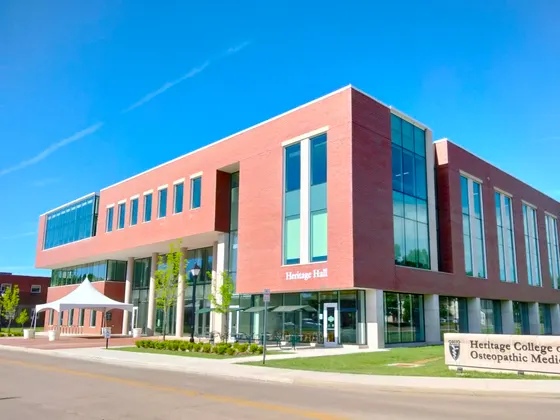
Athens, OH, USEst. 1975

Ohio University Heritage College of Osteopathic Medicine (DO) Medical School - 2027 Entry Requirements & Interview Format

Ohio University Heritage College of Osteopathic Medicine (OU-HCOM), founded in 1975, is Ohio's only public osteopathic medical school and one of the largest DO schools by total enrollment. Operating from Athens (main campus) plus Dublin and Cleveland campuses, OU-HCOM has a strong rural and Appalachian health mission, training physicians for underserved Ohio communities. As a public university programme, it offers in-state students a meaningful cost advantage.

Entry Requirements

What you need to apply to Ohio University Heritage College of Osteopathic Medicine (DO).

Admission overview
Bachelor's degree and MCAT required. AACOMAS application. CASPer required. Strong Ohio in-state preference. Commitment to rural or Appalachian health highly valued. Healthcare experience and DO shadowing expected.
MCAT median
504 (range 500–512)
GPA median
3.63 overall / 3.58 science (BCPM)
Acceptance rate
5.8%
Class size
262
In-state preference
Strong — primarily in-state
CASPer
Required
Holistic review emphasis
Ohio residency, Appalachian/rural health commitment, osteopathic philosophy, primary care interest.
Notes
MCAT/GPA hedged estimates from publicly available OU-HCOM and AACOMAS data.
Specialities offered
Rural Medicine, Appalachian Health, Primary Care, Osteopathic Manipulative Medicine, Family Medicine

Interview Format

How Ohio University Heritage College of Osteopathic Medicine (DO) interviews applicants.

Format
Traditional or MMI format (varies by cycle)
Interview window
September–February
Decision date
Rolling admissions
Post-interview chances
Approximately 25–35% post-interview (estimated).

What makes Ohio University Heritage College of Osteopathic Medicine (DO) different

Applications via AACOMAS. Ohio's only public DO school — significant in-state tuition advantage for Ohio residents. The Appalachian health mission is deeply embedded in the curriculum and clinical rotations. Multi-campus model gives students choice of training environment (rural Athens, suburban Dublin, urban Cleveland).

Tutor insight

Ohio residents who are committed to primary care or rural medicine will find OU-HCOM an exceptional public-school option. Out-of-state applicants should articulate Ohio or Appalachian connections if possible. The Appalachian rural health curriculum is a genuine differentiator — express authentic interest in underserved community medicine if applying.
Prometheus
595 medicine questions inside

Interview questions matched to Ohio University Heritage College of Osteopathic Medicine (DO)

Two questions our tutors flagged as a strong fit for Ohio University Heritage College of Osteopathic Medicine (DO)’s interview style. Try answering them out loud, then open Prometheus for the model answers and follow-up tips.

MediumPanelQ1

Holistic Review: Lived Experience of Poverty as an Applicant Asset

You grew up in a household that relied on Medicaid for health coverage. As a child, you witnessed your family struggle to navigate the healthcare system — long waits, clinic closures, providers who seemed rushed or dismissive. The AAMC's holistic review framework, reframed after the 2023 SCOTUS ruling, explicitly invites applicants to describe formative experiences as lived context. How does your upbringing shape your understanding of the healthcare system, and how do you guard against letting it produce uncritical bias in the other direction?

Likely follow-up · How do you avoid the 'poverty tourism' framing — where lived hardship becomes primarily a credential rather than a genuine source of insight?

3 expert tips in Prometheus
MediumPanelQ2

Holistic Review: Communicating Non-Traditional Pre-Med Pathway

You completed a four-year career as a paramedic before deciding to pursue medical school at age 30. Your undergraduate GPA from a decade ago is a 3.2, though your post-baccalaureate coursework shows all A grades. Your MCAT score is strong. How do you contextualise your academic record for an admissions committee, and what does your paramedic experience add to your candidacy that a traditional applicant's record cannot?

Likely follow-up · How does holistic review as practised by AAMC-member schools evaluate non-traditional applicants, and what weight is given to experiences versus GPA?

3 expert tips in Prometheus

Ready to practise Ohio University Heritage College of Osteopathic Medicine (DO)?

Book a school-specific mock interview with Ohio University Heritage College of Osteopathic Medicine (DO) preselected.

Book a Ohio University Heritage College of Osteopathic Medicine (DO) mock

Ohio University Heritage College of Osteopathic Medicine (DO) - Frequently asked questions

Bachelor's degree and MCAT required. AACOMAS application. CASPer required. Strong Ohio in-state preference. Commitment to rural or Appalachian health highly valued. Healthcare experience and DO shadowing expected.

Traditional or MMI format (varies by cycle)

Ohio University Heritage College of Osteopathic Medicine (DO) typically interviews in September–February.

Decisions are released Rolling admissions.

Applications via AACOMAS. Ohio's only public DO school — significant in-state tuition advantage for Ohio residents. The Appalachian health mission is deeply embedded in the curriculum and clinical rotations. Multi-campus model gives students choice of training environment (rural Athens, suburban Dublin, urban Cleveland).
Reviewed by Isaac Butler-King, medical student at the University of Glasgow. Last reviewed: 6 June 2026 · NextGen MedPrep editorial team
Ohio University Heritage College of Osteopathic Medicine (DO) | MCAT median 504, GPA & DO Interview Format | NGMP