
The Aberdeen Medicine course
What you actually study, and where you will be
Aberdeen's MBChB is a 5-year course with an integrated curriculum, with patient contact from Year 1 and placements in Grampian, the Highlands and the Scottish islands (2027 entry). Systems-based and integrated, with clinical attachments from year 1 and a remote-and-rural option in year 4 — Aberdeen places students as far out as Orkney, Shetland and the Western Isles.
- Degree
- MBChB
- Length
- 5 years
- Teaching
- Integrated
- Clinical contact
- Year 1
- UCAS code
- A100
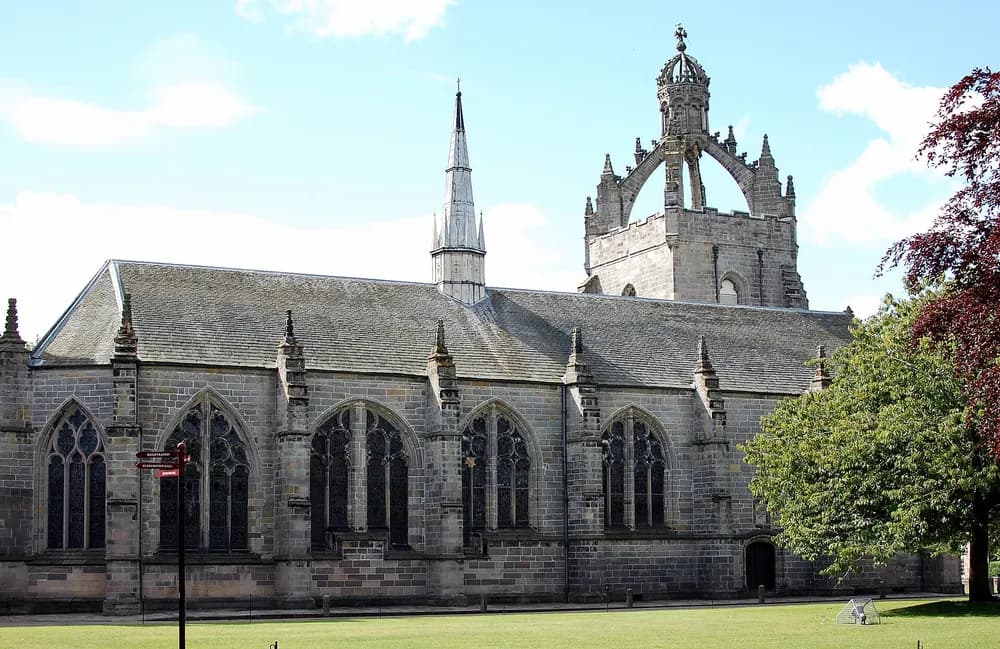
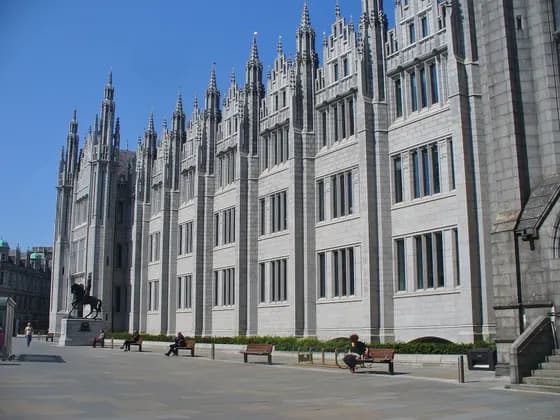
Photo: Bill Harrison · CC BY-SA 2.0 · cropped
Photo: Colin Smith · CC BY-SA 2.0 · Photo: UltrasonicMadness · CC BY-SA 4.0 · Photo: Bill Harrison · CC BY-SA 2.0
The Aberdeen medicine course at a glance (2027 entry)
Aberdeen's MBChB is a five-year, full-time degree starting in September, run by the School of Medicine, Medical Sciences and Nutrition. It is based on the Foresterhill Health Campus. The same site holds Aberdeen Royal Infirmary, the largest hospital in Grampian, plus children's and maternity hospitals, so your teaching buildings and many of your wards sit side by side.
The course is systems-based and integrated. After a first term of groundwork, you study the body one system at a time, starting with the lungs and heart. For each system you learn the anatomy, physiology and biochemistry, the diseases that disrupt it and how to examine it, all in the same block. Clinical cases act as a focus for this teaching, tying the science to real patients.
Patients appear early. From the start you practise on Patient Partners, members of the public trained to let students examine them and to play patients in practice consultations. Ward visits begin in term 2 of year 1, and general practice (GP) teaching runs through all five years. Most years also include a Student Selected Component (SSC), a block where you choose a topic and study it in depth.
Years 4 and 5 are mostly spent on placement in NHS Grampian and NHS Highland, the health boards for the north-east and the Highlands, so expect some blocks away from Aberdeen. Final year is an apprentice year that gets you ready for Foundation Year 1 (F1), your first year working as a doctor. It also includes an eight-week elective project anywhere in the world.
Clinical skills are tested in Objective Structured Clinical Examinations (OSCEs), where you rotate round timed stations, each testing one task such as examining a patient. Both parts of the Medical Licensing Assessment (MLA) are built into the degree. UK students graduating from 2024-25 onwards must pass it to join the General Medical Council (GMC) register. You sit its Applied Knowledge Test (AKT) in year 4 and its Clinical and Professional Skills Assessment (CPSA) in year 5.
| Degree | MBChB |
|---|---|
| Course length | 5 years full time, starting in September |
| UCAS code | A100 |
| Places (2026 entry) | 298: 268 for UK students and 30 for international students |
| Main campus | Foresterhill Health Campus, Aberdeen |
| Teaching style | Integrated and systems-based, with clinical cases as a focus |
| Anatomy | Prosected cadaveric specimens, taught through years 1 to 3 |
| First patient contact | Year 1: Patient Partners, GP tutorials and ward visits in term 2 |
| Placement area | NHS Grampian and NHS Highland, with island options in final year |
| Intercalation | Optional BSc, usually after year 3; MSc after year 4, or earlier for graduates |
What makes Aberdeen medicine different
The option of a whole fourth year in Inverness
Through the Remote and Rural option, selected students base all of year 4 at Raigmore Hospital in Inverness and carry on with rural attachments in final year. It is aimed at students who may want a career in rural medicine.
General practice teaching in all five years
A dedicated GP team teaches every year of the course. In years 1 to 3 you meet GP tutors in small groups in their own surgeries and visit patients at home. In year 4 you spend five weeks in a surgery, where students are likely to see around 250 consultations.
Six weeks of Medical Humanities in year 3
For six weeks in year 3 you study medicine through another subject. Recent options include creative writing, fine art with life drawing, Latin, Scots language, health economics and a teaching placement in a secondary school. You can also propose your own project, as long as it is not purely scientific or medical.
An elective built around your own research project
The eight-week final-year elective can be in the north of Scotland, elsewhere in the UK or abroad. It is more than an observation placement: you must plan, carry out and evaluate a project that an advisory committee approves in advance, and you must pass the report to graduate.
Practising on Patient Partners before real wards
Before going onto wards you practise in the Clinical Skills Centre with Patient Partners, who let you examine them, act out consultations with you and give feedback from a patient's point of view. History-taking sessions can also be filmed so a tutor can go through them with you.
How Aberdeen teaches medicine
Teaching is organised by body system and builds your knowledge, skills and professional attitudes step by step. Science and medicine are taught together wherever possible. While you study the heart and lungs in year 1, for example, your lectures, anatomy practicals and clinical skills sessions all focus on those organs.
Year 1 opens with a term of groundwork on how the healthy body works, how disease develops, and how psychology, society and health systems affect health. Alongside it you start anatomy and clinical skills, including how to respond to medical emergencies. From term 2 you work through the body systems, finishing them all in year 3.
From term 2 of year 1, clinical cases act as a focus for the systems teaching. Each case starts with a trigger, usually a short patient scenario, followed by a set of questions, so lectures and practicals are tied to real patient examples. Medicine 1 includes directed self-study of cases, and year 4 has its own online cases. This is not problem-based learning (PBL), where group work on cases replaces most lectures.
The senior years work differently. Year 4 is organised as clinical blocks, with five themes running across them: diagnostics, end of life care, health data science, quality improvement, and the cost and value of healthcare. Year 5 moves on to professional practice, where you deal with the whole patient as part of the team.
Two strands run alongside the main teaching. Personal and Professional Development (PPD), which covers your professional behaviour and personal growth as a future doctor, starts in year 1. An optional GP Enhanced programme offers extra general practice and community sessions in every year for students who opt in.
The ways you will learn
| Lectures and tutorials | Lectures carry the core science of each body system, backed up by tutorials and small-group sessions. Half of the year 1 GP topics are taught as interactive lectures. |
|---|---|
| Anatomy practicals | Held in the dissecting laboratories of the anatomy facility, using prosected specimens, models and scans, with a short lecture and a workbook before each session. |
| Clinical skills sessions | In the Clinical Skills Centre from year 1: examining each other and Patient Partners, using simulators to learn heart and lung examination, and working through clinical scenarios on patient simulators. |
| GP tutorials | In years 1 to 3, small groups meet a GP tutor in their practice around Aberdeen. Patients come in to help with teaching, and you visit people at home and in nursing homes. |
| Clinical attachments | Supervised visits to hospital wards and departments from term 2 of year 1. Two nurse educators work alongside students on the wards and teach at the bedside. |
| Student Selected Components | Project blocks where you choose a topic, research it, usually in a small group, and present what you found. |
How anatomy is taught at Aberdeen
Anatomy is taught and examined in years 1 to 3 as part of each body system. Year 1 opens with general anatomy, such as anatomical terms, bones and joints, muscles and nerves, and the back and spinal cord. You then follow the systems, from the lungs and heart in year 1 to the reproductive system in year 3.
Most teaching happens in the dissecting laboratories of the anatomy facility in the Suttie Centre. You learn from prosections: real human specimens already dissected by trained staff, so the structures are laid out for you to study rather than cut. Visiting surgeons, dentists and other doctors link what you see to clinical practice.
First you learn the rules of the Anatomy Act, the law governing the use of human bodies for teaching. Specimens are combined with models, X-rays, CT and MRI scans, 3D and video imaging, surface anatomy and histology, the study of tissue under the microscope. A 3D virtual anatomy system is also used in lectures, and the on-site Anatomy Museum, founded in the 1870s, holds skeletons, preserved specimens, models and anatomical art.
Anatomy is examined in an Objective Structured Practical Examination (OSPE), a practical test built around specimens and images. You sit one in every exam period in years 1 to 3 (Scottish universities call an exam period an exam diet).
Because core teaching uses prosections, you would not normally dissect. The school says some students get the chance to dissect individually, including a whole body, or to take on clinically focused dissection projects. The anatomy department's own pages link whole-body dissection to a year 3 Medical Humanities option it runs, Human Anatomy: Dissection with Historical, Cultural and Social Dimensions.
In the 2025-26 course catalogue, that option centres on a historical research project of your choice with an anatomical theme. It is backed by weekly history lectures, tutorials and library work, and includes a group presentation on a historical anatomical model.
When you first meet patients at Aberdeen
Your first patient contact is in a controlled setting. From the start you practise examination on fellow students and Patient Partners, and rehearse consultations with simulated patients in the Clinical Skills Centre. Tutors and the Patient Partners themselves give you feedback.
Ward visits begin in term 2 of year 1 at Aberdeen Royal Infirmary: four short visits to a medical or surgical ward, starting with an orientation from the senior charge nurse who runs it. In debrief sessions afterwards you discuss what you saw and present patients you examined. GP tutors also bring patients into their surgeries for teaching.
In year 2 you go onto medical wards weekly for nine weeks. You also have sessions at the Royal Aberdeen Children's Hospital and Royal Cornhill Hospital, in medicine for the elderly, the emergency department, theatres and labs, and with nurse specialists, radiographers and physiotherapists. The aim is to show how the whole team shapes a patient's care.
Year 3 brings 26 ward sessions, where clinicians lead case-based discussions about investigations and treatment. You also return to the children's hospital and theatres, and visit infection prevention and control and surgical pre-assessment clinics. By the end of the year you should be able to do a complete head-to-toe examination, ready for full-time placements in years 4 and 5.
Year by year at Aberdeen
- Year 1
Foundations, then the heart and lungs
Term 1 lays the scientific groundwork, and term 2 starts your tour of the body systems with the respiratory and cardiovascular systems. Clinical skills start straight away, and your first ward visits and GP tutorials also come this year.
- Foundations of Medicine (40 credits, term 1): normal physiology and biochemistry, how disease develops, principles of drug treatment, psychological and social influences on health, and healthcare in the UK and abroad.
- Medicine 1 (30 credits, term 2): the lungs and heart in health and disease, and how common conditions of each are diagnosed and managed.
- Anatomy 1 and Clinical Skills 1 (20 credits each) run all year, with clinical skills covering history taking, examination and basic procedures, first in general and then for the heart and lungs.
- GP teaching on health and normality, from health in the early years to the social, economic and political influences on health, including assessed reflective writing.
- SSC 1 (10 credits), a block of three to four weeks near the end of term 2. In groups of about eight you pick one of seven research themes, such as neuroscience or tropical diseases, then write a report and present it.
- Year 2
More body systems and the wider team
Medicine 2 continues the systems: the alimentary system, head and neck with dermatology, and the nervous system, then diabetes and endocrinology and the urinary system. Late in the year come advanced infection, the musculoskeletal system, and medical ethics and law. You also revisit resuscitation.
- Medicine 2 (60 credits), Anatomy 2 (30 credits) and Clinical Skills 2 (30 credits), with clinical skills now covering every system you have met.
- SSC 2, The Mysteries of How Molecules Cause Disease, at the start of term 2: small groups spend a month on one of 20 topics, such as why superbugs become resistant to antibiotics.
- Weekly ward placements for nine weeks, plus sessions in other Aberdeen hospitals and departments.
- GP teaching turns to illness, disease and disability: person-centred communication, long-term conditions, how the practice team works and living with a disability.
- Year 3
Finishing the systems, plus Medical Humanities
Year 3 starts with the reproductive system, then the six-week Medical Humanities block. Specialty teaching follows in medicine of old age, anaesthetics, clinical genetics and clinical pharmacology, then psychiatry, haematology and immunology, and paediatrics. The year ends with a project block that leads into the senior clinical rotations. Your year group grows in year 3, when students from partner schools join directly: St Andrews, the International Medical University in Malaysia and Universiti Brunei Darussalam. The GMC counted 20 such entrants in 2024.
- Medicine 3 and Anatomy 3, plus Clinical Skills 3 (25 credits), which focuses on the reproductive system and on communication in psychiatry, paediatrics and breaking bad news.
- Medical Humanities SSC: six weeks studying medicine through a humanities subject or a project of your own.
- 26 ward sessions with case-based discussions, building to a full head-to-toe examination.
- GP teaching on epidemiology, prevention, occupational and environmental health, ageing and living with several long-term conditions, and living with dying.
- The final term opens with SSC 3, Clinical Effectiveness and Human Factors. With a tutor, your group judges whether a treatment, operation or public health measure works. You use systematic review methods, a structured search and appraisal of the published studies, then write a report and present it.
- The Human Factors strand looks at how people interact with the systems they work in, and why that matters for patient safety. After a keynote seminar, your group tries to complete tasks by following written work procedures, testing whether such procedures can really be followed.
- Year 4
Senior Clinical Practice
After a short break you begin seven six-week clinical blocks. You build clinical reasoning and learn to diagnose and manage patients of all ages with conditions in any body system, increasingly helping to care for them under supervision.
- Blocks cover acute medicine and critical care; surgery and critical care; reproductive and child health; general practice; long-term conditions and integrated care; mental health; and diagnostics with attachments of your choice.
- Two one-week Preparing for Professional Practice courses on learning from clinical work and professional behaviour, the second also revisiting the five themes.
- The six-week GP block includes five weeks in a surgery in Grampian, Fife or Highland, where you carry out several consultations yourself.
- On every block you keep an online portfolio, including a log of the patients you see, and you work through online clinical cases written for year 4. At the end of each block a tutor reviews your portfolio, grades it above, meeting or below expectations, and adds written feedback.
- Some blocks, such as Long-term conditions and integrated care, can include time with charities and independent (non-NHS) services, so you see how patients, including vulnerable groups, move through their care.
- A compulsory course called Elective Outline, ahead of the elective itself in year 5.
- Year 4 exams: the AKT, which is your written exam, and a nine-station OSCE.
- Year 5
Professional practice: the apprentice year
Final year shifts from learning about systems to working as part of a clinical team and caring for the whole patient. It is built around three eight-week clinical attachments, an eight-week elective and a Professional Practice course. All of it gets you ready to work as a Foundation doctor, meaning a doctor in the two-year Foundation Programme after graduation, which starts with F1.
- Three 40-credit attachments: medicine, paediatrics and care of the elderly; surgical specialties, obstetrics and gynaecology, anaesthetics and intensive care; and general practice or psychiatry. Where possible you choose the specialty within each.
- A student assistantship in each attachment, where for a short time you take on the role of a junior doctor under supervision.
- The GP or psychiatry attachment starts with a week of core teaching in Aberdeen. Students who choose GP then spend seven weeks in a practice, consulting on their own, visiting patients at home and attending a day-release programme, where they leave the practice on set days for teaching.
- A Professional Practice course in two parts, at the start and end of the year, covering death and dying, ethics and law, careers, stress at work and time management.
- An Immediate Life Support course, which trains you in the first stages of resuscitation.
- The final OSCE, which also serves as your CPSA, the clinical skills part of the MLA.
How you are assessed at Aberdeen
Assessment runs through all five years so that you master basic skills before moving on. Formative assessments are practice exams with no penalty: they give you feedback and help staff spot anyone who needs support. Summative assessments are the degree exams, usually at the end of the year, that decide whether you progress. You normally have two chances to pass them.
Written exams use single best answer (SBA) questions, where you choose the one best option from a list, as well as extended matching and short answer questions. Some courses also set essays, reports, posters or group presentations. OSCEs cover history taking, communication, examination, diagnosis, treatment and professional skills such as ethics.
In year 1, Foundations of Medicine ends with a 100-question SBA exam in December. Pass it and you skip that course's degree exam in May. Online self-assessments every few weeks, and compulsory 30-question practice papers in Foundations of Medicine, help you track your progress. To sit any degree exam you need a class certificate, which confirms you attended and did the required work.
Year 4 has two main exams, and you must pass both in the same academic year to start year 5. The written exam is the AKT, a computer-based SBA exam pitched at the level of a doctor in their first week of F1. It is a shared national exam set by the Medical Schools Council (MSC), which represents UK medical schools. As the GMC described it in 2024, it has two two-hour papers of 100 questions each, sat on consecutive days.
The second is an OSCE of nine eight-minute stations, spread over two days. According to the GMC's 2024 review, year 4 includes a practice (formative) OSCE as well as the real one, both set out like the final-year CPSA, so the format is familiar by then. In years 4 and 5, clinicians also rate your work with real patients in workplace-based assessments.
The CPSA is the year 5 OSCE, run as a sequential exam at a single purpose-built assessment centre. As the GMC described it in 2024, everyone sits 12 stations over two consecutive days, each eight minutes long with two minutes' reading time. Students who meet the standard stop there. The rest sit nine more stations two weeks later and must pass 14 of the 21 as well as an overall pass mark. There is no resit later that year: if you do not pass, you repeat year 5.
- SSCs are generally marked on a group report, a group presentation, an individual summary and peer marks for teamwork. SSC 3 also includes individual reports and a class test.
- When the GMC reviewed the CPSA in 2024, Patient Partners played the patients and, in stations with a patient, awarded 1.5 or 2 of the 30 marks for rapport, empathy and communication.
- Your year 4 OSCE result comes with personalised feedback on MyMBChB, the course's online learning system, normally within three working weeks of the examiners' meeting.
- Each year 4 block ends with a low-stakes review of your portfolio, graded above, meeting or below expectations rather than given a mark.
- Practical procedures, from giving oxygen to taking blood and inserting a urinary catheter, are signed off in a Clinical Procedural Skills Passport that you complete across years 4 and 5.
Where you will actually be at Aberdeen
For the first three years you are based in Aberdeen, with ward attachments at Aberdeen Royal Infirmary and other city hospitals, and GP teaching in practices across Aberdeen and Aberdeenshire. Years 4 and 5 are spent in NHS Grampian and NHS Highland. The university also has NHS links for clinical attachments in Dumfries and Galloway, Fife, Orkney, Shetland and the Western Isles.
Every student spends time outside Aberdeen. There are clinical campuses at Raigmore Hospital in Inverness and Dr Gray's Hospital in Elgin. At least one of your seven year 4 blocks is in Inverness, and at least one of your three final-year attachments is in Inverness or Elgin. Final-year attachments can go further still, to Stornoway, Fort William, Wick, Orkney or Shetland.
The Remote and Rural option is aimed at students who want to see healthcare in rural settings and may be interested in a rural career. If you are selected, you spend all of year 4 based at Raigmore Hospital, with visits to remote clinics and rural GP practices where possible. In final year, two of your three attachments are then in rural places such as Stornoway, Orkney or Shetland.
GP placements have their own spread. In year 4 the GP block is in a practice in or around Aberdeen, elsewhere in Grampian or in Fife, or near Inverness for practices run from there. In final year, GP placements range from Aberdeen city to Stornoway in the Western Isles, and from Shetland in the north to Stranraer in the south-west.
When a placement takes you away from Aberdeen, you keep your home base in the city and your accommodation at the distant placement is paid for. Remote and Rural students have accommodation supplied in Inverness and can choose to give up their Aberdeen accommodation while they are there. In years 3 and 4 many students live near Foresterhill, in shared flats or in Rosemount Hall of Residence.
Base for years 1 to 3, with ward attachments from term 2 of year 1, and part of NHS Grampian for the senior years.
- Aberdeen Royal Infirmary
- Royal Aberdeen Children's Hospital
- Royal Cornhill Hospital
- GP practices across Aberdeen and Aberdeenshire
Clinical campus in NHS Highland, and the year-long base for Remote and Rural students in year 4.
- Raigmore Hospital
- GP practices in and around Inverness
Clinical campus used for final-year attachments.
- Dr Gray's Hospital
More distant final-year attachments, used by Remote and Rural students and others.
- Stornoway
- Fort William
- Wick
- Orkney
- Shetland
Year 4 GP blocks can be in Fife, and final-year GP placements are spread across Scotland.
- GP practices in Fife (year 4)
- GP practices as far south-west as Stranraer (year 5)
Electives and chosen modules at Aberdeen
SSCs are meant to build skills that lectures do not, such as self-directed learning, teamwork and managing your time, and to reward curiosity. Each one is described in its year above. In the Clinical Effectiveness SSC, a few groups each year have gone on to present their work at national conferences, send briefing papers to local clinical leads or submit it to journals.
The year 3 Medical Humanities SSC lasts six weeks. You can join a course alongside humanities honours students, take one designed for medical students, or propose an Alternative Project of your own. Some courses have no weekly lectures, so you work on your own initiative. Past students have produced art portfolios, photography and museum exhibits.
The 2025-26 catalogue lists options such as Creative Writing for Medical Students, Fine Arts and Medicine, Latin, Scots Language Awareness, Mandarin Chinese, Medicine and Economics, Human Factors and Patient Safety, and Sustainable Medicine. In Health Studies in Education you spend two weeks teaching in a secondary school and mentoring pupils who hope to study medicine.
The elective is a compulsory eight-week block in year 5, including travel. You pick the topic and an approved host in the north of Scotland, elsewhere in the UK or abroad, though the university may strongly advise against unsafe regions. The Committee of Advisors on Electives approves your research project in advance. You write it up as a 5,000-word report, which you must pass to graduate.
You arrange it yourself, helped by a local supervisor, a network of Electives Advisers and an electives website. Past projects include pain management on a hospital ship in Guinea, teaching children about malaria in Tanzania and mountain-biking injuries in New Zealand. Some students choose general practice topics supervised by GP staff, such as family planning.
Intercalation at Aberdeen
Intercalating means taking a year out of the MBChB to earn an extra degree before returning to medicine. At Aberdeen it is optional. Most students who intercalate go after year 3, but going after year 4 is also possible. Third-year students get an information session in December or January.
The BSc (Hons) Medical Sciences (Honours Year) puts you in the final honours year alongside Medical Sciences students, in subjects such as pharmacology, physiology, neuroscience with psychology, immunology or genetics. After taught courses in the first half of the year, you do a 10-week research project, usually with a team at Foresterhill, and write it up as a scientific paper.
The BSc (Hons) Medical Sciences (Medical Humanities) is a year in the College of Arts and Social Sciences. It combines a research project and 10,000-word dissertation with three taught courses, at least two of them related to health or medicine, such as Medical Anthropology or Law and Medical Ethics.
An intercalated master's is open only once you have completed four years of the MBChB, or if you already hold a bachelor's degree. Options include a Masters in Public Health and MScs in Health Data Science, Clinical Pharmacology, Medical Imaging, Molecular Medicine and Human Nutrition, among others.
Outside intercalation, you can apply for the school's research scholarships. The Aberdeen Summer Research Scholarship Programme offers competitive eight-week summer research studentships, and endowed scholarships fund a 10-week paid project in medical science or neuroscience after year 2, 3 or 4. There is also a surgical scholarship called SurgAnat.
Facilities and support at Aberdeen
Where you will learn
The Suttie Centre for Teaching and Learning in Healthcare, a joint project of the university and NHS Grampian, is the main teaching building at Foresterhill. It has floors given over to anatomy, MBChB teaching, NHS Grampian training and clinical skills.
Its Clinical Skills Centre has simulators for heart and lung examination and a recording system called SMOTS that films your history-taking for tutor feedback. There is also a simulation suite with patient manikins of varying realism, and a simulated ward where you practise looking after several patients at once.
You can also book practice rooms in groups of up to four, for an hour a week on weekdays or two hours at weekends. They are open 8am to 8pm on weekdays and 8am to 6pm at weekends, and contain a trolley bed, resuscitation manikins, an eye examination model, pelvic and pregnancy models and a neurology kit.
There is a Medical Library at Foresterhill, and the Sir Duncan Rice Library at King's College on the Old Aberdeen campus. In year 1 many students live in halls in or near Old Aberdeen, generally within a 30-minute walk of Foresterhill.
Support while you study
The school separates pastoral and academic support. For pastoral care, every medical student is given a Regent, a senior member of staff who meets you regularly throughout the course. Your Regent helps with personal problems and mentors your professional development, from spotting strengths and weaknesses to career advice and writing a CV. You first meet them in Freshers' Week or soon after.
Academic support comes from the Year Lead teams and from the staff who teach each part of the course. If you do badly in a formative assessment, you are invited to an advisory interview to talk it through and get advice.
A Student Support Lead is the first contact for worries such as leaving home, family, money, health or falling behind, and finds the right help if they cannot solve a problem themselves. The MBChB Support Service, run by senior academic staff with an NHS Grampian consultant psychiatrist, helps you understand your difficulties and treatment options and can arrange referral to specialist mental health services.
Through the Student Pairing Scheme, every first-year student is paired with two second-year students who act as informal parents and pass on advice from their own experience. A member of MBChB staff also has a specific remit for careers guidance.
Is the Aberdeen course right for you?
This course may suit you if
- You want patients from the start: Patient Partners, ward visits in term 2 of year 1 and GP tutorials in real surgeries.
- You like learning the body one system at a time, with anatomy, physiology, disease and clinical skills taught together.
- You are curious about rural medicine and would enjoy placements in Inverness or the islands, or a whole year based at Raigmore Hospital.
- You would welcome six weeks of creative writing, art, a language or economics as part of your medical degree.
- You want your elective to be a research project that is approved in advance and formally assessed.
Things to think about
- Every student has placements outside Aberdeen, in Inverness and possibly further afield, so expect to move for parts of years 4 and 5.
- Routine anatomy teaching is from prosections. Dissection, including of a whole body, is an extra that only some students get.
- Teaching is led by lectures, practicals and clinical sessions, with clinical cases as a focus, but it is not group-led PBL. If you want group cases to drive your learning, this course works differently.
- The senior exams carry weight: the year 4 AKT and OSCE must both be passed in the same year, and failing the final OSCE means repeating year 5.
Aberdeen medicine course — frequently asked questions
Applying to Aberdeen?
How to get into Aberdeen
Entry requirements, UCAT, personal statement and interview, step by step.
Open the guide →Aberdeen UCAT cut-offs and offers
UCAT cut-offs, A-level offers, interview format and decision dates.
See the requirements →Compare Aberdeen with other schools
Put the teaching style, anatomy teaching and placements next to another school.
Open the comparison →Prepare for the Aberdeen interview
Format breakdown, school-specific sample questions and prep tips from tutors who interviewed here.
Read the guide →Where this Aberdeen course guide came from
This guide was written from 33 official sources — University of Aberdeen's own course pages and programme documents, plus the regulator and NHS placement partners where they publish detail — read on 2026-09-23, then checked claim by claim against those sources.
- University of Aberdeen: Medicine (MBChB) course page
- Aberdeen medical school: Our Course
- Aberdeen medical school: Special Features
- Aberdeen medical school: Student Selected Components
- Aberdeen medical school: Direct Entrants
- General Practice and Community Medical Education
- GP teaching by year
- Intercalating at Aberdeen
- Intercalated BSc (Hons) Medical Sciences (Honours Year)
- Intercalated BSc (Hons) Medical Sciences (Medical Humanities)
- MBChB Medicine Undergraduate Guide, August 2026
- Catalogue of Courses: Undergraduate Medicine 2026-2027
- Catalogue of Courses: Undergraduate Medicine 2025-2026 (Medical Humanities options)
- Catalogue of Courses 2026-2027: ME2019 Foundations of Medicine
- Catalogue of Courses 2026-2027: ME4904 Senior Clinical Practice (OSCE)
- Catalogue of Courses 2026-2027: ME5012 Year 5 Assessment
- Catalogue of Courses 2026-2027: ME2512 Medicine 1
- Catalogue of Courses 2026-2027: ME4905 SSC 3, Clinical Effectiveness and Human Factors
- Catalogue of Courses 2026-2027: ME4023 Senior Clinical Practice 4B
- Catalogue of Courses 2026-2027: ME5017 Medical Elective
- Catalogue of Courses 2025-2026: ME33HA Human Anatomy: Dissection with Historical, Cultural and Social Dimensions
- The Suttie Centre: anatomy teaching
- The Suttie Centre
- The Suttie Centre: clinical skills room booking
- Aberdeen medical school: Clinical Skills Centre
- Aberdeen medical school: Medical Student Life
- Aberdeen final-year elective information
- Aberdeen Medical Humanities SSC
- Aberdeen Clinical Academic Training (ACAT)
- ACAT: Undergraduate Research Scholarship Programmes
- Aberdeen medical school: Admissions Data (2026 entry places)
- GMC: CPSA compliance decision for Aberdeen, March 2024
- GMC: AKT compliance decision for Aberdeen, June 2024
Courses are restructured between cycles. Anything here that decides your application — an anatomy offer, a placement city, a compulsory intercalated year — should be confirmed against the official page for your entry year.
Applying to Aberdeen?
We have helped hundreds of applicants turn their UCAT, personal statement and interview prep into offers from Aberdeen and other UK medicine schools.