
Oxford & Cambridge Medicine Interviews
Format, Questions & Prep Tips
Oxford interviews Medicine applicants online at two colleges in mid-December 2026; Cambridge Colleges interview from 7 to 18 December, online or in person. Both test how you reason aloud through unseen problems.
- Interviews
- December 2026
- Outcomes
- Oxford 12 Jan · Cambridge 27 Jan
- Format
- Oxford online · Cambridge varies
Applying for Dentistry? Neither university teaches it, so see the MMI or panel interview guide.

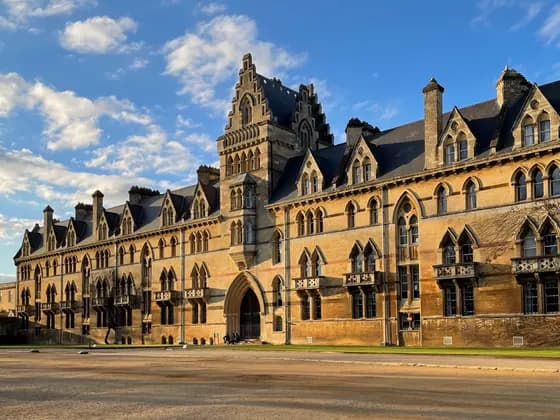

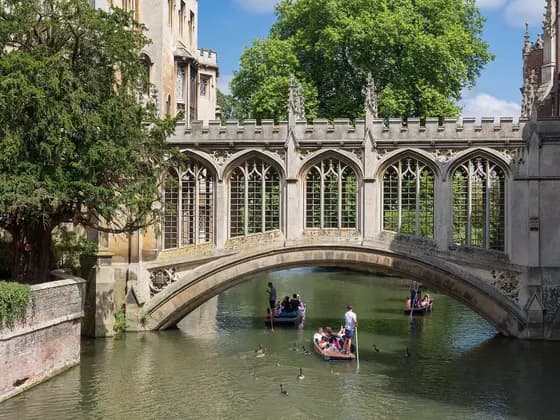
Photo: Julian Herzog · CC BY 4.0 · cropped
Photo: JM Lystad · CC BY-SA 4.0 · Photo: Dmitry Tonkonog (User:Heuschrecke) · CC BY-SA 3.0 · Photo: Diliff · CC BY-SA 3.0
What an Oxbridge Medicine interview is
Oxford and Cambridge interview Medicine applicants the way they teach: small-group conversations with academics who want to watch you think. Oxford calls its interviews “similar to a short tutorial”, and Cambridge says its interviewers are “interested in how you work out your answers and how you think”. You will meet problems you cannot have prepared for, and the reasoning you show matters more than the answer you reach.
That sets them apart from the MMIs and panel interviews every other UK medical school uses. Motivation and ethics still count, and both universities assess them, but they sit alongside unseen science, data and follow-up questions that keep going until you reach the edge of what you know.
For 2027 entry both universities shortlist with the UCAT, Oxford interviews entirely online, and Cambridge’s format depends on the College. As a school-leaver you can apply to only one of them, so this guide sets the two side by side before looking at each in turn.
Oxford vs Cambridge, side by side
The standard six-year courses (A100). Figures are the latest each university has published, labelled with their entry year.
| Oxford | Cambridge | |
|---|---|---|
| Admissions test | OxfordUCAT: overall cognitive score only SJT band seen only after interviews | CambridgeUCAT: overall cognitive score only SJT not used for 2027 entry |
| How the test is used | OxfordRanked with contextualised GCSEs, equal weight; no published cut-off | CambridgeUsed to choose who to interview and may inform offers; no minimum score |
| Your interviews | OxfordTwo colleges; at least two academics at each, and at least one clinician | CambridgeOne or two, 35–60 min in all, with two or three interviewers |
| Online or in person | OxfordOnline (Microsoft Teams) | CambridgeSet by your College 13 of 29 in person for UK-based applicants |
| Interview dates | OxfordMid-December 2026 Exact days not yet published | Cambridge7–18 December 2026 Winter pool: mid to late January 2027 |
| Outcome | Oxford12 January 2027 | Cambridge27 January 2027 |
| Latest published figures | Oxford1,156 applications, about 425 interviewed, 175 offers 2026 entry | Cambridge1,530 applications, 307 offers, 270 accepted 2025 entry |
| Typical offer | OxfordA*AA, including Chemistry | CambridgeA*A*A, including Chemistry |
How each university decides who to interview
Oxford shortlists by formula and then takes a second look; Cambridge Colleges read the whole application. The UCAT matters at both, and neither publishes a cut-off.
Oxford: a scored ranking, then a second look
Every eligible applicant is ranked on two things with equal weight: the UCAT cognitive score, and GCSEs measured as the number and proportion of grades 8 and 9, set against other students at the same school. The UCAT counts double if you have no GCSEs, five or fewer, or sat them in 2020 or 2021.
Oxford aims to interview about 425 applicants, roughly 2.5 per place. Tutors then review every applicant who was not shortlisted, taking account of individual circumstances that suggest the formula underestimated them. Those they nominate go to a shortlisting committee together with the applicants ranked just below the initial shortlist; for 2026 entry the committee added 80 applicants to the shortlist. Shortlisting emails go out in late November.
For 2026 entry, shortlisted applicants averaged 2,377.5 out of 2,700 on the UCAT (the mean for everyone who sat it in 2025 was 1,891) and 10.1 GCSEs at grade 8 or 9.
Cambridge: your College reads everything
Cambridge uses the UCAT cognitive score “as part of our selection for interview” and may use it when making offers, with “no minimum threshold”. Your College also weighs your academic record, school reference, personal statement, contextual data and any extenuating circumstances.
Cambridge says it is “most interested in your academic ability, as shown in your most recent and relevant performance”. Colleges differ in emphasis: Trinity “does not normally invite for interview applicants who do not perform well in the UCAT”.
Cambridge does not publish the share of Medicine applicants it interviews. Most invitations arrive in November, and the My Cambridge Application must be in by 22 October 2026.
What happens at each university
The same idea, run differently: Oxford organises one online process across two colleges, while each Cambridge College runs its own interviews.
Oxford: two colleges, online
- Two colleges interview you: your chosen college where possible (or the one allocated to an open application) and a second allocated at random, to balance the strength of applicants across colleges.
- At least two academics interview you at each college, and at least one practising clinician is involved. The number of interviews at each college varies, and Oxford says you cannot predict the outcome by counting them.
- Interviewers do not know your UCAT score or which college you chose, and Oxford asks you not to reveal your college.
- Any pre-reading is normally emailed the day before, and you may be asked to hold written workings up to your camera.
- By accepting an interview you agree not to share its content, record it, let anyone watch, or use assistive technology, including AI and automatic transcription tools.
- Afterwards each college ranks its candidates, sees the other college’s ranking and your UCAT result (including the Situational Judgement band), then finalises. For 2026 entry, 44.8% of offers came from a college other than the one the applicant chose.
Cambridge: your College runs it
- Most applicants have one or two interviews lasting 35 minutes to an hour in total, usually with two or three interviewers. Some have three or four, depending on the College.
- Most people have at least one subject interview, where you “apply your knowledge to new situations, materials, problems or scenarios” and, for Medicine, explain your understanding of the vocational side of the course.
- Some Colleges split the two jobs. St John’s runs an Aptitude for Medicine interview and a Scientific Reasoning interview; Girton runs one on scientific ability and one on suitability for the profession.
- There is no written test at interview for Medicine and no written work to send beforehand. You may be sent material to read, and you may be asked to share your workings.
- Interviews run from 7 to 18 December 2026 and cannot normally be rescheduled. When yours is scheduled says nothing about how strong a candidate you are.
| Format | Colleges |
|---|---|
| In person for everyone 5 Colleges | Churchill, Clare, Emmanuel, King's, Selwyn |
| In person if you live in the UK; online otherwise 6 Colleges | Corpus Christi, Jesus, Peterhouse, Robinson, Sidney Sussex, Trinity Hall Corpus Christi lets applicants in Ireland choose |
| In person if you live in the UK; your choice otherwise 2 Colleges | Pembroke, Trinity |
| Your choice if you live in the UK or Ireland; online otherwise 1 College | Gonville & Caius |
| Online for everyone 15 Colleges | Christ's, Downing, Fitzwilliam, Girton, Homerton, Hughes Hall, Lucy Cavendish, Magdalene, Murray Edwards, Newnham, Queens', St Catharine's, St Edmund's, St John's, Wolfson |
You cannot usually choose a different format. UK students eligible for free school meals can get help with travel costs for an in-person interview.
What Oxbridge interviewers are looking for
Oxford’s advice, in its own words: “Keep practising explaining what you are thinking – almost as if you are thinking out loud. This really is our top tip.”
Unseen science, from first principles
Problems you cannot have revised, worked through with A-level biology, chemistry, physics and maths. St John’s, Cambridge, describes linking basic-science concepts “in ways that you will not have encountered before”.
Data, graphs and objects
Oxford says you may be given “a text, a poem, a graph, or an object”. Describe what you see before you explain it, and ask where the numbers came from.
Questions with no single answer
Population-health puzzles and paradoxes, such as why viruses that depend on human cells cause disease at all. Tutors want hypotheses, and how you would test them.
Material put in front of you
Pre-reading, a scenario or a problem to work on paper. Peterhouse may send a typed clinical or ethical scenario before the interview, and you can use the internet while you read it.
Medicine itself
Motivation, patients, public health and ethics. Cambridge asks Medicine applicants about the vocational side of the course, and Oxford lists empathy and ethical awareness among its criteria.
You and your statement
Openers are often simple. Oxford says interviews may begin with “a few simple questions … perhaps about something in your personal statement or why you have applied”.
The criteria, in the universities’ words
Cambridge says its interviews assess your understanding of the subject, your readiness to study at a high academic level, how critically and independently you think, and your curiosity and enthusiasm. Oxford publishes its own selection criteria for Medicine:
Oxford: suitability for Medicine
- Empathy: “ability and willingness to imagine the feelings of others and understand the reasons for the views of others”
- Motivation: “a reasonably well-informed and strong desire to practise medicine”
- Communication: “ability to make knowledge and ideas clear using language appropriate to different audiences, including patients”
- Honesty and integrity, and ethical awareness
- Ability to work with others, and capacity for sustained and intense work
- Values and behaviours that align with the NHS Constitution
Oxford: academic potential
- Problem-solving: “critical thinking, analytical approach”
- Intellectual curiosity: “keenness to understand the reason for observations; depth; tendency to look for meaning; enthusiasm and curiosity in science”
- Communication skills: “willingness and ability to express clearly and effectively; ability to listen; compatibility with tutorial format”
Published questions, plus two to practise
Oxford tutors publish real questions and explain what they are listening for. Two come from Medicine and two from Biomedical Sciences, a neighbouring course; the last two are practice prompts of our own.
Put these countries in order by their crude mortality (deaths per thousand of the population): Bangladesh, Japan, South Africa, the UK.
Asked by Andrew King, Exeter College, who does not expect candidates to reach the right order unaided. The worked example below takes this question step by step.
The viruses that infect us are totally dependent on human cells for their reproduction; is it therefore surprising that viruses cause human diseases?
Asked by Chris Norbury, The Queen’s College. The discussion moves to why a virus that kills its host risks dying out, to viruses crossing from animals to people, and to whether some human viruses cause no disease, and how you would find them.
Why is sugar in your urine a good indicator that you might have diabetes?
Asked by Robert Wilkins, St Edmund Hall. Reason from the kidney: glucose is filtered, then taken back by a limited number of carriers. When blood glucose is high enough to saturate them, the excess spills into the urine.
Why do a cat’s eyes appear to “glow” in the dark?
Asked by Jan Schnupp, St Peter’s College. A reflective layer behind the retina bounces light back through it, giving the photoreceptors “two chances to capture light”, which helps in dim conditions.
If the radius of a blood vessel halves, what happens to the flow through it?
Under Poiseuille’s law flow scales with the fourth power of the radius, so halving it cuts flow to a sixteenth if nothing else changes. Without the law, you can still reason that the fall must be far more than half, and say why.
A drug’s concentration in the blood halves every four hours. Sketch the graph and explain its shape.
Exponential decay: steep at first, then flattening, because equal time intervals remove equal fractions rather than equal amounts. Then ask what repeated doses would do to the curve.
How a strong answer unfolds
An illustrative answer, written by our team, to Oxford’s crude-mortality question. It is not a transcript: it shows the habits both universities describe, one move at a time.
Pin down the measure
“Crude mortality is total deaths per thousand people per year, with no adjustment for anything, is that right?”
Say it, and say why
“My instinct is that South Africa or Bangladesh would be highest, because of lower average incomes and more infectious disease. I’m not confident, though.”
Follow the tutor’s prompt
Tutor: “Apart from health care, what decides how many people die in a year?” Candidate: “How many people are old. A country with an older population will have more deaths per thousand, even if its health care is excellent.”
Change your answer openly
“So I’d reorder: Japan first, then the UK, because both have older populations, then South Africa, with Bangladesh last if, as I’d guess, its population is the youngest. That surprises me, and it tells me a crude rate says little about health on its own.”
Answer the follow-up
Tutor: “So how could you compare mortality fairly between countries?” Candidate: “Compare like with like: death rates within each age band, or recalculate every country’s rate as if it had the same standard population. That’s age standardisation.”
Ask a question of your own
“I’d also want to know how completely deaths are recorded in each country, because a low rate could partly reflect missing data.”
Your personal statement and reading
Expect your statement to come up, often early. Cambridge lists “recent topics from school or your personal statement” among likely subjects, and Oxford may open with something you wrote. For every scientific idea you mention, be ready to explain the mechanism one level deeper than you wrote it.
Oxford publishes an introductory reading list, and its first rule is to “read what interests you the most”: it is “not a list of books you should rush out and buy”. Read one or two things properly and note the questions they raise, rather than collecting titles to mention.
From Oxford’s introductory list
- Life at the ExtremesFrances Ashcroft
- Bad ScienceBen Goldacre
- When Breath Becomes AirPaul Kalanithi
- Do No HarmHenry Marsh
- The Emperor of All MaladiesSiddhartha Mukherjee
- The Man Who Mistook His Wife for a HatOliver Sacks
- I Contain MultitudesEd Yong
- Very Short IntroductionsOUP series: the Medicine and Health volumes
Graduate-entry Medicine at Oxford and Cambridge
Both universities run a four-year accelerated course (A101) with its own forms, deadlines and interviews.
Oxford: Accelerated Medicine (A101)
For graduates with at least a 2:1 in an applied or experimental science. As well as applying through UCAS, you send Oxford’s supplementary form, with two extra referees, by 6pm on 22 October 2026.
Assessors score your forms and references against published criteria, alongside your UCAT. Interviews are online on Thursday 17 and Friday 18 December 2026, typically two at each of two colleges.
For 2026 entry there were 302 applications, 197 of them complete and eligible, and 46 offers: Oxford puts the success rate at 23% of complete, eligible applications.
Cambridge: Graduate Course in Medicine (A101)
Open to home-fee graduates with at least a 2:1 in any subject, plus A-level Chemistry and one of Biology, Physics or Maths. You apply through Hughes Hall, Lucy Cavendish, St Edmund’s or Wolfson, all of which interview online.
A separate application form, due by 22 October 2026, includes a record of your healthcare work experience, and Cambridge says “work experience plays a large role in our selection process”.
For 2025 entry the course received 172 applications and made 35 offers.
A preparation plan for December 2026
With the UCAT sat, use the weeks before invitations arrive to build the one skill both universities test: reasoning out loud.
Finish the application, then consolidate
Submit to UCAS by 15 October 2026, and complete the My Cambridge Application by 22 October if you applied to Cambridge. Then firm up A-level Biology and Chemistry and the maths you may have to do out loud: rearranging, rates, exponentials, logs, units and estimates.
Practise unseen problems out loud
Two or three a week: a physiology mechanism, a graph or dataset, a population-health comparison and a quick estimate. Say what the question is asking, state your assumptions, reason from fundamentals and use any hint. Record yourself and check your reasoning is audible.
Rehearse the medicine strand
Know the four principles of medical ethics, confidentiality, consent and capacity, and the NHS Constitution values, then practise reasoning through a scenario rather than reciting a framework. Be ready to say what you learned from any caring or healthcare experience.
Take mock interviews
Three or four full mocks with interviewers who do not know you, ideally including a clinician. Match your format: interviews at two colleges for Oxford; for Cambridge, whatever your College runs, online or in person (at St John’s and Girton, for example, a science interview plus one on aptitude for medicine).
Invitation week
Oxford sends shortlisting emails in late November and warns that you may get only a week’s notice. Most Cambridge invitations arrive in November, some in early December. Check the date, the format and any technology instructions straight away.
Set up, then rest
Test your camera, microphone and connection, and have pen, paper, water and your personal statement to hand. Read any pre-reading carefully (Oxford usually emails it the day before), then stop.
Outcomes
Oxford sends decisions on 12 January 2027. Cambridge sends outcomes on 27 January 2027, after the winter pool.
Six mistakes to avoid
Oxford and Cambridge Medicine interviews: FAQs
Sources
Every fact on this page comes from Oxford’s and Cambridge’s own pages, read for 2027 entry.
12 more sources
- Oxford Medicine: selection criteriaOxford’s published selection criteria for Medicine
- University of Oxford: sample interview questionsQuestions published by Medicine and Biomedical Sciences tutors
- Oxford Medicine: introductory readingThe official reading list and how to use it
- Oxford Graduate-Entry Medicine: interviews and selectionA101 shortlisting and the December 2026 interview days
- Oxford Graduate-Entry Medicine: entry requirementsA101 eligibility and 2026-entry application figures
- Oxford Graduate-Entry Medicine: application FAQsWhy graduates may apply to both Oxford and Cambridge
- University of Cambridge: dates and deadlinesMy Cambridge Application deadline and the 27 January 2027 outcome date
- University of Cambridge: admissions statistics for 2025 entryMedicine and Graduate Course applications, offers and acceptances, 2025 entry
- University of Cambridge: Graduate Course in MedicineA101 eligibility, Colleges and the role of work experience
- St John’s College, Cambridge: MedicineThe Aptitude for Medicine and Scientific Reasoning interviews
- Girton College, Cambridge: MedicineOne interview on scientific ability, one on suitability for the profession
- Trinity College, Cambridge: Medical SciencesHow much weight Trinity puts on the UCAT when inviting to interview
Rehearse the Oxbridge conversation
Book a mock interview run the way Oxford and Cambridge interview: unseen problems, data and follow-up questions, then feedback on how you reasoned.