

Medicine Beyond Helping People
What about medicine motivates you beyond the desire to help people?
Likely follow-up · How does the science of medicine appeal to you?
3 expert tips in Prometheus
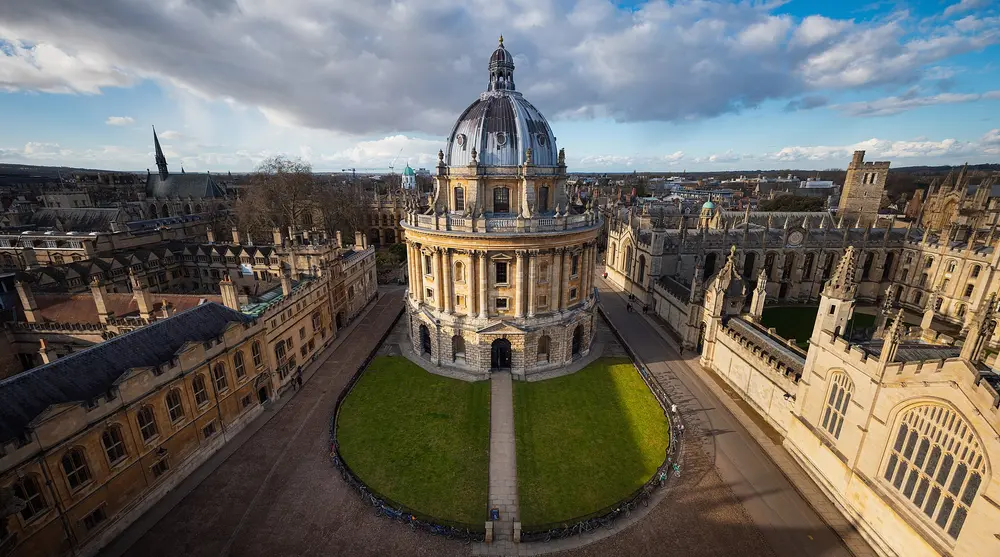
Photo: Julian Herzog · CC BY 4.0 · cropped
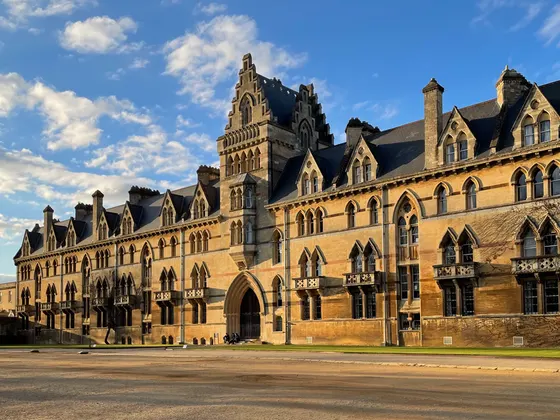
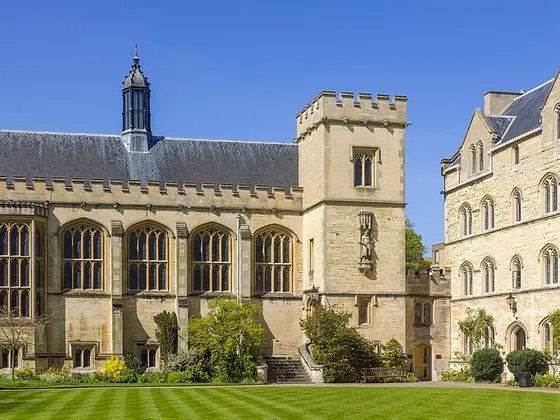
Photo: JM Lystad · CC BY-SA 4.0 · Photo: Michael D Beckwith · CC0 · Photo: Godot13 · CC BY-SA 4.0
Step-by-step: entry requirements, UCAT prep, personal statement, interview format and the key deadlines.
Open the guide →Format breakdown, school-specific sample questions, FAQs and prep tips from tutors who interviewed here.
Read the guide →Traditional / lecture-led, 6 years (3 pre-clinical + 3 clinical), placements across Oxford.
See the course →Oxford trains medics through its hallmark tutorial system, with strong emphasis on biomedical science in pre-clinical years and a small, research-intense cohort.
Pooling system means each applicant is assessed at two colleges, with a centralised shortlist - applying to a "less competitive" college gives no real advantage. GCSE performance is contextualised to your school. Tutors prize lateral reasoning and willingness to engage with the unfamiliar.
Traditional curriculum. Three years pre-clinical (Years 1-3 BMBCh first part) at Oxford, then three years clinical at Oxford-affiliated NHS hospitals. Tutorial system means small-group teaching alongside lectures throughout.
Oxford is strong in these research areas:
Optional intercalated BA at the end of Year 3 (medical sciences).
Format: Traditional or Panel Interviews
Two college-based panel interviews held in December, each typically 20-30 minutes. Tutors push you on scientific reasoning rather than rehearsed answers - expect questions that build on what you say and probe how you think under pressure. Topics often loop back to your personal statement, school work and experience.
Around 175 offers are made for roughly 165 A100 places; the realised intake averages about 155 students. A government quota caps international-fee students at a maximum of fourteen per year across A100 and A101 combined - there is no separate 24-place overseas allocation.
Founded in 1096. Based in Oxford.
Programmes offered:
What is TrueScore?
A data-driven estimate of the UCAT score you'll likely need to be invited to interview at Oxford for 2027 entry entry — based on its published cut-offs and recent admissions data. Treat it as a target to aim past, not a guarantee.
Oxford's TrueScore is 2230. Build a week-by-week UCAT plan that works back from your test date — free for the first two weeks.
Shortlisting combines the UCAT with a GCSE measure built from the number of A*/9/8 grades and the proportion of grades at A*/9/8, contextualised to the applicant's school. Oxford does not publish the exact weighting between the two. Applicants who sat GCSEs in summer 2020-2021 have their UCAT double-weighted instead, because teacher-assessed grades are not comparable between schools. SJT is not used pre-interview.
Not used for shortlisting. Theoretically post-interview alongside other factors. Bands 1, 2, 3 no cause for concern; band 4 also selected last year.
GCSE contextualised to school average. ~30 students interviewed each year with <90% A* grades (school context). Borderline 80 + tutor nominations + extenuating-circumstances review can lift lower-statistic applicants.
Shortlisting combines UCAT with a contextualised GCSE score. Around 425 applicants are interviewed each year (~2.5 per place): the bulk are ranked in automatically, and the Shortlisting Committee added a further 80 in the 2025 round. SJT band is not used pre-interview but is disclosed to colleges after interview.
Talk through your reasoning out loud. Tutors care more about how you approach a problem than the final answer. When a question sits outside what you have studied, work from first principles using whatever foundations you do have rather than freezing or guessing.
Two questions our tutors flagged as a strong fit for Oxford’s interview style. Try answering them out loud, then open Prometheus for the model answers and follow-up tips.
What about medicine motivates you beyond the desire to help people?
Likely follow-up · How does the science of medicine appeal to you?
When is it ethical to withdraw life-sustaining treatment from a patient who lacks capacity?
Likely follow-up · Who decides?
We've helped students into Oxford and other UK medicine schools — get tailored support for each stage of the application.
Hit the UCAT cut-off for Oxford with one-to-one tutoring from top scorers.
Learn morePractise the Traditional interview format with students who interviewed at Oxford.
Learn moreGet your personal statement reviewed by successful applicants.
Learn moreChecked field-by-field against University of Oxford's official course page on 11 September 2026.
We've helped students turn their UCAT, personal statement and interview prep into offers from Oxford and other UK medicine schools.