
Oxford Medicine Interview
Format, Questions & Prep Tips
Oxford medicine interviews for 2027 entry are a traditional interview, held December 2026, online (shortlists announced from late November). Published figures: Applications (2026 entry) 1,156; Interviewed Around 425 a year; Offers (2026 entry) 175 (158 quota, 16 open, 1 deferred).
- Institution
- University of Oxford
- Interview (2027 entry)
- December 2026, online (shortlists announced from late November)
- Decisions (2027 entry)
- Early January 2027 (Oxford gives 12 January 2027)

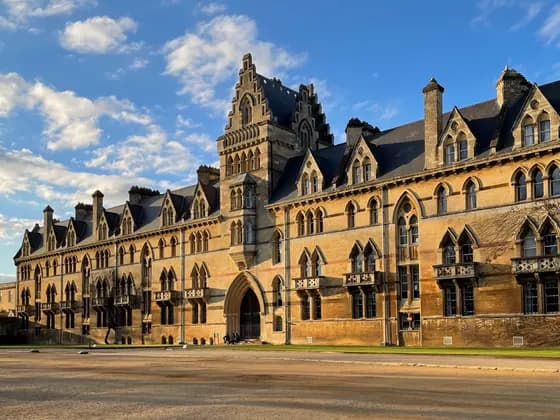

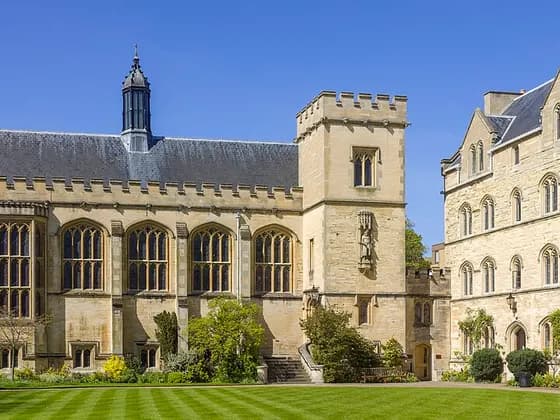
Photo: Julian Herzog · CC BY 4.0 · cropped
Photo: JM Lystad · CC BY-SA 4.0 · Photo: Michael D Beckwith · CC0 · Photo: Godot13 · CC BY-SA 4.0
Still deciding where to apply? Hear it from a student who's there
Oxford Medicine interviews for 2027 entry are held online in December 2026. Every shortlisted applicant is interviewed by two colleges — where possible your college of choice, plus a second college allocated at random — by at least two academics at each college, with at least one practising clinician involved.
The defining feature: Oxford tutors don't want rehearsed answers. They want to watch you reason out loud. Almost every question is designed so that the route to an answer matters more than the answer itself, and tutors will deliberately push you onto unfamiliar ground to see how you cope when you don't know.
There are no clinical scenarios and very little classical medical-ethics testing. The bar is scientific aptitude, intellectual curiosity and the ability to think under pressure.
Oxford interview key facts (2027 entry)
| Applications (2026 entry) | 1,156 |
|---|---|
| Interviewed | Around 425 a year |
| Offers (2026 entry) | 175 (158 quota, 16 open, 1 deferred) |
| International applicants (2026 entry) | 32 shortlisted, 8 offers |
Interview Format
- Interviewed by two colleges — your college of choice where possible, and a second college allocated at random
- Held online (Microsoft Teams) for 2027 entry; at least two academics interview you at each college, and at least one practising clinician is involved
- Format is conversational rather than rapid-fire; tutors build on what you say to probe deeper
- You may be given a paper to read, a graph to interpret or an image (e.g. an X-ray) to discuss
- Heavy emphasis on scientific reasoning, problem-solving, and reflection on your personal statement
- Almost no clinical or pure-ethics scenarios — Oxford screens those at other stages
- Colleges rank everyone they interview, then see the other college's ranking and your UCAT before finalising; 44.8% of 2026-entry offers came from a college other than the one applied to
Sample Interview Questions
Why does the heart need its own blood supply when blood is constantly flowing through it?
Reason from first principles. Reference the difference between the chamber blood and the muscle tissue. Oxford rewards clear stepwise thinking out loud over a polished final answer.
Estimate how many cells are in your body.
Use Fermi-style estimation. State your assumptions; the tutor wants to see your reasoning, not a memorised number (~37 trillion is the accepted estimate, but the path matters more).
Why can't you breathe underwater through a 1-metre straw?
Consider the pressure difference across your chest wall at depth — atmospheric pressure on the air column vs. ~10 kPa of additional water pressure on your thorax per metre of depth.
How would you find out the weight of all the blood in a living person?
Multiple valid approaches: dye dilution, density measurement, body mass × ~7% blood volume estimate. Discuss the trade-offs of each.
A patient is given a drug that blocks Na+/K+ ATPase. What happens to their cardiac function?
Trace the consequences: ↑ intracellular Na+ → impaired Na+/Ca2+ exchange → ↑ intracellular Ca2+ → increased contractility. This is digoxin's mechanism.
Here is a graph of arterial blood pressure during the cardiac cycle. Sketch the corresponding ventricular pressure and label the four phases.
Four phases: isovolumetric contraction, ejection, isovolumetric relaxation, filling. Label valve openings/closures.
Why are some antibiotics effective against gram-negative bacteria but not gram-positive, or vice versa?
Discuss the differences in cell wall structure (peptidoglycan thickness, outer membrane, LPS) and the mechanism of action of the antibiotic in question.
Why medicine, and why Oxford specifically?
Avoid generic answers. Tie "why Oxford" to the tutorial system, the science-heavy first three years, and the integrated BMedSci. Avoid "the prestige" or "it's the best".
Why not a pure biomedical sciences degree instead of medicine?
Articulate the difference between investigating disease and treating patients. Be honest about what attracts you to clinical work.
You mentioned [specific topic] in your personal statement. Tell me more about the underlying mechanism.
Re-read every sentence of your statement. Tutors will pick the most superficial claim and probe it; "I read about CRISPR" without being able to explain the mechanism is a red flag.
A patient with type 1 diabetes has a blood glucose of 22 mmol/L. Walk me through what's happening in their body.
No insulin → no glucose uptake in muscle/adipose → lipolysis → ketogenesis → acidosis. Connect the dots between metabolic state and clinical signs.
Here is an X-ray. Don't try to diagnose; describe what you can see systematically.
Tutors aren't expecting radiology knowledge. They want a systematic approach: orientation, what's visible (bones, soft tissue, lung fields), any obvious asymmetries.
Sketch what happens to enzyme activity as temperature increases above 37°C.
Initial rise (faster molecular motion) then sharp drop (denaturation). Be ready to discuss why the curve looks the way it does and what "denaturation" means at a molecular level.
How does a vaccine work? Take me through what happens after injection.
Antigen presentation → T cell activation → B cell proliferation → antibody production + memory cells. Distinguish primary from secondary response.
A patient refuses a blood transfusion that would save their life. They are competent. What should the doctor do?
Oxford rarely tests ethics in depth, but a Gillick-competent/autonomy answer is correct. Don't over-rehearse the four pillars; just reason clearly.
Explain how a vaccine works to a 10-year-old.
Avoid jargon entirely. Use an analogy (e.g. wanted-poster for the immune system). Check the child understands as you go.
Why does antibiotic resistance evolve so quickly compared to, say, resistance to chemotherapy?
Discuss bacterial generation time, horizontal gene transfer, selection pressure intensity, and the role of incomplete antibiotic courses.
Practise the Oxford interview
Rehearse the real format before the day — on demand with our AI interviewers, or live with a tutor.
Sit a mock with photoreal AI interviewers — any time
A timed MMI or panel interview on video — British & international voices — with interviewers who listen, react and press with follow-ups. Rubric-scored feedback and a replay the moment you finish.


Live mocks with a tutor who’s been in the room
A full Oxford-style mock with a medic or dentist tutor — honest scoring against real marking criteria, a station-by-station debrief and a written action plan.
Book a mock interviewHow to Prepare
Practise thinking aloud — Oxford tutors score reasoning, not the final answer. Silent thinking is invisible.
Re-read every claim in your personal statement and be ready to defend the underlying science. Tutors specifically probe the surface-level mentions.
Do 5–10 mock interviews with someone who will push back. Stress-resilience under follow-up questioning is half the battle.
Brush up on A-Level biology + chemistry topics adjacent to anything in your statement — cardiac physiology, immunology, basic pharmacology.
Practise Fermi-style estimation problems. The "how many X" questions are common.
Read 2–3 recent New Scientist or Nature News articles on medical topics so you can articulate genuine curiosity.
Visit the college if possible — interviewers do ask "what attracted you to this college specifically".
Invited to interview at Oxford? Say your first answer out loud today with the free two-minute warm-up drill, then sit a timed mock set up for Oxford.
Common Pitfalls
Frequently Asked Questions
Related guides
Free, evidence-based guides from current UK medical and dental students.
Free Interview Resources
Worked-through MMI stations, ethics scenarios, and panel questions.
Read guideNHS Core Values Guide
The 6 NHS values examiners listen for in every interview answer.
Read guideMedical School Rankings
See interview format (MMI vs panel) for each UK medical school.
Read guideUCAS 2026 Personal Statement
The new three-question format your interviewer will reference.
Read guideContextual Offers for Medicine
Every UK medical school's widening-access scheme in one place.
Read guideSources & official admissions information
We cross-check every interview guide against the school’s own admissions guidance and the UK regulators.
- University of Oxford — Medicine: Application Process — Shortlisting in late November, two college interviews, at least one clinician, outcome letters in early January.
- University of Oxford — Medicine: Shortlisting Process and Admissions Statistics — 2025 round (2026 entry): 1,156 applications, ~425 interviewed, 175 offers, 8 international offers.
- University of Oxford — Interviews (guide for applicants) — Interviews in December 2026 for 2027 entry are online (Microsoft Teams); outcomes on 12 January 2027.
- Oxford — official admissions page — Programme overview, entry requirements, interview format and timeline straight from the school.
- UCAT Consortium — Official UCAT registration, test format, scoring methodology and free practice materials.
- General Medical Council (GMC) — Statutory regulator. Approved medical schools, the registered-doctor register, and fitness-to-practise standards.
- Medical Schools Council — Selecting-for-excellence guidance, MMI principles, and an A–Z of UK medical schools.
Ready to nail your Oxford interview?
Book a mock interview with a current medical student who recently went through the same process, or practise on demand with the AI interviewer.