
Cambridge Medicine Interview
Format, Questions & Prep Tips
Cambridge medicine interviews for 2027 entry are a traditional interview, held 7–18 December 2026 (winter pool interviews mid-to-late January 2027). Published figures: Interview period (2027 entry) 7–18 December 2026; Interviews Usually 1–2, totalling 35–60 minutes.
- Institution
- University of Cambridge
- Interview (2027 entry)
- 7–18 December 2026 (winter pool interviews mid-to-late January 2027)
- Decisions (2027 entry)
- 27 January 2027 for December interviewees

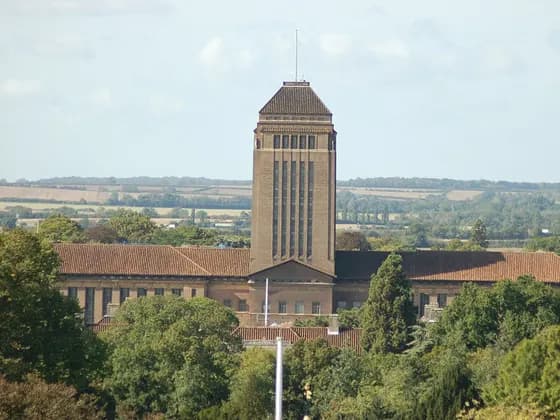
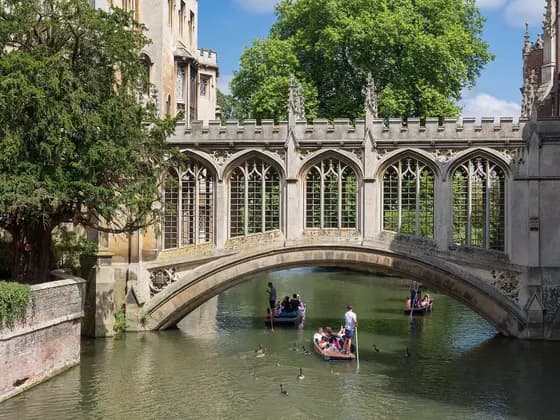
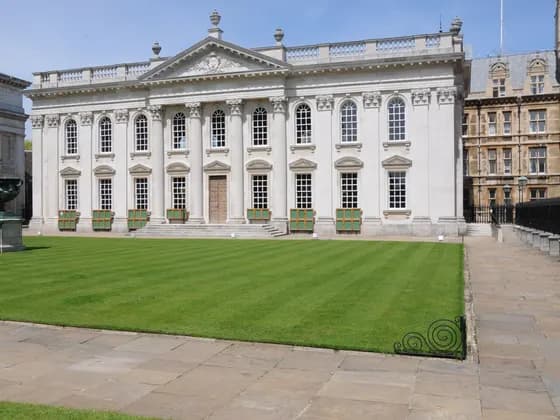
Photo: Dmitry Tonkonog (User:Heuschrecke) · CC BY-SA 3.0 · cropped
Photo: Unknown · Public domain · Photo: Diliff · CC BY-SA 3.0 · Photo: Philip Halling · CC BY-SA 2.0
Still deciding where to apply? Hear it from a student who's there
Cambridge Medicine interviews are College-based academic conversations: most applicants have one or two interviews lasting 35 minutes to an hour in total, in the main interview period of 7–18 December 2026 for 2027 entry. Like Oxford, the focus is academic — but Cambridge consistently goes harder on quantitative reasoning, expecting fluent A-Level maths and physics under interview-room pressure.
Since BMAT was discontinued, Cambridge Medicine applicants sit the UCAT, which must be taken by 24 September 2026 for 2027 entry. Whether your interview is online or in person depends on the College assessing you — for Medicine, Clare and Jesus (UK-based applicants) interview in person, while many other Colleges interview entirely online.
Approach: prepare like you're sitting an oral A-Level supervision rather than a competency interview. Sketch graphs cleanly, label axes, define every term you use.
Cambridge interview key facts (2027 entry)
| Interview period (2027 entry) | 7–18 December 2026 |
|---|---|
| Admissions test | UCAT (replaced BMAT) |
| Interviews | Usually 1–2, totalling 35–60 minutes |
Interview Format
- Usually one or two interviews at the College assessing your application; applicants placed in the winter pool may be interviewed again by another College in January
- Most applicants have 1 or 2 interviews totalling 35 minutes to an hour; online or in person depending on the College
- Heavy emphasis on scientific and quantitative reasoning, often beyond A-Level
- UCAT must be taken by 24 September 2026 for 2027 entry (it replaced BMAT)
- You may be asked to sketch graphs, solve calculations, or discuss data on paper
- Personal statement is used to seed questions but is not scored separately
- Conversational tone — tutors build follow-up questions on your previous answers
Sample Interview Questions
Sketch the relationship between pressure and volume during the cardiac cycle.
Four-phase PV loop: filling (low pressure), isovolumetric contraction (rising pressure, constant volume), ejection (high pressure, falling volume), isovolumetric relaxation. Label each phase as you draw.
A virus has a genome of N base pairs. How many possible distinct genomes of length N exist? What does this tell you about viral evolution?
4^N possible sequences (with 4 nucleotides). Discuss how this combinatorial space drives the speed of viral evolution and the difficulty of designing universal vaccines.
You have a beaker of water at 4°C. What happens to its volume as you cool it further?
Water has anomalous density behaviour — it expands as it cools below 4°C, which is why ice floats. Discuss the hydrogen-bond structure.
A drug has a half-life of 4 hours. After how many half-lives is it effectively cleared from the body?
After ~5 half-lives, ~97% is cleared. Discuss why dosing intervals are set this way and the implications for steady-state plasma concentration.
Why is haemoglobin's oxygen dissociation curve sigmoidal rather than hyperbolic?
Cooperative binding — each O2 bound changes the conformation of the other binding sites. Sketch the curve and explain the physiological advantage at the tissues vs. lungs.
Estimate the volume of blood pumped by the heart in a lifetime.
~5 L/min × 60 min × 24 h × 365 days × 80 years ≈ 200 million litres. State assumptions and round liberally.
Why are women more susceptible to autoimmune disease than men?
Multiple factors: X chromosome (carries many immune-related genes), oestrogen's immune-modulating effects, X-inactivation skewing. Acknowledge uncertainty — this is an active research area.
Walk me through the mechanism of action of a beta-blocker.
Blocks β1 adrenoreceptors → reduces sympathetic stimulation of heart → ↓ heart rate, ↓ contractility, ↓ renin release. Cover clinical uses and contraindications (asthma).
Walk me through what you have done outside of school to test whether medicine is right for you.
Tutors want reflection, not a list. For each experience, articulate what you learned about being a doctor that you couldn't learn from a textbook.
Why Cambridge specifically rather than a London medical school?
Reference the integrated BSc (the "Tripos" year), the supervision system, the strong basic-science focus in the first three years. Avoid prestige answers.
Here is a graph showing antibody concentration over time after a primary and secondary exposure to an antigen. Explain the differences.
Secondary response: faster, higher magnitude, longer-lasting, IgG-dominated. Discuss memory B cells and class switching.
Why do we shiver when we're cold?
Skeletal muscle contractions generate heat (~5× resting metabolic rate). Discuss the hypothalamic temperature setpoint and the autonomic response chain.
A patient has a sodium of 120 mmol/L. What does that mean and what could cause it?
Hyponatraemia. Differentiate hypovolaemic (D&V, diuretics), euvolaemic (SIADH), hypervolaemic (heart failure, cirrhosis). Discuss why correcting too quickly is dangerous (central pontine myelinolysis).
Explain the concept of natural selection to me as if I had never studied biology.
Use a concrete example (e.g. moths during industrial revolution, antibiotic resistance). Avoid jargon. Check understanding mid-explanation.
Why does a tennis ball bounce lower with each bounce?
Energy lost to heat, sound, deformation. Discuss coefficient of restitution. Cambridge will sometimes test physics-style reasoning even on biological topics.
Here's an ECG. What can you tell me about it?
You're not expected to diagnose. Describe what you can see systematically: rate, rhythm, intervals (PR, QRS, QT), waveform morphology.
Practise the Cambridge interview
Rehearse the real format before the day — on demand with our AI interviewers, or live with a tutor.
Sit a mock with photoreal AI interviewers — any time
A timed MMI or panel interview on video — British & international voices — with interviewers who listen, react and press with follow-ups. Rubric-scored feedback and a replay the moment you finish.




Live mocks with a tutor who’s been in the room
A full Cambridge-style mock with a medic or dentist tutor — honest scoring against real marking criteria, a station-by-station debrief and a written action plan.
Book a mock interviewHow to Prepare
Practise A-Level maths and physics calculations under time pressure — Cambridge probes these more than Oxford does.
Get comfortable sketching graphs cleanly with labelled axes; tutors hand you paper and pen routinely.
Be ready for follow-up "why?" questions on every answer — Cambridge interviews build like a Socratic dialogue.
Re-read your personal statement and prepare to defend every scientific claim at the molecular level.
Sit full timed UCAT mocks before your test date — UCAT is part of the application Cambridge considers for Medicine.
Read around recent medical news in physics-adjacent topics (e.g. MRI physics, radiotherapy dosing) so you can engage when these come up.
Invited to interview at Cambridge? Say your first answer out loud today with the free two-minute warm-up drill, then sit a timed mock set up for Cambridge.
Common Pitfalls
Frequently Asked Questions
Related guides
Free, evidence-based guides from current UK medical and dental students.
Free Interview Resources
Worked-through MMI stations, ethics scenarios, and panel questions.
Read guideNHS Core Values Guide
The 6 NHS values examiners listen for in every interview answer.
Read guideMedical School Rankings
See interview format (MMI vs panel) for each UK medical school.
Read guideUCAS 2026 Personal Statement
The new three-question format your interviewer will reference.
Read guideContextual Offers for Medicine
Every UK medical school's widening-access scheme in one place.
Read guideSources & official admissions information
We cross-check every interview guide against the school’s own admissions guidance and the UK regulators.
- University of Cambridge — What to expect at your Cambridge interview — 2027 entry: main interviews 7–18 December 2026, online or in person by College, 1–2 interviews of 35–60 minutes in total.
- University of Cambridge — University Clinical Aptitude Test (UCAT) — UCAT is the admissions test for Medicine (A100) and Graduate Medicine (A101); sit it by 24 September 2026.
- University of Cambridge — Application timeline (2027 entry) — Invitations in November, winter pool in January, outcomes for December interviewees on 27 January 2027.
- Cambridge — official admissions page — Programme overview, entry requirements, interview format and timeline straight from the school.
- UCAT Consortium — Official UCAT registration, test format, scoring methodology and free practice materials.
- General Medical Council (GMC) — Statutory regulator. Approved medical schools, the registered-doctor register, and fitness-to-practise standards.
- Medical Schools Council — Selecting-for-excellence guidance, MMI principles, and an A–Z of UK medical schools.
Ready to nail your Cambridge interview?
Book a mock interview with a current medical student who recently went through the same process, or practise on demand with the AI interviewer.