
The Aston University Medicine course
What you actually study, and where you will be
Aston University's MBChB is a 5-year course taught through problem-based learning, with patient contact from Year 1 and placements in West Midlands (2027 entry). A problem-based course in central Birmingham where you meet patients in term one — two one-week primary care placements sit in year 1, before the clinical phase proper begins in year 3.
- Degree
- MBChB
- Length
- 5 years
- Teaching
- Problem-based learning
- Clinical contact
- Year 1
- UCAS code
- A100

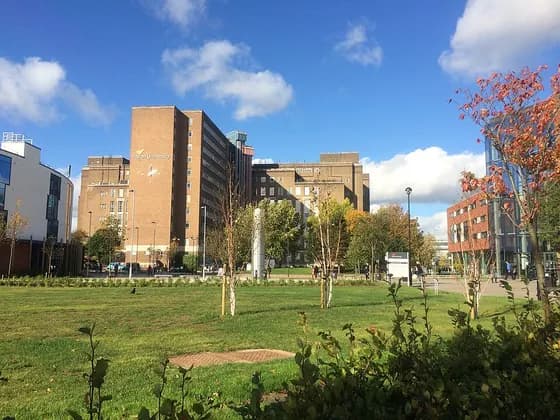

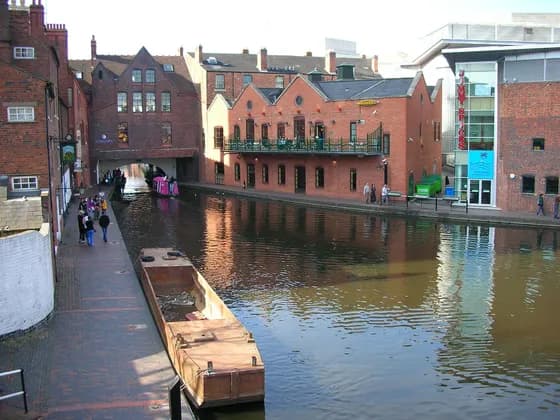
Photo: Tony Hisgett · CC BY 2.0 · cropped
Photo: Johand2222 · CC BY-SA 3.0 · Photo: Roger Kidd · CC BY-SA 2.0 · Photo: Oosoom at English Wikipedia · CC BY-SA 3.0
The Aston University medicine course at a glance (2027 entry)
Aston University's Medicine MBChB is a five-year degree taught by Aston Medical School on Aston's campus in the centre of Birmingham. MBChB stands for Bachelor of Medicine, Bachelor of Surgery. When you graduate you can be provisionally registered with the General Medical Council (GMC), the body that regulates doctors in the UK. You then start the UK Foundation Programme, two years of paid training as a newly qualified doctor.
Aston is a young medical school. It took its first medical students in September 2018. In April 2023 the GMC added Aston to its list of bodies allowed to award UK medical degrees, and the first year group graduated that July. When the GMC visited that group in its final year, it had 59 students. The course now has 110 places a year for home students and 30 for international students.
The course runs in two phases. In Phase 1 (Years 1 and 2) you build your science knowledge in blocks on themes and body systems, such as infection, the heart and circulation, and public health. Clinical and communication skills are taught alongside, and you spend short spells in GP surgeries. In Phase 2 (Years 3 to 5) most of your learning moves into hospitals and general practice, working with doctors and other health professionals.
General practice, also called primary care, runs right through the course. It starts with a week in a GP surgery in your first term, and you return to general practice in Years 2, 3 and 5. Hospital placements are with partner NHS trusts across Birmingham and the wider West Midlands, set out in the placements section below.
Day to day, much of your learning happens in groups. Alongside lectures, seminars, workshops and clinical skills sessions, Aston uses team-based learning (TBL): you prepare before a session, then work through questions and patient cases with a small team. You also learn alongside students from other Aston healthcare courses, such as pharmacy, so you get used to working with other professions.
| Degree | MBChB |
|---|---|
| Course length | 5 years; no shortened route for graduates |
| UCAS code | A100 |
| Places | 110 home and 30 international places a year |
| Main campus | Aston University, central Birmingham |
| Teaching style | Integrated blocks: lectures, group work and team-based learning |
| First patient contact | A week in a GP surgery in your first term |
| Placement area | Birmingham and the wider West Midlands |
| Intercalation | Optional, usually after Year 3; stipend paid on Aston programmes |
| GMC approval | Awarding body since April 2023; first graduates July 2023 |
What makes Aston University medicine different
General practice in four of your five years
General practice comes back in Years 1, 2, 3 and 5, building from single weeks in Year 1 to a long block in Year 3 and six weeks in Year 5. The school has teaching agreements with more than 100 GP surgeries. You see how patients are cared for outside hospital, and how a whole GP team works.
One patient followed through your first year
During your first GP week in November, the GP tutor chooses a patient for you to talk to. You meet the same person again in your second GP week in June, learning how their illness affects their body, mind and daily life. You then present their story as a poster at the medical school.
A final year shaped around your first job
After your final exams in Year 5 you do a six-week foundation assistantship, working in a clinical team and doing the tasks of a first-year doctor under close supervision. In 2022/23 Aston told the GMC that assistantships would include out-of-hours shifts alongside junior doctors, supervised by a consultant. The school also said that on Year 5 GP placements, students take on a junior doctor's role rather than just observing.
A paid intercalated year at Aston
Intercalating means taking a year out to complete a separate degree, such as an MSc. If you choose one of Aston's own programmes, your tuition for that year is paid at the home rate. You also receive a stipend, money towards your living costs, of £20,780 for the year (2026-27), paid in monthly instalments. Options include Artificial Intelligence for Health, Public Health, and Stem Cell and Regenerative Medicine.
Hearing from patients who live with a condition
Aston recruits expert patients: people living with conditions such as heart failure, asthma, Crohn's disease, stroke or Parkinson's disease. A member of staff interviews them while you watch, and you then ask your own questions; the whole session lasts 30 to 45 minutes. It connects the science you have studied with what the illness is actually like to live with.
How Aston University teaches medicine
Each year of the course is a single module worth 120 credits, split into shorter blocks that each cover a topic or body system. In Phase 1 the blocks are mainly science, but each topic is linked to how it matters for patients. Alongside them run Introduction to Clinical Practice blocks, where you learn to talk with patients, carry out consultations and start reasoning towards a diagnosis.
You are taught by doctors and other professionals from clinical practice, industry and research. Aston stresses learning with your peers: applying what you know in groups and solving problems together. It also expects you to become a self-directed learner quickly, deciding what you need to study and organising your own learning.
From Year 3 the balance shifts. Most of your time is spent on placements, which Aston builds into modules called clinical apprenticeships, learning by working alongside doctors and other staff. Lectures, group work, workshops and independent study continue, but they support what you see on the wards and in GP surgeries.
The teaching methods and block names in this guide come from Aston's course page for September 2027 entry. Aston reviews its modules regularly and posts any changes on its course pages, so treat the names as a guide.
The ways you will learn
| Lectures | Given face to face and online. They introduce the core science and clinical topics for each block, and carry on in Phase 2 to support your placements. |
|---|---|
| Group work and team-based learning | Team-based learning (TBL) is a structured form of group work. In its usual format, you prepare beforehand by working through set material on your own. In the session you answer questions on it, then apply what you know to patient cases with the same small team. Aston says much of your learning happens through group work. |
| Clinical skills and simulation | Sessions in Aston's simulation suites where you learn to take a history, meaning asking about a patient's symptoms and background, examine patients and carry out procedures. You use models, manikins and simulated patients. Simulated patients are trained people paid to play a patient, sometimes in difficult scenarios such as breaking bad news, and they give you feedback afterwards. |
| Practical sessions | Hands-on laboratory classes. For physiology you use PowerLab equipment to take measurements yourself, as described in the facilities section. |
| Interprofessional learning | Some sessions are shared with students on other Aston healthcare courses, such as pharmacy. You learn what each profession does and practise working together, as you will in multidisciplinary teams after you qualify. |
| Clinical apprenticeships | From Year 3, placement blocks in hospitals and general practice make up most of your year. You learn by working alongside doctors and other healthcare professionals in the clinical team. |
When you first meet patients at Aston University
You meet patients in your first term. In November of Year 1 you spend a week in a GP surgery, placed with at least one other student. The week runs Monday to Friday, 9am to 5pm, except Wednesday afternoon, which is kept free for university sport and societies. A GP tutor organises the week and gives you about 20 minutes of individual feedback at the end.
This first week is observational, so you watch and talk rather than treat. You sit in on GP and nurse clinics, spend time on reception and in the waiting room talking to patients, and ask patients and staff for feedback on how you came across. Depending on the practice, you may also join home visits, baby clinics, clinics for long-term conditions, team meetings or community nursing.
Your second GP week comes at the end of the summer term, in June. You practise the early clinical skills you have learned in Year 1 and see the same chosen patient again. In Year 2 you spend nine days in general practice, in groups of about eight at the same surgery, taught directly by a GP tutor. The focus is on consultation, examination and diagnostic reasoning skills.
On campus you practise with simulated patients and hear from expert patients about living with their conditions. From Year 3, when Phase 2 begins, you are on placement in hospitals and GP surgeries for most of the year.
Year by year at Aston University
- Year 1 (Phase 1)
Fundamentals of Medicine 1
Year 1 is one 120-credit module, Fundamentals of Medicine 1. It builds your science base through blocks that link each topic to patients, and it starts your clinical skills training. You also spend two separate weeks in general practice.
- Science blocks on cell biology and genetics, the fundamentals of body structure, physiology and pharmacology (how drugs work), infection, and pathological processes, meaning how disease damages the body.
- Body system blocks on the cardiovascular system (heart and circulation), the musculoskeletal system (bones, joints and muscles), and metabolism, endocrinology (hormones) and haematology (blood).
- Sociological and Psychological Aspects of Health, and Public and Global Health, looking at how society, behaviour and populations shape health.
- Introduction to Clinical Practice 1a and 1b: communicating with patients, consultation skills and a set list of clinical skills practised in simulation.
- Two one-week GP placements, in November and June.
- Learning to search medical databases and judge the quality of the evidence you find.
- Year 2 (Phase 1)
Fundamentals of Medicine 2
Year 2 completes Phase 1 with the remaining body systems and a stronger focus on drugs and treatment. Your clinical skills build towards full consultations, practised in simulation and in closely supervised clinical settings.
- Body system blocks on the gastrointestinal (digestive) system, the respiratory system, the renal and urinary systems (kidneys and bladder), the immune system, and the head and neck.
- Clinical Pharmacology and Therapeutics: how drugs act, how the body handles them, the monitoring they need and how to apply this to patient scenarios.
- Social and Psychological Aspects of Health 2, including asking patients about the psychological and behavioural side of their illness and responding with empathy.
- Introduction to Clinical Practice 2a and 2b, adding to your list of clinical skills and procedures.
- Integration Clinical Application, a block added on the course page for 2027 entry.
- Nine days in general practice.
- Year 3 (Phase 2)
Clinical Apprenticeships 1
Year 3 starts Phase 2, and most of the year is spent on placement. It is split into three blocks: two in hospital medicine and surgery and one in primary care. You apply the science from Phase 1 to real patients across a range of specialties.
- Integrated Medicine and Surgery 1 and 2: two hospital blocks covering a range of medical and surgical specialties.
- Primary Care: a long block in general practice. The course page gives each Year 3 block as 12 weeks, while the school's information for GP tutors describes a 10-week GP placement.
- Your first Student Selected Component (SSC), where you choose the topic you study.
- Learning to recognise, interpret and manage the ways diseases present, and to choose suitable drugs for a clinical situation in simulated practice.
- Year 4 (Phase 2)
Clinical Apprenticeships 2
Year 4 moves you through six specialty placements of six weeks each, plus a Student Selected Component (SSC). You learn to build a differential diagnosis, meaning a list of possible causes for a patient's problem, and to suggest a first plan of care within a team.
- Cancer Care. At Russells Hall Hospital in Dudley, for example, you rotate through breast, colorectal (bowel), urology, haematology (blood) and respiratory (lung) teams. You also spend time in palliative care (comfort care when cure is not possible), skin cancer clinics and radiotherapy.
- Child Health, the care of babies, children and young people.
- Integrated Care, a specialty block added on the course page for 2027 entry.
- Psychiatry, the diagnosis and treatment of mental illness.
- Reproductive Health. The course page lists obstetrics and gynaecology (pregnancy, childbirth and women's health) among the Year 4 specialty placements.
- Neurology and the senses: neurology alongside dermatology (skin), ENT (ear, nose and throat) and ophthalmology (eyes).
- A further SSC and practice in basic research methods. At Russells Hall Hospital the SSC lasts four weeks: a clinical audit, checking local care against an agreed standard, supervised by a clinician, with feedback at week two and a marked assessment.
- Year 5 (Phase 2)
Foundation Apprenticeships 3
Year 5 prepares you for your first job as a doctor, with the focus on diagnosing and managing patients. Before finals you complete three six-week blocks, one in general practice and two in hospital. After finals come a six-week foundation assistantship and a six-week elective.
- Acute Integrated Medicine and Surgery 1 and 2: two hospital blocks. Acute means sudden illness. At Russells Hall Hospital in Dudley, for example, Year 5 students spend six weeks in emergency medicine and surgical specialties, and six weeks in acute medicine and care of older people.
- Primary Care: six weeks in general practice.
- Final exams, including the national UK Medical Licensing Assessment described in the assessment section.
- Foundation Assistantship: six weeks of foundation-level work in a clinical team under close supervision.
- Student-selected component (SSC) / Electives: the 2027 course page pairs your final SSC with the six-week elective, taken after finals.
- Preparation for the Foundation Programme, including help with applying.
How you are assessed at Aston University
You are assessed through in-course assignments, computer-based knowledge exams, practical clinical skills exams and continuous assessment of your professional behaviour. The clinical exams are Objective Structured Clinical Examinations (OSCEs). In an OSCE you move round a circuit of short stations, each with an examiner. At each one you carry out a set task, such as examining or talking to a patient, who is often a trained actor. Aston uses OSCEs from Year 1.
Each year is a single 120-credit stage, and you must pass every part to move on. There is no condonement, so a strong mark in one exam cannot make up for a fail in another. If you fail a part, the exam board can let you resit only that part, called a referral, before the next year starts, or ask you to repeat the year. You can be referred once per year, repeat any year only once, and must finish within seven years.
Placements are assessed too. Each block comes with workbooks or a portfolio of set tasks, you are observed consulting with patients, and the hospital or GP practice hosting you writes an end-of-placement report. You need an up-to-date portfolio to progress. By graduation you must be able to carry out safely the 23 practical procedures listed in the GMC's Practical skills and procedures (2019). These are tracked in an ePortfolio, an online record, and signed off in Year 5.
In your final year you sit the UK Medical Licensing Assessment (UKMLA). Since 2024-25, every UK medical degree must include a pass in it. The Applied Knowledge Test (AKT) is set nationally: two computer-based papers of 100 single best answer questions, two hours each, on consecutive days. The Clinical and Professional Skills Assessment (CPSA) is Aston's own final OSCE, which must meet GMC requirements.
In the version Aston described to the GMC, which found it met the requirements in February 2024, the CPSA has 15 stations over three days, five a day. Each station lasts eight minutes, with two minutes' reading time. Examiners mark process, clinical judgement and communication. You must pass every part of the Professionalism in Practice assessment before you can sit it. Aston told the GMC the format may change as year groups grow.
When the GMC visited in 2022/23, final-year students were due to sit the Prescribing Safety Assessment (PSA), a national online test of safe prescribing, after a practice attempt in Year 4. Passing it was not then a condition of graduating, and a retake was offered. Nationally, every doctor must have passed the PSA to complete the first foundation year (F1).
- The MBChB has no degree classes. Honours may be given to around 10% of each graduating year, based on marks weighted 10, 15, 20, 25 and 30% across Years 1 to 5.
- If you have to leave the course, you can receive an award for the stages you have passed. After Year 1 this is a Certificate of Higher Education, and after Year 2 a Diploma of Higher Education. After Year 3 it is a Bachelor of Medical Studies BSc (Hons), and after Year 4 a Bachelor of Advanced Medical Studies (Hons).
Where you will actually be at Aston University
From Year 3 most of your time is spent with Aston's partner NHS trusts and GP practices. The school says these serve a wide mix of communities, from inner-city areas to towns and rural locations. It has teaching agreements with more than 100 GP surgeries. The sites named in official sources are listed below.
University Hospitals Birmingham NHS Foundation Trust says Aston students in Years 3, 4 and 5 are based in three of its hospitals. The Royal Wolverhampton NHS Trust says medical students from Aston rotate through New Cross Hospital. The Dudley Group NHS Foundation Trust says Russells Hall Hospital has taught Aston Year 4 and 5 students since 2022. Walsall Healthcare NHS Trust says its teaching academy is affiliated to Aston Medical School.
Aston says many clinical exams are held at partner hospitals in Birmingham, Dudley and Wolverhampton, and the GMC watched the final-year OSCE at New Cross Hospital in March 2023. On its 2022/23 visit the GMC also went to Sandwell General Hospital. Its trust, Sandwell and West Birmingham NHS Trust, has since moved acute care to the new Midland Metropolitan University Hospital in Smethwick, opened in October 2024.
Some placements are further from Birmingham. In 2022/23 the GMC spoke to students who had been placed in Hereford. Year 4 students said their accommodation there had improved after feedback from the year above, and final-year students valued 12 simulation sessions during a six-week block.
For Year 1, GP surgeries must be within about an hour of the medical school by public transport. On placement you are supported by clinical teaching fellows, doctors employed to teach students, and in 2022/23 the GMC found students valued them. That year, final-year students at University Hospitals Birmingham also joined simulation sessions carrying a bleep, the pager hospital doctors use. At Russells Hall Hospital, the Dudley trust says each rotation comes with a timetable, a named clinical supervisor you meet regularly, simulation training and formal teaching.
The trust says Aston students in Years 3 to 5 are based in three of its hospitals. It also ran simulation sessions for final-year students in 2022/23.
- Aston Medical School, Aston University campus
- University Hospitals Birmingham NHS Foundation Trust (three of its hospitals)
The trust calls itself a teaching trust of Aston Medical School and says Aston medical students rotate through New Cross. It hosted the final-year OSCE that the GMC observed in March 2023.
- New Cross Hospital (The Royal Wolverhampton NHS Trust)
The trust says it has taught Aston Year 4 and 5 students since 2022. Year 4 rotations there are Cancer Care and an SSC audit; Year 5 rotations are emergency and surgical care, and acute medicine with care of older people. Aston also holds clinical exams at partner hospitals in Dudley.
- Russells Hall Hospital (The Dudley Group NHS Foundation Trust)
The trust says it hosts a teaching academy affiliated to Aston Medical School.
- Walsall Healthcare NHS Trust (Manor Hospital teaching academy)
The GMC visited the trust's Sandwell General Hospital in 2022/23. The trust has since moved acute care to Midland Metropolitan University Hospital in Smethwick, opened in October 2024.
- Sandwell and West Birmingham NHS Trust
Used for Year 4 and Year 5 placements when the GMC visited in 2022/23, with accommodation for students placed there.
Year 1 surgeries are within about an hour of the medical school by public transport. Surgeries further away may take students in later years.
- More than 100 GP surgeries with teaching agreements
Electives and chosen modules at Aston University
Student Selected Components (SSCs) are parts of the course where you choose what to study. They run in each year of Phase 2, Years 3, 4 and 5, and let you go deeper into an area of medicine that interests you.
One SSC option is a research project with the Aston Medical Research Institute. Its four research themes are maternal health, mental health, cardiovascular medicine and regenerative medicine, which is about repairing or replacing damaged cells and tissues.
After your final exams in Year 5 you have a six-week elective. An elective is a placement of your choice, and Aston allows it in the UK or anywhere suitable in the world, so you can see medicine in a different setting before you start work.
Intercalation at Aston University
Intercalating means pausing your MBChB for a year to complete a separate, more specialised degree, then rejoining the course. At Aston it is optional, but the school encourages it. You normally intercalate after Year 3, though you can also apply to do it after Year 4.
Aston's own options are BSc degrees in Biomedicine and Biological Sciences, and the MBiol in Biomedicine. Master's options are Artificial Intelligence for Health, Addiction and Mental Health, Bioinformatics and Genomic Medicine, Biosciences, Neuroscience for Drug Delivery, Stem Cell and Regenerative Medicine, and Public Health (MPH). You can also intercalate at another university.
On an Aston programme, your tuition for the year is paid at the home rate. You also receive an annual stipend of £20,780 in 2026-27, paid monthly. The funding comes from the National Institute for Health and Care Research (NIHR), the national body that funds health and care research. International students pay the difference between home and overseas tuition. If you intercalate at another university, you pay its fees and receive no stipend.
Places are limited and competitive. Aston starts asking for applications from the middle of Year 2, and the deadline is normally the end of February before the year you intercalate. You send a 200 to 400 word personal statement endorsed by your personal academic tutor, with a transcript of your grades. Assessors look for strong marks in the early years and interest in a career that includes medical teaching, research, or teaching combined with clinical work. Decisions follow your end-of-year results.
Facilities and support at Aston University
Where you will learn
Medical students have their own facilities on Aston's campus. The clinical skills centre has Sonosite ultrasound machines and life-size anatomical models. There is also a simulated hospital ward with mid-fidelity manikins, life-size patient models with some built-in features for practising examinations and procedures. The ward includes an acute care simulation room, where you practise looking after patients who suddenly become very unwell.
A newer simulation suite has high-fidelity manikins, computer-controlled models that respond to what you do, so you can practise real-life scenarios. There is also a critical care simulation unit. SMOTS camera systems record simulation sessions discreetly, so tutors can play back your performance and give you feedback straight away.
For physiology practicals, PowerLab equipment measures blood pressure, lung capacity, ECG (the heart's electrical activity), EMG (muscle activity) and pulse oximetry (blood oxygen levels). Group work rooms have C-touch screens, and private study spaces are open 24 hours a day.
Support while you study
Every student has a Personal Tutor for advice on study and personal issues. There is also a Student Support Lead, whose job is to help with the particular demands of being a medical student. If you are making slow progress, the school's Support and Concerns Process is used to offer help. University-wide services, such as the library and the Learning Development Centre, sit behind these.
When the GMC met Year 4 and 5 students in 2022/23, they valued regular meetings with tutors, personal development plans and access to clinical teaching fellows on placement. Students could give feedback through open mic sessions, student-staff committees, meetings with the Dean and an anonymous survey at the end of each block.
For careers, you can book a series of appointments with the school's medical careers lead. The school works with the British Medical Association (BMA) and NHS careers teams in the West Midlands, including help with your UK Foundation Programme application. If you fail the final OSCE, the Student Support Lead and your Year Lead help you draw up a plan to improve.
Is the Aston University course right for you?
This course may suit you if
- You want general practice to be a major part of your training, with GP placements in four of your five years.
- You want to meet patients from your first term, not only once hospital placements start.
- You learn well by talking problems through with others, since much of the teaching is group work and team-based learning.
- You like the idea of studying in central Birmingham and training in hospitals across the city and the wider West Midlands.
- You are curious about research and would value a paid intercalated year on one of Aston's own programmes.
Things to think about
- Aston is a young school: its first students started in 2018 and it became a GMC awarding body in 2023. In its 2022/23 report the GMC asked it to keep monitoring staffing and administrative support.
- Placements mean regular travel across the West Midlands, and in 2022/23 some Year 4 and 5 students spent blocks living in Hereford.
- Every assessment must be passed on its own, and the chances to resit or repeat a year are limited.
- If you prefer mostly lecture-led teaching, think about how much of this course relies on group work and self-directed study, especially in the mainly campus-based first two years.
Aston University medicine course — frequently asked questions
Applying to Aston University?
How to get into Aston University
Entry requirements, UCAT, personal statement and interview, step by step.
Open the guide →Aston University UCAT cut-offs and offers
UCAT cut-offs, A-level offers, interview format and decision dates.
See the requirements →Compare Aston University with other schools
Put the teaching style, anatomy teaching and placements next to another school.
Open the comparison →Prepare for the Aston University interview
Format breakdown, school-specific sample questions and prep tips from tutors who interviewed here.
Read the guide →Where this Aston University course guide came from
This guide was written from 16 official sources — Aston University's own course pages and programme documents, plus the regulator and NHS placement partners where they publish detail — read on 2026-09-24, then checked claim by claim against those sources.
- Aston University: Medicine MBChB, September 2027 entry (modules, teaching, placements, facilities, assessment)
- Aston University: Medicine MBChB main course page (September 2026 entry)
- Aston Medical School home page (primary care placements, simulated and expert patients, history)
- Aston Medical School Advice Zone FAQs
- Aston Clinical Academic Training Office: Intercalated Degrees
- Aston University General Regulations for the MBChB and MSc Physician Associate/Assistant Practice Programmes 2026/27
- GMC Quality Assurance Report for Aston Medical School, 2022/2023 academic year
- GMC: MLA Clinical and Professional Skills Assessment compliance decision for Aston Medical School (February 2024)
- GMC: MLA Applied Knowledge Test compliance decision for Aston Medical School (June 2024)
- UK Foundation Programme: Prescribing Safety Assessment
- University Hospitals Birmingham NHS Foundation Trust: Aston University MBChB
- The Dudley Group NHS Foundation Trust, Ron Grimley Undergraduate Centre: Aston University medical students
- The Royal Wolverhampton NHS Trust: Who we are
- The Royal Wolverhampton NHS Trust: Medical education
- Walsall Healthcare NHS Trust: Undergraduate medical education
- Sandwell and West Birmingham NHS Trust: About us
Courses are restructured between cycles. Anything here that decides your application — an anatomy offer, a placement city, a compulsory intercalated year — should be confirmed against the official page for your entry year.
Applying to Aston University?
We have helped hundreds of applicants turn their UCAT, personal statement and interview prep into offers from Aston University and other UK medicine schools.