
The Dundee Medicine course
What you actually study, and where you will be
Dundee's MBChB is a 5-year course with a spiral curriculum, with patient contact from Year 1 and placements in Dundee and across Scotland (2027 entry). A spiral curriculum in which clinical history and examination are taught from year one, and anatomy is learned on Thiel-embalmed cadavers that keep the flexibility of living tissue.
- Degree
- MBChB
- Length
- 5 years
- Teaching
- Spiral
- Clinical contact
- Year 1
- UCAS code
- A100

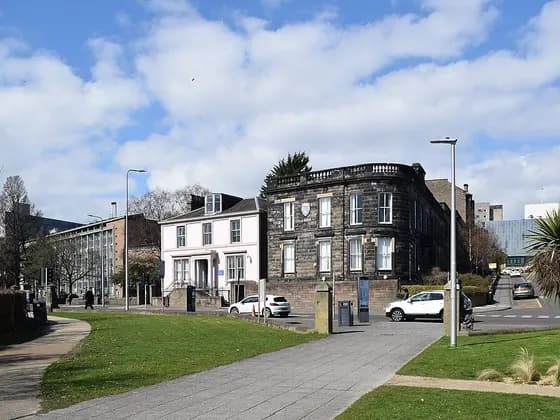

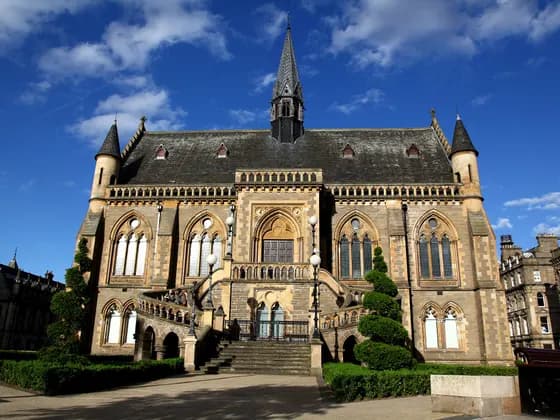
Photo: Ydam / Wikimedia Commons · CC BY-SA 3.0 · cropped
Photo: Bill Harrison · CC BY-SA 2.0 · Photo: Richard Szwejkowski · CC BY-SA 2.0 · Photo: BertieB · CC BY-SA 3.0
The Dundee medicine course at a glance (2027 entry)
Dundee's Medicine MBChB is a five-year degree with the UCAS code A100. MBChB stands for Bachelor of Medicine and Bachelor of Surgery. It is the degree you need, followed by two years of foundation training as a junior doctor, to become a fully qualified doctor in the UK. There are around 220 students in each year of the course.
The School of Medicine is based inside Ninewells Hospital in Dundee, and most of your lecturers are clinicians who work there. The university's donated bodies for anatomy are preserved by Thiel embalming, a method that keeps tissue soft and flexible. They are kept at the Thiel Cadaver Facility, part of the Centre for Anatomy and Human Identification on Dow Street, a separate site from Ninewells.
The first three years work through the body one system at a time, using what Dundee calls a spiral curriculum. You meet a topic early, then return to it each year in more depth, so earlier learning is built on rather than left behind. The course opens with a Foundations of Medicine block on the science that underpins everything else. After year 3 you can take an optional extra year to earn a second degree, a Bachelor of Medical Sciences (BMSc).
Patients are part of the course from the start. You learn to take a medical history and examine patients in year 1, and your early years include placements in general practice. Years 4 and 5 are clinical training: a series of placements lasting a few weeks each. They take place in hospitals and in primary care, meaning GP surgeries and other community services, mainly at Ninewells but also at other sites across Scotland.
To graduate you must also pass the Medical Licensing Assessment (MLA), often called the UKMLA. Since 2024-25, a UK medical degree only counts towards registration with the General Medical Council (GMC), the body that licenses doctors, if it includes a pass in the MLA. It has a written knowledge test and a clinical skills exam. At Dundee the written test is part of year 4 and the clinical exam comes in year 5.
| Degree | MBChB (Bachelor of Medicine and Bachelor of Surgery) |
|---|---|
| Course length | 5 years, or 6 with an optional intercalated BMSc |
| UCAS code | A100 |
| Students per year | Around 220 |
| Main base | School of Medicine inside Ninewells Hospital, Dundee |
| Teaching style | Spiral, systems-based curriculum with lectures, small groups and case-based teaching |
| Anatomy | Full-body dissection on Thiel-embalmed donors, from year 1 |
| First patient contact | History taking and examination from year 1, plus early GP placements |
| Final year | Eight-week foundation assistantship and eight-week elective |
| MLA timing | Written knowledge test in year 4, clinical exam in year 5 |
What makes Dundee medicine different
Dissection on bodies that stay flexible
You learn anatomy by dissecting whole donated bodies preserved by Thiel embalming. Unlike bodies embalmed the traditional way, these stay soft and flexible, with joints that still move, so what you see and feel is closer to a living patient.
A medical school inside a working hospital
The school sits within Ninewells Hospital, and most lecturers are clinicians who work at Ninewells. Medical students have open access to the wards, so you can go and speak with patients at any point, not only when a session is timetabled.
Clinical skills from year 1
You start learning to take a history and examine patients in your first year, and general practice placements run through your early years. By the time full clinical training begins in year 4, you have been practising these basics for three years.
A simulation centre running since 1998
The Clinical Skills Centre at Ninewells lets you practise on replica wards and in consultation rooms, with mannequins, actors and volunteer patients, before you do the same tasks for real. Your practical exams, including the final clinical exam, are held there too.
An eight-week assistantship with one team
Every UK medical school must include a student assistantship near the end of the course. It is a placement where you work with a clinical team under supervision to get ready for your first job as a doctor. At Dundee you spend eight weeks in year 5 as a Foundation Assistant, staying with the same team throughout and learning from the ward doctors.
An elective with overseas partner sites
Your eight-week final-year elective can be in the UK or abroad. Dundee's Responsible Elective Programme links students with partner sites in Malawi and Zambia. On it you must fundraise for your host, and you can choose an extended elective that gives you ten weeks with them instead of six.
How Dundee teaches medicine
Dundee teaches through lectures, small-group teaching, case-based teaching, dissection, simulation, ward experience and clinical placements. Interactive quizzes, a digital resource library and regular formative assessment support your own study. Formative assessments show you how you are doing but do not count towards your marks. Summative assessments are the ones that count towards whether you pass the year.
In years 1 to 3 the teaching is organised by body system. After the opening Foundations of Medicine block, each block covers one set of organs, and the weeks inside a block are usually themed around a common problem that brings patients to a doctor. Classroom teaching runs alongside clinical skills practice, meeting real patients and time on the wards from the start of year 1.
This is the spiral. From day one the course lays down the building blocks for every part of a medical career, then keeps coming back to them and adding more. A topic you first meet in year 1 reappears in later years with more depth, rather than being taught and examined once.
Years 4 and 5 are clinical training. You rotate between hospitals and primary care centres in a series of clinical attachments, and the focus moves from single diseases to the patient as a whole person, with their concerns at the centre. Formally, each year of the course is one year-long module, from MS10200 in year 1 to MS50200 in year 5.
The ways you will learn
| Lectures | Lectures take place in the medical school's lecture theatres at Ninewells and set out the science and clinical knowledge for each block. |
|---|---|
| Small-group and case-based teaching | In smaller groups you work through clinical cases: a patient's story, with symptoms, results and decisions to make. This makes you apply the science to a real problem rather than just memorising it. |
| Dissection sessions | Hands-on dissection sessions, where you work on a Thiel-embalmed donated body. The anatomy section below explains how this works. |
| Clinical skills and simulation | Sessions in the Clinical Skills Centre's replica wards and procedure rooms, from hand hygiene, infection control and vital signs up to skills used in specialties such as ophthalmology. The centre's simulation suite also runs simulated emergencies, such as a trauma victim, a cardiac arrest or a patient who is getting worse, with mannequins, actors and real patients. |
| General practice placements | Placements in GP surgeries run through the early years, so you see patients in the community long before hospital-based clinical training begins in year 4. |
| Clinical attachments | In years 4 and 5 you join clinical teams in hospitals and primary care for placements lasting a few weeks each. You learn on the job under supervision and meet a wide range of clinical problems. |
How anatomy is taught at Dundee
Dundee teaches anatomy by dissection. You work on whole bodies donated to the university and preserved by Thiel embalming. Unlike traditionally embalmed bodies, these keep flexible, realistic tissue, lifelike colour and joints with their full range of movement. The fascial layers, thin sheets of tissue between structures, are preserved too.
According to a Dundee student's 2024 account on the university's website, dissection starts in the first semester of year 1, and the anatomy you study is lined up with the body system being taught. The sessions also build your skill in handling a scalpel and in suturing, which means stitching tissue closed. Your anatomy knowledge is tested in anatomy spot tests, practical exams in which you identify structures on specimens.
The bodies are held in the Thiel Cadaver Facility, part of the Centre for Anatomy and Human Identification (CAHID) in the Medical Science Institute on Dow Street. It keeps about 200 Thiel-embalmed bodies at any one time, supported by around 90 donations a year. Its main Dissecting Room has 30 dissection stations, and a Functional Teaching Suite has nine teaching bays. Learning anatomy through dissection is one of the uses the facility lists.
Because the bodies stay flexible, the same facility is used to train surgeons and test medical devices. The bodies can be moved into any position and imaged with X-ray, CT, MRI and ultrasound, and they allow practice of camera-based procedures such as endoscopy and laparoscopy.
When you first meet patients at Dundee
You start learning to take a clinical history, which means asking a patient the right questions about their illness, and to carry out a clinical examination in year 1. According to the same 2024 student account, first-year clinical skills classes take place at Ninewells Hospital. They begin with the general examination, an overall check of how the patient looks, and then follow the body systems you are studying.
Your early years also include placements in general practice, where you meet patients in the community. Dundee says classroom learning is combined with meeting real patients and ward experience from the start of year 1. Its open-door policy means you can go onto the wards and speak to patients at any time.
From year 4 the balance changes. Clinical training becomes a series of longer placements, each a few weeks long, in hospitals and primary care. In year 5 you spend eight weeks with one clinical team as a foundation assistant, working alongside the ward doctors.
Year by year at Dundee
- Year 1
Foundations, then the first body systems
Year 1 opens with the Foundations of Medicine block. It covers the scientific principles behind how the body works, the normal structure and function of its systems, and broad categories of disease such as infection and cancer. You then move on to systems-based teaching, with clinical skills practice and anatomy dissection running alongside.
- Foundations of Medicine in semester 1. A Dundee student's account of year 1, published on the university's website in 2024, lists biochemistry, immunology, pharmacology and pathology among its topics
- In semester 2, the same account says, you cover the cardiovascular, respiratory and gastrointestinal systems: normal physiology, what goes wrong and how diseases are managed
- Anatomy dissection from the first semester, matched to the system being taught, according to the same account
- Clinical skills classes in history taking and examination; that account says they are held at Ninewells and begin with the general examination
- Placements in general practice
- Practice exams in December and April and a summative exam in May, according to that 2024 account, plus your first professional portfolio reflections
- Years 2 and 3
The body systems in more depth
Systems-based teaching continues through years 2 and 3. Each block covers a group of organs, and the weeks in a block are usually themed around common problems that bring patients to a doctor. Because the curriculum is a spiral, topics from year 1 come back with more clinical depth.
- By year 2 you go onto hospital wards to take histories and examine patients, according to a Dundee student's 2025 account on the university's website
- More clinical skills practice in the Clinical Skills Centre, with mannequins, actors and real patients
- A student selected component (SSC) in each year: a placement or supervised project in an area of medicine you choose
- Online summative exams at the end of each year, usually multiple choice
- Portfolio reflection on your progress, as in every year
- At the end of year 3 you can choose to intercalate, taking an extra year for a BMSc before year 4
- Year 4
Clinical attachments across the specialties
Year 4 is the first year of clinical training. It opens with a transition block that shows you how to get the most out of learning on the wards. You then rotate through attachments in hospitals and primary care covering all the clinical specialties taught earlier in the course.
- A transition block at the start of the year to prepare you for ward-based learning
- Clinical attachments of a few weeks each, in hospitals and primary care centres, covering every specialty met in years 1 to 3
- Workplace-based assessments in each clinical block, where a supervising clinician observes and rates you doing real tasks with patients
- The written half of the MLA, which Dundee uses as its year 4 written finals
- An OSCE (Objective Structured Clinical Examination), a practical exam in which you move round timed clinical stations while examiners mark you
- A formative review of your portfolio
- Year 5
Getting ready for your first job
Year 5 continues the clinical attachments and is built around preparing you to work as a junior doctor. It includes an eight-week foundation assistantship, an eight-week elective and a student selected component. You also sit the clinical half of the MLA and a final portfolio exam.
- Eight weeks as a foundation assistant with the same clinical team, shadowing and learning from the ward doctors
- An eight-week elective, with at least six weeks of clinical placement, in the UK or abroad
- A student selected component on a topic you choose
- The clinical and professional skills assessment (CPSA), a 12-station OSCE over two days
- A summative portfolio exam, which is also where your professionalism is formally assessed; you must pass it to graduate
How you are assessed at Dundee
Dundee assesses you through essays, case discussions, self-directed research, online exams that are usually multiple choice, anatomy spot tests, OSCEs and a portfolio. Some assessment, such as the portfolio, runs through the year; the rest is exams at the end of the year. Every year has formative assessment for practice, and at the end of each year you must pass a summative assessment to move on.
An OSCE is a practical exam. You move around a series of stations in the simulated ward, with an examiner marking you at each one. At a station you either perform a clinical task or respond to an actor playing a patient with symptoms. It tests your clinical skills and whether you stay calm and make good decisions under pressure.
The professional portfolio runs through the whole course. Each year you reflect on your progress, so the school can check you are developing core skills and professional behaviour. Practical procedures are assessed through a separate skills passport, which you must complete.
The written half of the MLA is the Applied Knowledge Test run nationally by the Medical Schools Council (MS AKT). Dundee uses it as its year 4 written finals, with no separate knowledge exam that year. It is two computer-based papers of 100 single best answer questions, where you pick the best of several options, sat on consecutive days with two hours each. The pass mark is set nationally at the level of a new doctor in their first week of work.
The clinical half, the CPSA, is sat in year 5 in the Clinical Skills Centre. In the version the GMC approved in May 2024, it is a 12-station OSCE run over two days, six stations a day. Each station lasts 14 minutes after two minutes of reading time, long enough for a full consultation. Some stations use real patients, so you have to find and interpret genuine clinical signs.
To pass the CPSA you need an overall score above the pass mark and at least seven of the 12 stations passed. Examiners are consultants, senior registrars, GPs or senior academics, and they mark every station against the same five areas of performance, one of which covers patient safety. You must normally attend at least 90 per cent of teaching to sit your exams, and pass every other element before taking the CPSA.
- Each summative exam normally has one main attempt and one resit
- If you fail both attempts at the MS AKT, you repeat year 4 and get two further attempts, four in total
- Failing the year 4 OSCE also means repeating the year and retaking the MS AKT, even if you passed it
- Students on ScotGEM, the graduate-entry course Dundee runs with the University of St Andrews, sit the same Dundee CPSA
Where you will actually be at Dundee
Most of your teaching takes place at Ninewells Hospital in Dundee, where the School of Medicine is based. Dundee says its Ninewells teaching is complemented by several other hospital sites and general practices across Scotland.
Early-year placements are based in general practice. In years 4 and 5 you rotate between hospitals and primary care centres in attachments of a few weeks each, so expect to spend some of your clinical training away from Ninewells.
Home of the School of Medicine and the Clinical Skills Centre, and where the majority of your teaching takes place.
- Ninewells Hospital
Other hospital sites and general practices across Scotland are used alongside Ninewells for clinical teaching.
Electives and chosen modules at Dundee
Student selected components (SSCs) are blocks of self-directed study in an area of medicine that interests you. You either spend time on a placement or do a project supervised by an expert in that subject. They run in years 2, 3 and 5.
Recent SSCs have included clinical placements in pathology, microbiology, biochemistry and surgery, and community outreach projects. Others were projects with other parts of the university, such as arts and humanities, quality improvement projects that test ways to make care safer or better, and work on innovation and technology. A Dundee student's 2025 account on the university's website adds that SSC placements or projects can even be overseas.
The elective is an eight-week block in year 5 when you choose both the specialty and the place, in the UK or abroad. At least six of the eight weeks must be clinical placement. You organise it yourself around your own learning goals, and preparation usually starts 12 to 18 months before.
Dundee's Responsible Elective Programme sets an ethical framework for electives in low and middle income countries, where a visiting student can help or burden a host. Its partner sites are in Malawi and Zambia, and a partnership in Rwanda is being explored. On this programme you can choose an extended elective, spending ten weeks with your host instead of six, because the partners say students help more once they have settled in. You must also fundraise for your host, so a partner with few resources gains from taking students.
Intercalation at Dundee
Intercalating is optional. After year 3 you can take a year out of the medicine course to study one subject in depth and gain a BMSc (Hons), a Bachelor of Medical Sciences with honours. You then rejoin the MBChB in year 4, so the whole route takes six years instead of five.
The intercalated course pages, such as the one for Medical Education, ask that you have completed three years of a medical degree first. Dundee lists nine intercalated BMSc (Hons) subjects:
- Anatomy
- Cancer and Personalised Medicine
- General, Vascular and Academic Surgery
- Global Health
- Healthcare Improvement
- Human Reproduction, Assisted Conception and Embryonic Stem Cells
- Medical Education
- Metabolic Disease
- Neuroscience of Brain Health and Disease
Facilities and support at Dundee
Where you will learn
The medical school building is inside Ninewells Hospital. It has a central open area called the Promenade, a reception and medical school office, the Wolfson lecture hall, where most medical school classes happen, and the Gannochy lecture theatre. The library is open 24 hours a day across two floors, with silent study areas and the Pippard IT suite.
The Clinical Skills Centre, on level 6 of Ninewells, is part of the Dundee Institute for Healthcare Simulation and has run simulation-based teaching since 1998. It has grown to three linked areas with nine clinical teaching rooms, a large seminar room and a resuscitation training room. It also has two large flexible teaching rooms, two self-directed learning rooms, a procedural skills room and an immersion room built to feel like an emergency department. Nursing students use it too.
Within the centre, the Dow Clinical Simulation Suite has three outpatient consultation rooms with a reception, a six-bed hospital ward and a high dependency area. The high dependency area recreates a ward for patients who need closer monitoring than a normal ward. It has audio-visual recording, a control room and debriefing space, so a simulation can be watched and talked through afterwards.
Teaching uses traditional simulators, augmented and virtual reality simulators, professional actors and a bank of volunteer simulated patients. Dundee has used volunteer simulated patients, people trained to act as patients, in its teaching since 1997.
The Surgical Skills Centre runs procedure-based courses for doctors at every stage of their career, and the MBChB course page lists it among the places you learn hands-on surgical procedures. It has laparoscopic (keyhole surgery) training labs, an operating theatre, micro-surgery microscopes, virtual reality simulators and surgical training on Thiel-embalmed bodies.
For your own study there is a digital resource library of animations, graphics, notes and custom medical illustrations, which students also contribute to.
Support while you study
The School of Medicine has its own Student Support Team, made up of professional services staff and Educational, Guidance and Support Tutors (EGSTs). They help with finance, withdrawing from the course, mitigating circumstances (problems that affected your studies or exams), visas, accommodation, adjustments, disability, mental health and academic skills. Meetings are one to one and confidential.
The team has links with services across the city campus, so it can refer you on to more specialist help. Dundee says support staff are available five days a week.
Exam support is built in. If you fail the MS AKT you get an automatic meeting with your year lead and the academic mentor team to prepare for the resit. If you fail the CPSA you are offered a meeting to go through your feedback and make an action plan. Results are not released on a Friday, for student support reasons.
Students also have a formal voice. When the GMC observed the Staff Student Liaison Committee in March 2021, it was chaired by the student School President, with representatives from every year. In the same review the GMC found the school's fitness to practise procedures, used when there are concerns about a student's health, conduct or professionalism, supportive, transparent and fair.
Is the Dundee course right for you?
This course may suit you if
- You want to learn anatomy by dissecting whole donated bodies yourself, starting in year 1.
- You like the idea of studying inside a working hospital, taught mostly by doctors who work there, with open access to the wards.
- You learn best by coming back to topics several times, each time in more depth, as the spiral curriculum does.
- You want to practise history taking and examination from year 1 rather than waiting for the clinical years.
- You would like the option of an elective through a structured overseas partner programme, with sites in Malawi and Zambia and the choice of a ten-week stay.
Things to think about
- A 2024 student account says dissection starts in your first semester, so be ready to work with donated bodies early in the course.
- Your written finals, the MS AKT, come in year 4, and failing both attempts means repeating the year.
- Years 4 and 5 rotate you between hospitals and GP practices, some of them elsewhere in Scotland, so expect time away from Ninewells.
- You normally need to attend at least 90 per cent of teaching to be allowed to sit your exams.
Dundee medicine course — frequently asked questions
Applying to Dundee?
How to get into Dundee
Entry requirements, UCAT, personal statement and interview, step by step.
Open the guide →Dundee UCAT cut-offs and offers
UCAT cut-offs, A-level offers, interview format and decision dates.
See the requirements →Compare Dundee with other schools
Put the teaching style, anatomy teaching and placements next to another school.
Open the comparison →Prepare for the Dundee interview
Format breakdown, school-specific sample questions and prep tips from tutors who interviewed here.
Read the guide →Where this Dundee course guide came from
This guide was written from 18 official sources — University of Dundee's own course pages and programme documents, plus the regulator and NHS placement partners where they publish detail — read on 2026-09-23, then checked claim by claim against those sources.
- Medicine MBChB course page, University of Dundee
- Teaching and assessment, Medicine MBChB, University of Dundee
- Medicine courses and intercalated degrees, University of Dundee
- Study with the School of Medicine, University of Dundee
- Medicine module catalogue (MBChB year modules MS10200 to MS50200), University of Dundee
- What to expect when studying medicine, student account, University of Dundee (August 2024)
- My experience at the University of Dundee School of Medicine, student account, University of Dundee (May 2025)
- Electives in Medicine, University of Dundee
- Entry requirements, Medical Education (Intercalated) BMSc (Hons), University of Dundee
- Student support in the School of Medicine, University of Dundee
- Clinical Skills Centre, Dundee Institute for Healthcare Simulation
- Surgical Skills Centre, Dundee Institute for Healthcare Simulation
- Thiel Cadaver Facility, Centre for Anatomy and Human Identification, University of Dundee
- School of Medicine facility tour, University of Dundee
- GMC compliance decision on the University of Dundee MLA clinical and professional skills assessment (May 2024)
- GMC compliance decision on the University of Dundee MLA Applied Knowledge Test (June 2024)
- GMC Annual Quality Assurance Summary, University of Dundee School of Medicine, 2020 to 2021
- Student assistantships, Guidance on undergraduate clinical placements, General Medical Council
Courses are restructured between cycles. Anything here that decides your application — an anatomy offer, a placement city, a compulsory intercalated year — should be confirmed against the official page for your entry year.
Applying to Dundee?
We have helped hundreds of applicants turn their UCAT, personal statement and interview prep into offers from Dundee and other UK medicine schools.