
The Exeter Medicine course
What you actually study, and where you will be
Exeter's BMBS is a 5-year course taught through problem-based learning, with patient contact from Year 1 and placements in Devon and Cornwall (2027 entry). Problem-based learning in small groups, supported by lectures, with your first patient in the first term. Anatomy is taught through imaging, plastinates, models, living anatomy and animal organ dissection, with no human dissection listed, and every student spends at least a year based in Cornwall.
- Degree
- BMBS
- Length
- 5 years
- Teaching
- Problem-based learning
- Clinical contact
- Year 1
- UCAS code
- A100

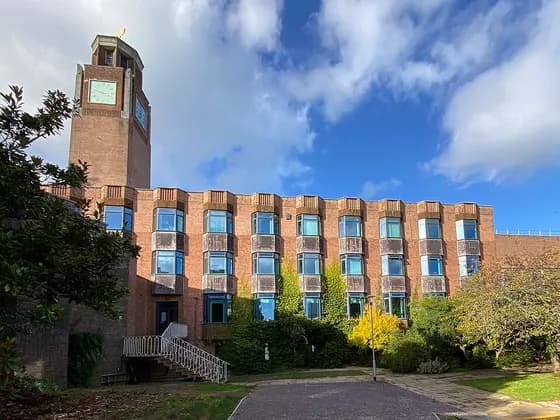


Photo: Benjamin Evans · Public domain · cropped
Photo: Alan Hughes · CC BY-SA 2.0 · Photo: Derivative work from Cathedral_of_exeter.jpg by Markus Koljonen ( Dilaudid ) Ori · CC BY-SA 3.0 · Photo: john bristow · CC BY-SA 2.0
The Exeter medicine course at a glance (2027 entry)
Exeter's medicine degree is the five-year BMBS (Bachelor of Medicine, Bachelor of Surgery), run by the University of Exeter Medical School with NHS partners across Devon and Cornwall. Your first year is based at St Luke's Campus in Exeter. At some point from year 2 onwards, every student spends at least one year, and no more than two, based at the Knowledge Spa on the Royal Cornwall Hospital site in Truro.
The first two years are taught mainly in small groups. Each three-week study unit is built around one medical scenario that your problem-based learning (PBL) group works through. In PBL the case comes first: the group decides what it needs to find out, you each research it between sessions, and you pool what you learned next time.
Patients appear early. You normally meet your first patient within the first few weeks of year 1, on community placements. In year 2 all your placements are in general practice with family doctors (GPs).
The balance then swings towards clinical work. Years 3 and 4, called Clinical Pathways 1 and 2, are each made up of eight rotating clinical blocks in hospitals and the community, with regular academic days for teaching. The final year, Preparation for Medical Practice, places you in five six-week blocks as an apprentice within clinical teams, plus a six-week elective you choose and arrange yourself.
Three themes run through years 1 to 4 and are assessed together: Medical Knowledge, Clinical Practice, and Research and Scholarship. Your knowledge is tested with multiple-choice exams about four times a year. The UK Medical Licensing Assessment (MLA) is the national exam that all UK medical students must pass to graduate and work as doctors. You sit its practical half in year 4 rather than in your final year, and its written half, the Applied Knowledge Test (AKT), in the final year.
| Degree | BMBS (Bachelor of Medicine, Bachelor of Surgery) |
|---|---|
| Course length | 5 years, or 6 with an intercalated degree |
| UCAS code | A100 |
| Main bases | St Luke's Campus, Exeter, and the Knowledge Spa, Truro |
| Time in Cornwall | One to two years based in Truro, possibly from year 2 |
| Teaching style | Problem-based learning in small groups, plus lectures, in years 1 and 2 |
| First patient contact | Normally within the first few weeks of year 1 |
| Anatomy | Imaging, plastinated specimens, human bones, models, living anatomy, computer resources and animal organ dissection |
| Placement area | NHS hospitals and general practices across Devon and Cornwall |
| Intercalation | Optional and competitive, between years 3 and 4 |
What makes Exeter medicine different
A year or two based in Cornwall
Every student is based at the Knowledge Spa in Truro for at least one year and no more than two, and for some students this starts in year 2. You have to move to Cornwall for that time. Some medical students live in Truro and others on the Penryn Campus near Falmouth.
Three-week PBL units in the first two years
Years 1 and 2 each contain eight three-week study units. Each unit follows one medical scenario through your PBL group, lectures, anatomy and clinical skills sessions and placements. Much of the learning happens in your own research between group sessions, so the format rewards curiosity and steady independent work.
Knowledge tests about four times a year
Exeter tests your medical knowledge with multiple-choice papers about four times a year. Testing this often is meant to show early if you are falling behind, so that help can reach you quickly.
The national clinical exam is done in year 4
You sit the Clinical and Professional Skills Assessment, the practical half of the MLA, in year 4. You rotate through timed clinical tasks, called stations: four at the end of the second term and eight at the end of the third. You must pass it to move into the final year.
Final year as an apprentice in the team
The final year is five six-week clinical blocks in different specialties, where you are embedded in the clinical team and much of your assessment happens on the wards with real patients. One half-day a week is kept for small-group and clinical skills teaching. A personal Educational Supervisor supports you through the year and helps you think about your career.
A research strand with a new theme each year
Research and Scholarship runs alongside the clinical learning. Years 1 and 2 build skills in finding and judging evidence, and year 2 adds global and planetary health. Year 3 looks at the doctor as educator and leader, and year 4 at the medical humanities. In both clinical years the strand ends in an assessed conference.
How Exeter teaches medicine
The course is organised around three themes that run through years 1 to 4. Medical Knowledge covers the biomedical, psychological, sociological and population health sciences. Clinical Practice covers history-taking, examination, communication and procedures. Research and Scholarship covers critical thinking and research skills, and is replaced by the elective in the final year. Professional and ethical behaviour, such as reflection, teamwork, consent and giving and receiving feedback, is developed alongside all three.
Years 1 and 2 are campus-based and case-led. Each year has eight three-week study units and two four-week Scholarship blocks. In a study unit, a medical scenario is explored in your PBL group, and lectures, workshops, anatomy and clinical skills sessions, placements and group reflection all connect to it. The Scholarship blocks switch to lectures and workshops on research methods and judging the quality of evidence.
The Scholarship blocks are run as special study units (SSUs): short blocks in which you study one topic in depth and are assessed on it. In year 2, one SSU covers research and the other global and planetary health. Years 3 and 4 also have short SSU blocks between clinical placements.
From year 3 you learn mainly on placement, meeting patients at home, in GP surgeries and in acute and community hospitals. The General Medical Council (GMC), which regulates doctors in the UK, sets the MLA. Exeter's clinical years use MLA Clinical Cases: patient problems worked through with a clinician, backed by video masterclasses and online resources.
The balance shifts sharply over the five years. Year 1 has 40 hours of placement against 484 hours of lectures, tutorials, workshops and practical sessions. Years 3 and 4 each have 392 hours of placement, and the final year has 852.
The ways you will learn
| PBL groups | Your small group works through a clinical case over several sessions. You prepare for each session, research the case between meetings from biomedical, public health, human science and professional angles, then share what you found. PBL is the centre of each three-week study unit in years 1 and 2. |
|---|---|
| Lectures | Large-group sessions on subjects linked to the case you are studying, often given by outside experts. They support the PBL cases rather than replace them. Lecture hours fall from 135 in year 1 to 14 in the final year. |
| Life Sciences Resource Centre | The Life Sciences Resource Centre (LSRC) is where you learn the structure and function of the body. There is one at St Luke's in Exeter and another at the Knowledge Spa in Truro. The anatomy section below explains the methods used. |
| Clinical Skills Resource Centre | In the Clinical Skills Resource Centre (CSRC) you practise on electronic patient simulators and in mock wards and emergency departments before using the skills on real patients. You learn to take histories, examine patients, interview patients and families, and carry out procedures such as injections, taking blood and basic life support. |
| Professional Development Groups | Small groups where you talk through what you saw on placement and what it means to be a doctor. Year 1 discussions cover topics such as health inequalities, the role of the family, being a patient and what makes a good doctor. Year 2 moves on to risk, change, carers, health beliefs and coping strategies. |
| Academic days in years 3 and 4 | Each of years 3 and 4 includes 22 academic days, alongside your placements, for clinical tutorials, clinical skills and Professional Development Group sessions, plus some applied anatomy sessions, lectures and workshops. Six further days in each year are given to Research and Scholarship lectures and workshops. |
A typical week on the Exeter course
In years 1 and 2 your weeks follow the three-week study unit. The unit starts from one medical scenario that your PBL group explores. Around it sit lectures, workshops, anatomy sessions in the LSRC, clinical skills practice in the CSRC, placement visits and Professional Development Group sessions, all linked to that case.
Across year 1 you have about 247 hours of seminars and tutorials, 135 hours of lectures, 58 hours of workshops, 44 hours of laboratory and practical sessions and 40 hours on placement. You are also expected to do about 676 hours of guided independent study, more than all the timetabled teaching combined. Year 2 has a very similar mix.
How anatomy is taught at Exeter
Anatomy is taught in the Life Sciences Resource Centre, using several methods side by side. You learn the structure of the body from medical imaging, including X-rays, magnetic resonance imaging (MRI) and ultrasound. You also study plastinated specimens, which are real body parts preserved with plastic so they can be handled, along with models and computer-based resources.
The centre also teaches with real human bones and the dissection of animal organs. None of the anatomy methods Exeter lists involves dissecting a human body. The centre has a large collection of anatomical models, which you can also use outside taught sessions when it is open.
Living and surface anatomy mean learning where structures lie by looking at and feeling a living body. Clinicians teach the anatomy that matters most in practice. When you feel able, you are also encouraged to take part in peer physical examination, where students carry out non-intimate examinations on each other to understand anatomy and physiology better.
Anatomy does not stop after year 2. The year 3 and 4 academic days include applied anatomy sessions, which link the structures you learned to the patients you are now seeing.
When you first meet patients at Exeter
You normally meet your first patient within the first few weeks of year 1. Year 1 placements are meant to give you a broad view of health and healthcare. Some are with doctors, and others are with organisations and people involved in health and social care. You talk with patients about what affects their health and bring what you learn back to your Professional Development Group.
In year 2 every placement is in general practice. Going back to the same practice several times shows you continuity of care and how chronic disease and disability are managed over time. These visits build your clinical and communication skills ready for year 3, and year 2 also contains a two-week Preparation for Clinical Placement block.
Throughout the first two years you rehearse skills in the Clinical Skills Resource Centre before using them on real patients. From year 3 you are on placement most of the time, and in the final year you work as part of the clinical team.
Year by year at Exeter
- Year 1
Foundations in a clinical context
You learn the core biological, psychological and social science of medicine through clinical cases, based at St Luke's Campus in Exeter. Clinical skills training and community placements start in the first term. The whole year is one 120-credit module, BMBS Medicine Year 1 (MDC1001). Exeter warns that some module details may change over the coming months, as it makes room for skills teaching it is adding to every degree.
- Two weeks of induction, then eight three-week study units, each built around a medical scenario worked through in your PBL group.
- The units follow the body's systems. In 2025-26 they ran in this order: muscles and bones, immune and lymphatic, nervous, hormones (endocrine) and reproduction, breathing (respiratory), heart and circulation (cardiovascular), kidneys (renal) and gut (gastrointestinal).
- Two four-week Scholarship blocks, run as SSUs, that introduce research and the appraisal of evidence.
- Core clinical skills from the start: basic life support, history-taking, physical examination and patient-centred communication.
- Community placements with doctors and other health and social care professionals, discussed afterwards in your Professional Development Group.
- Marks come from a 50-question exam (an eighth of the mark), a 100-question exam lasting 2 hours 45 minutes (three eighths) and two written reviews with commentary and analysis (half).
- Practice assessments that do not count: two 100-question multiple-choice papers, eight quizzes, two workplace case studies and two four-station Objective Structured Clinical Examinations (OSCEs), circuits of timed clinical tasks watched by an examiner.
- Year 2
Deeper science and general practice
Year 2 builds on the science of year 1 in a more integrated way and widens your clinical skills. It is based mainly at St Luke's, though some students are based in Truro from year 2. All your placements are in general practice. The year is one 120-credit module, BMBS Medicine Year 2 (MDC2001).
- Induction, eight three-week PBL study units, two four-week Scholarship blocks and a two-week Preparation for Clinical Placement block.
- The units are built around wider themes. In 2025-26 they were Host Defence, Movement and Control, Oxygen Supply and Exchange, Metabolism, Development, Carcinogenesis (how cancers form), The Mind, and Ageing and Staying Well.
- Repeated visits to the same GP practice, following patients with chronic disease and disability over time.
- Research and Scholarship in more depth, with one SSU on research and one on global and planetary health.
- Knowledge exams: two 100-question multiple-choice papers (5% each), an 80-question exam (about 9%) and a 100-question exam (14%).
- Three four-station OSCEs that now count, each worth about 11% of the year's mark.
- A group exercise or presentation and a poster, each worth about a sixth of the mark.
- Year 3
Clinical Pathways 1
Your learning moves into the clinical environment at one of the school's hospital trust sites, in Exeter or in Cornwall. You rotate through hospital and community placements. By the end of the year you should be familiar with managing core conditions and able to handle common emergencies. The year is one 120-credit module (MDC3001).
- A two-week induction, then eight rotating clinical blocks of four weeks each, plus two scholarship weeks and an assessment week.
- Across years 3 and 4 the placements cover medicine, surgery, general practice, reproductive health, mental health and other hospital specialties.
- 22 academic days of tutorials, clinical skills and Professional Development Group sessions, plus applied anatomy and six Research and Scholarship days.
- Research and Scholarship theme: the doctor as educator and leader, through a year-long assignment that ends in an assessment conference.
- Four 100-question, two-hour multiple-choice papers and three four-station OSCEs, each worth about 8% of the mark.
- Six must-pass workplace-based assessments (about 8%), plus 1,000 words of reflective writing and a presentation or A3 poster, each worth about a sixth.
- Practice on placement: eight clinical evaluation exercises, where a supervisor watches you with a patient, and 16 case-based discussions, where you talk a clinician through a patient.
- Year 4
Clinical Pathways 2
Year 4 continues the rotating clinical blocks across a wider range of specialties, again based in Exeter or Cornwall. Focus areas include acute care, long-term (chronic) illness, child health, and caring for people with cancer or with illnesses that cannot be cured (oncology and palliative care). This is also the year you sit the practical half of the MLA. It is one 120-credit module (MDC4001).
- An induction week, eight rotating clinical blocks across three clinical pathways, two scholarship weeks and an assessment week.
- 22 academic days of tutorials, clinical skills and Professional Development Group sessions, plus applied anatomy and six Research and Scholarship days.
- Research and Scholarship theme: the medical humanities, explored across the year and ending in an assessment conference.
- The Clinical and Professional Skills Assessment: a four-station OSCE (5%) and an eight-station OSCE (10%), which you must pass to enter the final year.
- Four 100-question multiple-choice papers, each worth about 8% of the mark.
- Must-pass assessment on placement: 16 case-based discussions, eight clinical evaluation exercises and six further workplace exercises, each set worth about 6%.
- Reflective writing and a presentation or poster, each worth about a sixth of the mark.
- Year 5
Preparation for Medical Practice
The final year prepares you to start work as a Foundation Year 1 doctor, the first job after graduating. You work as an apprentice embedded in clinical teams in hospitals and general practice across the South West and beyond, supported by a personal Educational Supervisor. The year is one 145-credit module (MDC5001).
- An induction programme, then five rotating clinical blocks of six weeks, each in a different specialty and centred on managing common conditions within the team.
- A six-week elective that you choose and arrange yourself, in the UK or abroad.
- One half-day a week of small-group teaching, specialist sessions and Clinical Skills Resource Centre work.
- A 200-question multiple-choice exam, sat as two two-hour papers and worth a third of the mark. This is the national Applied Knowledge Test, the written half of the MLA.
- Four sets of must-pass assessments on real patients and at work, including eight case-based discussions and eight clinical evaluation exercises, each set worth 12.5%.
- Must-pass feedback from your supervisors (about 9%) and a written plan for a project or assignment (8%).
- You apply for a Foundation Year 1 post during this year through the UK Foundation Programme Office's national scheme. The BMBS then gives you provisional registration with the GMC.
How you are assessed at Exeter
Assessment at Exeter is frequent and spread through the year, so that anyone who is struggling is spotted early and helped quickly. Knowledge is tested mainly through the Applied Medical Knowledge (AMK) test, a multiple-choice exam taken about four times a year. In 2025-26 the sittings fell in October, January, March and May.
The AMK is designed to measure lasting, practical knowledge rather than what you can cram at the last minute. After each test you see your grade and percentage score next to the average for that test. The GMC's 2024 report calls these progress tests, meaning repeated exams that track how your knowledge grows. It also notes that Exeter no longer uses negative marking, where wrong answers lose marks.
Practical skills are tested in OSCEs. They are practice only in year 1. In each of years 2 and 3 you sit three four-station OSCEs that count towards your mark. From year 3 more of your assessment happens on placement, through clinical evaluation exercises, case-based discussions and other workplace tasks, many of them must-pass.
Assessors giving feedback on your professionalism are registered doctors or nurses. Professional behaviour is tracked across the whole course through professional judgement records, which a Professionalism Panel reviews each term. At the end of each year your whole performance is reviewed before you move up.
The MLA has two parts, and Exeter builds both into the course. The practical part, the Clinical and Professional Skills Assessment (CPSA), is sat in year 4. The GMC's 2023 review describes the design used from 2024: a four-station circuit at the end of term 2 and an eight-station circuit at the end of term 3. Stations last 20 minutes with two minutes' reading time, you sit four a day, and the exam runs in both Exeter and Truro.
In the year 4 clinical exam, real patients and simulated patients, people trained to play a patient, take part. The GMC's review said simulated patients did not mark you but could give written feedback, and students who failed a termly OSCE were offered extra clinical skills teaching. The pass mark is set at the level of a doctor starting Foundation Year 1, and you must also pass a minimum number of stations. The resit is 12 stations over two days.
- The written part of the MLA, the AKT, is set nationally through the Medical Schools Council and replaced Exeter's own final-year knowledge tests. It is two computer-based papers of 100 questions, two hours each, on consecutive days. In 2025-26 final-year students sat it on 4 and 5 March.
- The AKT uses single best answer questions, which give you a short clinical scenario and a list of options from which you pick the one best answer.
- Final-year students are signed up to the national exam platform in the autumn of year 5 so they can sit a practice paper before the real AKT.
- Final-year students also sit the Prescribing Safety Assessment (PSA), which the GMC's 2024 report lists among Exeter's final-year assessments. The PSA is a national online exam on prescribing medicines safely, and you must pass it to complete your first foundation year. In 2025-26 it fell on 29 January.
Where you will actually be at Exeter
Placements are with NHS organisations across Devon and Cornwall, in coastal, rural and urban settings. Year 1 is based at St Luke's Campus, a short walk from Exeter city centre and close to the Royal Devon and Exeter Hospital, and its placements are in the community. From year 2 you may be based either at St Luke's or at the Knowledge Spa in Truro. All year 2 placements are in general practice.
In years 3 and 4 you are based either at the Royal Devon and Exeter site in Exeter or at the Royal Cornwall Hospitals site in Truro. From there you rotate through hospital and community placements across Devon or Cornwall. Final-year bases are Exeter, Truro, Barnstaple or Torbay, and the final year can take you to placements across the South West and beyond.
Every student spends at least one year, and no more than two, based at the Knowledge Spa in Truro, and you must move to Cornwall for that time. Your campus rotation is given to you after you enrol on the course.
In Cornwall, some medical students live on the Penryn Campus near Falmouth and others in Truro. Students based in Truro can use Penryn's social and support facilities. The Knowledge Spa sits on the edge of the Royal Cornwall Hospital (Treliske) site, a 25 to 30 minute walk or 10 to 15 minutes by bike from Truro station. Several buses stop at the hospital, and on-site parking is paid and busy, so the Langarth Park and Ride is the easier option by car.
Getting to placements can cost you money, and Exeter warns of travel costs in every year of the course. From year 3 the medical school's travel policy offers financial support, and in the final year travel to and from placement is refunded in line with that policy.
Your base for year 1, and one of the two possible bases from year 2 to year 4. Exeter is also a final-year placement location.
- St Luke's Campus, Heavitree Road
- Royal Devon and Exeter Hospital, Wonford site, including the RILD building
- Heavitree Hospital site (Exeter Clinical Skills Resource Centre)
- Royal Devon University Healthcare NHS Foundation Trust (partner trust)
Every student is based here for at least one year and at most two. It is a base for some students from year 2, one of the two bases for years 3 and 4, and a final-year location.
- Knowledge Spa, Royal Cornwall Hospital (Treliske), Truro
- Royal Cornwall Hospitals NHS Trust (partner trust)
- Penryn Campus, near Falmouth (student facilities and housing)
A final-year placement location.
- Torbay and South Devon NHS Foundation Trust (partner trust)
A final-year placement location in north Devon.
GP and community placements run from year 1 to the final year, including every year 2 placement.
- GP practices across Devon and Cornwall
- Devon and Cornwall Partnership Trusts
Electives and chosen modules at Exeter
The main elective comes in the final year: a six-week period that you choose and arrange yourself. It can be clinical, research-based or a mix of both, in the UK or anywhere in the world. Some students go to low- and middle-income countries to see care in mission or government hospitals, while others stay in the South West or elsewhere in the UK. Your plan needs agreed learning objectives and must pass clinical and health and safety risk assessments.
Choice appears earlier too. In the Research and Scholarship strand you pick an area to study in depth within each year's theme. The themes are research and global and planetary health in year 2, education and leadership in year 3, and the medical humanities in year 4.
Exeter also has a link with Wollega Medical School in Ethiopia. Its international placements information, parts of which predate the current course, describes several two-week placements a year there for year 3 and 4 students. They combine clinical experience with helping to teach Wollega's own medical students.
Outside the timetable, Exeter runs the local branch of INSPIRE, a national Academy of Medical Sciences scheme that introduces students to research, together with Bristol, Cardiff and Plymouth. It offers half-day research taster visits, usually on Wednesday afternoons from late November to the end of January, with travel between Truro and Exeter refundable. Funded summer research studentships of up to four weeks were open to Exeter students in years 1 to 4 in the 2025 round.
Intercalation at Exeter
Intercalating means taking a year out of medicine to complete a separate degree, which adds a year to the course. At Exeter it is optional and taken between years 3 and 4. You either study 120 credits from another bachelor's degree, usually its final year, or a one-year master's degree.
Places go to the highest-performing students on year 3 assessments. Roughly the top quarter of the year receive an automatic offer, and the second quarter compete for any remaining places. A small number can apply to intercalate elsewhere in a subject Exeter does not offer, for example at the London School of Hygiene and Tropical Medicine.
The Exeter options below are subject to availability. Conservation Biology, Evolutionary Biology and Zoology are taught at the university's Cornwall campus; the others are taught in Exeter.
- BSc options: Biological Sciences, Biomedical Sciences, Conservation Biology, Evolutionary Biology, Exercise and Sports Science, Infectious Disease, Molecular and Cellular Science, Neuroscience, Psychological Studies and Zoology.
- Master's options: MSc Bioarchaeology, Clinical Education, Environment and Human Health, Extreme Medicine, Genomic Medicine, Global Healthcare Management, Health Data Science, Health Research Methods, Sports and Exercise Medicine, and the Master of Public Health (MPH).
Facilities and support at Exeter
Where you will learn
At St Luke's Campus in Exeter the medical school has the Life Sciences Resource Centre, a Medical Imaging suite and a Medical Sciences Laboratory. The Exeter Clinical Skills Resource Centre, with its electronic patient simulators and mock wards and emergency departments, is on the Heavitree Hospital site.
The Research, Innovation, Learning and Development (RILD) building is on the Wonford hospital site, close to St Luke's. It is a partnership between the university and the local NHS trust, which has since become part of Royal Devon University Healthcare NHS Foundation Trust. It houses the Postgraduate Education Centre, the Wellcome Wolfson Medical Research Centre and the National Institute for Health and Care Research (NIHR) Exeter Clinical Research Facility.
In Truro, the Knowledge Spa gives medical students a lecture theatre, seminar rooms, a common room, the Cornwall Health Library, a second Life Sciences Resource Centre and the Constance Fozzard Clinical Skills Suite. The building is also the Cornwall base for the University of Plymouth's Peninsula School of Dentistry and its nursing school.
Support while you study
Every student has an academic tutor who oversees academic progress and personal and professional development, and who is your first point of contact for academic support. You change tutor each year. In the final year a personal Educational Supervisor supports you on placement and helps you think about your career.
Your assessment results are reviewed every term so that problems are spotted early. If you need help, you are referred to trained staff and receive a confidential report with advice on study techniques, assessment strategies and your approach to work. Students who are not ready to progress may be asked to repeat a year, and you are given chances to reflect and improve before anyone is asked to leave on academic grounds.
Professional Development Groups in years 1 to 4 give you a regular small-group space to talk through placement experiences. The GMC's 2024 report says students who fail the AKT are offered support, including from a Progress Support Team. Careers sessions and events are run with the regional NHS body that oversees doctors' training in the South West. If you are interested in a research career, the INSPIRE team may be able to help you find a local clinical academic to mentor you.
Is the Exeter course right for you?
This course may suit you if
- You learn well by working through a case in a small group and researching the gaps yourself, since years 1 and 2 are built on three-week PBL units.
- You want to meet patients in your first term and follow people with long-term conditions through repeated GP visits in year 2.
- You would enjoy living in two parts of the South West, with at least a year based in Truro, Cornwall.
- You like frequent feedback: knowledge tests about four times a year show your score next to the average for each test.
- You are curious about medical education, leadership or the humanities, which get year-long assessed strands in years 3 and 4.
Things to think about
- You must move to Cornwall for at least one year and possibly two, which can start as early as year 2. Your campus rotation is allocated after you enrol rather than chosen.
- If dissecting a human body matters to you, note that none of the anatomy methods Exeter lists involves it. Anatomy uses imaging, plastinated specimens, human bones, models, living anatomy and animal organ dissection.
- PBL relies on self-direction: year 1 expects about 676 hours of independent study, more than all the timetabled teaching combined.
- Intercalation is competitive. Only about the top quarter on year 3 results get an automatic place, and the second quarter compete for what remains.
- Final-year bases include Barnstaple and Torbay as well as Exeter and Truro, so you may need to travel or live away for some blocks. Placement travel can cost you money, though from year 3 the school's travel policy gives financial support.
Exeter medicine course — frequently asked questions
Applying to Exeter?
How to get into Exeter
Entry requirements, UCAT, personal statement and interview, step by step.
Open the guide →Exeter UCAT cut-offs and offers
UCAT cut-offs, A-level offers, interview format and decision dates.
See the requirements →Compare Exeter with other schools
Put the teaching style, anatomy teaching and placements next to another school.
Open the comparison →Prepare for the Exeter interview
Format breakdown, school-specific sample questions and prep tips from tutors who interviewed here.
Read the guide →Where this Exeter course guide came from
This guide was written from 18 official sources — University of Exeter Medical School's own course pages and programme documents, plus the regulator and NHS placement partners where they publish detail — read on 2026-09-23, then checked claim by claim against those sources.
- BMBS Medicine course page, University of Exeter (2027 entry)
- BMBS Medicine FAQs, University of Exeter
- Early clinical experience, University of Exeter Medical School
- International placements, University of Exeter Medical School
- Module MDC1001 BMBS Medicine Year 1, Exeter study guide 2026-27
- Module MDC2001 BMBS Medicine Year 2, Exeter study guide 2026-27
- Module MDC3001 Clinical Pathways 1, Exeter study guide 2026-27
- Module MDC4001 Clinical Pathways 2, Exeter study guide 2026-27
- Module MDC5001 Preparation for Medical Practice, Exeter study guide 2026-27
- The Life Sciences Resource Centre, University of Exeter Medical School
- Our campuses, BMBS Medicine, University of Exeter Medical School
- BMBS annual timetable 2025-26, years 1 to 5, University of Exeter Medical School
- Our locations, University of Exeter Medical School
- Truro Campus, the Knowledge Spa, University of Exeter
- NHS and research partnerships, University of Exeter Medical School
- INSPIRE research programme, University of Exeter
- GMC compliance decision on Exeter's MLA Clinical and Professional Skills Assessment (October 2023)
- GMC compliance decision on Exeter's MLA Applied Knowledge Test (June 2024)
Courses are restructured between cycles. Anything here that decides your application — an anatomy offer, a placement city, a compulsory intercalated year — should be confirmed against the official page for your entry year.
Applying to Exeter?
We have helped hundreds of applicants turn their UCAT, personal statement and interview prep into offers from Exeter and other UK medicine schools.