
The Kent and Medway (KMMS) Medicine course
What you actually study, and where you will be
Kent and Medway's BM BS is a 5-year course with an integrated curriculum, with patient contact from Year 1 and placements in Kent and Medway (2027 entry). A joint school — the degree is awarded by the University of Kent and Canterbury Christ Church University together. Clinical learning starts in year 1 through community and primary care, and year 4 carries a mandatory individual research project.
- Degree
- BM BS
- Length
- 5 years
- Teaching
- Integrated
- Clinical contact
- Year 1
- UCAS code
- A100

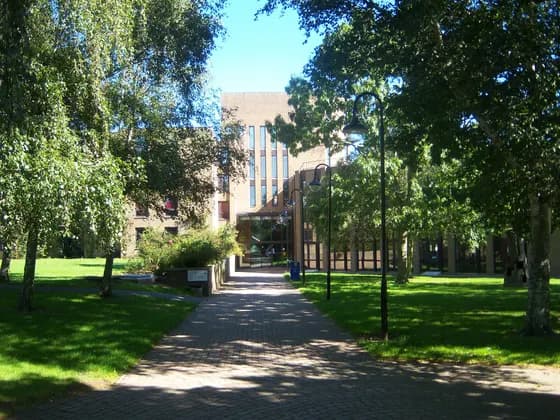
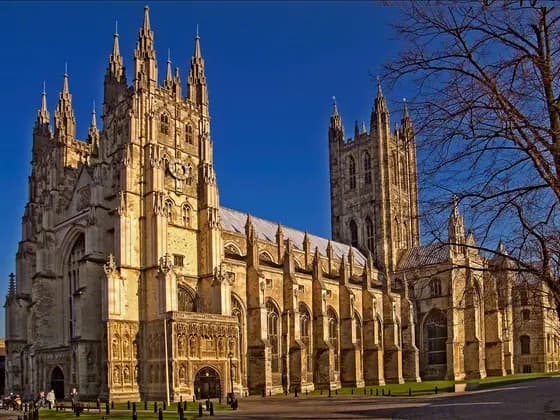
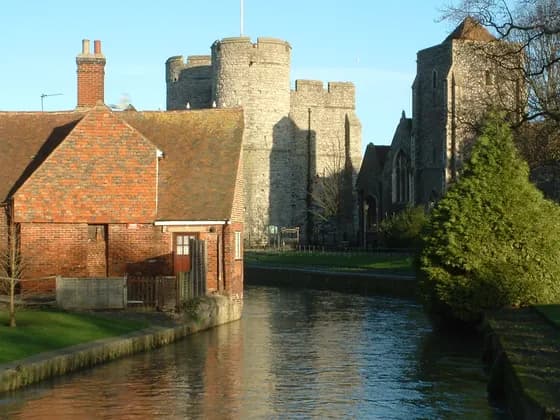
Photo: St BC / Wikimedia Commons · CC BY-SA 3.0 · cropped
Photo: St BC ( talk ) · CC BY-SA 3.0 · Photo: Antony McCallum: Who is the uploader, photographer, full copyright owner and pro · CC BY-SA 4.0 · Photo: Necrothesp · CC BY-SA 3.0
The Kent and Medway (KMMS) medicine course at a glance (2027 entry)
Kent and Medway Medical School (KMMS) teaches a five-year Bachelor of Medicine, Bachelor of Surgery (BM BS) in Canterbury. The school is a partnership between Canterbury Christ Church University and the University of Kent, and your degree is awarded jointly by both. KMMS took its first students in September 2020. In April 2025 it gained full accreditation from the General Medical Council (GMC), the body that regulates doctors and medical degrees in the UK.
The course is based on the integrated curriculum of Brighton and Sussex Medical School, adapted for Kent. Integrated means science and clinical practice are taught together rather than in separate halves. In the first two years you work through the body one group of systems at a time, such as the heart, lungs and blood, while also learning clinical skills and professional practice.
Patients appear early, with week-long GP placements from the first term of Year 1. From Year 3 the focus moves to hospitals. For most of each year you then live and study in the part of Kent or Medway served by the NHS hospital trust you are placed with.
Day to day, Years 1 and 2 are spent mostly on the two Canterbury campuses, which are about 15 minutes apart by bus. The school is small, with just over 500 medical students across all five years. Research is part of every student's course, through a Year 3 research module and a Year 4 individual research project.
| Degree | BM BS, awarded jointly by Canterbury Christ Church University and the University of Kent |
|---|---|
| Course length | 5 years, full time |
| UCAS code | A100 at institution code K31 |
| Main campus | The two university campuses in Canterbury, Kent |
| School size | Just over 500 medical students across all years |
| Teaching style | Systems-based integrated curriculum adapted from Brighton and Sussex Medical School |
| Anatomy | Cadaveric dissection and prosection, with radiology, in Years 1 and 2 |
| First patient contact | One-week GP placement in the first term of Year 1 |
| Placement area | Kent and Medway, based at one acute hospital trust from Year 3 |
| Intercalation | Optional; usually one extra year after Year 3 or 4, longer for a PhD |
| GMC status | Full GMC accreditation since April 2025 |
What makes Kent and Medway (KMMS) medicine different
Six weeks in general practice in each early year
Years 1 and 2 each include six one-week placements in a primary care network, a group of neighbouring GP practices that work together. Each week is themed on the module you are studying at the time: in Year 1, weeks three and four focus on the heart, lungs and blood.
A year-long base in one hospital trust
From Year 3 you are based mainly in and around one acute hospital trust, the NHS organisation that runs a group of local general hospitals. You live in that area for most of the year, so you get to know one set of hospital teams and patients over a long stretch. A Clinical Academic Tutor, usually a senior clinician at a local trust, supports you from Year 3.
Dissection in the anatomy learning centre
In Years 1 and 2 you learn anatomy hands-on in the anatomy learning centre, by dissecting bodies donated for medical education as well as studying ready-prepared specimens and medical images.
Research built into every student's course
All students take Principles of Clinical Research and Scholarship in Year 3, which follows how scientific discoveries reach patient care. In Year 4 the Individual Research Project gives you 30 credits to investigate a question in depth and write it up in a scholarly format. More than 150 of these projects were completed in the module's first two years.
A student of two universities
Because KMMS belongs to Canterbury Christ Church University and the University of Kent, you are a student of both. You can use both universities' libraries and facilities, you are a member of both students' unions, and you can choose first-year accommodation on either campus. You are usually housed alongside other medical or healthcare students.
How Kent and Medway (KMMS) teaches medicine
KMMS describes its course as systems-based and integrated. In Years 1 and 2 each science module covers one group of body systems. Every module draws on a shared set of ten curriculum threads, which the school calls Fundamental Tracks. Subjects such as pathology and pharmacology therefore come up in module after module rather than being taught once.
The ten tracks are anatomy; biomedicine; ethics, law and professionalism; human behaviour; pathology; person and population health; pharmacology and therapeutics; physiology; professional and clinical skills; and scholarship and scientific enquiry. Alongside three science modules, each of the first two years has a clinical skills module, a module on professional development and person-centred practice, and a module built around your GP placements. Person-centred means treating the patient as a whole person with their own priorities, not just a condition.
From Year 3 most of your learning happens on placement rather than on campus. Central teaching continues alongside it, for example psychiatry teaching days in Year 3 and weekly online sessions during Year 4 general practice blocks. You also learn about leadership and teamwork with students from other years and from other courses at the Canterbury campuses.
Patient educators, people who share their own experience of illness and care, take part in teaching throughout the course and give you feedback on your skills. Learning is also anchored in individual patient studies, which tie knowledge and professional values to real people's circumstances. The course trains digital skills too, including using electronic patient records and the principles of bioinformatics, the use of computing to handle biological data.
The ways you will learn
| Lectures | Large-group teaching for the core science of each module. Lecturers often post their slides and recordings on the online learning environment, which also holds videos, quizzes and interactive cases. |
|---|---|
| Tutorials, clinical seminars and workshops | Small-group sessions with a tutor, where you discuss topics, work through problems and apply what you have learned. The school lists these as core formats in Years 1 and 2, alongside lectures. |
| Team-based learning | A structured small-group method that KMMS lists among its teaching formats. In team-based learning you prepare material in advance, are tested on it first on your own and then as a team, and then use it together to solve realistic problems. |
| Clinical skills and simulation | You practise examinations, procedures and communication in the school's simulation suites, which are set up like hospital and GP settings. Practising here first means you arrive on placement already familiar with the equipment and routines. |
| GP immersion weeks | Week-long placements in a primary care network in Years 1 and 2, supervised by GP educational supervisors, where you use the clinical skills taught on campus with real patients. |
| E-learning and self-directed study | Online e-modules and virtual microscopy support campus teaching. Self-directed learning, split between the university and healthcare settings, gives you time to study topics in more depth and build your academic skills. |
A typical week on the Kent and Medway (KMMS) course
The University of Kent's course page shows a sample week from the first term of Year 1. Days start at 9am and finish by about 4pm, and most of the time goes on lectures for the first science module, Foundations of Health and Disease. Small-group workshops fill Tuesday and Thursday afternoons and Friday morning, with a seminar on Friday afternoon.
Wednesday is different. The morning has lectures for the general practice and clinical skills modules, and the afternoon is free; KMMS says Wednesday afternoons are usually kept clear for sport, societies and other university activities. On Thursday there is also a workshop for the professional development module. Small-group sessions may fall at other times depending on your group.
The same page gives Year 1 contact hours. Across the year you have about 150 hours of lectures, 125 of workshops, 78 of seminars and 158 on placement, plus smaller amounts of practical classes, simulation, tutorials and drop-in sessions. In total the year has just under 700 timetabled hours.
Six weeks a year look different, because you spend them at your GP placement instead of on campus. The first includes an induction to your primary care network. Each week starts and ends with a meeting with the network's Lead Educational Supervisor, who oversees your placement and runs joint teaching sessions. In between, you attend clinics and services with a range of healthcare professionals.
During the week you meet selected patients whose conditions fit the theme, join case-based group sessions and go to specialised clinics. Supervisors are asked to protect teaching time, both with patients and away from them. As you progress, you are expected to work more independently and to practise skills repeatedly until you are competent.
How anatomy is taught at Kent and Medway (KMMS)
Anatomy is taught within the body-system modules of Years 1 and 2. KMMS uses cadaveric dissection, where students dissect a human body donated for medical education, and prosection, where you study specimens that have already been dissected by experts to show particular structures. The University of Kent's course page describes this as full-body dissection.
Teaching takes place in the anatomy learning centre, which is equipped for dissection, prosection and radiology. Radiology is medical imaging, such as X-rays, CT and MRI scans. Learning it next to real specimens helps you recognise structures the way you will later see them on patients' scans. Digital media are also used in the dissection lab.
Anatomy does not stop after Year 2: it is one of the Fundamental Tracks that the final-year Finals module builds on. Virtual microscopy, where you examine digitised tissue slides on screen, and radiology are used in lectures, tutorials and clinical placements to give a fuller picture of a patient's illness.
When you first meet patients at Kent and Medway (KMMS)
Your first clinical placement comes in the first term of Year 1, usually in early November; in 2026-27 the first Year 1 placement week begins on 9 November. You join a primary care network in a group of six to eight students and stay with it for all six placement weeks of the year.
In Year 1 the placements show you the professionals, services and care pathways that support patients and their carers outside hospital. In Year 2 the focus moves to people with long-term conditions and how their care is joined up. Where possible you move to a different network for each year, so you see different patient populations and ways of working.
From Year 3 you work in hospitals and mental health services, based mainly at one acute trust, and general practice returns in Years 4 and 5. By Year 5 your placements are aimed at preparing you for the role of a junior doctor, including deciding when a patient in the community needs to be referred to hospital.
Year by year at Kent and Medway (KMMS)
- Year 1
Foundations of health and disease, and first GP weeks
Year 1 has six 20-credit modules. Three cover the science of the body, starting with its basic structure and function and then two groups of systems. The other three build clinical skills, professional practice and your experience in general practice.
- Foundations of Health and Disease: the structure and function of the body, how people develop psychologically from infancy to adulthood, and the basic principles of disease and diagnosis.
- Heart, Lungs and Blood, then Nutrition, Metabolism and Excretion: how these systems work, their common and serious diseases, how they are diagnosed and the principles of treatment.
- Skills for Clinical Practice 1 prepares you for learning in clinical settings. Professional Development and Person-Centred Practice 1 looks at the needs of patients, of you as a practitioner and of the wider healthcare team.
- Community and Primary Care in Practice 1: your GP placement weeks, themed in turn on Foundations of Health and Disease, Heart, Lungs and Blood, and Nutrition, Metabolism and Excretion.
- The GP module is assessed through a small-group presentation and a quality improvement project, where you look at how one part of patient care could be improved.
- Written knowledge tests for the science modules. The year ends with an Objective Structured Clinical Examination (OSCE), a practical exam made up of timed stations, each testing one clinical or communication task.
- Year 2
More body systems and long-term conditions
Year 2 follows the same six-module pattern at a higher level. The science modules move on to the nervous system, reproduction and hormones, and the musculoskeletal and immune systems. Your GP weeks now centre on people living with long-term conditions.
- Neuroscience and Behaviour: the nervous system in health and disease, how the brain develops, and the changes that come with ageing, including degeneration.
- Reproduction and Endocrinology: the reproductive system, foetal development, pregnancy and birth, and the endocrine (hormone) system, with their common and serious diseases.
- Musculoskeletal and Immune Systems: the science of bones, joints, muscles and immunity, and how it explains the diagnosis and basic management of related diseases.
- Community and Primary Care in Practice 2: your Year 2 GP weeks, assessed through a student-selected project on managing long-term illness and through workplace-based assessments. In these a supervisor assesses you doing real tasks, and the results go in your ePortfolio, an online record of your progress.
- Skills for Clinical Practice 2 continues your preparation for clinical settings, and Professional Development and Person-Centred Practice 2 turns to patients with more complex needs.
- Year 3
Fundamentals of secondary care
Year 3 moves you into hospital-based care, known as secondary care, while you live near the acute trust you are placed with. It has three modules: a large 80-credit clinical module, a 10-credit research module and a 30-credit module that brings the year's learning together.
- Fundamentals of Secondary Care (80 credits): how care is delivered in hospitals, with the core clinical knowledge and skills you need to work safely as a future doctor.
- Principles of Clinical Research and Scholarship (10 credits): how knowledge moves from laboratory science to patient care, and how evidence is generated, judged and used in practice.
- Integrated Practice 1 (30 credits) joins up knowledge and skills across the year. The end-of-year knowledge test and OSCE use sequential testing, where students who have not clearly passed the first part sit a second part.
- Hospital work is split into rotations. A Year 3 student's account on the KMMS site from March 2026 describes a surgery rotation at the East Kent trust, working alongside a placement partner, followed by a medical rotation.
- That surgery rotation included theatres, clinics, lectures and grand rounds, which are hospital-wide teaching meetings. It also included case-based discussions, where you talk a patient's case through with a supervisor.
- Psychiatry teaching comes from the Kent and Medway Mental Health NHS Trust on eleven Thursdays, six in the autumn and five between January and June. On each, you spend half the day studying set materials on your own and the other half in a face-to-face session that builds on them.
- Psychiatry placement mornings run on Mondays, Tuesdays and Wednesdays. Halfway through your psychiatry rotation you swap location, so every student has both a ward placement and a placement with a community team.
- Year 4
Specialist rotations, general practice and research
Year 4 is a larger year of 180 credits and starts earlier, in early September. You rotate through specialties mainly in hospital, spend a block in general practice, complete your Individual Research Project and finish with an integrated end-of-year assessment.
- Specialist Rotations (80 credits): how care is delivered in each specialty, mainly in hospital but also in some community settings.
- General Practice and Public Health Medicine (30 credits): the breadth of general practice and how it links with specialist services. It also covers public health ideas such as social causes of disease, global disease burden and access to care.
- The GP block lasts seven weeks: one week of campus teaching, then six weeks on placement in pairs, with sessions in optometry and at a hospice and online teaching on Wednesday mornings.
- The GP module is assessed through reflective ePortfolio entries and a case-based discussion given as an individual oral presentation.
- Individual Research Project (30 credits): you study a health-related question in depth, apply research methods and present your results in a scholarly format.
- Integrated Practice 2 (40 credits) assesses the whole year through an end-of-year knowledge test and OSCE. You must pass the year's three other modules to sit it.
- Year 5
Senior rotations and Finals
The final year, set at Level 7 (master's level) on the national qualifications framework, prepares you to work as a junior doctor. It starts in late August and has two modules: Senior Rotations (80 credits) and Finals (100 credits), which includes your licensing exams and the elective.
- Senior Rotations aims to sharpen your clinical, diagnostic and management skills and move you towards the role of a junior doctor.
- Primary care: a three-week block, usually in a community setting, with a day of central teaching each week. It focuses on managing uncertainty and caring for patients in the community at the level of a foundation doctor (a newly qualified doctor in their first two years of paid training).
- Psychiatry: three weeks with the Kent and Medway Mental Health NHS Trust. It includes eight days under a consultant psychiatrist, a session with the liaison psychiatry team, who see patients on general hospital wards, and two Tuesdays of teaching and simulation. You also sit workplace-based and written communication assessments.
- Finals brings together everything you have learned and includes self-directed study on topics of professional interest. It contains the national knowledge test, the final clinical exam and the Prescribing Safety Assessment, a national online test of safe prescribing.
How you are assessed at Kent and Medway (KMMS)
KMMS uses two kinds of assessment. Formative assessments are practice runs whose results only give you feedback. Summative assessments count towards whether you pass. Every major summative assessment is preceded by a formative one in the same format, so you are never seeing a format for the first time when it counts.
You must pass every module in a year to move on to the next year or to graduate. The knowledge tests in the Year 1 and 2 body-system modules have in-year resits. The OSCEs at the end of every year, and the end-of-year knowledge tests in Years 3 and 4, use sequential testing instead. Everyone sits a first sequence, and students who have not clearly met the standard sit a second one, so there is no separate in-year resit.
A failed year can usually be repeated, but under the 2026 regulations, failing the same year twice, or failing a third year, ends your place on the course. You have at most ten years to finish, or longer if you intercalate. If you leave early, you can receive a Certificate of Higher Education in Medical Science after Year 1, a Diploma after Year 2 or a Bachelor of Medical Science (BMedSci) after Year 3.
Since the 2024-25 academic year, a UK medical degree only counts as a qualification to register as a doctor if it includes a pass in the Medical Licensing Assessment (MLA), often called the UKMLA. It has two parts. The Applied Knowledge Test is set nationally by the Medical Schools Council as two papers of 100 single best answer questions, two hours each, on consecutive days. It is pitched at the level of a doctor in their first week of the Foundation Programme, the training new doctors start after graduating.
The second part, the Clinical and Professional Skills Assessment, is KMMS's own final-year OSCE, checked against GMC requirements. In the plan KMMS submitted in 2022, which the GMC approved in 2024, it is a 20-station sequential OSCE. The first sequence has 12 stations over two days; an extra 8 stations follow about eight to ten days later for students below the standard. Stations last 12 minutes, with a minute and a half of reading time.
In that plan, simulated patients and healthy volunteers can award up to two marks per station, and all candidates get written feedback within about three working days of the first sequence. Failing the whole sequence usually means repeating the year. The GMC's 2024 report on KMMS's final knowledge test also lists the other parts of Finals. They are the Prescribing Safety Assessment, an ePortfolio, a clinical activity logbook, case-based discussions, workplace-based assessments, an Immediate Life Support resuscitation course and an elective report, and each must be passed on its own.
- Applied Knowledge Tests: online papers of single best answer questions, where you choose the best of five options, and very short answer questions, where you type a brief answer. All are sat in the same campus building on the platform used for the national MLA test.
- OSCEs: stations marked by clinical examiners on iPads in the simulation suite at Christ Church. The format works much like the multiple mini interviews used in admissions, where you move round short timed stations.
- Essays and reports for coursework on scholarly and scientific skills.
- An ePortfolio for coursework, workplace-based learning and records of attendance and engagement, which count towards professionalism.
- Individual or small-group oral presentations of projects.
- Case-based discussions in the senior years, where you present and discuss a patient case from your placement.
- The Year 4 knowledge test uses the same timings as the national MLA knowledge test.
Where you will actually be at Kent and Medway (KMMS)
For the first two years your placements are in primary care networks across Kent and Medway, so placement weeks can mean travelling from Canterbury to other towns. KMMS works with GP practices across the region and with community providers such as urgent treatment centres and hospices. Its partners page also lists 13 community hospitals, four mental health care providers and one ambulance trust.
From Year 3 to Year 5 you are based mainly in and around one of the four acute hospital trusts in Kent and Medway. You live for most of the year in the part of the region linked to that trust, rotating through medical, surgical and other specialties there. The Kent and Medway Mental Health NHS Trust runs psychiatry placements across the county.
KMMS's travel and accommodation policy for 2026-27 sets out who pays. In Years 3 to 5, accommodation near your hospital placement is provided during placement weeks, including weekends and holidays, and paid for from NHS England funding for student placements. KMMS also refunds one trip from the university to the trust at the start of a placement and one back at the end.
In Year 5, accommodation is funded only for placement weeks up to 24 April 2027. For the Easter break and the exam period you arrange and pay for your own.
For GP placements, travel is refunded at set rates. In Years 1 and 2 you claim the cost above your normal journey to campus. In Years 4 and 5 the refund is capped at the cost from the university campus to your network's lead practice. If the commute would be over 50 miles or 1.5 hours each way, or mean leaving before 6.30am or getting back after 7.30pm, you can ask for paid accommodation. Food costs are not refunded.
When the first KMMS students reached Year 3 in 2022, they were split between the trusts in groups of up to 31 and spent 32 weeks on site. In October 2025 the Maidstone and Tunbridge Wells trust opened an Undergraduate Medical Building at Tunbridge Wells Hospital, with 144 en-suite rooms and teaching space. The mental health trust refunds approved travel between your accommodation, its placements and its teaching.
One of the four acute trusts KMMS names as placement partners. A 2022 KMMS news story names a Year 3 student placed at the Queen Elizabeth the Queen Mother Hospital in Margate. A 2026 student account describes a Year 3 surgery rotation with this trust.
- East Kent Hospitals University NHS Foundation Trust
- Queen Elizabeth the Queen Mother Hospital, Margate
An acute trust partner that has taken KMMS students since the first hospital placements in 2022.
- Medway NHS Foundation Trust
- Medway Maritime Hospital, Gillingham
Takes KMMS students in Years 3 to 5. A 2021 KMMS news story said KMMS students would be split between the trust's two hospitals, slightly more at Tunbridge Wells, with a free staff bus to Maidstone Hospital. The trust pairs every student with a first-year junior doctor as a buddy.
- Maidstone and Tunbridge Wells NHS Trust
- Maidstone Hospital
- Tunbridge Wells Hospital, Pembury
The fourth acute trust KMMS names among the hospital trusts where its students take placements.
- Dartford and Gravesham NHS Trust
Provides Year 3 psychiatry teaching and placements and a three-week Year 5 rotation. Placements are with community teams or wards in East Kent (Ashford, Canterbury and Margate) or West Kent (Dartford, Maidstone and Medway).
- Kent and Medway Mental Health NHS Trust
Years 1 and 2: one network for each year's GP weeks. Year 4: a seven-week general practice block, placed in pairs, where possible in a different network from earlier years. Year 5: a three-week block, usually in another community setting where primary care is delivered.
Electives and chosen modules at Kent and Medway (KMMS)
KMMS gathers its optional and self-directed work under the heading of student choice, which builds up over the five years. Student-selected components (SSCs) let you study an area beyond the core curriculum. In Year 2 the GP module includes an SSC project on managing long-term illness.
By August 2025, students had completed 115 different SSCs. Topics ranged from global health, quality improvement, forensics and medical ethics to robotic surgery, leadership and digital health. The Year 4 Individual Research Project also sits within student choice, with supervisors drawn from KMMS, both universities and the NHS.
The elective programme began in 2025. An elective is a placement you choose, and KMMS supports clinical or academic electives in Kent, elsewhere in the UK or abroad. Early electives ranged from placements in Ghana to floating hospital boats in Peru. The GMC's 2024 report on KMMS's final knowledge test lists an elective report as one of the required parts of the final-year Finals module.
Beyond the timetable, the school also points students to summer research internships funded by the National Institute for Health and Care Research (NIHR).
Intercalation at Kent and Medway (KMMS)
Intercalating means pausing the medical course to study for an extra degree, then returning to medicine. At KMMS it is optional and usually adds one year, taken after Year 3 or after Year 4. After Year 3 you can take a bachelor's or master's degree. After Year 4 you can also take a PhD, which keeps you away from the course for more than a year.
To be eligible you must have passed every year at the first attempt and discussed intercalating with your Clinical Academic Tutor. KMMS also looks at your marks, attendance and engagement so far, and the approval lapses if you later have to repeat a year. You apply to KMMS by mid-December and hear in mid-January. You can then apply for a course at another university, but must not accept a place without KMMS's permission.
KMMS has NIHR funding that pays full fees and a stipend, a living allowance, for an intercalated master's degree. The current award covers 2024-25 to 2026-27, with 8 funded places in 2026-27, and is open only to KMMS students. To be considered, you say so in your application and show how the subject will help your medical studies and build your research experience.
KMMS also runs its own intercalated MSc in Clinical Education, which trains you to teach. It includes the equivalent of a Postgraduate Certificate in Medical or Clinical Education, a teaching qualification many doctors take later in their careers. You do 20 hours of teaching practice during the year, with help finding local opportunities. Completing the certificate stage lets you apply for membership of the Academy of Medical Educators, subject to approval.
Facilities and support at Kent and Medway (KMMS)
Where you will learn
In Years 1 and 2 you use purpose-built teaching space on both Canterbury campuses: lecture theatres, seminar rooms, PC suites, flexible work spaces, the anatomy learning centre, clinical skills facilities and simulation suites. KMMS has a high-fidelity hospital simulation suite, where realistic equipment is used to rehearse clinical situations safely, and a GP simulation suite set up like a general practice.
The clinical simulation suite is on the Canterbury Christ Church University campus, in its science, technology, health and medicine building. The GMC's 2024 report on KMMS's final clinical exam describes the suite as an eight-bed ward, two further ward areas, open-plan skills areas, simulation rooms, and debriefing and control rooms. It uses the same clinical equipment as local NHS trusts. You learn clinical skills there and sit your OSCEs there.
You have full access to both universities' libraries, which have extended opening hours, and a dedicated KMMS librarian helps you build research and digital skills. Placement sites have their own medical libraries, computer suites and clinical skills training areas. Every university campus and hospital site has computers connected to both the university and hospital networks.
Support while you study
In your first week of teaching you are given a Personal Academic Tutor, who guides you on academic progress and personal development and can help with minor short-term problems. From Year 3 a named Clinical Academic Tutor takes over and stays with you for the rest of the course. This is usually a senior clinician at a local hospital trust, and you meet both tutors together at the start of Year 3.
In Year 1 you can choose to be paired with a second-year student through the Student Academic Peer Mentoring Scheme. KMMS's own Student Life and Guidance team is the first place to go with any difficulty. It runs drop-ins during office hours, offers one-to-one check-ins throughout the programme and supports you on placement as well as on campus.
Specialist help comes through the University of Kent's Student Support and Wellbeing team. Disability, specific learning difficulty and mental health advisers arrange adjustments for teaching, exams and placements. Counselling includes short-term solution-focused sessions and cognitive behavioural therapy (CBT), with online sessions if you cannot get to Canterbury. Out of hours, Spectrum Life offers phone, text and online support.
The University Medical Centre, an NHS GP practice on the University of Kent campus, is open to KMMS students, and a 24-hour nursing service on the same campus treats minor illnesses and injuries. MedSoc, the student medical society founded by the first KMMS cohort, runs socials, balls and specialty sub-societies. In Year 2 you are invited to help create the annual KMMS Inclusion Conference.
Is the Kent and Medway (KMMS) course right for you?
This course may suit you if
- You want to spend time in general practice from your first term.
- You would like to settle into one hospital trust and its local area for most of each clinical year.
- You want to learn anatomy by dissecting, not only from models and screens.
- You like the idea of doing your own research, with a research module in Year 3 and a 30-credit project in Year 4.
- You would value a school of just over 500 students where you belong to two universities at once.
Things to think about
- From Year 3 you live for most of the year near your placement trust, which may be some distance from Canterbury and the friends you made there.
- The KMMS year runs longer than a standard university year, to mid-July for Years 1 to 3, and Years 4 and 5 start earlier, in early September and late August. Your summers are therefore shorter than those of friends on other courses.
- OSCEs and the Year 3 and 4 knowledge tests have no separate in-year resit, because sequential testing gives borderline students a second sitting instead.
- KMMS is still young, with its first students starting in 2020, and the course is still developing: the elective programme only began in 2025.
- KMMS expects you at every session, and each module needs at least 80% attendance to pass; missing key sessions can count against you even above that. Attendance is part of your professionalism, and you are expected to follow a dress code in different settings.
Kent and Medway (KMMS) medicine course — frequently asked questions
Applying to Kent and Medway (KMMS)?
How to get into Kent and Medway (KMMS)
Entry requirements, UCAT, personal statement and interview, step by step.
Open the guide →Kent and Medway (KMMS) UCAT cut-offs and offers
UCAT cut-offs, A-level offers, interview format and decision dates.
See the requirements →Compare Kent and Medway (KMMS) with other schools
Put the teaching style, anatomy teaching and placements next to another school.
Open the comparison →Prepare for the Kent and Medway (KMMS) interview
Format breakdown, school-specific sample questions and prep tips from tutors who interviewed here.
Read the guide →Where this Kent and Medway (KMMS) course guide came from
This guide was written from 33 official sources — University of Kent and Medway's own course pages and programme documents, plus the regulator and NHS placement partners where they publish detail — read on 2026-09-23, then checked claim by claim against those sources.
- Study: BM BS programme overview, modules by year and assessment - Kent and Medway Medical School
- KMMS course structure diagram (modules, credits, levels and intercalation points)
- KMMS Prospectus, 2027 entry
- KMMS Prospectus, 2025 entry (older edition)
- Developing you as a doctor - Kent and Medway Medical School
- Supporting your learning - Kent and Medway Medical School
- Your learning environment - Kent and Medway Medical School
- Accommodation - Kent and Medway Medical School
- Funding your degree - Kent and Medway Medical School
- About KMMS: GMC accreditation and 2026-27 term dates
- Our partners - Kent and Medway Medical School
- GP and Community Education - Kent and Medway Medical School
- KMMS Primary Care Placements: structure, themes and 2026-27 dates
- Expanding Horizons: The Growth of Student Choice in Our Medical School (KMMS, August 2025)
- Intercalation: MSc in Clinical Education - Kent and Medway Medical School
- Another landmark has been reached by the Kent and Medway Medical School (KMMS news, November 2022)
- Medicine BM BS - University of Kent undergraduate course page
- Undergraduate in psychiatry - Kent and Medway Mental Health NHS Trust
- Undergraduate Medical Building - Maidstone and Tunbridge Wells NHS Trust Medical Education
- GMC: MLA clinical and professional skills assessment compliance decision for KMMS (2024)
- GMC: MLA applied knowledge test compliance decision for KMMS (2024)
- GMC: MLA compliance reports, medical schools A to L
- GMC: List of awarding bodies and new schools
- Intercalation: eligibility, permission and NIHR-funded intercalated master's places - Kent and Medway Medical School
- KMMS Intercalation Policy and Procedures, version 3.2 (effective September 2026)
- KMMS Regulations for the award of BMBS, version 6 (effective September 2026)
- KMMS Travel and Accommodation on Placement Policy, version 6.0 (effective September 2026)
- KMMS Attendance and Engagement Policy, version 6.1 (effective September 2026)
- University of Kent: sample first-term timetable and Year 1 contact hours for BM BS Medicine
- London and South East University Group (LASEUG) FAQs - Kent and Medway Medical School
- Undergraduates - Maidstone and Tunbridge Wells NHS Trust Medical Education
- Plans for student accommodation and teaching building given the go ahead (KMMS news, June 2021)
- Insight into Year 3 Surgery Rotation (KMMS news, March 2026)
Courses are restructured between cycles. Anything here that decides your application — an anatomy offer, a placement city, a compulsory intercalated year — should be confirmed against the official page for your entry year.
Applying to Kent and Medway (KMMS)?
We have helped hundreds of applicants turn their UCAT, personal statement and interview prep into offers from Kent and Medway (KMMS) and other UK medicine schools.