
The Sheffield Medicine course
What you actually study, and where you will be
Sheffield's MBChB is a 5-year course with an integrated curriculum, with patient contact from Year 1 and placements in South Yorkshire and north Derbyshire (2027 entry). GP placements start in week two of year 1. Anatomy is taught through prosections, real plastinated human specimens and 22 Anatomage tables, and four-week social accountability placements run with over 130 charities and community organisations.
- Degree
- MBChB
- Length
- 5 years
- Teaching
- Integrated
- Clinical contact
- Year 1
- UCAS code
- A100

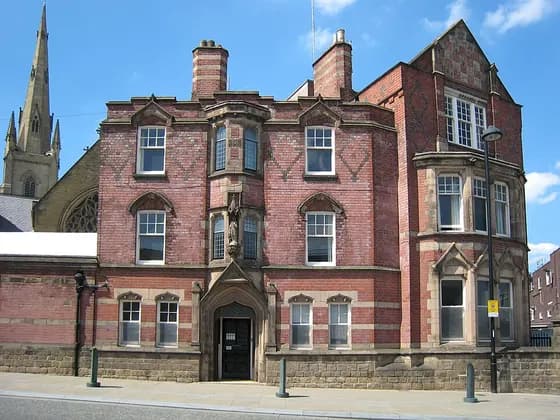


Photo: Chanpeter · CC BY-SA 4.0 · cropped
Photo: Chemical Engineer · CC BY-SA 4.0 · Photo: Nottingham311 · CC BY-SA 4.0 · Photo: Neil Theasby · CC BY-SA 2.0
The Sheffield medicine course at a glance (2027 entry)
Medicine at Sheffield is a five-year, full-time course leading to the MBChB, which the university spells out as Bachelor of Medicine and Surgery. The UCAS code is A100, and there are 291 places a year, 18 of them for international students. The course is run by the School of Medicine and Population Health. The university says its medical school dates back to 1828 and was one of the founding parts of the University of Sheffield.
The core of the course is built from the clinical cases a newly qualified doctor must be able to handle, and the science is taught around those cases. In years 1 and 2 you work through the body one system at a time, from the heart and lungs to the nervous and immune systems. Ethics, public health and clinical skills run alongside, and the course page says your academic learning is tied to what you see in hospitals and general practices.
Patients appear early. Small-group visits to a general practice start in your second week. Volunteer patients also help teach you to take a history, which means asking someone about their symptoms, background and how illness affects their life. In the later years most of your time is spent on placement in hospitals and GP surgeries across South Yorkshire, North Derbyshire and the surrounding areas.
Sheffield is replacing its curriculum, and if you start in 2027 the change arrives part-way through your degree. Your first two years follow the current course, and from year 3 you move onto the new one. The university aims to start teaching the new first and third years in September 2028, so 2027 starters join the new course in September 2029. The plans are still going through university approval, so details of the later years may change.
The General Medical Council (GMC) is the UK regulator for doctors and sets the standards medical schools must meet. Its most recent annual review of Sheffield covers December 2024 to November 2025. It found the school to be meeting those standards, and said it wants to follow the curriculum review closely. The GMC has also published the school's self-assessment for its 2025 review cycle, a report in which the school describes how the course currently runs.
| Degree | MBChB (Bachelor of Medicine and Surgery) |
|---|---|
| Course length | 5 years, full-time, starting in September |
| UCAS code | A100 |
| Places a year | 291, including 18 for international students |
| Main base | Medical School building, connected to the Royal Hallamshire Hospital, Sheffield |
| Teaching style | Integrated and case-based, taught body system by body system in years 1 and 2 |
| Anatomy | Prepared specimens, plastinated human specimens and 22 Anatomage digital tables |
| First patient contact | General practice from week two of year 1 |
| Placement area | South Yorkshire, North Derbyshire and surrounding areas |
| Curriculum change | 2027 starters move to a new curriculum from year 3 |
| Intercalation | Optional extra year: BSc Medical Sciences Research or a masters |
What makes Sheffield medicine different
General practice from your second week
Small-group visits to a general practice begin in week two of year 1, long before hospital placements, and the university says this first-year GP experience stays in the new curriculum.
Patients who teach you, and help examine you
The Patients as Educators programme, set up in 2004, involves more than 800 patients, volunteers and simulated patients (people trained to act out a case) across the university's healthcare courses. They talk you through their illness, let you examine them under supervision and take part in your exams. In finals, the patient in each clinical station awards some of the marks for your bedside manner.
Four weeks with a charity or community group
Every student spends four weeks with a local charity or community organisation, working on a project agreed with the host. The placements section below explains how it works and why it is there.
Anatomy from real specimens and digital tables
You learn anatomy from body parts that specialists have already dissected, from real human tissue preserved with polymers and from 22 life-size Anatomage digital tables, rather than by dissecting a body yourself. The anatomy section explains each.
A fifth of the course is your choice
Student-selected components (SSCs), the parts of the course you choose yourself, make up 20% of the programme. Early SSCs build research skills and lead to a research project. Later ones let you go deeper into a specialty you might want as a career, and many students spend up to 15 weeks of SSC time abroad.
How Sheffield teaches medicine
Sheffield describes its course as fully integrated. Topics are linked across each year, which the programme specification calls horizontal integration, and themes also run through every year, which it calls vertical integration. Four threads run the whole way through: medical sciences, clinical competencies, Integrated Learning Activities and student-selected components.
The school treats seeing patients as the most important way to learn medicine: taking a history, examining the patient and agreeing a plan of care. On clinical attachments you see patients alone or with a clinical teacher, and follow some of them through a whole episode of illness. You also spend time with other professionals, such as nurses and social services staff.
The current course is split into four phases, which do not line up exactly with academic years, and your role grows phase by phase. In Phase 1 you mostly watch clinical demonstrations and healthcare staff at work. In Phase 2 you learn practical skills in the clinical skills centre and with patients. In Phase 3 you use them on hospital and GP placements. Phase 4 takes you to the level of a Foundation Year 1 (F1) doctor, the first year of paid training after graduation.
The programme is also designed so that you manage more of your own learning as the years go on. The new curriculum plans to add more simulation, where you rehearse clinical scenarios in a safe, supervised setting before doing them for real.
The ways you will learn
| Lectures, seminars and tutorials | Lectures give the whole year group the core science. Seminars and tutorials are smaller groups where you discuss and apply it, often through clinical case discussions built around one patient's problem. |
|---|---|
| Integrated Learning Activities | Integrated Learning Activities, or ILAs, are tasks that connect a piece of medical science to clinical practice. They start simple and become more complex as you move through the programme. |
| Integrated Clinical Demonstrations | A clinician shows the group real clinical cases and findings, either in a small group or in a lecture theatre. Along with watching staff at work, they are the main way you learn clinical medicine in Phase 1. |
| Clinical skills sessions | You practise on models, with simulated patients and with real patients, always under close supervision. In Phase 2 this is where you learn practical clinical skills, before using them with patients on hospital and GP placements. |
| Patients as Educators sessions | Volunteer patients describe their condition, their journey through the health service and how illness has affected their life. You then carry out a simple examination with a clinical tutor watching. Volunteers without a medical condition help you practise communication and consultation skills. |
How anatomy is taught at Sheffield
Sheffield teaches anatomy in dedicated labs built around prosection. That means you study parts of the body that trained anatomists have already dissected and carefully exposed, rather than cutting structures out yourself. Teaching comes from clinical anatomists and other anatomy teachers, and the same team also teaches students of dentistry, biomedical science and pharmacy.
The collection includes von Hagens plastinated specimens. Plastination replaces the water and fat in real human tissue with durable polymers, so the body keeps its natural shape, texture and detail. You examine muscles, organs, nerves and blood vessels as they actually sit in the body, which the university says is more accurate than models or digital images.
The lab also holds 22 Anatomage tables. These full-size interactive tables let you move through a digital body layer by layer, rotate it, isolate single structures and simulate clinical conditions. That helps you link a structure to the problems you might meet as a doctor.
The programme specification still lists dissection among practical sessions. However, in its 2024 to 2025 review with the GMC, the school described moving away from cadaveric dissection, where students dissect a donated body, towards prosection and digital resources. The university says anatomy teaching continues in the new curriculum.
When you first meet patients at Sheffield
Your first patient contact is in general practice. In year 1 you spend 10 half-days in a GP surgery as part of a small group, starting in week two, and the school describes these as fortnightly sessions. GP visits continue into year 2, and the new curriculum plans regular GP placements through the clinical years as well.
Also in year 1, the Multi-Professional Experience is a two-week block in which you work alongside medical and nursing teams, with a focus on building clinical skills. The Community Attachment Scheme puts patient-centred care at the heart of the course from the start. Through it, volunteer patients can host you at home for a history-taking session.
Phase 1 is mostly about watching and basic skills: clinical demonstrations, observing staff at work, first steps in history-taking and examination, and cardiopulmonary resuscitation (CPR). On the current course you learn most practical skills in simulation, and are assessed on most of them by the end of year 2, before your first long hospital placement.
On the current course, that placement comes in year 3. It opens Phase 2b and is the first Longitudinal Integrated Clinical Placement, called LICP1, a 12-week block in hospital. Longitudinal means one hospital team is your hub for the whole block. You go out from it to other departments for specific learning, and since a recent change you also rotate through two wards.
As part of that team you attend ward rounds, operations, pathology meetings and outpatient clinics. If you start in 2027, though, year 3 is the first year of the new curriculum, so you will not do Phase 2b or LICP1 in their current form. The shape of your first long placement is part of the plans still going through university approval. The later placements are described year by year below.
Year by year at Sheffield
- Year 1
Phase 1: foundations and first GP visits
Year 1 is Phase 1 of the current curriculum and lasts 31 weeks. You start the systems-based science, learn the basics of talking to and examining patients, and begin the GP visits, Multi-Professional Experience and Community Attachment Scheme described above. Clinically, the year is mostly observation and introductory skills.
- An introduction to medical studies and the medical sciences, alongside the body-systems teaching that runs across years 1 and 2.
- The systems covered in the early years are cardiovascular, respiratory, gastrointestinal and liver, musculoskeletal, skin, nervous, genitourinary, endocrine, reproductive, haematology (blood) and immunology.
- Introductory clinical skills: basic history-taking and examination, CPR, and critical incident reporting, which means recording when something goes wrong or nearly does so the team can learn from it.
- Professionalism, patient safety, medical ethics and an introduction to how health service resources are used.
- Your first SSCs build critical thinking and research skills, working up to a research project in the early years.
- Year 2
Phase 2a: basic clinical skills
For 2027 starters, year 2 is the last year on the current curriculum. On the current course it is Phase 2a, which lasts 29 weeks. The body-systems teaching continues, GP visits carry on and your clinical skills move from introductory to basic level. The next part, Phase 2b, lasts 22 weeks, includes the 12-week LICP1 hospital placement and opens year 3.
- Fuller history-taking and examination, including assessing a patient's mental state: their mood, thinking and behaviour.
- Writing case records, drawing up a problem list and a differential diagnosis (the list of conditions that could explain the symptoms), and planning investigations and treatment.
- Pharmacology and prescribing begin, alongside care that involves several professions working together.
- Early-years strands continue: public health and population health science, medical ethics, personal and professional development, and clinical medical sciences.
- Students on the four-year Graduate Entry route (A101) join at this point, in Phase 2a, after their own six-week introductory course.
- Years 3 to 4
Specialty placements, on the new curriculum
For 2027 starters, year 3 is where the new curriculum begins, and its detailed content is still being approved. On the current course, year 3 opens with Phase 2b and LICP1, and Phase 3 then runs through the rest of years 3 and 4 as a series of specialty placements. The points below describe the current course and the changes the university has announced.
- Phase 3 on the current course is a run of 6 to 8 week placements. They cover Child Health, Community and Public Health, Care of Older People, Neurology, Psychiatry, Women's Health, General Care, and Acute and Critical Care.
- Phase 3 also includes placements where you choose the specialty yourself.
- Skills for harder situations: examining acutely ill patients and those who cannot give a history, breaking bad news, choosing treatments and handling adverse events.
- The four-week social accountability placement, described under placements below, currently falls in year 3.
- New curriculum plans: an operative care placement for hands-on surgical experience, regular GP placements, and more say over your placements based on the areas you want to focus on.
- The new curriculum also plans to organise content into standard academic years rather than phases, with semesters and holidays closer to the rest of the university and more holiday time.
- Year 5
Getting ready to work as a doctor
The final year is about reaching the level expected of an F1 doctor. On the current course it is Phase 4, built around two long placements in hospitals and general practice, followed by finals and a six-week assistantship. If you start in 2027, year 5 falls under the new curriculum, so its shape may differ from the points below.
- Two long integrated placements, LICP2 and LICP3, in hospitals and general practice, where you refine your history-taking and examination to the level of an F1 doctor.
- The year opens with two practice written exams in the national format, set against the topic list for the Medical Licensing Assessment (MLA), the exam every UK medical student must pass to qualify.
- Your clinical skills logbook, the record of practical procedures you have been signed off on, must be complete by December of the final year before you can sit finals.
- Preparation-for-practice workshops include simulated ward activities, practice at prioritising tasks and a simulated electronic patient record, the computer system that holds patients' notes and results.
- The school has also told the GMC it plans to run its Ward Intensive Simulated Experience again. This is a ward simulation in which volunteer patients take part.
- Explaining conditions, test results and treatment options to patients and relatives, and working with the wider health service.
- Final exams, including the MLA, explained in the assessment section below.
- After finals, the last six weeks are the student assistantship. If your first job is in the local region, you shadow the F1 doctor whose post you take over in August. If you are moving away, you work with an F1 in the same specialty as your first job.
- Graduating gives you provisional registration with the GMC. Full registration follows after a satisfactory F1 year.
How you are assessed at Sheffield
There are two kinds of assessment. Formative assessments are practice: they do not count, but they show you where you stand. Summative assessments count, and you must pass them to move on to the next phase and, at the end, to graduate. Material from earlier phases comes back in later exams, so topics are tested again as you go.
Some summative tests are mastery assessments, which check you can carry out essential clinical skills. Practical procedures are observed first in simulation and then in practice, under direct and then indirect supervision, and logged in an e-portfolio that the clinical skills team signs off. Professional behaviour is judged by the clinicians who supervise you on placement, and their reports go into a progress file in your portfolio.
To qualify you must pass the MLA. The GMC requires it in every UK medical degree from 2024 to 2025 onwards. It has two parts: the Applied Knowledge Test (AKT), a written test of medical knowledge, and the Clinical and Professional Skills Assessment (CPSA), a practical exam. Sheffield runs both as part of its finals. You must pass all your in-course assessments, and on the current course finish your skills logbook by December of year 5, before you can sit finals.
The AKT is the national version, created centrally by the Medical Schools Council, the body that represents UK medical schools. It has two computer-based papers of 100 single best answer questions each, two hours per paper, on consecutive days. A single best answer question asks you to choose the best of several plausible options. The pass mark is set at the level of a new F1 doctor in their first week.
The CPSA, as the GMC approved it in June 2024, is a sequential OSCE. An Objective Structured Clinical Examination (OSCE) is a circuit of timed stations, each testing a clinical task in front of an examiner. Everyone sits 12 screening stations. If your score is not clearly above the pass mark, you sit 12 more confirmation stations some weeks later. Each station gives one minute of reading, an eight-minute task and two minutes of questions.
At the time of the 2024 GMC reviews, finals also included a short-answer paper on topics of local importance, and you had to pass the Prescribing Safety Assessment, an online test of safe prescribing. Assessment is set to change. At an October 2025 assessment event observed by the GMC, the school sought views on a planned move to Programmatic Assessment for Learning. That approach bases decisions on many smaller assessments gathered over time. The new curriculum is also reviewing when finals fall.
- Written formats: single best answer questions, structured short answer questions, project reports, poster presentations and logbooks.
- Clinical formats: OSCEs, observed long cases (you assess a patient in full while an examiner watches), mini clinical examinations, reports from your clinical attachments and oral presentations.
- In the finals OSCE, the patient in each station awards 3 of the 25 marks for your bedside manner, and since 2023 you must pass at least 8 of the 12 screening stations.
- At the time of the 2024 GMC review, the school did not run an official mock finals OSCE. The student Medical Society ran one for every candidate, and placement providers were encouraged to run their own. For the written papers, year 5 now opens with two practice exams in the national format.
- If you do not pass the finals OSCE, you meet the lead for that phase on results day and get a performance review and advice before the resit.
Where you will actually be at Sheffield
Clinical placements take place in hospitals and GP practices across South Yorkshire, North Derbyshire and the surrounding areas. Over the course you work in general practice and community care, and in two kinds of hospital. District general hospitals serve a local town and its surroundings, while large teaching hospitals also train doctors and run specialist services.
Named placement hospitals include the Northern General Hospital in Sheffield, Doncaster Royal Infirmary, Rotherham Hospital and Chesterfield Royal Hospital. Their details are listed below. Placements in Doncaster, Rotherham and Chesterfield mean regular travel out of Sheffield.
In its 2025 self-assessment to the GMC, the school said it had changed travel payments in response to student feedback. It also told the GMC that a pilot bus between the medical school and the hospital in Doncaster was due to begin in summer 2026.
The social accountability placement works differently. The school introduced these placements in 2015, and every student now spends four weeks with a charity or community organisation as part of their SSC time. With the host, you agree a piece of project work that helps its activities or the people it serves.
Partners are spread across Sheffield, Rotherham, Doncaster, Barnsley, Chesterfield, Bassetlaw and Derbyshire. The aim is to show you how poverty, isolation and other circumstances shape health, and to get you working with people from very different backgrounds. A 2024 university film features one partner, Sheffield Mencap and Gateway, which supports people with learning disabilities and autism and their families.
Run by Sheffield Teaching Hospitals NHS Foundation Trust. The school told the GMC that a new student space with a common room and study pods opened at the hospital in 2025.
- Northern General Hospital
Students placed here can use a high-fidelity simulation facility in Mexborough, a centre that uses realistic manikins and equipment to recreate clinical situations.
- Doncaster Royal Infirmary
Run by The Rotherham NHS Foundation Trust, which describes the site as a base for undergraduate education for the University of Sheffield. Its Medical Education Centre has tutorial rooms, a lecture theatre and a medical library.
- Rotherham Hospital, Moorgate Road
The hospital's undergraduate medical education team supports student doctors from Sheffield and Nottingham. It organises ward placements and adds bedside, classroom, clinical skills and simulation teaching, and the trust runs its own Patients as Educators team.
- Chesterfield Royal Hospital
More than 130 charities and community organisations host the four-week social accountability placement.
Electives and chosen modules at Sheffield
Eighty per cent of the curriculum is core and everyone takes it. The other 20% is made up of SSCs, which must relate to medicine and are aimed at generic skills, research skills and employability.
In the early years, SSCs build your critical thinking and research skills step by step and lead up to a research project of your own. Later SSCs let you study an area in more depth or try a clinical field you might want to work in. The course page lists community-based options, electives and medical audit among them. An audit checks how care on a ward or in a clinic measures up against an agreed standard.
An elective is a placement you choose and help to arrange, often somewhere quite different from your usual placements. The programme specification says many Sheffield students spend up to 15 weeks of their SSC time abroad.
Intercalation at Sheffield
Intercalation means taking a year out of medicine to study for an extra degree, then returning to the course. At Sheffield it is optional. On the current course you can apply for an intercalated honours BSc once you have passed Phase 2, which ends partway through year 3. The masters options open after at least three years of medicine. These entry points belong to the current course, and the new curriculum is still going through approval.
You register your intention with the school by a deadline, which was 31 March for 2026 to 2027. You also meet an Associate Director of Student Affairs to arrange a leave of absence for the year. The school asks early because it needs to fit returning students back into clinical placements.
Sheffield's own option is the BSc Medical Sciences Research. It has three compulsory modules: Ethical Research Practice; Research Skills, which covers statistics including multiple linear regression and survival analysis; and a six-month original research project, assessed by a dissertation and an oral presentation. You add one optional module to match your project. Understanding Medical Research Practice includes time in the Clinical Research Facility. Understanding Surgical and Anaesthetic Practice, for surgery or anaesthetics projects, adds theatre skills and surgical attachments.
Projects span oncology, cardiovascular sciences, infection, immunity, neuroscience, child health, endocrinology, reproductive medicine and surgery. They are grouped as clinical or surgical, laboratory, medical humanities or qualitative. Applications run in two rounds, supervisors interview applicants, and the school matches students to projects using both sides' preferences. You can also design your own project if you find a willing supervisor.
Alternatively you can intercalate into a one-year masters. Current options include Public Health, Clinical Neurology, Translational Neuroscience, Cancer Biology and Therapeutics, Health Economics and Decision Modelling, Human and Molecular Genetics, Science Communication, and Cognitive Science and Philosophy of AI.
Separately, if you have to leave medicine after completing the first three years of the course, you can receive a BMedSci Clinical Sciences exit degree.
Facilities and support at Sheffield
Where you will learn
The Medical School building is connected to the Royal Hallamshire Hospital and is close to Sheffield Children's Hospital, the Students' Union and the rest of the university campus. In 2025 the school opened a new student space in the building, with a large common room, smaller study rooms and a kitchen.
Most teaching in years 1 and 2 happens in the Medical School and the Medical Teaching Unit, where anatomy is taught, with some sessions in other campus buildings. When the school wrote its 2025 self-assessment, the clinical skills centre was being refurbished, so rooms elsewhere on campus were being used in the meantime.
Clinical skills are taught in simulated settings equipped with high-fidelity manikins, which can mimic signs such as breathing and heart sounds, and virtual reality equipment. The school says the kit reflects what is used in the workplace, and the same facilities serve its postgraduate and apprenticeship programmes. Most Patients as Educators sessions take place in the George Porter building on campus.
The Health Sciences Library is the specialist library for the Faculty of Health. It covers subjects from anatomy, physiology and pharmacology to surgery, psychiatry, paediatrics, obstetrics and the history of medicine. The university's five library sites hold more than 1.3 million books and journals between them, and the online library is available 24 hours a day.
Support while you study
You have a personal academic tutor through the school's Personal and Academic Tutor Scheme, and you keep the same tutor for the whole course. You meet at least twice a year, and each meeting has set questions to help you through the big changes, such as moving from campus to hospital placements.
The MBChB also has its own Student Affairs and Support team, made up of three academic leads, ten more academic staff and four administrative staff. You can go to them, or to the team running your phase, for help, and they can refer you on to occupational health or university support services. Associate Directors of Student Affairs are the senior staff you meet about decisions such as taking a leave of absence.
On placement, support also comes from the hospital. At Chesterfield Royal Hospital, for example, every student has a named supervisor from the trust plus pastoral support from its undergraduate team. The team's office in the Education Centre is staffed from 8am to 4pm on weekdays, and students there get an out-of-hours number for emergencies.
The university's Disability and Dyslexia Support Service contacts every offer holder with a learning support questionnaire, so any support you need can be planned before you start.
The GMC's 2024 to 2025 review also records a Race Equality Group with a student chair and a staff chair, and an event celebrating the achievements of Black, Asian and minority ethnic students. The school has also written a staff guide to what it calls decolonising the curriculum.
Is the Sheffield course right for you?
This course may suit you if
- You want to meet patients in general practice from your second week, rather than waiting for the clinical years.
- You like the idea of learning from patients as teachers, including volunteers who share their own experience of illness and help assess you.
- You are interested in how people's circumstances shape their health, which the four-week placement with a charity or community group is built around.
- You would rather learn anatomy from prepared and plastinated specimens and 3D digital tables than dissect a body yourself.
- You want room to shape your degree: a fifth of it is student-selected, with up to 15 weeks abroad possible and an optional intercalated year.
Things to think about
- If you start in 2027, your clinical years will follow a new curriculum whose details are still being approved, so parts of this guide may change.
- If dissecting a body yourself matters to you, the school is moving away from cadaveric dissection.
- Placements run across South Yorkshire and North Derbyshire, including hospitals in Doncaster, Rotherham and Chesterfield as well as Sheffield, so expect regular travel out of the city in the clinical years.
- In the finals clinical exam format approved in 2024, patients mark your bedside manner at every station, so communication counts directly towards passing.
Sheffield medicine course — frequently asked questions
Applying to Sheffield?
How to get into Sheffield
Entry requirements, UCAT, personal statement and interview, step by step.
Open the guide →Sheffield UCAT cut-offs and offers
UCAT cut-offs, A-level offers, interview format and decision dates.
See the requirements →Compare Sheffield with other schools
Put the teaching style, anatomy teaching and placements next to another school.
Open the comparison →Prepare for the Sheffield interview
Format breakdown, school-specific sample questions and prep tips from tutors who interviewed here.
Read the guide →Where this Sheffield course guide came from
This guide was written from 21 official sources — University of Sheffield's own course pages and programme documents, plus the regulator and NHS placement partners where they publish detail — read on 2026-09-23, then checked claim by claim against those sources.
- Medicine MBChB, 2027 entry, University of Sheffield course page
- Programme specification, Bachelor of Medicine and Surgery (SMPU001), 2026-27 version
- Programme specification, Graduate Entry Bachelor of Medicine and Surgery (SMPU002), 2026-27 version
- Our new Medicine curriculum, School of Medicine and Population Health
- Medicine admissions, School of Medicine and Population Health (places per year)
- Admissions policy, Medicine MBChB A100, 2026-2027 cycle (intake numbers and support for offer holders)
- Facilities in Medicine, School of Medicine and Population Health
- Anatomy at Sheffield, Faculty of Health
- Patients as Educators, School of Medicine and Population Health
- Intercalated BSc Medical Sciences Research
- Intercalated masters degrees
- Applying for intercalated degrees 2026/27
- Social Accountability in Medicine, University of Sheffield Player film (March 2024)
- GMC compliance decision, MLA Applied Knowledge Test, University of Sheffield (June 2024)
- GMC compliance decision, MLA Clinical and Professional Skills Assessment, University of Sheffield (June 2024)
- GMC Annual Quality Assurance Summary, Sheffield Medical School, 2024-2025
- Undergraduate Medical Education Team, Chesterfield Royal Hospital
- Rotherham Hospital, The Rotherham NHS Foundation Trust
- GMC self-assessment questionnaire, University of Sheffield, 2025 quality assurance cycle (reviewed 2026)
- Partnership placements, Social Accountability, Faculty of Health, University of Sheffield
- MBChB Medicine courses, School of Medicine and Population Health (Graduate Entry route)
Courses are restructured between cycles. Anything here that decides your application — an anatomy offer, a placement city, a compulsory intercalated year — should be confirmed against the official page for your entry year.
Applying to Sheffield?
We have helped hundreds of applicants turn their UCAT, personal statement and interview prep into offers from Sheffield and other UK medicine schools.