
The St Andrews Medicine course
What you actually study, and where you will be
St Andrews's BSc (Hons) Medicine, then MBChB/MBBS elsewhere is a 6-year (3 at St Andrews + 3 clinical) course with an integrated, spiral curriculum, with patient contact from Year 1 and placements in St Andrews for years 1–3, then a partner school in Scotland or England (2027 entry). A six-year route split between two universities. You graduate from St Andrews with a BSc (Hons) Medicine after three years, then spend three years at one of six partner schools (Aberdeen, Dundee, Edinburgh, Glasgow, Manchester or Queen Mary), which awards the MBChB or MBBS. Anatomy is taught by full-body dissection in all three St Andrews years.
- Degree
- BSc (Hons) Medicine, then MBChB/MBBS elsewhere
- Length
- 6 years (3 at St Andrews + 3 clinical)
- Teaching
- Integrated + Spiral
- Clinical contact
- Year 1
- UCAS code
- A100

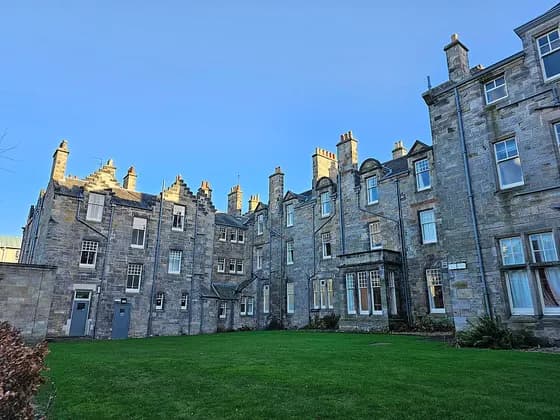


Photo: Daytrick / Wikimedia Commons · CC BY-SA 4.0 · cropped
Photo: Daytrick · CC BY-SA 4.0 · Photo: Optograph · CC BY-SA 3.0 · Photo: Bill Harrison · CC BY-SA 2.0
The St Andrews medicine course at a glance (2027 entry)
The A100 course at St Andrews is a six-year route to becoming a doctor, split between two universities. You spend three years at St Andrews and graduate with a BSc (Hons) in Medicine. You then move to one of six partner medical schools in Scotland or England for three more years, and that school awards your medical degree, an MBChB or MBBS.
The St Andrews years build a deep understanding of the science behind medicine, taught body system by body system. Each system comes back in more depth, and with more clinical focus, in years 2 and 3.
You dissect donated human bodies in every year at St Andrews, and you meet patients from year 1 in small, planned doses. The final semester pairs a research project of your own choosing with a clinical reasoning module that prepares you for hospital-based training. Your main clinical training happens at your partner school.
The school says medicine has been taught in St Andrews since 1413. The university also runs a separate five-year MBChB called ScotCOM (UCAS code A10C), which you complete entirely with St Andrews. This guide covers A100.
| Degree | BSc (Hons) Medicine, then MBChB or MBBS from a partner school |
|---|---|
| Course length | Six years: three at St Andrews, three at a partner school |
| UCAS code | A100, with campus code S, R or N for your route |
| Main base | School of Medicine, North Haugh science campus, St Andrews |
| Teaching style | Integrated spiral curriculum, taught body system by body system |
| Anatomy | Full-body dissection in all three St Andrews years |
| First patient contact | Year 1: volunteer patients in the school, then a one-day placement |
| Partner schools | Aberdeen, Dundee, Edinburgh, Glasgow, Manchester, Queen Mary University of London |
| Research | 40-credit honours research project in your final St Andrews semester |
| Overseas fee status | Final three years are at Manchester |
What makes St Andrews medicine different
An honours science degree before clinical training
You graduate from St Andrews with a BSc (Hons) in Medicine at the end of year 3, including a 40-credit research project of your own choosing. You reach your partner school already holding a degree.
Full-body dissection in all three years
You dissect donated human bodies yourself in every year at St Andrews, working region by region as each system is taught: the back first, the head and neck last.
Six partner schools to finish your training
For the last three years you move to Aberdeen, Dundee, Edinburgh, Glasgow, Manchester or Queen Mary University of London. You gain experience of two medical schools, but it means changing university midway.
Clinical skills practice with video at every bed
The clinical skills suite has 48 beds, each with a ceiling-mounted camera and a touch screen at the bed head. Your consultation or examination can be played back, so you and your tutor can review what you did straight away.
A final semester built around clinical reasoning
The Clinical Reasoning module mostly applies what you already know, but adds several new practical skills, such as a quick bedside ultrasound scan used in trauma. Every two weeks you spend a day taking histories from people trained to play patients, examining and reasoning towards a diagnosis, then talking your thinking through with a tutor.
How St Andrews teaches medicine
St Andrews describes its course as an integrated spiral curriculum. Integrated means science and clinical practice are taught together rather than in separate years. Spiral means the course keeps coming back to the same topics. Year 1 lays the foundations, and the honours modules in years 2 and 3 revisit each body system in much more depth.
Each system module follows the same order: normal structure, then function, then disease and finally treatment. Clinical cases tie this together. In semester 2 of year 1, for example, cases on trauma and deep vein thrombosis, a blood clot in a deep vein, usually in the leg, link straight to the limb anatomy you dissect.
Themes run through every year alongside the body systems: medical ethics, communication skills, professionalism, public health, health psychology and infection. In the year 2 module on the gut, kidneys and reproductive system, they include alcohol-related harm in Scotland, the global burden of disease and the ethics of assisted reproduction. A research skills strand trains you to critique published studies and write scientifically.
The style shifts as you progress. Years 1 and 2 are built around lectures, laboratory practicals, dissection and small-group tutorials. Year 3 introduces flipped-classroom teaching: you work through an interactive guided study on a platform called Nearpod, and a linked lecture then clears up the difficult parts. Clinical Reasoning, in the final semester, is taught entirely in small groups, mainly by clinicians, including some who are not university employees but hold honorary posts to teach there.
The ways you will learn
| Lectures | Large-group teaching that introduces each topic, mostly given in person. Lectures are not compulsory, though the school strongly recommends going. |
|---|---|
| Dissection and laboratory practicals | Hands-on classes in the dissecting room and the science labs, covering subjects such as physiology, pharmacology, microbiology and histology, the study of tissues under the microscope. Attendance is compulsory and recorded on a register. |
| Tutorials, seminars and workshops | Small-group sessions in which you apply lecture material to problems and clinical cases with a tutor. Like practicals, they are compulsory. |
| Clinical and communication skills sessions | Practice in taking a history, examining patients and skills such as measuring blood pressure and basic life support, with volunteer patients and simulated patients, who are people trained to play a patient. These skills are examined in an Objective Structured Clinical Examination (OSCE), a circuit of timed stations where an examiner watches you carry out a task. |
| Guided studies | Structured self-study tasks and reading set by the school to prepare you for a class. From year 3 they open several key topics before the linked lecture, and each Clinical Reasoning cycle. |
A typical week on the St Andrews course
In years 1 and 2 and the first semester of year 3, a typical week has about 10 lectures and around 6 hours of seminars, tutorials and practicals, including dissection. Clinical case studies and skills sessions run alongside, with placements fitted in. The school also sets up to 6 hours a week of directed self-study, or up to 8 in the year 2 heart and lungs module.
Most teaching is in person, and class times and rooms are posted on Galen, the school's own online learning system. Practicals, workshops and tutorials are compulsory. If you miss three days in your first semester, the module leaders invite you to a supportive meeting to check how you are and help you catch up.
Semesters have about 12 teaching weeks, with a week in the middle set aside for independent study. In the 2026/27 first-year timetable, this was week 6. A mid-semester test followed in late October, and exams ran in December after a revision week.
In the second semester of year 3, a Clinical Reasoning day comes round every two weeks. It starts with a three-hour morning of simulated patient scenarios and skills sessions. The afternoon, of two or three hours, usually opens with a case discussion. Attendance is compulsory, and falling below 80 per cent removes you from the module's OSCE. Around these days you work on your research project.
How anatomy is taught at St Andrews
You learn anatomy by dissecting whole human bodies donated for medical teaching, guided by demonstrators. The dissecting room has 16 dissection tables, space for hundreds of models and specimens, and technology at each table for calling up teaching resources. Technicians and medical staff are on hand to help.
Dissection follows the body systems you are studying. In your first semester you get an overview of the major systems and learn to use dissection instruments while dissecting the back. The upper and lower limbs follow in semester 2. In year 2 you dissect the thorax (the chest), then the abdomen and pelvis. In year 3 you study the head and neck by dissection, including neuroanatomy, the structure of the brain and nerves.
The year 2 modules link dissection to clinical imaging, and year 3 covers aspects of radiology. In the final semester, anatomy is revised as it applies to examining patients and reading scans, including cross-sectional anatomy of the kind seen on CT and MRI images.
A first-year student writing on the school's news site in March 2026 said the embalming chemicals that preserve the bodies smell strongly at first. One task was carefully removing part of the spine to expose the structures beneath it. He also noted that the donors are local people who chose to give their bodies to help train doctors.
When you first meet patients at St Andrews
You begin working with patients in year 1, but early contact mostly happens inside the medical school. In your first semester you learn core skills such as handwashing and measuring blood pressure, and talk to volunteer patients who live with long-term health conditions. Some of these patient partner sessions may be held online.
In semester 2 of year 1 you have your first placement outside the school: one day at a general practice or a community hospital. Year 2 brings a series of attachments in primary care, meaning GP surgeries and other community services where most patients are first seen. These run alongside clinical case studies on a two-week cycle, and are a mix of face-to-face and virtual placements.
Year 3 moves you into secondary care, meaning the hospital services that patients are referred on to. The first-semester module on the nervous and endocrine systems includes a range of hospital attachments. In the final semester, a ward simulation has you managing acutely unwell patients alongside other health professionals.
Year by year at St Andrews
- Year 1
Foundations of Medicine
Year 1 is the first turn of the spiral. It gives you a broad grounding in how the body is built and works, from molecules and cells up to whole systems. There are two 60-credit modules, one in each semester.
- Foundations of Medicine 1 (MD2001), semester 1: six strands covering cells and molecules, body structure, body function, disease mechanisms, the practice of medicine and clinical medicine
- Dissection of the back, and an introduction to how the immune system responds to infection
- Foundations of Medicine 2 (MD2002), semester 2: the musculoskeletal system, nerve and muscle physiology, control of movement and the autonomic nervous system, with limb dissection
- Principles of disease and treatment, including how the body handles drugs (pharmacokinetics), genetics, and behavioural topics such as stress, coping and pain
- A one-day placement in semester 2, plus a practice OSCE in December and a formal one at the end of the year
- Year 2
Honours: heart, lungs, gut, kidneys and reproduction
Year 2 starts the honours programme, the second turn of the spiral. Two 60-credit modules revisit body systems in far more depth, each moving from normal structure and function to disease and treatment.
- Cardiovascular and Respiratory Systems (MD3001), semester 1, including the regional anatomy of the thorax
- Reproductive, Renal and Gastrointestinal Systems (MD3002), semester 2: the gut, then the kidneys, then reproduction, with the anatomy of the abdomen and pelvis
- A series of primary care attachments in GP surgeries and community services
- An end-of-year OSCE, with 11 stations in the 2026/27 format
- Year 3
Honours: brain, hormones, research and clinical reasoning
Year 3 covers the body's most complex control systems, then shifts to applying what you know. The first semester is one 60-credit module. The second combines a 40-credit research project with a 20-credit Clinical Reasoning module. You graduate with your BSc (Hons) Medicine at the end of the year.
- Central Nervous System and Endocrine System (MD4001), semester 1: neurology for the first seven weeks, then endocrinology, with head and neck dissection and hospital attachments
- An orientation week at the start of the year, with some assessed content
- Student-selected Component (MD4002), semester 2: an honours research project written up as a dissertation and presented orally
- Clinical Reasoning (MD4003), semester 2: simulated scenarios, a multidisciplinary ward simulation, a clinical escape room and revision of tests such as blood results and ECGs (recordings of the heart's electrical activity)
- New skills including the ABCDE approach to an acutely unwell patient (airway, breathing, circulation, disability, exposure), drug calculations, fluid management, breast examination and eFAST, a quick bedside ultrasound scan used in trauma
- Basic life support recertification from the NHS clinical education team before the May exams, then the Clinical Reasoning OSCE
- Years 4 to 6
Clinical training at a partner medical school
You move to your partner school and join its own MBChB or MBBS partway through, following that school's course for your final three years.
- To transfer, you must graduate from St Andrews with an honours degree and be judged fit to practise
- At Aberdeen, a bridging course helps you settle into its curriculum; Manchester provides a coordinator for St Andrews students, peer mentors and academic advisers
- You sit the Medical Licensing Assessment (MLA), which every UK medical graduate must now pass, as part of your partner school's degree
- You graduate with an MBChB, or an MBBS from Barts at Queen Mary. This is your primary medical qualification, which lets you register provisionally with the General Medical Council (GMC)
- In your final year you apply, through the UK Foundation Programme Office, for a Foundation Year 1 post, your first year working as a doctor
How you are assessed at St Andrews
The 60-credit modules are assessed in a similar way. Midway through the semester there is a 72-minute test of 60 multiple choice questions (MCQs). At the end you sit another 60-question MCQ paper, a short written answer paper of about two hours, and a 10-minute anatomy practical exam using real specimens, models or images. The mid-semester test counts for a quarter of the marks from these papers.
In each OSCE you must pass a minimum number of stations and reach an overall pass mark. The number of stations grows each year.
From 2026/27, starting with first-year students, the school is moving its semester 2 modules to marking in three domains. Knowledge counts for 75 per cent, clinical skills from the OSCE for 20 per cent, and professionalism, judged through your portfolio, for 5 per cent. You must pass each domain on its own, and if you fail one you resit only that part. The OSCE formats listed at the end of this section come from the 2026/27 handbooks, and those for years 2 and 3 may change as this roll-out reaches later years.
Throughout the three years you keep a professional portfolio recording your personal development and professional behaviour. What matters is completing its tasks satisfactorily: if more than two are not, you go through a formal review and a plan to put things right. The research project is assessed entirely by coursework, and you must pass both the dissertation and the oral presentation.
Modules are graded on the university's 20-point scale, and you must pass every module with at least 7.0 to move on each year. In modules still marked the older way, your graded papers are combined, so a strong paper can make up for a weak one if the weighted total passes. The OSCE must still be passed on its own. Resits are held in July, and resit marks are capped at 7.
The MLA has two parts. The Applied Knowledge Test (AKT) is a computer-based exam of multiple choice questions. UK medical schools write it together through the Medical Schools Council, and the GMC regulates it. The Clinical and Professional Skills Assessment (CPSA) is a practical exam that each medical school runs to GMC standards. Students graduating from the 2024/25 academic year onwards need a pass in both to be awarded a medical degree. Because your medical degree comes from your partner school, you sit both there.
- Year 1, 2026/27 format: a compulsory practice OSCE in December, then 8 five-minute stations over two days at the end of the year, with at least 4 to pass
- Year 2, 2026/27 format: 11 stations over two days, four lasting 10 minutes and seven lasting 5 minutes, marked pass or fail, with at least 7 to pass
- Year 3, 2026/27 format: a graded 12-station OSCE in May that makes up the whole Clinical Reasoning mark. Seven 7-minute stations test clinical reasoning and reading clinical data such as test results, and five 10-minute stations test more complex tasks. You need at least 8 to pass, and the July resit uses the same format
Where you will actually be at St Andrews
Where you spend years 4 to 6 is decided in stages. When you apply through UCAS you choose one of three routes, each with its own campus code under A100. During year 2 you state your preferred location on your route. Places are then allocated on your preference combined with your results in the first semester of year 2.
If you are classed as an overseas student for fee purposes, you go to Manchester, the only partner school with places for overseas students on this course. Manchester then places each St Andrews student at one of its clinical education campuses at random, during the second semester of year 2. If you are an overseas student who lives in Canada or holds Canadian residency rights, St Andrews also runs a separate route, A990. It has the same three St Andrews years, followed by the MBChB at the University of Edinburgh.
- Scotland route (campus code S): Aberdeen, Dundee, Edinburgh or Glasgow
- England route (campus code R): Manchester or Queen Mary University of London (Barts)
- No Preference route (campus code N): the Medical Admissions Officer puts you on the England or Scotland route, which your offer states and which is then fixed
Your base for the first three years.
- School of Medicine, Medical and Biological Sciences Building, North Haugh
You join year 3 of the Aberdeen MBChB. The medical school sits on a large hospital campus in Aberdeen itself. Placements also run at the other hospitals listed and further afield, in Fort William, Stornoway, Wick, Orkney, Shetland and elsewhere in the Highlands and Islands.
- Foresterhill campus, Aberdeen, with Aberdeen Royal Infirmary
- Dr Gray's Hospital, Elgin
- Raigmore Hospital, Inverness
You join year 3 of the Dundee MBChB. The medical school is part of Ninewells Hospital, close to St Andrews, and placements extend to hospitals and general practices across Tayside and other centres.
- Ninewells Hospital, Dundee
You join year 4 of Edinburgh's six-year MBChB.
You join year 3 of the Glasgow MBChB. Placements range from national specialist referral services to rural general practices run by a single GP.
You join year 3 of the Manchester MBChB and are based at one of these four clinical education campuses.
- Oxford Road Campus, Manchester
- Wythenshawe Hospital, Manchester
- Preston
- Salford
You join year 3 of the MBBS at Barts and The London School of Medicine and Dentistry, Queen Mary's medical faculty, with teaching spread across these three campuses.
- Royal London Hospital, Whitechapel
- St Bartholomew's Hospital, West Smithfield
- Mile End campus
Electives and chosen modules at St Andrews
The main piece of student choice at St Andrews is the Student-selected Component (MD4002), a 40-credit honours research project in the second semester of year 3. You choose an area that interests you. The project is either primary research, in the lab or using data, or a critical review of the published evidence on a question.
A supervisor meets you for up to an hour a week, and there are regular workshops. You learn to search the literature, judge the quality of studies and understand scientific methods, and you get the chance to work alongside staff doing active research.
At the end you submit a dissertation, give an oral presentation of your findings and write a portfolio entry reflecting on a significant learning event.
Intercalation at St Andrews
Many UK medical students add a year to their course to earn a separate science degree, which is called intercalating. On A100 an honours science degree is built into the six years instead, through the honours programme in years 2 and 3.
Facilities and support at St Andrews
Where you will learn
The School of Medicine moved in 2010 into the Medical and Biological Sciences Building on the North Haugh science campus, purpose-built for its redesigned curriculum. Teaching rooms include a 300-seat lecture theatre, two 50-seat seminar rooms and thirteen 12-seat tutorial rooms.
The clinical skills suite has 7 rooms with 48 beds and a full range of real and simulated clinical equipment. The medical resource centre is equipped to the same standard and works as a self-study space, open 14 hours a day.
A multi-purpose science lab takes up to 100 students at a time for practicals in physiology, pharmacology and histology. When they are not in use for teaching, you can book private study time in the dissecting room or the clinical skills rooms through an online system called Resource Booker.
Support while you study
When you start, you are given a personal tutor, and you normally keep the same tutor until you graduate from St Andrews. Module controllers and year leads deal with general questions about the course.
The Medical School Support Team, known as Medsupport and led by the school's Pro-Dean, offers pastoral support on top of the university's Student Services. The school also has a wellbeing officer. For study skills, the university's International Education and Lifelong Learning Institute offers one-to-one appointments.
The Peer Assisted Learning Scheme (PALS) is a mentoring scheme run by students. It pairs you with a mentor, usually from second or third year, who can advise on study skills, organisation and time management. You can ask for a mentor at any point in the year.
Is the St Andrews course right for you?
This course may suit you if
- You want three years of in-depth medical science, ending in an honours degree and a research dissertation, before your main clinical training.
- You want to learn anatomy by dissecting donated bodies yourself, in every year at St Andrews.
- You like the idea of training at two universities and are open to moving to one of six partner schools in Scotland or England after year 3.
- You learn well by practising in simulation first, with video playback of your own performance, before working with real patients.
Things to think about
- You will change university after year 3, and where you go depends partly on your results in the first semester of year 2.
- If you pay overseas fees, your only option is Manchester, where your clinical campus is allocated at random.
- Patient contact before year 4 comes in short attachments, some of them virtual, alongside a full timetable of lectures, labs and dissection.
- You must pass every module each year to progress, and you need an honours degree to transfer to your partner school.
- Practicals and tutorials are compulsory, and attending less than 80 per cent of Clinical Reasoning in your final semester stops you sitting its OSCE.
St Andrews medicine course — frequently asked questions
Applying to St Andrews?
How to get into St Andrews
Entry requirements, UCAT, personal statement and interview, step by step.
Open the guide →St Andrews UCAT cut-offs and offers
UCAT cut-offs, A-level offers, interview format and decision dates.
See the requirements →Compare St Andrews with other schools
Put the teaching style, anatomy teaching and placements next to another school.
Open the comparison →Prepare for the St Andrews interview
Format breakdown, school-specific sample questions and prep tips from tutors who interviewed here.
Read the guide →Where this St Andrews course guide came from
This guide was written from 31 official sources — University of St Andrews's own course pages and programme documents, plus the regulator and NHS placement partners where they publish detail — read on 2026-09-23, then checked claim by claim against those sources.
- Medicine BSc (Hons) A100, 2027 entry - University of St Andrews
- Partner medical schools - University of St Andrews
- Course pathways - University of St Andrews
- After graduation (MLA, PMQ and Foundation Year 1) - University of St Andrews
- Medicine BSc (Hons) A100, 2026 entry (archived course page) - University of St Andrews
- Medicine BSc (Hons) A990, 2027 entry (route for Canadian applicants) - University of St Andrews
- MD2001 Foundations of Medicine 1, module handbook 2026/27
- MD2002 Foundations of Medicine 2, module handbook 2026/27
- MD3002 Reproductive, Renal and Gastrointestinal Systems, module handbook 2026/27
- MD4001 Neurology and Endocrinology, module handbook 2026/27
- MD4003 Clinical Reasoning, module handbook 2026/27
- BSc (Hons) Medicine: the spiral curriculum, School of Medicine handbook (2023)
- Module catalogue 2026/27: MD2001 Foundations of Medicine 1
- Module catalogue 2026/27: MD2002 Foundations of Medicine 2
- Module catalogue 2026/27: MD3001 Cardiovascular and Respiratory Systems
- Module catalogue 2026/27: MD3002 Reproductive, Renal and Gastrointestinal Systems
- Module catalogue 2026/27: MD4001 Central Nervous System and Endocrine System
- Module catalogue 2026/27: MD4002 Student-selected Component
- Module catalogue 2026/27: MD4003 Clinical Reasoning
- UG student support, School of Medicine handbook
- PALS peer assisted learning scheme, School of Medicine handbook
- About the School of Medicine and its facilities - University of St Andrews
- Prospective students - School of Medicine, University of St Andrews
- Medicine subject hub - University of St Andrews
- Medicine entry requirements, fitness to practise and Professionalism Agreement - University of St Andrews
- Student stories: life in the dissection room, School of Medicine news (March 2026)
- Medicine MBChB A10C ScotCOM, 2027 entry - University of St Andrews
- First St Andrews MBChB cohort begins clinical training in Fife, School of Medicine news (January 2026)
- New schools and programmes under review - General Medical Council
- MLA applied knowledge test compliance decision, ScotGEM, Universities of St Andrews and Dundee - General Medical Council (June 2024)
- Foresterhill campus - School of Medicine, Medical Sciences and Nutrition, University of Aberdeen
Courses are restructured between cycles. Anything here that decides your application — an anatomy offer, a placement city, a compulsory intercalated year — should be confirmed against the official page for your entry year.
Applying to St Andrews?
We have helped hundreds of applicants turn their UCAT, personal statement and interview prep into offers from St Andrews and other UK medicine schools.