
University of Maryland School of Dentistry Interview
Format, Questions & Prep Tips
University of Maryland School of Dentistry dentistry interviews for 2027 entry are a traditional interview, held September 2026 through March 2027. Published figures: Annual DDS class size 130 (Fall 2023); Tuition (2025–26) ~USD 31,000 (in-state) / USD 65,000 (out-of-state).
- Institution
- University of Maryland School of Dentistry
- Interview (2027 entry)
- September through March
- Decisions (2027 entry)
- Rolling decisions; waitlist through spring

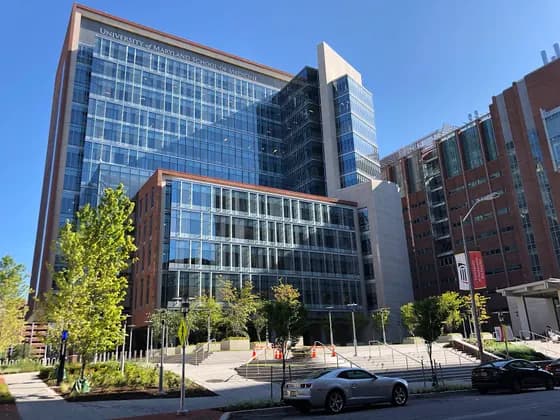


Photo: Acroterion · CC BY-SA 4.0 · cropped
Photo: Alx bio · CC BY-SA 4.0 · Photo: Farragutful · CC BY-SA 4.0 · Photo: Iracaz ( talk ) · CC BY-SA 3.0
How to get into University of Maryland School of Dentistry (DDS) dentistry
Step-by-step: entry requirements, admission tests, personal statement, interview format and the key deadlines.
Open the guide →University of Maryland School of Dentistry (DDS) entry requirements
Admission profile, interview format, decision dates and what makes University of Maryland School of Dentistry (DDS) different.
See the profile →The University of Maryland School of Dentistry (DDS) dentistry interview
University of Maryland School of Dentistry is the oldest continuously operating dental school in the world (founded 1840). It uses a traditional interview format with two sessions (faculty and student) at its Baltimore campus in the Health Sciences facility.
Maryland Dentistry is a public school committed to serving Maryland and Baltimore's diverse patient population — the dental clinics see patients across the socioeconomic spectrum, including a large uninsured and Medicaid-insured population. Interviewers probe genuine commitment to access and public service.
The school's Dental Action Committee and community dental health outreach programs are sources of institutional pride and interviewers probe student engagement with community oral health.
University of Maryland School of Dentistry (DDS) interview at a glance (2027 entry)
| Annual DDS class size | 130 (Fall 2023) |
|---|---|
| Interview format | Traditional — faculty + student sessions |
| DAT required | Yes — via ADEA AADSAS |
| Tuition (2025–26) | ~USD 31,000 (in-state) / USD 65,000 (out-of-state) |
| Application system | ADEA AADSAS primary + Maryland secondary |
| Interview window | September–March |
Interview format
- Two sessions: faculty and student.
- No MMI.
Sample interview questions
Why dentistry rather than medicine or another health profession?
Maryland wants applicants who chose dentistry deliberately. Speak to the procedural craft, the blend of art and science, the immediacy of restoring function and confidence, and the long-term patient relationships. Avoid framing dentistry as a second choice to medicine.
Maryland is the oldest dental school in the world, founded in 1840. What does that history mean to you, and how does it shape your sense of the profession's responsibilities?
Reflect on the evolution of dentistry from its origins into a science-based profession, and on the obligation that legacy implies — to advance public oral health and serve the community. Connect the history to your own values rather than reciting dates.
Dentistry is a fine-motor profession. How have you developed and tested your manual dexterity?
Give concrete evidence — drawing, sculpture, an instrument, model-building, or lab and craft work — and reflect on improvement with practice. Tie it to the steadiness, precision, and patience that chairside dentistry demands.
Why the University of Maryland School of Dentistry specifically?
Reference its public mission to serve Maryland and Baltimore's diverse, largely uninsured and Medicaid-insured patient population, its community outreach through the Dental Action Committee, and its historic significance. Show genuine alignment with a public-service-oriented training environment.
Baltimore has among the highest rates of childhood caries of any US city. Beyond training dentists, what can a dental school do to address this?
Discuss school-based sealant programs, community water fluoridation advocacy, the dental-school clinic as a safety-net provider, and partnerships with schools and community health workers. Show you see oral health as a population issue, not just individual treatment.
A Medicaid patient needs extensive work, but reimbursement barely covers your costs. A wealthier patient wants elective cosmetic treatment that is far more profitable. How should a dentist think about balancing these realities?
Engage with justice, professional duty to access, and the economics of safety-net care. Discuss why Maryland's mission centers on serving underserved patients, and the ethical tension between sustainable practice and equitable access — without pretending the financial pressures do not exist.
You discover a colleague routinely turns away patients who arrive late or seem 'difficult,' many of whom are low-income. Is this acceptable?
Justice and non-discrimination argue against this. Discuss the access consequences for vulnerable patients, the difference between legitimate practice policies and de facto exclusion, and how you would raise the concern. Maryland's mission makes equitable access a core value.
A patient with capacity refuses a clearly needed extraction and wants antibiotics instead, repeatedly. How do you handle the autonomy-versus-beneficence tension?
Respect the patient's right to refuse while ensuring they understand the risks of recurrent infection and antibiotic limits. Discuss documentation, antibiotic stewardship, and continuing to offer care. Autonomy is respected, but you must give honest information and avoid enabling harm.
How would you build trust with a patient who has avoided dental care for years out of fear or past bad experiences?
Acknowledge their experience without judgment, go at their pace, use tell-show-do and a stop signal, and frame the relationship as a partnership. In a population with significant barriers to care, rebuilding trust is often the first clinical task.
Describe a meaningful community or clinical experience and what it taught you about serving underserved populations.
Go deep on one experience and reflect on access barriers, the social determinants of oral health, and your own assumptions. Maryland values genuine commitment to public service over a long list of activities.
What is the connection between oral health and overall systemic health?
Discuss the periodontal-systemic links — diabetes, cardiovascular disease, adverse pregnancy outcomes — and the dentist's role in screening and early detection. Show you understand the mouth as part of whole-body health.
Why are prevention and routine recall so central to dentistry, especially in an underserved population?
Most dental disease is preventable or best managed early, yet underserved patients often present late with advanced disease. Discuss the cost-effectiveness of prevention, sealants and fluoride, and the public-health logic of catching problems early.
How would you approach a patient who presents with a suspicious oral lesion?
Show structured reasoning:
- thorough history and examination
- documentation
- prompt referral for biopsy or specialist evaluation
Emphasize the dentist's role in early oral cancer detection — particularly important for populations with limited access to care.
A parent brings a child with several untreated cavities and says they could not afford to come sooner. Reassure them and agree a plan. (Hypothetical scenario.)
Lead with empathy, not blame. Acknowledge the financial reality, prioritize urgent care, and discuss preventive steps and any assistance available. Frame it as a partnership. Judgmental tones drive vulnerable families away from care.
A patient is upset about a long clinic wait and is becoming loud in the waiting area. Defuse the situation. (Hypothetical scenario.)
Stay calm, acknowledge their frustration, take the conversation somewhere private, explain honestly, and offer a concrete next step. Show empathy and de-escalation without being defensive — safety-net clinics often run busy and patients have competing pressures.
If Baltimore data showed childhood caries falling in some neighborhoods but not others, what factors would you want to examine before concluding why?
Consider differences in fluoridated water access, school sealant program reach, dietary patterns, insurance coverage, and clinic availability. Show you would look for the structural causes of disparity rather than attributing it to individual behavior.
Practise the University of Maryland School of Dentistry (DDS) interview
Rehearse the real format before the day — on demand with our AI interviewers, or live with a tutor.
Sit a mock with photoreal AI interviewers — any time
A timed MMI or panel interview on video — American & international voices — with interviewers who listen, react and press with follow-ups. Rubric-scored feedback and a replay the moment you finish.





Live mocks with a tutor who’s been in the room
A full University of Maryland School of Dentistry (DDS)-style mock with a medic or dentist tutor — honest scoring against real marking criteria, a station-by-station debrief and a written action plan.
Book a mock interviewHow to prepare for the University of Maryland School of Dentistry (DDS) interview
Common pitfalls to avoid
University of Maryland School of Dentistry (DDS) interview — frequently asked questions
Sources & official admissions information
Ready to nail your University of Maryland School of Dentistry (DDS) interview?
Book a mock interview with a tutor who knows the US interview formats, orpractice unlimited stations from our interview question bank.