
Penn Dental Medicine Interview
Format, Questions & Prep Tips
Penn Dental Medicine dentistry interviews for 2027 entry are a traditional interview, held October 2026 through February 2027. Published figures: Annual DMD class size ~130; Tuition (2025–26) ~USD 72,000/year.
- Institution
- Penn Dental Medicine
- Interview (2027 entry)
- October through February
- Decisions (2027 entry)
- Regular decisions by late March; waitlist through spring

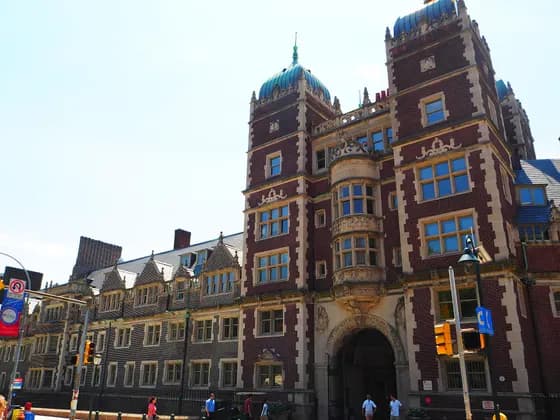
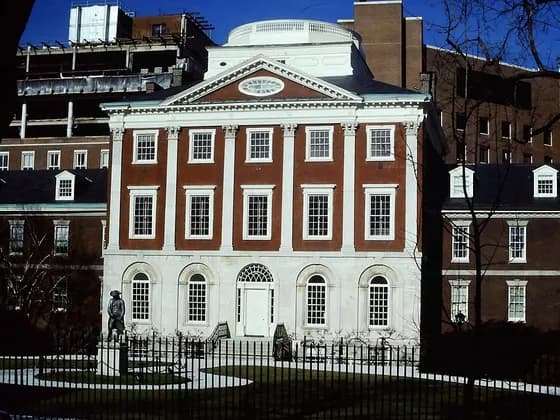

Photo: Bestbudbrian · CC BY-SA 4.0 · cropped
Photo: Lemonade000 · CC BY-SA 4.0 · Photo: Bmzuckerman · CC BY 4.0 · Photo: SidewalkMD · CC BY-SA 4.0
How to get into Penn Dental Medicine (DMD) dentistry
Step-by-step: entry requirements, admission tests, personal statement, interview format and the key deadlines.
Open the guide →Penn Dental Medicine (DMD) entry requirements
Admission profile, interview format, decision dates and what makes Penn Dental Medicine (DMD) different.
See the profile →The Penn Dental Medicine (DMD) dentistry interview
Penn Dental Medicine uses a traditional interview format — two sessions (faculty and student) of 30–45 minutes at the University of Pennsylvania campus in Philadelphia. Penn Dental is one of the oldest dental schools in the US (founded 1878) and has a strong emphasis on research and innovation — its research expenditure is among the highest of any US dental school.
Penn Dental is affiliated with Penn Medicine and trains dentists in a deeply integrated biomedical environment. Interviewers probe interest in translational research, oral-systemic health, and the science underlying dental practice.
Penn Dental's West Philadelphia location means clinical training includes significant exposure to underserved urban communities. Interviewers probe genuine commitment to providing care across socioeconomic groups.
Penn Dental Medicine (DMD) interview at a glance (2027 entry)
| Annual DMD class size | ~130 |
|---|---|
| Interview format | Traditional — faculty + student sessions |
| DAT required | Yes — via ADEA AADSAS |
| Tuition (2025–26) | ~USD 72,000/year |
| Application system | ADEA AADSAS primary + Penn Dental secondary |
| Interview window | October–February |
Interview format
- Two one-on-one sessions: faculty (open-file) and student.
- No MMI.
Sample interview questions
Why dentistry rather than medicine? What specifically draws you to the mouth as your field of care?
Articulate a positive case for dentistry: the blend of manual craft and science, longitudinal patient relationships, immediate visible outcomes, and autonomy. Avoid framing it as 'medicine but easier'; Penn wants applicants committed to dentistry on its own terms.
Penn Dental is one of the oldest dental schools in the US and is closely affiliated with Penn Medicine. What does that history and integration mean for how you think about dental education?
Institutional heritage since 1878, the oral-systemic health connection, and the value of training alongside medical students and researchers in a translational environment.
Penn Dental has one of the largest research portfolios of any US dental school. How does research fit into your vision of a dental career?
Genuine interest in inquiry: oral microbiome, implant biomaterials, craniofacial genetics. Even if you plan to practice clinically, show you value evidence-based dentistry and the school's research culture.
Tell us about the experience that first made you certain you wanted to be a dentist.
A specific, reflective story — shadowing, a personal dental experience, or hands-on work — that reveals genuine motivation and realistic understanding of the profession's daily reality.
Describe how you have developed your manual dexterity and fine-motor skills, and why they matter for dentistry.
Concrete examples — instruments, art, crafts, surgery, music, lab work — and honest reflection on how you build precision under time pressure. Connect dexterity to patient safety and quality of restorative work.
A patient is terrified of the drill and has avoided the dentist for years, presenting now with significant decay. How do you build trust and proceed?
What they are listening for:
- Dental anxiety management
- non-judgmental tone
- explaining steps
- signaling control to the patient
- pacing treatment
Show empathy without minimizing the clinical need.
West Philadelphia has among the highest rates of untreated dental decay in any US city. As a Penn-trained dentist, what obligation do you have to those communities during and after your training?
What they are listening for:
- Community dental clinic participation
- sliding-scale school-clinic fees
- advocacy for dental Medicaid expansion
- a realistic pro bono commitment
Avoid hollow promises.
A patient requests an expensive cosmetic procedure they do not clinically need while neglecting active decay you have flagged. How do you handle it?
Patient autonomy versus the duty to inform and prioritize health. Explain the clinical risks, document the conversation, and respect an informed choice while ensuring the patient understands consequences.
Dental Medicaid reimburses so poorly that many private dentists decline Medicaid patients. What does this mean for low-income patients and for the profession?
The dental access crisis, FQHC and dental-school clinics as safety nets, and the profession's responsibility to advocate for adequate reimbursement rather than simply opting out.
You discover a billing error in your favor after a patient has already paid. The amount is small. What do you do?
Integrity and transparency: disclose and correct it regardless of size. Trust in the dentist-patient relationship depends on honesty even when the stakes are low.
The DMD preclinical sciences are rigorous and run alongside hands-on simulation work. How will you manage that combined load?
Realistic study strategy, time management between didactic and lab work, and use of support resources. Show self-knowledge about how you learn and build technical skill.
Is there anything in your DAT scores or AADSAS academic record you would want to explain or contextualize?
Address weaknesses honestly without excuses, and show upward trajectory or changed habits. Self-awareness reassures interviewers more than a flawless record.
Role-play: a fellow student offers to share answers from a prior cohort's practical exam. Respond.
Decline and uphold integrity while staying collegial. Suggest legitimate preparation instead. Professionalism in a clinical training program is being assessed.
Role-play: a parent insists their child does not need a recommended filling because 'they're just baby teeth.' Respond.
What they are listening for:
- Educate without condescension on the role of primary teeth in development
- spacing
- pain
- while respecting the parent
Use plain language and check understanding.
You are shown data showing untreated decay rates several times higher in some Philadelphia ZIP codes than others. What might explain this and what would you want to know?
What they are listening for:
- Access
- insurance coverage
- water fluoridation
- diet environment
- provider distribution
Distinguish association from causation and identify what further data would sharpen the analysis.
Practise the Penn Dental Medicine (DMD) interview
Rehearse the real format before the day — on demand with our AI interviewers, or live with a tutor.
Sit a mock with photoreal AI interviewers — any time
A timed MMI or panel interview on video — American & international voices — with interviewers who listen, react and press with follow-ups. Rubric-scored feedback and a replay the moment you finish.





Live mocks with a tutor who’s been in the room
A full Penn Dental Medicine (DMD)-style mock with a medic or dentist tutor — honest scoring against real marking criteria, a station-by-station debrief and a written action plan.
Book a mock interviewHow to prepare for the Penn Dental Medicine (DMD) interview
Common pitfalls to avoid
Penn Dental Medicine (DMD) interview — frequently asked questions
Sources & official admissions information
Ready to nail your Penn Dental Medicine (DMD) interview?
Book a mock interview with a tutor who knows the US interview formats, orpractice unlimited stations from our interview question bank.