Australian Medicine · 2027 Entry

Adelaide Medical School

2027 Entry Requirements & Interview Format

Adelaide University School of Medicine in Adelaide, SA runs a school-leaver medicine program for 2027 entry. Admission tests listed: UCAT-ANZ. Published hurdles: ATAR — minimum entry ATAR 90.00 (adjusted selection rank). Adelaide holds multiple mini interviews (MMI): November 2026-December 2026. Decisions for 2027 entry: January 2027.

Location
Adelaide, Australia
Established
1885
Interviews (2027 entry)
November 2026-December 2026
Decisions (2027 entry)
January 2027
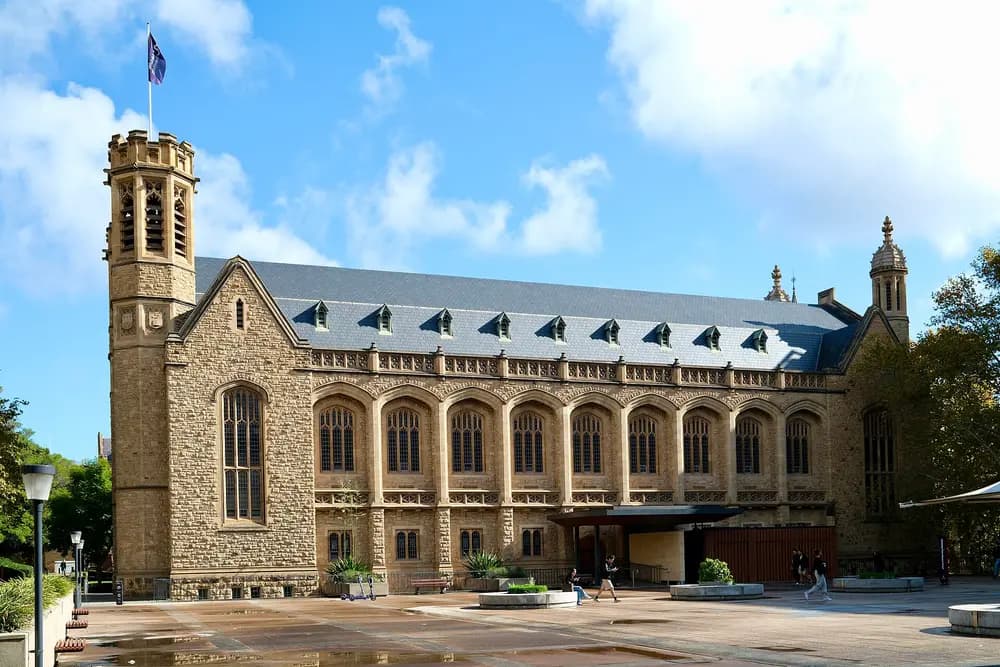
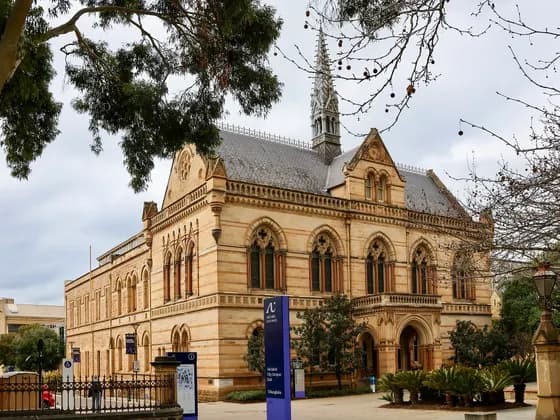
Adelaide — Bonython HallAdelaide — Mitchell Building of Adelaide University on 2 September 2026

Photo: Yu Chu Chin · CC BY-SA 4.0 · cropped

Photo: Yu Chu Chin · CC BY-SA 4.0 · Photo: Pavel Špindler · CC BY 3.0 · Photo: Dietmar Rabich · CC BY-SA 4.0

Student life

Still deciding where to apply? Hear it from a student who's there

Student guides · Medicine

Honest student guides to medicine universities

Current medical students at Australian universities are filming their guides right now: what the course and teaching are really like, the city they live in, the social side, and whether they'd pick it again.

Coming soon

Not on sale yet — we'll open these up as soon as the first Australian videos land.

Filming now

Start here
Overview

About Adelaide

Adelaide delivers South Australia's flagship 6-year undergraduate Bachelor of Medical Studies + Doctor of Medicine (BMS/MD), anchored at the North Terrace campus and Royal Adelaide Hospital with rural placements across Whyalla, Port Lincoln, and Mount Gambier.

Since 1 January 2026 it has been part of Adelaide University, the merged University of Adelaide / UniSA entity, taught through the College of Health's School of Medicine.

What makes Adelaide different

Adelaide runs South Australia's oldest medical school (est. 1885) as a 6-year undergraduate BMS+MD (3+3). Admission offer weighting: Academic 40% + UCAT cognitive 20% + Interview 40%. Strong rural pipeline via the Rural Clinical School (Whyalla, Port Lincoln, Mount Gambier).

Dedicated Aboriginal and Torres Strait Islander pathway with no UCAT ANZ requirement (the former Wirltu Yarlu Access Pathway is not the route into this degree).

The University of Adelaide and UniSA amalgamated into Adelaide University on 1 January 2026, and the program now sits in Adelaide University's College of Health, School of Medicine; applications for 2027 entry opened via SATAC on 3 August 2026 and close 30 September 2026.

New for 2027 entry: a Northern Community Care Stream of up to 20 places (SATAC ABP292 non-bonded, ABP293 bonded) for applicants schooled in Adelaide's northern suburbs, ranked on ATAR or IB plus interview with no UCAT ANZ; applicants with any prior higher education record are excluded from this stream for the 2027 intake.

Adelaide course & teaching

Integrated curriculum. 6-year undergraduate Bachelor of Medical Studies + Doctor of Medicine (BMS/MD; 3 + 3).

Taught at the Adelaide City Campus (Adelaide Health and Medical Sciences building, corner of North Terrace and George Street) with small-group Scenario-Based Learning and patient contact from Year 1; first clinical placements come in Year 3 and run through the Doctor of Medicine across Royal Adelaide, The Queen Elizabeth, Lyell McEwin, Modbury and Women's and Children's hospitals plus 13 Adelaide Rural Clinical School sites (Mount Gambier, Port Augusta, Port Lincoln, Whyalla, Ceduna, Port Pirie, Roxby Downs, Barossa, Clare, Jamestown, Mount Barker, Yorke Peninsula and Broken Hill NSW).

Rural placement is compulsory: every Commonwealth Supported student does at least four weeks, and 30% of domestic students spend a full clinical year rurally, allocated by random ballot if not filled voluntarily.

Since 1 January 2026 the program has been run by Adelaide University's College of Health, School of Medicine; the AMC accredits the BMS/MD to 31 March 2029, with the old MBBS in teach-out.

Adelaide research strengths

Adelaide is strong in these research areas:

  • Reproductive medicine
  • Cancer biology
  • Indigenous health
  • Rural workforce

How the Adelaide interview runs

Format: Multiple Mini Interview — a minimum of six stations of 10 minutes each, one interviewer per station, held online over Zoom (2027 entry; Adelaide states there is no in-person, telephone or alternative-platform option).

Adelaide runs a Multiple Mini Interview with a minimum of six stations lasting 10 minutes each, one interviewer per station, held entirely online over Zoom — there is no in-person, telephone or alternative-platform option, and requests for one are declined (2027 entry). Stations assess problem solving, communication skills, teamwork, empathy, integrity, preparedness for the program, cultural awareness and motivation.

Interviewers have all completed an Adelaide University training program and may be University employees, academic titleholders, medical alumni, health professionals or members of the wider community. Applicants who qualify for Medicine, Dentistry and/or Oral Health attend a single combined interview.

Candidates must be in a private location, must not communicate with anyone during the interview, and may not take or access notes of any kind.

Aboriginal and Torres Strait Islander pathway applicants instead sit a panel interview of around 20 minutes with three to four panellists (academics, clinicians and alumni, largely Aboriginal and/or Torres Strait Islander), preceded by an informal yarn.

International applicants sit a shorter format — at least two stations of up to 10 minutes for a single preference, and up to four interviewers if multiple preferences are listed.

Adelaide intake

Adelaide does not publish a total place count, though it publishes sub-pathway reservations (approximately 41 Rural Background, up to 20 Northern Community Care Stream, minimum 10 Higher Education). Its official student profile shows 160 students commencing in Semester 1 2026 (28 international, 17.5%; 96 admitted on ATAR plus additional criteria; 33 through the Higher Education pathway). Approximately 600 domestic and 160 international applicants are invited to interview each cycle. Domestic offer weighting: Academic 40% + UCAT ANZ 20% + Interview 40%.

Where Adelaide is

Adelaide University School of Medicine was founded in 1885 and is based in Adelaide.

Programmes offered:

  • Rural Medicine
  • Clinical Research
  • Reproductive Medicine
  • Indigenous Health
  • General Practice
Practise

Practise the Adelaide interview with an AI interviewer

These are real recordings of the interviewers you would meet, from a panel of 19 photoreal faces. Speak your answers out loud, get pressed with follow-ups, and receive rubric-scored feedback about two minutes after you finish, with a replay of your answers.

Try the AI interviewer
Entry requirements

What you need to apply to Adelaide

Adelaide at a glance

Adelaide University School of Medicine Medicine — 2027 entry at a glance
Entry pathwayUndergraduate (school-leaver) entry
ATARMinimum entry ATAR 90.00 (adjusted selection rank)
UCAT-ANZUCAT ANZ then carries 20% of the final domestic offer ranking, alongside Interview 40% and Academic 40%
Interview formatMultiple mini interviews (MMI)
Decisions (2027 entry)January 2027
Adelaide University School of Medicine Medicine entry requirements — 2027 entry
Admission overviewAdjusted ATAR / selection rank of 90.00 minimum (an eligibility floor, not a cut-off) + UCAT ANZ + MMI. The prerequisite is any ONE of SACE Stage 2 Biology, Chemistry or Mathematical Methods (or equivalent); high proficiency in written and spoken English is assumed knowledge, not a prerequisite. The medicine program does not apply subject adjustment factors — only the Universities Equity Scheme. Separate routes: a dedicated Aboriginal and Torres Strait Islander pathway (no UCAT ANZ; all eligible applicants interviewed), a Rural Background pathway (approximately 41 places), a Northern Community Care Stream (up to 20 places, no UCAT ANZ, SATAC codes ABP292 non-bonded / ABP293 bonded), a Higher Education pathway (minimum 10 places, open only to applicants whose sole tertiary record is at Adelaide University or an antecedent institution, with 1–2 years completed at a credit average / GPA 5.0), and a Work and Life Experience route via a competitive STAT score. Adelaide notes entry requirements for this degree are provisional and subject to change.
ATARMinimum entry ATAR 90.00 (adjusted selection rank). Adelaide states that 'the actual ATAR required for entry is typically much higher' than the 90.00 eligibility floor but 'does not disclose ATAR cut-off scores from previous years'. Its published ATAR profile for Semester 1 2026 (ABP171 and ABP271) suppresses every figure as '<5', because almost all offers are made on ATAR plus additional criteria rather than ATAR alone — so no median, lowest or guaranteed selection rank exists in the public record, and figures such as 99.75 are unsourced. Adelaide explicitly does not publish ATAR cut-offs.
Contextual ATARAdjustment factors for the Bachelor of Medical Studies are available only under the Universities Equity Scheme — the medicine program does not consider subject adjustment factors, so the Universities Language, Literacy and Mathematics Scheme does not apply. A minimum 50% of school-leaver applicants invited to interview will be from South Australia (an interview-invitation quota, not an offer quota).
UCAT-ANZUCAT ANZ alone decides who is interviewed (except Aboriginal and Torres Strait Islander pathway and Northern Community Care Stream applicants, who do not sit it): Sections 1–3 carry equal weight, and Section 4 (Situational Judgement, reported separately on 300–900 and not part of the /2700 cognitive total) separates only lower-ranked candidates with equal totals across the other three. UCAT ANZ then carries 20% of the final domestic offer ranking, alongside Interview 40% and Academic 40%. Adelaide publishes no cut-off and will not comment on score competitiveness; the South Australian advantage is structural — a minimum 50% of school-leaver interview invitations must go to South Australian applicants — not a published score gap. For national calibration only (not an Adelaide threshold), the official UCAT ANZ 2026 sitting used for 2027 entry had a total cognitive mean of 1,964, median 1,950, 8th decile 2,220 and 9th decile 2,340 across 17,341 candidates.
Place typesTwo Commonwealth Supported Place types with separate SATAC codes — non-bonded (ABP171) and Bonded Medical Program (ABP271, carrying a Return of Service Obligation); the split is not published. Adelaide publishes no annual place count; its official student profile shows 160 students commencing the program in Semester 1 2026, of whom 28 (17.5%) were international — a commencement count, not a place allocation. Indicative international tuition is AUD $103,000 per year. The previously cited 136 does not appear on any current Adelaide University page.
Indigenous pathwayEntry is via the School of Medicine's own Aboriginal and Torres Strait Islander pathway, documented on the Bachelor of Medical Studies page — not via the old Wirltu Yarlu Access Pathway, whose URLs now redirect to Adelaide University's First Nations page, which lists the Bachelor of Medical Studies among degrees with their own dedicated entry routes rather than under the general Aboriginal and Torres Strait Islander Pathway. Applicants apply through SATAC with an Aboriginal and Torres Strait Islander Statutory Declaration uploaded within five working days and are not required to sit the UCAT ANZ. A number of places are reserved — Adelaide does not publish the count — and all eligible applicants are invited to interview: a panel of three to four people (academics, clinicians and alumni, largely Aboriginal and/or Torres Strait Islander), around 20 minutes long, preceded by an informal yarn. The Faculty of Health and Medical Sciences no longer exists; the program sits in the College of Health, School of Medicine.
Bonded / ruralBonded Medical Program places sit under their own SATAC code (ABP271) with a Return of Service Obligation in eligible regional, rural or remote areas; the count is not published. Separately, approximately 41 places are reserved for the Rural Background pathway, open to applicants who lived in a Modified Monash Model (MMM 2019) MM 2–7 area for at least five consecutive years or ten years cumulatively, with a Rural Entry Pathway Statutory Declaration uploaded to SATAC within five days; interview places are filled in four priority categories (MM 2–7 applicant at an SA rural school, then at any SA school, then at a rural school in any state, then anywhere in Australia) and ranked on UCAT ANZ within each. All Commonwealth Supported students must complete at least four weeks of rural placement, and 30% of domestic students must spend a full clinical year rurally — allocated by random ballot if not filled voluntarily. A minimum 50% of school-leaver interview invitations go to South Australians.
Specialities offeredRural Medicine, Clinical Research, Reproductive Medicine, Indigenous Health, General Practice

Working towards the UCAT score Adelaide expects? Build a week-by-week plan from your test date — free for the first two weeks.

Interview

How Adelaide interviews applicants

Adelaide University School of Medicine Medicine interview — 2027 entry
FormatMultiple Mini Interview — a minimum of six stations of 10 minutes each, one interviewer per station, held online over Zoom (2027 entry; Adelaide states there is no in-person, telephone or alternative-platform option).
Interview window (2027 entry)November 2026-December 2026
Decision date (2027 entry)January 2027
Post-interview chancesNot published by Adelaide, and no admissions centre or Medical Deans report gives an interview-to-offer rate for this program. The only Tier-1 figures are approximately 600 domestic applicants invited to interview and 160 students commencing in Semester 1 2026 (28 of them international) — enough to show that a ~35% domestic conversion is unsupported, but not enough to state a rate, since commencements are not offers and the same interview also covers Dentistry and Oral Health applicants.
Tutor insight
Adelaide's MMI runs entirely over Zoom, with a minimum of six 10-minute stations and one interviewer each — long stations reward depth, so practise sustaining a line of reasoning rather than delivering a set piece. The University explicitly warns that rehearsed replies 'can diminish your overall performance', so show your working in ethics stations and name the principles you're weighing rather than reciting a framework. Plan for the published conditions too: a private location, no communication with anyone, and no notes of any kind, physical or electronic. The school's long history and basic-science depth mean candidates who can articulate why they want a 6-year undergraduate grounding (rather than a 4-year graduate path) play well. Be ready to discuss the Rural Clinical School footprint specifically; vague rural enthusiasm scores poorly.
Practice

Practise for your Adelaide interview

PrometheusQuestion Bank621 medicine questions inside

Interview questions matched to Adelaide

Two questions our tutors flagged as a strong fit for Adelaide’s interview style. Try answering them out loud, then open Prometheus for the model answers and follow-up tips.

MediumMMI · PanelQ1

Explain Medicare to an International Friend

A friend from overseas is moving to Australia and asks you to explain how Medicare works in five minutes. Walk us through what you would say.

Likely follow-up · What is the Medicare Benefits Schedule (MBS) and how does the rebate work?

3 expert tips in Prometheus
MediumMMI · PanelQ2

The Indigenous Life Expectancy Gap

Aboriginal and Torres Strait Islander Australians have a life expectancy approximately 8 years shorter than non-Indigenous Australians. What is driving the gap, and is it closing?

Likely follow-up · What proportion of the gap is explained by chronic disease?

3 expert tips in Prometheus
Get support

Apply to Adelaide with confidence

We've helped students into Adelaide and other Australian medicine schools — get tailored support for each stage of the application.

Sources

Where Adelaide's figures come from

Checked field-by-field against Adelaide University School of Medicine's official course page on 11 September 2026.

FAQ

Adelaide — frequently asked questions

UCAT-ANZ: UCAT ANZ alone decides who is interviewed (except Aboriginal and Torres Strait Islander pathway and Northern Community Care Stream applicants, who do not sit it): Sections 1–3 carry equal weight, and Section 4 (Situational Judgement, reported separately on 300–900 and not part of the /2700 cognitive total) separates only lower-ranked candidates with equal totals across the other three. UCAT ANZ then carries 20% of the final domestic offer ranking, alongside Interview 40% and Academic 40%. Adelaide publishes no cut-off and will not comment on score competitiveness; the South Australian advantage is structural — a minimum 50% of school-leaver interview invitations must go to South Australian applicants — not a published score gap. For national calibration only (not an Adelaide threshold), the official UCAT ANZ 2026 sitting used for 2027 entry had a total cognitive mean of 1,964, median 1,950, 8th decile 2,220 and 9th decile 2,340 across 17,341 candidates. UCAT-ANZ cognitive subtests required (Situational Judgement only as a tiebreaker at the lowest rank). No minimum or cut-off UCAT ANZ score is published; Adelaide states it 'will not comment on the competitiveness of your score'. Adelaide publishes no SA-versus-interstate score thresholds — the state effect is structural, arising from the rule that a minimum 50% of school-leaver interview invitations go to South Australians, not from a separate score bar. Any figure on the retired /3600 scale (last used for the 2024 ANZ sitting, 2025 entry) is not comparable to the current /2700 scale and must not be ratio-converted.

Apply to Adelaide with confidence

We've helped students turn their UCAT, personal statement and interview prep into offers from Adelaide and other Australian medicine schools.