
The Adelaide Medicine course
What you actually study, and where you will be
Adelaide's BMS/MD is a 6-year (3-year BMS + 3-year MD) course taught through case-based learning in an integrated curriculum, with patient contact from Year 3 and placements in Adelaide, rural South Australia and Broken Hill (2027 entry). The three-year Bachelor of Medical Studies is taught on campus through scenario-based learning, worked through in small groups inside large workshops, plus lectures, lab practicals and simulated patients. The three-year Doctor of Medicine that follows is spent mostly on placement. Real-patient placements start in Year 3 with a day a week in general practice, and 30% of domestic students must spend Year 5 in the country.
- Degree
- BMS/MD
- Length
- 6 years (3-year BMS + 3-year MD)
- Teaching
- Integrated + Case-based learning
- Clinical contact
- Year 3
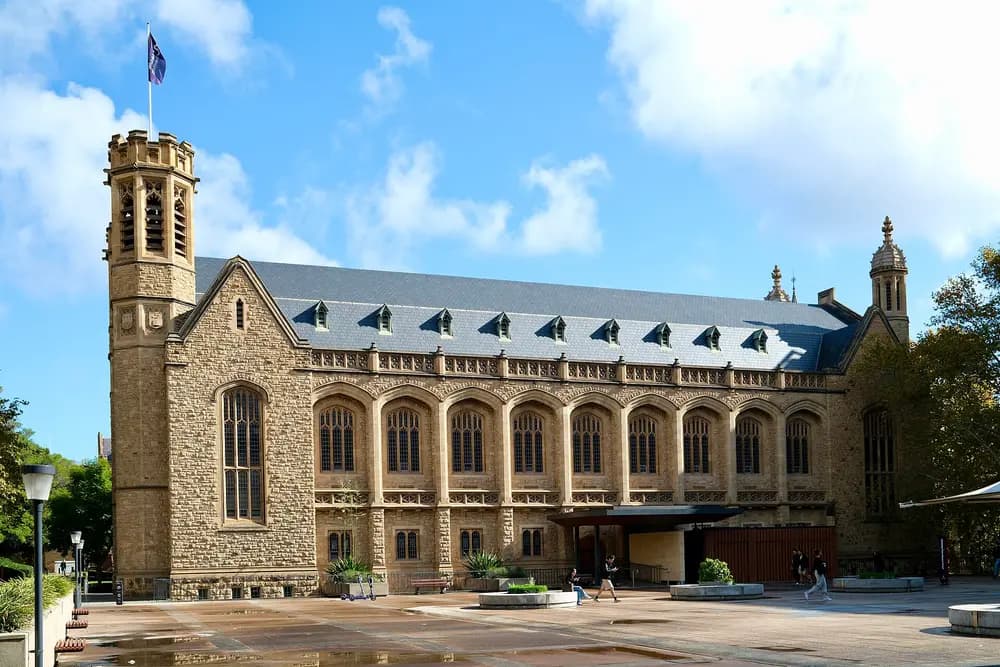
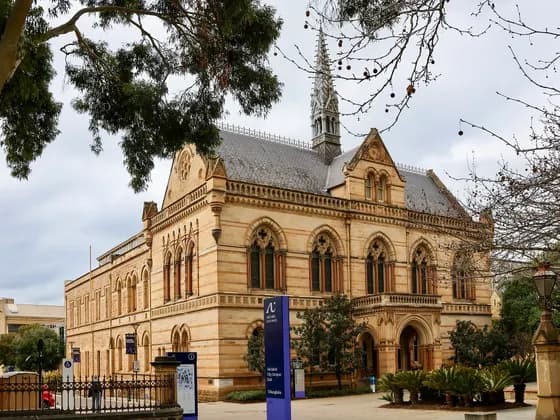
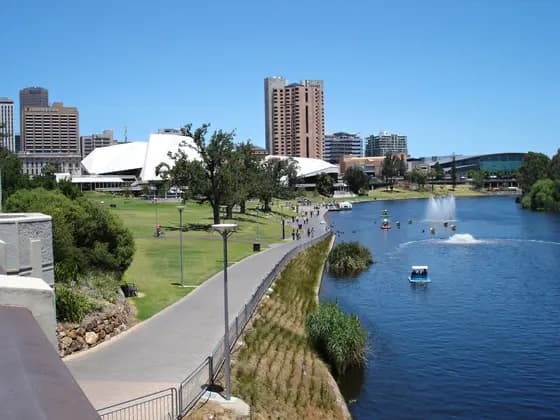

Photo: Yu Chu Chin · CC BY-SA 4.0 · cropped
Photo: Yu Chu Chin · CC BY-SA 4.0 · Photo: Pavel Špindler · CC BY 3.0 · Photo: Dietmar Rabich · CC BY-SA 4.0
The Adelaide medicine course at a glance (2027 entry)
Adelaide's medical course is a six-year, full-time program made of two degrees taken back to back: the three-year Bachelor of Medical Studies (BMS), then the three-year Doctor of Medicine (MD). In Australia an MD like this is an extended masters-level degree rather than a research doctorate. Complete the BMS and you move straight into the MD, which takes no direct applications.
The course belongs to the School of Medicine in Adelaide University's College of Health. Adelaide University, formed from the University of Adelaide and the University of South Australia, runs it from 2026. The BMS/MD replaced the Bachelor of Medicine, Bachelor of Surgery (MBBS) from 2022. The Australian Medical Council (AMC), which accredits medical courses, lists it as accredited to 31 March 2029.
Years 1 to 3 are taught on campus, mostly in the Adelaide Health and Medical Sciences (AHMS) building on North Terrace, beside the Royal Adelaide Hospital. You work through the body a few systems at a time. Patient scenarios give the teaching its focus, and lectures, lab practicals and clinical skills sessions cover the same systems. Clinical skills are rehearsed first with simulated patients, people trained to play patients.
Placements with real patients begin in Year 3, with a day a week in general practice (GP). Years 4 to 6 are full-time placements in Adelaide's hospitals, general practices and community settings. In Year 5, part of the year group lives and works in the country for the whole year with the Adelaide Rural Clinical School, which runs rural placements.
Research runs through the course, from a research proposal in Year 3 to a major project in the final year. The final year is new: on the AMC's timeline the first BMS/MD students reach it in 2027.
| Degree | BMS/MD: Bachelor of Medical Studies, then Doctor of Medicine |
|---|---|
| Course length | 6 years full time: 3-year BMS, then 3-year MD |
| Year 1 intake (2026) | 160 students in Semester 1 2026, including 28 international |
| Main campus | Adelaide Health and Medical Sciences building, North Terrace, Adelaide |
| Teaching style | Integrated, with scenario-based learning in small groups inside large workshops |
| First patient contact | Year 3 general practice day; simulated patients in Years 1 and 2 |
| Placement area | Adelaide hospitals and GPs, rural South Australia and Broken Hill |
| Rural year | Year 5 in the country, required of 30% of domestic students |
| Research | Research proposal in Year 3; major project in Year 6 |
| Accreditation | Accredited by the AMC until 31 March 2029 |
What makes Adelaide medicine different
A whole clinical year living in the country
The Adelaide Rural Clinical School teaches the rural Year 5 in an integrated way rather than in discipline blocks, though some sites add blocks for subjects such as obstetrics. Much of the GP work is parallel consulting: you see patients in your own room, then a supervisor reviews each one with you.
Trained actors and a hospital-style simulation centre
Adelaide Health Simulation, in the AHMS building, runs its simulated-patient program in partnership with the State Theatre Company of South Australia. The AMC's 2022 report commended the school's simulation teaching, which combines high-tech equipment with actors playing patients.
A weekly day in general practice from Year 3
After a successful pilot, the AMC heard in 2023, about 80 practices had signed up, each to take two students for a day a week. The School's Discipline of General Practice also leads city GP placements in Years 5 and 6.
Research skills built in, ending in a major project
Research is taught in steps. In the 2025 outlines, online research skills modules ran through the first two and a half years. Year 3 has you write a research proposal and defend it orally, and Year 4 includes two weeks introducing scholarship. Year 6 brings a major project in an area of your choice.
A six-year stream rooted in Adelaide's northern suburbs
For the 2027 intake, up to 20 places go to the Northern Community Care Stream. These students do most of their study and placements at Adelaide University sites and health services in the northern suburbs, including Lyell McEwin and Modbury hospitals and affiliated general practices. Their curriculum and degree requirements are identical to everyone else's.
How Adelaide teaches medicine
The six years are built on four domains, strands of learning that run from start to finish: Science and Scholarship, Clinical Practice, Health and Society, and Professionalism and Leadership. Most semesters in Years 1 to 3 are a single course covering all four. So the semester on the blood, heart and lungs also teaches you to examine those systems and apply population data to their diseases. It covers the ethical and social issues their patients face too.
The main group method is Scenario-Based Learning (SBL), Adelaide's form of case-based learning. The 2026 catalogue entry for Medical Studies 2A calls it discovery learning: you take a patient case and, as a group, work out the mechanisms behind it and what to do next. Lectures in pathology, anatomy, physiology and pharmacology support the scenarios.
In the 2025 outlines, first-semester scenarios came in fortnightly blocks, introduced one week and explored the next. From the second semester a new scenario arrived each week, and groups of typically four to eight worked on it across two workshops. Those groups share a much bigger room: the 2026 timetable's workshop classes hold about 80 students, twice a week from semester 2 of Year 1 through Year 2. The AMC reported in 2022 that the case sessions had moved to this large-group format because of COVID-19.
Two threads run alongside. Aboriginal and Torres Strait Islander health runs through the course, starting in Year 1 with the diversity of Indigenous histories and cultures and the continuing effects of colonisation on health. Interprofessional learning puts you alongside students from other health courses, such as nursing, including in simulated scenarios.
From Year 4 learning is mainly experiential: you join clinical teams on wards and in clinics, backed by tutorials, workshops, simulation and online modules.
The ways you will learn
| Scenario-based learning workshops | Small groups within the large workshop take each scenario and work out the mechanisms, likely diagnoses and next steps, practising how to form and test hypotheses. |
|---|---|
| Lectures | In person and as online videos. In the 2025 outline for Medical Studies 1, lectures took 108 of the semester's 234 scheduled hours, 84 of them on science. |
| Practical classes | Multidisciplinary lab sessions on the structure, function and diseases of the systems you are studying, including anatomy and histology (tissue under the microscope). |
| Clinical skills sessions | Called medical practice workshops in the 2025 outlines: you practise history taking and examination on simulated patients and reflect on your encounters. |
| Health and Society and Professionalism workshops | In the 2025 outlines, tutor-guided group sessions on epidemiology, prevention, the determinants of health and Indigenous health, and on ethics, law and professional behaviour. |
| Research skills modules | Online modules in the 2025 outlines. Year 1 covered finding sources and how scientific inquiry works; Year 2 quantitative and qualitative analysis, research ethics and presenting findings; Year 3 evidence-based medicine and clinical trials. |
A typical week on the Adelaide course
The 2026 class timetable shows a Year 1 week. Scheduled classes came to about 13 hours a week in each semester, and some lecture content is online video. The rest is private study: the 2025 outlines put a full-time load at an average of 48 hours a week, classes included.
In 2026, Year 3 had a full placement day every Wednesday in both semesters. In semester 2 the timetable added clinical sessions on most Tuesdays, from about 9am to 2pm, in groups of 10 to 12. From Year 4 you are on placement full time, and the 2025 outlines expected an average 48-hour week, including private study but not after-hours call.
- Lectures for the whole year group: seven a week in semester 1 and four in semester 2.
- Workshops for about 80 students at a time: one two-hour session a week in semester 1, two in semester 2.
- In Year 1, a two-hour clinical class every Tuesday, in a group of about 20.
- A practical class in groups of about 40, mostly in the Helen Mayo South building: an hour a week in semester 1, two hours in semester 2.
- A seminar in a group of about 27, lasting 80 minutes in semester 1 and an hour in semester 2.
How anatomy is taught at Adelaide
Anatomy is taught inside the Year 1 and Year 2 courses, with the systems you are studying. Medical Studies 1 covers the blood, heart and lungs, 2A the nervous and musculoskeletal systems, and 2B the endocrine, digestive and urinary systems. In the 2025 outlines the practicals were multidisciplinary: in Medical Studies 2A, for example, they explored anatomy, histology, physiology and pathology together.
Anatomy returns in Year 4: the 2025 surgery course included anatomy practicals, and its musculoskeletal workshops assessed anatomy alongside examination, plastering, injection and aspiration. Adelaide University's 2027 Health study guide describes a wet and dry anatomy lab for its health students. Adelaide University's Body Donation Program runs the central mortuary for all bodies donated for study and teaching in South Australia. Staff and students take part in an annual memorial service for donors.
When you first meet patients at Adelaide
The BMS page promises patient contact from the first year. In Years 1 and 2 that is mostly simulated: in weekly clinical sessions you interview and examine simulated patients, adding new body systems each semester. Much of this happens in the Adelaide Health Simulation centre.
In 2025, real patients joined clinician-led discussions with students about the personal and social side of their illness during Early Clinical Interaction seminars in Medical Studies 1. These seminars also brought in nurses, nurse practitioners, pharmacists, physiotherapists, psychologists and social workers who manage the conditions in that week's scenarios.
Placements with real patients begin in Year 3: a day a week in a general practice in semester 1, practising interviews, examinations and basic procedures under supervision. In semester 2 the 2025 outline set two full days a week in general practice and hospital, building full and focused histories and examinations. In 2024 a small Kulpi Minupa group met patients earlier, in Port Augusta (see Electives).
Year by year at Adelaide
- Year 1
Foundations, then the blood, heart and lungs
Semester 1, Foundations of Medicine, is an overview of how the body is organised and how health and disease work in molecules and cells. It also introduces the health system and what it means to be a professional. Semester 2, Medical Studies 1, starts the body-systems sequence with the blood, heart and lungs.
- Foundations of Medicine (MEDI1001, 24 units, a full-time semester's load) also covers public health and the social determinants of health.
- First clinical skills: structured interviews with simulated patients, showing rapport and empathy, and limited examinations of set body systems.
- Ethics from the start: the principles behind the doctor-patient relationship, such as autonomy, confidentiality and informed consent.
- Medical Studies 1 (MEDI1002, 24 units): structure, function, common diseases and basic management of the blood, heart and lungs, examination of each system, and written and oral case summaries.
- In 2025, Year 1 also included Mental Health First Aid training, finished with a workshop and assessment in semester 2.
- Year 2
Nervous system and movement, then metabolism
Year 2 finishes the body-systems sequence. Medical Studies 2A covers the neurological and musculoskeletal systems, and Medical Studies 2B takes metabolism as its theme, through the endocrine, digestive and urinary systems. Histories become more structured, and you start choosing and interpreting investigations.
- Medical Studies 2A (MEDI2001): anatomy, physiology and common diseases of the nervous and musculoskeletal systems, their drug and non-drug treatments, and the principles behind common pathology tests.
- Communication and ethics: patient-centred communication, shared decision-making, safety and quality in healthcare and ethical and legal dilemmas, with interprofessional learning activities.
- Population health: incidence, prevalence and risk, and how demographics and the social determinants of health drive inequalities, including for Indigenous peoples.
- Medical Studies 2B (MEDI2002): the endocrine, digestive and urinary systems in health and disease, current and emerging treatments, psychosocial histories, problem lists and communicating at challenging stages of care.
- Year 3
The lifespan, general practice and the move to clinical work
Semester 1, Medical Studies 3, follows human reproduction and the stages of life while you start a weekly day in general practice. Semester 2 combines Transition to Clinical Studies with a research course. If you leave after Year 3, the BMS can be awarded as an exit degree, but you cannot then re-enter the MD.
- Medical Studies 3 (MEDI3001): embryonic and fetal development, child development and childhood illness, puberty and adolescence, mental health, sexual health, pregnancy, reproductive cancers and ageing.
- In 2025 the course also ran workshops on sexual health, spinal injury and ear, nose and throat problems. Simulation sessions covered hand hygiene, basic life support, vital signs, protective equipment and aseptic technique.
- Transition to Clinical Studies (MEDI3002, 18 units): real patients in hospitals and primary care, plus prescribing, medical imaging, clinical handover, patient safety and recognising a deteriorating patient.
- It also covers Aboriginal community-controlled health services and one global health challenge in depth. In 2025 its simulation added venepuncture (taking blood) and cannulation (inserting a drip).
- In the 2027 catalogue, Medical Studies 3 and Transition to Clinical Studies each list 150 hours of work-integrated learning, meaning supervised learning in workplaces such as general practices and hospitals.
- Research Skills Development (MDST3011, 6 units, recoded MEDI3030 for 2027): weekly tutorials in which you appraise research on a current medical issue and write a proposal. Marks: proposal 30%, oral defence 40%, discussion 20%, learning journal 10%.
- Year 4
Full-time placements in medicine and surgery
The MD begins with two 24-unit courses of full-time placements, each taking about half the year. In 2026 both ran in each half, starting on 19 January, and the AMC's outline of the planned structure shows them taken in either order. The 2025 outlines describe 20-week courses that open with classroom teaching and end with an assessment week.
- Medicine, Cancer and Palliative Care and Psychiatry (MEDI4001): six weeks each of adult medicine; cancer, palliative care and specialty medicine; and psychiatry, on wards and in clinics. It lists 540 hours of work-integrated learning.
- Surgery and Musculoskeletal Medicine (MEDI4002): typically eight weeks of surgery, six of orthopaedics and rheumatology, and two introducing scholarship. Settings include theatres, recovery wards and outpatient and rehabilitation clinics, for 480 hours of work-integrated learning.
- Across both: history, examination and mental state assessment, differential diagnosis, choosing investigations, safe prescribing for a limited range of conditions and simple procedures.
- Medicine covers the law on capacity, substitute decision-making, end of life and mental health; surgery covers acute, chronic and post-operative pain management.
- Year 5
Women's and children's health and the wider health system
Year 5 covers child health, obstetrics and gynaecology, general practice, geriatrics and anaesthesia, with chances to work with First Nations or disadvantaged communities. You take it in one of two streams: two semester-long courses in Adelaide, or the same two subjects spread across a whole year in a rural community.
- Metropolitan stream: Women's and Children's Health (MEDI5001) and The Healthcare Continuum (MEDI5002), one each semester; in 2026 both ran in each half of the year.
- Women's and Children's Health: assessing patients by developmental age, prescribing safely in pregnancy and childhood, and the law on child protection, consent and women's safety.
- The Healthcare Continuum: access to health services, models of care and patients' experiences of them, and Aboriginal and Torres Strait Islander knowledges of wellbeing and models of care.
- Rural stream: Parts 1 and 2 of the same two courses (MEDI5003 to MEDI5006) run side by side through the year.
- Approved students can swap one metropolitan semester for an exchange at Aarhus University in Denmark (see Electives).
- Year 6
Preparation for internship, first run in 2027
On the AMC's timeline the first BMS/MD students reach Year 6 in 2027, and its catalogue pages still list course content as to be announced or confirmed. The Doctor of Medicine page says the year combines three placements: one preparing you for internship, one in a medical field you choose, and one in research and scholarship. You also complete a major project in an area of your choice. Internship is your first supervised year working as a doctor.
- The Doctor of Medicine page's study plan lists Preparation for Practice (MEDI6001, 18 units) and Transition to Medical Practice (MEDI6002, 6 units) in semester 1. Professional Placement (MEDI6003, 12 units) and the Research Enquiry Project (MEDI6004) follow in semester 2.
- Sources disagree on the project's size: the study plan lists it at 12 units, while the same page's course list and its own catalogue page say 24. The 12-unit figure is the one that adds up to the page's 96 core units.
- The 2027 catalogue renames and resizes the courses: Preparation for Practice (MEDI6011, 24 units), Scholarly Placement (MEDI6012, 12 units) and Professional Placement (MEDI6013, 12 units).
- In 2023 the AMC heard the project might last about nine weeks, with possible streams such as audit, which checks care against agreed standards, and medical education. Plans for Years 4 to 6 were then still being developed.
How you are assessed at Adelaide
Courses build in sequence, with earlier courses as prerequisites, so you must pass each stage to move on. The 2026 catalogue lists each course's task types, from multiple choice questions, exams, skills demonstrations and assignments to professional simulations and workplace-based assessments, mostly without published weightings.
In the 2025 outlines every course was assessed across the four domains. You had to reach the minimum standard in each, because a strong domain could not make up for a weak one. Most tasks were pass or fail hurdles. Written tests mixed multiple choice, short answer and data analysis questions, with standard-set pass marks, calculated for each exam rather than fixed. From Year 2 the mid-semester test made up 30% of the combined test result and the end-of-semester test 70%.
Clinical skills are signed off in stages. In 2025, Foundations of Medicine students recorded four simulated clinical encounters and passed checks such as vital signs and hand hygiene. From Medical Studies 1, courses used a series of clinical competencies. The AMC heard in 2023 that the first cohort's early skills were signed off this way rather than in an Objective Structured Clinical Examination (OSCE). In an OSCE you rotate through timed stations, each testing one task. By 2025, Transition to Clinical Studies ended with an OSCE you had to pass.
On placement, supervisors assess you at work. In Year 3 in 2025 this meant mini clinical evaluation exercises, in which a supervisor watches you with a patient, plus reports, reflections and a clinical logbook.
For Year 4, the 2026 overview of the surgery course lists written assignments, oral presentations, placement assessments, a multiple choice test and an OSCE. The 2025 Year 4 outlines add the detail: Entrustable Professional Activities (EPAs), key tasks such as assessing a patient, observed with feedback, and a supervisor report for each block. In each course, multiple choice testing and an OSCE were weighted equally: you needed a standard-set score of at least 50 across both and 45 in each.
- Professional behaviour counts throughout. The 2025 outlines required on-time work and at least 80% attendance at core group sessions such as workshops and practicals. The Year 5 course pages cite a policy called Assessment of Professionalism in the MD.
- In 2023 the AMC noted that progression rules for Years 4 to 6 were not yet settled, and that assessment in the rural year appeared to differ from the city's.
- In 2023 the AMC also noted that feedback included optional mock OSCEs run with the simulation centre.
Where you will actually be at Adelaide
For Years 1 to 3 you are based on the Adelaide City Campus, and Year 3 general practice placements are spread across greater Adelaide. In the MD years, city placements are in the public hospitals listed below, general practices and community settings. Placements can include time usually regarded as after hours, and travel to them across greater Adelaide is at your own cost.
Placements in SA Health facilities, South Australia's public health system, run under an agreement with the Minister for Health, so you sign a deed poll promising to keep patient information confidential. You also need criminal history and working with children checks, immunisations and tuberculosis screening. When you enrol you are registered as a student through the Australian Health Practitioner Regulation Agency (AHPRA), the national agency that handles registration for health practitioners. Scope of Practice documents set out what students in each year may do.
Rural placement is a condition of enrolment. The Bachelor of Medical Studies page says every Commonwealth supported student, meaning a domestic student in a government-subsidised place, must do at least four weeks rurally before graduating. It adds that 30% of all domestic students must spend a full clinical year in a rural location, with a random ballot of Commonwealth supported students if too few volunteer. Both degree pages warn that the rules can change with federal funding agreements.
Older documents give other rules: the University of Adelaide's 2025 program rules said half of Commonwealth supported students needed four rural weeks and a quarter a rural year. Counts of the rural Year 5 vary too. The AMC's 2022 report put it at about 45 students, or 30% of the cohort, in one passage and about 25% in another. The Rural Clinical School's 2024 report counted 41 students, and in 2026 the catalogue's class lists for the rural Year 5 courses showed about 40 enrolled.
The Adelaide Rural Clinical School (ARCS) runs rural placements in MD Years 4 to 6 lasting four, eight or 36 weeks. Year 4 surgery can be done in a country hospital. The ARCS program page and the 2026 surgery course give eight weeks, though the Port Augusta entry on the ARCS Locations page and older reports say nine. The Year 5 Integrated Program follows the normal academic calendar, and Year 6 selective placements, which you choose, last four weeks. Rural accommodation is free, furnished and has internet, and you receive a living allowance.
Sources count the rural sites differently. The Doctor of Medicine page mentions six rural clinical sites for Year 5, while ARCS says it runs placements at twelve sites and lists twelve Year 5 locations. Its 2024 report says Year 5 students worked in 22 towns across rural South Australia, Broken Hill and Alice Springs.
The School names all three among its main locations. The Royal Adelaide and The Queen Elizabeth are run by the Central Adelaide Local Health Network.
- Royal Adelaide Hospital
- The Queen Elizabeth Hospital
- Women's and Children's Hospital
Both hospitals belong to the Northern Adelaide Local Health Network, one of the two key sites for the metropolitan program, the AMC heard in 2023. Northern Community Care Stream students do most of their six years here.
- Lyell McEwin Hospital
- Modbury Hospital
- Affiliated general practices
In Year 5, Port Lincoln students rotate through anaesthetics, obstetrics and general practice, with at least three emergency shifts a month and some weeks in Tumby Bay. Ceduna students split the year with Port Lincoln, and Roxby Downs students with Whyalla. Whyalla and Port Lincoln also take Year 4 and Year 6 students.
- Port Lincoln and Tumby Bay
- Whyalla and Cummins
- Ceduna
- Roxby Downs
Port Augusta takes all three MD years; its Year 5 has paediatrics and obstetrics blocks, with GP time in Quorn and at the Pika Wiya Health Service. Port Pirie students spend 8 to 9 weeks in obstetrics and seven in the emergency department. Clare students do six weeks of obstetrics in Port Augusta.
- Port Augusta
- Port Pirie
- Jamestown
- Clare
Mount Barker's 36-week program covers paediatrics, obstetrics and gynaecology, geriatrics, anaesthesia and general practice every week rather than in blocks. Barossa students usually have a weekly University Day and work alongside Flinders University students. Yorke Peninsula students have seven supervised consulting sessions a week.
- Barossa (Kapunda, Tanunda and Angaston hospitals)
- Mount Barker (GPcare and Mount Barker Hospital)
- Yorke Peninsula (Kadina, Wallaroo and Moonta)
Year 4 surgery and Year 6 general practice only. Surgical placements are coordinated by Flinders Rural Health SA, so you may work alongside Flinders University students.
- Mount Gambier Hospital
Year 4 surgery in the year's final rotation only. The year-long Year 5 placement combines hospital obstetrics and gynaecology, the emergency department and GP parallel consulting, with four weeks in Bourke or Wilcannia.
- Broken Hill
- Bourke or Wilcannia
Electives, selectives and options at Adelaide
The first three years have no electives: all 144 units of the BMS are core. In Year 5, students approved for exchange can spend one semester at Aarhus University in Denmark (MDST5009, recoded MEDI5007 for 2027). The exchange course has the same learning outcomes as Women's and Children's Health and is assessed half by multiple choice questions and half by professional simulation.
In Year 6 the Doctor of Medicine page says you choose a preferred discipline to explore through a professional placement, locally, interstate or overseas. The Rural Clinical School's four-week Year 6 selectives run in community and outpatient settings, and it can help you find a placement in another rural town. The AMC heard in 2023 that international electives and exchanges had returned to pre-COVID-19 levels.
There was also an early-years rural option in 2024. The Rural Clinical School's Kulpi Minupa program took Year 2 students to Port Augusta in semester 1 and Year 1 students in semester 2, for 8 to 12 weeks. Students kept up their usual course, with extra support and early clinical experience.
Facilities and support at Adelaide
Where you will learn
The AHMS building, at the corner of North Terrace and George Street, was purpose-built in 2017 in the Adelaide BioMed City precinct. It sits beside the Royal Adelaide Hospital and the South Australian Health and Medical Research Institute (SAHMRI). It holds classrooms, study spaces, staff offices and the simulation centre. Most Years 1 to 3 classes are here in the 2026 timetable, with many practicals in the Helen Mayo South building.
Adelaide Health Simulation is a multi-floor centre whose suites copy real hospital environments. They have working oxygen and suction, nurse call, an integrated electronic medical record and equipment matching the local health networks. Manikins range from newborns to adults, and 24 assessment rooms have full audio-visual recording for clinical exams. The 2025 admissions guide also mentions an immersion lab using 360-degree technology. The College of Health says the centre holds two accreditations from the Society for Simulation in Healthcare.
In 2023 the AMC saw modern teaching facilities and student spaces at Lyell McEwin Hospital. At the Royal Adelaide Hospital, it found student spaces shared with hospital staff and spread through the building. Port Pirie has a simulation centre used for rural assessments (AMC, 2022), and Broken Hill has a simulation lab.
Support while you study
In 2022 the AMC found a precinct officer at each clinical site handling onboarding, orientation and placement requirements, but not wellbeing. It also found a Student Welfare academic with no assessment role guiding Years 1 to 3 students towards help. It asked the school to confirm its planned Clinical Deans, or another way to give students on placement wellbeing support kept separate from progression decisions. An August 2026 university news item names a Clinical Dean of Medicine.
On rural placements each centre usually has a local Student Support Coordinator, who handles accommodation, timetabling and orientation, and a Clinical Academic who supervises and mentors you. The AMC commended this pastoral support in 2022. The student rural health club, the Adelaide University Rural Health Alliance, runs trips, school visits and social events. The $5,000 Hoopmann Rural Medicine Scholarship helps Commonwealth supported students in financial need who will do a rural placement the next year.
Year 1 teaches you to find self-care resources for yourself and your peers. Students with a disability can get adjustments through the university's counselling and disability services. In 2022 the AMC also found that placement allocation took account of disability access plans and caring responsibilities. In 2023 Aboriginal and Torres Strait Islander students had a culturally safe study room in the AHMS building. The AMC found, though, that the gap left when a dedicated support position was centralised had not yet been addressed.
Is the Adelaide course right for you?
This course may suit you if
- You want to start medicine as an undergraduate and stay on one six-year path, with no second selection round before the MD.
- You would welcome a whole clinical year in the country, with free accommodation and a living allowance.
- You like working through patient scenarios in a small group inside a large workshop, with lectures supporting them.
- You want research skills built up in stages, from a defended Year 3 proposal to a final-year project.
- You value rehearsing consultations with trained simulated patients before meeting real ones.
Things to think about
- Regular placements with real patients start in Year 3; before then, clinical practice is mainly with simulated patients.
- If too few students volunteer for the rural year, you could be balloted to spend Year 5 in the country.
- The final year has not run yet: the first cohort reaches Year 6 in 2027, and its course details are still to be confirmed.
- You pay your own travel to placements across greater Adelaide, and placements can include after-hours time.
Adelaide medicine course — frequently asked questions
Applying to Adelaide?
How to get into Adelaide
Entry requirements, admission tests, written application and interview, step by step.
Open the guide →Adelaide entry requirements
ATAR or GPA, GAMSAT and UCAT ANZ thresholds, interview format and place types.
See the requirements →Compare Adelaide with other schools
Put the teaching style, anatomy teaching and placements next to another school.
Open the comparison →Prepare for the Adelaide interview
Format breakdown, school-specific sample questions and prep tips from tutors who interviewed here.
Read the guide →Where this Adelaide course guide came from
This guide was written from 59 official sources — Adelaide University School of Medicine's own course pages and programme documents, plus the Australian Medical Council or Australian Dental Council and the health services the school places students with where they publish detail — read on 2026-10-07, then checked claim by claim against those sources.
- Adelaide University: Bachelor of Medical Studies course page (domestic, 2027 entry)
- Adelaide University: Doctor of Medicine course page and study plans
- Adelaide University: Bachelor of Medical Studies student profile, Semester 1 2026
- Adelaide University: School of Medicine
- Adelaide University School of Medicine: About, Discipline of General Practice
- Adelaide University archives (Adelaide Connect): Adelaide Medical School, founding history
- Adelaide University: College of Health, including Adelaide Health Simulation
- Adelaide University: Health 2027 Study Guide (facilities and medicine pages)
- Course catalogue 2026: MEDI1001 Foundations of Medicine
- Course catalogue 2026: MEDI1002 Medical Studies 1
- Course catalogue 2026: MEDI2001 Medical Studies 2A
- Course catalogue 2026: MEDI2002 Medical Studies 2B
- Course catalogue 2026: MEDI3001 Medical Studies 3
- Course catalogue 2026: MEDI3002 Transition to Clinical Studies
- Course catalogue 2027: MEDI3001 Medical Studies 3
- Course catalogue 2027: MEDI3002 Transition to Clinical Studies
- Course catalogue 2026: MDST3011 Research Skills Development
- Course catalogue 2027: MEDI3030 Research Skills Development
- Course catalogue 2026: MEDI4001 Medicine, Cancer and Palliative Care and Psychiatry
- Course catalogue 2026: MEDI4002 Surgery and Musculoskeletal Medicine
- Course catalogue 2026: MEDI5001 Women's and Children's Health
- Course catalogue 2026: MEDI5002 The Healthcare Continuum
- Course catalogue 2026: MEDI5003 Women's and Children's Health (Rural) Part 1
- Course catalogue 2026: MEDI5004 Women's and Children's Health (Rural) Part 2
- Course catalogue 2026: MEDI5005 The Healthcare Continuum (Rural) Part 1
- Course catalogue 2026: MEDI5006 The Healthcare Continuum (Rural) Part 2
- Course catalogue 2026: MDST5009 Exchange Studies for Medicine Students (Aarhus University)
- Course catalogue 2027: MEDI5007 Exchange Studies for Medicine Students
- Course catalogue 2026: MEDI6001 Preparation for Practice
- Course catalogue 2026: MEDI6002 Transition to Medical Practice
- Course catalogue 2026: MEDI6003 Professional Placement
- Course catalogue 2026: MEDI6004 Research Enquiry Project
- Course catalogue 2027: MEDI6011 Preparation for Practice
- Course catalogue 2027: MEDI6012 Scholarly Placement
- Course catalogue 2027: MEDI6013 Professional Placement
- Adelaide Rural Clinical School
- Adelaide Rural Clinical School: rural medicine placement programs
- Adelaide Rural Clinical School: placement locations
- Adelaide Rural Clinical School: study experience, accommodation and student clubs
- Adelaide Rural Clinical School 2024 Stakeholder Report (University of Adelaide era)
- Adelaide University: Body Donation Program
- Adelaide University: Hoopmann Rural Medicine Scholarship
- Adelaide University news, August 2026: School to Scholar program with the Northern Adelaide Local Health Network
- 2025 Academic Program Rules: Bachelor of Medical Studies (University of Adelaide era)
- 2025 Academic Program Rules: Doctor of Medicine (University of Adelaide era)
- 2025 Medicine Admissions Guide for domestic applicants, University of Adelaide (archived copy)
- 2025 course outline: MEDIC ST 1501 Foundations of Medicine, University of Adelaide (archived copy)
- 2025 course outline: MEDIC ST 1502 Medical Studies 1, University of Adelaide (archived copy)
- 2025 course outline: MEDIC ST 2501 Medical Studies 2A, University of Adelaide (archived copy)
- 2025 course outline: MEDIC ST 2502 Medical Studies 2B, University of Adelaide (archived copy)
- 2025 course outline: MEDIC ST 3501 Medical Studies 3, University of Adelaide (archived copy)
- 2025 course outline: MEDIC ST 3502 Transition to Clinical Studies, University of Adelaide (archived copy)
- 2025 course outline: MEDIC ST 7401HO Medicine, Cancer and Palliative Care and Psychiatry, University of Adelaide (archived copy)
- 2025 course outline: MEDIC ST 7402HO Surgery and Musculoskeletal Medicine, University of Adelaide (archived copy)
- Australian Medical Council: accredited medical schools list
- Australian Medical Council: 2022 accreditation report, University of Adelaide medical programs
- Australian Medical Council: accreditation report with the October 2023 follow-up assessment, published February 2024
- SA Health: Northern Adelaide Local Health Network
- SA Health: Central Adelaide Local Health Network
Courses are restructured between cycles. Anything here that decides your application — an anatomy offer, a placement city, a compulsory intercalated year — should be confirmed against the official page for your entry year.
Applying to Adelaide?
We have helped hundreds of applicants turn their GAMSAT / UCAT ANZ, written application and interview prep into offers from Adelaide and other Australian medicine schools.