
The UQ Medicine course
What you actually study, and where you will be
UQ's MD is a 4-year (graduate entry) course taught through team-based learning in an integrated curriculum, with patient contact from Year 1 and placements in Greater Brisbane, regional and rural Queensland, and New Orleans (2027 entry). UQ's Doctor of Medicine was rebuilt from 2023 as one year-long course per year. You belong to a learning community, a cluster of hospitals and practices in Greater Brisbane or regional Queensland. Clinical time grows from a day a week in Year 1 to full-time immersion from Year 3, ending with an 8-week pre-internship term. School leavers can also enter through a provisional place or the six-year BMedSc/MD.
- Degree
- MD
- Length
- 4 years (graduate entry)
- Teaching
- Integrated + Team-based learning
- Clinical contact
- Year 1
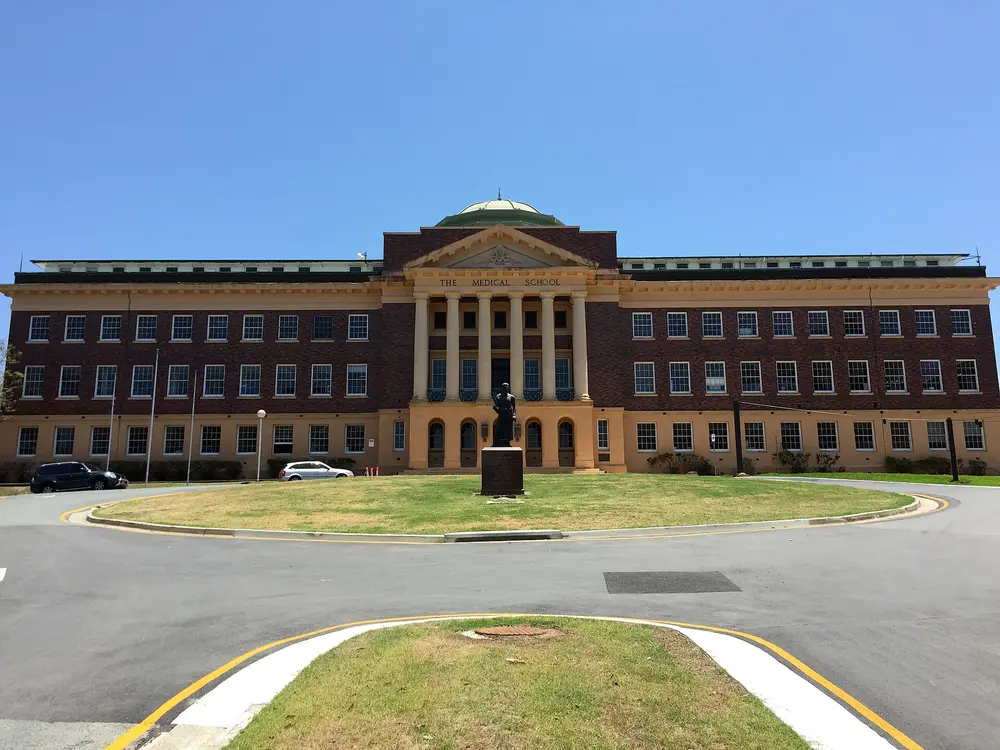
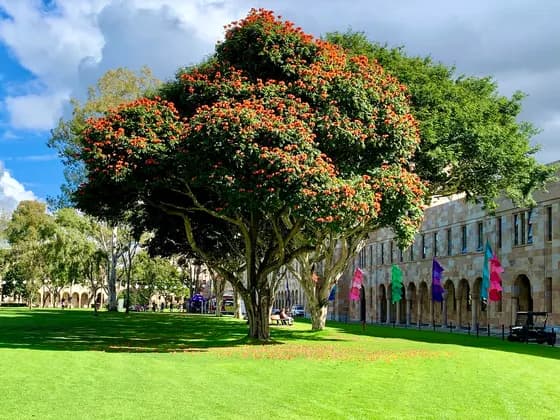
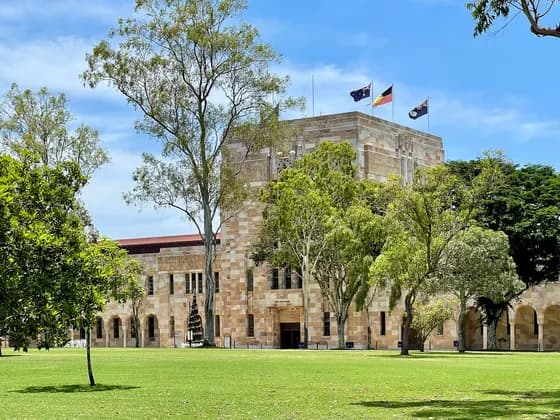
Photo: Kgbo · CC BY-SA 4.0 · cropped
Photo: Chris Olszewski · CC BY-SA 4.0 · Photo: Kgbo · CC BY-SA 4.0 · Photo: Kgbo · CC BY-SA 3.0
The UQ medicine course at a glance (2027 entry)
The University of Queensland's Doctor of Medicine (MD) is a four-year, full-time degree run by UQ's Medical School. In Australia an MD like this is an extended masters-level degree, at level 9 of the Australian Qualifications Framework, not a research doctorate. It enrols over 400 students a year and is accredited until 31 March 2029 by the Australian Medical Council (AMC), which accredits medical courses.
The course is new. UQ replaced its previous MD from 2023 with one year-long course per year: Foundations of Medicine, Developing Skills in Medicine, Clinical Immersion and Transition to Practice. The final-year course first ran in 2026, so 2027 entrants join the complete new program. Six themes, each a role of a doctor, run through all four years.
Each student belongs to a learning community: a cluster of hospitals, general practices and community services, with the students and staff based there. Greater Brisbane students spend most of Year 1 at St Lucia, then join one of four Brisbane communities. Students on a regional entry pathway belong to the Rural Clinical School, UQ's network of regional teaching sites, for the whole MD.
Clinical learning starts in Year 1 with a day a week of simulation, small-group coaching and hospital or community visits. From Year 3 you work full time in clinical teams, ending with an 8-week pre-internship term. After graduating you apply through the Australian Health Practitioner Regulation Agency (Ahpra) for provisional registration with the Medical Board of Australia. That lets you start an internship, your first supervised year as a doctor, also called postgraduate year one (PGY1).
Graduate entry is for applicants who already hold a degree. Provisional entry holds an MD place for a school leaver while they complete a first degree at UQ, CQUniversity (Central Queensland University) or the University of Southern Queensland (UniSQ). Direct entry is the six-year Bachelor of Medical Science/Doctor of Medicine (BMedSc/MD): two years of pre-medicine study, then the MD in Greater Brisbane. US citizens and permanent residents can take the UQ-Ochsner MD, with Years 3 and 4 in New Orleans.
| Degree | Doctor of Medicine (MD), an extended masters-level degree |
|---|---|
| Course length | 4 years full time; 6 years through the BMedSc/MD |
| Intake | Over 400 students a year |
| Year 1 base | MD Learning Hub, St Lucia, or your regional clinical unit |
| Teaching style | Integrated; team-based learning in Year 1, clinical scenario groups in Year 2 |
| Anatomy | Donor bodies in Brisbane; plastinated specimens and models at CQUniversity |
| First clinical experience | Year 1: a day a week of simulation, coaching and visits |
| Clinical schools | Greater Brisbane, Rural (four regional units) and Ochsner in New Orleans |
| Final year | Four 8-week terms, then an 8-week pre-internship term |
| Research | Team scholarly project in Year 3; optional MD-PhD or MD-MPhil |
What makes UQ medicine different
Nearly all of the course in regional Queensland
The regional pathways base you in one region for nearly the whole course. The main exceptions are your elective and the 8-week Year 4 Clinical Extension, which must be outside your learning community, though you can preference another region or a rural hospital. School leavers first take CQUniversity's Bachelor of Medical Science (Pathway to Medicine) in Rockhampton or Bundaberg, or UniSQ's Bachelor of Biomedical Sciences (Medicine Pathway) in Toowoomba.
A final year that prepares you for intern work
Alongside your Year 4 terms, a longitudinal program rehearses core junior doctor tasks, and you sit a prescribing exam used by 15 Australian medical schools. The year ends with the pre-internship term (PRINT), 8 weeks as a pre-intern in a hospital team. If your internship is at a UQ-affiliated hospital, you can ask to do PRINT there, though it is not guaranteed.
Eight weeks outside your own learning community
The Year 4 Clinical Extension is a rural generalist or medical specialty placement away from your home community. Options include another Brisbane community, Rockhampton, Bundaberg, Hervey Bay, Toowoomba, small rural hospitals and Ochsner in New Orleans. Regional, rural and remote options come with accommodation and travel subsidies.
Up to 24 weeks in one rural community
Through the Extended Placement Program, a small number of Year 4 students who apply and are approved take general practice and Clinical Extension back to back in one rural town. That gives 16 weeks there, or 24 with the elective. UQ provides free accommodation, travel and living support and a medical educator. Possible 2027 sites are Charleville, Chinchilla, Roma, Dalby, St George, Kingaroy, Emerald and Maryborough.
Coaching and peer mentoring built into Years 1 and 2
Each first-year student is assigned a development coach and a peer mentor, usually a second-year student, and the meetings are course requirements. In Year 2 the roles reverse: after a mentoring certificate you hold four meetings with a first-year mentee. Year 2 groups also design a learning resource for other students and write and review multiple-choice questions.
How UQ teaches medicine
Science, clinical skills and professional practice are taught together, body system by body system, rather than in separate preclinical and clinical halves. Year 2 goes deeper into pathology and pathophysiology, the disease processes behind symptoms, and into clinical reasoning: moving from history and examination to a diagnosis and plan.
Year 1 sessions are held in person at your site or online, and most come with pre-reading such as videos, modules or quizzes. Your timetable places you in a small group of about 10 for team-based learning, history and examination tutorials and procedural skills workshops. Lectures, symposia and clinical plenaries are recorded to support attendance, not replace it.
From Year 3 you learn mainly as a member of clinical teams, in full-time 8-week placements that UQ calls immersions. UQ's curriculum page puts Year 4 at 20 per cent structured learning and 80 per cent clinical exposure in the first semester, then 10 and 90 per cent in the second.
The ways you will learn
| Team-based learning (TBL) | Before each session you work through set resources and take a short readiness test online. In class your team sits the same test together, then applies the ideas to problems, and your facilitator rates your contribution after each study period. |
|---|---|
| Clinical scenario-based learning (CSBL) | Year 2's core small-group format, around which timetables are built. Students present and discuss clinical scenarios while a clinician facilitates. Four times a year you give a five-minute summary of the case just discussed, marked by your tutor and peers. |
| Clinical skills sessions | History and examination, clinical communication and procedural skills sessions in small groups. You practise on classmates, and tutors run short observed assessments followed by a feedback conversation. |
| Lectures, plenaries, symposia and practicals | Lectures explain core concepts. Clinical plenaries, led by clinical experts and sometimes involving patients, give a clinical overview of the week's topics. Integrated symposia bring several disciplines to one theme. Practicals cover anatomy, histology, physiology and pathology, and Year 2 adds online radiology modules. |
A typical week on the UQ course
The MD keeps its own calendar rather than UQ's standard semesters. In 2027, Year 1 starts on 1 February, Year 2 begins with an introductory week from 28 January, and Years 3 and 4 start on 4 January. The course is planned at about 40 hours a week: in Years 1 and 2, roughly 26 hours of scheduled sessions and 14 of guided self-study. The Year 1 figure comes from UQ's 2024 slides, which described four classroom days and one clinical day.
In Year 2, Greater Brisbane students spend Mondays at St Lucia or online and take small-group and clinical skills classes at their community's hospitals. Timetables allow 30 minutes' travel from St Lucia to the PA-Southside unit at the Princess Alexandra Hospital or the Mater, and 60 to Royal Brisbane or Greenslopes. For the Queen Elizabeth II (QEII) Hospital and The Prince Charles, they allow 90. Rural Clinical School students have a placement day each Tuesday and mostly face-to-face classes from Wednesday to Friday.
A Year 3 week has 34 hours in your learning community: about 30 in the workplace and 3.5 to 4 in immersion tutorials. Add three hours of whole-cohort learning (including a one-hour online tutorial on Thursdays) and three hours for your project and portfolio. Year 4 averages 28 to 30 hours on placement, plus the intern-preparation program, prescribing exam preparation and 6 to 8 hours of self-study.
Year 1 classes mostly run 8am to 6pm on weekdays. Clinical learning follows the team's hours, generally 6am to 6pm, with some evening, weekend and overnight shifts. You get at least 10 hours' break after an evening shift, and you are not expected at classes on the day a run of night shifts begins or ends.
How anatomy is taught at UQ
In Brisbane, anatomy is taught in the Gross Anatomy Facility in the Otto Hirschfeld Building at St Lucia. The facility is run by the School of Biomedical Sciences and relies on the UQ Body Donor Program. It has two large climate-controlled laboratories and a teaching collection of prosections (specimens already dissected by staff) and skeletons.
Year 1 has a weekly anatomy tutorial on a different body region, with practical classes from week 1. The Medical School's guide for new students also mentions dissection classes later in the year, for which you supply disposable gowns.
Queensland's Transplantation and Anatomy Act 1979 requires respectful, orderly conduct around donated bodies, and phones and cameras stay at the bag racks. You wear a lab coat or gown, safety glasses, enclosed shoes, a surgical mask and your student ID. Online inductions must be done at least 72 hours before your first session.
Year 2 practicals combine gross, surface and imaging anatomy with histology, physiology and pathology. Brisbane students keep using the Gross Anatomy Facility, while students in Bundaberg and Rockhampton use plastinated human specimens (real tissue preserved with plastic), models and digital resources at CQUniversity's anatomy facilities.
When you first meet patients at UQ
Your first clinical contact is controlled. In Year 1 you practise histories and examinations on classmates and spend a day a week on simulation, small-group clinical coaching and hospital or community visits. You meet trained simulated patients in the Year 1 Objective Structured Clinical Examination (OSCE), a circuit of timed stations each testing one clinical task. Rural Clinical School students, and a small number of Brisbane students, also take part in a rural immersion to see life and healthcare in rural and remote communities.
Year 2 puts you in real clinical settings for up to two days a week, where your role is mainly to observe and, where appropriate, take part. You join bedside clinical coaching and general practice, outpatient and collaborative care placements, which can include community services, private practices and home visits. Some observed assessments now use real patients, such as a history taken in general practice.
From Year 3 you work in a clinical team on wards and in outpatient clinics, admission units, delivery suites and operating theatres. In Year 4, assessments should ideally be signed off by registrars (doctors in specialist training) or more senior doctors. In the final term, your intern-like work is checked and co-signed.
Year by year at UQ
- Year 1
Foundations of Medicine (MEDI7100)
The first year covers the foundations of biomedical, clinical, social and human sciences, the doctor's role and basic clinical skills, taught by body system across six focus areas. It opens with the Transition to the MD. The 2026 calendar and orientation page list it as three weeks, although UQ's curriculum page and participation guidelines still say four.
- Transition to the MD: a welcome to the profession, the six themes, program structure and assessment, a first taste of each learning format and where to find help.
- Small-group clinical communication, history and examination, and procedural skills sessions. You complete seven different Mini-CEX (short observed history or examination tasks with feedback) and seven different DOPS (direct observations of procedural skills).
- Two Integrated Group Projects on topics chosen from a list, each ending in a group presentation, a written report and a peer evaluation of your teammates.
- A Rural Health Group Project: your group profiles a rural or remote Queensland community, meets local health workers and residents in person or online, and develops a rural health research question.
- Mental Health First Aid accreditation, two meetings with your development coach and four with your peer mentor.
- Assessment: five computer-based multiple-choice tests, one of them a practice test, and an OSCE of six 10-minute stations in two parts; a strong Part 1 exempts you from Part 2.
- Year 2
Developing Skills in Medicine (MEDI7200)
Year 2 is a 35-week course moving from the healthy body to disease. Nine focus areas combine clinical medicine, biomedical sciences, and public health and social sciences across the life stages, building clinical reasoning.
- General practice, a full day at a time. Greater Brisbane students do eight full days during an eight-week block, plus eight sessions in other clinical settings; Rural Clinical School students do 15 full days, one a week.
- Collaborative care and outpatient placements: four half-day sessions in each, spread across four weeks (Greater Brisbane timetables fit these around clinical capacity). Your group presents a poster on them at a showcase.
- Seven procedural skills workshops (five with an observed DOPS), history and examination classes, clinical examination masterclasses and two clinical communication sessions in groups of 10 to 20. Greater Brisbane students also do a three-week pathology practical at Royal Brisbane.
- Personalised Learning Stream (weeks 18 to 35): explore an interest or strengthen a weaker area, for example through Research in Medicine (6 hours a week for 16 weeks). UQ-Ochsner students prepare for the US medical licensing exam.
- A leadership and professional development stream building skills in leadership and quality management, which includes mentoring a first-year student.
- Written work: an Access to Healthcare report, a 500-word reflection on an interaction with a First Nations person, and two 1,000-word professional development reviews.
- Assessment: four tests of 60, 60, 60 and 80 questions, 13 observed clinical assessments including three tasks in general practice, a GP supervisor report and a 10-station OSCE in week 33.
- Year 3
Clinical Immersion (MEDI7300)
Year 3 runs as five 8-week clinical immersions over 40 weeks, mostly within your learning community. They cover child and adolescent health and wellbeing, medicine, mental health or rural health, obstetrics and gynaecology, and surgery, in one of five set orders that you preference.
- Greater Brisbane students take an 8-week mental health immersion. Rural Clinical School students instead spend 8 weeks in a rural or remote community. They learn mental health across the year in inpatient, community, older persons', alcohol and other drugs, consultation liaison, and child and youth services.
- All immersions except the rural one include a Patient Focused Assessment (an in-depth discussion of a patient), such as a long case in medicine or a case presentation in surgery.
- Weekly Integrated Concept Tutorials for the whole year group link what you see across specialties and show how the multidisciplinary team shares care.
- The scholarly project: in groups of 4 to 5 you complete literature-based, lab-based or clinical research over 35 weeks, through five milestones ending in a poster presentation and written report. The course profile allows 2 hours a week; UQ's research page says 6.
- Clinical Skills Passport, a record of 75 set procedures you must be observed doing to the required standard: 50 must be signed off by the end of Year 3. UQ advises doing perineal suturing, colposcopy, intrauterine device insertion and vaginal delivery in obstetrics and gynaecology.
- Year 4
Transition to Practice (MEDI7400)
The final year prepares you to work as an intern. Its Preparation for Practice phase has four 8-week terms in pairs (general practice with Clinical Extension, Critical Care Plus with the elective) in one of four orders. A Learning and Development week of workshops, panels and lectures prepares you for internship. After it, students who have met every requirement start the 8-week pre-internship (PRINT) term.
- Critical Care Plus: 4 weeks of emergency medicine, 2 of anaesthesia, 1 of intensive care and 1 of ophthalmology, in your home learning community where possible. Simulations cover chest pain with an abnormal heart rhythm and a deteriorating post-operative patient.
- General practice: 8 weeks in a Greater Brisbane practice you preference, a regional practice arranged by your rural learning community, or, by application, a rural practice through GP in a Rural Location. Weekly small-group tutorials run alongside, by Zoom for rural and remote students.
- Clinical Extension: 8 weeks of rural generalist or medical specialty placements outside your learning community, with three two-hour Zoom sessions on Indigenous health and history led by Elder Wayne Williams.
- Extended Placement Program: if your application is approved, you take general practice and Clinical Extension back to back in one rural town.
- Longitudinal Learning Program: 24 units on the acutely unwell patient, safe prescribing, ward calls and investigations, and multimorbidity and whole person care. Sixteen units have face-to-face tutorials and eight are online, with six quizzes to pass at 80 per cent.
- Prescribing Skills Assessment: modules, practice tests and a two-hour, 60-item exam in the Learning and Development week, then an analysis of your result in your portfolio. It is endorsed by the Australasian Society for Clinical and Experimental Pharmacologists and Toxicologists.
- PRINT: 8 weeks in a hospital team as a pre-intern, not yet an employee or registered doctor. You join the team's rosters, take on supervised intern-like duties, get at least eight work-readiness tasks signed off and receive supervisor reports at weeks 4 and 7.
- Also: a half-day pre-hospital trauma and emergency simulation (on a weekend for Greater Brisbane students) and two tests, after your second and fourth terms.
How you are assessed at UQ
UQ uses programmatic assessment: many smaller assessments by different assessors across the year, pooled to decide if you are ready to progress. Each year, three components are judged separately (knowledge, clinical skills, and professionalism and leadership), and strength in one cannot make up for weakness in another. The Year 3 OSCE and the Year 4 PRINT term count as a fourth component. Standards come from expert judgement of competence, such as the Angoff method, not from ranking students, so every student can meet them. Each year's course is graded pass, fail or incomplete.
Knowledge is tested mainly through cumulative achievement tests (CATs): invigilated, computer-based multiple-choice exams spread through each year, each including some earlier material. Year 1 has a practice test and four scored tests, Year 2 four, Year 3 three, timed to your immersion order, and Year 4 two. Year 1 questions ask for the single best of five options, with no negative marking, and you receive feedback reports on your strengths and gaps.
Clinical skills are tested by OSCEs and in the workplace. Year 2 ends with a 10-station OSCE of history, examination and explanation stations, each with 2 minutes' reading and 8 minutes' performance. Year 3 ends with a 10-station whole-cohort OSCE. To pass it, you must meet the overall standard and the standard in at least 7 stations. A marginal fail leads to a supplementary OSCE in the same format.
Workplace assessment grows each year. Most Year 3 and 4 terms bring observed Mini-CEX, a Patient Focused Assessment and a clinical supervisor report. All 75 Clinical Skills Passport procedures must be completed at standard before PRINT. A portfolio of learning plans and reflections runs through every year.
If you marginally fail a component, you may be offered supplementary assessment, but not if you are judged not ready to progress. Supplementary assessment is capped at 32 units across the program. Failing a course brings a progression alert; a second failure requires an improvement plan; a third, or failing the same course twice, ends your enrolment. If you leave the program early, you can apply for a Graduate Diploma in Medical Studies after one year or a Master of Medical Studies after two.
Where you will actually be at UQ
UQ organises clinical teaching through three clinical schools, each a group of teaching hospitals and sites: Greater Brisbane, Rural and Ochsner. Your learning community is your home within them. Greater Brisbane students rank the four Brisbane communities in the second half of Year 1 and stay with the one allocated; Aboriginal and Torres Strait Islander students receive priority.
Placements are mostly within your community, but Year 3 immersions use other sites when needed. In the 2027 Year 3 pathways, paediatrics is at the Queensland Children's Hospital in every Central pathway, most South pathways and many West ones. The Year 4 Clinical Extension is taken outside your community, and at least half of Greater Brisbane domestic students do it regionally, rurally or remotely, to meet Commonwealth requirements.
You pay your own travel and living costs on placement, but UQ-arranged rural terms come with free accommodation, from UQ units and Queensland Health staff quarters to shared houses and homestays. Most add a travel subsidy scaled by distance (from $65 to $670), a placement allowance of $50 a week and, where there is no Wi-Fi, $100 for internet. PRINT carries no subsidies.
The Royal Brisbane and Greenslopes clinical units. Royal Brisbane and Women's Hospital has almost 1,000 beds; Greenslopes is a private hospital 5 km south of the city.
- Royal Brisbane and Women's Hospital, Herston
- Greenslopes Private Hospital
- Queensland Children's Hospital
The PA-Southside Clinical Unit in Metro South Health. The Princess Alexandra, 2 km south-east of the city, covers most adult specialties; QEII and Redland are smaller community hospitals. Many 2027 Year 3 pathways also include weeks at the Mater, including its neonatal unit.
- Princess Alexandra Hospital
- Queen Elizabeth II Hospital, Coopers Plains
- Redland Hospital, Cleveland
- Queensland Children's Hospital
- Mater hospitals, South Brisbane
The Northside Clinical Unit in Metro North. The Prince Charles is 10 km north of the city and Caboolture midway to the Sunshine Coast; St Vincent's Private, on the Prince Charles campus, offers intensive care placements.
- The Prince Charles Hospital, Chermside
- Redcliffe Hospital
- Caboolture Hospital
- St Vincent's Private Hospital Northside
The Mater and Ipswich clinical units. Ipswich Hospital is 40 km west of Brisbane, with a direct rail link. The 2027 Year 3 pathways add The Park Centre for mental health.
- Mater hospitals, South Brisbane
- Ipswich Hospital
- The Park Centre for Mental Health, Wacol
- Queensland Children's Hospital
UQ General Practice works with this group of practices on student placements. Year 2 placements may be outside your learning community, and in Year 4 you cannot preference a practice where your family are patients or staff.
- More than 260 UQGP partner practices
The Rockhampton Regional Clinical Unit is on the Rockhampton Hospital campus, about 600 km from Brisbane. For Year 3 you preference Rockhampton or Gladstone as your main base.
- Rockhampton Hospital
- Mater Misericordiae Hospital Rockhampton
- Gladstone Hospital
Years 1 and 2 are in Bundaberg, about 360 km north of Brisbane. For Years 3 and 4 you are based there or at Hervey Bay, about 300 km north, where the unit sits beside Hervey Bay and St Stephen's hospitals. Each can take 10 to 18 students.
- Bundaberg Hospital
- Hervey Bay Hospital
- Maryborough Hospital
UQ's Teaching and Learning Centre is next to Toowoomba Hospital, about 125 km west of Brisbane. Some Year 1 and 2 classes are at UniSQ.
- Toowoomba Base Hospital
- St Vincent's Private Hospital, Toowoomba
- St Andrew's Hospital, Toowoomba
Rural placements, in the Year 3 rural immersion and Year 4 rural options, are limited to listed Queensland sites that vary by term, and you cannot self-arrange them. These examples come from UQ's 2027 lists.
- Charleville
- Chinchilla Hospital
- Cunnamulla Hospital
- Dalby Hospital
- Emerald Hospital
- Kingaroy Hospital
- St George Hospital
- Woorabinda Multipurpose Health Service
Years 3 and 4 for UQ-Ochsner students, who return to Australia for Clinical Extension. Other students can apply for a Year 4 Clinical Extension (five medical-specialty places a term), elective or PRINT term there, each as two 4-week rotations in different disciplines. PRINT there is for students planning US training who have passed the first two US licensing exams.
- Ochsner Health (UQ-Ochsner Clinical School)
Electives, selectives and options at UQ
The compulsory elective is the 8-week Personal Learning and Development term in Year 4, at any approved location worldwide. You can use it to explore a career interest, build clinical or research skills, work in an area of need or study overseas. You meet the costs. If you have no approved elective 4 weeks before the term, UQ allocates one in your learning community.
You can preference an elective offered by any UQ learning community, taken as a full 8 weeks, or arrange your own at least 12 weeks ahead. A self-arranged elective can be split between two providers and needs a student placement agreement. It can include up to 2 weeks of supervised work, such as a case report, or up to 4 weeks of supervised research. Places rated level 3 or 4 by Smartraveller are off limits.
Exchange partners each take a few UQ students. They are the Medical University of Graz, the Chinese University of Hong Kong, the University of Lille (B1-level French required), Jikei University, the University of Tübingen and Kobe University. Kobe electives are 6 weeks on site plus 2 weeks of remote supervised work. Several partners were full for 2027.
Optional electives are extra placements in your breaks, not assessed and not on your academic record. In Years 1 and 2 they must be observerships in Australia. In Years 3 and 4 they can be anywhere UQ's travel rules allow, within the 30-day (240-hour) yearly cap on unpaid work experience.
Intercalation and research degrees at UQ
Intercalation at UQ means a research degree. The Clinician Researcher Track lets you interrupt the MD after Year 2 for full-time research, then return for Years 3 and 4. An intercalated MD-PhD adds three years, making seven in total, and an MD-MPhil, a research masters, adds one. BMedSc/MD students make the same move after the fourth year of their program.
You need the Medical School's approval before applying: satisfactory progress in the MD, a project and principal supervisor, and an interview with the Director of MD Student Research. UQ asks for an informal expression of interest before 1 May of Year 2. Incoming students can also ask to defer the MD to begin or finish a PhD or MPhil.
Research outside the curriculum counts as unpaid work experience. UQ's careers page also lists summer research scholarships and a Master of Public Health alongside the MD.
Facilities and support at UQ
Where you will learn
Year 1 in Brisbane is based in the MD Learning Hub on levels 4 and 5 of Building 69 at St Lucia. Its 14 tutorial rooms, most with an examination bed and clinical equipment, can be booked for group study. There is also a student area with a study lounge, computers, 24-hour lockers, a kitchenette and a seminar room, open 6am to 11pm on weekdays. Doctor's kits are available to borrow.
Over 100 casual tutors teach Year 1 and 2 small groups at the Hub, Royal Brisbane, PA-Southside and the Mater. Teaching also uses the Clinical Skills Development Centre on the Royal Brisbane campus and Greenslopes' Francis Baron Burnett Simulation Centre, with its simulated emergency bays, operating theatres and wards.
Rockhampton, Bundaberg and Hervey Bay each have a clinical simulation lab, task trainers and a mock ward, and Toowoomba a clinical skills laboratory and simulation facilities. Brisbane hospital units have their own spaces too, such as tutorial rooms and a student common area at Redland Hospital and 24-hour library access at Ipswich.
Support while you study
For academic problems your learning community is the first contact. Academic Guidance Leads for each year and region take on harder cases with a stepped-care approach, which can include helping you write a learning plan. If you miss more than 10 per cent of a learning block, your tutor or supervisor tells your learning community, which checks in and arranges any make-up time.
The Medical School Student Support Team handles pastoral, health, disability, financial and international concerns. It sits within UQ Student Services, is confidential and plays no part in progression decisions. Principal advisers cover named learning communities and rural units. Appointments can be in person, by phone or on Zoom, and UQ-Ochsner students in New Orleans get extended hours.
Every new student is invited into the Personal Advisor Network, which pairs you with an academic, clinician or researcher, ideally for the whole course. You meet about three times a year to talk about progress, wellbeing and life as a medical student. Your Year 1 advisor comes from your own learning community. A Personal Advisor Rural Network supports students interested in rural careers.
Is the UQ course right for you?
This course may suit you if
- You want a clinical home: a learning community you stay with for most of the course.
- You would like to train in regional Queensland for nearly the whole course, and could preference a regional or rural site for your Year 4 Clinical Extension too.
- You prefer steady, cumulative testing through the year, judged against a set standard rather than your classmates.
- You want a final year spent preparing for intern work, ending with 8 weeks as a pre-intern.
- You are curious about rural medicine and would apply to spend up to 24 weeks in one rural community.
Things to think about
- Expect 8 weeks of Year 4 away from your learning community, often in a regional or rural hospital.
- In Year 2, Brisbane students may travel between St Lucia and their community's hospitals, with up to 90 minutes allowed in timetables.
- The MD keeps its own calendar: Years 3 and 4 start in early January, and immersions can include evening, weekend and night shifts.
- Expect plenty of written reflection, portfolio entries and coaching paperwork, and late submissions count against your professionalism record.
- The curriculum is new, and some UQ pages still disagree on details such as the length of the Transition to the MD or the year of the Extended Placement Program.
UQ medicine course — frequently asked questions
Applying to UQ?
How to get into UQ
Entry requirements, admission tests, written application and interview, step by step.
Open the guide →UQ entry requirements
ATAR or GPA, GAMSAT and UCAT ANZ thresholds, interview format and place types.
See the requirements →Compare UQ with other schools
Put the teaching style, anatomy teaching and placements next to another school.
Open the comparison →Prepare for the UQ interview
Format breakdown, school-specific sample questions and prep tips from tutors who interviewed here.
Read the guide →Where this UQ course guide came from
This guide was written from 83 official sources — University of Queensland Medical School's own course pages and programme documents, plus the Australian Medical Council or Australian Dental Council and the health services the school places students with where they publish detail — read on 2026-10-07, then checked claim by claim against those sources.
- UQ Study: Doctor of Medicine (program 5740), 2027
- UQ Study: Doctor of Medicine direct entry (BMedSc/MD)
- UQ Study: Doctor of Medicine admissions and entry pathways
- UQ Study: Doctor of Medicine provisional entry pathways
- UQ Study: Central Queensland - Wide Bay Regional Medical pathway (provisional entry)
- UQ Study: Darling Downs - South West Medical pathway (provisional entry)
- UQ Study: Central Queensland - Wide Bay Regional Medical pathway (graduate entry)
- UQ Study: Bachelor of Medical Science / Doctor of Medicine (program 2578)
- UQ Programs and Courses: Doctor of Medicine program summary
- UQ program rules: Doctor of Medicine (5740), 2027
- UQ program rules: Bachelor of Medical Science / Doctor of Medicine (2578), 2027
- UQ program rules: Doctor of Medicine (Ochsner) (5741), 2027
- UQ course page: MEDI7100 Foundations of Medicine (offering locations)
- UQ course page: MEDI7200 Developing Skills in Medicine
- UQ course page: MEDI7300 Clinical Immersion
- UQ course page: MEDI7400 Transition to Practice
- Course profile: MEDI7100 Foundations of Medicine, 2026, St Lucia
- Course profile: MEDI7100 Foundations of Medicine, 2023 (archived)
- Course profile: MEDI7200 Developing Skills in Medicine, 2026, St Lucia
- Course profile: MEDI7300 Clinical Immersion, 2026, St Lucia
- Course profile: MEDI7400 Transition to Practice, 2026, St Lucia
- UQ MD Program Description, December 2022 (archived copy)
- UQ Medical School: 2026 MD academic calendar
- UQ Medical School: 2027 MD academic calendar
- UQ Medical School: Doctor of Medicine 2026 Getting Started webinar slides
- UQ Medical School: Doctor of Medicine 2024 Getting Started webinar slides
- UQ Medical School: General Assessment Guidelines (updated March 2026)
- UQ Medical School: Medical Program teach-out and transitional arrangements
- UQ Medical School: participation, attendance and engagement guidelines
- UQ Medical School: Clinical Immersion Guidelines
- UQ Medical School: Learning Community Allocation Guidelines
- Year 3 clinical immersion pathways 2027: Greater Brisbane Clinical School
- Year 3 clinical immersion pathways 2027: Rural Clinical School
- Year 4 clinical immersion pathways 2027: Greater Brisbane Clinical School
- Clinical Immersion Allocations, Year 3 2027 (slides)
- Year 4 clinical immersion pathways 2027: Rural Clinical School
- MEDI7400 Transition to Practice: introduction to Year 4, 2027 (slides)
- Year 4 2027 allocation process and timeline (slides)
- UQ PRINT pre-intern placement flyer
- 2027 Extended Placement Program flyer
- Clinical Extension discipline availability 2027 (spreadsheet)
- UQ Medical School: About
- UQ Medical School: provisional entry progression requirements
- UQ Medical School: Doctor of Medicine curriculum
- UQ Medical School: Learning Communities
- UQ Medical School: Greater Brisbane Clinical School
- UQ Medical School: MD Learning Hub St Lucia
- UQ Medical School: Rural Clinical School
- UQ Medical School: Ochsner Clinical School
- UQ Medical School: onshore student placements at Ochsner
- UQ Medical School: UQ-Ochsner Years 3 and 4
- UQ Medical School: Royal Brisbane Clinical Unit
- UQ Medical School: PA-Southside Clinical Unit
- UQ Medical School: Northside Clinical Unit
- UQ Medical School: Mater Clinical Unit
- UQ Medical School: Ipswich Clinical Unit
- UQ Medical School: Greenslopes Clinical Unit
- UQ Medical School: Children's Health Queensland Clinical Unit
- UQ Medical School: Rockhampton Regional Clinical Unit
- UQ Medical School: Bundaberg Regional Clinical Unit
- UQ Medical School: Hervey Bay Regional Clinical Unit
- UQ Medical School: Toowoomba Regional Clinical Unit
- UQ Medical School: current Rural Clinical School MD students
- UQ Medical School: Clinical Immersions
- UQ Medical School: Elective (Personal Learning and Development term)
- UQ Medical School: Optional Elective Placements
- UQ Medical School: MD Timetable, Year 2
- UQ Medical School: Gross Anatomy Facility (getting started)
- UQ School of Biomedical Sciences: Gross Anatomy Facility
- UQ Medical School: MD Orientation 2026
- UQ Medical School: Curricular and extracurricular research
- UQ Medical School: Clinician Researcher Track, MD-PhD and MD-MPhil
- UQ Medical School: Medical School Student Support Team
- UQ Medical School: Academic guidance
- UQ Medical School: Personal Advisor Network
- UQ Medical School: Building your medical career
- UQ Medical School: Rural and Remote Medicine (2027 placements and subsidies)
- UQ Medical School: UQ General Practice
- Australian Medical Council: accredited medical schools
- Australian Medical Council: accreditation report, University of Queensland, October 2022
- Medical Board of Australia: accreditation of medical schools
- Medical Board of Australia: interns (PGY1) and provisional registration
- Medical Board of Australia: student registration
Courses are restructured between cycles. Anything here that decides your application — an anatomy offer, a placement city, a compulsory intercalated year — should be confirmed against the official page for your entry year.
Applying to UQ?
We have helped hundreds of applicants turn their GAMSAT / UCAT ANZ, written application and interview prep into offers from UQ and other Australian medicine schools.