
The Bond Medicine course
What you actually study, and where you will be
Bond's BMedSt/MD is a 4-year, 8-month course taught through problem-based learning and case-based learning, with patient contact from Year 1 and placements in Brisbane, South-East Queensland and Northern New South Wales (2027 entry). Bond's Medical Program, based on the Gold Coast, is two degrees taken back to back: the Bachelor of Medical Studies and then the Doctor of Medicine, run over 14 semesters at three a year. Years 1 and 2 centre on a weekly patient case worked through in small groups, and Year 3 on clinician-led simulated cases based at Robina Hospital. Years 4 and 5 are twelve seven-week placements in public and private hospitals, general practices and community settings.
- Degree
- BMedSt/MD
- Length
- 4 years 8 months
- Teaching
- Problem-based learning + Case-based learning
- Clinical contact
- Year 1
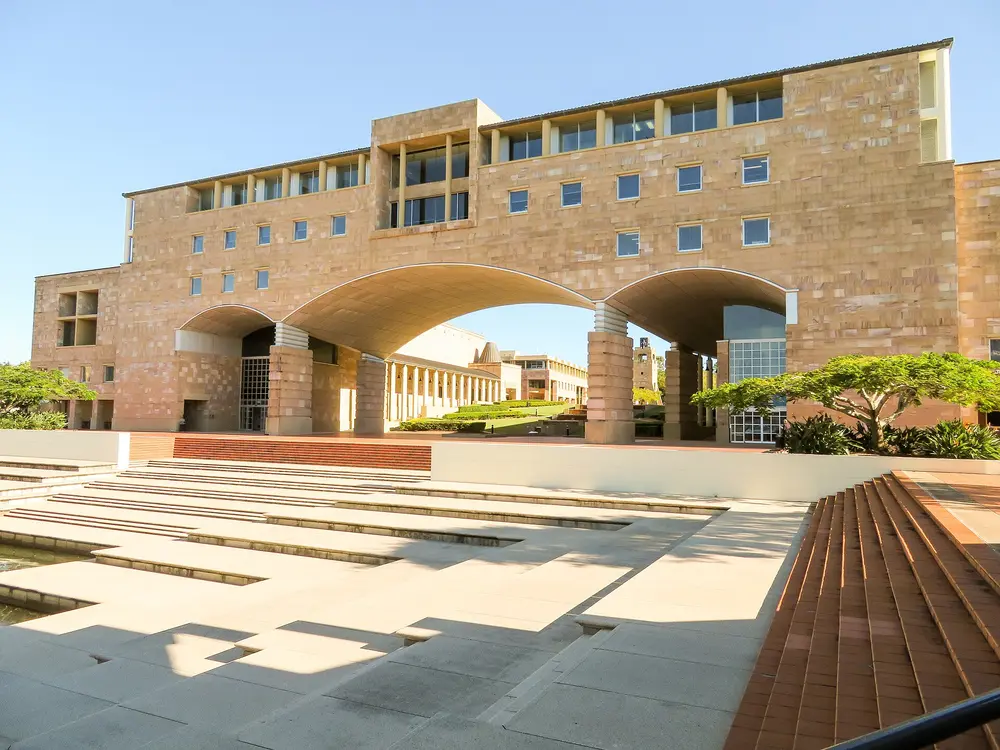
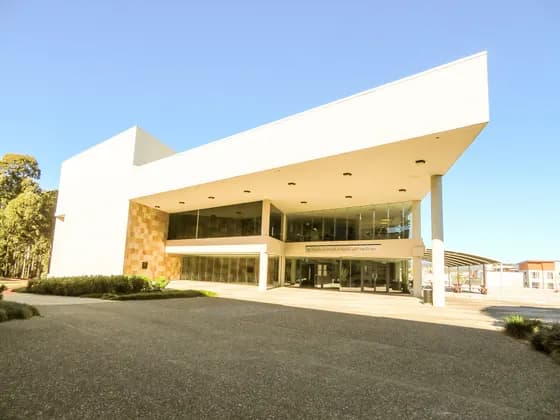


Photo: coastal.culture.vulture · CC BY-SA 3.0 · cropped
Photo: coastal.culture.vulture · CC BY-SA 3.0 · Photo: Kgbo · CC BY-SA 4.0 · Photo: Shane Smith · CC BY-SA 3.0
The Bond medicine course at a glance (2027 entry)
Bond's Medical Program is two degrees studied back to back at Bond University on the Gold Coast. You first complete the Bachelor of Medical Studies (BMedSt), then the Doctor of Medicine (MD), which in Australia is an extended masters-level degree rather than a research doctorate. You need both to register as a doctor in Australia or New Zealand, and both are awarded when you finish the MD.
The program is accelerated. Bond teaches three semesters a year, so the 14 semesters take 4 years and 8 months: two semesters in Year 1 and three in every later year. New students join in May or September.
Years 1 and 2 are taught mainly in small groups on Bond's campus at Robina, built around a weekly patient case. In Year 3 you are based at the Bond University Clinical Education and Research Centre (CERC), a teaching centre run with Queensland Health inside Robina Hospital, where clinicians lead you through simulated cases. Years 4 and 5 are twelve seven-week placements, mostly in Brisbane, South-East Queensland and Northern New South Wales, in public and private hospitals, general practices and community services.
The Australian Medical Council (AMC), which accredits medical courses, visited in July 2025. In February 2026 it reaccredited the program until 31 March 2032, finding that it substantially meets the AMC's standards but setting 20 conditions due between 2026 and 2028.
Some of those conditions will change the course itself. Bond must have a defined pre-internship program running by the end of 2027 to prepare you for internship, the first supervised year of work after graduating (PGY1). It must also develop more opportunities for hands-on learning in regional, rural and remote settings and finalise its First Nations health curriculum by 2027, ready to use in 2028. Other changes due in 2028 include structured chances to care for Aboriginal and Torres Strait Islander communities and more formal, assessable clinical learning, including work alongside other health professions.
| Degrees | Bachelor of Medical Studies (BMedSt), then Doctor of Medicine (MD) |
|---|---|
| Course length | 4 years 8 months (14 semesters), starting in May or September |
| Class size | Up to 180 domestic places a year (entry requirements page) or 200 (FAQ) |
| Where you study | Robina campus, Gold Coast; Year 3 at Robina Hospital's teaching centre |
| Teaching style | Problem-based learning in Years 1 and 2, case-based learning in Year 3 |
| First patient contact | Year 1 community volunteering placement and an aged care visit |
| Clinical years | Twelve seven-week placements across Years 4 and 5 |
| Placement area | Brisbane, South-East Queensland and Northern NSW, with some rural and overseas |
| Research | MD project: research, professional project or capstone, presented at a conference |
| Accreditation | AMC accredited to 31 March 2032, with 20 conditions |
What makes Bond medicine different
Medicine in 4 years and 8 months
Breaks are short: in 2027 the semesters run from 18 January to 24 April, 17 May to 21 August and 13 September to 18 December. MD semesters can vary in length to fit placements.
A simulation year inside Robina Hospital
Year 3 bridges campus and wards. Based at the CERC, you work through realistic cases with clinicians in small groups and join ward rounds with simulated patients, in blocks that mirror the MD rotations. A GP placement and hospital visits add real patients.
Clinical Placement Coaches on hospital sites
Since August 2024 Bond has employed doctors, often junior doctors, as Clinical Placement Coaches at Gold Coast Health, Tweed Valley Hospital, The Wesley, John Flynn and Pindara. They give bedside teaching and feedback, help you settle into placements and can sign off up to two workplace assessments per placement. The AMC counted 11 part-time coaches in 2025.
Private hospitals as well as public ones
The AMC found in 2025 that students in private hospitals often had more time with senior doctors and patients, especially in surgery. Some students, though, worried about seeing too little of public hospitals, where internships take place.
A capstone in remote or global health
Eligible final-year students can replace an elective with a capstone placement in a remote, Indigenous or global health setting with limited resources. Bond reported in 2024 that its students had worked in Solomon Islands hospitals most years since 2013, and the AMC lists the Pilbara, India, Taiwan and South Africa among other locations.
How Bond teaches medicine
Everything you study sits under four themes that run through all five years. Scientist and Scholar covers science, research and critical appraisal, and Clinical Practice covers communication, examination and procedures. Health and Society includes Aboriginal and Torres Strait Islander health and planetary health, and Professionalism and Leadership covers ethics, law and self-care. The AMC calls the design a spiral curriculum: topics come back each year in more depth.
In Years 1 and 2 you learn mostly through problem-based learning (PBL), in which a small group works through a patient case and uses it to decide what it needs to learn. Each week opens with a new case, and that week's lectures, labs and clinical skills sessions are built around it, so the timetable changes weekly and is released at the weekend. The AMC found in 2025 that small-group teaching usually runs at about four students per staff member.
Year 3 switches to clinician-led case-based learning in Bond Virtual Healthcare, Bond's simulated patient program. Small groups work through realistic cases, partly in student-led tutorials and partly with experienced clinicians who facilitate and give feedback. Students told the AMC it was a safe, low-stakes place to practise.
In Years 4 and 5 most learning happens on placement as part of a clinical team, with on-site teaching such as weekly topic sessions in child health and women's health. Bond adds timetabled sessions, including back-to-base sessions that bring the whole cohort onto campus, and you build an MD e-Portfolio of research and clinical activities.
The ways you will learn
| Small-group PBL tutorials | Years 1 and 2. Your group pulls together the science, clinical, social and ethical sides of the week's case. In Year 2 some sessions become moral dilemma conferences that test your ethical reasoning. |
|---|---|
| Lectures, workshops and labs | These supply the science behind each case. The AMC noted in 2025 that workshops, physiology sessions and anatomy labs run in groups of a third of the cohort or smaller. |
| Clinical skills with simulated patients | From Year 1 you practise communication, examination and procedures in clinical skills rooms with simulated participants, community members trained to play patients. The AMC counted more than 75 in 2025, the year a program with child and young person participants began. |
| Interprofessional simulations | Occasional sessions with other health students, such as an Interprofessional Escape Room in Year 2 and a geriatric emergency medicine bootcamp in Year 5. Years 3 and 4 add work with occupational therapy and physiotherapy students. The AMC noted in 2025 that joint work with occupational therapy students tends to be infrequent. |
A typical week on the Bond course
Bond's FAQ gives a guide to a first-semester week in Year 1. It includes 4 to 6 hours of small-group problem-based tutorials, 3 to 4 hours of clinical sessions, 5 to 6 hours of lectures, 3 hours of lab work and 2 hours of interactive sessions. Classes usually run from around 8 or 9am to 4 or 5pm. The 2026 Year 1 outlines also budget about 380 to 390 hours of personal study per subject, more than 30 hours a week.
In Year 3 each subject includes about 66 hours of Bond Virtual Healthcare tutorials, roughly 5 to 6 hours a week, alongside lectures, workshops, clinical sessions and simulation.
From Year 4 a normal week is five days on placement, and each MD subject budgets 539 hours of work-based training over 14 weeks. Emergency medicine rosters include evenings, nights and weekends. The Advanced Clinical Skills Rotation adds ward call shifts, working with the doctors who respond to calls about patients on the wards. In Year 5 general practice, most Wednesdays are teaching days at Bond.
How anatomy is taught at Bond
Anatomy is part of the integrated Year 1 and 2 subjects rather than a separate course. In Year 1 you learn how the body is organised into systems, cavities and regions. In Year 2 you study each organ's relations, blood and nerve supply and lymph drainage, and how the body systems develop in the embryo. You also learn to recognise structures shown in different ways and apply them to clinical problems.
Practical classes take place in the Dr John Kearney Anatomy Laboratory, which is fitted to handle human cadaveric material and holds anatomical models and microscopes; it is also used for extra study. At its 2025 visit the AMC noted a wide range of anatomical and prosection specimens, meaning body parts already dissected by experts. Anatomy returns later in applied form, such as airway anatomy in the Advanced Clinical Skills Rotation.
When you first meet patients at Bond
Your first patients are simulated ones, as you learn history-taking and how to observe healthy and unwell people. Real-world contact in Year 1 comes through a community or volunteering placement (12 hours over two or three sessions) and a four-hour visit to a residential aged care facility. Year 2 adds three four-hour visits to public and private hospital clinics, one in each subject.
Year 3 brings your first general practice placement: six sessions on three Tuesdays. Bond's 2026 placement guide for GPs says students can take a history on their own and, under supervision, do basic checks such as blood pressure and urine tests. They have not yet been trained in mental health. You also have two hospital clinic sessions, a full day at The Wesley Hospital in Brisbane and ward visits.
From Year 4 you are on full-time placement as part of the team. You clerk new patients, taking their full history and examination on admission, join ward rounds, clinics and theatre, and take on handover and discharge summaries as you progress.
Year by year at Bond
- Year 1 (2 semesters)
Health and Wellbeing Across the Generations
Year 1 follows the human lifecycle from conception to old age, starting with the molecular and cellular basis of life and moving on to the structure and function of the body systems. Alongside the science you learn to communicate with patients, take a history and work in a team.
- Two 50-credit-point subjects: Part A (MEDI11-101) and Part B (MEDI11-102).
- Science: biochemistry, cell and tissue biology, anatomy, physiology, genetics, microbiology, and first steps in pathology and pharmacology.
- Health and Society: population health, planetary health, health in remote regions, and how colonisation and racism affect the health of First Nations Peoples, with a one-day cultural immersion on Country.
- Clinical skills: history-taking, the basics of examination, vital signs, wound care, aseptic procedures and Basic Life Support.
- Two Bond Core subjects shared with students from other degrees: Critical Thinking and Communication, and Responsibility, Integrity and Civic Discourse.
- Assessment in 2026: written exams (58% of Part A, 44% of Part B), a history-taking assessment (18% of Part B) and a First Nations narrative reflection (14%). Pass-or-fail tasks include a points-based Continuing Professional Development (CPD) portfolio, introduced in 2025.
- Year 2 (3 semesters)
Challenges to Health
Year 2 is a second, deeper cycle through the body systems, focused on disease, infection, restoring normal function and using tests. Health psychology, ethics and law develop alongside. Students admitted through Bond's lateral entry pathway, after a Bond degree such as the Bachelor of Biomedical Science, join at the start of this year; about 25 did so in 2025.
- Three 50-credit-point subjects: Parts A, B and C (MEDI12-201 to MEDI12-203).
- Science: core conditions taught in organ-system blocks, embryology and congenital disorders, applied anatomy, pharmacology and interpreting tests.
- Clinical skills: examining each body system, giving injected and infused treatments safely, and breaking bad news using SPIKES, a step-by-step framework.
- Health and Society: chronic illness and health behaviour, the roles of First Nations health workers, kinship care and past forced removals of Indigenous children, and care in remote communities.
- Assignments in 2026: a public health promotion project (30%), a planetary health group report (32%) and a dementia educational podcast (28%), plus a clinical practice assessment and a written exam in each subject.
- Year 3 (3 semesters)
Understanding and Recognition of Illness
Year 3 prepares you for clinical work. Its blocks mirror the MD placements, from surgery and women's health to mental health and emergency medicine, and focus on diagnosis, interpreting tests, clinical reasoning and first steps in management. You are based at the CERC in Robina Hospital, with some simulation on campus.
- Three 50-credit-point subjects: Parts A, B and C (MEDI13-301 to MEDI13-303).
- Bond Virtual Healthcare tutorials, with simulation and teaching on prescribing, documentation and end-of-life care.
- Research skills linked to Bond's Institute for Evidence-Based Healthcare, including a survival analysis task, a critical appraisal presentation that earns MD portfolio points and a generative AI literature review.
- Procedures signed off as competencies: urinary catheter insertion, IV cannulation and nasogastric tube insertion, plus Direct Observation of Clinical Skills (DOCS), pass-or-fail checks introduced in 2025.
- Assessment: written exams are 100% of the marks in Parts A and B. In Part C the end-of-year OSCE (Objective Structured Clinical Examination), a circuit of timed clinical stations, is worth 67% and must be passed, and a written exam makes up the rest.
- Year 4 (3 semesters)
Core Clinical Practice (MD)
Year 4 begins the MD and is spent on six seven-week placements. The 2026 subject outlines list seven rotation types for these six placements: Medicine, Surgery, Child Health, Women's Health, Mental Health, Community and the Advanced Clinical Skills Rotation. The course page lists Year 4 without the Advanced Clinical Skills Rotation. You start your MD project, and the year ends with the MD OSCE.
- Three 60-credit-point subjects, Core Clinical Practice A, B and C (MEDI71-401 to MEDI71-403), each covering two placements and budgeting 539 hours of work-based training and 181 hours of MD project work.
- Medicine: clinics, clerking admissions, ward rounds and team meetings. Surgery: clinics, theatre, minor procedures, at least two surgical specialties, and a weekly topic module with student presentations.
- Child health, women's health and mental health: paediatric wards and clinics; antenatal clinics, labour ward and gynaecology theatre, where you may deliver a baby under supervision; and acute, community and older-age psychiatry.
- Community: an immersion across clinical and community sites, with a project based on that site's needs.
- Advanced Clinical Skills Rotation: seven weeks on intern readiness, with ward call shifts, a fracture clinic shift, long-case assessments where you work up a patient in depth, and Advanced Life Support and ultrasound courses.
- Year 5 (3 semesters)
Extended Clinical Practice and Research (MD)
The final year prepares you for internship by having you work as part of the team on common conditions and on undifferentiated patients, those whose problem has not yet been diagnosed. Placements can be local, interstate or international. You complete your MD project and present it at the Faculty's annual MD Conference.
- Three 60-credit-point subjects, Extended Clinical Practice and Research A, B and C (MEDI72-501 to MEDI72-503), covering placements 7 to 12.
- Bond's documents differ on the rotations. The 2026 Year 5 outlines and the course page include a critical care rotation covering anaesthetics, intensive care and orthopaedics, alongside emergency medicine, general practice, a selective and electives.
- The 2026 program guide, the subjects page and the FAQ leave that rotation out, while the AMC's report on its July 2025 visit refers to a critical care and orthopaedics term.
- Emergency medicine: rostered shifts focused on resuscitation and undifferentiated patients, with all four observed mini-CEX assessments focused on management plans at pre-intern level.
- General practice: at least 28 sessions in one practice, teaching at Bond and palliative care teaching at Robina Hospital, with tasks such as a home medication review and a carer interview.
- A selective in a specialty or subspecialty, and two electives you organise yourself, one of which can be a capstone.
- Internship preparation: the course page says the final four weeks prepare you for internship, and the subjects page calls the two electives elective or pre-internship rotations. The AMC, however, found no defined pre-internship program in 2025 and has required one.
How you are assessed at Bond
In Years 1 to 3 you are assessed through written exams, clinical practice assessments, assignments and pass-or-fail competency tasks. Progression is decided at the end of each year. You must reach the pass mark in each type of assessment separately, so strong exam results cannot make up for falling short in clinical assessments. Written exams are taken on computer through ExamSoft, which gives you a personalised performance report.
Clinical skills are tested in clinical practice assessments in Years 1 and 2 and an OSCE at the end of Year 3. Each OSCE station tests one task, such as taking a history or examining a patient, often with an actor as the patient. The Year 3 OSCE is the final check on your clinical safety before the MD.
Every MD subject is a competency-based, ungraded pass: you reach the standard or you do not, with no marks. On each placement your supervisors record workplace-based assessments in Osler, Bond's online ePortfolio, including in-training assessments of your overall performance. Hospital rotations add four mini-CEX, where a clinician watches you take a history, examine a patient or plan management and rates you.
Most rotations also set a clerked case. You take a full history and examination from a patient and write it up in no more than 1,500 words, with a problem list, a care plan and a letter to the GP. You then present it to your supervisor. A Board of Examiners reviews all of this, with your attendance and professionalism, before deciding whether you pass each placement.
Knowledge is tested by five computer-based Progress Tests, partly open-book, one at the end of each of the first five MD subjects. Your combined score on the first three must reach the pass mark by the end of Year 4. In Year 5 you must pass the fifth test and reach the pass mark on the last two combined. The MD OSCE at the end of Year 4 checks that you are safe to start final year, with one repeat, if needed, the next time it is offered in Year 5.
Bond's 2026 Rules of Assessment and Progression set out what happens if you fail. In Years 1 to 3, a student who fails a year may be offered pass-or-fail resit exams covering the whole year, and may otherwise be allowed to repeat it. You get two attempts at any subject: failing the same subject twice, or failing a year and then the next, leads to exclusion. The whole program must be finished within seven years of starting.
- Mini-CEX use a four-level entrustment scale; below Level 3 (competent with minimal supervisor input), the task must be repeated before the placement ends.
- MD e-Portfolio points for research and evidence-based practice build up in stages: 15 by the end of Year 3, 40 by the end of Year 4 and 100 by the end of Year 5. Missing the points due in an MD subject means failing that subject.
- Before graduating you need 11 procedural skills signed off on real patients, from IV cannulation and suturing to blood cultures and bag-and-mask ventilation. The AMC reported that Bond plans to grow its list of required skills and tasks from 17 in 2026 to 20 over five years.
- Other requirements include clinical tasks such as a discharge summary and a First Nations cultural safety assessment, plus Advanced Life Support, ultrasound and intimate examination training.
- Bond's 2026 documents disagree about the prescribing exam. The Year 5 outlines call the Prescribing Safely Assessment formative (one adds compulsory and invigilated). The 2026 Rules call it the Prescribing Skills Assessment and require a pass, with one repeat, then an alternative task if needed. The AMC's report says it was to count for graduation from 2026.
- You can fail a placement for unprofessional behaviour, or for poor attendance even if your supervisor's overall assessment is good.
- In the MD only one failed placement can be repeated across Year 4 and the first Year 5 subject, and the repeat may take up an elective or selective slot. A second failed placement, or any failed placement in the last two subjects, means failing that subject.
- Failing a placement can also cost you a capstone or elective placement, even one already arranged, and so can recorded attendance or behaviour problems.
- The MD OSCE must be passed: failing it and its repeat means a 14-week remedial Special Topic Subject of mentored clinical work. After failing any MD subject you may be allowed to repeat it or take a Special Topic Subject, but failing that second attempt can lead to exclusion.
- In February 2026 the AMC required a formal process for timely, individual OSCE feedback during 2026, after finding that OSCE feedback had fallen short of expectations.
Where you will actually be at Bond
Placements in Years 1 to 3 are short. The faculty allocates community placements within commuting distance of Bond and posts them on iLearn, Bond's online learning system, one to two weeks before each semester. GP placements in Years 3 and 5 are arranged with the Gold Coast Primary Health Network.
For the MD you may be placed in public, private or not-for-profit hospitals and health services, mostly in Brisbane, South-East Queensland and Northern New South Wales, with some rural and overseas options. Bond sends a preference survey around August in Years 3 and 4 and emails allocations by about October. It cannot always meet preferences, and allocations can change.
You pay your own placement travel and accommodation, and Bond does not treat either as grounds for special arrangements, though serious health problems or caring responsibilities can be. At its 2025 visit the AMC noted that Bond does not cover accommodation for placements in Brisbane, the Tweed or the Gold Coast, and that students had raised rising accommodation costs and transport difficulties.
Bond's Child Health and Women's Health handbooks, revised in September 2026, also describe Integrated Clinical Placements, which differ from the standard rotations. A group of students spends 14 weeks together, seven focused on women's health and seven on child health, mixing hospital wards with general practice, private paediatric clinics, urgent care, family planning and IVF clinics. One women's health day is at Marie Stopes International, focused on termination of pregnancy, and there are no make-up sessions.
Rural placements are currently chosen as a capstone, elective or selective. In 2025 the AMC found a lack of structured regional, rural and remote learning and required Bond to introduce it in 2028. It also noted plans for more placements across Northern New South Wales.
- Before any placement you must meet Queensland and New South Wales Health requirements. They include police and Blue Card (working with children) checks, National Disability Insurance Scheme (NDIS) worker screening, vaccinations and first aid training, all kept current on Osler. A lapsed requirement stops you attending placement.
Home base.
- Gold Coast University Hospital
- Robina Hospital, including the CERC
- Pindara Private Hospital, Benowa
- John Flynn Private Hospital, Tugun
- Gold Coast Private Hospital
UnitingCare private hospitals. Year 3 students spend a day at The Wesley.
- The Wesley Hospital
- St Andrew's War Memorial Hospital
The hospital opened to patients in May 2024. Bond is a founding member of the Northern NSW Academic Health Alliance, which unveiled a training hub there.
- Tweed Valley Hospital
- Tweed Education Hub
Practices whose supervisors met the AMC in July 2025. A Bond-funded post coordinates student placements in Institute for Urban Indigenous Health clinics.
- Mermaid Central Medical Clinic
- Robina Bulk Billing Medical Centre
- Lake Orr Family Practice
- Tamborine Mountain Medical Practice
- Our Medical Home Gold Coast
- Institute for Urban Indigenous Health clinics
Named in Bond's 2024 news and the AMC's 2026 report.
- National Referral Hospital, Honiara, Solomon Islands
- Gizo Hospital, Solomon Islands
- Helena Goldie Hospital, Munda, Solomon Islands
- The Pilbara
- India, Taiwan and South Africa
Electives, selectives and options at Bond
Most choice comes in Year 5. In the selective you pick a clinical service with one of Bond's placement providers to go deeper into a specialty or subspecialty. Bond publishes placement handbooks for specialties you can choose, from anaesthetics, cardiology and ENT to orthopaedics, palliative care, radiology and urology.
The two electives are placements you organise yourself, in Australia or overseas, to see care in a different setting or explore a field. A Bond story about a student due to graduate in 2025 describes his electives in the emergency department of Charing Cross Hospital in London and in transplant surgery at Cambridge University Hospitals. A GP elective means 56 sessions over seven weeks.
Eligible students can use one elective for a capstone, applying clinical and research skills where resources are limited, and it can also serve as the MD project. The AMC reported that Bond partly covers flights, accommodation and transport for international capstones with a stipend. In 2023, 22 students spent six weeks in the Solomon Islands, first at the National Referral Hospital in Honiara, then four weeks at Gizo Hospital or Helena Goldie Hospital in Munda.
Rural placements are another option. Bond's 2026 Rural handbook says they often bring more clinical variety and closer supervision than city hospitals. A 2022 Bond news story followed a student who volunteered for a final-year rural placement based in Charleville, working with the Royal Flying Doctor Service and visiting towns such as Thargomindah and Windorah.
Facilities and support at Bond
Where you will learn
Campus teaching uses the Faculty of Health Sciences and Medicine building at Robina, home to the anatomy laboratory and health science laboratories, along with clinical skills rooms equipped like real clinical settings. The Simulation Ward is a 12-bed mock ward that can be set up as anything from a rural outback hospital to a large city hospital. The Pathology Museum holds diseased specimens with their case histories.
The CERC, on the ground floor of Robina Hospital, is a joint project of Bond and Queensland Health, with a 100-seat lecture theatre, clinical skills laboratories and tutorial rooms. It is accredited as an affiliate skills centre of the Queensland Health Skills Development Service, and its teaching includes ward rounds with simulated participants.
The Tweed Education Hub, a short walk from Tweed Valley Hospital, adds space for teaching and simulation. At the AMC's 2025 visit, extensions to the CERC and the Health Sciences and Medicine building were under way to support projected growth in student numbers. A Futures Building with another anatomy laboratory was also planned.
Support while you study
Each phase has Student Support Leads as a first point of contact, and the faculty's Office of Student Affairs and Service Quality (SASQ) handles academic progress, extensions, learning access plans and appeals. Support is kept separate from progress decisions: MD support leads can give context, but the Board of Examiners decides.
You have free, confidential counselling, including access to a clinical psychologist, a Wellbeing Curriculum on stress, burnout and coping, and Mental Health First Aid training. In 2025 some students told the AMC that counsellors were hard to reach. On placement, Clinical Placement Coaches can help students who need academic support, and Bond-funded Sub-Deans, all senior clinicians, oversee the student and staff experience at the major teaching sites.
The Medical Students Society of Bond University (MSSBU) runs orientation for each intake and represents students to the faculty. Bushfire, the Bond rural health club, supports students from rural backgrounds, and BondAbility supports students with disabilities, including on placement.
The Nyombil Indigenous Support Centre offers Aboriginal and Torres Strait Islander students culturally safe support and free peer tutoring. In 2025 the AMC found it under-resourced and heard that some First Nations students had experienced racism without knowing how to report it. It set conditions, due in 2026 and 2027, to strengthen culturally safe support.
Is the Bond course right for you?
This course may suit you if
- You want to qualify as a doctor quickly and can keep up the pace of three semesters a year.
- You learn well by working through a weekly patient case in a small group, with lectures and labs built around it.
- You would value a whole year of clinician-led simulated cases at Robina Hospital before full-time placements.
- You would welcome private hospital placements, where the AMC found students often get more time with senior doctors.
- You are drawn to global or remote health and would apply for a capstone in a place such as the Solomon Islands.
Things to think about
- There is little time off: semesters run back to back with only short breaks.
- Placements stretch from Brisbane to Northern New South Wales, and you pay your own travel and accommodation.
- Pre-internship and structured rural teaching are still being built to meet the AMC's conditions.
- Some students told the AMC in 2025 they wanted more public hospital experience to prepare for an internship in a public hospital.
- Bond's own documents list the Year 4 and Year 5 rotations differently, so check the current subject outlines rather than relying on one list.
Bond medicine course — frequently asked questions
Applying to Bond?
How to get into Bond
Entry requirements, admission tests, written application and interview, step by step.
Open the guide →Bond entry requirements
ATAR or GPA, GAMSAT and UCAT ANZ thresholds, interview format and place types.
See the requirements →Compare Bond with other schools
Put the teaching style, anatomy teaching and placements next to another school.
Open the comparison →Prepare for the Bond interview
Format breakdown, school-specific sample questions and prep tips from tutors who interviewed here.
Read the guide →Where this Bond course guide came from
This guide was written from 62 official sources — Bond University Medical Program's own course pages and programme documents, plus the Australian Medical Council or Australian Dental Council and the health services the school places students with where they publish detail — read on 2026-10-08, then checked claim by claim against those sources.
- Bond University: Medical Program, Bachelor of Medical Studies and Doctor of Medicine, course page
- Bond University: Medical Program subjects page (themes, Years 1 to 3, MD rotations)
- Bond University: Medical Program graduate outcomes
- Bond University: Medical Program frequently asked questions
- Bond University: Medical Program entry requirements (domestic place numbers)
- Bond University: 2026 Medical Program Guide
- Bond University: 2026 Medical Program Rules of Assessment and Progression (approved 20 November 2025)
- Bond University: clinical placements overview, Medicine
- Bond University Faculty of Health Sciences and Medicine: clinical education, Medicine (Osler, handbooks, Clinical Placement Coaches, assessment)
- Bond University: Clinical Placement Coaches Program fact sheet, August 2024
- Bond University: Health Sciences and Medicine facilities
- Bond University: Medicine Compliance Hub
- Bond University: Medical Program important dates, 2027 intake
- Bond University: academic calendar 2026 and 2027
- Bond University: Faculty of Health Sciences and Medicine additional costs (placement travel and accommodation)
- Bond University: GP and Student Information Guide for Placements, Year 3 students 2026
- Subject outline: MEDI11-101 Health and Wellbeing Across the Generations Part A, September 2026
- Subject outline: MEDI11-102 Health and Wellbeing Across the Generations Part B, September 2026
- Bond University subject: MEDI11-011 Critical Thinking and Communication
- Bond University subject: MEDI11-012 Responsibility, Integrity and Civic Discourse
- Subject outline: MEDI12-201 Challenges to Health Part A, January 2026
- Subject outline: MEDI12-202 Challenges to Health Part B, May 2026
- Subject outline: MEDI12-203 Challenges to Health Part C, September 2026
- Subject outline: MEDI13-301 Understanding and Recognition of Illness Part A, January 2026
- Subject outline: MEDI13-302 Understanding and Recognition of Illness Part B, May 2026
- Subject outline: MEDI13-303 Understanding and Recognition of Illness Part C, September 2026
- Subject outline: MEDI71-401 Core Clinical Practice A, May 2026
- Subject outline: MEDI71-402 Core Clinical Practice B, September 2026
- Subject outline: MEDI71-403 Core Clinical Practice C, September 2026
- Subject outline: MEDI72-501 Extended Clinical Practice and Research A, September 2026
- Subject outline: MEDI72-502 Extended Clinical Practice and Research B, September 2026
- Subject outline: MEDI72-503 Extended Clinical Practice and Research C, September 2026
- Bond University: Advanced Clinical Skills Rotation handbook, 2026
- Bond University: Medicine placement handbook, 2026
- Bond University: Surgery placement handbook, 2026
- Bond University: Child Health placement handbook including Integrated Clinical Placements, September 2026
- Bond University: Women's Health placement handbook including Integrated Clinical Placements, September 2026
- Bond University: Mental Health placement handbook, 2026
- Bond University: Emergency Medicine placement handbook, 2026
- Bond University: General Practice Core (Year 5) placement handbook, 2026
- Bond University: General Practice electives and selective handbook, 2026
- Bond University: Rural placement handbook, 2026
- Bond University: Anaesthetics placement handbook, 2026
- Bond University: Orthopaedic placement handbook, 2026
- Australian Medical Council: Bond University accreditation report (visit July 2025, decision February 2026, published May 2026)
- Australian Medical Council: accredited medical schools list
- Medical Board of Australia: provisional registration
- Medical Board of Australia: provisional to general registration
- Queensland Health Careers: applicant groups for intern positions
- Gold Coast Primary Health Network: medical student placement types, for GP supervisors
- Gold Coast Health: Robina Hospital and the Clinical Education and Research Centre
- The Wesley Hospital: UnitingCare Clinical School
- Pindara Private Hospital, Gold Coast (Ramsay Health Care)
- John Flynn Private Hospital: about the hospital
- Bond University news: Bond students train at new Tweed hospital, May 2024
- Bond University news: Bond medical students in the Solomon Islands, January 2024
- Bond University news: a final-year rural placement, December 2022
- Bond University ThinkingSteps: a final-year student's overseas elective placements (due to graduate in 2025)
- Bond University: Medical Students Society of Bond University (MSSBU)
- Bond University: Student Affairs and Service Quality, Health Sciences and Medicine
- Bond University blog: Medical Program alumni and the 1,000th graduate, December 2021
- Bond University news: the first medical intake, June 2005
Courses are restructured between cycles. Anything here that decides your application — an anatomy offer, a placement city, a compulsory intercalated year — should be confirmed against the official page for your entry year.
Applying to Bond?
We have helped hundreds of applicants turn their GAMSAT / UCAT ANZ, written application and interview prep into offers from Bond and other Australian medicine schools.