
The Notre Dame Sydney Medicine course
What you actually study, and where you will be
Notre Dame Sydney's MD is a 4-year (graduate entry) course taught through problem-based learning in an integrated curriculum, with patient contact from Year 1 and placements in Sydney, Melbourne, and rural NSW and Victoria (2027 entry). Notre Dame Sydney's Doctor of Medicine is a four-year graduate-entry course based at the Darlinghurst campus, opposite St Vincent's Hospital. The 2027 intake is the first Sydney group to start the school's new national curriculum. Years 1 and 2 are taught through weekly problem-based learning cases in small groups led by a clinician, with ethics, public health and First Nations health built in. In Years 3 and 4, placements are allocated by ballot and run through seven hospital-based clinical schools in Sydney, Melbourne, and rural NSW and Victoria.
- Degree
- MD
- Length
- 4 years (graduate entry)
- Teaching
- Problem-based learning + Integrated
- Clinical contact
- Year 1
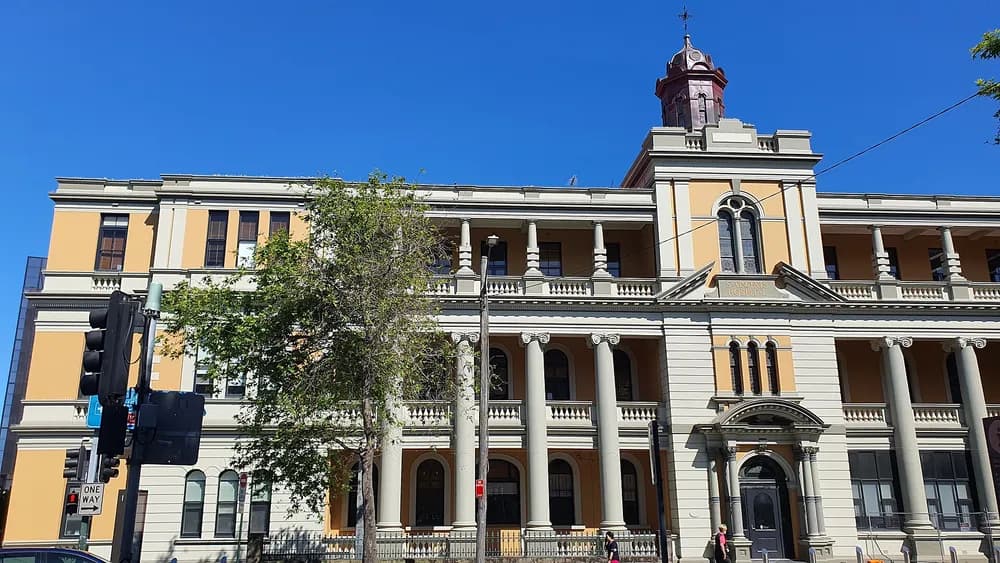
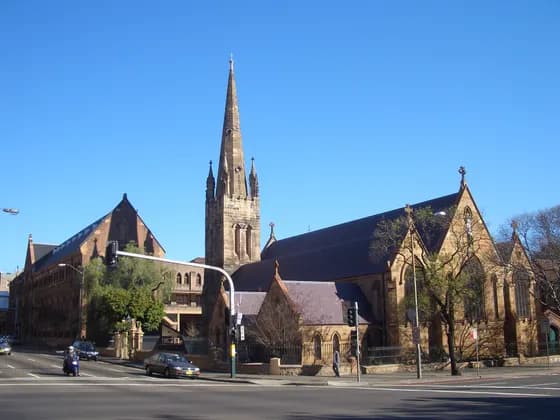
Photo: Shkuru Afshar · CC BY-SA 4.0 · cropped
Photo: J Bar · CC BY 3.0 · Photo: Dietmar Rabich · CC BY-SA 4.0 · Photo: Toby Hudson · CC BY-SA 3.0
The Notre Dame Sydney medicine course at a glance (2027 entry)
Notre Dame Sydney's Doctor of Medicine (MD) is a four-year, full-time, graduate-entry course. Graduate entry means you need a bachelor's degree first, in any subject. In Australia an MD like this is an extended masters degree, at Level 9 of the Australian Qualifications Framework (AQF), and it is the degree that qualifies you to begin work as a doctor.
The course is run by the School of Medicine, Sydney, which merged with Notre Dame's Fremantle school in 2021 to form a National School of Medicine. You are based at the Darlinghurst campus on Oxford Street, opposite St Vincent's Hospital. The course is changing: the 2027 intake is the first Sydney group to start the new national MD curriculum, shared with Fremantle and Broome, beginning with the Year 1 course MEDI6111. Sydney's 2026 first years still took the previous Year 1 course, MEDI6001.
Years 1 and 2, the Foundation Years, are taught mainly through problem-based learning (PBL). Each week a real patient case sets the context, and your small group works through it with a clinician tutor, backed by lectures, tutorials and practicals. In Years 3 and 4, the Clinical Years, your placements run through seven clinical schools in Sydney, Melbourne, and rural NSW and Victoria. A clinical school is a teaching base attached to a hospital, with its own teaching rooms and staff.
Notre Dame's founding objects commit it to university education within a context of Catholic faith and values, and several of the hospitals you may train in are Catholic. The school names respect for human life, each person's dignity, social justice and ethics among its founding values. It puts weight on bioethics, rural medicine, palliative care and Aboriginal and Torres Strait Islander health, and every student completes a supervised applied research project, the capstone project.
The Australian Medical Council (AMC), which accredits Australian medical courses, first accredited the Sydney program in 2007. After graduating you apply to the Medical Board of Australia, through the Australian Health Practitioner Regulation Agency (AHPRA), to work as an intern. Internship is your first year as a doctor, also called PGY1 (postgraduate year 1), spent under supervision in a hospital. The course is designed to prepare you for internship in Australia or New Zealand.
| Degree | Doctor of Medicine (MD), an extended masters degree at AQF Level 9 |
|---|---|
| Course length | 4 years full time, with no part-time or accelerated option |
| 2027 start | Year 1 orientation begins 18 January 2027; attendance in person is compulsory |
| Curriculum | New national curriculum; 2027 is the first Sydney intake to start it |
| Main campus | Darlinghurst, 160 Oxford Street, opposite St Vincent's Hospital |
| Intake | Up to about 149 places expected in 2027; 130 students in 2023 |
| Teaching style | Problem-based learning in clinician-led small groups in Years 1 and 2 |
| First patient contact | Year 1: simulated patients and supervised clinical site visits |
| Clinical years | Years 3 and 4 placed through seven clinical schools, allocated by ballot |
| Rural clinical schools | Lithgow and Wagga Wagga in NSW; Ballarat in Victoria |
| Research | Capstone applied research or audit project, completed in Year 4 |
What makes Notre Dame Sydney medicine different
Weekly patient cases in clinician-led small groups
Each week of the Foundation Years centres on one clinical case, which your PBL group works through with a clinician tutor. The 2027 Year 1 calendar lists 32 weekly cases, so you learn how the body works one patient story at a time.
Seven clinical schools across two states
Clinical placements in Years 3 and 4 run through seven clinical schools and include both public and private hospitals. The schools range from St Vincent's in inner Sydney and Hawkesbury in Sydney's north-west to Werribee in Melbourne and rural schools in Lithgow, Wagga Wagga and Ballarat.
Rural Trauma Week in Year 2
Rural Trauma Week is an annual five-day trauma course for second-year students. In 2024, 120 of them spent it in the Blue Mountains, at the Lithgow Rural Clinical School and at the University of Tasmania's Rozelle campus. Alongside paramedicine students, they worked through road-crash simulations: rescuers freed patient actors from wrecked cars, and the students assessed and stabilised them and moved them to a mock emergency department.
Ethics built into the whole course
The program rules say ethical issues in professional life underpin the MD. PBL cases raise ethical and professional questions from Year 1, and Year 2 adds a separate compulsory course, PHIL6030 Ethical Issues in Professional Life. Among the graduate outcomes is practising in a way that values the dignity of every person.
First Nations health as one of six domains
Alongside the sciences and clinical skills, one of the course's six learning domains is First Nations health and culture. The graduate outcomes include recognising the importance of kinship, culture and connection to Country. Year 1 includes a Rural and Indigenous Immersion Trip, and the AMC's 2023 report also describes a Year 2 immersion day run with the Australian Museum.
How Notre Dame Sydney teaches medicine
Problem-based learning (PBL) is the backbone of Years 1 and 2. Each week a real-life clinical case sets the context for what you learn. Your small group explores the case with a clinician tutor, and tutorials, lectures, practicals, workshops, site visits and your own study fill in the content. In the school's 2026 Year 1 timetable, each case was worked through over three small-group tutorials across the week.
The course is organised into six domains of learning that continue through all four years. They are basic and clinical sciences; communication and clinical practice; First Nations health and culture; public health; personal and professional development; and medical research and innovation. The weekly case ties them together, so the science, the patient's story and the ethical or public health questions arrive at the same time.
The focus shifts each year. Year 1 covers how the healthy body is built and how it keeps its balance when challenged. Year 2 turns to the disease processes that affect each organ system. In Years 3 and 4 you learn on the wards and in general practice as a clinical apprentice, and Year 4 concentrates on the thinking an intern needs.
Research skills build steadily. Year 1 introduces research methods, Year 2 adds literature searching and critical analysis, and Year 3 applies research principles on placement. The AMC's 2023 report describes journal club and sessions on reading graphs and data being strengthened across the years. It all leads to the capstone project you complete in Year 4.
According to the AMC's 2023 report, the previous curriculum added teaching on climate and health. It included planetary health sessions in Year 1, and Year 4 teaching on the carbon and waste footprint of anaesthetics and unnecessary pathology tests. The school is also a Beacon Site for sustainable quality improvement (SusQI), accredited by the Centre for Sustainable Health Care in Oxford. SusQI means improvement projects that also cut the environmental impact of care. So far the school's SusQI training has run through a graduate certificate and as a short course for physician trainees.
The ways you will learn
| PBL tutorials | Small-group sessions with a clinician tutor, built around the week's case and held in the PBL rooms at the Darlinghurst campus. This is the main teaching method in Years 1 and 2. |
|---|---|
| Lectures, tutorials and workshops | These fill in the science behind the weekly case and cover practical topics. They support the PBL case rather than set the agenda. |
| Communication and clinical skills sessions | Practice in interviewing, history-taking and physical examination in simulated cases, starting with Year 1's core communication skills block. Community volunteers trained by the school as simulated patients play the patient in teaching sessions and exams and give you feedback, sometimes over video to mimic a telehealth consultation. |
| Laboratory practicals | In the 2026 Year 1 timetable, anatomy, physiology and microbiology practicals ran face to face at the Darlinghurst campus, in a block on Tuesday afternoons. Until at least 2023 this science teaching was run with the University of Technology Sydney (UTS). The AMC's 2023 report described the school's plan to bring it in-house, with new laboratories at Darlinghurst. |
| Work integrated learning | In Years 1 and 2 the school runs a structured, supervised program of workshops and visits to clinical sites. In Year 2 this directly supports the PBL cases. The AMC's 2023 report lists GP telehealth site visits among recent additions. |
| Clinical rotations and Back-to-Base days | In Years 3 and 4 you learn on rotation under supervising clinicians. Once a week a Back-to-Base day brings students together for small-group learning, clinical skills practice and lectures, backed by e-learning resources for self-directed study. |
A typical week on the Notre Dame Sydney course
In Years 1 and 2 the week follows the PBL cycle, one case per week. The 2027 Year 1 calendar gives each case a title, such as Night Starvation or A Rural Town, and the first case, Blood on the Road, runs across two weeks.
The school's weekly timetable for 2026, written for the previous Year 1 course, shows how a case runs. Each case is worked through in three PBL tutorials: the first on a Friday afternoon, the second on the Wednesday morning after, and the last on the following Friday. Wednesdays start with an hour-long clinical debriefing session, and Fridays with a two-hour clinical and communication skills session, such as vital signs, history taking or an introduction to physical examination.
In weeks 2 to 4 of that timetable, Tuesday from noon to 6.30 pm was the laboratory practical: cardiovascular anatomy, blood pressure physiology, then infection control in microbiology. Most science, public health and professional development lectures were delivered by Zoom, while PBL tutorials, skills sessions and practicals were face to face. The first teaching week also had two full-day bioethics intensives at the Broadway campus.
The 2027 first-year calendar starts with orientation in the week of 18 January. Semester 1 runs to a study week and a mid-year exam week at the end of June, followed by a two-week break. Semester 2 starts on 19 July and ends with a study week and exams in late October. There are non-teaching weeks at Easter and in late September.
The clinical years are longer. In the 2027 calendar, Year 3 starts with an orientation week on 11 January and runs to mid-December, with a two-week break in June.
How anatomy is taught at Notre Dame Sydney
The school's 2026 Year 1 timetable, for the previous course, shows anatomy taught through lectures and through practicals in the laboratory at the Darlinghurst campus, starting with an introduction to the anatomy lab. Lectures covered body systems and regions with their clinical anatomy, such as the cardiovascular system and the upper limb.
The 2026 first-year forms include an Anatomy Code of Conduct and a form on expected behaviour in the clinical laboratory, which you sign before starting. For labs and clinical skills, the 2026 enrolment checklist asked first years to buy a lab coat, clear goggles, a stethoscope and a suture practice kit, and to keep them for later years.
When you first meet patients at Notre Dame Sydney
Your first patients are simulated. Year 1's communication skills block moves from patient-centred interviewing to full history-taking and physical examination, practised in simulated cases. Through its Volunteer Simulated Patient Program, the school trains community members to play a scripted patient and give you feedback from the patient's side. They are never used for examinations of sensitive areas or for anything involving needles.
Real clinical settings come early too. The school says placements run through all four years, in places such as general practice, public and private hospitals and aged care facilities. In Years 1 and 2 these take the form of supervised workshops and clinical site visits.
Year 2 builds your examination of each organ system, normal and abnormal, and asks you to use clinical reasoning to reach a diagnosis. Year 3 is the first full-time clinical year. At Hawkesbury, for example, the school says students manage patients hands-on under the supervision of ward consultants. By Year 4 you are expected to draw up investigation and treatment plans much as an intern would.
Year by year at Notre Dame Sydney
- Year 1
Foundations of a Medical Vocation
Year 1 is a single year-long course, MEDI6111, worth 200 of the MD's 800 units of credit. It is the first course of the new national curriculum, starting in Sydney with the 2027 intake. It covers the normal structure and function of the body and how it responds to physiological challenges, all taught through weekly PBL cases across the six domains.
- A core communication skills block: patient-centred interviewing, then organised history-taking and physical examination in a range of simulated cases.
- Weekly cases that build clinical reasoning and a diagnostic approach, along with ethics, professionalism, patient safety, reflective practice and research methods.
- Public health and health inequalities, in Australia and around the world.
- A Community Engagement Week in mid-March, set aside in the 2027 calendar for the Rural and Indigenous Immersion Trip.
- Sessions on ethics, arboviral diseases (infections spread by mosquitoes and ticks) and Aboriginal health, added to Year 1 under the previous curriculum, according to the AMC's 2023 report.
- Year 2
Foundations of Clinical Practice
Year 2's main course, MEDI6222 (200 units of credit), moves from normal function to the disease processes that affect the body and how the body responds. PBL remains the main way you learn about the major organ systems. Alongside MEDI6222 sits PHIL6030 Ethical Issues in Professional Life, a compulsory course that carries no units of credit. A 2027 entrant takes MEDI6222 in 2028; in 2027 Sydney's second years are still on the previous Year 2 course, MEDI6002.
- History-taking and physical examination of each system, normal and abnormal, using clinical reasoning to reach a diagnostic approach.
- PBL cases supported by work integrated learning: supervised workshops and clinical site visits.
- Literature searching, critical analysis, teamwork, professional communication and public health responses to threats to health.
- Rural Trauma Week, listed for August in the 2027 calendar for the Year 2 group still on the previous course. In 2024 teachers included NSW Ambulance paramedics, Nepean Hospital emergency specialists, Careflight teams and rural generalist doctors.
- PHIL6030 was added to the program rules in January 2026.
- Year 3
Clinical Apprenticeships
Year 3 (MEDI6333, 200 units of credit) is your first full clinical year, with placements through your allocated clinical school. The 2027 calendar is the first to list MEDI6333 for Sydney. You rotate through the core areas of medicine under supervising clinicians, applying what you learned in the Foundation Years to real patients.
- Rotations in general practice, medicine, surgery, paediatrics and child health, women's health and psychiatry.
- Eight five-week rotations in the 2027 calendar.
- A weekly Back-to-Base day of small-group learning, clinical skills and lectures.
- Applying your knowledge of disease, history-taking, examination and applied research principles in the clinical setting.
- Exams in mid-November in the 2027 calendar.
- The program rules also list a rural version of Year 3 (MEDI6301), but the course page limits it to students of the WA Rural Clinical School.
- Year 4
Preparation for Internship
Year 4 (MEDI6444, 200 units of credit) gets you ready to work as an intern. You rotate through general practice, medicine, surgery and critical care, complete your capstone project and take an elective rotation. The focus is on forming a differential diagnosis, meaning the list of conditions that could explain a patient's problem, and on planning tests and treatment.
- Weekly Back-to-Base days of small-group learning, clinical skills and lectures. The 2027 calendar covers the Year 4 group still on the previous course, MEDI6004. Its topics run from anaesthetics, intensive care and emergency medicine to hepatology, dermatology, ophthalmology, orthopaedics and ENT (ear, nose and throat).
- That calendar also sets out eight four-week rotations from February to September and final exams from 1 October. A 2027 entrant reaches the new Year 4 in 2030, and its timing may differ.
- Completion of the capstone project: a translational research project, which carries research findings into practice, or an audit, which checks care against an agreed standard.
How you are assessed at Notre Dame Sydney
You sit formative assessments, which are practice tests for feedback, and summative ones, which decide whether you progress. Much of what is published about assessment comes from the AMC's 2023 report, the latest one available for the Sydney program. It says results use the university scale from fail to high distinction, with 50% as the pass mark.
Summative written exams are sat on computer under supervision, using ExamSoft software, while practice tests run through Blackboard, the online learning system. Clinical skills are tested in OSCEs (Objective Structured Clinical Examinations). In an OSCE you move round a circuit of timed stations, each testing one task, such as taking a history or examining a patient. OSCEs are used in both practice and summative assessment.
In the clinical years, supervisors also assess you with mini-CEXs (mini clinical examination exercises): short, observed encounters with a patient, marked on the spot. The school uses recognised standard-setting methods, called modified Angoff and borderline regression, to set fair pass marks. Examiners at every clinical school are trained centrally so that all sites mark to the same standard.
After practice written exams the Head of Assessment gives general feedback, and tutors give feedback after practice OSCEs. After the end-of-year exams you are told which quarter of the year group your result falls in. Results go to the School's Board of Examiners, then to the University's.
In the 2027 calendar, the new Year 1 course has a mid-year and an end-of-year exam week, and the new Year 3 course has one exam period in November. You must finish the degree within six years, including any approved leave, and cannot normally take more than one year of leave at a time.
- The capstone project is completed and assessed in Year 4.
- If you repeat a course, you may be excused a continuous assessment item you passed in the previous two years, but only in exceptional circumstances.
- Under the school's Fitness to Practice Policy, you must tell the school about any criminal conviction or health issue that could affect your clinical placements.
Where you will actually be at Notre Dame Sydney
In Years 3 and 4 your placements are delivered through seven clinical schools: three in Sydney, one in Melbourne and three rural. You are allocated by ballot. The school takes your preferences into account but cannot guarantee a first preference, because each site has a limited number of places.
Placements cover hospitals, general practice, aged care and community services, in cities and rural areas, and in Years 3 and 4 they include both public and private hospitals. St Vincent's Hospital Sydney, Mercy Hospital Werribee and St John of God Ballarat are Catholic hospitals. Rural placements are open to domestic students only.
The rural schools in Lithgow, Wagga Wagga and Ballarat belong to Notre Dame's National Rural Clinical School network. Placements with them are available to some students, not all. The network is part of the Rural Health Multidisciplinary Training program, funded by the Australian Government Department of Health, which aims to build the rural health workforce by training students in the country. The school says the program provides accommodation, scholarships and pastoral care.
Sites use students in different ways. Hawkesbury takes 25 Year 3 students for the whole year, and four to six Year 4 students at a time on four-week rotations. Wagga Wagga's clinical school building has teaching facilities for students in both clinical years. Lithgow houses rotating and visiting students in a six-bedroom house 500 metres from the hospital and in four ensuite rooms in the clinical school building.
The school registers you as a medical student with the Medical Board of Australia while you are enrolled. Before placements you also provide a criminal record check and your immunisation records. The 2026 first-year forms list the NSW Health student checks, including a national police check and vaccination record, plus a Working with Children Check and a first aid certificate (units HLTAID009 and HLTAID011).
St Vincent's & Mater Clinical School, based in the de Lacy Building at St Vincent's, opposite the campus. Outpatient clinics range from ophthalmology to drug and alcohol services, and the hospital is associated with the Garvan Institute and the Victor Chang Cardiac Research Institute. The Mater is a private hospital.
- St Vincent's Public Hospital, St Vincent's Private Hospital and St Vincent's Clinic
- Mater Hospital, North Sydney
Auburn Clinical School. The hospital began in 1907 as an 18-bed cottage. Its patients come from many cultural backgrounds, which the school says brings a wide range of conditions and a close view of the social causes of ill health.
- Auburn Hospital
Hawkesbury Clinical School, in Sydney's north-west, took its first students in January 2010. The 127-bed hospital provides public and private care, including emergency, maternity, neonatal, palliative, intensive and coronary care. Local GPs and psychiatrists from St John of God Hospital, Richmond, also teach.
- Hawkesbury District Health Service
Melbourne Clinical School, alongside Mercy Hospital Werribee; its first graduates finished in 2011. The school's page dates from when the course was an MBBS (Bachelor of Medicine, Bachelor of Surgery). It also lists training at St Vincent's, St George's, Western Health (Sunshine, Footscray and Williamstown), Cabrini and Calvary Health Care Bethlehem.
- Mercy Hospital Werribee
Rural clinical school in a small city 900 metres above sea level on the western edge of the Blue Mountains, 150 km from Sydney. The 46-bed hospital has a maternity unit and operating theatres. Students join ward rounds, GP attachments, palliative care, surgery and anaesthetics, and see prison medicine.
- Lithgow District Hospital
- Lithgow Correctional Centre
Rural clinical school on the Murrumbidgee River, about four and a half hours' drive from Sydney or Melbourne. Calvary is a 100-bed private hospital with surgical, medical and obstetric services. The school also hosts the Riverina Regional Training Hub, which helps graduates find specialist training in the region.
- Calvary Health Care Riverina (Calvary Hospital)
Rural clinical school in Victoria. St John of God Ballarat is a 190-bed not-for-profit Catholic private hospital, and the clinical school sits on its campus in Baileys Mansion.
- St John of God Hospital Ballarat
Electives, selectives and options at Notre Dame Sydney
There are no optional courses in the MD: every course in the program rules is compulsory. Choice comes through the elective periods and your capstone project instead.
Year 4 includes an elective clinical rotation in an area of medicine that interests you. For the 2027 Year 4 group, still on the previous course, it is a four-week block straight after the final exams, starting on 11 October, followed by an elective term report. The 2027 calendar for the new Year 3 course also ends with a four-week elective learning period after the November exams.
You choose the topic of your capstone project, an applied research or audit project in an area that interests you. If academic general practice appeals, the school's Primary Care Research group invites students to explore placements, mentoring and collaboration with its researchers.
Facilities and support at Notre Dame Sydney
Where you will learn
The School of Medicine is at the Darlinghurst campus, 160 Oxford Street, about a 10-minute walk from Kings Cross station. It has a lecture theatre, a library and rooms for workshops, clinical skills and PBL groups, plus simulated hospital wards and consultation suites. According to the AMC's 2023 report, a second lecture theatre was turned into a simulation lab.
The university has no on-campus housing in Sydney. Students find rooms in residential colleges, shared student apartments or private rentals.
Each clinical school has its own teaching space. Lithgow's building has a 120-seat lecture theatre, consulting and tutorial rooms, and SimMan training areas (SimMan is a computer-controlled patient manikin). Auburn has a simulation centre in a building finished in 2013. The Melbourne Clinical School has a large lecture theatre, a library, a clinical skills simulation area, laboratories and a student common room.
Wagga Wagga's purpose-built clinical school opened in August 2014 with a lecture theatre, consulting suites, tutorial rooms and a student common room. Ballarat students use classrooms in Baileys Mansion, a tutorial room in the hospital's new ward building and the refurbished medical library at Ballarat Health Services next door. Hawkesbury's hospital has simulation space, a lecture theatre and tutorial rooms.
Support while you study
The school says practising academics support and mentor you through the course. Student Success runs workshops on time management, academic writing, referencing, stress management, memory skills and exam preparation.
According to the AMC's 2023 report, a Head of Student Matters provides support alongside the university's services, and students whose assessment results suggest they need help are referred to support services. In 2023 a Post-Entry Language Assessment was brought into first year to spot students who may need help with academic writing. MANDUS, the Medical Association of Notre Dame University Sydney, which represents medical students, meets school leaders regularly to raise students' concerns.
Commencing Aboriginal and Torres Strait Islander students can take a one-week intensive preparation program in December, run by the Indigenous Health and Medicine team.
The program publishes inherent requirements: the abilities you need in eight areas, from ethical behaviour and communication to sensory abilities and sustainable, timely performance. The school follows the Inclusive Medical Education framework of Medical Deans Australia and New Zealand, and its Access and Inclusion team can discuss reasonable adjustments in confidence.
Is the Notre Dame Sydney course right for you?
This course may suit you if
- You learn well by talking cases through: Years 1 and 2 are built on a weekly PBL case in a small group led by a clinician.
- You would welcome the chance of a rural clinical school placement (some students go to Lithgow, Wagga Wagga or Ballarat) and hands-on trauma training in Rural Trauma Week.
- You want ethics treated as part of medicine, with a compulsory ethics course in Year 2 and ethical questions built into the weekly cases.
- You care about Aboriginal and Torres Strait Islander health or health equity: First Nations health and public health are two of the six learning domains.
- You would like to see private as well as public hospital care: the course places students in both during Years 3 and 4.
Things to think about
- Your clinical school is decided by ballot, and it may be in Melbourne or a rural town rather than inner Sydney, so be ready to move.
- Your own study is one of the listed ways you learn each week's case, alongside tutorials, lectures and practicals, so expect plenty of self-directed work.
- The course is full time only, with no optional courses, and you must finish within six years including any leave.
- Choose your campus carefully: transfers between Sydney and the Fremantle or Broome campuses are granted only in exceptional circumstances.
- If you are an international student, note that rural placements are open to domestic students only.
Notre Dame Sydney medicine course — frequently asked questions
Applying to Notre Dame Sydney?
How to get into Notre Dame Sydney
Entry requirements, admission tests, written application and interview, step by step.
Open the guide →Notre Dame Sydney entry requirements
ATAR or GPA, GAMSAT and UCAT ANZ thresholds, interview format and place types.
See the requirements →Compare Notre Dame Sydney with other schools
Put the teaching style, anatomy teaching and placements next to another school.
Open the comparison →Prepare for the Notre Dame Sydney interview
Format breakdown, school-specific sample questions and prep tips from tutors who interviewed here.
Read the guide →Where this Notre Dame Sydney course guide came from
This guide was written from 32 official sources — University of Notre Dame Australia (Sydney) School of Medicine's own course pages and programme documents, plus the Australian Medical Council or Australian Dental Council and the health services the school places students with where they publish detail — read on 2026-09-28, then checked claim by claim against those sources.
- Notre Dame: Doctor of Medicine course page (2027 program information)
- Program Requirements: Doctor of Medicine (MD), program code 5180, effective 1 January 2027
- School of Medicine, Sydney: course descriptions
- National School of Medicine: 2027 academic calendar for the Sydney MD (new Year 1 and Year 3 courses; Year 2 and Year 4 groups on the previous courses)
- School of Medicine, Sydney Campus
- School of Medicine, Sydney: Clinical Schools
- St Vincent's & Mater Clinical School
- Auburn Clinical School
- Hawkesbury Clinical School
- Melbourne Clinical School
- Lithgow Clinical School
- Wagga Wagga Clinical School
- Ballarat Clinical School
- Rural Health Multidisciplinary Training
- Volunteer Simulated Patient Program
- A Beacon Site for environmentally sustainable health care
- School of Medicine, Sydney: Primary Care Research
- Notre Dame news: Rural Trauma Week (November 2024)
- Notre Dame: Sydney campuses and facilities
- Notre Dame: Pathways to Medicine
- GEMSAS admissions consortium: school-supplied entry for The University of Notre Dame, Sydney (2026-27 cycle)
- Australian Medical Council: Accreditation of the University of Notre Dame Australia, School of Medicine Sydney medical program (November 2023)
- Notre Dame: Calendars and timetables (School of Medicine calendars for 2026 and 2027)
- MEDI6001 Academic Calendar 2026: Sydney Year 1 on the previous course
- MEDI6001-6004 Outline of Academic Year 2026 (Sydney, all four years)
- National School of Medicine: 2027 academic calendar for Fremantle (MEDI6111 Year 1)
- MEDI6001 Weekly Generic Timetable 2026 (orientation and weeks 1 to 4)
- School of Medicine, Sydney: MEDI6001 enrolment forms and documents
- Checklist for School of Medicine, Sydney 2026 enrolment
- School of Medicine, Sydney: School resources (student organisations)
- Notre Dame: Vision and objects
- Australian Medical Council: Accredited medical schools (expiry dates and next accreditation events)
Courses are restructured between cycles. Anything here that decides your application — an anatomy offer, a placement city, a compulsory intercalated year — should be confirmed against the official page for your entry year.
Applying to Notre Dame Sydney?
We have helped hundreds of applicants turn their GAMSAT / UCAT ANZ, written application and interview prep into offers from Notre Dame Sydney and other Australian medicine schools.