
The UNSW Medicine course
What you actually study, and where you will be
UNSW's BMed MD is a 6-year (direct entry) course taught through case-based learning in an integrated curriculum, with patient contact from Year 1 and placements in Sydney, rural New South Wales and north-eastern Victoria (2027 entry). UNSW's six-year course takes you straight from school to two degrees, the Bachelor of Medical Studies (BMed) and the Doctor of Medicine (MD). Years 1 and 2 are mostly on campus, with fortnightly hospital sessions. Year 3 puts you in hospital three days a week, year 4 is a research year, and years 5 and 6 are almost all clinical. UNSW plans a redesigned course from 2028, and 2027 entrants move into it at year 3.
- Degree
- BMed MD
- Length
- 6 years (direct entry)
- Teaching
- Integrated + Case-based learning
- Clinical contact
- Year 1
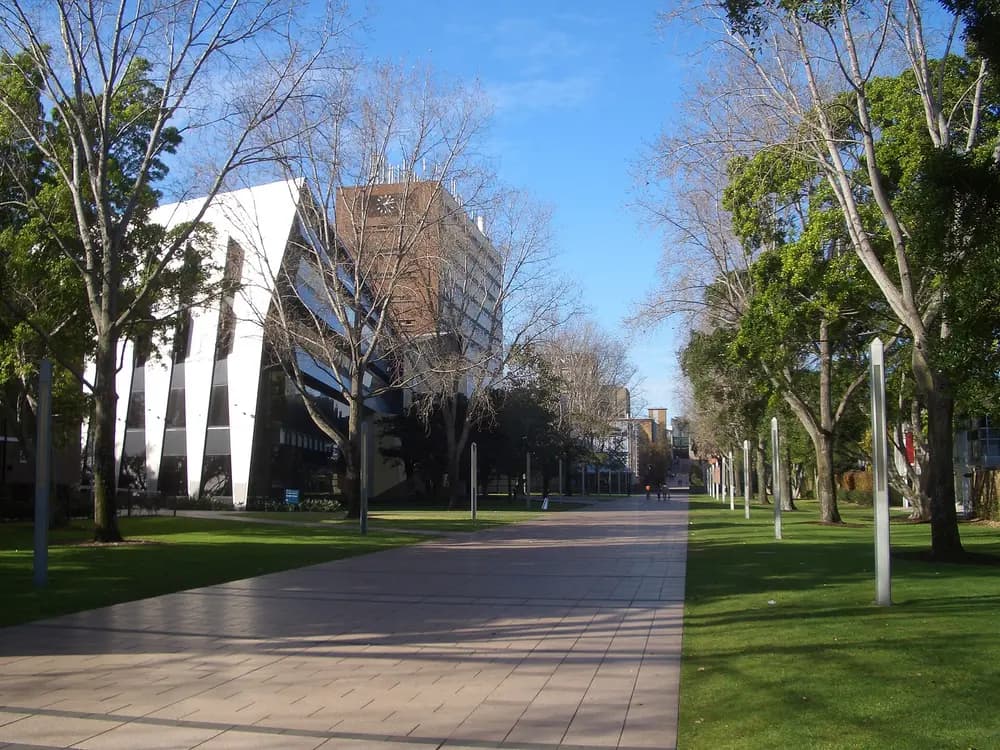
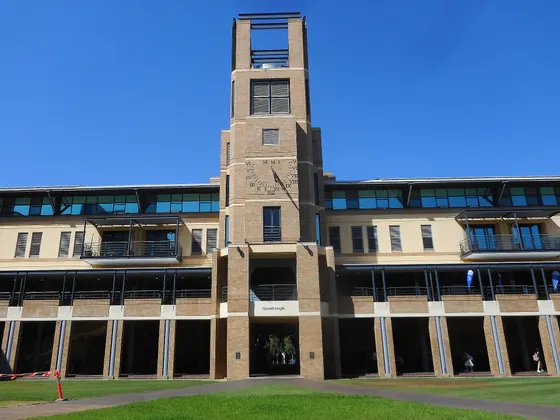
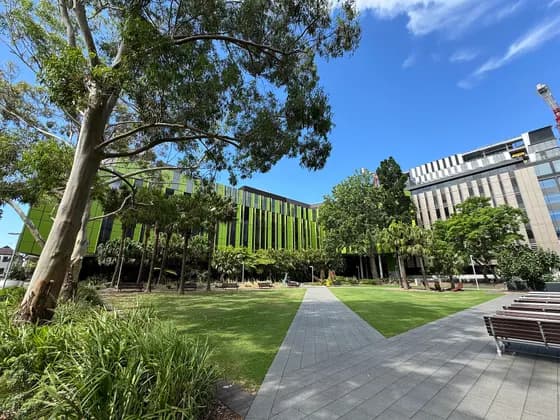
Photo: J Bar · CC BY-SA 3.0 · cropped
Photo: Sardaka · CC BY-SA 4.0 · Photo: FlyingKoala · CC BY 4.0 · Photo: Sardaka · CC BY-SA 4.0
The UNSW medicine course at a glance (2027 entry)
UNSW's Bachelor of Medical Studies / Doctor of Medicine (BMed MD) is a six-year, full-time course that you start straight after Year 12. It leads to two degrees, and you must complete both. The handbook places the first three years in the BMed and the research year and final clinical years in the Doctor of Medicine (MD). In Australia the MD is an extended master's-level degree, even though you begin it without an earlier degree.
The course is accredited by the Australian Medical Council (AMC), which sets the standards for Australian medical courses; the AMC report referred to in this guide dates from December 2023. Throughout the course you must be registered as a medical student with the Medical Board of Australia, and the faculty arranges this when you start year 1. After graduating you can apply for provisional registration, which the Board runs through the Australian Health Practitioner Regulation Agency (AHPRA), and for an internship. That is your first year working as a supervised doctor, also called PGY1 (postgraduate year 1).
Teaching follows the human life cycle rather than separate science subjects. Four domains, Beginnings, Growth and Development; Health Maintenance; Ageing and Endings; and Society and Health, return in each phase. Three strands run through every course: Clinical Skills, Ethics, and Quality of Medical Practice, which covers evidence-based practice, statistics and patient safety.
The six years form three two-year phases. Phase 1 is mostly on campus at Kensington, or at UNSW's rural campuses in Port Macquarie and Wagga Wagga. From Phase 2 you belong to a clinical campus, the hospital-based teaching base you are allocated to for a whole phase: one of four in Sydney or one of five rural clinical campuses. Phase 2 is a clinical year followed by a research year, and Phase 3 is spent almost entirely in hospitals and general practices.
The course is changing. UNSW plans to launch a redesigned Medicine Program in 2028, subject to approval by the AMC and the UNSW Academic Board. If you start in 2027, you take years 1 and 2 in the current course and move into year 3 of the redesigned course in 2029. It keeps the six years, the two degrees and the clinical campuses, and adds more general practice. This guide describes the current structure and marks what is due to change.
| Degree | Bachelor of Medical Studies / Doctor of Medicine (BMed MD) |
|---|---|
| Course length | 6 years full time, in three two-year phases |
| Cohort size | 198 domestic places plus up to 100 international (AMC, 2023) |
| Main campus | Kensington, Sydney; Phase 1 also taught at Port Macquarie and Wagga Wagga |
| Teaching style | Integrated, life-cycle courses taught through scenario groups, then practice-based learning |
| First patient contact | Year 1: fortnightly hospital sessions from the second course |
| Placement area | Four Sydney clinical campuses and five rural campuses in NSW |
| Rural time | At least 4 weeks (domestic); redesign plans 7 weeks for Sydney-based students |
| Research year | Year 4: Independent Learning Project or BSc(Med) Honours |
| Combined degree option | Medicine/Arts adds a Bachelor of Arts, taking 7 or 8 years |
| Curriculum change | Redesigned course from 2028; 2027 starters join it at year 3 |
What makes UNSW medicine different
A full year of research in year 4
Almost every student spends year 4 on a supervised research project in a UNSW school or affiliated research institute. The Independent Learning Project means at least 25 hours a week in the research setting for 30 weeks. The separate BSc(Med) Honours degree means 35 hours a week for 34 weeks. Your final report should reach the standard of a journal article.
A weekly general practice placement beside your research
From 2027, year 4 also includes the General Practice Longitudinal Placement: about 30 half-day sessions in a general practice, usually one a week through the year, though some students do theirs as a block. The aim is to let you follow patients' continuing care in the community and get early experience of general practice.
Rural training from year 1, if you want it
Smaller Phase 1 cohorts are taught at Port Macquarie and Wagga Wagga for the whole of Phase 1. Rural Entry Admission Pathway (REAP) students are expected to train rurally throughout. If the rural Phase 1 places are full, they start at Kensington and move to a rural campus for Phases 2 and 3. Other domestic students can be placed at a rural clinical campus for a whole phase.
Learning alongside the year above
In the second half of year 1 you take your Phase 1 courses together with second-year students, working in small groups that mix both years. From your first year, then, you study alongside students who are a year further into the course.
A portfolio examined at the end of every phase
Alongside exams, you build an online portfolio of assignments, projects, feedback and reflections, judged against eight graduate capabilities such as teamwork, ethics and reflective practice. It is examined at the end of each phase, finishing with an interview in year 6.
Two courses from outside medicine
You take 12 units of credit of general education, usually two courses, from faculties other than Medicine & Health, mostly during the research year. The AMC report saw this breadth as a valuable feature of the six-year course.
How UNSW teaches medicine
In Phase 1 your learning revolves around your scenario group. Each course is built on scenarios showing work a new doctor might do, which your group discusses and follows up, with lectures, practicals, tutorials, online lessons and hospital visits alongside. In each course you also complete an individual assignment and a group project on topics you choose from the course themes, so part of what you study is up to you.
Phase 2 moves to practice-based learning. Each year 3 clinical term is organised around weekly themes linked to clinical presentations, covered on the wards, in lectures and in tutorials. Each week ends with a case method tutorial that you prepare for and that pulls the week together. Some quality, safety and professionalism sessions use team-based learning, where you prepare in advance and then solve problems as a team.
In Phase 3 formal teaching is deliberately limited so that you spend your time with patients. You join clinical teams, take the history and examine newly admitted patients, present them on ward rounds and take on tasks under supervision, working to a learning plan agreed with your supervisor. A biomedical sciences program continues alongside, with hospital tutorials, campus days, medical imaging seminars and pathology laboratory visits.
The AMC report found that students learned with other health professions mostly informally on placement, and set UNSW a condition to build a structured interprofessional program by 2026. It also noted a tilt towards hospital care over general practice. The redesign lists interprofessional education among its workstreams and adds GP placements in years 3, 4 and 6.
The ways you will learn
| Scenario groups | Facilitated small groups in years 1 and 2 that work through each course's scenarios. The facilitator gives feedback on your contribution, and the discussions help you plan your assignments and projects. |
|---|---|
| Lectures and practical classes | Lectures carry the core science, and laboratory practicals cover anatomy, histology, pathology, physiology, pharmacology, biochemistry and microbiology. Some practicals need an online activity first, or you will not be let into the lab. |
| Clinical skills sessions | Held in the Clinical Skills Centre on campus from year 1, with simulated patients (well people trained to play patients). You practise communication, history taking and examination, then repeat them with real patients in hospital. OSPIA, an online platform, lets you interview simulated patients remotely. |
| Case method tutorials | The session that closes each week of a year 3 term. You prepare beforehand and take an active part in bringing that week's clinical, scientific and social learning together. |
| SimConverse virtual patients | An AI virtual patient platform used in year 3 for harder conversations: anxious or depressed patients, cross-cultural communication, motivational interviewing, social and sexual histories, and patients with late-stage cancer. You complete 18 scenarios and get instant feedback. |
| Clinical team attachments | In years 5 and 6 you join a clinical team for four or eight weeks and work alongside its doctors, nurses and other staff, taking on tasks under supervision. UNSW calls these attachments clinical clerkships. |
How anatomy is taught at UNSW
Anatomy is taught by UNSW's Department of Anatomy, which teaches gross anatomy, histology (tissues under the microscope) and embryology (how the body develops) to medical and other students. The department says its students learn hands-on in its anatomy facilities, using bodies donated to the university alongside digital technology. In Phase 1 anatomy sits inside the life-cycle courses as practical classes.
It is examined through the cumulative practical exam, three tests spread across Phase 1. Anatomy and neuroanatomy form one of its four discipline groups, and you need a cumulative pass in each group. In year 3, one angle you can take in a case assignment is the patient's normal anatomy and how it explains their signs and scans. The AMC report noted that students valued the university's licences for Complete Anatomy, a 3D anatomy platform.
Anatomy returns in years 5 and 6 through anatomy workshops on campus days, run as combined in-person and online sessions, and seminars on chest, head and spine, abdominal and cancer imaging. Anatomical specimens and scans can be used in the Biomedical Sciences Viva at the end of year 5.
When you first meet patients at UNSW
You start with simulated patients. Communication skills teaching begins in Foundations, and most Phase 1 courses then include clinical skills classes on campus with simulated patients, while online sessions on OSPIA add more practice. Phase 1 focuses on communication, taking a history and correct examination technique, and you are not expected to make diagnoses yet. Before entering a hospital you must meet NSW Health requirements, including vaccinations, a police check and online training modules.
Hospital sessions begin in the second course of year 1, Beginnings, Growth and Development A, and continue fortnightly through Phase 1. Kensington students go to Sydney teaching hospitals, and the Port Macquarie and Wagga Wagga cohorts to regional hospitals. You examine real patients to learn the range of normal, and a logbook records your attendance. The AMC report notes that all students take part in an Aboriginal health immersion activity in year 1.
In year 3 you spend three days a week, about 60% of your time, on placement. That means your home hospital, a women's or children's hospital or, in the Society and Health term, community services including general practices. You take focused histories, examine patients and begin reasoning about diagnoses. Year 4 adds the weekly GP session, and in years 5 and 6 you work within clinical teams almost full time.
Year by year at UNSW
- Year 1 (Phase 1)
Foundations and the first life-cycle courses
Year 1 opens with Foundations, which introduces how you will learn and be assessed, how to find and reference evidence, and the conduct expected of a medical student. You then take 8-week courses built around the life cycle, working in scenario groups and starting hospital sessions. In the second half of the year you share courses with second-year students.
- Foundations (MFAC1501): assessed on attendance, engagement, an assignment and a project, plus an end-of-course exam you must pass to continue.
- Beginnings, Growth and Development A (MFAC1521), from the domain that runs from conception and birth through childhood and adolescence; hospital sessions start here.
- Two shared courses in the second half of the year, one each from Health Maintenance and Ageing and Endings. Which half of each pair you meet first depends on whether you start in an odd or even year.
- In every course after Foundations: an individual assignment of up to 2,000 words, a group project for 4 to 6 students, and a 2-hour written exam.
- The first of three practical exams, at the end of the year.
- Year 2 (Phase 1)
Completing the life cycle
Year 2 completes the four domains, including the Society and Health course. Most students do their negotiated assignment this year. The year ends with three barrier exams, which you must pass to enter Phase 2.
- Society and Health (MFAC1527): how society, culture, genes, income, health systems and human rights shape health.
- A compulsory research-based group project in the first half of the year: analysing simulated data and published studies, written up as a journal review article.
- A negotiated assignment on a topic you propose, required for your portfolio and due before the end-of-year-2 portfolio exam; each course takes at most 110 proposals.
- Student-Patient Observed Communication Assessments (SOCAs), observed conversations with patients online, on campus and in hospital; at least four, with your reflections, go into the portfolio.
- Three End of Phase barrier exams: written and practical, clinical (an Objective Structured Clinical Examination, or OSCE, a circuit of timed stations) and the portfolio examination.
- Preferences for your year 3 clinical campus.
- Year 3 (Phase 2)
Clinical coursework, and the move to the new course
Year 3 makes patients the context for your learning. In the current course you complete six clinical terms, with three days a week on placement and two on campus, at Kensington or your rural campus. If you start in 2027, you take year 3 in 2029 as part of the redesigned course, which aligns years 1 to 3 more closely with UNSW's new flex-semester calendar.
- Current terms: Adult Health 1, Adult Health 2, Aged Care and Rehabilitation, Beginnings, Growth and Development (women's and children's health), Oncology and Palliative Care, and Society and Health, taken in one of four sequences.
- Society and Health includes a four-week placement in community settings such as general practices.
- At least one case assignment or oral case presentation per term, based on a patient you have seen, plus a group project in Society and Health.
- Clinical skills tasks: at least six mini-CEXs, where a clinician watches you with a real patient and gives structured feedback, the 18 SimConverse scenarios and a signed-off procedural skills logbook.
- The Phase 2 Integrated Clinical Examination at the end of the year.
- In the redesigned year 3 from 2029: a new GP and Primary Care course, modelled on Society and Health, with about 24 GP sessions in a three- or six-week block.
- Year 4 (Phase 2)
Research year with weekly general practice
Year 4 is a full year of supervised research, as the Independent Learning Project (ILP) or BSc(Med) Honours. Both include a Value-Based Health Care course, and you attend the general practice placement, usually one half-day a week. ILP students finish their general education by the end of term 2; Honours students must finish it before year 4 starts. The year closes with the Clinical Transition Course, which takes you back into clinical work.
- Choosing a project happens during year 3: you negotiate one with a supervisor or pick from projects listed online, and allocations come out in August.
- ILP assessment: a 3,000-word literature review, a 3,000 to 4,000-word manuscript, a three-minute thesis presentation and your supervisor's rating.
- General Practice Longitudinal Placement: about 30 half-day GP sessions.
- Your Phase 2 portfolio essay, submitted early in the year.
- Clinical Transition Course (4 weeks), the first course of Phase 3, refreshing clinical reasoning, communication and professionalism; the AMC report notes that it includes an activity with exercise physiology students.
- Year 5 (Phase 3)
Core clinical rotations
In the current course, Phase 3 has seven core courses, a Selective and an Elective, each eight weeks long, taken in one of eight fixed sequences. Year 5 starts with a summer teaching period. Everyone completes Medicine and Surgery in year 5, and at least five of the seven core courses.
- Core courses: Medicine, Surgery, Psychiatry, Primary Care (general practice), Obstetrics and Gynaecology (O&G), Children's Health and Critical Care.
- Critical Care: four weeks in an emergency department and four in anaesthesia, intensive care or both.
- Each course can be split into two 4-week attachments with different teams.
- Primary Care, in year 5 or 6: 8 weeks split between two general practices, 4 weeks in each, typically 3 to 3.5 days a week in the practice.
- During Primary Care, the AMC report says, every student visits an Aboriginal Community Controlled Health Organisation (ACCHO), a primary health service run by its local Aboriginal community.
- During Medicine and Surgery: biomedical science tutorials, pathology laboratory visits and a presentation on the quality use of medicines for a patient taking many drugs.
- Biomedical Sciences Viva in November: an oral exam on the science behind clinical cases, also run at the main rural campuses, which you must pass to graduate.
- Redesign: a 7-week rural placement in year 5 for Sydney-based students, subject to AMC and UNSW Academic Board approval of the new course.
- Year 6 (Phase 3)
Elective, final exams and preparing for internship
Year 6 opens with the 8-week Elective, then the remaining core courses and the Selective. Final exams follow the third teaching period, and the year ends with Preparation for Internship (PRINT), which gets you ready for the intern role. The redesigned year 6 is planned to strengthen this stage, with more focus on teaching, leadership, communication and teamwork.
- Elective (8 weeks) in the summer teaching period, in Australia or overseas.
- Selective (8 weeks) in any discipline at a UNSW-affiliated site.
- Phase 3 Integrated Clinical Examination in September, and the final portfolio examination.
- Online National Prescribing Curriculum modules and a Prescribing Skills Assessment, in which you need the national pass mark of over 65% to complete PRINT.
- Redesign: a Transition to Clinical Practice term with about 20 GP sessions in the role of a GP assistant.
- Internship applications through NSW Health's Health Education and Training Institute (HETI), which open in May.
How you are assessed at UNSW
Assessment is built around the eight graduate capabilities. Assignments, projects and many clinical assessments are graded F (fail), P- (needs more work), P (meets expectations) or P+ (exceeds them). Clinical skills are assessed on placement as well as in formal exams. Several exams are barrier assessments: you must pass them to progress, whatever your other results.
An OSCE moves you through timed stations, each testing one task, such as examining a patient or explaining a diagnosis. In Phase 1 each course ends with a 2-hour written exam, roughly 40% multiple-choice and 60% short-answer questions, with a pass mark of 50%. At the end of year 2 you must pass a written exam (80 multiple-choice questions in 120 minutes, plus the practical tests), a six-station OSCE and the portfolio examination.
The Phase 2 Integrated Clinical Examination (ICE) at the end of year 3 has two equally weighted parts, and you must pass both. One is an OSCE; the other is a written paper of six image-identification questions and 48 single best answer questions. Sydney students sit the OSCE at a campus other than their own. The ILP or Honours is marked on your written work, presentations and your supervisor's report.
In years 5 and 6 each course is graded mainly on the learning plan your supervisor completes, plus tasks such as case reports, presentations and at least one observed clinical assessment. The final Phase 3 ICE, after the third teaching period of year 6, has a multiple-choice paper (30%), an OSCE (40%) and a structured oral viva (30%). You must pass each of the seven core disciplines and clinical pharmacology separately.
Each phase ends with a portfolio examination in which you reflect on your development against the capabilities. In year 6 you must reach P or better in all eight, through a 1,200-word essay and a 30-minute online interview that opens with your 7-minute presentation. The AMC report described the course as assessment dominant.
All of this describes the current course. If you start in 2027, years 3 to 6 fall in the redesigned course, which plans a move to programmatic assessment, where many smaller assessments are combined over time to judge your progress. The exams described here for those years may therefore change.
Where you will actually be at UNSW
In Phase 1 the largest group is taught at Kensington and goes to Sydney hospitals for its clinical sessions, while smaller cohorts are based at Port Macquarie and Wagga Wagga. From Phase 2 you are allocated to a clinical campus for the whole phase. You also rotate to general practices and private hospitals across NSW and north-eastern Victoria. Some year 3 terms, and the Psychiatry, O&G, Children's Health and Primary Care courses, may take you away from your home campus.
You give preferences during year 2 for Phase 2 and during year 4 for Phase 3, and a Clinical Allocations Committee decides. You are told at least three months before the phase starts and can swap with a student in the same category within two weeks. Preferences are not guaranteed, and home address, access to a car, accommodation, paid work and finances are not normally considered. Serious health needs, being a parent or carer, elite sport or music, and a concurrent PhD at UNSW can be.
All domestic students must complete a rural placement of at least four weeks, mostly in year 5, through a GP attachment, a hospital attachment, the Elective or the Selective. For Sydney-based students, the redesign plans a longer seven-week rural placement in year 5. The AMC report found that 30% of the cohort did a year-long rural placement.
Rural Entry Admission Pathway (REAP) students are expected to train rurally from start to finish. Those who start Phase 1 at Port Macquarie or Wagga Wagga stay at a rural campus for Phases 2 and 3. Any who start at Kensington because the rural campuses are full move to a rural campus for the rest of the course. Other domestic students placed rurally stay for the whole phase.
If you are placed at a rural campus for Phase 2 or 3, you sit your exams there, although supplementary exams may be in Sydney at your own cost. There is no up-front funding, but you may be able to claim back relocation costs under faculty policy. Students placed rurally for Phase 3 take every Phase 3 course except the Selective and Elective at that campus. A research project done at a rural campus does not count towards the rural requirement.
Next to the Kensington campus, within the Randwick Health & Innovation Precinct.
- Prince of Wales Hospital
- Sydney Children's Hospital
- Royal Hospital for Women
- Prince of Wales Private Hospital
Hosts clinical terms in all three phases, including Phase 3 Medicine, Surgery and Critical Care. The Garvan Institute and Victor Chang Cardiac Research Institute are on the same campus.
- St Vincent's Hospital
- St Vincent's Private Hospital
- St Vincent's Clinic
- Sacred Heart Hospice
The St George campus sits within the Kogarah Health and Knowledge Precinct in southern Sydney. Sutherland Hospital is in Caringbah, and Sydney Hospital and Sydney Eye Hospital, in central Sydney, are also used.
- St George Hospital, Kogarah
- Calvary Hospital, Kogarah
- Sutherland Hospital, Caringbah
- Sydney Hospital and Sydney Eye Hospital
Liverpool Hospital has up to 855 beds. The campus has its own clinical skills and simulation centre and works with the Ingham Institute for Applied Medical Research.
- Liverpool Hospital
- Bankstown-Lidcombe Hospital
- Campbelltown Hospital
- Camden Hospital
- Fairfield Hospital, Prairiewood
- Braeside Hospital, Prairiewood
Wagga Wagga, Griffith and Albury are rural clinical campuses, and Wagga Wagga also teaches a Phase 1 cohort.
- Wagga Wagga Base Hospital
- Griffith Base Hospital
- Albury Base Hospital
- Albury-Wodonga Health Service, Wodonga (Victoria)
- Mercy Health, Albury
Port Macquarie and Coffs Harbour are rural clinical campuses, and Port Macquarie also teaches a Phase 1 cohort. Kempsey and Wauchope are extra rural settings.
- Port Macquarie Base Hospital
- Coffs Harbour Health Campus
- Kempsey District Hospital
- Wauchope District Hospital
Further rural hospitals used for placements beyond the five main rural campuses.
- Broken Hill Base Hospital
- Orange Health Service, Bloomfield Health Campus
- Grafton Base Hospital
- Maclean District Hospital
Electives, selectives and options at UNSW
The Elective is a compulsory 8-week course at the start of year 6, taken as one placement or two of four weeks. It can be outside UNSW's teaching sites, in Australia or overseas, and can help you explore a career, see a different health system, fill a gap in your skills or do research. Overseas placements must be in countries at level 1 or 2 of the Department of Foreign Affairs and Trade (DFAT) travel advice. You must also apply for at least one Australian placement as a back-up.
Overseas placements take a long time to arrange, so the faculty suggests starting in year 4. Your elective must be approved before it begins or it will not count. Afterwards you write an elective report, which is part of your final portfolio. The redesign keeps the 8-week Elective in year 6.
At present, four students a year take their year 5 O&G and Paediatrics rotations on exchange at the University of Oslo in Norway, from about mid-August to mid-December, taught in English. You need at least a credit average with no more than one failed course, and you pay your own travel and living costs. Your Elective can be split around the exchange.
The Selective is a separate 8-week course in a discipline of your choice, taken at a UNSW-affiliated metropolitan or rural hospital or general practice. Students already allocated to a campus get priority there.
Intercalation and research degrees at UNSW
Research is built into the course rather than optional. The Independent Learning Project (ILP), also called MD Research, sits inside the MD. BSc(Med) Honours is a separate one-year degree taken in place of the ILP, so Honours students graduate with a third qualification alongside the BMed and MD.
Honours has entry requirements: an average mark of at least 65 across the Phase 1 life-cycle courses, not needing to repeat year 3, and your general education courses finished before year 4 begins. Failing key Phase 1 or Phase 2 assessments moves you back to the ILP. Honours comes as a research-intensive stream or a coursework-intensive stream with more specialised coursework, and the options listed include clinical AI.
Projects must test a hypothesis or answer a research question with data: for example a laboratory or clinical study, a new analysis of an existing dataset, or a systematic review with meta-analysis. Case reports, descriptive audits and reviews without meta-analysis do not qualify. Your supervisor designs the project and arranges ethics approval, and interstate and overseas projects are not accepted.
Students who already hold a research Honours degree or a research higher degree can be exempted from the ILP. If you want to complete a separate master's degree, you must take a year's leave from Medicine, and the faculty strongly advises doing so before Phase 3.
You can also add an arts degree. During year 1 you can apply to transfer at the end of the year from Medicine (program 3805) to the combined Medicine/Arts program (3856), which adds a Bachelor of Arts to the BMed MD. The Arts part is 96 units of credit: a major and a minor plus electives, or two majors. It takes 8 years in total, or 7 if your year 4 Independent Learning Project is an approved arts-focused project.
Facilities and support at UNSW
Where you will learn
In Phase 1, clinical skills classes are held on campus in the Clinical Skills Centre. At Kensington, the AMC report describes the faculty's teaching spaces in the Wallace Wurth Building, including clinical skills simulation space and physiology teaching laboratories, plus central lecture theatres used for Phase 1. The Samuels Building, used in Phases 2 and 3, has a pathology museum.
In the Randwick precinct next to Kensington, the new UNSW Health Translation Hub opened in November 2025. UNSW says its School of Clinical Medicine, which manages the course, is to be based there, and the building includes a clinical skills and simulation centre.
Each Sydney clinical campus has UNSW teaching rooms and a Clinical Teaching Unit in its hospital; at St Vincent's the clinical school is on level 5 of the De Lacy building. Students told the AMC that Liverpool offered supervised simulation labs. Rural campuses have teaching rooms, computer labs and clinical skills facilities, with simulation labs at Wagga Wagga and Albury. In February 2025 UNSW welcomed students to a new Biomedical Sciences Centre in Wagga Wagga.
Support while you study
Each Phase 1 student has a Portfolio Advisor for academic advice on the portfolio: at Kensington by surname, with one advisor each at Port Macquarie and Wagga Wagga. In Phase 2 there is a portfolio advisor at each clinical site, and in Phase 3 the Director of Medical Education at your site can help. Advisors will not read drafts of your essay.
The Clinical Mentoring Scheme pairs students in years 3 to 6 with one of more than 150 clinician mentors, working on goals such as clinical skills and career planning. The redesign plans more peer and formal mentoring with alumni, staff and industry.
You can take up to eight self-care days a year, planned days off for your wellbeing, registered at least a day ahead and never on an assessment day. Wider help comes from a Faculty Wellbeing Officer, Rural Wellness Advisors for the rural campuses, clinical campus administrators trained in mental health first aid, and free Employee Assistance Programs in NSW Health teaching hospitals. Rural students can also use the Rural Adversity Mental Health Program, which UNSW Medicine partners with.
Aboriginal and Torres Strait Islander students have a dedicated faculty support contact and Nura Gili, UNSW's centre for Indigenous students. The AMC report notes that the faculty funds the Rural and Allied Health Medical Society, the main peer support for rural-entry students.
Is the UNSW course right for you?
This course may suit you if
- You want to go straight from Year 12 into medicine and also spend a full year doing supervised research.
- You are comfortable directing your own study and writing reflectively, since a capability portfolio is examined in every phase.
- You would like to train in a regional centre, starting at Port Macquarie or Wagga Wagga or moving to a rural clinical campus later.
- You enjoy small-group learning, including groups shared with second-year students in the second half of year 1.
- You want some breadth, with two general education courses from outside medicine inside the degree.
Things to think about
- Year 4 is mostly research, away from the wards apart from one GP session a week; the AMC report recorded concerns about this break in clinical learning.
- You rank your clinical campus preferences, but allocation is not guaranteed, so you may spend a whole phase at a campus you did not pick, including a rural one.
- If you start in 2027 you switch to a redesigned course in year 3, and UNSW has so far published only its main changes.
- There are barrier exams at the end of each phase plus the year 5 Biomedical Sciences Viva; the AMC report called the course assessment dominant.
- Domestic students spend at least four weeks rurally, planned to rise to seven weeks in year 5 for Sydney-based students, and some are placed at a rural campus for a whole phase.
UNSW medicine course — frequently asked questions
Applying to UNSW?
How to get into UNSW
Entry requirements, admission tests, written application and interview, step by step.
Open the guide →UNSW entry requirements
ATAR or GPA, GAMSAT and UCAT ANZ thresholds, interview format and place types.
See the requirements →Compare UNSW with other schools
Put the teaching style, anatomy teaching and placements next to another school.
Open the comparison →Prepare for the UNSW interview
Format breakdown, school-specific sample questions and prep tips from tutors who interviewed here.
Read the guide →Where this UNSW course guide came from
This guide was written from 24 official sources — UNSW Sydney's own course pages and programme documents, plus the Australian Medical Council or Australian Dental Council and the health services the school places students with where they publish detail — read on 2026-09-28, then checked claim by claim against those sources.
- Bachelor of Medical Studies / Doctor of Medicine, UNSW Sydney course page
- UNSW Handbook 2027: Medicine (program 3805)
- UNSW Handbook 2027: Medicine / Arts (program 3856)
- UNSW Medicine & Health: Phase 1 Student Guide 2025
- UNSW Medicine & Health: Phase 2 Student Guide 2026
- UNSW Medicine & Health: Phase 3 Student Guide 2026
- Guidelines for the Allocation of Students in the Medicine Program to Clinical Environments (September 2025)
- UNSW Medicine Program: structure, teaching methods, assessment and capabilities
- UNSW Medicine Program: Year 4 Medicine Research Project (ILP and BSc(Med) Honours)
- UNSW Medicine Program: Allocation to Clinical Teaching Sites
- UNSW Medicine & Health: Medicine Program Redesign FAQ
- UNSW Medicine & Health: Medicine Program Redesign overview
- UNSW Academic General Practice Network: primary care teaching
- UNSW School of Clinical Medicine: Randwick Clinical Campus
- UNSW School of Clinical Medicine: St Vincent's Healthcare Clinical Campus
- UNSW School of Clinical Medicine: St George and Sutherland Clinical Campuses
- UNSW School of Clinical Medicine: South West Sydney Clinical Campuses
- UNSW School of Clinical Medicine: Rural Clinical Campuses
- UNSW School of Biomedical Sciences: Department of Anatomy
- Australian Medical Council: accreditation report on the UNSW medical program (December 2023, published 2024)
- UNSW Medicine Program: Exchange to Oslo in Phase 3
- UNSW: Lateral Entry Scheme fact sheet (June 2025)
- UNSW Health Translation Hub: Education
- UNSW Medicine & Health: Domestic - How to apply to UNSW Medicine
Courses are restructured between cycles. Anything here that decides your application — an anatomy offer, a placement city, a compulsory intercalated year — should be confirmed against the official page for your entry year.
Applying to UNSW?
We have helped hundreds of applicants turn their GAMSAT / UCAT ANZ, written application and interview prep into offers from UNSW and other Australian medicine schools.