
The Monash Medicine course
What you actually study, and where you will be
Monash's BMedSci/MD is a 5-year (direct entry) course taught through problem-based learning in an integrated curriculum, with patient contact from Year 1 or A and placements in metropolitan Melbourne, Gippsland and north-west Victoria (2027 entry). Monash runs one medical course with two entry points. Direct Entry takes five years from Year 12, with two campus years at Clayton; Graduate Entry takes four, with one pre-clinical year at Monash Rural Health Churchill in Gippsland (Year A) or, for 10 students, in Mildura (Year M). From Year 3B everyone follows the same three clinical years across Melbourne, Gippsland and north-west Victoria, learning through case sessions, active workshops and long placements, with rural cohorts that spend most of those years in the regions.
- Degree
- BMedSci/MD
- Length
- 5 years (direct entry)
- Teaching
- Integrated + Problem-based learning
- Clinical contact
- Year 1 or A
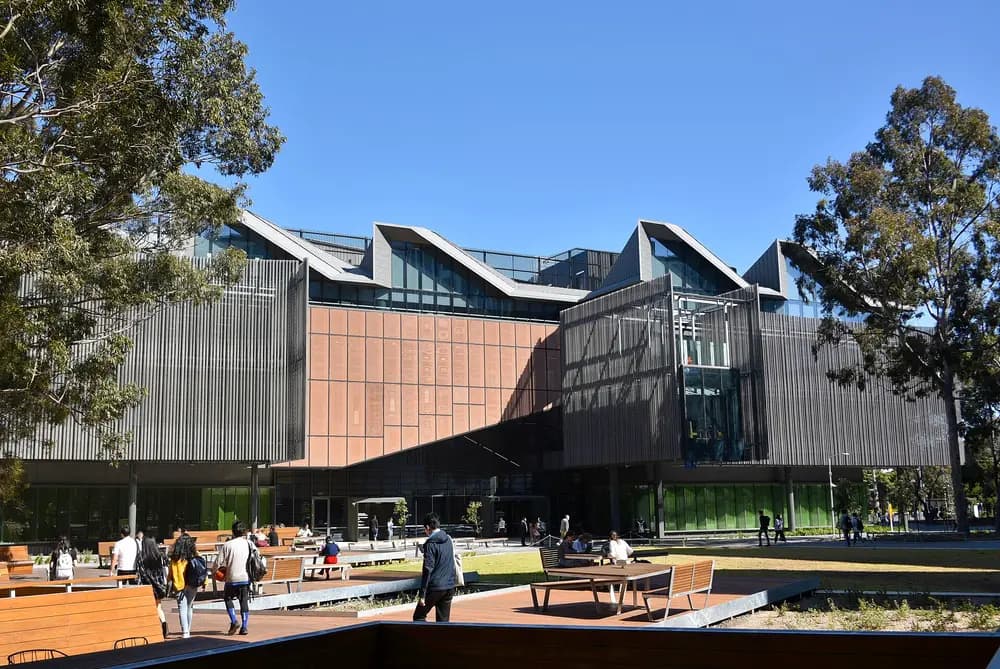
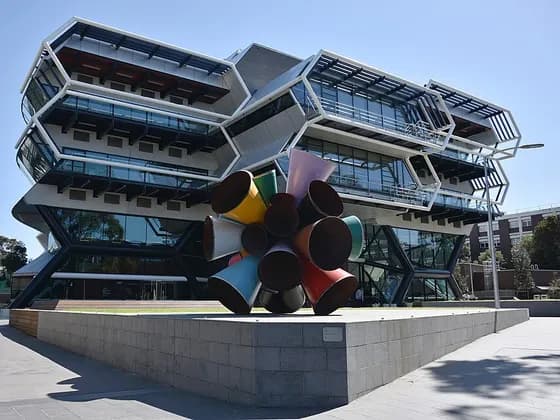
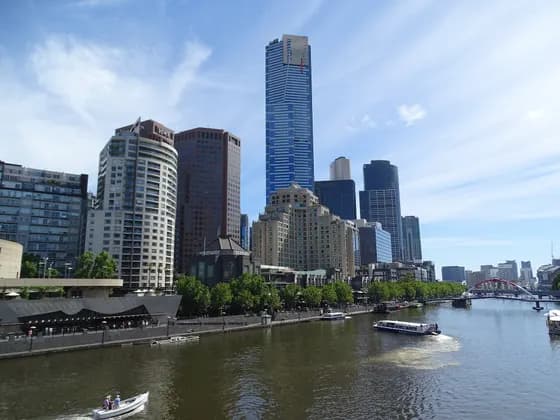
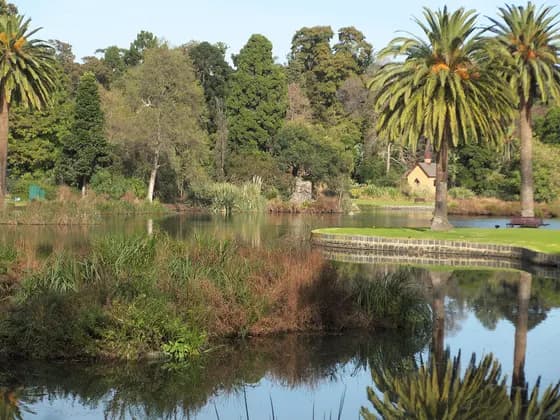
Photo: Rob Deutscher from Melbourne, Australia · CC BY 2.0 · cropped
Photo: Rob Deutscher from Melbourne, Australia · CC BY 2.0 · Photo: -jkb- · CC BY-SA 3.0 · Photo: Gary Houston · CC0
The Monash medicine course at a glance (2027 entry)
Monash's medical course leads to two degrees awarded together, the Bachelor of Medical Science and Doctor of Medicine (BMedSci/MD). The Doctor of Medicine (MD) is an extended masters-level degree, now the usual qualification for new doctors in Australia. There are two ways in: Direct Entry, a five-year course for school leavers, and Graduate Entry, a four-year course for people who already hold a degree. Both are accredited by the Australian Medical Council (AMC), the body that checks medical courses.
The years are labelled 1, 2, 3B, 4C and 5D. Direct Entry students spend years 1 and 2 largely on the Clayton campus. Graduate Entry students spend one pre-clinical year, Year A, at Monash Rural Health Churchill in Gippsland; the 10 students a year on the Mildura pathway take the same year, called Year M, in Mildura. From Year 3B the groups merge into the same three clinical years across Melbourne, Gippsland and north-west Victoria. There is one intake a year, in February or March.
The curriculum is integrated: anatomy, physiology, pathology and clinical skills are taught together around the same body system and the same patient cases, under four themes that run through every year. Patients arrive early, through year 1 site visits at Clayton and fortnightly hospital placements from early in Year A.
Final year is six 6-week rotations that turn you into a trainee intern, including a Scholarly Intensive Placement spent on a scholarly project. The school is large. About 320 Direct Entry students start at Clayton each year, around 234 domestic (30 of them in the Extended Rural Cohort) and 90 international. About 110 Graduate Entry students start each year: around 72 domestic at Churchill (35 in the End-to-End cohorts), 10 in Mildura and 30 international. A clinical year level therefore holds a little over 400 students in Australia, and the same course is also taught at Monash's Malaysia campus.
The academic year runs from late January or February to late October. Years 1 and 2 follow the standard Monash semesters. Year A runs two 15-week semesters, 2 February to 22 May and 29 June to 23 October in 2026. Year 3B runs two 18-week semesters, 1 February to 4 June and 28 June to 29 October in 2027. Years 4C and 5D start on 25 January 2027 and finish on 22 October, with a three-week mid-year break from 31 May, and 5D's exams and Back to Base week follow on 25 to 29 October.
On graduating you are eligible for provisional registration with the Australian Health Practitioner Regulation Agency (Ahpra) and the Medical Board of Australia. You then complete an internship, a supervised first year of work in an approved hospital, before general registration; the school warns that international students cannot be guaranteed an internship in Australia.
| Degree | Bachelor of Medical Science and Doctor of Medicine (BMedSci/MD) |
|---|---|
| Course length | 5 years (Direct Entry) or 4 years (Graduate Entry); 240 credit points |
| Intake | One intake a year, in February or March |
| Cohort size | About 320 Direct Entry and 110 Graduate Entry students start each year |
| Main campus | Clayton for years 1 and 2; Churchill for Year A (Mildura for Year M) |
| Teaching style | Integrated systems blocks taught through Integrated Case Learning and active workshops |
| Anatomy | Small-group dissection and prosected specimens at Clayton, with virtual reality |
| First patient contact | Year 1 clinical site visits; Year A fortnightly hospital placements from semester 1 |
| Placement area | Four clinical schools across Melbourne, Gippsland and north-west Victoria |
| Rural cohorts | Extended Rural Cohort (30 places) and End-to-End Rural Cohorts (35 places) |
| Honours | Optional intercalated BMedSc(Hons) research year after year 3 or 4 |
What makes Monash medicine different
A first year in Gippsland for graduate entry students
Year A is taught at Monash Rural Health Churchill. You are on clinical placement every fortnight at one of six hospitals in and around Gippsland, from Wonthaggi and Sale to St John of God Berwick on Melbourne's edge. You also take a community-based practice placement with a local agency and travel to Clayton for anatomy, histology, medical law and ethics.
Rural cohorts based in the regions
The Extended Rural Cohort (30 Direct Entry places) and the End-to-End Rural Cohorts (35 Graduate Entry places) do all of Years 3B and 4C and at least half of 5D at rural sites from Mildura to Bairnsdale, sitting the same exams as everyone else.
Six weeks of scholarly work built into final year
The Scholarly Intensive Placement (unit MED5101) gives you six weeks full time on a research, education or professional-practice project with a named supervisor, written up in a report of up to 4,000 words.
Pass-grade-only, competency-based assessment
Units are assessed pass or fail through hurdle tasks, with a hidden weighted average used for prizes and scholarships. The final-year Scholarly Intensive Placement is marked differently, with weighted tasks that make up a unit grade. Clinical skills are examined through the Assessment for Progression Examination (APEx), a face-to-face test you can sit up to four times, with feedback in between, from Year 2 or Year A onwards.
Cardiac placements at the Victorian Heart Hospital on campus
The Victorian Heart Hospital opened on the Clayton campus in February 2023 and took over Monash Health's cardiac and cardiothoracic services. Year 3B and 5D students on cardiac rotations are placed there, 15 to 20 at a time, and pre-clinical students can use its learning suite.
How Monash teaches medicine
Monash calls its curriculum integrated: units are taught by staff from across the faculty, and each block of the campus years combines basic science, patient-based presentations and small-group discussion around one body system. The school describes the doctor-patient interaction as the core that binds each year.
The small-group case format is Integrated Case Learning (ICL), which the AMC's 2023 report describes as Monash's adaptation of problem-based learning (PBL). A group works through a patient case, decides what it needs to learn and reports back, alongside taught sessions rather than instead of them. Most basic science is delivered in active workshops, with lecture content provided online in short chunks, and every few weeks a concept and consolidation session (formerly a digilab) pulls the recent science from all disciplines together.
The campus years are timetabled heavily. For each of the two year-long units the handbook expects about 12 to 14 hours of teacher-directed study plus 10 to 12 hours of your own, 24 hours a week per unit. Attendance at tutorials, practicals and simulation classes is compulsory, because the school treats them as preparation for placements. Persistent absence can cost you access to placements and, with it, the course.
From Year 3B the teaching follows your rotation, with each specialty attachment bringing its own lectures, tutorials, case-based learning, bedside tutorials and practical skills sessions. Lecture delivery varies between sites, some clinical schools keeping recorded online content and others teaching face to face, and pathology is taught online to the whole cohort. Back to Base sessions bring the dispersed Year 3B and 5D cohorts together for shared teaching on the core curriculum.
Two strands run across the years. Interprofessional learning puts you alongside pharmacy, midwifery, nursing, nutrition and dietetics and radiation science students. The Indigenous health curriculum is developed with the faculty's Gukwonderuk Unit: two ICL tutorials carry Indigenous health outcomes, faculty-wide modules are delivered in Year 3B, and every unit's outcomes include culturally safe care for Aboriginal and Torres Strait Islander patients.
The ways you will learn
| Active workshops | Large interactive classes on a flat floor where basic science is taught through tasks rather than a lecture from the front. Year 1 timetables five hours a week. |
|---|---|
| Clinical skills tutorials with simulated patients | Small-group tutorials on communication, history taking, examination and procedures, practised on simulated patients: members of the public trained to give a history and be examined. |
| Site visits and community placements | Four half-day clinical site visits in year 1 and the Community Based Practice program, then the one-week Rural Health Education Program placement in year 2. For Year A students, fortnightly hospital placements and community agency placements across Gippsland. |
A typical week on the Monash course
In year 1 you take two year-long units at once. Introduction to medical practice budgets 12 hours a week of teacher-directed study, about five hours of workshops and seven hours of seminars, practical assessment sessions and lectures, plus 12 hours of your own. Principles of medicine 1 adds eight hours of tutorials and four hours of applied sessions and practicals, again with 12 hours of self-directed work.
Year 2 follows the same pattern. Foundations of medical practice lists 12 hours a week of tutorials, workshops, practical sessions, site visits, integrated case-based tutorials and online lectures. Principles of medicine 2 lists 14 hours: six hours of lectures and two two-hour tutorials, with 10 hours of online and self-directed study on top.
Year A in Churchill budgets 12 hours of teacher-directed time plus 12 hours of self-study for each of its two units. Clinical placements run fortnightly, and each semester half the cohort also attends a non-clinical community placement. Year M students in Mildura have one non-contact day a week, with the rest of the week live, either online or face to face.
In the clinical years the week is the working week of your placement: around 40 hours at the clinical site, including ward rounds, clinics and case meetings, with seminars, tutorials and online modules fitted around it. School of Clinical Sciences students spend Tuesday afternoons back at Monash Medical Centre for an academic program. During the six-week Scholarly Intensive Placement there are no other classes, and the handbook expects 48 hours a week of supervised work and private study.
How anatomy is taught at Monash
Anatomy is taught inside the systems blocks of the campus years rather than as a stand-alone subject, so the anatomy of a system is learnt in the same block as its physiology and its diseases. Teaching sits with the Department of Anatomy and Developmental Biology at Clayton, whose Centre for Human Anatomy Education (CHAE) oversees anatomy education across the university.
The AMC's 2023 report says anatomy tutorials and dissection are delivered in small groups in the dissection facility. Gross anatomy, histology and basic radiology are taught using mixed methods that include virtual reality. Direct entry students also have access to a large collection of prosected specimens: real human specimens already dissected by staff so that the structures are laid out for study.
Graduate entry students spend Year A in Churchill but come to Clayton for their histology and gross anatomy classes, and the AMC report notes that they travel there to experience some dissection. The same report states that performance in anatomy assessments is equivalent across all of the school's sites.
When you first meet patients at Monash
Your first contact with the health system comes through four half-day clinical site visits in year 1, two each semester, to hospitals, medical practices and community care services. Alongside them, clinical skills tutorials start with communication, handwashing and sharps disposal, then subcutaneous and intramuscular injections, and you take histories and examine simulated patients.
In years 1 and 2 you also join the Community Based Practice program and learning activities in Indigenous health. In year 2 the Rural Health Education Program gives you a one-week rural placement, in April or August, in one of six communities: Bairnsdale, Bendigo, Mildura, Sale, Traralgon and Warragul. In Bendigo, for example, you shadow a GP and tour Bendigo Health. Monash Rural Health arranges and pays for your accommodation, in cabins, holiday apartments or motels depending on the town.
Year A students start earlier and more often. Clinical placements begin early in semester 1 and run fortnightly at one of six hospitals in and around Gippsland. Five are in the region, Wonthaggi Hospital, Central Gippsland Health in Sale, Leongatha Hospital, Latrobe Regional Health in Traralgon and West Gippsland Healthcare Group in Warragul, and the sixth is St John of God Hospital in Berwick, on Melbourne's south-eastern edge. Each semester half the cohort also completes a non-clinical placement with a community organisation in Gippsland, working alongside multidisciplinary teams and their clients.
Year by year at Monash
- Year 1 (Direct Entry)
Introduction to medical practice
Two year-long units, MED1100 Introduction to medical practice and MED1200 Principles of medicine 1, introduce the four themes and the basic medical and behavioural sciences through integrated cases. Clinical skills start in the first semester, and four half-day site visits take you into hospitals, practices and community services. Everything is assessed pass or fail through hurdle tasks.
- Systems-based blocks across years 1 and 2 run from the cardiovascular, respiratory, gastrointestinal, urinary and musculoskeletal systems through neurosciences, endocrinology, reproduction, immunology and infection, genomics, metabolism and nutrition to human development and human behaviour.
- Assessment: four assignments, a reflective journal, a presentation and an infographic totalling 17,000 words, three hours of online quizzes and 12 hours of written papers across the two semesters.
- The handbook lists a 120-minute multi-station clinical skills assessment. The 2026 schedule shows year 1 sitting numbered observed clinical encounters at Clayton (OCE 6 on 30 September, OCE 7 on 21 October), with up to four attempts at each.
- Calendar: standard Monash semesters, with second-semester written papers on 2 and 5 November in 2026.
- Before placements you need a police check, a Working with Children check and proof of immunisation, and the university registers you as a student with Ahpra; a Level 2 first aid certificate is recommended by the end of semester 1.
- Year 2 (Direct Entry)
Foundations and principles of medicine 2
MED2100 Foundations of medical practice and MED2200 Principles of medicine 2 extend the systems blocks and push you towards clinical reasoning: forming a differential diagnosis and outlining basic management for very common conditions. A one-week rural placement takes you to one of six regional towns.
- MED2100 runs 72 hours of lectures, 48 of workshops and 12 of seminars; MED2200 is built around 72 hours of practicals and 48 of tutorials, approaching common and significant illnesses system by system.
- The Rural Health Education Program places you for one week in April or August in Bairnsdale, Bendigo, Mildura, Sale, Traralgon or Warragul, with accommodation arranged and paid for by Monash Rural Health.
- Assessment in MED2100: 6,000 words of written assignments, a 30-minute oral presentation, a three-hour multimedia task and six hours of online quizzes. In MED2200: a 90-minute multi-station exam spread across the two semesters and a written examination of five papers totalling 15 hours.
- Calendar: standard Monash semesters; in 2026 APEx 2 and 3 fall in October and November and the second-semester written papers on 10, 12 and 16 November.
- Year A (Graduate Entry)
Foundation studies in Churchill
Graduate entry students cover the same systems-based blocks as years 1 and 2 in a single pre-clinical year at Monash Rural Health Churchill, through GMA2100 Foundations of medical practice and GMA2200 Principles of medicine. Clinical placements start early, community placements run each semester, and you travel to Clayton for anatomy, histology, law and ethics. The 10 students a year on the Mildura pathway take the equivalent year, Year M, at the Monash Mildura General Practice Academy instead.
- The same fifteen systems-based topic blocks as years 1 and 2 of Direct Entry, compressed into one year.
- Knowledge is developed through problem-based learning clinical case studies, with small-group work that includes case-based learning, role plays and simulations, team-based learning and research or enquiry activities.
- Fortnightly clinical placements from early in semester 1 at one of the six hospitals in and around Gippsland listed under clinical contact above, plus community partnership placements with Gippsland agencies overseen by a Community Advisory Committee.
- Assessment in GMA2100: an online workbook and 1,500-word reflection, and a portfolio of six written assignments and a 10-minute oral presentation totalling 15,000 words. In GMA2200: five written papers totalling 15 hours 50 minutes and a 90-minute multi-station clinical skills exam.
- Calendar: two 15-week semesters, 2 February to 22 May and 29 June to 23 October in 2026, with one-week mid-semester breaks.
- A car is encouraged because public transport around Churchill is limited.
- Year 3B
Integrated medicine and surgery
Your first full clinical year and the last year of the Bachelor of Medical Science stage. You are based at one of the four clinical schools for two 18-week semesters of continuous rotations, studying MED3100 Medicine and surgery and MED3200 Foundation clinical studies. By the end of the year you must be able to take a history and examine a patient with a straightforward condition.
- You are allocated to Eastern Health Clinical School, the School of Clinical Sciences at Monash Health, the School of Translational Medicine (The Alfred, Cabrini or Peninsula University Hospital) or Monash Rural Health in Bendigo, Mildura or Gippsland.
- Integrated medicine and surgery is taught with pathophysiology through problem-based and core-based learning sessions, and the units also cover evidence-based clinical practice, occupational and environmental medicine, pharmacology, ethics and law.
- MED3100 hurdles: two observed clinical encounters of 15 to 20 minutes, two 2,000-word evidence-based clinical practice essays, a logbook of work-integrated learning assessments and a 45-minute, 20-item medical law quiz.
- MED3200 hurdles: two three-hour written papers of multiple-choice and extended-matching questions (100 and 80 items), four online pathology exams of 25 items each, a 110-minute multi-station clinical skills exam run as APEx, a 2,000-word research skills assignment and a portfolio.
- Calendar: 1 February to 4 June and 28 June to 29 October in 2027, with the two written papers in the second week of November.
- Passing 3B completes Stage 1, the Bachelor of Medical Science (144 credit points for Direct Entry, 96 for Graduate Entry); you progress to Stage 2, the Doctor of Medicine, if in good standing, and leaving at this point earns the BMedSc alone.
- Year 4C
Specialty clinical practices
The first year of the Doctor of Medicine stage is built around four specialty rotations: General Practice, Obstetrics and Gynaecology, Children's Health and Psychiatry, taken through MED4100 Specialty clinical practices and MED4200 Integrated clinical studies over two 18-week semesters. It is the most mobile year, because you move between hospitals and community practices to reach all four disciplines.
- Metropolitan cohort: four 9-week rotations in any order, with GP in practices across Melbourne, children's health at Angliss, Maroondah, Box Hill, Casey, Dandenong or Monash Children's Hospital, and psychiatry at sites including The Alfred.
- Peninsula cohort: GP across the Mornington Peninsula and the other three rotations at Peninsula University Hospital in Frankston.
- School of Rural Health cohort: one 18-week regional hospital semester (Mildura, Bendigo, Traralgon, Warragul or Sale) covering O&G, children's health and psychiatry, and one 18-week semester in a rural general practice in Gippsland, the Goldfields, the Highlands or Swan Hill.
- Evidence-based clinical practice and health economics are woven into the placements, and the Professional Standards, Ethical Behaviour and Student Support (ProFESS) framework applies to every attachment.
- MED4100 hurdles include observed clinical encounters in GP (prescribing and clinical reasoning) and children's health (a neonate), a 1,000-word paediatric case report, a 12-minute O&G oral case, two psychiatry assignments totalling 4,500 words, a 400-word referral letter, logbooks and professional behaviour appraisals.
- MED4200 ends with two three-hour written papers in early November. Its 160-minute clinical skills demonstration is eight APEx clinical examinations, held inside the rotations and as an end-of-year APEx H+ in the first half of November; you must pass all eight, with up to four attempts at each.
- Calendar: in 2027 the four 9-week rotation slots run 25 January to 26 March, 29 March to 28 May, 21 June to 20 August and 23 August to 22 October.
- Year 5D
Trainee intern year
Final year is six 6-week rotations, taken in any order, that move you into the workplace as a trainee intern: medicine, surgery, emergency medicine, aged care, a specialty of your choice and the Scholarly Intensive Placement. Three units run concurrently: MED5105 Advanced clinical practice (24 credit points), MED5103 Patient safety and preparation for practice (12) and MED5101 Applied studies in medical research and professional practice (12).
- You nominate a Home Base Clinical School and choose a full-year placement there or a semesterised model that splits the year between a metropolitan school and the School of Rural Health.
- The specialty rotation is your choice within what your sites offer, with a GP option through the Department of General Practice.
- MED5103 covers medication safety, teamwork and handover, and recognising and managing the deteriorating patient, taught through simulation, interactive seminars and online activities.
- MED5103 hurdles: a 50-minute practical skills assessment, a simulated team scenario and 2,000 words of written assignments. Back to Base week brings the Safe Practice Assessment (Written), a 100-question, three-hour-ten-minute exam, and the next day the two-hour, 60-question online Prescribing Skills Assessment.
- MED5105 hurdles: the Assessment for Progression Examination (up to four attempts), three 40-minute observed clinical encounters with real patients on the emergency, surgery and medicine rotations, of which you must pass two, plus online palliative care sessions and quizzes.
- Your supervisor completes a pre-intern appraisal at the end of each of the five clinical rotations, and you keep a logbook of work-based procedural skills, with two attempts allowed at each skill.
- The Scholarly Intensive Placement is written up as a report and an oral and written executive summary. Its tasks carry percentage weights that add up to a unit grade.
- Calendar for 2027: rotations run 25 January to 5 March, 8 March to 16 April, 19 April to 28 May, 21 June to 30 July, 2 August to 10 September and 13 September to 22 October. Exams and Back to Base week follow on 25 to 29 October.
How you are assessed at Monash
Monash assesses the whole course on a pass-grade-only basis. Every unit is a set of hurdle tasks, each marked pass or fail, and failing a hurdle can mean failing the unit. A weighted average mark is kept behind the scenes and can be used for scholarships and prizes, but it does not appear on your transcript. Supplementary assessment, a second exam offered after a fail, is not available in the medicine units. Instead, each hurdle comes with a set number of attempts, listed below.
One hurdle appears in every unit from year 1 to 5D: Clinical Learning Engagement Activity Recognition, or CLEAR. It requires you to take part in at least 80 per cent of the unit's learning activities, as defined in each year's progression guidelines, by the end of second semester. If you fall short, you get one further chance to make it up.
End-of-year written papers are on-campus eExams of 100 questions in three hours and ten minutes, sat in early to mid-November. In 2026 Year 1 sits its second-semester papers on 2 and 5 November, and year 2, Year A and Year M sit theirs on 10, 12 and 16 November. Year 3B sits a 100-question paper on 10 November and an 80-question paper the next day, plus four online pathology exams of 25 questions each. Year 4C sits its papers on 2 and 3 November.
Final year ends in Back to Base week at Clayton in late October. In 2026 you sit the Safe Practice Assessment (Written) on Monday 26 October: a 100-question on-campus eExam of three hours and ten minutes. The next day you sit the Prescribing Skills Assessment, a 60-question online prescribing exam of two hours run through the British Pharmacological Society's platform. The handbook lists it at three hours and ten minutes, but the 2026 timetable gives two hours. If you do not pass the prescribing exam at the first sitting, you must complete an online written prescribing assignment before you can graduate.
Clinical skills are examined through the Assessment for Progression Examination (APEx): a face-to-face assessment you can sit up to four times, with feedback between attempts. The AMC's 2023 report records that it replaced the end-of-year OSCE (Objective Structured Clinical Examination, a circuit of timed stations) in most years from 2023. In 2026 the second and third APEx for Years 2, A and M fall in October and early November. Year 3B sits APEx 1 from late August and APEx 2 and 3 at its clinical school in September or October. Year 4C sits APEx inside its rotations and an APEx H+ in early November, and 5D has its own.
Much clinical assessment happens at the bedside through observed clinical encounters (OCEs): a consultation watched and graded by a clinician. They begin in year 1 as numbered encounters at Clayton and move to real patients in the clinical years. You complete two in 3B, and several in 4C, including a GP prescribing task, a GP clinical reasoning task and a neonatal examination. In 5D you sit three 40-minute OCEs with real patients on the emergency, surgery and medicine rotations, and must pass two of them.
- How many attempts you get depends on the hurdle. Most written exams and assignments allow one more attempt after a fail. The Year A and Year M written exams are stricter: only a borderline fail, a result just below the pass mark, earns a further attempt, and a clear fail gets none.
- The assignment portfolios of years 1, 2 and A allow three attempts. Clinical skills exams and each APEx allow up to four, and each final-year OCE allows two.
- The Scholarly Intensive Placement is marked differently. Its report counts for 60 per cent of the unit grade, the online modules 10 per cent and the executive summary 30 per cent, split equally between an oral presentation and a written reflection of up to 250 words. The AMC's 2023 report describes pass-grade-only assessment as adopted across the course.
- Professional behaviour is a hurdle in every unit through the Professional Standards, Ethical Behaviour and Student Support (ProFESS) framework. Failing it means repeating the unit, and serious or repeated concerns go to a Faculty Fitness to Practice panel, which can exclude a student. The AMC's 2023 report notes a small number have been held back or excluded this way.
- Results are released in mid-November for 5D (16 November in 2026) and in early December for years 1 to 4C (3 December 2026). Deferred and additional written papers run on 4 to 6 January 2027, and last attempts at APEx and observed clinical encounters fall between 4 and 14 January.
Where you will actually be at Monash
For the three clinical years you are attached to one of four clinical schools: the School of Clinical Sciences at Monash Health, the School of Translational Medicine, Eastern Health Clinical School and the School of Rural Health. Year 3B and Year 5D are each spent at one home clinical school, while Year 4C moves you around to reach four specialties and community general practice. Since 1 January 2026 Alfred Health, Peninsula Health, Bass Coast Health and Gippsland Southern Health Service have been one organisation, Bayside Health, though every hospital keeps its name and Monash's pages still use both sets of names.
Placements are allocated the year before each clinical year through a two-phase process in InPlace, the university's placement system. Phase 1 ranks your preferred school or cohort and Phase 2, for School of Rural Health students, ranks specific sites, weighing your preferences, approved special requirements, recorded home address and the places available. Miss the deadline and you are allocated at random, and every allocation is provisional until results are released, so the school warns you not to sign a lease until placements are published.
Accepting a place in the course means accepting your placement allocation, and the school tells applicants to expect both metropolitan and rural placements. Students in Commonwealth Supported Places, the government-subsidised places, must do at least four weeks in a rural area under the federal Rural Clinical Training and Support requirements. A proportion must also spend a semester of Year 5D at the School of Rural Health if they have not been rural before. Rural-background students can ask for their home region, and Dean's Rural List students may get preference, though nothing is guaranteed.
You are responsible for your own travel and accommodation. The school recommends reliable transport, a car is advised at rural sites, and students on late-night rosters are always paired. In the regions, Monash Rural Health provides subsidised accommodation at $130 a week in 2026 and $140 in 2027: college-style dormitories for Year 3B and furnished shared houses near your site, with a two-week minimum stay. Emergency grants, low-interest loans and a Monash Rural Health Financial Assistance Fund exist for students under financial pressure.
Two rural cohorts commit to the regions from the start. Extended Rural Cohort students (Direct Entry, 30 places) spend years 1 and 2 at Clayton, then sign a Statement of Understanding to complete five clinical semesters, all of 3B and 4C and half of 5D, in Gippsland or north-west Victoria. They sit the same exams and carry no return-of-service obligation. End-to-End Rural Cohort students (Graduate Entry, 30 North West places and five Gippsland places from 2027) do Year A at Churchill and then follow the same pattern. Both cohorts preference their 3B and 4C sites as a locked two-year block.
The Monash Mildura Primary Care Training Pathway is smaller still: 10 Graduate Entry places for local applicants who complete the entire degree in Mildura through the Monash Mildura General Practice Academy. Its pre-clinical year, Year M, has its own calendar (8 February to 4 June and 5 July to 22 October in 2027) and blends face-to-face and online teaching at regular, predictable hours, with local clinical and community placements. The second year places you at Mildura Base Public Hospital, Mildura Health Private Hospital, general practices, Aboriginal Community Controlled Health Organisations and community health services, and the later years follow the usual pattern locally. Shared accommodation costs $130 a week.
Sites within about 40 minutes of the city centre; Casey is in Berwick, about 26 km from Clayton. Students return to Monash Medical Centre on Tuesday afternoons, and only Casey can be nominated as a first preference.
- Monash Medical Centre
- Dandenong Hospital
- Casey Hospital
- Moorabbin Hospital
- Kingston Centre
- Monash Children's Hospital
- Victorian Heart Hospital
Students are based at The Alfred, Cabrini or Peninsula University Hospital, which is about 32 km from Clayton and can be a first preference; the rest are allocated at random. A separate Peninsula cohort exists in Years 4C and 5D.
- The Alfred
- Sandringham Hospital
- Caulfield Hospital
- Cabrini Hospital
- Peninsula University Hospital (Frankston)
A site shared with Deakin's medical school. In Year 4C psychiatry is at Maroondah, and children's health and O&G across Angliss, Maroondah and Box Hill.
- Box Hill Hospital
- Maroondah Hospital
- Angliss Hospital
- Peter James Centre
- Wantirna Health
- Blackburn Public Surgical Centre
Full-year 3B placements and 5D semesters at the larger hospitals; Year 4C rural practice rotations in general practices across Central, East, South and West Gippsland.
- Latrobe Regional Health (Traralgon)
- West Gippsland Healthcare Group (Warragul)
- Central Gippsland Health (Sale)
- Bairnsdale Regional Health Service
- Leongatha Hospital (Gippsland Southern)
- South Gippsland Hospital (Foster)
- Wonthaggi Hospital
The north-west sites, with Year 4C community rotations in the Goldfields (Castlemaine, Kyneton, Maryborough), the Highlands (Gisborne, Woodend) and Swan Hill. In Mildura you spend two hours a week in the simulation centre in 3B, fortnightly two-hour sessions in 4C and at least four hours a week in 5D.
- Bendigo Health
- Mildura Base Public Hospital
Run by the Department of General Practice for the Year 4C GP rotation and the optional Year 5D GP specialty rotation.
- Practices across metropolitan Melbourne
- Practices across the Mornington Peninsula
- Rural practices in Gippsland and north-west Victoria
Electives, selectives and options at Monash
Choice comes mainly in final year. One of the six 6-week rotations of Year 5D is a specialty rotation you select, and what is on offer depends on your home base. Bendigo lists anaesthetics, clinical education and simulation teaching, intensive care, oncology, orthopaedics, paediatrics, palliative care, renal medicine and urology. Mildura lists anaesthetics, cardiology, general practice, orthopaedics, medical education and Indigenous health, the last spent at Coomealla Health Aboriginal Corporation or Mallee District Aboriginal Services. The Department of General Practice also runs a GP option you can opt into outside your home base.
The Scholarly Intensive Placement is the other chosen block. You preference a host school alongside your other 5D rotations: the School of Translational Medicine, Eastern Health Clinical School, the School of Rural Health, the School of Clinical Sciences at Monash Health or the School of Public Health and Preventive Medicine. Topic lists appear two to six weeks before the rotation and are ranked, claimed or allocated depending on the school. You cannot find your own supervisor, and group projects are allowed if each student is assessed separately.
Overseas options are specific rather than open-ended. In semester 1 of Year 4C you can apply through Monash Abroad to take the Obstetrics and Gynaecology and Children's Health rotations at the Karolinska Institute in Sweden. In Year 5D, away rotations are allowed only in rotations 3, 4 and 5 and for at most two rotation periods, for an overseas exchange in the specialty rotation or for Canadian and United States permanent residents who must train at home for registration.
The clinical sites page lists short-term overseas opportunities with the Karolinska Institute, Charite in Berlin, King's College London, the National University of Singapore and Osaka University. The Scholarly Intensive Placement cannot be taken overseas except by students returning to an overseas Honours supervisor, or by Canadian students who must be in Canada for their medical exams and are then supervised remotely from Monash.
Intercalation and research degrees at Monash
The Bachelor of Medical Science (Honours), written BMedSc(Hons), is an optional one-year intercalated research degree. Intercalating means pausing the medical course, which Monash calls taking intermission, to spend a full year on a research project with a Monash supervisor before returning to complete the MD. You can apply after completing the first three or four years of the course, and the school says it is now the only way to earn Honours in medicine.
There are overseas Honours opportunities, and the school's November 2025 conference brought together 51 medical students who had intercalated that year. High-achieving Honours students can continue into an accelerated PhD through the Monash MD-PhD pathway. A different route is the MD/MPH: you take a one-year Master of Public Health between Year 4C and Year 5D, so the whole program takes six years. Entry is competitive on your results to the end of third year, and applications close in June of Year 4C (22 June in 2026).
The school is candid that the six-week Scholarly Intensive Placement cannot replace a research year: most placements are small contributions to larger projects, and few produce a publication. Students aiming to be clinician-researchers are steered to BMedSc(Hons), which qualifies you for PhD entry where the MD alone does not, and Honours students can return to their Honours supervisor for the placement.
Practically, you flag a planned Honours year or other 12-month leave in InPlace so that no clinical placement is arranged, and you can change that choice without penalty until March of the following year. Intermission itself is applied for through the Web Enrolment System during the October to November re-enrolment period.
Facilities and support at Monash
Where you will learn
At Clayton, anatomy and histology teaching happens in the Department of Anatomy and Developmental Biology, which houses the Centre for Human Anatomy Education, the dissection facility, a full-service histology laboratory and a 3D printer used for anatomical models.
The Victorian Heart Hospital is the newest teaching site and sits within the School of Clinical Sciences; the AMC's 2023 report calls its learning suite the most significant new infrastructure for the medical school.
Monash Rural Health Churchill occupies Building 3W on Federation University's Gippsland campus, with library services and a clinical skills simulation environment. Monash Rural Health Bendigo sits beside the 724-bed Bendigo Health, with a simulation centre, tutorial rooms, an auditorium, a medical library and student accommodation. Monash Rural Health Mildura is next door to Mildura Base Public Hospital, which has more than 170 beds, and across the road from Mildura Health Private Hospital. It has student accommodation, a medical library and a two-laboratory simulation centre, one laboratory set up as an intensive care and emergency bay and the other as a birthing suite.
The school runs a simulated patient program with separate registries for Clayton and Gippsland; the volunteers take part in teaching sessions and in end-of-year exams coordinated across several campuses at once. Teaching materials, unit guides and the required online modules live in Moodle, the university's learning platform.
One caveat from the AMC's 2023 report: it flagged a pressing need for dedicated teaching space at the largest clinical school network, a project delayed indefinitely by spending caps from 2021.
Support while you study
The school has student support staff and a clinical lead dedicated to the clinical years, alongside their pre-clinical equivalents, and an international student support lead. Each School of Rural Health clinical school has student advisors linked into the clinical-years support team. Each clinical school and site also has a Student Wellbeing Liaison Officer who can arrange practical help, including with money pressures on placement.
ProFESS is built to support as well as to judge. Its first two quadrants, support and then review and remediation, are managed by academics while your studies continue and do not affect progression; only serious or persistent concerns move to a Fitness to Practice panel.
Monash Rural Health's Year A page describes a peer-mentoring scheme at Churchill, written for the 2023 intake. New Year A students were placed in small mentee groups, mentored by Year 3B students who had recently done Year A themselves. The faculty also runs peer mentoring more widely, and its student health and wellbeing pages collect stress-management advice, guidance on unplanned leave and emergency contacts.
Wellbeing is also taught: the pre-clinical Health Enhancement Program and mindfulness sessions, and a Compassion Training course for final-year students introduced in 2023 to help with self-regulation and burnout. Indigenous students have scholarships and living support, and three Indigenous medical graduates have been appointed as teaching associates to support them.
Is the Monash course right for you?
This course may suit you if
- You want a course you can start straight from Year 12 or after a degree, and you like that both routes merge into the same clinical years.
- You are drawn to rural medicine: a Year A in Gippsland, the Extended Rural or End-to-End cohorts, or the Mildura-only pathway.
- You learn well in interactive workshops and small-group case sessions rather than a lecture-heavy timetable.
- You want a research or quality project built into final year, with the option of a full Honours research year.
- You are comfortable with pass or fail, competency-based assessment rather than chasing grades.
Things to think about
- Placements can be anywhere across Melbourne, Gippsland and north-west Victoria; preferences are not guaranteed, and accepting an offer means accepting your allocation.
- Graduate entry means a year living in Churchill in Gippsland, with regular trips to Clayton, and the school encourages you to have a car.
- Clinical years mean around 40 hours a week on placement, and you pay your own travel and accommodation, with subsidies only at rural sites.
- The school is large, with more than 400 students in each clinical year level and teaching spread across many sites; the AMC noted that lecture delivery varies between clinical schools.
- Hurdles are pass or fail, with no supplementary assessment. Each comes with a fixed number of attempts, from one extra go at a written exam to four at a clinical exam, and running out of attempts can mean failing the unit.
Monash medicine course — frequently asked questions
Applying to Monash?
How to get into Monash
Entry requirements, admission tests, written application and interview, step by step.
Open the guide →Monash entry requirements
ATAR or GPA, GAMSAT and UCAT ANZ thresholds, interview format and place types.
See the requirements →Compare Monash with other schools
Put the teaching style, anatomy teaching and placements next to another school.
Open the comparison →Prepare for the Monash interview
Format breakdown, school-specific sample questions and prep tips from tutors who interviewed here.
Read the guide →Where this Monash course guide came from
This guide was written from 56 official sources — Monash Medical School, Monash University's own course pages and programme documents, plus the Australian Medical Council or Australian Dental Council and the health services the school places students with where they publish detail — read on 2026-09-27, then checked claim by claim against those sources.
- Monash Medical School: Direct entry medicine
- Monash Medical School: Direct entry medicine course outline
- Monash Medical School: Graduate entry medicine
- Monash Medical School: Graduate entry medicine course outline
- Monash University: Bachelor of Medical Science and Doctor of Medicine (Graduate Entry), M6018 course page
- Monash Medical School: Direct entry, domestic applicants (intake numbers, 2027 entry)
- Monash Medical School: Direct entry, international applicants (intake numbers, 2027 entry)
- Monash Medical School: Graduate entry, domestic applicants (intake numbers, 2027 entry)
- Monash Medical School: Graduate entry, international applicants (intake numbers, 2027 entry)
- Monash Medical School: Clinical sites
- Monash Medical School: Simulated patients
- Monash Medical School: Bachelor of Medical Science (Honours)
- Monash Medical School: Doctor of Medicine / Master of Public Health
- Monash Medical School: MED5101 Applied studies in medical research and professional practice (Scholarly Intensive Placement)
- Monash Medical School: Information for new students (Year 1, Year A and Year M)
- Monash Medical School: Medicine semester dates 2026 and 2027
- Monash Medical School: Assessment dates, semester 2 2026
- Monash Medical School: Information for new students, clinical placements
- Monash Medical School: Extended Rural Cohort
- Monash Medical School: End-to-End Rural Cohorts
- Monash Medical School: Monash Mildura Primary Care Training Pathway
- Monash Medical School: Career outcomes, internship and registration
- Monash Medical School: About us
- Monash Handbook 2026: Bachelor of Medical Science and Doctor of Medicine, M6011 (direct entry)
- Monash Handbook 2026: Bachelor of Medical Science and Doctor of Medicine, M6018 (graduate entry)
- Monash Handbook 2026: MED1100 Introduction to medical practice
- Monash Handbook 2026: MED1200 Principles of medicine 1
- Monash Handbook 2026: MED2100 Foundations of medical practice
- Monash Handbook 2026: MED2200 Principles of medicine 2
- Monash Handbook 2026: MED3100 Medicine and surgery
- Monash Handbook 2026: MED3200 Foundation clinical studies
- Monash Handbook 2026: MED4100 Specialty clinical practices
- Monash Handbook 2026: MED4200 Integrated clinical studies
- Monash Handbook 2026: MED5101 Applied studies in medical research and professional practice
- Monash Handbook 2026: MED5103 Patient safety and preparation for practice
- Monash Handbook 2026: MED5105 Advanced clinical practice
- Monash Handbook 2026: GMA2100 Foundations of medical practice (Year A)
- Monash Handbook 2026: GMA2200 Principles of medicine (Year A)
- Australian Medical Council: Accreditation of the Monash University Faculty of Medicine, Nursing and Health Sciences medical program, extension report, November 2023
- Monash Biomedicine Discovery Institute: Centre for Human Anatomy Education
- Monash Rural Health: Year 2 Rural Health Education Program
- Monash Rural Health: Year A community-based practice program
- Monash Rural Health: Year A learning opportunities at Clayton
- Monash Rural Health: Year A, foundation studies in Churchill
- Monash Rural Health: Monash Mildura General Practice Academy
- Monash Rural Health: Year 5D rural placements
- Monash Rural Health: Year 5D rotations in Mildura
- Monash Rural Health: Churchill
- Monash Rural Health: Bendigo
- Monash Rural Health: Mildura
- Monash Rural Health: Clinical Simulation Centre Mildura
- Monash Rural Health: Accommodation for rural placements
- Monash Rural Health: Bendigo medicine placements
- Faculty of Medicine, Nursing and Health Sciences: Student health and wellbeing
- Bayside Health: Wonthaggi Hospital (Bass Coast Health joined Bayside Health on 1 January 2026)
- Victorian Government (Premier of Victoria): Bayside Health voluntary merger of Alfred Health, Bass Coast Health, Gippsland Southern Health Service, Kooweerup Regional Health Service and Peninsula Health, 29 August 2025
Courses are restructured between cycles. Anything here that decides your application — an anatomy offer, a placement city, a compulsory intercalated year — should be confirmed against the official page for your entry year.
Applying to Monash?
We have helped hundreds of applicants turn their GAMSAT / UCAT ANZ, written application and interview prep into offers from Monash and other Australian medicine schools.